Tr for Teachers

Teacher’s Day

September 5th is Teacher’s Day in India. This year, I was wished by my parents and family, and I glowed with happiness. It really is a marvelous profession. The day is packed with things to do, and activities to finish, lessons to teach, and all the rest of it. But most importantly, it is filled with loving, energetic children who sometimes dance into the classroom, other times have to be coerced through a tough lesson with the promise of a treat at the end of it.

As my biological children were growing, I often heard complaints about teachers from my friends. How teachers weren’t doing enough, how their children were smart and were not being challenged enough etc etc. Having grown up in a school environment  and the child of teachers, it was interesting to see their perspectives. Like many of us do, the adults seem to have forgotten what we were capable of at every age, and the expectations from the children and teachers was especially high. We live in the Bay Area after all. A place notorious for its high expectations of its children.

But now. I am in a classroom all day long. I see what a hard job teachers are presented with everyday. There is a wide range of personalities, learning abilities, attitudes, quirks, and even motivations for coming to school. A child once confessed that the favorite part of their day was recess, and I smiled at that. How could I blame the child? After all, recess is the basis of culture, as I myself wrote. Every other place, they were being asked to do this and that. At recess, they did what they wanted. Bright sunshine, choice of playmates, choice of play, and more importantly no expectations of them. Of course they love recess! 

Nothing All Day!

I can feel their excitement seep through my ears – the cheers and moans at recess are of a particularly dramatic nature. There is drama too. The cheaters at 4-square, the one who refused to take their place in line, but that rarely walked into the classroom with the children. How can one not admire that?

Sometimes it did. Thorough investigations lead to root causes. So how is a teacher meant to juggle all of that, and ensure that the children feel sufficiently stimulated, develop good behaviors and keep the parents happy? After all, the parents think the children and the teachers happily do nothing all day.

For years, when asked about school, our conversations went like this:

“How was your day?”

Good

“What did you do?”

Nothing!

Never one to let things be, I’d prod.

Ask them about sharks-and-minnows, and their friends, they’d be eloquent, their vocabularies vibrant, and their passions evident. That too, is as it should be. Our learning is safe and steady. Our passions, dramatic and vivid. As parents, we get a tiny window into their day and it is hardly fair to form our opinions based on it. Yet, what choice do we have?

Whenever I asked about what they did learn in English, or Math, or Science, or Social Studies, the answers were hardly inspiring. I can imagine the same across millions of Bay Area homes. But our children learn to read, do math, read and analyze scientific articles, learn about community and history. The growth seems gradual, yes, but it is there, and in just a few years, it is phenomenal. A child who could barely read confidently picks up books for pleasure. A child who struggled to evenly split the pizza between his siblings does so seamlessly, and tells you strange facts about caterpillars when you’re least expecting it. 

The educational calendar reminds me more than ever of one of my friend’s favorite sayings: “We always over-estimate what we can do in one day and under-estimate what we can do in one year.”

I wish there was a way in which we could afford a better peek into their energetic days, but alas!

#TrForTeachers

My loving family in India sent me Happy Teacher’s Day wishes and I glowed all day. I had lost my voice teaching the previous week. But I still croaked to them excitedly and passionately about my children. The biological children rolled their eyes and said, “Ask Amma about her kids, and she doesn’t talk about us anymore. It is all about those 5th graders of hers!”

The parents laughed, and said, “It is what happens to teachers!”

My parents still receive wishes from their own students who are now adults. It always brightens their day, and they smile thinking of their days teaching.

“You aren’t just given happiness, you have to pick it up here and there all through the day.”

― Miss Read, Fresh from the Country

They told me that the Karnataka State government initiated a movement to give teachers the prefix, Tr (like doctors have Dr). What a marvelous idea?! I saw the campaign gain strength and the videos were inspiring and oh so loving. I wish the idea catches on. A simple idea, sure, but a powerful one. One of my professors in my teaching credential program also showed us video, and we all glowed. 

#TrForTeachers

Happy Teacher’s Day to all wonderful teachers.

Embracing Eudaemonia

One child came to school wearing a t-shirt that said, Eudaemonia. I asked her what it meant and she shrugged. Some fancy word. I thought of all the things we don’t stop to think about in our daily lives, and the times we do, what interesting things we are led towards. I was reminded of a recent conversation and experience.

Reel lives

We were standing in the latest add-on exhibit of the American Natural History Museum. The role of cell-phones, social media in our lives, and how our real lives coincide with our reel lives. This was never a problem for any generation before ours. There were a few people who had to live with fame – bask in it, grapple with it, embrace it, or accept its ephemeral nature at various points in their lives. But it was a small minority.

The majority of people lived their lives out without attention.

I was reminded of a recent conversation with the daughter. “Why are there so many people with image issues these days?” I’d asked her in an attempt to understand. She had been telling me about some friends of hers whose attention to what they ate made me feel sorry. For I do know one thing, metabolism only takes a dive as you age. So, if these young folks were finicky in their teens and early twenties, it was going to be no party in their 40’s. I said as much to her, and she laughed. “Yes – I know! I keep telling them too. I’ve seen my mother! I tell them. Do they listen? No!”

“Hey!” I protest, but she waves me off. “It’s okay to grow older. Happens to everyone!” There wasn’t much to be said after that, I supposed.

It is painful to see so many young folks have image issues.

“Well – before you knew there  were beautiful folks – film stars, models etc. But then, the regular people around you were not extraordinary looking in any remarkable ways. In fact the ones who were, were the anomaly and often felt out of place. But then, suddenly, with the rise of social media, beautiful images of influencers from across the globe are being flashed in to your faces every minute of every day. Suddenly, you think there are so many good people out there, I must the anomaly -with the normal looks that I do have.”

I mused on this. It is true. Social media seems to have exposed all the good-looking features and elements of people from all over the world. Suddenly that endearing cleft in your chin looks like a chasm, that pimple feels like a volcano, and those bushy eyebrows seem unseemly. But they are anything but. They are aspects of our personalities – some with fleeting effects, and others more enduring features.

Social media has tapped a deeply-ingrained not-good-enough response in humans. This not-good-enough combined with the vanity of seeing ourselves has contributed in unequal proportions to something that humanity has not grappled with for centuries.

Every time somebody glanced at a mirror, they may have had the thought, “Do I look good enough for <whatever occasion or person>’ Now, it can be every time we pick up the phone which can be up to 300 times a day – even if that particular thought related to our looks only comes a fraction of the time, it is still multifold compared to before.

Talk about messing with psyches. 

Art is evolving

Already art is evolving to address an issue like this: More quirky character based television shows are on the rise: shows with casts as varied as:

* Grocery store owners and their families

* School atmospheres with quirky characters

* Small offices, hospitals, a modern family in LA – you get the gist.

But the entertainment industry still goes for the good-looking.

Something has shifted in the storylines, character driven books etc. Human psychology and  its effects on average humans has shifted towards a more cause-and-effect method, begging the question: Are we all simply a product of our times and influences?

If somebody does this, then this must’ve happened.

While acknowledgement of issues can lead to some positive outcomes, the  diagnosing and labeling can lead to problems – is already leading to problems. For if all our problematic tendencies can be traced to psychological traumas, do we really have a problem? Surely, it was something that’s done to us, and therefore not in our control to fix or cure.

This means someone wanting agency in their lives is going to have to work against this narrative.

Sigh.

Therapy-Speak of our Daughters

I read this article in the New York Times about the therapy-speak of our daughters. It reminded me of this conversation I had with the daughter a few months ago.

While the article talks about more than image issues, it talks about this trend of diagnosing and labeling ourselves prematurely, unhelpfully.

“Several years ago, I started noticing something new when teenage girls or young women came to my office for their first psychiatric sessions. Patients used to dread being told that there was something, as they saw it, wrong with them. Now these young women were announcing their diagnoses — attention deficit hyperactivity disorder, obsessive-compulsive disorder, anxiety, depression — almost before telling me their names.

They had researched their symptoms on Instagram; they’d taken TikTok quizzes about them; they had cross-indexed their conditions with those of their friends.”

Is this a cry for attention as she says in the article?

“One girl told me she had assigned herself a diagnosis of depression, which she later acknowledged she thought would make me care about her. Another girl was stuck on an A.D.H.D. diagnosis, mostly because it made her feel less alone by connecting her to a vocal and vibrant online community.”

Or is it simply so everybody can feel like they belong somewhere. More than ever, what is you is being celebrated and ridiculed. Exaggeratedly so.

“Another girl said she used her various self-diagnoses as a container for whatever felt like “too much” about her, allowing her to fulfill what she thought was the teenage female’s highest calling: to be chill.

Eudaemonia

Maybe the only thing that can actually illuminate the human condition is our biology – when we understand our brains better, would we able to wrest a better understanding of our psyches and all that plagues us too?

Our human calling is eudaemonia. How do we find the path and keep to it? The Greek philosopher, Aristotle, popularized the concept in Aristotelian Ethics, viewing eudaemonia as the ultimate goal of human life (eudaemonia means engaging in personal growth and meaningful actions).

When I told the child what Eudaemonia meant, her face lit up. She hadn’t given it any thought – possibly something gifted to her by a g(r)eeky parent, but she was thrilled to be able to share the meaning with them

https://nourishncherish.org/2020/12/06/eudaimonia-human-flourishing/

The Inner Self & The Outer Self

Our Inner & Outer Selves

I am sitting in a classroom, my heart bursting at the warm atmosphere. The teacher has given an activity in which they sketch their personality – their inner and outer selves. I do not remember doing something like this in school. But oh! What a wonderful activity?! I don’t think I actively thought about inner personality & outer personality the ways in which these children are taught to in as early as elementary school, and it is such a refreshing change. 

The past few months have been a completely different perspective on life than what has been playing out in the larger world and the dichotomy of being alive and welcome in a classroom seems so different from what is happening elsewhere. I cannot believe that hateful forces are at work outside our elementary classrooms. 

In all our teaching classes, we are taught ways in which we can embrace each child’s culture, make them feel like their perspective is welcome, and prepare them for the future.

The activities in our schools and with children seem so unifying and geared towards belonging. It is what the teachers are trained to do  – and they do it with competence, warmth and flair. The hum of work and chatter is a strangely comforting rhythm when monetary rewards are taken away from one. 

Teachers ask children their names – how they’d like to be called, and how they would like to respect each other, and maybe these are things that the children in adults have forgotten. But the children are marvelous teachers and I am grateful that I get to learn from them. The cheaters at four-square are not appreciated and a sense of fairness pervades the playgrounds. 

A Year to Learn About Ourselves

So what happens to all that as we grow? They vote ‘Be patient’ as a virtue to be upheld in the classroom almost universally. Yet, as adults, we seem to forget. 

The more I live life, the more I come back to the simple tenets in life. Every ten years, adults should be allowed the freedom and beautiful belonging that comes from an elementary school classroom. A year in which we are allowed to embrace art, music, dance, theatre, physical education, math, science, language and literature, history and geography with fresh perspectives, and equal fervor. 

“You aren’t just given happiness, you have to pick it up here and there all through the day.” 

― Miss Read, Fresh from the Country

Reinforce our faith in humanity through the finer things in life without expectation. Every decade. If I ever get to design a utopian society, this is just what I would do. A year in which all your worries drop at least for those few hours in the classroom.

K-Pop & Cultural References

“Would you like to explain your drawing to me?” I asked the children as they handed their drawing to me. Mild music floated around us, as the children stopped to show me what they had done. One child truly had done a fantastic job. “This, here are my favorite K-Pop albums.” she said, pointing to something that I had to squint at to decipher, while I drudged up the only K-Pop music I remembered. “Oh! The only one I know is Gangnam Style!” I said, looking sheepish. I really do need to get my cultural references in order. The other day, I told them the most recent movie I watched was Pride & Prejudice, and they gave me looks they reserved for their favorite dinosaur. It was true, but why didn’t I think of watching Spiderman the week before school started?

She gave me an indulgent look, and said, “Oh – that is good – but a little old. You can try Crazy by Le SSeraFim. ” She waited patiently as I wrote it down. I just watched it, and I can see why it appealed to her.  It is catchy with brilliant visuals.

https://www.youtube.com/watch?v=n6B5gQXlB-0&list=RDn6B5gQXlB-0&start_radio=1

Another boy’s drawing was filled with baseball. I made a mental note to look up some baseball facts, remembering the famous Leslie Vs Recht Baseball Study on learning cognition.

I had this sudden gratitude that here I was surrounded by 30 different personalities, and I knew not what I would learn from them as I taught my way through the curriculum. The hour of art had done marvels for us all. Teachers and students alike emerged happy and refreshed from the exercise, and I smiled in thanks.

Erik Erikson’s 8 stages of life

Learning to Teach

For those of you who do not yet know – I am choosing, and learning to become a teacher.

A good part of learning to teach is grounded in psychology. Developmental psychology. Vygotsky, Bandura, Piaget, Gardner, Erik Erikson – they are all rattling in the brain after a fascinating few months of learning.

I have always been interested in the kinds of problems and things that occupy our lives at various stages. Even the upanishads had the 4 stages of life laid out for reference. One particular psychosocial theory resonated with me:

Erik Erikson’s 8 stages of life.

Here is a quick overview:

  • Basic Trust Vs Mistrust (birth – 12/18 months of age)
  • Autonomy Vs Shame/Doubt (18 most – 3 yrs)
  • Initiative Vs Guilt (3-6 yrs)
  • Industry Vs Inferiority (6-12 yrs)
  • Identity Vs Role confusion (adolescence)
  • Intimacy Vs Isolation (Young adulthood – forming intimate relationships, love, family)
  • Generativity Vs Stagnation (Middle adulthood – parent/mentor)
  • Ego integrity Vs Despair (Late adulthood – retirement)

These 8 stages are largely an indicator for folks in their stages of life. For instance,

Basic trust vs mistrust: Birth – 12/18 months of age.

Largely shaped by their relationship with their caregivers, this determines how they learn to be trustful. Having stable and loving caregivers is usually key to successfully being able to form trusting relationships.

Autonomy vs Doubt: 18 months – 3 years

Most parents have experienced the ‘terrible twos’. How many perplexed parents are left wondering why their thus-far pliant child throws a tantrum for no reason? It is all about building autonomy.

I still remember this 3 year old who sat next to me on a long flight more than 2 decades ago. I was in my mid-twenties, had not yet become a mother, and always loved children. His mother, the child, and I got to chatting, and became friendly. His mother was just happy to have him talk to someone else, I think, and we hit it off.

At the airport a few hours later, this sweet boy threw himself on the floor and gave himself up to a truly fantastic tantrum with flailing arms, wailing shrieks, watery eyes – the works. I had gone to get myself some coffee, and came back to find this child making a spectacle. I crouched down, and asked him, “What are you doing?”. He looked up at me, recognition dawning on his face and smoothing out the wrinkled crying face to tell me soberly, “I am throwing a tantrum!”

How I laughed! Luckily, this seemed to break his meltdown and he became a happy child in our midst once more. I have never quite forgotten the little fellow – he must be a young man possibly doing his graduate studies or working by now.

But there you go : Autonomy

According to Erik Erikson’s psychosocial stages of life, I am currently in the Generativity  Vs Stagnation stage of life. This is usually the stage in life when people are starting to turn their minds towards mentoring, guiding, or otherwise becoming more community-minded. I have seen many folks in my parents’ generation where the generativity did not quite happen and led to stagnation instead. But where it led to generativity,  it coincided with the phase in life where wealth generation and / or philosophical musings tended to occupy their thoughts and actions. New goals, new purpose. Some drastic, and some not so much.

Starting a new career at this stage of life? Mine is drastic, I think.

I am nervous, excited and hope that this stage is both fulfilling and interesting. So that, I may when my time comes, look back upon retirement age with ego integrity instead of with regret or despair.

 The Husband’s Perspective

எட்டு எட்டா மனுஷ வாழ்வை பிரிச்சுக்கோ

“I don’t about know Erik Erikson! But I know Rajinikanth’s song!”, said the husband. I laughed and vaguely remembered the song too. So, I went you-tubing to check for it, and ridiculous as the dance and visuals are, the concept only roughly matches the psychosocial stages as mentioned by Erik Erikson. Maybe the lyricist (Vairamuthu I think) started off with this, and then ran away with it.

Loosely speaking, according to the song:

  • The first 8 years are for playing
  • The second 8 for learning
  • The third 8 marriage & settling down
  • The fourth 8 children
  • The fifth 8 is for wealth building
  • The sixth 8 is for traveling and globe-trotting
  • The seventh 8 is for rest and ticking off your bucket list
  • The eighth 8 isn’t worth it according to the song. For you’ll gain no additional peace of mind.

The Daughter’s Perspective

The daughter scoffed and said, “I know Erik Erikson! It is a psychosocial theory Amma! Not a psychological one. Want to bet that there are at least a few in there who are taking this and running away with these theories and diagnosing themselves?!” At this point, she raised her hands in air quotes and continued, “Oh you know? I am just a terrible person because there was this one person when I was 1 year old who was not nice?!”

I can’t say I agreed with her, but it is always interesting to see how the 8 stages of life theories can be interpreted in 8 different ways.

So there you go, what to make of Erik Erikson’s psychosocial stages of life is entirely upto you. But I did find it an interesting theory to think about, especially when you look at all the people in your life – younger, older, your peers etc.

So, which stage of life are you in? And when you look back, how do you think you have fared in each stage?

Pinecones & the Secrets of the Universe

I was in a class in which we were learning how to teach art. This class was particularly fascinating for me. For the class had a very hands-on make-your-art-while-learning approach to it. One session we learnt free-play, another session: elements of music. One time we all went downstairs and broke off into small groups choreographing dance routines with little themes. Birds in a storm, ritual-rhythm-like movements, a morning routine etc. Teaching through drama, poetry (this is where I learnt about black-out poetry), and one time we learnt how to extract pine nuts from a pinecone. 

The Secrets of the Universe

There are many reasons that I loved that particular activity. I have always loved pinecones. There is something about them. Like it is hiding all the layers and secrets of life itself inside that protective cone. I thought if I could ever design a home for myself, it would be like living inside a pine cone hanging off a handsome, bounteous pine tree, swaying in the breeze, holding my own in the storm, and gently lulling fellow living beings to a peaceful state as they rest under my boughs. 

Of course, human-beings are never as accomplished as all that, and instead, I spent many wonderful evenings gazing lovingly at the pine trees nearby. Watching a pine cone drop from the boughs above, trying to pry it open to see  what lies inside. 

I was reminded of Hope Jahren’s book, Lab Girl while musing about the pine cones.

In the book, Dr Jahren writes about the science and its demands on its lovers. Her writing is lyrical, and when she writes of her research and her little moments of leap, it is nothing short of poetic. For instance, she writes of the time she was studying the structural makeup of the seeds of hackberry trees, and she unmistakably finds traces of Opal in the seeds:

“It was opal and this was something I could draw a circle around and testify to as being true. While looking at the graph, I thought about how I now knew something for certain that only an hour ago had been an absolute unknown, and I slowly began to appreciate how my life had just changed.

I was the only person in an infinite exploding universe who knew that this powder was made of opal. In a wide, wide world full of unimaginable numbers of people, I was – in addition to being small and insufficient—special. I was not only a quirky bundle of genes, but I was also unique existentially because of the tiny detail that I knew about Creation,…Until I phoned someone, the concrete knowledge that opal was the mineral that fortified each seed on each hackberry tree was mine alone.”

Not that we learnt anything that was ours alone during that lesson with pinecones, but it felt just as special. Like the pinecones were divulging the little secrets of the universe to us, to hold carefully and pass on.

Pine nuts are nuts!

It was a fascinating experience to see how pine nuts were extracted from the pinecone. The pine cones do not open wherever they please. It has to be under certain temperatures and even then, it is a tricky business. Once the pine nuts can be extracted, it isn’t a simple task to extract the flesh within them which is the edible part of the whole thing. 

So we sat there polishing the nuts against sandpaper chatting amiably with each other on how much effort it takes. I could very well imagine this being a community-building, all-the-aunts-and-grandmas-singing-together kind of activity. 

https://www.youtube.com/shorts/N1OeoaHGeLM

Of course, now there are mechanical shakers and crushers to do some of the work. But still, the process remains an expensive, labor-intensive process. Pine nuts are expensive – “Pine nuts are nuts!”

By the end of extracting the flesh from within the nuts though,I had a renewed sense of appreciation for the expensive packets in stores. 

I sat there one evening gazing up at the tree and saw the squirrels in the neighborhood loosen a pine cone from the tree. It fell with a soft thud upon the grass below. A single pine cone in a suburban lawn. Holding the secrets of the universe or at least the universes of pine trees in them.

Literary Conversations

I was talking to a friend recently.

“Are you driving?” She said, astute as ever. I smiled to myself in the car. She had me there. She knew from the relaxed way in which I was carrying on the conversation that I must have time and not flibberty-gibbeting around like I usually do.

“Yes!” I confessed – the sheepish feeling in my heart oozing into my voice, and she laughed.

“In that case we can talk about books!”, she said, and my heart warmed toward her. Bless her.

I told her about a book that I read recently:

The Care & Management of Lies – By Jacqueline Winspear

The tone of the writing on Jacqueline Winspear is somewhat similar to Miss Read (one of my favorite authors) – full of warmth and everyday practicality. Winspear was introduced to me by one of my son’s teachers, and I enjoyed this book more than her more famous series based on Maisie Dobbs, the detective. 

The main character, Kezzie’s treatment of food preparation borders on irreverent and artsy enough to be charming, though the food recipes do get to be a bit much towards the end.

I identified with the young bride Kezzie married to a farmer, Tom, with these short lines:

“They were in the first flush of marriage, and this was another source of fascination for the young husband, that this wife of his had no attachment to her prowess as a cook. She didn’t seem to care that pastry might be underdone, meat overdone, that bread was too doughy in the crumb, too hard on the crust, or that the men looked at their eggs and bacon and then at each other every morning. She seemed like a sprite assigned to a factory job, flitting from stove to table, then out to the kitchen garden, cutting rosemary to garnish an egg on toast-and not one of the farmworkers had ever seen garnish, nor would the word be part of their vocabulary.”

How could I not? Kezzie’s flair for the artistic, and the unconventional had me smiling. After all, I share the same sentiment towards cooking even after all these years. When I say things like, “No need to make a big deal – I’ll figure something for dinner.” I can see the looks being exchanged as though this means starving the family. It doesn’t. The family is well-fed. Ask the weighing scale. It just means, I will not think about it when I am looking for the deer shaped cloud with the sun peeping out from its antlers.

In turn, she told me about a similarly warm-toned book, A Tree Grows in Brooklyn. I look forward to reading it. That got us talking about how the same things that life has to offer can be written in bleak ways, or in uplifting ways. After all, the book I had just read was set in The First World War, and the whole world was buffeted by its ill-effects. It isn’t fairy-tale material. It isn’t bedtime reading material. And yet, somehow the sentiment of the book felt welcoming.

On the other hand, Grapes of Wrath – By John Steinbeck had me moping for days afterward. Good writing – but bleak in outlook.

We spoke of this and that, and hung up.

Relatable optimism?

So, what is it that makes the tone of a story appealing to you? Plenty of people like Steinbeck & Dostoevsky. I do too. Just not for comfort reading. The same sentiment seems to rule my entertainment options. Life is hard enough – I don’t need my entertainment to be the same. Maybe that is the reason sitcoms are so popular with society.

Could it relatable optimism and a familiar feeling of laughter and comfort at the end of the day?

Related: https://nourishncherish.org/2012/07/25/slimy-brazil-sprout-rice-recipe/

🌥️🌎🎨🌦️ Gaia, the Artist 🌥️🌎🎨🌦️

🌦️🌎🌥️ Pleasures of a Pluviophile 🌦️🌎🌥️

The clouds were beautiful on this summer day, and though I had a row of deadlines to meet, I took off cloud gazing. As I walked towards my regular haunt admiring the riverbed nearby, I felt a few plops of satisfying raindrops.

Raindrops in July – even the sparsest of sprinklings – is a blessing. I took my time, strolling and savoring every drop on my face. The pleasures of being a pluviophile in the Bay Area means that, that part of me only gets to come out and play rarely.

By evening, the clouds could scatter and be gone. The next day was forecasted to be scorching. And yet, I had no option but to turn back and take care of my work, instead of doing what the avocets and bluebirds were doing. Swooping and swaying to the mild breeze and enjoying the weather.

🌥️ 🌥️ 🌥️ Is there a task more important than cloud-gazing? 🌥️ 🌥️ 🌥️

Duty beckons. Life is earnest. I tried telling myself. But it was no use – how could there be anything more important than cloud-gazing? I wonder.

When I have a classroom, I shall have a marvelous lesson on clouds, replete with cloud-poetry, art, and a science lesson, on beautiful cloudy days. Cirrus, cumulonimbus, cumulus, stratocumulus. The poetry writes itself, the paintbrush yearns, and the moisture droplets coalesce, weigh into Earth without pressing down, and all of it is science and magic.

I went home, and finished up my tasks in a tearing hurry so I could step out for sunset again, all the while praying that the clouds would still be there in the evening. They were. You see? The summer thus far has had its share of sunsets with not a speck of a cloud. I know because I gaze longingly for clouds every time I step out at sunset.

🌥️🌎🎨🌦️ An Evening on Earth  🌥️🌎🎨🌦️

I sighed a gusty sigh as I saw the beautiful fluffy cirrus clouds on the horizon. No deadline was going to keep me from this sunset now. The birds chirped in agreement and the breeze swirled its approval of my decision. So, this time, I took my time. I savored every streak: every elegant swirl of grey, every blushing splash of pink, watched it turn into a brilliant orange, and then bloom into purple.

I watched the diamonds of the evening twinkle from in between the clouds.

I watched the planets shine, and hours later, the stars sparkle and tease. If I could send a snippet of this to fellow beings on other planets, I would. For what greater magic is there than the birds flying home, the crickets chirping their evening greeting, the California poppies slowly closing their petals as though trapping that last drop of golden light in them, and the deer stopping to gaze at a being admiring a sunset?

An Evening on Earth.

Black-out Poetry

“MGR is dead?”

“MGR is dead?”

That’s the joke in the house when I tell folks I learnt of something. The joke is on them of course. Because MGR is dead. But the cultural reference is to a Tamil movie in which a comedian says, “What?! MGR is dead?!”  years after he died. In fairness, I am unusually dense when it comes to cultural trends, and so many times entire songs or references that rocked the younger generation just pass me by. Usually, some kind child enlightens me and by then of course the joke is gone. Very tiring – especially now in the age of social media. Remember when 6-7 was a thing? Now it is not a thing, it is a cringe. Things 15 year olds get called ‘gramps’ by 10 year olds for. Sigh.

So expecting some similar response, I told folks about this latest thing we learnt called Black-out Poetry. As expected, the children had heard of it, the husband thought it was cool. Poets have been running channels and videos posting how it is done for over a decade. So, all is well. MGR is dead.

What is Black-out Poetry?

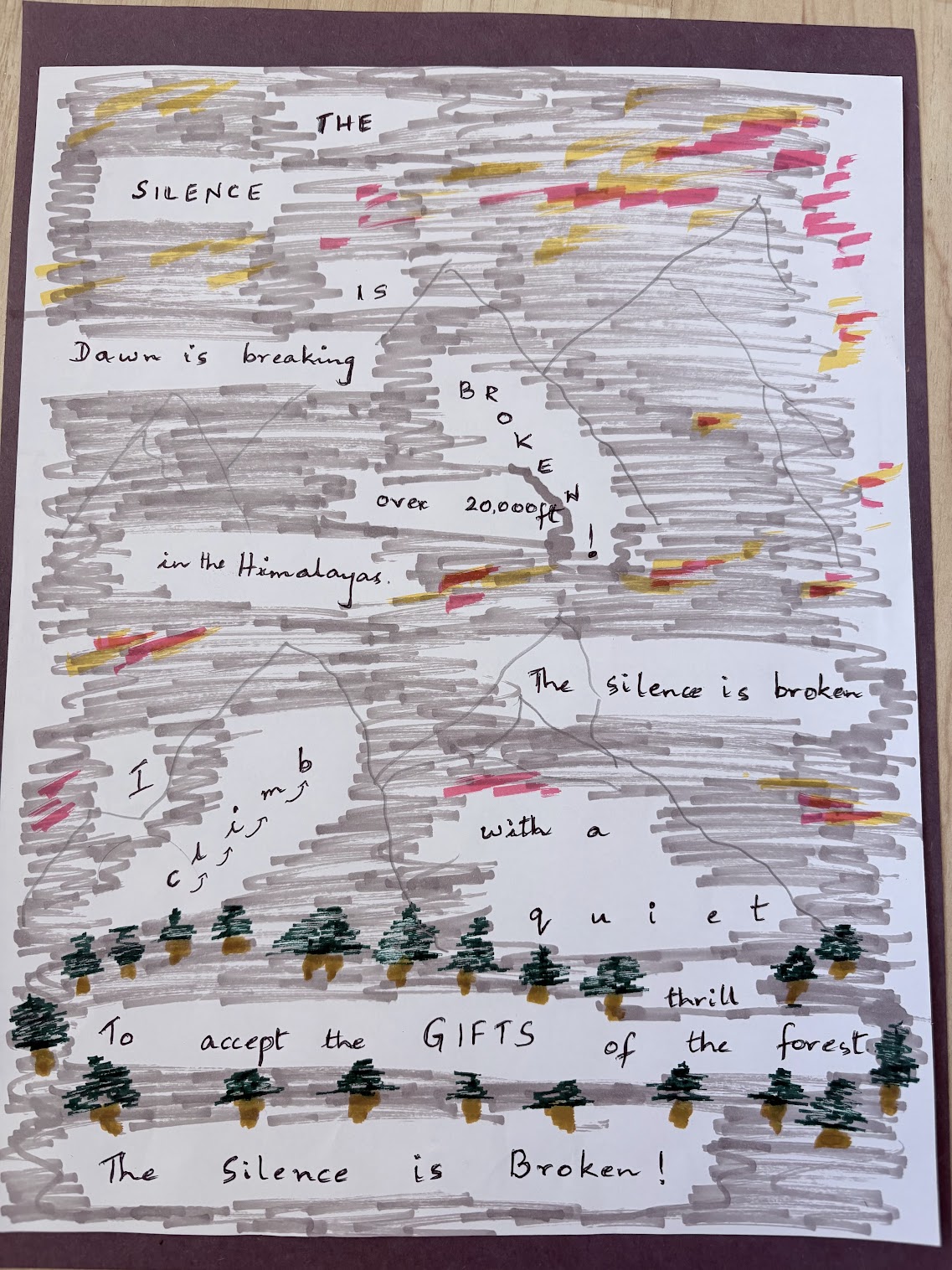
As it turns out, this is an amazing thing to do while riffling through old magazines or you just want to do something creative in a short span. Pick out random words or phrases across the page, and try to frame a poem from it.

I tried it, and even for an amateur, I loved it. The process, the words, the picture it conjured in my mind. It was all beautiful.

I chose an article in the magazine, The Outlook Traveller, which was an absolute delight to fish for words and phrases in.

The finished piece is here:

The Silence is Broken

Dawn is breaking
over 20000 ft
in the Himalayas.

The silence is broken
I 
          b
       m
      i
    l
 c
with a q    u   i  e  t  thrill
to accept the GIFTS of the forest.

The silence is broken.

Your One Marvelous Life

Now, I am sure poets will do a fantastic job with this sort of thing. I shall be looking for exemplary black-out poetry from now on. Really! The world is full of creative souls. 

So, what do you plan to do with one marvelous life ( to paraphrase Mary Oliver)? Would you try your black-out poetry and share it with me?

What are your favorite bedtime books?

Bedtime Books 

The past few nights have been hot. I would’ve used the term ‘sweltering’ but after reading about chinchillas, I am not sure. They are the ones that live in the sweltering volcanic regions. I live in a place that is hot in summer. It is hot till the air conditioner kicks in. I was over-stimulated and was looking for something soothing to calm down and go to bed.

I sighed, and picked up a book from my latest set of creature books. (I need to put up a separate post on them soon)

The Bedtime Book of Nighttime Animals: More Than 100 Creatures Who Come Out to Play When You Go to Bed

Why this strange fascination for creature books?

What is this strange fascination with children’s books on creatures, you ask. To that, I say, if you aren’t reading them, you’re missing out on life. Take for instance this set of books that I have been reading, admiring and glancing through every chance I get. Sometimes, we think being a human is all there is to life. But is it? A book like this is marvelous to imagine all the creatures out and about on Earth just as we tuck ourselves into bed. I felt a pang for the times the children and I would read these kind of books when they were toddlers. So, maybe it is just a little piece of that I cling to when reading these books. 

I know the children as toddlers would have been enthralled by the names of the creatures in this book: Tasmanian devils, roborovski monsters, spinner dolphins, pipstrelles, kakapo, natterjack toad, kuhli loach. If I were a rap singer with any sort of talent, just imagine rapping the names of the creatures who are up at night.

Imagine being a kinkajou?

Still unable to sleep, I sat with a strange urge for a midnight snack and wondered whether to get out of bed, go downstairs, and then decided against it. Now, if I were a kinkajou that would not be a problem at all, would it?

The kinkajous live on trees, and think nothing of hanging from them for a midnight snack. They love to raid beehives for honey, and being nocturnal means that the bees must be in residence when they do so. If that isn’t brave, I don’t what is.

  • Why does the kinkajou not get stung by bees? Because the bees are asleep!
  • And what of blood sugar at night? The kinkajou doesn’t care.

I flipped a few more pages, and there staring at me was the roborovski hamster. It is the smallest and fastest hamster in the world. Why the long name, Roborovski? I think it is brilliant.  “Roborovski hamster – come here this instant!” And he vanishes before you finish calling his name. See? 

As I nodded off to sleep, I couldn’t help thinking of the cute chinchillas who are so smart that when caught by predators, they simply shrug off their fur and take off into the silver night. They manage to sleep during the day in hot volcanic regions, I am sure I should be able to sleep now, I told myself and thought of all the happy creatures sleeping at night and all the ones enjoying themselves in the light of the stars.

The Unlikely Friendships of Larks & Koalas

Sunrise! Sunrise! Please don’t sing!

It was one of those swift week-end trips to the Pacific Northwest. An early morning flight to catch meant that we were out before the sun rose. Watching the sunrise is something I do not do often, but when I do, I like it to be just the way I am. A little sleepy, groggy, the rays of the sun slowly brightening the skies. Taking its time. 

I have written about this appalling tendency of some people to get up and switch themselves on like fluorescent flashlights illuminating an international football stadium. The daughter and yours truly are not like that. We like to take our time. Rise and shine in slow motion after a cup of coffee preferably. We have just switched out from another realm of our dreams to earth, and we like to adjust.

The daughter looked like a rock. Literally. She had a brown hoodie pulled over her head, and looked slightly delirious if addressed. Clearly wishing to be left alone. Her eyelids drooping behind the eyelids. Yours Truly did not have the hoodie, but I was yawning so relentlessly even after a shower and a cup of coffee, that no one but visiting fruit flies should have come near me.

The husband, on the other hand, had this beaming smile on his face, and was … get this … hold your breath … dancing to the appalling music he had on. The daughter and I moaned, but it didn’t seem to deter him. Feigning sleep only seemed to make this enthusiasm worse. “Come on!”, he said with an exaggerated dance move that made the car swerve a bit with the early morning winds of the bay.

Sunrises soothe souls

I was lost for a solution when I peeked outside and the caught the pinkening of the skies. Like soothing an overactive child, I directed his attention to the skies. He wow-ed and look-ed – but at least the dancing had stopped. The daughter’s feeble , “Good job ma!” Was all the appreciation I needed. The sunrise had given us all what we were looking for.

What was it that made some of us diurnal creatures and others nocturnal? How is it some of us are koalas and groggy after 18 hours of sleep and a dose of eucalyptus oils, while others chirp and think nothing of belting out that early morning birdsong and hopping about – what are these birds? Yes, larks.

We were like larks and koalas in the mornings, and somehow, we manage to shake down together on this earth. Talk about unlikely friendships and all that.

Are you good at this-and-that OR that-and-this?

Indians in India have this habit of rising at ungodly hours to drink coffee. Even when there is nothing much to be done for the rest of the day. Why potter about at 5:30 in the morning, rouse the household, and drink coffee if you are only to get into bed for a nap at 11 a.m?

There have been plenty of studies showing that an early riser is good and this-and-that, while late-night folks are good at that-and-this. 

This turtle that I saw in the Pacific Northwest after a good few hours of sunshine, was rising and clearly taking its time. I saw it shrinking from the energetic joggers and speed walkers, and felt a sense of kinship with it. Even though I got a baleful look at the fact that I crouched down to take its picture that early in the morning, I thought I’d share it with my readers. 

So tell me. How are you in the mornings?