Dance-wherever-and-whenever-you-wish Month

April Dancing

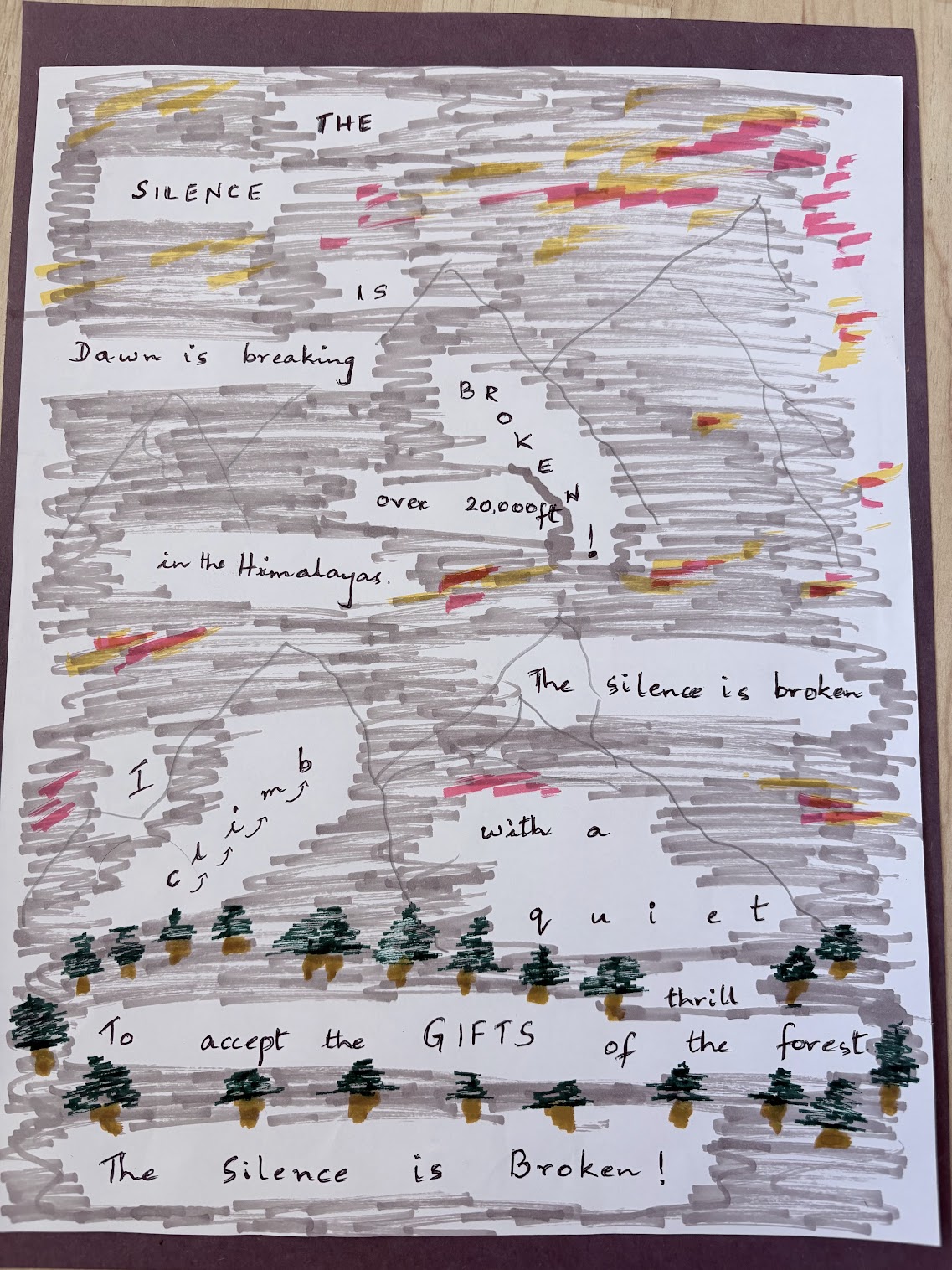
Spring time walks are meant for dancers. But human beings, especially as adults, develop this appalling habit that we associate with dignity. We curtail our movements. Getting stiffer and stiffer as we age, and then complain about the loss of agility. We have International Dance Day on April 29th. Why don’t we make dancing in public – just like that – in April a social convention? 

Look at all the world in April.

Is this Dignified?

The hares don’t just move – they hop, they hip, they hip-hop
The birds don’t just fly – they flit, they swoop, they skim
The dogs don’t just run – they wander, they romp, they swagger
The snakes don’t just slither – they rattle, they pulse, they coil
The plants don’t just grow – they blossom, they reach, they sprout
The trees don’t just become green – they flower, they photosynthesize, they crown

I, too, feel the urge to prance and skip
But adults don’t just dance in meadows – they think, they weigh, they worry
When the mind leaps, and the body stays still
Where does the energy go?
It sings, it muses, it writes.
All the while asking: Is this dignified?

The other day, I walked with difficulty – you see what I wanted to do was skip, prance and twirl a jig or two. That’s spring time – like a coiled spring waiting to release its energy. I was on a trail with people. Adults who all seemed to be in a similar state of imbalance between the internal energy and what the world expects from us. I could see it in the size of their smiles.

How do you do Mrs Potts, and you, Mr Binns?

How marvelous it would be if we could do just as we please? Skip and sing. So what if Mrs Potts scowls or Mr Binns purses his lips. Alas! We do not do that. Not when one’s hair is graying. That’s when you are supposed to know better isn’t it? I could not help thinking of the young child who skipped to school as she was dropped off by an adult one morning. Most adults had the ‘office look’, but even they could not help smiling at the spring time exuberance of this child.

Mating in Springtime

As I walked on musing thus, I stopped to watch the spring time mating rituals with amusement. There were two wood ducks chasing after a female. Their bluish green heads glinting in the morning sunlight.

Elsewhere, a couple of blackbirds, and a pair of hummingbirds swooped in circles. Teasing each other, attracting their mate. That’s when the western grebes grabbed my attention. They ran, nay skipped and danced, across the waters – is there a touch of the basilisk in them?

I am not sure I recognize giggles in birds, but if I could anthropomorphize, that is what I would say – they giggled and reveled in each other’s company. They danced together on the waters, and then skimmed below the surface for, what I can only assume is, frolicking underwater.

When finally, they surfaced one after another, as though daring each other to see who could hold out the most, I laughed. They were far from where they swooped under, they managed to continue their play and resurfaced together before running on the water again.

Apparently, that is their mating ritual. Really – birds have the most beautiful mating rituals. Take the peacock for instance- this bird isn’t leaving anything to chance. 

Talk about dancing your way into hearts.

Dance-wherever-and-whenever-you-wish month

“I wish we would dance!” I said to the son later that day when I told him about International Dance Day.

“I think you already do that, amma. You just think you don’t. I saw you wiggling your hands just now!”

I laughed. “But I want to properly dance you know? Tap dance, ballet dance, classical dance, jazz dance. ”

He rolled his eyes.

Who would like to join me in petitioning for a dance-wherever-and-whenever-you-wish month?

Celebrating Earth Day: A Perspective on Time

Google’s Doodle on Earth Day was images of earth scapes, and I remember drifting from there to thinking of the different things Earth represents. Not philosophically, not in a dead-without-planet way, but in a mind’s eye sort of way.

Happy Earth Day! 

Rain, sunshine, rainbows
Lakes, rivers, oceans

Cranes, wrens, ducks
Elephants, horses, leopards

Willows, pines, maples
Hydrangeas, lilies, roses

Snails, caterpillars, worms
Dogs, cats, monkeys

Whales, manta rays, dumbo octopi
Kelp, seagrass, phytoplankton

Snow, sand, silt
Mud, marsh, quicksand

Hurricanes, avalanches, tsunamis
Floods, droughts, famines

Mountains, knolls, ridges
Valleys, trenches, canyons

Leaves, trunks, roots
Petals, flowers, nectar

All blanketed in our beautiful atmosphere
We can either breathe it all in or not think of it at all

It isn’t a very good poem. But it made me think of something my friend once told me when I lamented the state of our beautiful Earth. “The Earth will be fine. The only question is whether we will be fine on Earth.”

Wise words from a wise soul.

Earth will be fine!

I thought of that the other day as the son & I meandered around the Smithsonian Natural History Museum. It really is a marvelous museum. We found ourselves going twice to the Oceans section – The Sant Ocean Hall. There was one particular exhibit showing the range and number of species prior to The Great Dying, and after it all.

I cannot imagine the work that went into designing an exhibit like that. The number of geologists, naturalists, biologists, scientists: and then, the scientific accuracy, the research papers, the peer review. But I stood there taking it in, and really did want to go back to the time before the Great Dying. To see the different kinds of life in the oceans, the sheer enormity of it all compared to what we have now.

To think we live in a time of less than 1/4 the diversity and abundance of life, and it is still so beautiful. I realize human-beings could not have been there – we needed to find our place in the evolutionary queue, and all that. But if there was a way to get a peek, I would take it. Even if just a simulation. How do you simulate more jellyfish varieties, more squid varieties.

Even The Most Imaginative 

I remember one interview I watched of J K Rowling a while ago, in which she attempted to create a new mythical creature, and found after all her thinking, that the creature resembled our planet’s manta rays. Our human imagination, even from arguably one of the most imaginative person on the planet, is still limited. That is the vast expansive nature of the diversity on this Earth.

To think that Earth bounced back from an event like The Great Dying, and is thriving now, is remarkable. To think one species (us) is capable of wreaking havoc on a planet as resilient and marvelous as Earth is also something to think about.

https://ocean.si.edu/through-time/ocean-through-time

It is also amazing to realize that we are but a blip on the planet’s life. All our problems, our wars, our angsts – every thing that means so much to us, is but a blip. We rarely stop to think if what is bothering us now would be a problem for us next week, next year, next decade. Does Earth stop to think whether we will be a problem a few centuries from now, a few millennia, a few eras, a few eons?

It is our beautiful Earth Day, and I am grateful for the rainy day, the sun’s watery rays afterward, and the slowly forming into a sharp and exquisite rainbow.

The Magic of Rain & Light

The past few days have been days of unimaginable beauty in the Bay Area. They have been rainy days. Rainy days in the Bay Area are a different kind of beautiful. For it rains, it pours, it drizzles, it teases, it dances, and it drums and sometimes just goes away. Occasionally, if you are really lucky, you can see a rainbow or two. 

One evening, the son & I wrapped up and went on a walk. It was a windy day, and temperatures tend to dip a bit more than usual on windy days around the time of a sunset. The clouds were so thick and ready for some rains, that we knew we would not be gazing at the sunset exactly. Still, that time of the day seems to beckon one, doesn’t it? Something about it makes it feel sacrosanct. 

Feeling Bubbly?

We chatted about this and that. Mostly of the experiment I had done with the children at the school I had volunteered in. Our experiment with air and whether they have force, culminating in blowing bubbles were a thumping success if the joy, laughter and smiles were anything to go by. We blew small, medium, big and humongous bubbles into the air. It is an amazing feeling when volunteers, teachers & the children have a great time. I told the son as much, and he grinned with what I knew was not just indulgence but genuine happiness for us.

Shining With Divinity?

On the way back, a beautiful trick of the light meant that the world behind us glowed golden through the clouds, while ahead of us, it glowed silver through the clouds. The pair of us stopped our chattering, and smiled together. Both of us stuck trying to find the right word for the light. Maybe even wondering how to catch this moment in a literal bubble. For it was so beautiful. 

“Divine light, huh?”

“Yeah! I don’t think I know exactly what that light is, but this comes closest no?” the son agreed. 

Light is such a beautiful phenomenon. We spend our lives trying to hold it, we have endless literary devices around it (Light at the end of the tunnel, lightness of being, making light of a situation) – But always, it is in a positive light (huh!) 

Rainy days bring out the beautiful potentialities for experiencing light. It can evoke melancholy, gratitude, divinity, surrender, and most importantly awe. 

Rainbows

When the raindrops manage to create total internal refraction, there is nothing but joy, wonder and an overwhelming sense of loving this beautiful Earth with its thin blanket of an atmosphere that allows us to experience rainbows. 

On Sunday night, I snuggled into bed and read heartily the essays on the atmosphere, bubbles and rainbows from the book: The Miraculous from the Material – Understanding the Wonders of Nature – By Alan Lightman.

That seemed like a marvelous way to say goodbye to the rainy week-end. How was your week-end?

Apollo 11 & Artemis II : Selenophilia

Selenophilia

I moped around one evening. The thing is, as much as I love cloudy days and rainy days, I don’t like them to intersect with full-moon days. It feels like the waxing-full-moon is meant to bathe all of the Earth in its glow, and encourage mooning-about. It is not meant for sighing and trying to see if the moon can finally peek out of the clouds.

I had not quite realized the thing that was keeping me up that night. I blamed it on the ill-timed coffee, but it could not have been that. Not when I fell asleep moments after the near-full-moon peeked out of the clouds, and I sighed happily at it.

The day after, the moon looked full in the sky, bathing the Earth with its luminous glow. The clouds flitted, but never enough to hide the moon. I took off – after the eternally present tasks that even robots and AI-based beings do not consider worth doing: clearing up and the cleaning up.

“Where’re you going?” “Out!” I said, and ignored the chuckle that followed me out. The golden moon was waiting, and I wanted nothing more than to gaze at it. The word unblemished came to mind, but that does not quite describe the moon, does it? The pockmarks and craters on the moon looked plenty blemished, yet the feeling it invokes in one is unblemished.

This fascination for our celestial neighbor, Selenophilia, is a beautiful term that is derived from the Greek language, denoting a love of the moon. Meaning for centuries, folks have finished up their chores and headed out to the admire the moon. Hopefully, for centuries more, they will continue to do so.

Apollo & Artemis

The previous day, Artemis II had taken flight into the skies with 3 astronauts aboard: to the other side of the moon. I was in an elementary school classroom introducing books about space travel that day, and I remembered the excitement the discussion about Artemis II had generated. The class sent all the astronauts a fond good luck as they listened to the brief loss in communication with the spaceship. 

That night as I sat gazing at the moon, I thought of the planet watching and praying: united in its excitement as Artemis II left the Earth. Did the Artemis II crew ( Reid WisemanVictor Glover, and Christina Koch, along with Canadian Space Agency astronaut Jeremy Hansen) feel the good vibes? I hope they did. 

Then, I thought of Apollo 11.  The astronauts: Neil Armstrong, Buzz Aldrin, and Michael Collins making the trip almost 3 decades ago. The entire planet fascinated, and enthralled.  Did they feel the companionship of the planet even as they left? The moon itself was in its waxing moon phase that day, and thousands must’ve gazed up that day abuzz with excitement.

Magic of the Moon

There are a few things that humanize us, and the magic of the moon is, I believe firmly, one of them. Something that can evoke wonder, awe, a yearning to attempt great things, set difficult targets, and above all, work together to achieve it, is Magic, isn’t it? 

A Spring Bike Ride: Discovering a Doe’s Beauty

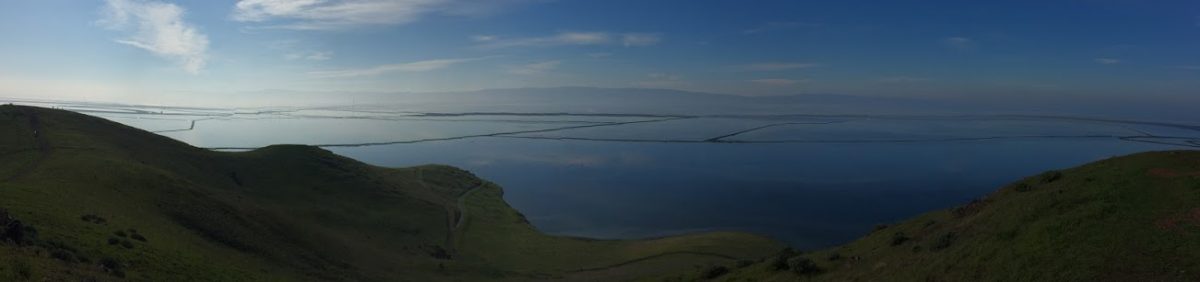
The son & I went on a spring bike ride. Spring time beauty in the Bay Area has been extolled about plenty in my writing. So, regular readers already know the beautiful frame of mind in which we were when we started back. The headwind that had been pushing us back on the way to the bay, was working in our favor on the way back, and we decided to take a rather more meandering path. Through meadows – with little ponds on the way.

After a while, the son stopped, around a curve in the hillside, and signaled to me to slow down. I tutted. I had taken advantage of a downhill and zipped up hill with enough momentum to keep going. Now wasn’t the time to take a break. Besides, we had just stopped to admire the white of the gulls and egrets against the clouds less than two minutes prior.

“Why are …”

He turned around and placed a finger on his lips. I rolled my eyes and got off my bike to peer around the hillside at whatever he had stopped for. Couldn’t he see how his mother was looking after that hill?

We had been admiring the spring beauty all around us the whole way. Fresh greens were blooming on trees and shrubs. Thistles and wildflowers were everywhere. The wild mustard flowers were being enjoyed by hordes of singing blackbirds. We’d seen a congregation of egrets, a colony of gulls, and clouds of blackbirds. In fact, the last time I stopped to take a picture, I remember the son warning me about making it back on time.

Then I saw her. It was the most beautiful doe – she was young, skittish, and trying to get at some spring leaves standing there on the bike path. She had a look of utmost contentment on her face. Fresh greens must be especially tasty now. The leaves are sprouting everywhere, and the salad options must be wonderful to them. We watched her for a bit and then she took off up the hill. She met up with her mother, and nestled against her for a bit before bounding off again, her mother in hot pursuit.

She gave us a few stunning poses. We were, as ever, completely enamored.

Sometimes, gifts don’t announce themselves.

We biked back quieter than before. Sunset time means the song birds pipe up with extra vigor, and we were glad. We burst into the home, startling the husband like a deer in the headlights, rattling on about the sights he had missed.

This is the best thing about nature, isn’t it? You never know what you’ll see, but somehow it always manages to be just the thing you needed to see. 

The Self-Selection of Stillness

Washington D C in Spring

It was one of those weeks when life was traveling fast. The night had barely slipped on its night gown, when dawn was pinkening it again with haste. The traffic was zipping with haste, the lines to the museum opening were moving fast. Things were happening. And they kept happening through the day.

We were in Washington D C – traveling on spring break.

Things are happening all the time everywhere – but especially so in the nation’s capital, I think. The hotel we stayed in was hosting hundreds of soldiers from the National Coast Guard. The areas near the Capitol building and the Washington monument bustled with people with important tasks to do. Every one seemed to have an agenda: even the tourists. Visitors in national parks they have agendas too, but here in the capital, the agendas seemed more immediate. There were monuments to visit, museums to see, senate & house galleries to witness. Everyone bustled. I felt like I was in one of those time-lapse videos sometimes.

The Exhibit – “Ma! Come on!”

Put a few days like this together, and suddenly, you can appreciate why I found myself zoning out in front of the painting. I sat there, staring at it. Unmoving, beautiful, still. It truly was a work of art. We had finally washed up at the National Gallery of Art in Washington DC – after zip-zipping through the Holocaust museum & the Smithsonian Museums: Natural History Museum, Air & Space Museum, American History Museum.

In one place, I sank down between 2 exhibits, and felt a light doze coming on. It was in the American Modern Culture section of the American History Museum. Folks pointed at me and said, “Ah look at this exhibit! The modern day parent – exhausted but present.” I didn’t move.

The Calm & The Storm

When finally the National Gallery of Art offered sofas in which to enjoy the paintings, I took full advantage of them. At one painting, I sat and stared. The stillness of the painting made it seem sublime, the swirling waters of the seas strangely soothing. Can sublime be used to describe a stormy painting? Just as I caught my thoughts begin to meander, I saw it. I did not think it was possible for this to happen. Can art make one hallucinate? After a few moments, I saw the clouds in the painting brighten like lightning rippled through them.

Painting by William Trost Richards in the National Gallery of Art

I sat up. Alert once more. And stared. Then again, it happened. The clouds darkened. I peered around the painting to see if there were any hidden panel lighting fixtures – there were none.

I beckoned the son, and had him observe the painting. “Did you see that?”

“Yes!” His face shone.

“So I wasn’t hallucinating!”

“Nope – it really did brighten.”

After observing another minute or so, he peered up, and said, “Maybe it is the effect of the skylight above!”

I agreed. Must be. Though it felt like magic. But then, a little nagging voice told me we were on the second floor of a building that had 4 floors. So, it could not have been the sun itself – maybe the artificial lighting that gave the impression of a skylight behind the panels had flickered.

Who knew?

Relishing the Stillness

The only thing I did know was how much I relished the quiet, stillness of the paintings in the gallery. Our entertainment options have become swifter: I need to convince children to watch an episode of a sitcom these days. They don’t have the patience to sit through a 20 minute program when they could have reeled and scrolled past 20 different snippets in that time, while checking their chat, keeping an eye on their video games, and looking into that assignment due.

From movies to episodes to YouTube videos to Shorts & reels: everything has become faster. The serenity of a still painting seems dead and dull in comparison.

In truth, it felt like bliss.

Maybe that is the new self-selection evolution. Those who can sit with nothing, will finally be the ones to create something.

“The museum closes in 15 minutes” – I heard the harried announcement ripple through the quiet stillness of the gallery. Quiet or not. Still or not. Time moves on. I sighed and pleaded with  my tired feet to move again. I could sit still on the pavement outside for 3 minutes while I watched the traffic and waited for my ride home, no?

What Would You Miss Most from Earth If You Went to Space?

Claustrophobia & Agoraphobia

The Smithsonian National Air & Space museum in Washington D C had us wrapped in its wings. The son was thrilled. We’d started off at the original model of Wright brothers’ air glider, and then steadily moved on from one exhibit to another. When finally, we stood in the moon (‘Destination Moon’) exhibit, I glanced over at the son to see that familiar look of awe in his face – it had been flitting in and out at almost every section in the museum. 

I peered into the Apollo 11 Mission Control capsule on display and wondered yet again, how is it that astronauts deal with the immensely crushing feeling of cramped space in a space capsule. It seems alright, manageable even for a short day or two. But nothing these astronauts undertake seems to be in days – they all seem to stretch on and on. Weeks, months, years – when everything you want to get to, is measured in light years, how can we hope for short travels? Peering into the capsule again, it seems like it could give the most robust of us, claustrophobia.

Then again, I peeked out into the simulated views from the spacecraft. Light years of nothingness with little sparkling diamonds interspersing the views for miles and miles. Charming and beautiful as it looks. After a few days, weeks, months, years, it is enough to give the most optimistic of us agoraphobia.

How must their psyche work with this constant tidal forces of agoraphobia and claustrophobia pushing and pulling all the time?

The Orbital Sunrise – By John Green

I was reminded of the essay, The Orbital Sunrise by John Green in the book,  The Anthropocene Reviewed. It really is a wonderful collection of essays by a nimble, curious mind on a wide range of topics.

He writes of astronaut Scott Kelly’s 342 days spent in space where he experienced approximately 11,000 sunrises. The International Space Station orbits the Earth every 90 minutes. Even in the famous book by Antoine Saint de Exupery, The Little Prince, the imaginary soul occupant of the planet he came from, only enjoyed 44 sunrises a day. Take that, Little Prince!

In the same essay he goes onto tell us a little about the misfortunes and luck that enabled us to view the first works of art from space. Alexie Leonov’s space mission aboard the Voskhov 2 holds the record for the first space walk in 1965. The mission itself went woefully wrong, and in a desperate attempt to calm himself, he drew some simple images as they overwhelmed him in space. They can be viewed here.

https://www.lindahall.org/about/news/scientist-of-the-day/alexei-leonov/

“Sunrise” sketched by Alexei Leonov on the Voskhod 2 mission, Mar. 18, 1965, the first work of art made in space, Museum of the Yuri Gagarin Cosmonaut Training Center, Moscow Oblast, Russia, exhibited, with the original pencils used by Leonov, at the Science Museum, London, 2015-16 (theguardian.com)

The sunrise looks like a child’s drawing – a rainbow of colors sandwiched between layers of space’s black, and that right there, for me is the beauty of the piece. Even in that moment of awe, a person with an art pedigree, tapped into his childlike sense of wonder and drew something that miraculously survived a desperate landing that nearly destroyed the space capsule and the astronauts in it.

What would you miss on Earth?

“What would you miss most on this Earth, if you were to leave Earth and live elsewhere?” The son asked me, bringing me back to the Earth, as I mused on this and that. I saw him peering up at the question flashing in front of him as he gazed up at the question on the screen in the Air & Space museum. “My family & friends first, followed by nature itself, I think. But I suppose there will be a different sense of nature on whichever planet we go to.” I said.

“Over the Black Sea,” painting by Alexei Leonov, date and present location unknown (thestatussymbol.com)

He nodded. “Yes – looks like the majority feel that way too.”, he said pointing to the survey results on the screen.

“What about you?” I asked him.

He took his time answering. Then he said, “I think I would like to take you all with me. Then, I will miss Earth’s nature.” I smiled at this response. I distinctly remember the feeling of wanting to take my family & friends if I went very far away, so I wouldn’t miss them. Life did not always work out like our childish wishes, does it?

I knew too that there would be no orbital sunrises in my lifetime for me witness. “I am past the age of astronaut training to go to space and all that. “, I laughed, “But if you do get to see it, remember me for a moment, and I will have the satisfaction of seeing it too.”

He smiled indulgently. “No you won’t! But okay – I’ll think of you.”

With that, we meandered through the exhibit, each wrapped in our own fantasies and thought capsules. How beautiful and marvelous an experience to go to a museum far away and glimpse at a spacecraft that first enabled humankind to fly, and then took mankind to space?

I pondered on the question a lot more. I realized agoraphobia and claustrophobia of space travel aside,  there is so much more to life on this Earth that I would miss:

Art, music, dance, literature, math, science, history, geography, philosophy
Friendship, the exalting and exasperating aspects of the human spirit
Oceans, rivers, lakes, streams
Creatures large and small – manta rays, lions, giraffes, geese, ducks, woodpeckers, wrens, deer
Forests, trees, flowers, vegetables, fruits, canyons, volcanoes 

Most of all: Laughter, Love and all that makes up Life itself.

What about you? What would you miss most about Earth?

The Beauty of Butterflies

It was one of those beautiful days March casually throws at you. When in one of these days, it is almost easy to forget that there are unbearably hot days or bitingly cold days – and what’s more you might have endured them as recently as the previous day or week. Halcyon days.

On one such day, I had no idea how I found myself sitting on a park bench and watching a butterfly. Well I do – always pottering about on a day like this, aren’t I? A neighbor caught sight of me after I had wandered around for a bit, and laughed, “I was wondering why you aren’t fluttering about with the butterflies, and there you are!”

Ectothermic Poikilotherms

Anyway, the butterfly was beautiful – aren’t they all? I remembered something I had read about butterflies. Jogging the science lessons in the old brain – They are ectotherms. Err… that means they do not exactly preserve heat well. Technically they are ectothermic poikilotherms. Seems like a such a heavy term to describe such light creatures, no? Like naming a baby Rajavardhan Gopikrishna Muthu Narasimhan, when Chikku would’ve done the trick.

I watched as it flitted about in the sunlight clearly trying to catch the sun’s rays and get a good days’ work in. I envied it somewhat. I myself had no intention but to bask in the glory of the day outside, not to head inside and look at some documents and spreadsheets. After a while, its industriousness must’ve rubbed off on me for I made my way in.

The Day’s Achievement

I can’t say I achieved much. But maybe that was the day’s achievement: imagine how marvelous it would be to answer the question: What did you achieve today?

With this:

Well, I mused upon a butterfly’s wings, and admired its flight.
I wondered whether it preferred the pink cherry blossoms to the white ones.
I wondered whether the rose bush or the lavender patch tempted it more.
I wondered whether the vegetable patch held any appeal.
I wanted to ask it which succulents flower had sweeter nectar – the aloe vera or the ruby lips.

In the end, I did none of that. Too lethargic to even whip out my phone for a good picture of it flitting. The images fluttering behind my eyelids are enough.

“The butterfly counts not months but moments, and has time enough.” — Rabindranath Tagore

Maybe that is the gift of the butterfly. In revelling in the present.

The Golden Moments of Spring

I was walking on the beach one morning. One glorious morning. The waters were glittering in the morning sunlight like a million little diamonds had been sprinkled on the waters. Maybe it was the effect of the rose-colored glasses I was seeing the world through, or the fact that the world felt brighter and more colorful that day, but the beach was filled with … Gold? I scrubbed my eyes beneath my glasses and looked again. There was no fooling me. The sands sifting beneath my bare feet, and glistening with what looked like gold particles.

Fool’s gold?

It must have been. For if not, I am sure, there would have been quarries there, and not contented looking seagulls trying to bully smaller sanderlings out of the way. I admired the unruffled sanderlings – holding their own, outnumbered as they were by the aggressive seagulls. It was a pleasant sight.

Golden Hour

A few evenings later, I strolled during sunset drinking in the fresh green after the rains. Really, I have raved about this before so often, I feel like a bit of broken record myself – but spring in the Bay Area is the most wonderful time of the year. The hills are bursting with tiny yellow and purple flowers set against lush green grasses. Entire hillsides of it. Simply waving and swaying in the mild breezes of the season.

I sat upon a rock to take in the sight. There were deer grazing nearby, and I turned my serene senses towards them.

“To sit in the shade on a fine day, and look upon verdure, is the most perfect refreshment – Mansfield Park, Jane Austen

What’s this?

I was composing a pedantic piece for my blog on the tranquillity of the lives they lead – blah, blah, blah.. when they started to, I kid you not, fight. Fight! Like stallions in heat – on their hind legs, kicking each other. I started laughing, and sensitive as ever to human sounds, the deer audience noticed me. The drama in front of them was too much to resist, they turned back. The smaller one walked away, and taunted from a distance, to which the older one rose up again.

Golden Truths

In geese, I rarely stop to notice anymore. Aggressive as they are, they are always chasing each other off or splashing off. But, so often have I gazed upon deer on my walks. Always drawing from them beauty and grace. It was different seeing ..  was it a display of power, anger, annoyance, or just dispelling of nervous energy?

I would never know. Not until our human systems make headway into animal cognition and translation. Apparently, some of our big and beautiful AI models can now decipher whale sounds.

https://www.npr.org/2024/05/20/1198910024/ai-sperm-whales-communication-language

Really, nature knows how to entertain us almost endlessly – if we stop and watch. Sometimes, in slow waves, other times in passionate displays of spring time, and maybe in the future using the ultimate lure of humankind – through stories.

Nature’s Sense of Purpose

Cloudy Skies : Inspiration or Melancholy?

The week-end was fabulous in terms of weather in the Bay Area. The rain-washed Earth was beginning its early spring blooms. The trails were scented heavily with sage, eucalyptus, and the occasional squashed lemon or orange. The clouds made for a perfect backdrop – lighting wise. Cloudy skies do give the best pictures even if the blue skies lift one’s spirits up better. Feeling in the mood for a bit of rumination or deep thought? Cloudy skies are there for that. Or maybe it is the other way around- the melancholic strain inspired by the cloudy skies. Either way.

The son and I started off on a bike ride when the skies were cloudy, threatening rain. We pedaled, each lost in our own thoughts, when some fat droplets reminded us of the rainy day forecasts. The son, always the mature one, when it comes to things like this, insisted we turn back, and so we did. Though, I did try my whining first: “Let’s try for some more time – maybe it is just a drizzle, and we shall be ready for it to break into mild blue skies afterwards. “

The skies doubled down, and so we started back away from the lakes, and the bay, towards our home.

But the rains were taunting us. They came, and then didn’t. Then came again and didn’t again.

By the time we made it home, the clouds had said their good-byes and didn’t shed a single raindrop for another 2 hours.

Oh well.

The Next Day

The next day, I set off on my own. This time, the cumulonimbus clouds had given way to cumulus clouds, and the day felt bright, clean and inviting.

I biked on. By the river. To the bay. Through the bay, and finally emerging on some hills.

It was beautiful. I had the trail to myself. Probably because most folks had attempted and wrestled with the ‘will-it won’t-it’ the previous day, and decided to stay indoors. I felt my spirits rise, like the ebbing of the bay waters. I sang – my pitch nowhere  as shrill and clear as the blackbirds, and nowhere as cacophonous as the ubiquitous geese, but enough to make me happy.

I am a sap when it comes to nature. Every one knows it. Everyone indulges me with it when I get going. But even I felt all nature had a purpose that day: a purpose to make those outside to feel grateful, to feel fulfilled. The mustard flowers threw their stalks back and danced with that intent. The blackbirds sang with a kind of devotion that saints wish for. The deer grazed looking at you as if daring you to find fault with a day like this.

What would Mary Oliver have done?

Mary Oliver would’ve written a book by the time she came back. That’s the sort of day it was.

“Whoever you are, no matter how lonely, the world offers itself to your imagination, calls to you like the wild geese, harsh and exciting – over and over announcing your place in the family of things.” — Mary Oliver, Wild Geese

What was to be done with such a sense of purpose? I yielded and gave myself up to this – pedaling, humming, looking every which way. One time, I wobbled looking at the hawk overhead and straying off the trail. I swear the hawk smirked. I heard it’s laugh or cry.

Another time, the heart gave a few lurches and sputtered and stuttered, as I spotted a dead snake on the trail. “Would you have preferred a live one?” whispered Mary Oliver, and I genuinely had no answer to that. I shoved my hammering heart back to its spot behind the ribs and pedaled on. Eyes resolutely keened away from the dead snake. 

When finally I reached home, sighing with the contentment, I knew the aching muscles were a small price to pay.

What is your favorite post-rain activity?