Erik Erikson’s 8 stages of life

Learning to Teach

For those of you who do not yet know – I am choosing, and learning to become a teacher.

A good part of learning to teach is grounded in psychology. Developmental psychology. Vygotsky, Bandura, Piaget, Gardner, Erik Erikson – they are all rattling in the brain after a fascinating few months of learning.

I have always been interested in the kinds of problems and things that occupy our lives at various stages. Even the upanishads had the 4 stages of life laid out for reference. One particular psychosocial theory resonated with me:

Erik Erikson’s 8 stages of life.

Here is a quick overview:

  • Basic Trust Vs Mistrust (birth – 12/18 months of age)
  • Autonomy Vs Shame/Doubt (18 most – 3 yrs)
  • Initiative Vs Guilt (3-6 yrs)
  • Industry Vs Inferiority (6-12 yrs)
  • Identity Vs Role confusion (adolescence)
  • Intimacy Vs Isolation (Young adulthood – forming intimate relationships, love, family)
  • Generativity Vs Stagnation (Middle adulthood – parent/mentor)
  • Ego integrity Vs Despair (Late adulthood – retirement)

These 8 stages are largely an indicator for folks in their stages of life. For instance,

Basic trust vs mistrust: Birth – 12/18 months of age.

Largely shaped by their relationship with their caregivers, this determines how they learn to be trustful. Having stable and loving caregivers is usually key to successfully being able to form trusting relationships.

Autonomy vs Doubt: 18 months – 3 years

Most parents have experienced the ‘terrible twos’. How many perplexed parents are left wondering why their thus-far pliant child throws a tantrum for no reason? It is all about building autonomy.

I still remember this 3 year old who sat next to me on a long flight more than 2 decades ago. I was in my mid-twenties, had not yet become a mother, and always loved children. His mother, the child, and I got to chatting, and became friendly. His mother was just happy to have him talk to someone else, I think, and we hit it off.

At the airport a few hours later, this sweet boy threw himself on the floor and gave himself up to a truly fantastic tantrum with flailing arms, wailing shrieks, watery eyes – the works. I had gone to get myself some coffee, and came back to find this child making a spectacle. I crouched down, and asked him, “What are you doing?”. He looked up at me, recognition dawning on his face and smoothing out the wrinkled crying face to tell me soberly, “I am throwing a tantrum!”

How I laughed! Luckily, this seemed to break his meltdown and he became a happy child in our midst once more. I have never quite forgotten the little fellow – he must be a young man possibly doing his graduate studies or working by now.

But there you go : Autonomy

According to Erik Erikson’s psychosocial stages of life, I am currently in the Generativity  Vs Stagnation stage of life. This is usually the stage in life when people are starting to turn their minds towards mentoring, guiding, or otherwise becoming more community-minded. I have seen many folks in my parents’ generation where the generativity did not quite happen and led to stagnation instead. But where it led to generativity,  it coincided with the phase in life where wealth generation and / or philosophical musings tended to occupy their thoughts and actions. New goals, new purpose. Some drastic, and some not so much.

Starting a new career at this stage of life? Mine is drastic, I think.

I am nervous, excited and hope that this stage is both fulfilling and interesting. So that, I may when my time comes, look back upon retirement age with ego integrity instead of with regret or despair.

 The Husband’s Perspective

எட்டு எட்டா மனுஷ வாழ்வை பிரிச்சுக்கோ

“I don’t about know Erik Erikson! But I know Rajinikanth’s song!”, said the husband. I laughed and vaguely remembered the song too. So, I went you-tubing to check for it, and ridiculous as the dance and visuals are, the concept only roughly matches the psychosocial stages as mentioned by Erik Erikson. Maybe the lyricist (Vairamuthu I think) started off with this, and then ran away with it.

Loosely speaking, according to the song:

  • The first 8 years are for playing
  • The second 8 for learning
  • The third 8 marriage & settling down
  • The fourth 8 children
  • The fifth 8 is for wealth building
  • The sixth 8 is for traveling and globe-trotting
  • The seventh 8 is for rest and ticking off your bucket list
  • The eighth 8 isn’t worth it according to the song. For you’ll gain no additional peace of mind.

The Daughter’s Perspective

The daughter scoffed and said, “I know Erik Erikson! It is a psychosocial theory Amma! Not a psychological one. Want to bet that there are at least a few in there who are taking this and running away with these theories and diagnosing themselves?!” At this point, she raised her hands in air quotes and continued, “Oh you know? I am just a terrible person because there was this one person when I was 1 year old who was not nice?!”

I can’t say I agreed with her, but it is always interesting to see how the 8 stages of life theories can be interpreted in 8 different ways.

So there you go, what to make of Erik Erikson’s psychosocial stages of life is entirely upto you. But I did find it an interesting theory to think about, especially when you look at all the people in your life – younger, older, your peers etc.

So, which stage of life are you in? And when you look back, how do you think you have fared in each stage?

Pinecones & the Secrets of the Universe

I was in a class in which we were learning how to teach art. This class was particularly fascinating for me. For the class had a very hands-on make-your-art-while-learning approach to it. One session we learnt free-play, another session: elements of music. One time we all went downstairs and broke off into small groups choreographing dance routines with little themes. Birds in a storm, ritual-rhythm-like movements, a morning routine etc. Teaching through drama, poetry (this is where I learnt about black-out poetry), and one time we learnt how to extract pine nuts from a pinecone. 

The Secrets of the Universe

There are many reasons that I loved that particular activity. I have always loved pinecones. There is something about them. Like it is hiding all the layers and secrets of life itself inside that protective cone. I thought if I could ever design a home for myself, it would be like living inside a pine cone hanging off a handsome, bounteous pine tree, swaying in the breeze, holding my own in the storm, and gently lulling fellow living beings to a peaceful state as they rest under my boughs. 

Of course, human-beings are never as accomplished as all that, and instead, I spent many wonderful evenings gazing lovingly at the pine trees nearby. Watching a pine cone drop from the boughs above, trying to pry it open to see  what lies inside. 

I was reminded of Hope Jahren’s book, Lab Girl while musing about the pine cones.

In the book, Dr Jahren writes about the science and its demands on its lovers. Her writing is lyrical, and when she writes of her research and her little moments of leap, it is nothing short of poetic. For instance, she writes of the time she was studying the structural makeup of the seeds of hackberry trees, and she unmistakably finds traces of Opal in the seeds:

“It was opal and this was something I could draw a circle around and testify to as being true. While looking at the graph, I thought about how I now knew something for certain that only an hour ago had been an absolute unknown, and I slowly began to appreciate how my life had just changed.

I was the only person in an infinite exploding universe who knew that this powder was made of opal. In a wide, wide world full of unimaginable numbers of people, I was – in addition to being small and insufficient—special. I was not only a quirky bundle of genes, but I was also unique existentially because of the tiny detail that I knew about Creation,…Until I phoned someone, the concrete knowledge that opal was the mineral that fortified each seed on each hackberry tree was mine alone.”

Not that we learnt anything that was ours alone during that lesson with pinecones, but it felt just as special. Like the pinecones were divulging the little secrets of the universe to us, to hold carefully and pass on.

Pine nuts are nuts!

It was a fascinating experience to see how pine nuts were extracted from the pinecone. The pine cones do not open wherever they please. It has to be under certain temperatures and even then, it is a tricky business. Once the pine nuts can be extracted, it isn’t a simple task to extract the flesh within them which is the edible part of the whole thing. 

So we sat there polishing the nuts against sandpaper chatting amiably with each other on how much effort it takes. I could very well imagine this being a community-building, all-the-aunts-and-grandmas-singing-together kind of activity. 

https://www.youtube.com/shorts/N1OeoaHGeLM

Of course, now there are mechanical shakers and crushers to do some of the work. But still, the process remains an expensive, labor-intensive process. Pine nuts are expensive – “Pine nuts are nuts!”

By the end of extracting the flesh from within the nuts though,I had a renewed sense of appreciation for the expensive packets in stores. 

I sat there one evening gazing up at the tree and saw the squirrels in the neighborhood loosen a pine cone from the tree. It fell with a soft thud upon the grass below. A single pine cone in a suburban lawn. Holding the secrets of the universe or at least the universes of pine trees in them.

Literary Conversations

I was talking to a friend recently.

“Are you driving?” She said, astute as ever. I smiled to myself in the car. She had me there. She knew from the relaxed way in which I was carrying on the conversation that I must have time and not flibberty-gibbeting around like I usually do.

“Yes!” I confessed – the sheepish feeling in my heart oozing into my voice, and she laughed.

“In that case we can talk about books!”, she said, and my heart warmed toward her. Bless her.

I told her about a book that I read recently:

The Care & Management of Lies – By Jacqueline Winspear

The tone of the writing on Jacqueline Winspear is somewhat similar to Miss Read (one of my favorite authors) – full of warmth and everyday practicality. Winspear was introduced to me by one of my son’s teachers, and I enjoyed this book more than her more famous series based on Maisie Dobbs, the detective. 

The main character, Kezzie’s treatment of food preparation borders on irreverent and artsy enough to be charming, though the food recipes do get to be a bit much towards the end.

I identified with the young bride Kezzie married to a farmer, Tom, with these short lines:

“They were in the first flush of marriage, and this was another source of fascination for the young husband, that this wife of his had no attachment to her prowess as a cook. She didn’t seem to care that pastry might be underdone, meat overdone, that bread was too doughy in the crumb, too hard on the crust, or that the men looked at their eggs and bacon and then at each other every morning. She seemed like a sprite assigned to a factory job, flitting from stove to table, then out to the kitchen garden, cutting rosemary to garnish an egg on toast-and not one of the farmworkers had ever seen garnish, nor would the word be part of their vocabulary.”

How could I not? Kezzie’s flair for the artistic, and the unconventional had me smiling. After all, I share the same sentiment towards cooking even after all these years. When I say things like, “No need to make a big deal – I’ll figure something for dinner.” I can see the looks being exchanged as though this means starving the family. It doesn’t. The family is well-fed. Ask the weighing scale. It just means, I will not think about it when I am looking for the deer shaped cloud with the sun peeping out from its antlers.

In turn, she told me about a similarly warm-toned book, A Tree Grows in Brooklyn. I look forward to reading it. That got us talking about how the same things that life has to offer can be written in bleak ways, or in uplifting ways. After all, the book I had just read was set in The First World War, and the whole world was buffeted by its ill-effects. It isn’t fairy-tale material. It isn’t bedtime reading material. And yet, somehow the sentiment of the book felt welcoming.

On the other hand, Grapes of Wrath – By John Steinbeck had me moping for days afterward. Good writing – but bleak in outlook.

We spoke of this and that, and hung up.

Relatable optimism?

So, what is it that makes the tone of a story appealing to you? Plenty of people like Steinbeck & Dostoevsky. I do too. Just not for comfort reading. The same sentiment seems to rule my entertainment options. Life is hard enough – I don’t need my entertainment to be the same. Maybe that is the reason sitcoms are so popular with society.

Could it relatable optimism and a familiar feeling of laughter and comfort at the end of the day?

Related: https://nourishncherish.org/2012/07/25/slimy-brazil-sprout-rice-recipe/

Black-out Poetry

“MGR is dead?”

“MGR is dead?”

That’s the joke in the house when I tell folks I learnt of something. The joke is on them of course. Because MGR is dead. But the cultural reference is to a Tamil movie in which a comedian says, “What?! MGR is dead?!”  years after he died. In fairness, I am unusually dense when it comes to cultural trends, and so many times entire songs or references that rocked the younger generation just pass me by. Usually, some kind child enlightens me and by then of course the joke is gone. Very tiring – especially now in the age of social media. Remember when 6-7 was a thing? Now it is not a thing, it is a cringe. Things 15 year olds get called ‘gramps’ by 10 year olds for. Sigh.

So expecting some similar response, I told folks about this latest thing we learnt called Black-out Poetry. As expected, the children had heard of it, the husband thought it was cool. Poets have been running channels and videos posting how it is done for over a decade. So, all is well. MGR is dead.

What is Black-out Poetry?

As it turns out, this is an amazing thing to do while riffling through old magazines or you just want to do something creative in a short span. Pick out random words or phrases across the page, and try to frame a poem from it.

I tried it, and even for an amateur, I loved it. The process, the words, the picture it conjured in my mind. It was all beautiful.

I chose an article in the magazine, The Outlook Traveller, which was an absolute delight to fish for words and phrases in.

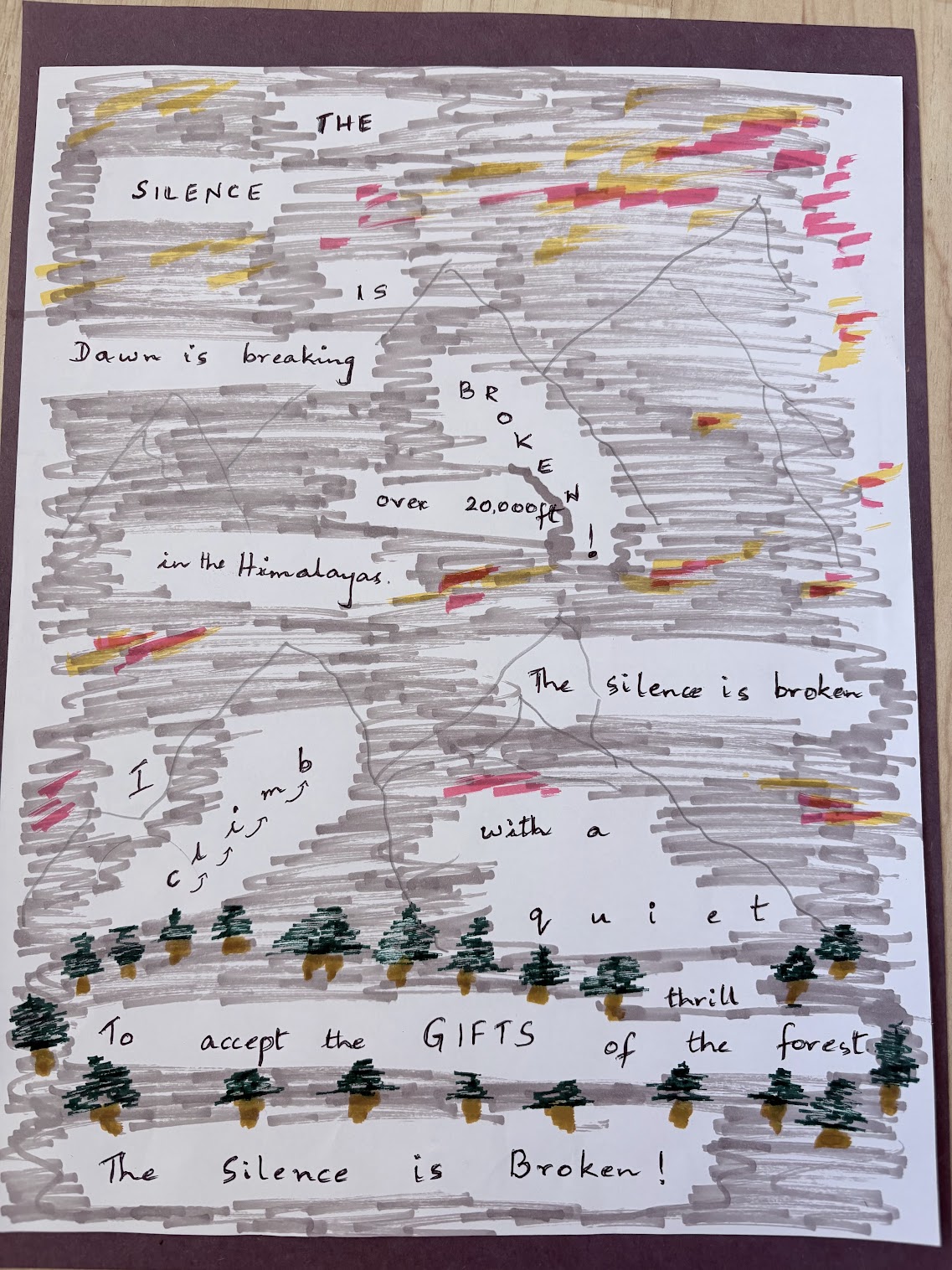
The finished piece is here:

The Silence is Broken

Dawn is breaking
over 20000 ft
in the Himalayas.

The silence is broken
I 
          b
       m
      i
    l
 c
with a q    u   i  e  t  thrill
to accept the GIFTS of the forest.

The silence is broken.

Your One Marvelous Life
Now, I am sure poets will do a fantastic job with this sort of thing. I shall be looking for exemplary black-out poetry from now on. Really! The world is full of creative souls. 

So, what do you plan to do with one marvelous life ( to paraphrase Mary Oliver)? Would you try your black-out poetry and share it with me?

What are your favorite bedtime books?

Bedtime Books 

The past few nights have been hot. I would’ve used the term ‘sweltering’ but after reading about chinchillas, I am not sure. They are the ones that live in the sweltering volcanic regions. I live in a place that is hot in summer. It is hot till the air conditioner kicks in. I was over-stimulated and was looking for something soothing to calm down and go to bed.

I sighed, and picked up a book from my latest set of creature books. (I need to put up a separate post on them soon)

The Bedtime Book of Nighttime Animals: More Than 100 Creatures Who Come Out to Play When You Go to Bed

Why this strange fascination for creature books?

What is this strange fascination with children’s books on creatures, you ask. To that, I say, if you aren’t reading them, you’re missing out on life. Take for instance this set of books that I have been reading, admiring and glancing through every chance I get. Sometimes, we think being a human is all there is to life. But is it? A book like this is marvelous to imagine all the creatures out and about on Earth just as we tuck ourselves into bed. I felt a pang for the times the children and I would read these kind of books when they were toddlers. So, maybe it is just a little piece of that I cling to when reading these books. 

I know the children as toddlers would have been enthralled by the names of the creatures in this book: Tasmanian devils, roborovski monsters, spinner dolphins, pipstrelles, kakapo, natterjack toad, kuhli loach. If I were a rap singer with any sort of talent, just imagine rapping the names of the creatures who are up at night.

Imagine being a kinkajou?

Still unable to sleep, I sat with a strange urge for a midnight snack and wondered whether to get out of bed, go downstairs, and then decided against it. Now, if I were a kinkajou that would not be a problem at all, would it?

The kinkajous live on trees, and think nothing of hanging from them for a midnight snack. They love to raid beehives for honey, and being nocturnal means that the bees must be in residence when they do so. If that isn’t brave, I don’t what is.

  • Why does the kinkajou not get stung by bees? Because the bees are asleep!
  • And what of blood sugar at night? The kinkajou doesn’t care.

I flipped a few more pages, and there staring at me was the roborovski hamster. It is the smallest and fastest hamster in the world. Why the long name, Roborovski? I think it is brilliant.  “Roborovski hamster – come here this instant!” And he vanishes before you finish calling his name. See? 

As I nodded off to sleep, I couldn’t help thinking of the cute chinchillas who are so smart that when caught by predators, they simply shrug off their fur and take off into the silver night. They manage to sleep during the day in hot volcanic regions, I am sure I should be able to sleep now, I told myself and thought of all the happy creatures sleeping at night and all the ones enjoying themselves in the light of the stars.

Equal opportunity mispronunciations

I was attending a graduation ceremony in the USA and wondering how they managed to get so many of the names mispronounced. In fact, at that point, more than 3/4th of the names were mispronounced in one way or the other. Latin American names, Indian names, Chinese names, Jewish names, African American names, Greek names, Arabic names—everyone’s names were equally butchered. Equal-opportunity mispronunciations.

The world, whether we like it or acknowledge it, has become more global in its make-up than it has ever been. So, learning how to say each other’s name, is more important than ever. For that, learning the importance of one’s name is quite as important, isn’t it?

Sitting outdoors on that sunny afternoon,  I reflected on Suma Subramaniam’s book, My Name is as Long as a River.

My Name is as Long as a River By: Suma Subramanian

Suma Subramaniam writes about South Indian life, and is a member of the WNDB (We Need Diverse Books) initiative.

This particular book is especially relevant as there are many children with long names in schools these days.

In the book, the child is named after the river Kaveri. In fact her full name is: Kaveri Thanjavur Jayalakshmi Ganesan.

Kaveri : the name of the river she is named after. A beautiful river in South India, it is the harbinger of prosperity in the South. The rice fields, temple towns, and estuaries are the centres of culture and history millennia old. The Kaveri river waters literally help feed millions of people.

Kaveri is embarrassed by her long name in the USA, and has shortened it to Kav because it is consistently mispronounced, but after visiting her grandmother along the banks of the river Kaveri, she learns the significance of her beautiful name.

“Ganesan is my father.

Jayalakshmi is my mother.

Thanjavur is where I was born.

Kaveri is who I am.

My name is: Kaveri Thanjavur Jayalakshmi Ganesan.”

Tara Anand’s illustrations combined with Suma Subramaniam’s writing makes it a truly wonderful book, and one I think many teachers will love to use in their diverse classrooms.

What’s in a name?

For a person whose name is as long as a river, I loved the book. I know that the daughter has shortened her name with a beautiful Tamil meaning to mean something ‘brave and bold’ in Irish. I have a Starbucks-name, a more lilting explanation for those who are in the mood to try a few Hawaiian excursions into the language if they really want to pronounce my name, and so on.

I‘ve often asked children to help me understand the significance, meaning and cultural importance of their names. There are so many origins of names – some religious, some mythical, some nature-based, some philosophical references: the list is truly as varied as the names themselves.

It is curious how willingly they answer this question when younger, and then seem to almost drift away as teens for the same question. Like they would all just love to be called the same thing: wall, plant, brick. I understand it, wanting to blend in is an innate characteristic (Be a Roman in Rome & all that – the adage didn’t start yesterday did it?)

At some point in early adulthood though, the innate need to return to your unique name, hopefully, kicks in.

The magic of names

My thoughts drifted to Ursula K Le Guin, whose writings, if I remember correctly, also had a lot of interesting names. Naming was important to her. It set the place, the setting, even the story forward. How easily we can imagine an island kingdom, separate from a desert oasis town, or a hillside rural area by the names alone?

Now, pluck all these characters and have them live together in a university, and the resulting entertainment from the names is enough to tide guests through a whole afternoon.

“To weave the magic of a thing, you see, one must find its true name out… for there is great power, and great peril, in a name.” — A Wizard of Earthsea

In a non-fiction essay , Ursula Le Guin talks about the responsibility of choosing names. 

“To make up a name of a person or a place is to open the way to the world of languages the name belongs to. It’s a gate to Elsewhere.” – Ursula K Le Guin

J K Rowling’s Harry Potter series has so many interesting names, and etymologies once you get past the story, and actually delve into the details. The first time I realized Sirius & Remus names with respect to their alter-ego/animagus forms, I felt a jolt of pleasure.

Mythologies the world over have fantastic names for their characters. What is in a name then? Is it’s meaning important? Is there a specific magic to what we have been named? Is it linked to something greater or is it just a name?

The first sounds to which we respond uniquely.

What does your name mean to you? I’d love to know.

Buddha & The Doves in Love

Where miniature buddhas take a deep breath

It was one of those quiet week-end mornings. I was cooking. I had not yet switched on any music. Just cooking.

I glanced out of the bay window in my kitchen for a moment, and couldn’t help smiling.  The buddha statue in the backyard is always a serene sight for those wishing for a quiet moment. It is doubly so in spring and early summer. The little statue is surrounded by sweet smelling star jasmine, making it look like a spot where miniature buddhas take a deep breath. 

That particular morning – there were two doves feeding each other. Probably fruit from the trees nearby. It was the most heart warming sight. 

Do we notice the quiet moments only in contrast to something else?

Usually, when I notice moments like this, it is in contrast to the busy things going on in my life just then. I’ve always wondered whether I appreciate moments like these because of the contrast. But this time, it was different. I had a slow morning. I got up in a leisurely manner with neither alarm nor sunrise giving me the slightest nudge. I was feeling well rested, and savored my coffee as I pottered around the kitchen prepping for the cooking. 

The birds were having an equally relaxed loving morning by the looks of it. It did not even occur to me to get my phone and take a picture till they had started to flit away from each other. 

I remembered a passage from one of Miss Read’s books, Village Diary by Miss Read ,  in which she noticed the starlings as she was going about her domestic tasks.

The Secret To Blooming Like a Flower

Quote:

As I ironed, I amused myself by watching a starling at the edge of the garden bed. He was busy detaching the petals from an anemone…

This short scene, I thought as I pressed handkerchiefs, is typical of the richness that surrounds the country dweller and which contributes to his well-being. As he works, he sees about him other ways of life being pursued at their tempo – not only animal life, but that of crops and trees, of flowers and insects – all set within the greater cycle of the four seasons. It has a therapeutic value, this awareness of myriad forms and the varied pace of other lives.

Doves in Love

The sweet interlude of the doves in love done with, I started cooking. The pace and labor of human food preparation is always so much more frenzied and complicated.

I glanced at the Buddha statue nestling amidst the star jasmines, and found his sweet contented smile still in place, like he remembered the doves playing around him that morning.

P & L : Build Your P In Life

Life with Purpose or Passion?

I sat with a set of children’s books in my arms. I looked down fondly at the pile next to me – I did love this particular selection. For nestling in there were the kind of careers that I had not imagined since being a child myself – A balloonist, giraffologist, naturalist.

The Giraffologist – Anne and her Tower of Giraffes – by Karlin Gray and Aparna Varma

I picked up the book on Dr Annie and read about how she decided on a lifetime studying giraffes. What remarkable creatures? No wonder it fascinated a young girl all those decades ago when zoos did not have them. World travel and exotic creatures felt almost impossible. She tried studying zoology just so she could learn more about giraffes. But nobody had studied them in any detail.

As I looked at the pictures in the book, Dr Annie came to life again. In her gentle understanding of these creatures in a time when they only graced black-and-white illustrations of some books.

Butterflies open up Etymology

I thought of Maria Sibylla Merian and her love for butterflies in the 18th century. She raised caterpillars and painstakingly drew and described metamorphosis. I am not sure if it was a revolutionary discovery, but it certainly seems to have opened up the world of etymology to the western world.

Sylvia Earle – the oceanographer who spent more than 7000 hours underwater, in a lifelong journey to understand the astounding diversity of life in the marine world.

The fact that these women kept at their areas of passion is inspiring – I wonder what their personalities were like. Beyond the obvious curiosity, intelligence, perseverance etc. What were the forces that shaped them?

Life’s Calling, Yearning or Liking

I remember reading in Stephen Cope’s book, The Great Work Of Your Life – A Guide for the Journey to your True Calling, about Jane Goodall’s mother encouragement when she couldn’t find her daughter one day. She searched for her for 4 hours only to find that the young child had simply been curious to find out about how an egg came to this world. Jane had spent the afternoon in the chicken coop waiting for the hens to lay eggs. Instead of chastising her for it, her mother saw a passion in the young child and nurtured it instead.

I was a little wary of the book when I picked it up. Purpose, and finding your life’s purpose etc were things that had given me enough existential grief over the years. When people told me we each were born with a purpose, I felt a little lost. Like everyone was born with a map( “Here you go – keep it safe and look it up when ever you want!”), just before arriving, and I had missed picking it up – dreaming I suppose.

I feel no great calling to study deer as much as I love gazing at them. I never felt the urgent yearning to study Compiler Design though I thoroughly enjoyed the subject. I did not seem to have that intense humanitarian strain either that came to Mother Teresa in life. In fact, apart from musing and writing about life in general, I am not sure I had any inner force driving my inner purpose etc. All I knew was that I could spend hours in nature and in my own imagination. I liked company, but was also quite capable of amusing myself.

Where did that lead?

I remembered reading Mark Twain’s words:

“The two most important days in your life are the day you are born and the day you find out why.”

I don’t remember the former, and I am waiting for the latter. I am well aware that I am in the second innings of my life, so I am not sure the realization that Mark Twain had, is coming for me.

What appealed to me more was a concept I read in passing somewhere: Build your purpose.

So while I find it wonderful that for some people their purpose seems apparent to them, and their motivations align beautifully with their life’s journeys, I think that for many of us, the meandering journey is life. The purpose is built along the way. If we can find things to be passionate about, that is great, but it isn’t a given. 

This wasn’t the first time I mused on professions and its link as a means of economic prosperity. If the two weren’t linked. If money was not the primary driver, what kinds of jobs would people choose?

What Would You Do?

I remembered the Elephant Keeper I had met and befriended on a day trip in Ireland. She & I were the only ones who had come without companions on that sight-seeing trip, so we took to talking to each other. It was the most fascinating day-in-the-life I had heard from someone in person. She lived on a farm, worked with elephants, and sent me pictures and videos of the gentle giants in her care. Her love for them evident in each of them.

What would each of you have chosen if livelihoods, and societies weren’t involved in the decision-making? The wackier the jobs the more I’d like to hear them. So, please let me know.

Up to my neck!

The Giraffologist 

I sat with a set of children’s books in my arms. I looked down fondly at the one in my hands. The first one was about a giraffologist – the title pulling my attention almost immediately. What a delightful sounding profession?

The Giraffologist – Anne and her Tower of Giraffes – by Karlin Gray and Aparna Varma

The book is based on Dr Annie Innis Dagg who was the world’s first giraffologist. The world’s first primatologist, Dr Jane Goodall, is of course well-known. But Dr Annie, who went to Africa to study her favorite animals, giraffes, just 4 years later is practically unheard of. That is the weird nature of public attention.

https://www.cbc.ca/news/canada/kitchener-waterloo/new-heritage-minute-anne-innis-dagg-giraffes-1.7648146

Dr Annie’s life and work was made into a documentary in Canada honoring her work towards preserving these tall creatures.

The daughter’s drawing of a giraffe:

Bill Bryson’s book, The Body – A Guide for Occupants

I was thinking of giraffes and their beautiful necks one day after reading Bill Bryson’s book, The Body – A Guide for Occupants. One section of the book dealt with how prone we are to choke. One particularly sad anecdote about a person who had a gold coin lodged in his throat was especially excruciating. If nothing else, I am glad we now live in a time and age when surgical techniques have come so far from the ones outlined in the book. (The coin only fell out when he was hoisted by his foot and swung like a pendulum. )

Beautiful Necks Everywhere!

Our evolution into bipedalism means that necks took on a truly unique structure to support the head, and provide a forward looking face for navigation. I stopped and chuckled at that. I was on a walk, and just like that, I started noticing necks everywhere. The crane, the gray heron, the hummingbird, the dog, squirrel and the cat.

I got home to look up the giraffe’s neck again.

Did you know that both giraffes and humans have the exact same number of bones in our necks : 7

Yet, the giraffe’s neck supports its long neck, and its heart supports pumping blood all the way up there. All those jokes about tall folks( How’s-the-weather-up-there?) suddenly feels biologically profound.

In any case, the understanding of our biology, our evolution, and our unique places in the planet is shaped by so many factors –  How many giraffes with weird ears and longer tails evolved before the long necked ones that we know and love?

I craned my neck to look at a white egret crook its neck and plunge into the waters with precision and force for its breakfast, and gently massaged my own neck. ‘Up to my neck with worries’ took on a new meaning too, and I hoped giraffes and herons never had to use that phrase, when worried.

21 Years of Blogging – My Blog is now an Adult!

21 years of blogging

Just like that, my blog has become a proper functioning adult. 

21 years of selectively writing about what matters to an ordinary person. Somehow, reflecting on the writing makes it seem like our lives were more adventurous, humorous, and fun-filled. 

Now, isn’t that a lovely gift? 

I was reading Bill Bryson’s book, The Body, and in it, he says something incredible about memories – that we can predominantly choose what we want to remember. That often our most colorful memories aren’t the original ones at all – but rather deepened by the feeling and retelling of it. We’ve seen it in the stories we love to tell each other all the time. Every time we laugh about our own foibles, it makes the memory a more endearing one, doesn’t it? 

Where am I going with all this?

Curating the blog’s theme

I realize that I am probably tending to what gets on my blog. I tend to actively gravitate towards what I want to cherish in life – beautiful moments, humorous moments, peaceful moments, intellectual moments: in short, moments of awe, curiosity, love, levity, and transformation. The negative rooted out like weeds (which is not to say that I don’t have them. I do, of course. Just in measured quantities on the blog.) 

Anyway.

There are no awards given for 21 years of writing 1-2 blog posts a week, every week for 1092 weeks. 5-9 posts a month for 252 months. The award is the writing, and the wholly generous readers who stop by to wave, hopefully feel a moment of peace, get a laugh or two, and encourage me endlessly. 

So, go ahead – this is a party! 

Get drunk – I mean on the posts in the blog. I don’t actually offer alcohol. Please head on over and randomly click on any month, read a few, and let me know what you think, or you know, just have fun. 

“I mused for a few moments on the question of which was worse, to lead a life so boring that you are easily enchanted, or a life so full of stimulus that you are easily bored.”

― Bill Bryson, Lost Continent: Travels In Small-Town America

Is there more to life?

Is there more to life? Our lives? Most lives? I don’t know. But I know that ‘this one precious life’, as Mary Oliver puts it demands our attention. What you value, and what you remember over the moments of your life, becomes you, doesn’t it?

To pay attention, this is our endless and proper work. – Mary Oliver

P.S: WordPress tells me I have a significant achievement: World Domination – for receiving visitors from over 150 countries – with the sweet caption: The United Nations has nothing on you.