A Lament for Short Stories

Give me short stories over real news or fake news any day

The clouds are wondering whether or not to drizzle. It is the perfect weather for musing and meandering thoughts.

I wonder how I meander to the thoughts on short stories – maybe a recent conversation. But I feel the short story is one of the most poignant losses of literary fiction. As children, magazines were filled with short stories and the thrill of finding a short piece contained in and of itself providing the nourishment of the soul was brilliant. What happened to short stories these days?

Give me short stories over real news or fake news any day. Please.

Stories in their natural length: stream, or rivulet, or tributary, or river

I’ve read stories stuffed into tweets – threatening to spill over, and bulging in all the wrong places.

And Then.

I’ve read stories watered down and stretched into novels. The original essence there, somewhere perhaps, but too watered down like homeopathic medicine.

What I’d like is a story – at its length. No fluff. No dilution. Just essence.

If a story is meant to dance and spurt joyously like a stream, let it. If it settles in, and flows like a river, let it. If it is a tributary and wants to join the main river, let it. If it is vast and encompasses depth adn breadth and expands into an ocean, let it.

Kindle Singles came up with the idea – I wonder what happened to it. They fizzled out.

There are anthologies – but they are few.

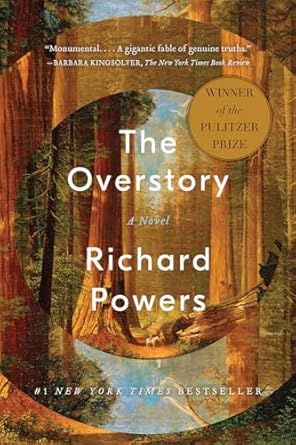
Reading the first half of The Overstory by Richard Powers made me yearn for short stories again. I think it is time to revisit Golf stories by P G Wodehouse or a little visit to Malgudi to reacquaint myself with all the characters. Tales from a Village School would be welcome too, wouldn’t it? Miss Clare Remembers is a wonderful book of short stories all woven around the fallen giant – the elegant, thin, straight-backed kind teacher, Dolly Clare.

Give me short stories when my attention is wandering. Enough to keep me stimulated, and wanting more.

Recommendations Please

Are we losing another art-form altogether? What would Somerset Maugham say, what would Alice Munro say? I remember the thrill of liking an author’s story, and then finding a whole book written by them. How marvelous it would be to crack open any magazine and find short stories there?

If you do read short stories, which magazines do you get your source from? Apart from The New Yorker I mean.

P.S: I have written a collection of short stories of my own too – both singles & themed collections. Written to its natural length, and savored from time to time by Yours Truly, but otherwise waiting – wondering where they can be published. So, if you have any recommendations of publications for short stories, please let me know.
How Reading Changes Our Understanding of the World

Reading, Absorbing, Retaining

We were discussing books and one of my friends said wistfully, “I like what I am reading, but I don’t know how much of it I will be able to retain afterwards.”

The rest of us nodded. It is a problem and one that I have yearned to be better at too. How marvelous it would be to quote with ease from our various influences! The internet truly is a savior for folks like me who have a vague idea. I don’t think stunning speeches are made by saying things like: “Remember that saying by Shakespeare where he said something about wise men knowing they are fools, and fools being very sure of their awesomeness? Or something like that?”

Aah….here it is:

“The fool doth think he is wise, but the wise man knows himself to be a fool”.  – Shakespeare

So, it is with knowledge. The more one yearns to learn about the world around us, the universe, and the lives we lead within it, the more one realizes how little one actually knows. There is no surer path to humility than learning.

“Even if that is the case, I suppose we retain things that appeal to us subconsciously.” I said.

The conversation meandered after that  but I found myself thinking back to that statement. It was true enough.

The OverStory – Subtle Influences

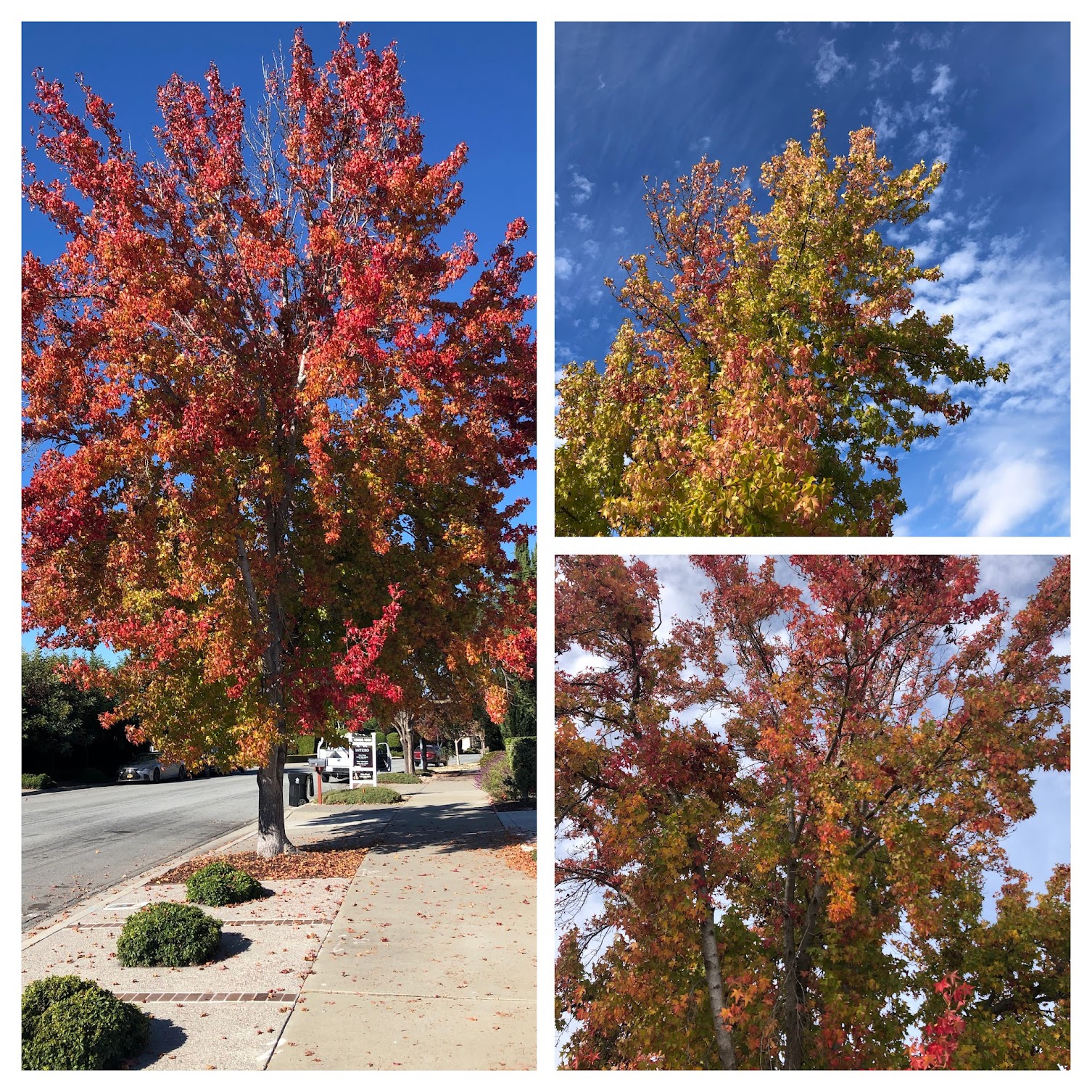
I read The OverStory by Richard Powers a few years ago, and loved many aspects of the book – its lyrical language, the poetry of the trees, the rich interweaving of nature in its stories etc so much that I wanted to read it again with my book club. It is when I started it again that I realized the Hoel family tradition of photographing their old chestnut tree must have appealed to me. Why else would we have started taking photographs of this particularly gorgeous maple tree every fall? I did not even realize this till we started re-reading the book, and I visualized the hundreds of pictures taken generation after generation. The only surviving chestnut tree for hundreds of miles in every direction. 

There is a timeless charm to a tradition like that.

Reading is a critical part of Becoming

Reading is a critical part of Becoming. Things we read voluntarily, can influence how we think. The characters in stories that appeal to us? They appeal to us for a reason. The actions of flawed individuals? They appeal to us for a reason – maybe we learn to be more forgiving towards follies – our own and of others when we catch them.

There are many studies proving fiction readers were generally more empathetic.

https://www.scientificamerican.com/article/novel-finding-reading-literary-fiction-improves-empathy/

Read Across America Week

It is Read Across America Week in schools honoring Dr Seuss’s birthday, and I found myself loving the rich world of stories once more. We each have a world of stories within us – stories that shaped our beliefs, joyously transported us to different realms, acted as escape mechanisms at times, stress busters at others, and just a marvelous source of shoshin otherwise.

Languages all over the world have a phrase or word for the vastness of knowledge, and I suppose I am grateful for it all.

Anantha gyana, gewaltiger umfang, enorm kunnskap, Abhijñā

Happy Read Across America Week – may we all read more about hopeful, brave, courageous, witty, humourous, compassionate, kind, vibrant personalities, and become like them.

Exploring Happiness: Is It in Our Genes?

In what was an intriguing chat with the son last evening, we poked around the ethics of genetic modification. Apparently, that had been an area of discussion in their classroom, and the son was keen – the novelty of a discussion with multiple viewpoints at that age is amazing. I smiled and listened to him talk offering a question here, a hum there, an insight elsewhere.

“What do you want to do with human-beings if we are smarter?” I asked him.

“We could fly.”

“Cool! But then what?”

I took a deep breath and said as casually as I could. “Everyone wants to be smarter, for things to come more easily to them. So we wouldn’t have to spend so much time figuring things out. But – the thing is, if everything came easily, we would not know what to do with all the time we have on our hands. What do they say? An empty mind is a devil’s workshop? I don’t know – I think it could lead to more mental health issues – what do you think?”

He pondered this for a while, and said it was an intriguing thought. 

Who Survives?

It reminded me of another chat the husband and I had a few months ago – on the larger theme of the future of humanity. With smarter, faster, stronger, what would happen to humans? The husband took a moment to gather his thoughts, and said, “Well – it will come back to good old basics then, wouldn’t it? Survival of the fittest. Those humans who can learn to be peaceful with themselves will ultimately win out – that is the strain that will survive.”

I was impressed – yes, no matter what we had, it ultimately came down to temperament, attitude, and the ability to be happy, didn’t it?

Generosity by Richard Powers: The Happiness Gene

Incidentally the book I am currently reading: Generosity by Richard Powers, talks about a variation of this: The Happiness Gene.

The story tries to figure out the reason for Thassa’s happiness. Thassadit Amswar is a refugee who has fled the Algiers region. Her brother is still under house arrest in a totalitarian regime, her parents are dead after years in which they were stuck in the midst of a civil war that raged around them, and any which way you look at it, she should be morose, sad – not chirpy, cheerful, and full of light.

The whole set up reminded me of one of Rumi’s sayings that have been making its way around the instagram world: something to the effect of:

When the world around you is dark, you could very well be the light.

Rumi

In any case, somehow Thassa’s ability to be happy attracts attention – first from local friends, then a policeman, a local news report diagnoses her as having ‘Hyperthymia’ – a condition of overwhelming happiness, and goes on to attract those who want to auction and buy her eggs, decode her DNA, figure out the happiness gene. She finds herself unmoored by how people feel bad because she is happy, and having to navigate the horrors of fame.

In Essence

  • Is there a genetic component to being happy?
  • If so, can that be picked and chosen for our offspring in the not-so-distant future?
  • What issues would that create for mankind? For just as sure as we are of creating solutions, so too can we be sure for creating problems for ourselves, isn’t it?

A Redwood Run

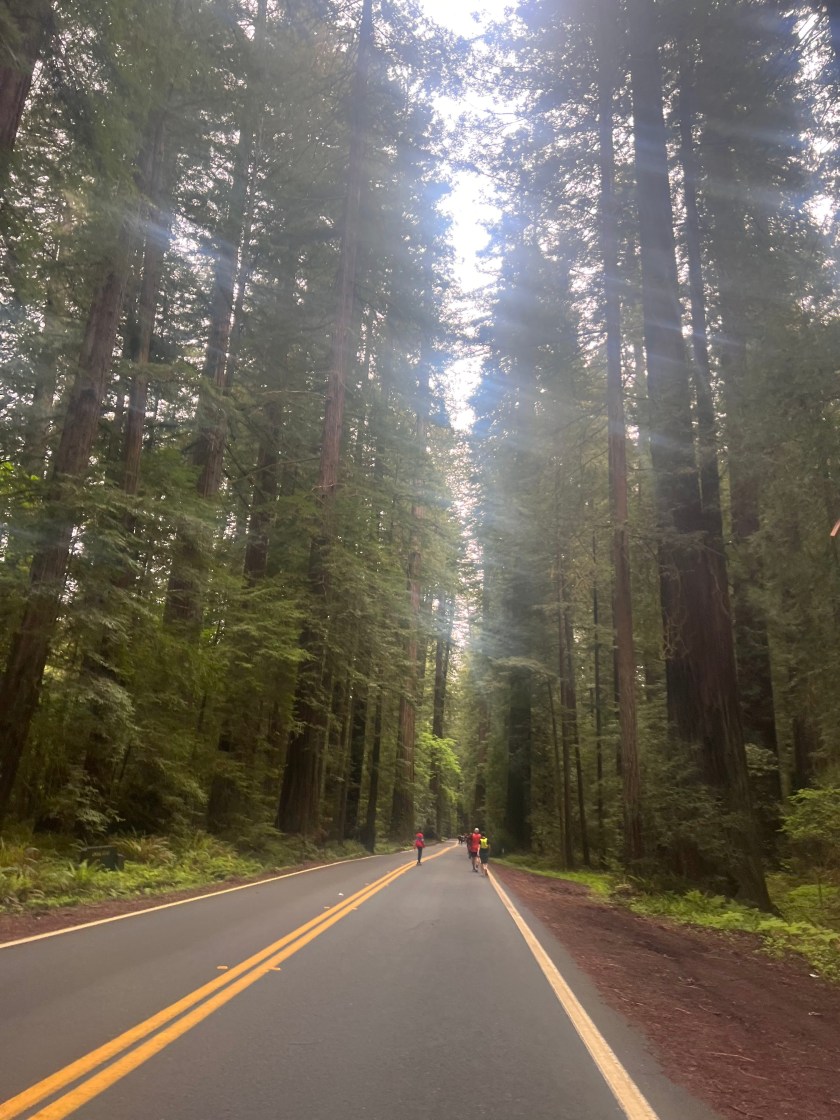
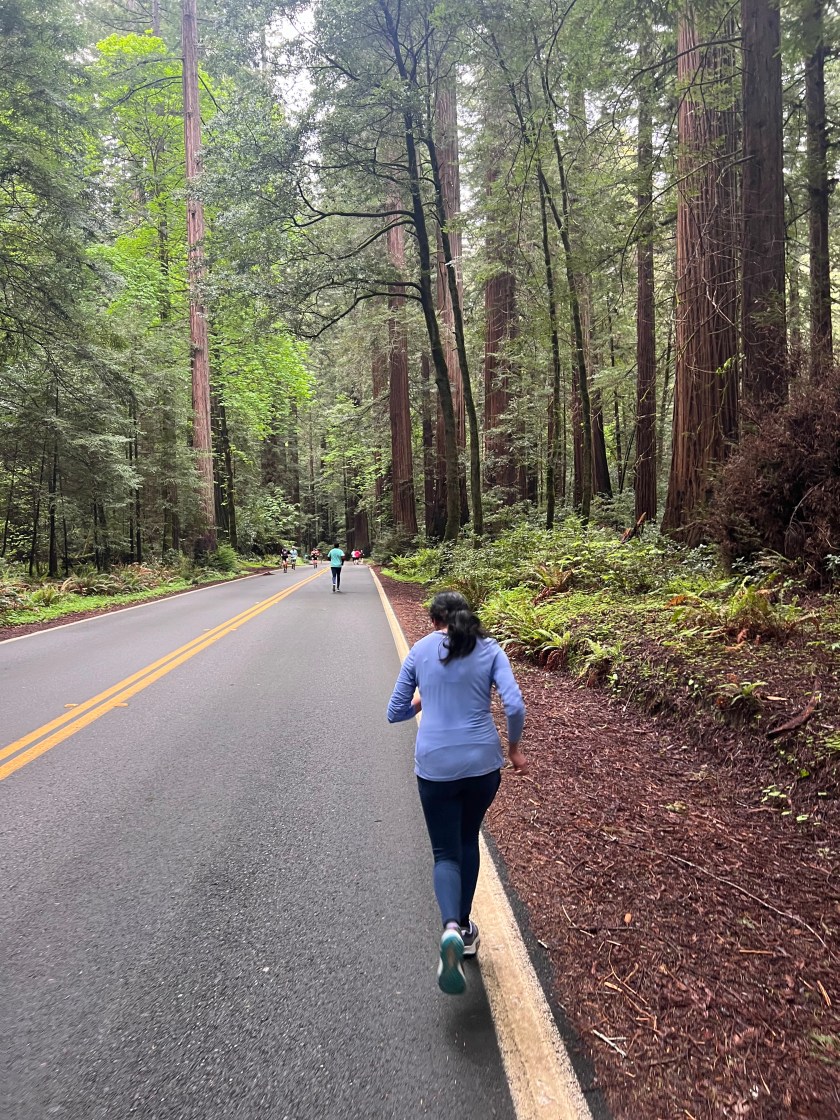
It has been a few years since we attempted a destination run. The type where we run for the scenery, the physical gravitas of one’s surroundings, and the joy of camaraderie among one’s fellow runners. As we ran through the redwood forests, I thought to myself how marvelous it was to run and run like a true child of the Earth without urban buildings, construction noise, and piles of concrete. Even the gray road through the forest felt poetic and somehow attuned to its surroundings. (Well, maybe the double yellow lines were a bit jarring, but the gray road didn’t feel quite so intrusive) 

img_5125

After a chaotic start to the half-marathon, it took some time for us to settle into the run. The traffic jams were horrendous – the husband’s implacable optimism about making it to the start line on time was a bit misplaced, especially when we could see other runners leap out of their cars and run to the start line (adding a good mile to their already long runs). Our group  of runners were split between two cars and by the time the bibs were collected and we started the race, it was a good 20 minutes past the race start. To make matters worse, the officials were adding to the confusion yelling to all in the vicinity that they would be removing the starter mats that record time. We were thoroughly frazzled as we ran across – not at all sure it had recorded our run, but we ran anyway. 

The son ran a 10K, while the husband and I ran the half-marathon. The son having age and weight on his side flew on, while we huffed and puffed behind him trying to keep up. This resulted in a shin injury for the husband (which, he told me later, almost had him wondering whether he should do a 10K instead. Coming from the sun-is-shining husband, this must’ve been a serious enough injury) However, some stretches and slow miles later, he seemed to be in a better shape. 

As we ran on and on, deeper into the forest, there was tranquillity there. A meditative pulse to running through trees that started life when humanity was still contemplating  the merits of civilized living. Physical gravitas takes on a new meaning in the redwood forests. Young shoots and ferns, the young greens against the textured markers hues of the older trees, the sunlight poring through the branches high above. I thought of the books on redwood trees – Richard Power’s Overstory – the best one I could think off: powerful in its imagery and cathartic to think about just then.

“This is not our world with trees in it. It’s a world of trees, where humans have just arrived.” 

– Richard Powers, The Overstory

Between the 7th and 8th mile, I thought I’d missed the mile marker somehow. It seemed interminably long. My leg seemed to have just given up, and I found myself looking up into the tall redwoods begging for strength. To drink from the infinity that seemed to stretch among those majestic trunks. It helped. The depths of the forest tends to speak to the depths of the soul, and I prodded on, careful not to tell the husband about the injury like saying it out loud would somehow make the injury worse. I stretched, grimaced, and plodded on. Each mile excruciatingly long. 

img_5114

I thought of the gray road cutting the mycelium web underground that sustained these trees for millennia and felt a strange stab of remorse : would the web have found a way to continue underneath the gravel to sustain the trees on either side? I’d have to check. 

Cosmos episode for: The Search for Intelligent Life on Earth : narrated by Neil DeGrasse Tyson, written by Ann Druyan & Carl Sagan

But yet again, the forest helped. 

Whenever the body felt drained and the pain in the right leg flared up, it felt grounding to remind myself that running this course was one of the best things to happen. For the redwoods were calm, the mists rolling in mystical, and the pattering of fellow runner’s feet grounding. There was a strange other worldliness to running through the redwood forests. Pain (possibly ITB) the only reminder that this was not a dream.

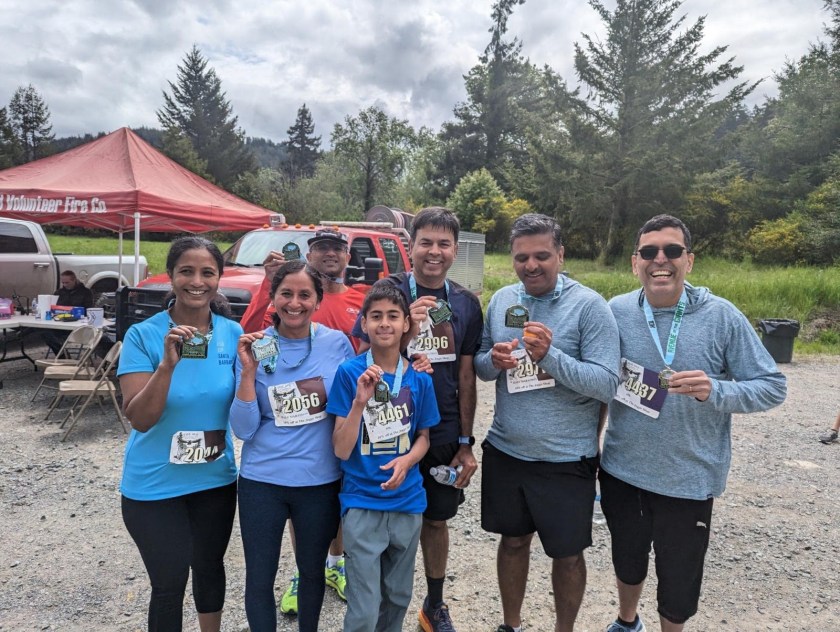
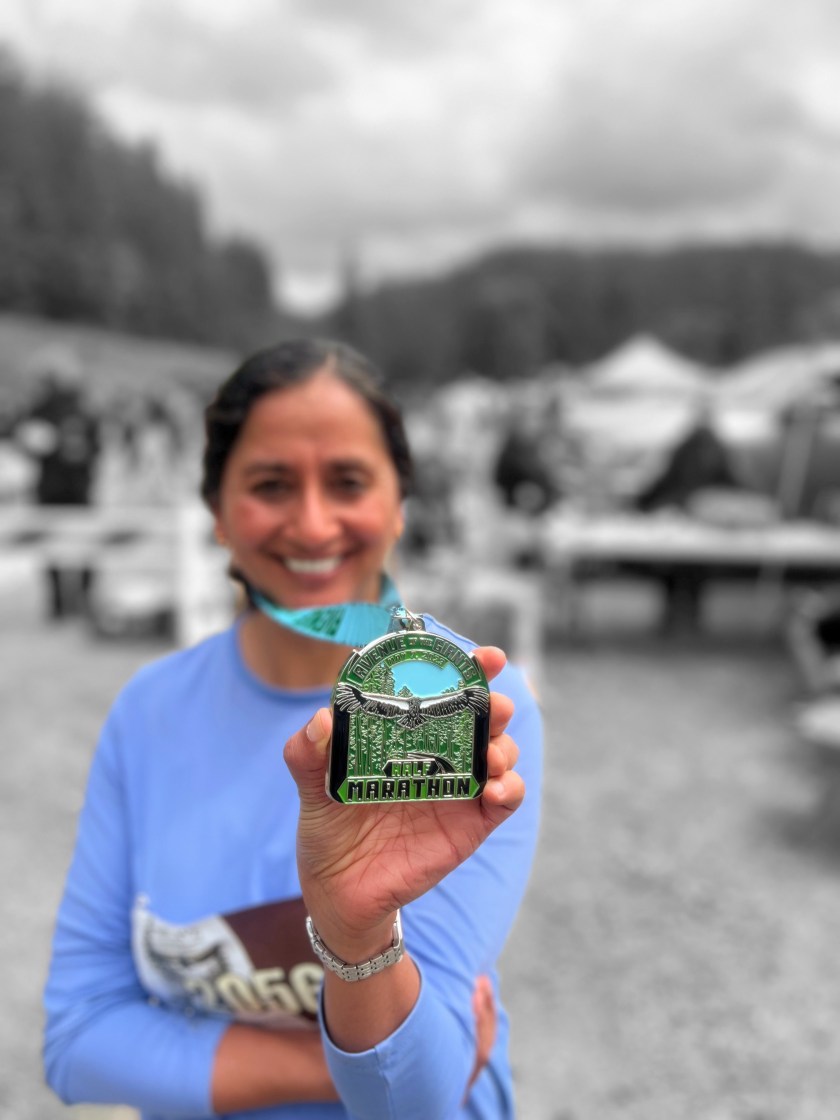
I cannot tell you how marvelous it felt to run the last mile and arrive at the finish line – famished yes, but we had managed to finish! Between our injuries, and a clatter of a start, a horse-wallop of a run, we had finally finished. The son was there cheering us on and all was well.

Having a wonderful set of friends on the journey is always helpful, and though we were scattered throughout the race, and didn’t see much of each other – the glimpses and cheers we did get was hugely inspiring.

31cd5c30-3b9c-4241-95e1-a5e263e1fbab

color_pop

Our quaint cosmic neighborhood!

Everywhere on social media and news platforms were images from the James Webb telescope magnifying in glorious detail sections of the universe billions of light years away. The universe has enlightened us all and reminded us of our humble place in it once again. In the midst of all this chaos, and enormous gas clouds is a tiny planet where our particular kind of life evolved capable of acquiring these images. 

If, along with these images, and the equally glorious full moon, one has not caught a whiff of shoshin, I urge you all to do so. I also have the resident astronomer of the house on summer vacation, so I am constantly being given statistics along with the images. 

It is fortune indeed to, purely by chance, be immersed in starlight myself even in the reading world.

The beautiful images in the children’s book: The Stuff of Stars – Illustrated by Ekua Holmes, Written by : Marion Dane Bauer 

The Stuff of Stars by Marion Dane Bauer Illustrated by Ekua Holmes

I just finished reading Bewilderment by Richard Powers last week. Bewilderment: the book and the feeling

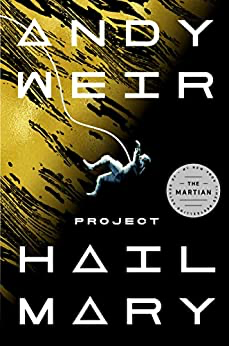
I am now reading Project Hail Mary by Andy Weir.

After a walk under the stars, our corner of the universe seems sanguine – the countryside of the cosmic arena. In our suburban areas, not too many stars are visible, and the gas clouds in the James Webb photographs seem surreal. The universe is a happening place – stars and galaxies being born every day, yet the rise of our faithful moon glowing rose-gold in the early evening makes for a satisfying adventure enough in the cosmos. 

“The laws that govern the light from a firefly in my backyard as I write these words tonight also govern the light emitted from an exploding star one billion light-years away. Place changes nothing. Nor does time. One set of fixed rules runs the game, in all times and places. That’s as big a truth as we Earthlings have discovered, or ever will, in our brief run.” 

Richard Powers, Bewilderment

With images such as these, we are perhaps closer than ever to finding another planet that is capable of harboring earth-like lifeforms. 

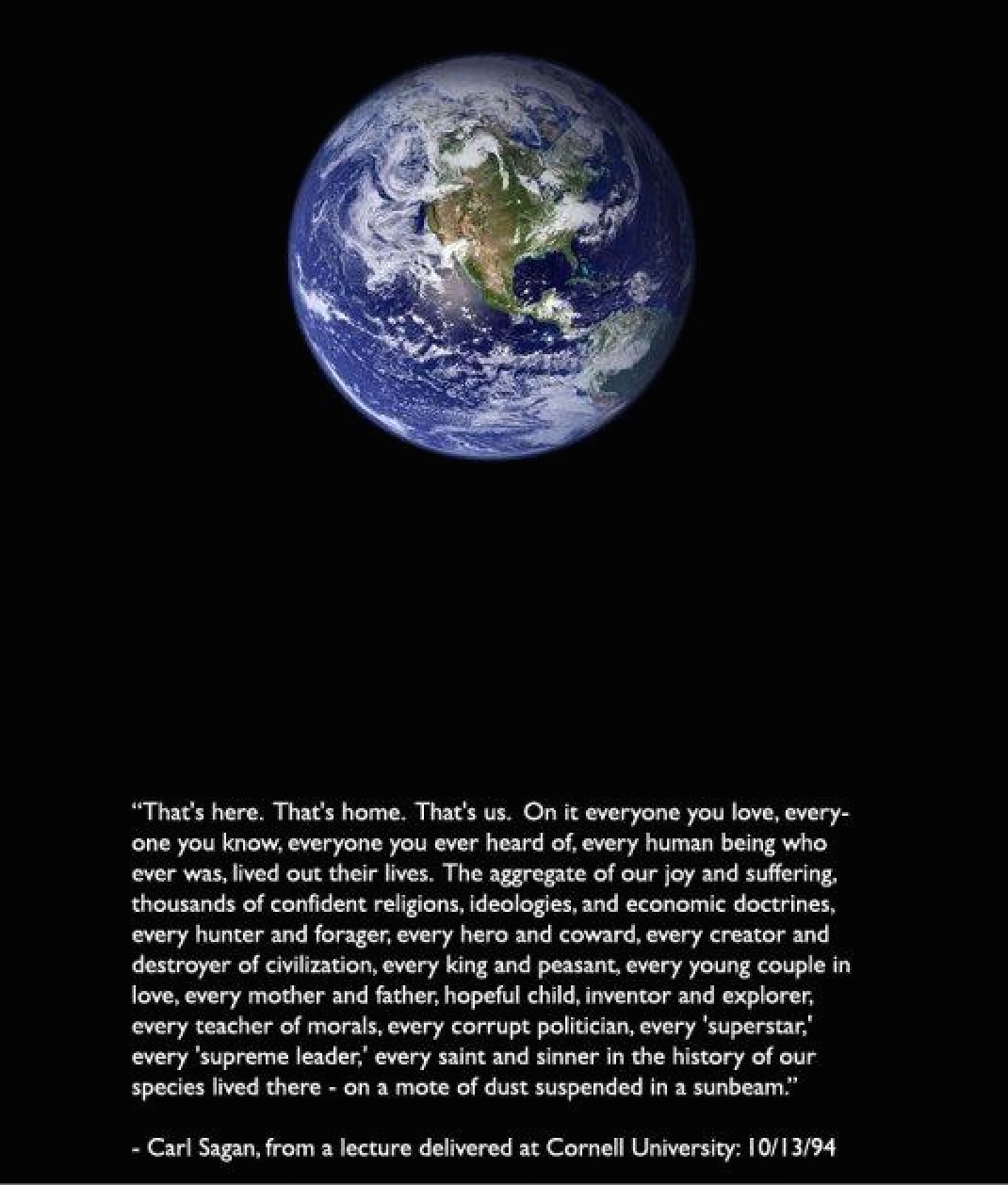
But till then, Carl Sagan’s words hold true:

Bewilderment – The book and the feeling

A friend of mine teased me lovingly and perfectly validly that every time she looks at the stars she thinks of me looking up and wondering about the various kinds of worlds out there, the vastness of it, the beauty and grandeur.  “You will become a star one day.” , she said, and we laughed. 

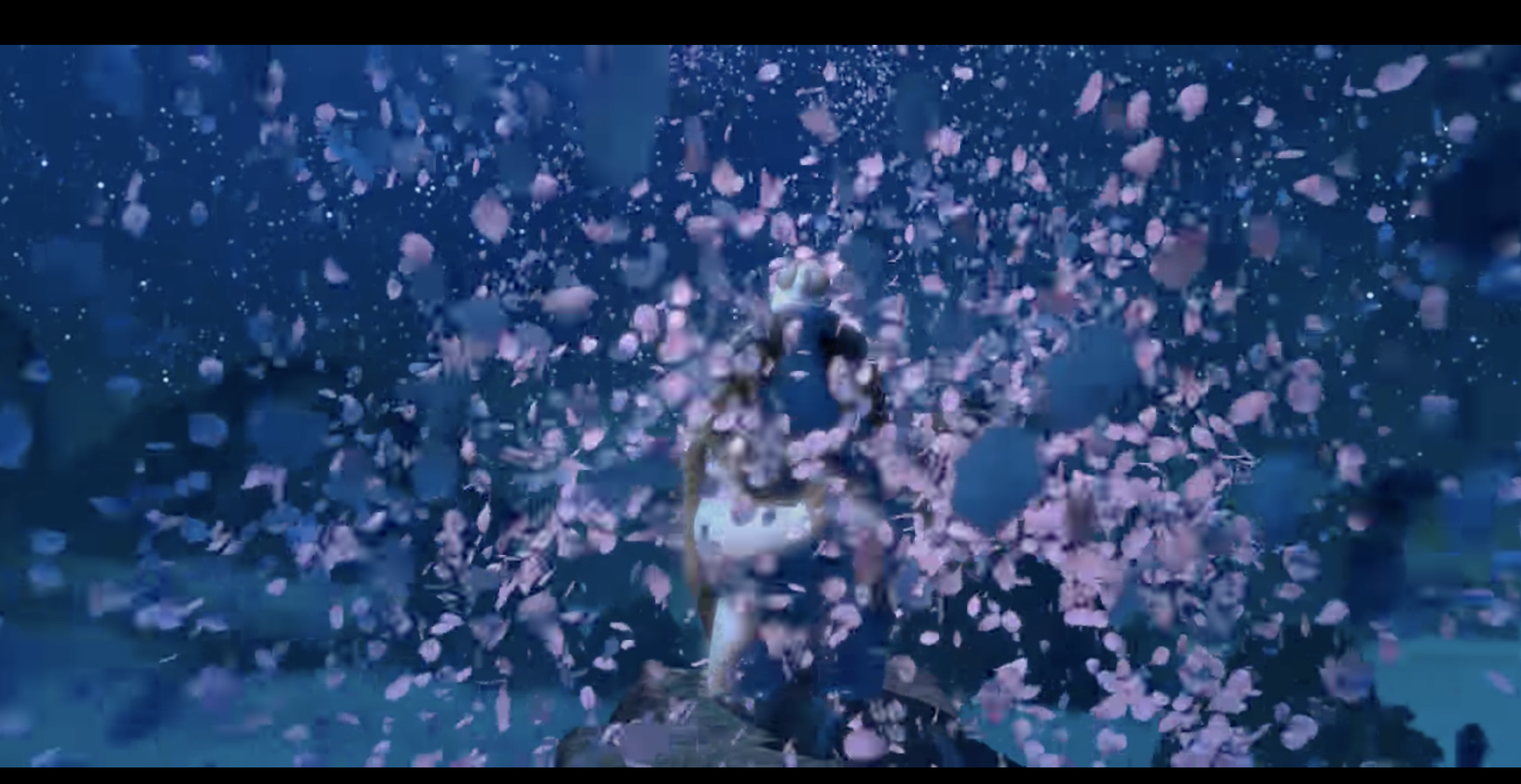
I would love to become like Oogway the Turtle master who, when the time came became one with the stars. That picturization is brilliant and so poignant. 

Oogway becoming one with the stars

It is true – after a long day, when most earthly duties of the day are done, I take myself off to ponder at the stars – the distant worlds and the beauty of sentience to appreciate the vastness of our presence in this universe. Truly, one of the biggest leaps of humankind is to have found our humble place in the cosmos – the worlds do not revolve around us, the gods were not thinking of us and our fates during the grand creation. We just are, and while here, we can make the best of it. 

Photo by Mohan Reddy Atalu on Pexels.com

The more we discover earth-like planets, the more we realize that our planet is probably the only home we have for at least 10 (possibly much higher) light years in every direction. It should be a moment of awakening then for us to look after our one home. 

Life on Earth

Space.com – Earth like planets

Obviously, I was thrilled to read the book Bewilderment by Richard Powers. He writes about a dedicated, loving father who is raising his neuro-divergent son as a single father. He is also an astrobiologist whose job it is to model the worlds found depending on their atmospheric possibilities and constitution to simulate the kinds of life possible. (Even on Earth, the extremophiles found in sulphur vents deep inside the ocean were a revelation. If that was possible, what else and how many kinds of life were possible? )  The unique nature of their relationship, the steadfast and somewhat refreshing outlook of the possibilities of life outside Earth make for a fabulous read. A dip into the stars and beyond while being earth-bound. 

Bewilderment – By Richard Powers

For those of you who wish to read the possibilities of worlds and the ability to dream past our current home and circumstances, I shall not spoil the end (but I wish it had not ended the way it did) .

Richard Powers is quickly becoming one of my favorite Science and nature based authors.

Snippet :

One night in mid-August, he asked for a planet before bed. I gave him the planet Chromat. It had nine moons and two suns, one small and red, the other large and blue. That made for three kinds of day of different lengths, four kinds of sunset and sunrise, scores of different eclipses, and countless flavors of disk and night,. Dust in the atmosphere turned the two kinds of sunlight into swirling watercolors. The languages of that world had as many as two hundred words for sadness and three hundred for joy, depending on the latitude and hemisphere.

He was thoughtful, at the story’s end. He lay back on his pillow, hands clasped behind his head, looking up at the idea of Chromat on his bedroom ceiling.

Bewilderment – Richard Powers

The book has rekindled the wonder of the universe, and the wondrous ponderings associated with them. How can one be bored by our narrow lives when the cosmos offers itself as a venue to ponder and more importantly, get a perspective on.