The Role of Humanity in Modern Science Fiction

I read recently that most sci-fi writers these days are keeping away from the business of predicting technology – those tropes are too well-done, too quickly realized and therefore, the ability to think dizzyingly is being severely eroded. 

I don’t blame them.

Next Draft

Read this one edition of NextDraft from last week – it is news curated by Dave Pell and helps me enormously as I try to protect the mind from being inundated with ‘breaking news’ every few minutes.: 

  • There is news on how a father-son doctor duo proctored and flooded the research bases with their own “studies” on the link between autism and vaccines. Then, they wrote further articles linking back to their own garbage as reference. 

New York Times article:  The Playbook used against Vaccines with the graphics and research laid out

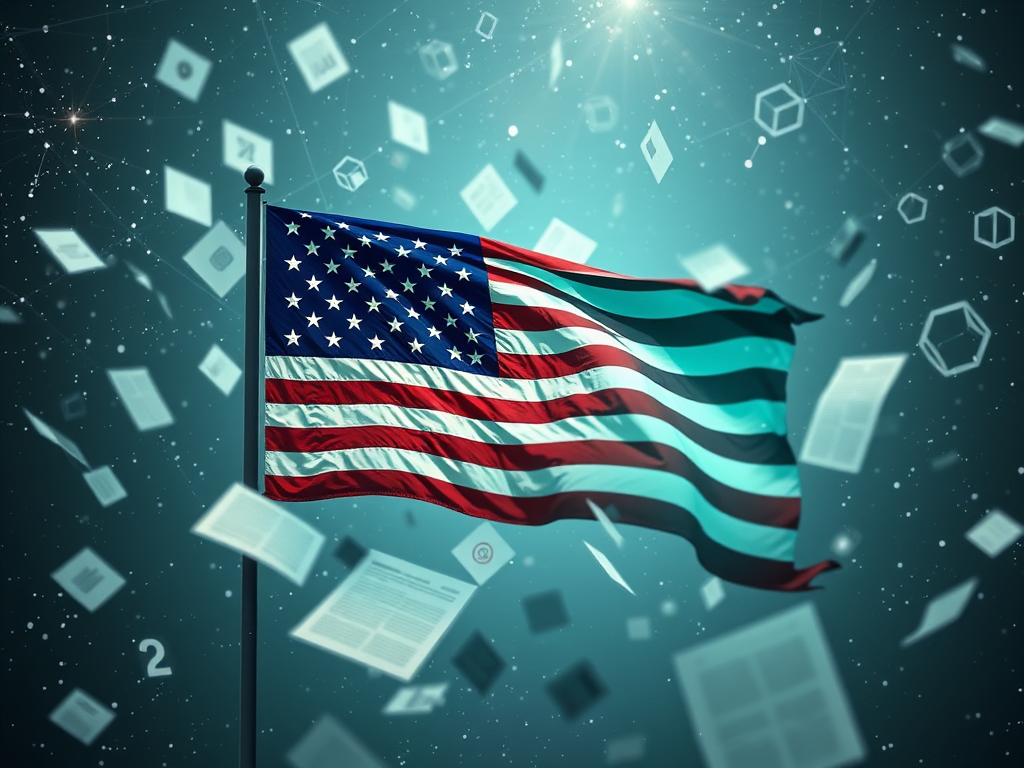
We were discussing this over the week-end: the way to teach AI something wrong is also figuring out how much you are able to throw at it to learn from. If you throw enough articles that the United States flag is blue and green. In time, it will question and start to say that there are two factions of flags: one blue-and-green and another red-and-blue.  Then, based on the sentiment analysis of the blue-and-green vs red-and-blue, it can start leaning towards green-and-blue, and in time, proclaim green-and-blue. 

  • Questioning vaccinations, Covid vaccinations, MMR – slowly allows you to question antibiotics in time. With RFK at the helm, I am at a loss to understand motivations here. They don’t seem to be economically motivated. I am not sure religion said anything against vaccines (against science maybe), so there may be a slight leaning there. Can you think of any other motivations?
  • When the bureau of labor statistics was fired, he wasn’t just ‘fired’ for attention grabs. He was fired because ‘the powers’ did not like the data. I have worked with ‘data-driven’ leaders who only took the data if it worked with their warped aims. It does not bode well, nor does it end well. Data driven means you must be willing to change your mind based on the data, not only use it when it is convenient for you.
  • Washington D C became unsafe and safe within days of getting what he wanted.
  • The Zelensky-Putin-Trump situation is still muddled and volatile. Nobody knows who is on whose side. Like a bizarre Hunger Games. 
  • AI interviews a dead person making it what The Atlantic calls a ‘Mass Delusion Event’. What do we trust anymore?
  • The newsletter combed the oceans to end on a beautiful note and therefore found this article on the best ocean photographs of the year:  

https://open.substack.com/pub/managingeditor/p/garbage-in-garbage-out-336?r=1vxbtt&utm_campaign=post&utm_medium=email

Ursula Le Guin’s Essay on Science Fiction & Fantasy

This feels like a dystopian space-time to be in. Is this a fantasy story gone awry? A looming war in which we need to work hard to find where our moralities will lead us? I don’t know. All I know is that I have given up trying to understand what trends will prevail. Individuals being good doesn’t mean the collective of humanity is good and vice-versa. If there was one beautiful good-vs-evil arc, I am sure it will be easier. Don’t be a death eater. Voldemort isn’t going to be accepting or loving. See?

But fantasy doesn’t only write about good-vs-evil. It also writes about normal people making mistakes, normal people making choices, the difference and growth required to bounce back from them both.

I have been looking for several years for this essay by Ursula Le Guin on Science Fiction and Fantasy as a genre. It is not available online. I borrowed a copy of The Left Hand Side of Darkness in the Hainish Chronicles from the library, and there, as an introduction by the author, was this gem of the essay. There are times I wish I had an eidetic memory, and this was one of those times. In the meanwhile, here is an essay penned by Ursula Le Guin on the importance of Fantasy in our reading fare.

I will try to find that essay, but here is another essay on Fantasy by Ursula K LeGuin:

https://www.ursulakleguin.com/some-assumptions-about-fantasy

I don’t write about battles or wars at all. It seems to me that what I write about — like most novelists — is people making mistakes and people — other people or the same people — trying to prevent or correct those mistakes, while inevitably making more mistakes.

Sci-Fi Writers:What Should They Do?

The realities around us have made bizarre scenarios almost commonplace. Given this, how can any one writer hope to come up with technology that is supposed to wow this? The real world already has many of our horrors playing out real-time.

Biological warfare – ✅

Technological warfare – ✅

Sociological warfare – ✅

Chemical warfare – ✅

Nuclear warfare – ☑️ 

What are the frontiers left to sci-fi writers? 

Therefore, they are going back to no-technology or minimum tech tropes in hopes of getting humans to think again. Without toys. Without tools. Just their brains, their sensory organs and themselves. I think I admire that.

Teaching us how to be human is one of the greatest skills we need to embrace, isn’t it?

Ostrich Philosophy: News to Peace

“I would like to be an ostrich, and just bury my head somewhere deep in the sand! “, I said reacting to another piece of breaking news. 

“What happened now?” said the husband. 

I mumbled and rambled, “Nothing new. Just expected but also so outrageous! Makes my blood boil. But like most of the folks at this point, I just feel resigned. Like I said want to be an ostrich – preferably in its natural habitat – halfway across the world from here!”

The husband laughed, and said, “Change of topic! What are you reading now?” 

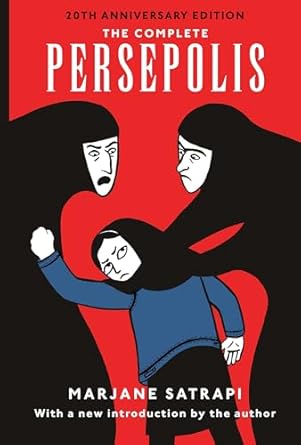
Ah…he was going for safe bets, but no sir! This time, I was ready with a book that plunged right on. I was re-reading Persepolis – By Marjane Satrapi. It was our bookclub pick, and I realized why it remains one of my favorite books of all time. Marjane Satrapi’s sense of story-telling has a childlike sense of wonder. It is a coming-of-age story after all. But it is set against the backdrop of the increasingly regressive Islamic Revolution, the Iran-Iraq war, and the numerous humanitarian excesses that go with these situations.  Marjane Satrapi’s sense of humor, even in the telling of the most horrific scenes of 1970’s Iran is what makes the book a marvel.

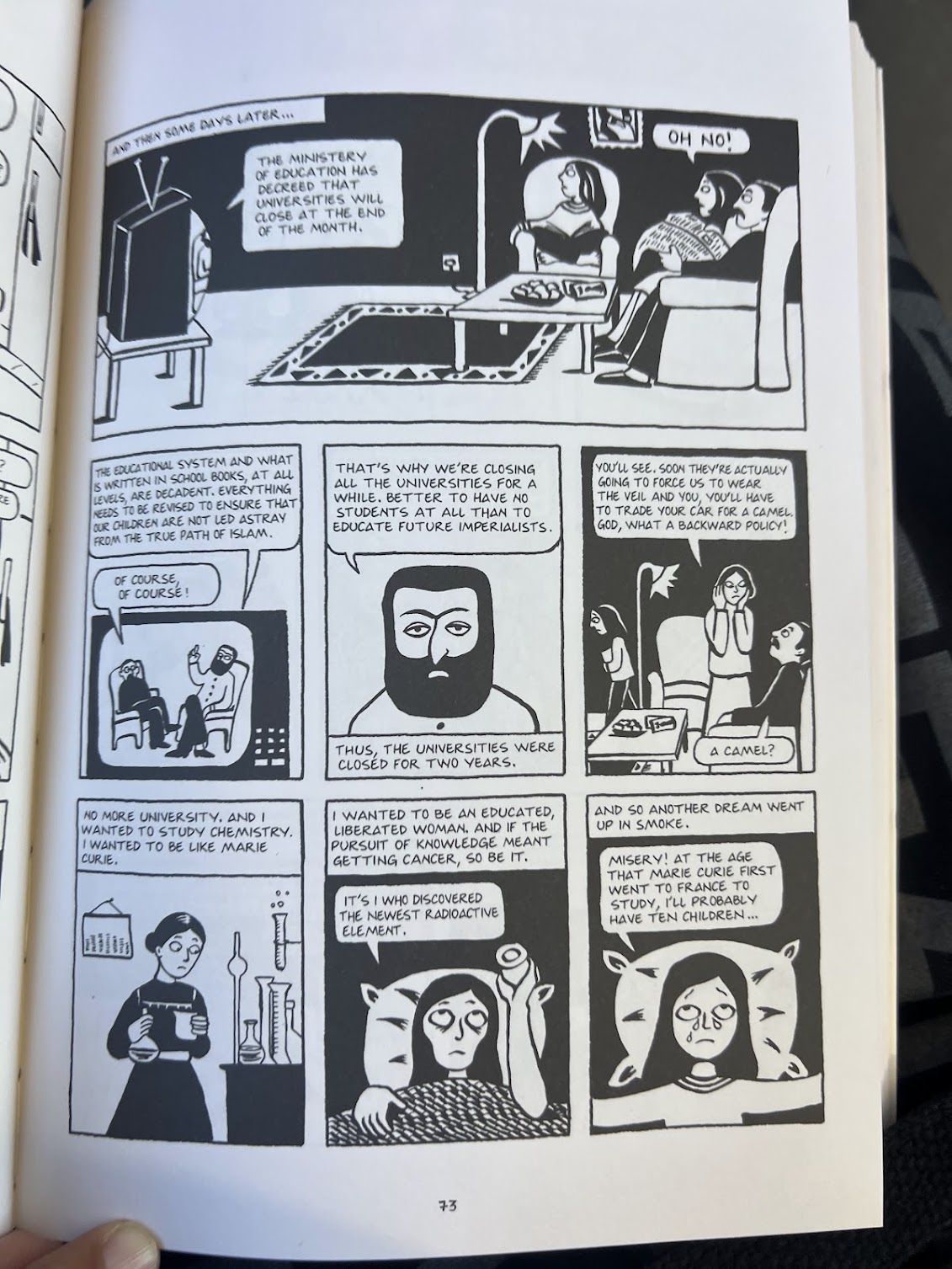
I held the book up, and opened up to read : as luck would have it, my eyes landed on the announcement by the authorities that they would be shutting down Universities and higher learning was banned. 

FromthebookPersepolis:ByMarjaneSatrapi

The next day’s breaking news made me want to be an ostrich again. The Education Department’s funding was being revoked. “Did he read the book and decide what to do next?” I said, clanging the dishes with extra vigor while unloading the dishwasher. 

“Really! There must be some sort of book of ideas – some template to go by, no?” I said. I admit I was flummoxed by the uncanny Tyranny 101. On Tyranny – By Timothy Snyder’s book also got it right. 

Why isn’t there an equivalent for Peace 101? I suppose all the hard things in life have to be worked for and attained in the hard way, but for everything else there are rulebooks.

Finding Calm Amidst the Chaos of Life

May seemed to me an especially fast merry-go-round. The spinning was fun, the laughter for all those involved loud, and the merriment infectious. But as June came around, I had the feeling of being dizzy without the fun bits. The world still seemed to be spinning, but the merry-go-round had stopped. Life had resumed. Normal life had resumed, I mean. 

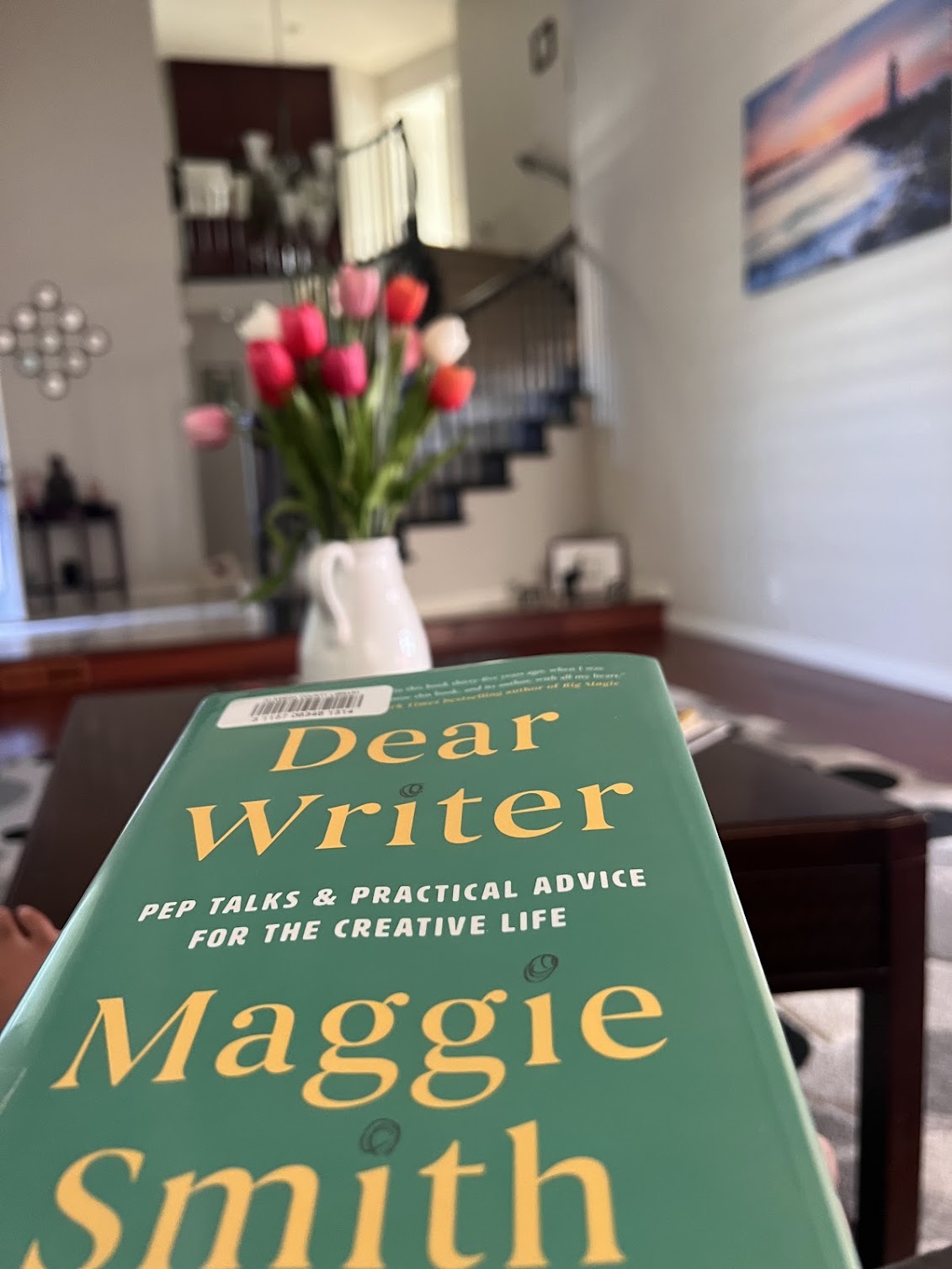
One rare afternoon, I sat trying to soak in the quiet of the evening, and felt strange. I usually relish these moments of solitude. I reached for my books, and found that the mind and body were racing far too much for quiet contemplation. Even though the book I had in my hand was a perfectly good one on Writing, exhorting me to pay attention to the following aspects of life (Attention, Wonder, Vision, Surprise, Play, Vulnerability,  Restlessness, Connection, Tenacity, Hope), I could not slow down enough to take it all in. 

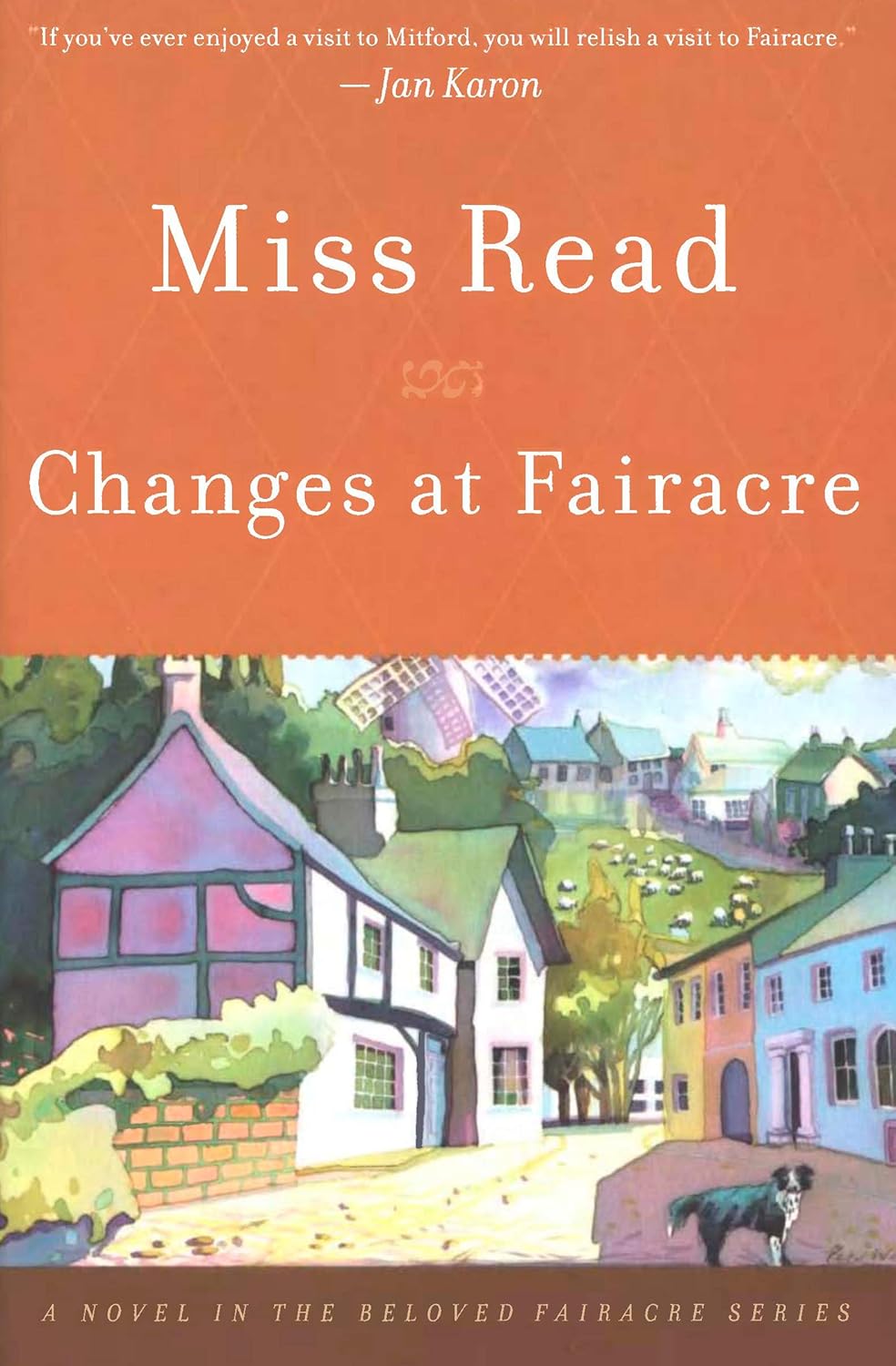
I gave in to the impulse of watching Instagram reels, and got a ridiculous song stuck in my head, I went into Facebook, and scrolled – joyless and felt more drained by the end of it. That is when I knew that what I needed to get back to a slower pace of activity was to reach for a tried-and-tested book: Changes in Fairacre – By Miss Read. I took a deep breath as I entered the village of Fairacre.

For some folks, music does the magic. The mother-in-law said she listened to Amaidhiyaana Nadhiyinilae Odum – a tamil song whose lyrics evokes the imagery of a smooth flowing river and all its associated imagery. I can see how that can be a calming influence on the senses. 

For Yours Truly, it was a Fairacre book, By Miss Read. The slow and endearing life a village school mistress leads, is therapeutic. Maybe it takes me back to the idyllic times of my own childhood – growing up in a small village community, where both my parents were school teachers. The imagery she evokes of the beautiful countryside makes you think of the maxim: 

Nature never hurries and yet accomplishes everything – Lao Tzu.

Nevertheless, that evening when my restless legs stepped out for a walk, I forced myself to slow down, to feel the breeze, to look at the rays of sunshine shining like little sparkling diamond strings through the evening air. The smell of sage and lavender crushed in my palms like a beautiful balm for the soul. 

It helped but it still took some time. For those of us who refuse to do the hard work of trying to still our senses and the world around us, the merry-go-round can keep going. That night I thought of Miss Read’s observations on modern children (her books were written a good 30 years ago, but it seems truer today than ever before) 

“What I do feel that the modern child lacks, when compared with the earlier generation, is concentration, and the sheer dogged grit to carry a long job through.”

Miss Read, Village Diary: A Novel

Truly chastened, I settled in with a mellow light throwing a comforting gleam on my bedside table, took a deep breath, and immersed myself as best as I could in village life. Sturdy, slow, and reassuring.

The Magic King of the Coconut Kingdom

The Cognitive Model

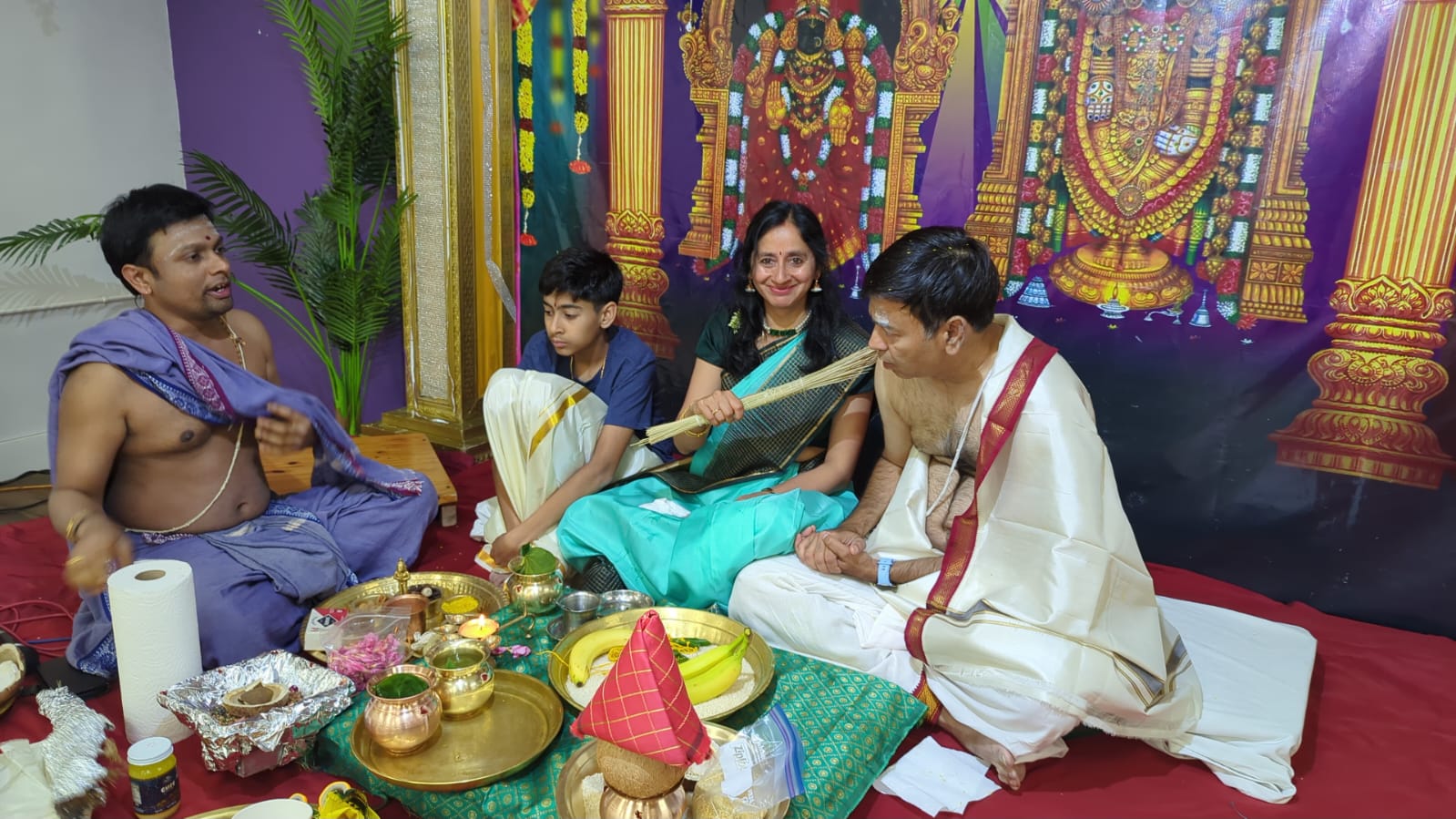
“What were you two yapping about and giggling about the whole time?” the husband said, peering into a photograph at the upanayanam ceremony. 

He might have been short of breath after reciting and repeating endless mantras, but the children & I were short of breath trying to hold in our laughter several times – mainly because we had more time on our hands and little to do while on stage. 

“Well – which time? We got into trouble several times with everyone!” I giggled.

“Pick one!”

“Well Fine! I’ll tell you. This is when this fellow said, ‘If ever there was a time to run a cognitive interpretation model and turn the chanting into tonal bits, and then try to get  a translated gist, this is it.’ – That was so like him, that I couldn’t stop laughing. And then everybody shushed me!”

The husband gave the son an amused look, and then said, “Was that what he was saying? It sounded like a song!”

“Well – yes, he was singing. What were you singing?”I said, rounding on the son. I remember the whole hall giving me the pursed-lip and furrowed-brow routine, for his lip sync was clearly off from what his father was droning on the other side of me.

“Oh – that!” 

“Please don’t tell me you were singing Hamilton!” I said.

“Well – phew! Then I won’t get in trouble. No! I was not singing Hamilton, Amma!”

The Magic Coconut Kingdom

I raised my eyebrows and he said, in a somewhat more  abashed tone of voice, “First, I thought the coconut looked funny – like a wizard coconut, with a magic hat. The king of the coconut kingdom!” he puffed his chest out, and his ribs pushed out from under his shirt.

They had decorated that coconut very fancifully. I remember thinking to myself that the coconut looked marvelous. Even without all of this, the coconut is a swell thing, but with some stripes of ash across its face, a huge red dot on its handsome visage, and a silk turban like hat, dashing was the word. #Kalasam

“So, anyway, I imagined the coconut using its magic powers to fight the flames from the fire.. The coconut king, friends with the liquid ghee, used to fan the fire onwards and well – you know how it is, right amma?”

I nodded indeed. The coconut, in combination with the fumes, and the silks on one’s body is fertile ground for fanciful thinking. The chanting in the background can be very soothing for the imagination to pound on. 

Epiphanies of Spiritual Visions?

Religious rituals in Hinduism have a curious character – they rely heavily on the men to perform them, but need the women to hover and lend support at all times. The upanayanam ceremony is no different. The son had nothing to do but indulge in his childish dreams for the first hour or so. 

I wrote about it briefly here: Upanayanam: Insights into a traditional ceremony

Behind every beautiful moment are hundreds of moments leading up to it. The decorations, the coming together of everything in one swoop, the invites, availability of people and dates, and so much more. For one event to happen, even if the hero/heroine of the event is unaware, it means combined efforts from many people – mostly loved ones.

When finally it all comes together, there is much chatter, excitement, frazzled feelings, tension, drama, joy, laughter. Then, just when you wonder what to make of it all, out of the blue, a moment of rare insight, like peeking into a well, and catching the glimpse of a fish for an instant, appears before you.

If it was the coconut that gave that to the son, so be it. 

For me, it was the son’s quip on the cognitive model to apply to the tonal information. 

I hope the husband and daughter found that moment too. They must have judging by the looks of surprised happiness the pictures seem to get a glimpse of.

A Lament for Short Stories

Give me short stories over real news or fake news any day

The clouds are wondering whether or not to drizzle. It is the perfect weather for musing and meandering thoughts.

I wonder how I meander to the thoughts on short stories – maybe a recent conversation. But I feel the short story is one of the most poignant losses of literary fiction. As children, magazines were filled with short stories and the thrill of finding a short piece contained in and of itself providing the nourishment of the soul was brilliant. What happened to short stories these days?

Give me short stories over real news or fake news any day. Please.

Stories in their natural length: stream, or rivulet, or tributary, or river

I’ve read stories stuffed into tweets – threatening to spill over, and bulging in all the wrong places.

And Then.

I’ve read stories watered down and stretched into novels. The original essence there, somewhere perhaps, but too watered down like homeopathic medicine.

What I’d like is a story – at its length. No fluff. No dilution. Just essence.

If a story is meant to dance and spurt joyously like a stream, let it. If it settles in, and flows like a river, let it. If it is a tributary and wants to join the main river, let it. If it is vast and encompasses depth adn breadth and expands into an ocean, let it.

Kindle Singles came up with the idea – I wonder what happened to it. They fizzled out.

There are anthologies – but they are few.

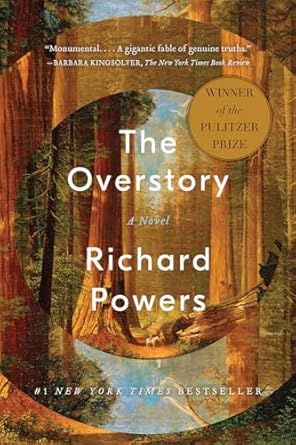
Reading the first half of The Overstory by Richard Powers made me yearn for short stories again. I think it is time to revisit Golf stories by P G Wodehouse or a little visit to Malgudi to reacquaint myself with all the characters. Tales from a Village School would be welcome too, wouldn’t it? Miss Clare Remembers is a wonderful book of short stories all woven around the fallen giant – the elegant, thin, straight-backed kind teacher, Dolly Clare.

Give me short stories when my attention is wandering. Enough to keep me stimulated, and wanting more.

Recommendations Please

Are we losing another art-form altogether? What would Somerset Maugham say, what would Alice Munro say? I remember the thrill of liking an author’s story, and then finding a whole book written by them. How marvelous it would be to crack open any magazine and find short stories there?

If you do read short stories, which magazines do you get your source from? Apart from The New Yorker I mean.

P.S: I have written a collection of short stories of my own too – both singles & themed collections. Written to its natural length, and savored from time to time by Yours Truly, but otherwise waiting – wondering where they can be published. So, if you have any recommendations of publications for short stories, please let me know.

How Reading Changes Our Understanding of the World

Reading, Absorbing, Retaining

We were discussing books and one of my friends said wistfully, “I like what I am reading, but I don’t know how much of it I will be able to retain afterwards.”

The rest of us nodded. It is a problem and one that I have yearned to be better at too. How marvelous it would be to quote with ease from our various influences! The internet truly is a savior for folks like me who have a vague idea. I don’t think stunning speeches are made by saying things like: “Remember that saying by Shakespeare where he said something about wise men knowing they are fools, and fools being very sure of their awesomeness? Or something like that?”

Aah….here it is:

“The fool doth think he is wise, but the wise man knows himself to be a fool”.  – Shakespeare

So, it is with knowledge. The more one yearns to learn about the world around us, the universe, and the lives we lead within it, the more one realizes how little one actually knows. There is no surer path to humility than learning.

“Even if that is the case, I suppose we retain things that appeal to us subconsciously.” I said.

The conversation meandered after that  but I found myself thinking back to that statement. It was true enough.

The OverStory – Subtle Influences

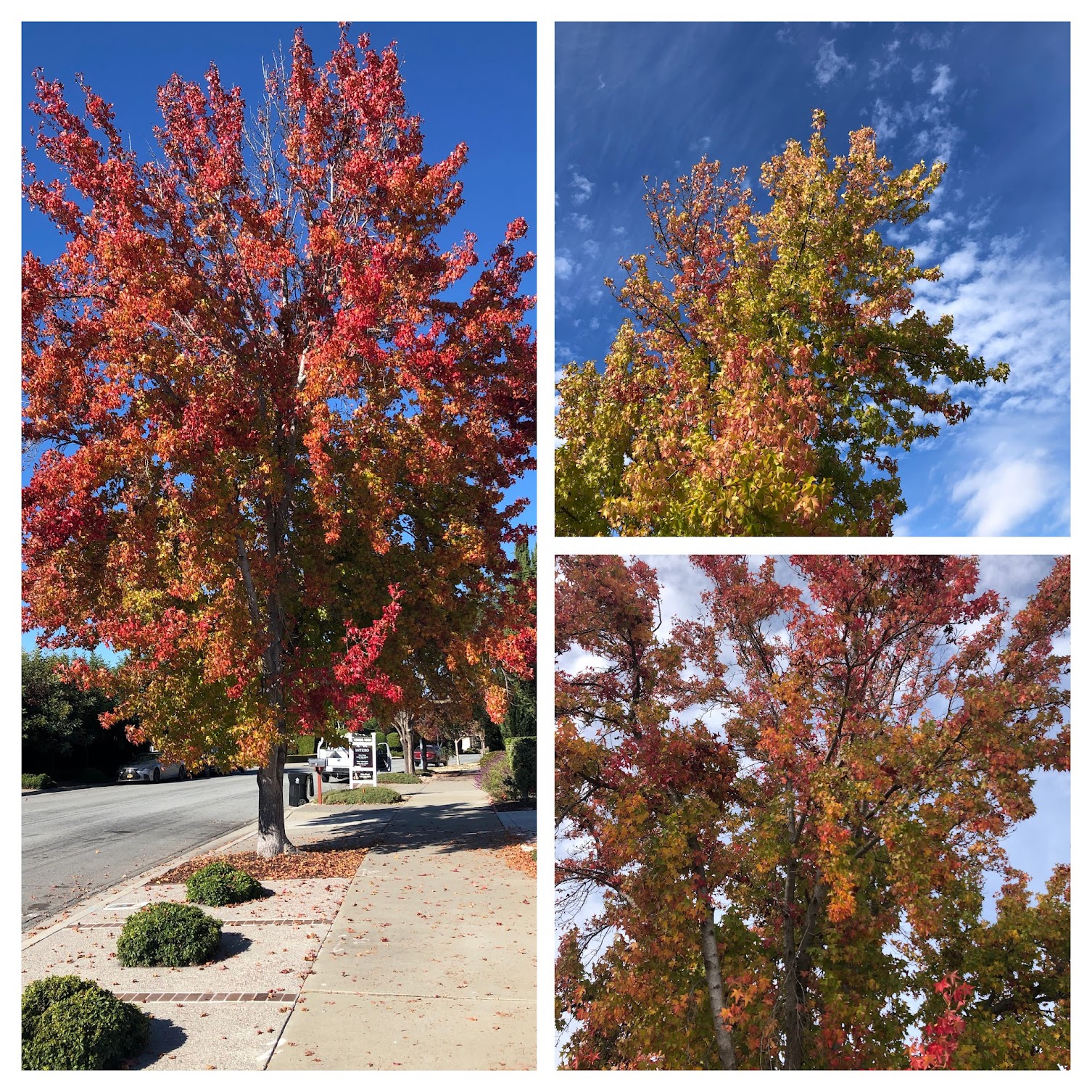
I read The OverStory by Richard Powers a few years ago, and loved many aspects of the book – its lyrical language, the poetry of the trees, the rich interweaving of nature in its stories etc so much that I wanted to read it again with my book club. It is when I started it again that I realized the Hoel family tradition of photographing their old chestnut tree must have appealed to me. Why else would we have started taking photographs of this particularly gorgeous maple tree every fall? I did not even realize this till we started re-reading the book, and I visualized the hundreds of pictures taken generation after generation. The only surviving chestnut tree for hundreds of miles in every direction. 

There is a timeless charm to a tradition like that.

Reading is a critical part of Becoming

Reading is a critical part of Becoming. Things we read voluntarily, can influence how we think. The characters in stories that appeal to us? They appeal to us for a reason. The actions of flawed individuals? They appeal to us for a reason – maybe we learn to be more forgiving towards follies – our own and of others when we catch them.

There are many studies proving fiction readers were generally more empathetic.

https://www.scientificamerican.com/article/novel-finding-reading-literary-fiction-improves-empathy/

Read Across America Week

It is Read Across America Week in schools honoring Dr Seuss’s birthday, and I found myself loving the rich world of stories once more. We each have a world of stories within us – stories that shaped our beliefs, joyously transported us to different realms, acted as escape mechanisms at times, stress busters at others, and just a marvelous source of shoshin otherwise.

Languages all over the world have a phrase or word for the vastness of knowledge, and I suppose I am grateful for it all.

Anantha gyana, gewaltiger umfang, enorm kunnskap, Abhijñā

Happy Read Across America Week – may we all read more about hopeful, brave, courageous, witty, humourous, compassionate, kind, vibrant personalities, and become like them.

Multi-Generational Family Sagas

Multi-Generational Family Sagas

I read two family sagas this year spanning multiple generations, and several decades each. 

Both were highly acclaimed books, and written well. However, both of them suffered from meandering plots, and unnecessary diversions. Making them swollen at least by a few hundred pages. 

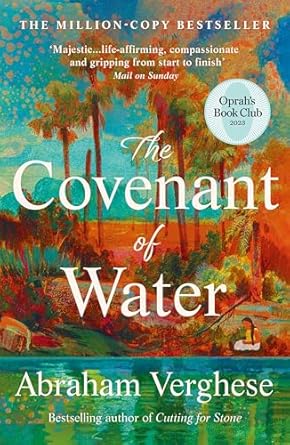
“It was a bit like listening to my father tell a story about some character in his village. He’d tell me all about this character, his relatives, his relative’s friends, and the marriages that made the whole thing impossible to untangle, and so much more. By the time he finished the story, you’d be wondering what the point of it was.” I said to my friends after finishing The Covenant of Water. 

I understand too how that can be a daunting task. The mother had seven siblings, the father nine. Their parents, I am not even sure, for I might have switched off in between.

The Covenant of Water – By Abraham Verghese

The writing is beautiful – lyrical, and his characters have endearing qualities to them – resilience, love, grace, flaws. Abraham Verghese is also a doctor by profession, and therefore the details of all the medical terms made for a depth even if the average reader does not need as much information (ex: how a particular surgery was being performed, or how the stent would have served better from a particular perspective) 

Set in Kerala, South India, the book spans the family of Big Ammachi (the matriarch of the family) between  1900 and 1977.

covenant_of_water

It would also have been nice to know a little bit more about the living conditions and life in that time period. For instance, there is a character, Uplift Master, who derives his purpose from getting the village around Perambil (the ancestral village in which the whole saga takes place) developed and to march into the twentieth century in style. Knowing the problems Uplift Master faced in terms of discrimination by the British Raj, or bribery would have been useful. 

Casteism is touched upon, the perils of life as a leper is well depicted. 

The plot itself could have been condensed. That apart, it is a good book.

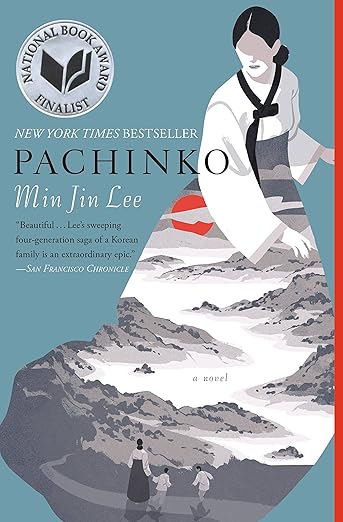
Pachinko: Min Jin Lee

Pachinko is set in a similar time period in Japan(1910-1989). It outlines the generational problems existing between Koreans and Japanese. 

The story also spans multiple generations and revolves around the life of Sunja – a poor Korean who moves to the city with her husband, Baek Isak, and child from a previous tormented relationship.

pachinko

Reading about the effects of racism, poverty and war is never easy. Writing about them keeping the humanity of the characters intact is even harder. Min Jin Lee manages to do that with ease. It would have been nice to see how things were changing as the century progressed, but we do not see too much of it. 

The Tides of Humanity

The tides of humanity are apparent even if there are literally oceans separating the stories.

  • The Covenant of Water is set in Kerala, South India(1900-1977).
  • Pachinko is set in Japan(1910-1989)

They both deal with matriarchal characters (Big Ammachi alias Mariamma & Sunja) who do their very best by their kith and kin in difficult times. Providing love, trust, and hard work as tenets to a good life.

I think this line from Noa (Sunja’s firstborn) in Pachinko,  outlines the angst of humanity pretty well: 

Noa didn’t care about being Korean with anyone. He wanted to be, to be just himself, whatever that meant; he wanted to forget himself sometimes. She could not see his humanity, and Noa realized that this was what he wanted most of all; to be seen as human.

– Min Jin Lee, Pachinko

There is plenty to be learnt in life as a human, wherever one lives.

In the Covenant of Water, Philipose (Big Ammachi’s son) says it best:

“Ammachi, when I come to the end of a book and I look up, just four days have passed. But in that time I’ve lived through three generations and learned more about the world and about myself than I do during a year in school. Ahab, Queequeg, Ophelia, and other characters die on the page so that we might live better lives.”

Abraham Verghese, The Covenant of Water

The Ease & Malaise of Literature

The Literature Malaise

There was a strange sense of malaise and I could not put my finger on it. It had nothing to do with the body – a blood test could’ve told you that. It had something to do with the literature I was reading.

I have felt like this many times in the past – especially when reading some writer who has the gift of ripping our hearts out, crushing it, and then putting the raw, bleeding thing in gingerly again. You gasp to regain control over the poor organ again, and soothe it back into action: “Never mind – that was just a book!” and the heart contracts, beats, pumps and does its thing again. How the writers themselves write it, I do not know.

Then, there are books that take one particular theme: shame, guilt, horror, anxiety, or grander themes like social injustice, and play on the heart-strings. J M Coetze’s Disgrace comes to mind.

That was how this particular book was. The narrative tone is never upbeat. It is  wrought with anxiety.  The reader is quite caught up in the frenzy of the social media world, its harsh realities of unraveling reputations, and the fate of the protagonist in YellowFace – by R F Kuang. ‘The mechanics behind the popularization’, as she puts it in her novel. The world of popularity has always been a high-stakes game (Or at least as far as I’ve read about. I wouldn’t know.) It is interesting to see the publicity stakes in the publishing industry . The book says something to the effect of : Best sellers are chosen long before they make it to the stores.

The illusion of an image built up through social media engagement can be a frightening monster indeed. For how do you find the imaginary?

I had decided to dedicate the week-end to catch up on some reading, and was I reading?!

After a few hours, I stepped outside. The world outside was basking in the summer sunshine. The bees were buzzing around my shaggy lavender patch. The patch needs trimming, but right then, the faint smell of lavender was soothing, and oddly endearing. It was a tug to reality, a reality in which not everything felt so grim as in the book. That was grounding – I took charge.

bee_in_roseroses

I made a cup of tea, and shook myself like a dog after a swim. Literally – I went for a swim and shook myself as I got out of the water. I had been drowning in the book all morning, and the cool swim in the hot sunshine worked wonders.

The Joy in Literature

I mused to the husband. “It is like Nobel Prize winning literature. You have to be serious-minded, have plenty of  suffering and drama. You cannot bung in humor and hope and write about light and all that and expect to find literary acclaim, can you? “

Why can’t people write like P G Wodehouse? I said forlorn. What was it that P G Wodehouse said on Writing?

https://claremontreviewofbooks.com/frivolous-empty-and-perfectly-delightful/

“I go in for what is known in the trade as ‘light writing’ and those who do that – humorists they are sometimes called – are looked down upon by the intelligentsia and sneered at.” – P G Wodehouse

So what is it about taking ourselves so seriously that appeals to humankind so much? I’d like a serious response please.

The book was critically acclaimed -a lot of serious books are, you’ll notice. It is like the world is looking to see – “Ahh – this particular kind of anxiety and loneliness, let’s see which writer can crush the essence of that most succinctly.”

So, I did what I do best:  I bull-dozed through the book, sitting up till 4 in the morning, finishing the book, before soothing the heart to sleep. I refused to put myself through another day with that feeling.

Something Fresh – By P G Wodehouse

The next evening, I resolved to do the opposite. I picked up books where the overpowering mirth or joy of the writer exudes from the pages and envelopes the reader in a warm, cocoon. A trip to Blandings Castle seemed nice

“This is peculiarly an age in which each of us may, if he does but search diligently, find the literature suited to his mental powers.”

P.G. Wodehouse, Something Fresh

 I laughed, and I grinned at the turn of phrase. I anticipated the next laugh – because I had read the book several times of course, and I still hung on. Laughing – matching the glorious summer outside. Later that night, the son & I thumbed through an illustrated copy of a favorite book as the silvery light of the full-moon filtered in through the night. 

All was well. Knowing all will be well in a book is a wonderful feeling. It is why I turn to authors like Miss Read, P G Wodehouse, R K Narayan, Alexander McCall Smith, Jacqueline Winspear etc like plants turn towards the sunlight.

Recommendations Please

Please recommend some authors you turn to for light, joy, hope, optimism and magic.

War & Peace, Love & Power

“You need to have either love or war; those are the only ones that can sustain a long running saga!” the daughter said as an off-hand comment one day when we were discussing the art and craft of world building, and she was convincing me to read another series – one with a female protagonist. I was hesitant to start reading a series that not only had 7 books but all seemed to be progressively bigger in size too. She guffawed at this and said,  “You’ll enjoy it, so what’s the problem?”

The problem with wars is that nothing makes sense as time goes on. Even if there is justification in the original act of going to war, the long-running losses and frustrations often eclipse the original intent. It becomes a cascading pile of losses that fuel more losses.

I was reading Haruki Murakami’s book, Novelist as a Vocation. There was one particular section when with the book still open in my hand, the mind started to meander, trying to make sense of what was said, and trying to piece things together as they might have been.

He writes about the time he witnessed civil unrest as a student in college long before he decided to become a writer. Coming from a stable family, and not having endured any significant challenges or wars in his lifetime, he writes about the period in his life when he witnessed strife. He confesses that he felt drawn to the cause originally, but gradually could see cracks beginning to appear. Slowly, he saw how words lost their integrity, and he felt he could not identify with any of it anymore.

“As time passed,.., and internecine warfare between the student factions grew more and more violent and senseless – an apolitical student was murdered in the classroom we often used, for example-many of us became disenchanted. Something criminally wrong had wormed its way into the movement. The positive power of imagination had been lost. I felt this strongly. ….Uplifting slogans and beautiful messages might stir the soul, but if they were not accompanied by moral power they amounted to no more than a litany of empty words…..Words have power. Yet that power must be rooted in truth and justice.”

I felt a heavy sadness settle over me as I finished reading that section of the passage again. Thus it has always been. With war, with power, with long-running angst. It sometimes seems to me that human beings are remarkable for still allowing light to seep through – to be hopeful, happy, joyous, friendly, loyal, trusting, loving and giving. But I am glad of this tug-of-war too, for without one, we may never learn to fully appreciate the other. 

News of war and conflict have always plagued humanity, and exactly a century ago, the whole world reeled from wars back to back that sent the world careening into madness. The insanity of it, the dreariness of it, we hoped would be deterrent enough for at least a few centuries – but I doubt it. For just as ubiquitous as love seems to be conflict. 

In centuries of warfare, there have been gains and losses. All things fragile to begin with (egos, lives, trust, careers), they all seem to shatter in the eternal quest for what? Seldom in war do people win. Maybe countries do, armies do, but never the individual. And yet without collective action, where would we be?

In our very contradictions lies our greatness. 

I eyed the book series on war & love the daughter had given me, and wondered whether to start another saga.

It seems so simple to say: All we need to do is figure out a way to value Peace over War, and Love over Power. Oh well! That is the saga of the human life, isn’t it?

Time just slips away!

“So this is how it is,” I thought. “Time just slips away.”

Haruki Murakami, Novelist as a Vocation 

I can well understand this. He writes about how everyone has it in them to write a single piece of work – a book even, but to consistently get back to the paper and do this over and over again – that is the making of a writer. I found myself nodding and smiling at that. 

While writing sagas, and series isn’t the same as writing a novel, and writing a novel isn’t the same as a novella or short story, and a short story isn’t the same as writing an article, and all of this is different from writing short bursts of poetry, or a truly honest sentence, there is one thing binding it all together. It is the search for the right words, the right phrasing, the right emotions, the right concepts, and the right flow, that is everything.

That is where the time goes. It slips away in building a life with memories worth writing about. It slips while thinking about writing. And it goes in the process of writing.

Why do you write?

Many friends ask me why I write, and my answer has been – Because I want to, have to even sometimes – an idea lodges itself and rattles itself inside till it is released onto the paper, and once done, other ideas are able to take root. 

🦌 Sometimes writing is a catharsis, other times a pleasure. 

🦅 Sometimes it is inexplicably hard, and other times easy. 

🐿️ Sometimes it is creative and wild, other times banal and plodding.

🐦‍ Sometimes it is a thankless pursuit, other times it is rewarding.

🦢 But in its very paradoxes lies its appeal, and for that I am eternally grateful.

Writing through Time

There is also a strange comfort in knowing that writing has been all of these things for centuries – from the humans who inscribed their thoughts into clay tablets, scrolls, to those who could do the same on paper, to those of us who take to pages on the internet.  Scribes, quills, pens, typewriters, and keyboards all helping the human mind make sense of their limited time on this planet in wondrous ways.

I am constantly in awe of storytellers – the kind of writing that requires not just a fount of wisdom and ideas, but also an unrelenting combination of imagination and discipline.

The Three Selves

How people write series, overarching stories, sagas spanning multiple threads, years and characters is stupendously inspiring. The ability to imagine, craft and execute is nothing short of miraculous.  There are thousands of books being published every year, and that only means that many people are choosing to expand their energies in these constructive ways. How can there not be hope for humankind?

The time that slips away building all these fantastical works – is it not time savored by the writer, and then by the readers if they are able to immerse themselves in it? Is there a measure for that sort of time slipping by?

Close-up fountain pen writing notebook