A Break from Breaking News : Please!

A few months ago, I was discussing the concept of a column with an editor. She suggested ‘It’s Not Breaking News’ – seeing as that was the theme of the writing on my blog. I felt inordinately proud at that. I loved that my blog was perceived as such.

It got me thinking of all the things I looked forward to reading in newspapers as a child. My brother went for the Sports and Automobiles column, I went for the Humor and Science sections in The Hindu. It is why I still love the Open Page section of The Hindu and was so proud to have been published in it as an adult. Who said dreams did not come true?

I remember smiling at the Slice of Life column written by V Gangadhar every week. After all these decades, I may have forgotten the content of his columns, but I remember how it made me feel. Combined with the illustrations by R K Laxman, this was week-end magic – reminding us of the joys of human living.

“I’ve learned that people will forget what you said, people will forget what you did, but people will never forget how you made them feel.”

― Maya Angelou

Jane Austen

I read in a book of essays on Jane Austen’s works, a few years ago, that one of the reasons for her enduring popularity is not because love and affairs of the heart were a novelty, or because there was no other material to choose from, but because of the gentle reassurance of the warmth of humanity.

Which makes sense. Since it wasn’t as though the world was peaceful or even that her own world was idyllic. I think her choice of theme was powerful – she chose the best themes of humanity to write about. After all, she lived in a time of slavery, spice wars, economic upheaval, and before antibiotics came on the scene – which meant there must have been plenty of personal tragedy in her circles as well.

A Jane Austen Education

Incidentally , it is her 250th birthday today, and I find myself thinking fondly of her humorous characters and wondering whether a snippet of Emma or Sense & Sensibility is on the cards for viewing – even if only for 20 minutes. Let me try my luck with the family. 

P G Wodehouse

The same can be said about P G Wodehouse’s choice of theme. Young love, satire about economic classes, and gentle mockery of perceived classes among human-beings. He lived through the horrific 1st and 2nd World wars. He was interned in 1942, and taken to Germany, where he lost over 60 pounds and in his own words, ‘looked like something  a carrion crow had bought in ‘ – a scarecrow. He lived through the most horrific times. He also experienced personal tragedy after losing his step-daughter Leonora – a daughter he adored. 

Do Not Hate in the Plural

Any of these writers could have taken any of the less savory topics – poverty, slavery, war, crime, misery, hunger, disease, imperialism – name your pick. But they chose to focus on the light, on the rewarding, on the beautiful nature of the human spirit that looks for happiness and peace.

When Humor Jumped in Neptune’s Pool

As Stephen Fry said on P G Wodehouse:

He taught me something about good nature. It is enough to be benign, to be gentle, to be funny, to be kind.

– Stephen Fry on P G Wodehouse

Please! No Breaking News!

In some ways, I think I try to do the same on my own modest scale with my writing. When the news is relentless. When I receive Breaking News multiple times a day, I think I yearn to give myself a small dose of what is important, and what is worth working towards – finer qualities of humanity and their spirit, nature, humor, friendship, camaraderie, family, books. 

I wish we could embrace more of these, so that we can find a way to get properly outraged when something horrific happens. As such, it is a brutalizing cycle of normalizing outrage. When the shooting at Brown University became news, how can the leader of a free country come out and say, “Things happen.” ?

Fallout after Trump’s critical statement about Rob Reiner

https://www.usatoday.com/story/news/politics/2025/12/15/donald-trump-brown-university-shooting/87772785007/

Why are we not more affected by it? 

A voice in my brain answers logically: Because the desensitization is deep.  Because you cannot be angry and upset all the time. Because action means nothing. Because this. Because that. Because.

What is the best medicine?

Then I stop to pause and reflect. The warm qualities of humanity is the best antidote. It is the only thing that matters in the end isn’t it?

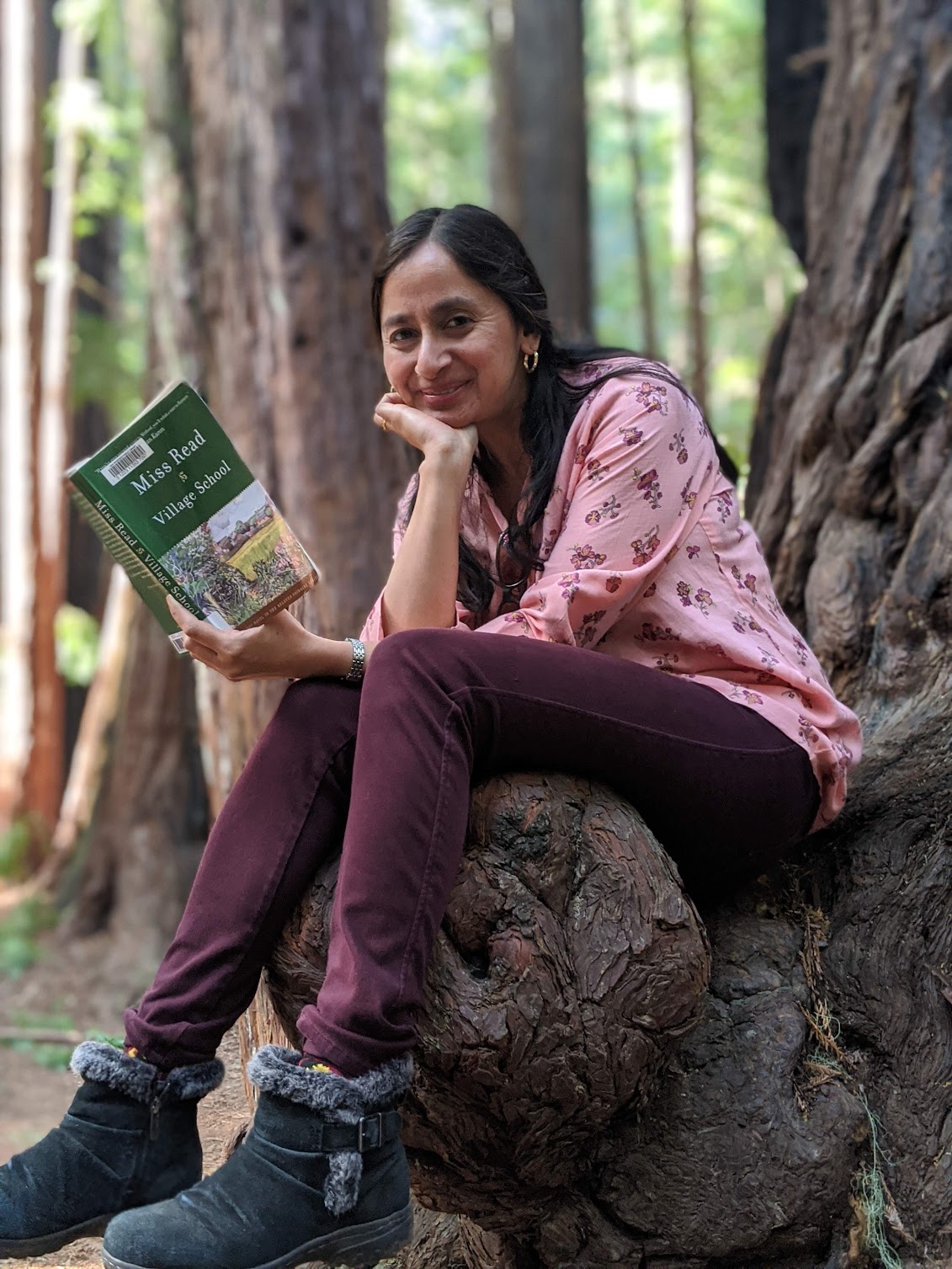
It is why 250 years later, we still relish a Jane Austen movie’s nth remake. It is why we still laugh at the absurdities of life as outlined by P G Wodehouse, Jerome K Jerome, Miss Read, R K Narayan, Gerald Durrell and stalwart authors who do the difficult job of finding light and keeping us hopeful through it all.

Breaking News is bleh. The lack of Breaking News is what we have to strive for.

“Be the reason someone smiles. Be the reason someone feels loved and believes in the goodness in people.”
― Roy T. Bennett, The Light in the Heart

So, my questions for you:

  • What is the source of reading that serves as the light in your life?
  • What is it that you look forward to rather than dread?

An Enchanted Adventure: A Journey Through Children’s Books

Mystique & Intrigue for an Adventurer & Explorer

“I am going to indulge myself in something that I haven’t had the chance to do in some time!” I said – throwing it over my shoulder casually in a manner intended to intrigue and mystify.

“Going to the library? Good job ma!” said the son, and I moaned. Mystique and I. My foot. 

I guarded the time I had between a drop-off and pick-up session like it was precious (because it was) and headed towards the library. I fended off requests for the grocery store, deftly ducked under an amazon return order request, and dodged an enticing offer to search for missing documents in the house. 

When finally I walked into the cool library that hot summer evening, I felt something like an adventurer. An explorer who found their way to treasured lands. It was beautiful.

The display stacks groaned with new children’s titles, the popular books section assured me that the authors displayed there had been continuing to do their good work of broadening children’s minds. 

I cannot adequately state how marvelous it all is. 

The hot evening outside meant I picked up books with illustrations with cooler themes in illustration. Sleepy dreamers, cozy woodland creatures, forests in fall, the gleam of windows in the night, the beautiful shapes of the stars in the night sky. The here-and-now of long summer days has us all yearning for these themes, I suppose. 

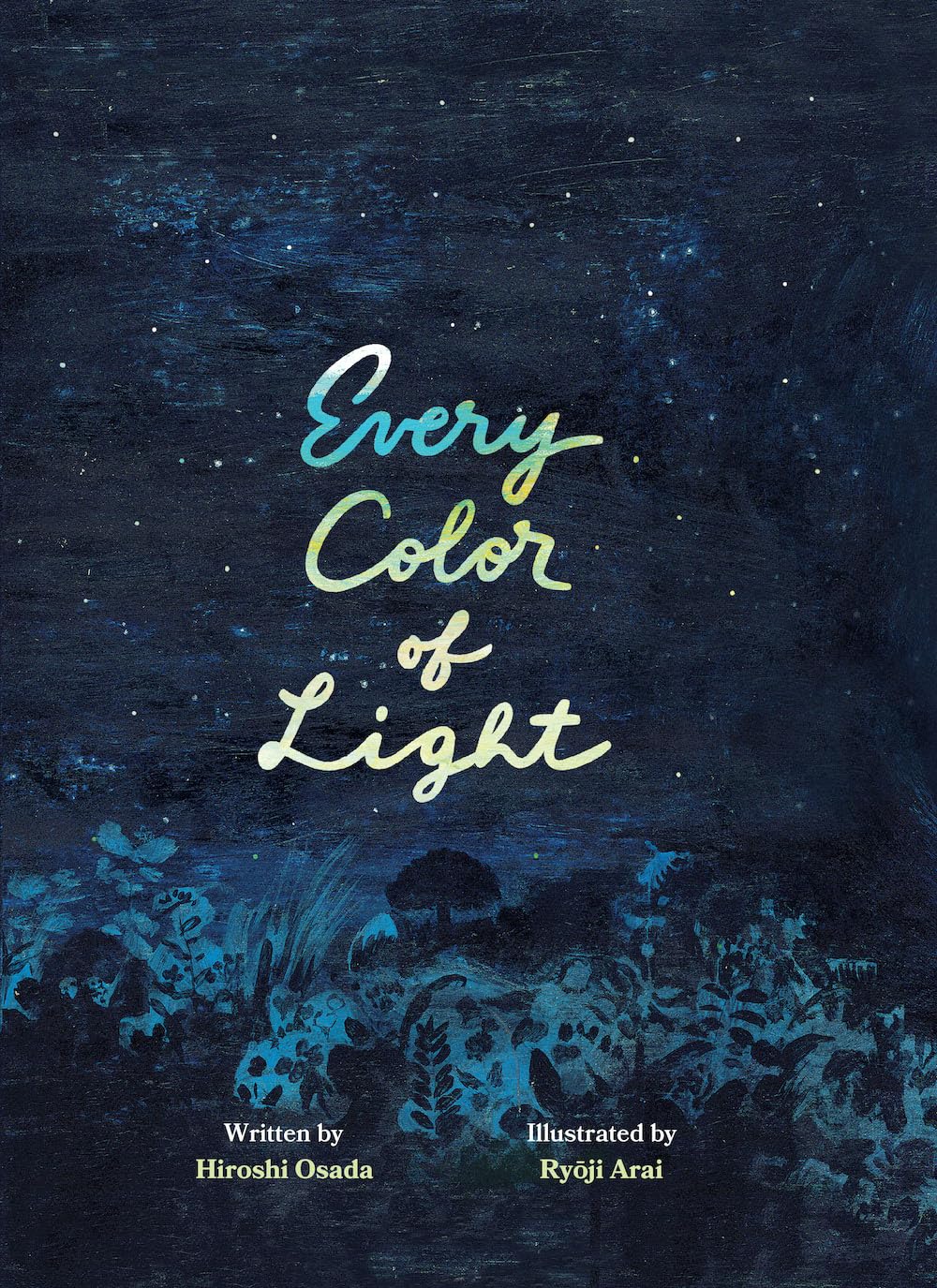
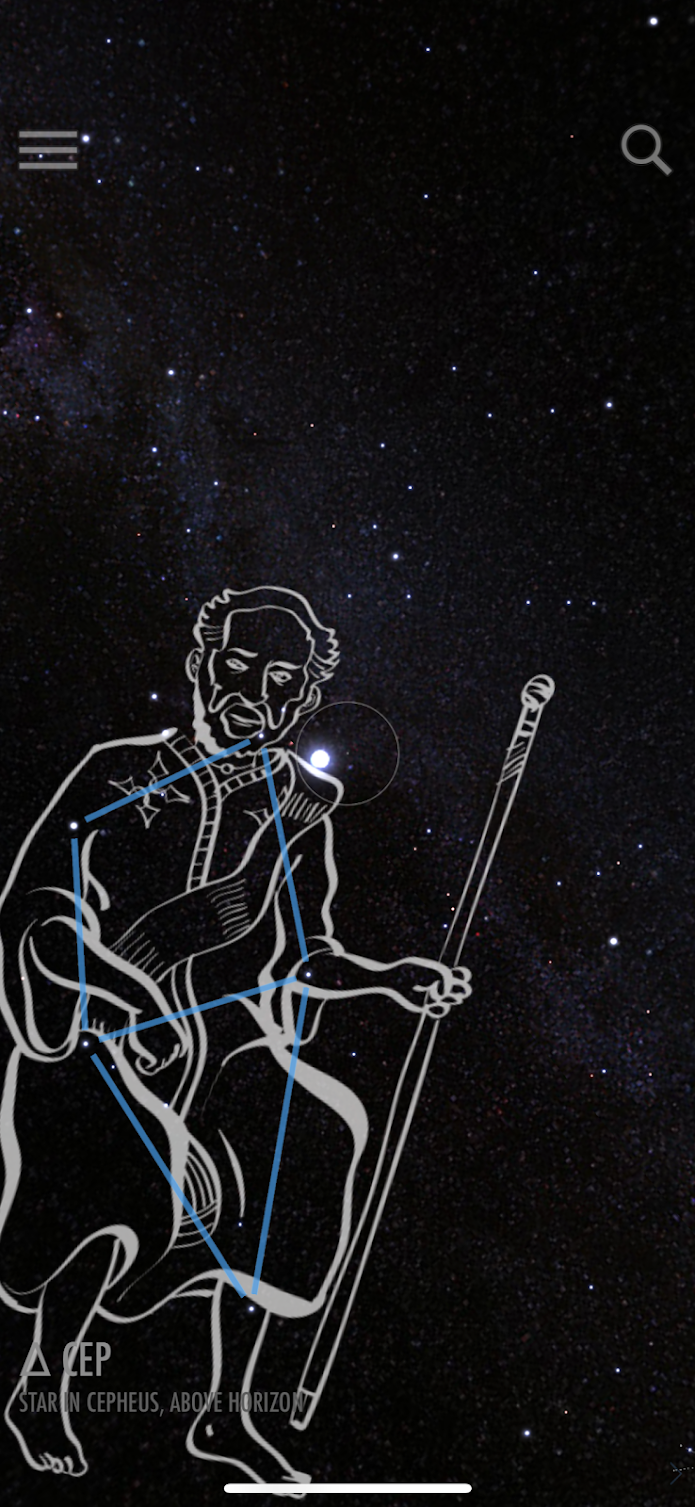
As I gazed down at an illustration in the book, Every Color of Light – by Hiroshi Osada, I closed my eyes for a moment thinking of the evening we went in search of the stars. Specifically, Delta-Cep in the Cepheus constellation

Version 1.0.0 – from Amazon page

Delta Cep in the Cepheus Constellation

The son was bemused at how enthusiastically we wanted to help in this particular homework assignment. He, of course, in the innocence of youth cannot understand our childish enthusiasm for learning new things, finding out about new things. “Did you know that if we scale our universe, if the solar system is a football field in California, the nearest star, Alpha Centauri, is in the East Coast of America?” 

“Really?”

See? Amused at the awe shining like Alpha Centauri on our faces. 

Anyway, he said it was difficult to find Delta Cep in the summer skies because of the light pollution in city areas. It isn’t the brightest star system.  The husband asked his talented photographer friends for the best places to go, and off we went. For half an hour, we forgot about all the travails that seemed to be whipping our daily worlds. Maybe Delta-Cep had a better time of it. A place where peace and harmony prevailed. A star-system in which the greatest turmoils were mild-summer-breezes that rippled through their atmospheres. 

That is the power of story-telling isn’t it? The ability to transport us to realms other, feelings exalted, and wholesome?

Farmhouse Menagerie

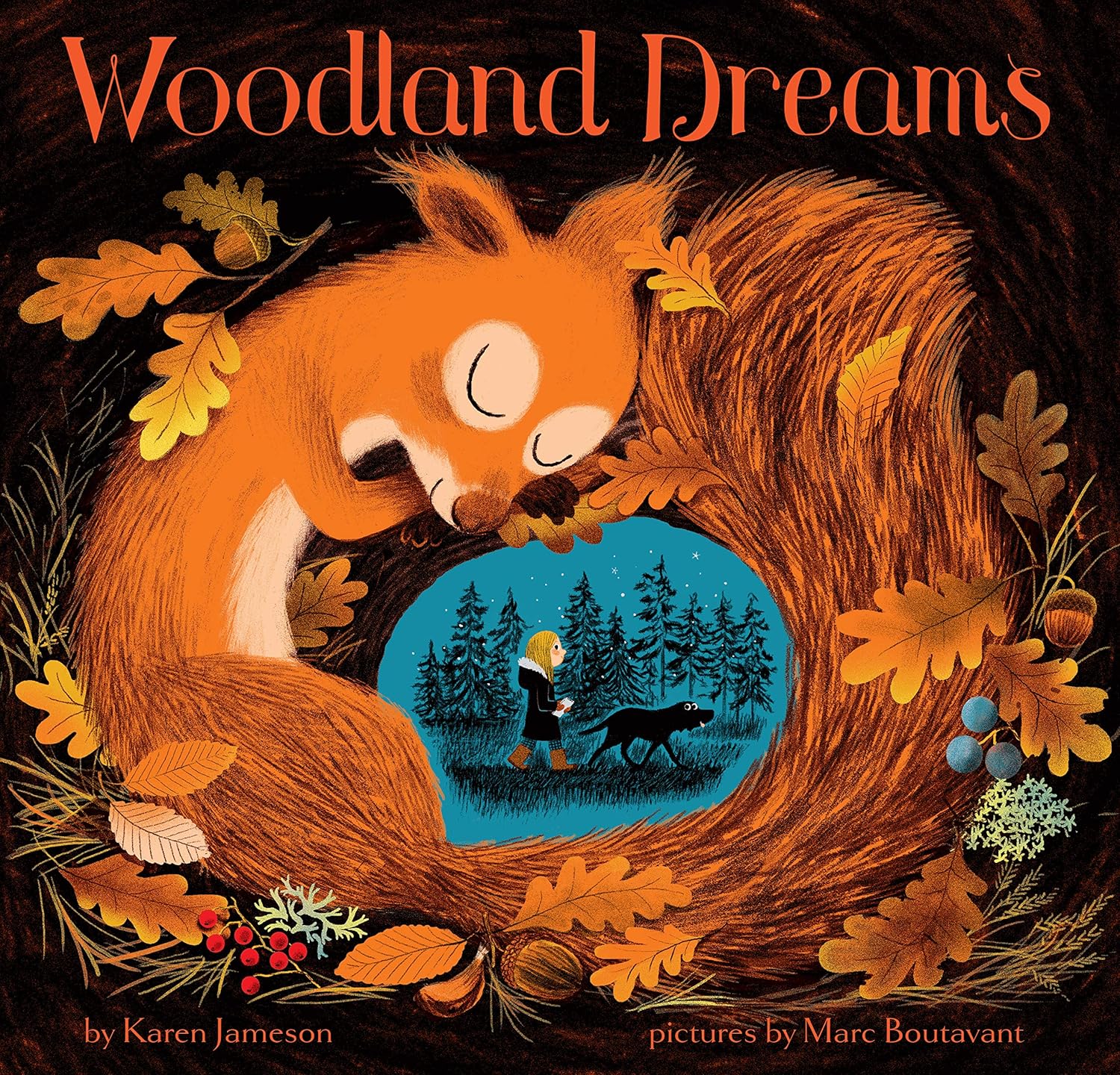
I picked up the book on cozy woodland creatures, Woodland Dreams – by Karen Jameson pictures by Marc Boutavant

What whimsical names would you give our fellow creatures? Karen’s names were fascinating: Fox (Swift Legs) , Fish (Shiny Scales), Deer (Tiny Hooves), Woodpecker (Strong Beak)

Come Home – Swift Legs

Furry Schemer 

Red-tailed Dreamer

  • Karen Jameson, Picture by Marc Boutavant

The lyrical poems she gives for each creature was enough to bring a smile.

It got me thinking: What would you name some of your fellow creatures? I have always loved listening to the names people give their pets. The daughter had quite the list, and I must say, some of them made me sit up and listen. The menagerie she had in mind for her horses, dogs and cats, reminded me of the little girl whose stories as a girl all involved moving to the countryside, and a horse in the stables revealing themselves to be a unicorn only to her. There is a sweetness to thinking like that. A simple yearning.

The feeling of a children’s book

And so it went, a little reverie of my own every time I picked up a book. It was the rare book that disappointed. Most children’s books had a sweet emotion it evoked – warmth, beauty, companionship, safety, love, growth. 

It only seemed right that I finished my stash for the evening with the book, Grow Grateful – – By Sage Foster-Lasser and  Jon Lasser, PhD. Illustrated by Christopher Lyles

“So, how was it?” said the son as I picked him up. 

“It was amazing! I wish you could’ve come!” He beamed. “Yes, next time. Tell me which ones did you like the best?”

I told him about all the ones I had read, and we chatted about them all the way home. He listened, an indulgent look on his face, and I felt a pang – he was growing and children’s books seemed childish to him just now as a newly minted teenager with a reputation to grow into.  I hope he’ll come back to them one day like C S Lewis said to his niece for whom he had written The Lion, The Witch and The Wardrobe

“Some day you will be old enough to start reading fairy tales again.” C S Lewis 

🌎 Happy Earth Day 🌎

🌎 Earth Day 🌎

Earth Day is coming up, and I feel the familiar flutter of gratitude for our planetary home.

It is the time Spring is in full bloom in the countryside around us. When Earth’s bounty surrounds us, it is hard to not feel like we really must be foolish to ravage Mother Earth the way we do with our greed and pointless consumption.

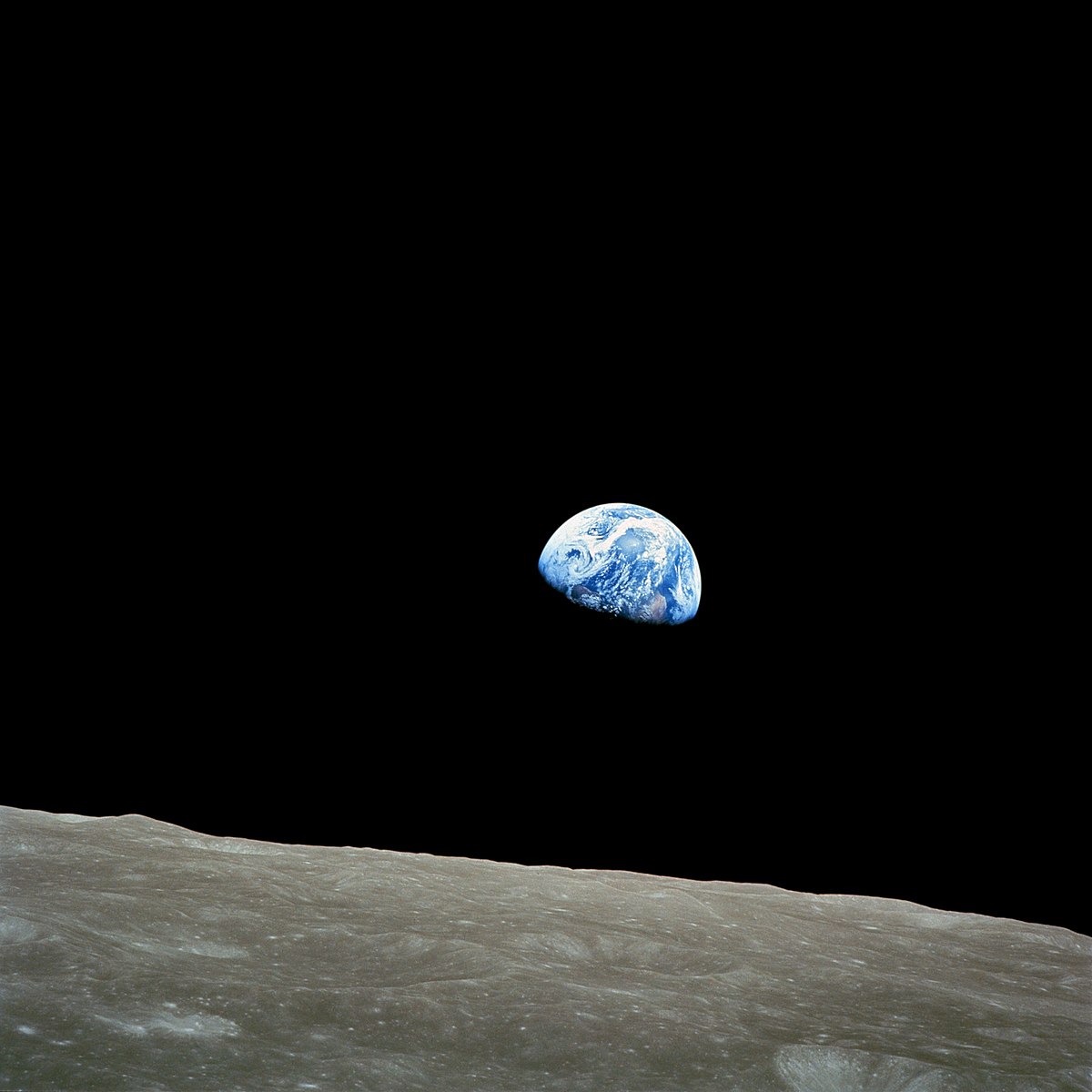
It is the time I moon about outside, reveling in the lengthening days of spring, and watching the stars peep outside. A couple of days ago when the full moon rose a- beautiful golden orb in the sky, I gasped, and thought of the image taken from there that led to the creation of Earth Day as a concept.

https://en.wikipedia.org/wiki/Earthrise
The picture was taken by an astronaut, Bill Anders, aboard the Apollo 8 spacecraft in 1968.

Books Celebrating Our Life on Earth

Children’s books are one of the best resources for celebrating our marvelous planet. Authors like Oliver Jeffers seem to know the knack of grounding us while making us soar high above the Earth to see our home.

These two, in recent times, have had me humming. 

If you come to Earth – by Sophie Blackall

The premise of the book is not unheard of. It is narrated by a boy named Quinn who introduces a visiting alien to Planet Earth. The pictures are a delight, and the book is charming in itself. The narrator show the esteemed visitor all the places

  • Where we live – towns, cottages, villages, towns, cities, high-rise buildings.
  • What we do – the range of occupations was truly fascinating to see. (I also had a little doubting-deborah contest trying to see which of these jobs would be around in a decade and in a century) 
  • How we read, speak, and communicate – languages, written alphabet, morse code, braille

And so many more aspects of life. 

The best part of the book to me was the note by the author at the very end. I always seem to relish notes by the author, and this one went on to delight.

Excerpt from the Author’s Note:

Continue reading “🌎 Happy Earth Day 🌎”

Inspirations for Writing

Talented Inspirations

I recently read The Firework Maker’s Daughter by Philip Pullman

I’ve always wondered about the series of books that are titled thus: Galileo’s Daughter, The Clockmaker’s Daughter. The appeal of the daughters of men with interesting careers is an interesting premise. For so many years, women were denied the opportunity to consider interesting careers.

Like Elinor Dashwood (of Sense & Sensibility fame) says of women and careers:

“You talk of feeling idle and useless. Imagine how that is compounded when one has no hope and no choice of any occupation whatsoever”.

  • Jane Austen, Sense & Sensibility

If ever I am grateful for anything, it is that women’s talents are now nurtured and recognized. After all, talent does not distinguish between the crude lines drawn out by humanity – it does not care about race, caste, creed, sex, religion.

Fascinated as I was by the book, The Firework Maker’s Daughter,  I loved the colorful cast of characters, and  what is required from them to succeed in their profession. It also got me interested in the writing style of Philip Pullman – his was witty, whimsical, and oh-so-light.

Pullman on Writing (Source: Wikipedia)

I have stolen ideas from every book I’ve ever read. My principle for researching a novel is ‘Read like a butterfly, write like a bee,’ and if this story contains any honey, it is because of the quality of the nectar I have found in the work of better writers.” 

  • Philip Pullman

A better imagery for writing I could not think of. If one thinks about it, life itself presents all the inspirations we want. Even when is in the midst of the Thanksgiving week-end, and may be busier with spending time with family, friends, trips etc, the inspirations are all around us. 

If you are looking for that November spark, look at sparkling fireworks of Diwali, the colorful trees of the fall foliage around us, the many friends and family one meets during November’s Diwali & Thanksgiving  seasons to gain your sense of well-being, gratitude and inspirations!

The Ease & Malaise of Literature

The Literature Malaise

There was a strange sense of malaise and I could not put my finger on it. It had nothing to do with the body – a blood test could’ve told you that. It had something to do with the literature I was reading.

I have felt like this many times in the past – especially when reading some writer who has the gift of ripping our hearts out, crushing it, and then putting the raw, bleeding thing in gingerly again. You gasp to regain control over the poor organ again, and soothe it back into action: “Never mind – that was just a book!” and the heart contracts, beats, pumps and does its thing again. How the writers themselves write it, I do not know.

Then, there are books that take one particular theme: shame, guilt, horror, anxiety, or grander themes like social injustice, and play on the heart-strings. J M Coetze’s Disgrace comes to mind.

That was how this particular book was. The narrative tone is never upbeat. It is  wrought with anxiety.  The reader is quite caught up in the frenzy of the social media world, its harsh realities of unraveling reputations, and the fate of the protagonist in YellowFace – by R F Kuang. ‘The mechanics behind the popularization’, as she puts it in her novel. The world of popularity has always been a high-stakes game (Or at least as far as I’ve read about. I wouldn’t know.) It is interesting to see the publicity stakes in the publishing industry . The book says something to the effect of : Best sellers are chosen long before they make it to the stores.

The illusion of an image built up through social media engagement can be a frightening monster indeed. For how do you find the imaginary?

I had decided to dedicate the week-end to catch up on some reading, and was I reading?!

After a few hours, I stepped outside. The world outside was basking in the summer sunshine. The bees were buzzing around my shaggy lavender patch. The patch needs trimming, but right then, the faint smell of lavender was soothing, and oddly endearing. It was a tug to reality, a reality in which not everything felt so grim as in the book. That was grounding – I took charge.

bee_in_roseroses

I made a cup of tea, and shook myself like a dog after a swim. Literally – I went for a swim and shook myself as I got out of the water. I had been drowning in the book all morning, and the cool swim in the hot sunshine worked wonders.

The Joy in Literature

I mused to the husband. “It is like Nobel Prize winning literature. You have to be serious-minded, have plenty of  suffering and drama. You cannot bung in humor and hope and write about light and all that and expect to find literary acclaim, can you? “

Why can’t people write like P G Wodehouse? I said forlorn. What was it that P G Wodehouse said on Writing?

https://claremontreviewofbooks.com/frivolous-empty-and-perfectly-delightful/

“I go in for what is known in the trade as ‘light writing’ and those who do that – humorists they are sometimes called – are looked down upon by the intelligentsia and sneered at.” – P G Wodehouse

So what is it about taking ourselves so seriously that appeals to humankind so much? I’d like a serious response please.

The book was critically acclaimed -a lot of serious books are, you’ll notice. It is like the world is looking to see – “Ahh – this particular kind of anxiety and loneliness, let’s see which writer can crush the essence of that most succinctly.”

So, I did what I do best:  I bull-dozed through the book, sitting up till 4 in the morning, finishing the book, before soothing the heart to sleep. I refused to put myself through another day with that feeling.

Something Fresh – By P G Wodehouse

The next evening, I resolved to do the opposite. I picked up books where the overpowering mirth or joy of the writer exudes from the pages and envelopes the reader in a warm, cocoon. A trip to Blandings Castle seemed nice

“This is peculiarly an age in which each of us may, if he does but search diligently, find the literature suited to his mental powers.”

P.G. Wodehouse, Something Fresh

 I laughed, and I grinned at the turn of phrase. I anticipated the next laugh – because I had read the book several times of course, and I still hung on. Laughing – matching the glorious summer outside. Later that night, the son & I thumbed through an illustrated copy of a favorite book as the silvery light of the full-moon filtered in through the night. 

All was well. Knowing all will be well in a book is a wonderful feeling. It is why I turn to authors like Miss Read, P G Wodehouse, R K Narayan, Alexander McCall Smith, Jacqueline Winspear etc like plants turn towards the sunlight.

Recommendations Please

Please recommend some authors you turn to for light, joy, hope, optimism and magic.

The Crafting of Characters

Development of our Characters

Book: Normal Rules Don’t Apply – By Kate Atkinson

I was reading a book (predictably), the son and husband fiddling about with their laptops. The short stories in the book,  Normal Rules Don’t Apply – By Kate Atkinson, were good. Really – we need more short stories than large novels of our lives, and this particular story was proving it so.

kate_atkinson

Quote:

“Good looks didn’t count for much with Franklin, he was the handsome child of handsome parents and had witnessed at firsthand the havoc that could be wrought by the pursuit of beauty without truth.”

A simple sentence – borne out generation after generation, and still as relevant in its truth.

In fact as I am writing this post, I thought of the variation of the quote in Jane Austen’s Emma:

“Vanity working on a weak head produces every sort of mischief.”

Jane Austen, Emma

Many of us remember the struggle (or continue to struggle depending on age, sex, race, nationality etc) of perception against self-esteem – I suppose it is hard to escape that. Society has improved by spades, but yet I do still see the expectations of eternal youth and raving beauty all around us. It is there in the filters that apps like instagram offer, it is there in the AI generated models’ and their definitions of beauty. It is there in the cosmetics, the advertisements, and even if most folks aren’t consumed by it, they are at the very least affected by it.  

Character Building

The building of character, the shaping and becoming of our authentic selves, however is a harder journey, and therefore, that much more satisfying, was it not? Luckily that is where the short story was heading towards. I read on, and stopped to read this piece twice. 

“Franklin spent his life under the impression that one day he would be tested, that a challenge would appear out of the blue- a war, a quest, a disaster-and that he would rise to this challenge, and not be found wanting. It would be the making of him, he would come into his own. But what if this never happened, what if nothing was asked of him? Would he have to ask it of himself? And how do you do that?” 

I remember writing a short story as a child. It was of a young girl, influenced by adventure books of Enid Blyton, looking for an adventure to prove their worth – their bravery, loyalty, their ‘goodness’ in the world. It was, in hindsight, partially autobiographical. For adventures seemed to come to these protagonists in stories, but seldom on such grand scales to ordinary beings such as us. I asked the middle schooler in our midst about the adventures they had, and he sighed somewhat wistfully, and said, ‘Ugh! Most days, The biggest stuff is whether to run via the library to PE, or return the book after PE, but risk getting to the next class late, amma! There aren’t any adventures! That’s Harry Potter stuff, not for us!”

We laughed and I told him about the story of the girl I wrote as a girl. But I continued musing that night. 

Everyday Choices & Grand Tests

Was a Grand Test better than the somewhat lackluster set of everyday choices and conundrums that shaped our characters?  

🪅Do you let your friend copy your homework? 

🎋Do you give in to the temptation of an extra toffee knowing your sibling will lose their share? 

🎏Do you sheepishly confess to being the person responsible for not finishing that group project on time?

Would we welcome the dramatic or realize that solid, everyday security was more difficult to achieve?

‘Dramatic things always have a bitterness for someone.” – L M Montgomery, Rilla of Ingleside, Anne of Green Gables series

Whether by dramatic events or small everyday events, we are constantly becoming – as long as we look into the mirror and like the character reflected to us, does it matter?

What do you think? Do you feel our small everyday choices help us take on the dramatic when they do happen, or do we find something within us that we didn’t know existed when the dramatic happens?

🐲When Women Were Dragons 🐉

Intriguing beginnings:

There are powerful beginnings and there are intriguing beginnings to stories. It has been a while since I saw a beginning as brilliant as the one in the book, When Women Were Dragons – By Kelly Barnhill

women_dragons

Dragoning

Dragoning is the term that seemed to be used when some women turned permanently into dragons and left their human life aside – taking off to wherever dragons live. For those left behind, the phenomenon is bizarre, frightening, traumatic, and quite often fatal. 

This is how the book starts:

“Greetings, Mother- I do not have much time. This change (this wondrous, wondrous change) is at the very moment upon me.

I married a man who was petulant, volatile, weak-willed, and morally vile. 

But there were no babies, were there? My husband’s beatings saw to that. Tooth and claw. The downtrodden becomes the bearer of a heavenly, righteous flame.

I shall not miss you Mother. Perhaps I won’t even remember you. Does a flower remember its life as a seed? Does a phoenix recall itself as it burns anew? You will not see me again. I shall be but a shadow streaking across the sky-fleeting, speeding, and utterly gone.

– From a letter written by Marya Tilman, a housewife from Lincoln Nebraska, and the earliest scientifically confirmed case of spontaneous dragoning within the United States prior to the Mass Dragoning of 1955-also known as the Day of Missing Mothers”

I am midway through the book, and the story soars with the dragons – fiery tempests in teacups and how the placid bore it within themselves.

The book’s narrative voice is brilliant. Seamlessly moving between dragoning as a phenomenon and when it was first observed, slowly moving onto research of dragoning and its funding removed, to the whole topic becoming a taboo.

Society isn’t really mysterious once you understand the original intent. Cruel maybe, but not as mysterious. For instance, in this world, drawing or mentioning dragons could get children in serious trouble. Those who had lost a mother or a sister or a friend to dragoning don’t ever want to hear anything to do with it. They ignore it so it may never happen again. The news forgets to mention it, and society plows on.

For those looking for dystopian fiction or just a jolt from our current state, When Women Became Dragons, is worth a read.