Fascinating Hidden Worlds

The son sat next to me one evening as I was typing out this article and looking up the picture of the Corona Virus.

3D_medical_animation_coronavirus_structure

Image By https://www.scientificanimations.comhttps://www.scientificanimations.com/wiki-images/, CC BY-SA 4.0, https://commons.wikimedia.org/w/index.php?curid=86436446

We both sat looking at the image that showed up and he said, “Wow! Is this really the virus? It looks so lovely, doesn’t it?” I had to agree.

The unimaginable beauty of the microscopic world is so rarely stopped and admired. Who knew a blade of grass could be this spell-binding?

img_7653

This particular virus has caused such unimaginable disruption world over, it is humbling to see the world buckle on its knees against the onslaught of this virus. While, viruses and bacteria often come to the spotlight in scenarios such as these, the truth is that we need a multitude of them to survive on a daily basis. There are studies linking gut bacteria  to mental well-being for instance.

Theodor Rosebury, a microbiologist, wrote in 1928, during his research that:

“The knowledge that micro organisms can be helpful to man has never had much popular appeal, for men as a rule are more preoccupied with the danger that threatens their life than in the biological forces on which they depend. The history of warfare always proves more glamorous than accounts of co-operation.”

The Corona Virus has brought the rich world of microbes to the forefront for the world. To give us an appreciation of how many microbes we regularly thrive on for our living, consider these figures: There are an estimated 100 Trillion microbes in our bodies. The estimated number of stars in our galaxy is around 100 billion.

Many children growing up in these times may well be awed by the power microbes, bacteria and viruses exert on us, and go on to study Microbiology and change our understanding of the worlds within us in unimaginable ways.

The microscopic world is a marvelous one. Revealed to us 350 years ago by the talented man often hailed as the Father of Microbiology, Antony von LLeuwenhoek, his letter about animalcules was published by the Royal Society in London. As Ed Yong says in his book, I Contain Multitudes, his letters were published by the Royal Society in “an extraordinary monument to the open-minded skepticism of science“. LLeuwenhoek had no background as a scientist, yet he applied the scientific method to sampling and studying the world around him. In 1680, the draper cum businessman, whose curious mind and hobby led to the revelation of Microbiology was elected a Fellow of the Royal Society.

I Contain Multitudes – Ed Yong – Article from Brain Pickings

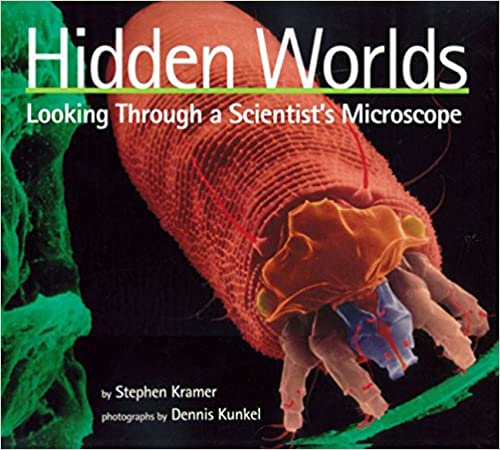
For those of you wanting a quick, fascinating glimpse into a Universe within our Universe, please check out the book, Hidden Worlds by Stephen Kramer with photographs by Dennis Kunkel.

hidden_worlds
Hidden Worlds

While Lleuwekhoeks early microscopes could only magnify upto 260 times, the images revealed in the book, Hidden Worlds magnify images by upto 1000,000 times. The resulting images are breath-taking.

The images revealed are only black-and-white by the microscopes. Scientists then use computer modeling to color in the images and the stunning pictures are better than works of Art. For instance, the picture below shows some common allergens and pollens that cause so many to sneeze all Spring.

The book briefly explains about SEM and TEM microscopes, the work that scientists typically do to prepare their specimens.

  • Transmission Electron Microscopes: TEM can magnify images by 1000,000 times
  • Scanning Electron Microscopes : SEM can magnify images by 10 – 300,000 times

Looking through the pictures in the book, we realize how marvelous life is, and what a fragile ecosystem we have to thrive in.

Covid-19 has also made us realize the importance of our normal lives. The gratitude to be alive and healthy, to be able to do the work that interests and moves the world forward, to be able to revel in the beautiful companionship of our friends and family.

“As the years pass, I am coming more and more to understand that it is the common, everyday blessings of our common everyday lives for which we should be particularly grateful. They are the things that fill our lives with comfort and our hearts with gladness — just the pure air to breathe and the strength to breath it; just warmth and shelter and home folks; just plain food that gives us strength; the bright sunshine on a cold day; and a cool breeze when the day is warm.” 
― Laura Ingalls Wilder, Writings On Wisdom and Virtues

References:

Is It Only Tuesday?!

I don’t like to go on about First World problems when the world is grappling with the stifling effects of the Covid-19 lockdown, but as a chronicler of the Nourish-N-Cherish household, my job is a tough one. There is much to write – my list of unwritten posts grows by the day.

In the latest news, I had to shoo out protestors before my meeting started. The protestors were noisy, marched with placards and while their motion held merit, I could not allow protests of this nature to carry on into my meeting slot, plus they did not have the critical mass of individuals required to ban the protest altogether.

img_7534

The morning had started with the son asking “Is it only Tuesday?” and we laughed.

“Yes it is only Tuesday my child – only the second day since school closed! I hear you!” I said. The daughter was singing the Disney song “When will my life begin?!” and looking forlorn before her day started. Covid-19 has us all in Shelter-in-place mode, and that has thrown all of us in a loop.

While we are grateful for the ability to be able to work from home during these times, it also makes for an interesting dynamic in the home. Do we wear gloves and arm wrestle for the office space? The daughter has online classes and is therefore quite happy to be holed up in her own room.

In what is a low move, the Television in the house has decided to go into social distancing and is sheltering-in-place. When asked to glow and sing, and generally make merry, the television has decided to go mute and shut down with a satisfying click.

The daughter, when she heard of it, moaned and said
“What?! Oh my goodness! Do you really think we can spend all that time together without TV and not drive each other nuts?” I laughed and said that I was touched she thought that way of her kind family. She rolled her eyes. “You know what I mean!”

The son rallied as best as he could and said it would be lovely since he has never spent a summer with parents with all of us at home through the day. I was touched, and also glad to see the silver lining. He, too, did not take the TV blow stoically, however.

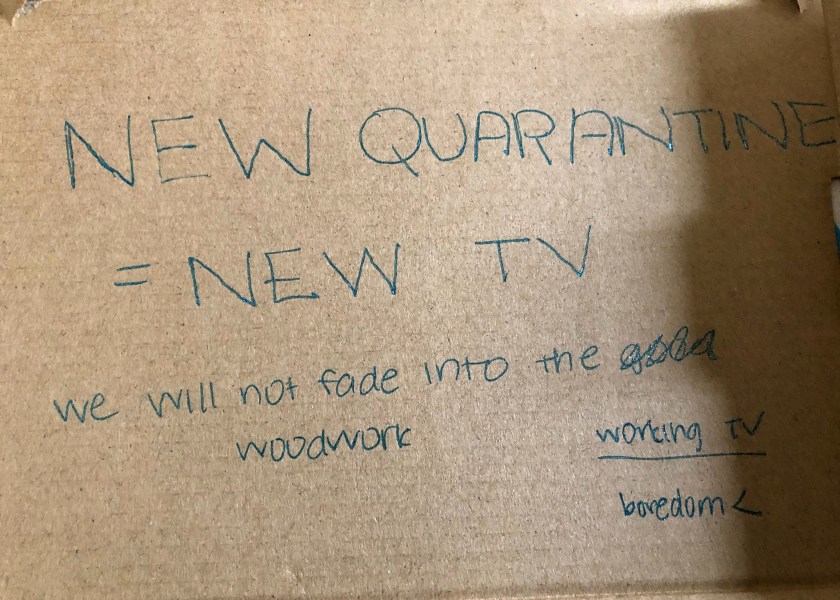
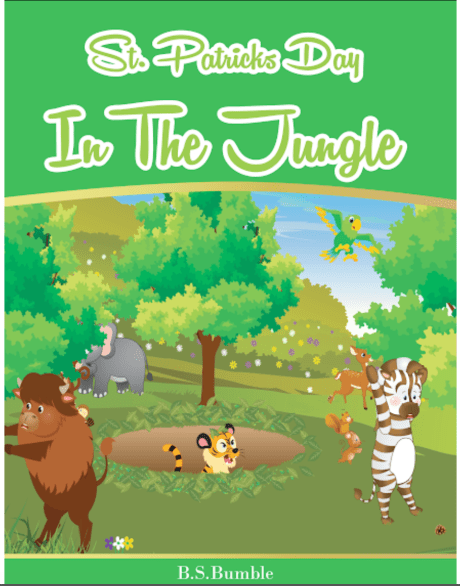
That is how I found the pair of them crouching and writing up protest slogans on a piece of cardboard, which in happier times would have been used for making traps for St Patricks Day. patricks_day_ij-v1

Screen Shot 2020-03-17 at 11.57.17 PM

They came marching noisily protesting for the TV and I found myself laughing.

I was reminded of the New York Times article that a friend shared with me a while ago, “Let Children Be Bored”. One thought in that article particularly spoke to my heart, As children, we rarely complained of boredom, because we knew where that would get us. It would get us the task of cleaning our room, or cleaning up our clothes cupboard, or worse yet, the haunted, “Why don’t you study?” refrain. It was vastly better to draw five hundred versions of a snowflake than to concede your boredom to an adult.

Thich Nhat Hanh said, We have more possibilities available in each moment than we realize.

Life is boring and the sooner we learn to keep ourselves occupied, the better for us. We learnt that lesson quickly did we not? So, why do we feel the obligation to whip out a form of entertainment for the children or feel the need to engage them in anyway? By doing so, are we not starving the creative self in some way? The eternal self , as Mary Oliver calls our creative self, needs solitude, it needs boredom to whip up an imaginary world, a novel game or a piece of Art.

Three days of no television, shelter-in-place mandates, no school, and continuing work will quickly have me begging for the Television, but for now, I have a list of chores ready.

“Come children – let’s start dinner! While you put away the dishwasher, why don’t you help me with the vegetables?” I said in my best head-chef voice humming loudly – “When will my life begin!?”

I heard the daughter say, “Is it only Tuesday?!”

Read also:


The Dream Weavers Web

It had been a few years since we had taken the magical pill. When the daughter was younger, she was enamored with Disney movies, was obsessed with unicorns and mermaids (the mermaids still hold sway), but the general euphoria with Disney has come down somewhat, or so we thought. It turns out, magic may be dormant, but thankfully not absent. When those Mickey ears came on, so did the smiles, the magic, the ridiculous mixed with the plausible, the tales with long tails, the myths and legends, everything came bubbling up in one hot cauldron full of fun and adventure.

I must say I was thrilled too. The day to day living tends to routinely pound magic out of us unless we make a concerted effort to keep it. The schools manage to do so for the children. There are Dr Seuss weeks, there are Read-a-thons, crazy hair days and crazed sock days to keep it all intact. But as the business of earning a living and adult hood takes on, there is a brush working in the background to make us more even keel, more predictable and less whimsical.

Reading children’s books keeps it for us in some ways.

I had expected to have a good time at Disneyland. I manage to put my whimsies on with a delight, and get the children going too. So far so good. But there are serendipitous surprises lurking even in the most magical of places. The Disney World in Florida was even better than I had expected. There was Animal Kingdom, in which I expected plastic hippos and lions made to scale. Consider my surprise then when we went on the Kilimanjaro safari to be taken into the hinterlands with animals in relatively free reign. It is marvelous to see a bloat of hippos, a tower of giraffes, a something of warthogs, and a blush of pelicans roaming freely. When a white horned rhino waddled across our path, we simply waited for it to move quietly. Even the children, though looking awed, did not utter a sound. There is majesty in nature.

One of the best surprises for me was the onus on conservation of our beautiful planet for the years to come. There were green houses showing us the marvels and possibilities of vertical farming. It was apparent to those of us floating in the boats by the lazy river taking us through these green houses, that many of us had never seen plants of many vegetables and fruits before. One excited child pointed to an eggplant plant, and squealed – “Look the eggplants are hanging from them!” I could see it was a beautiful revelation for the child who had simply assumed you picked it up in the grocery aisles of the supermarket, while making a passionate case for a Hot Wheels toy car at the billing counter.

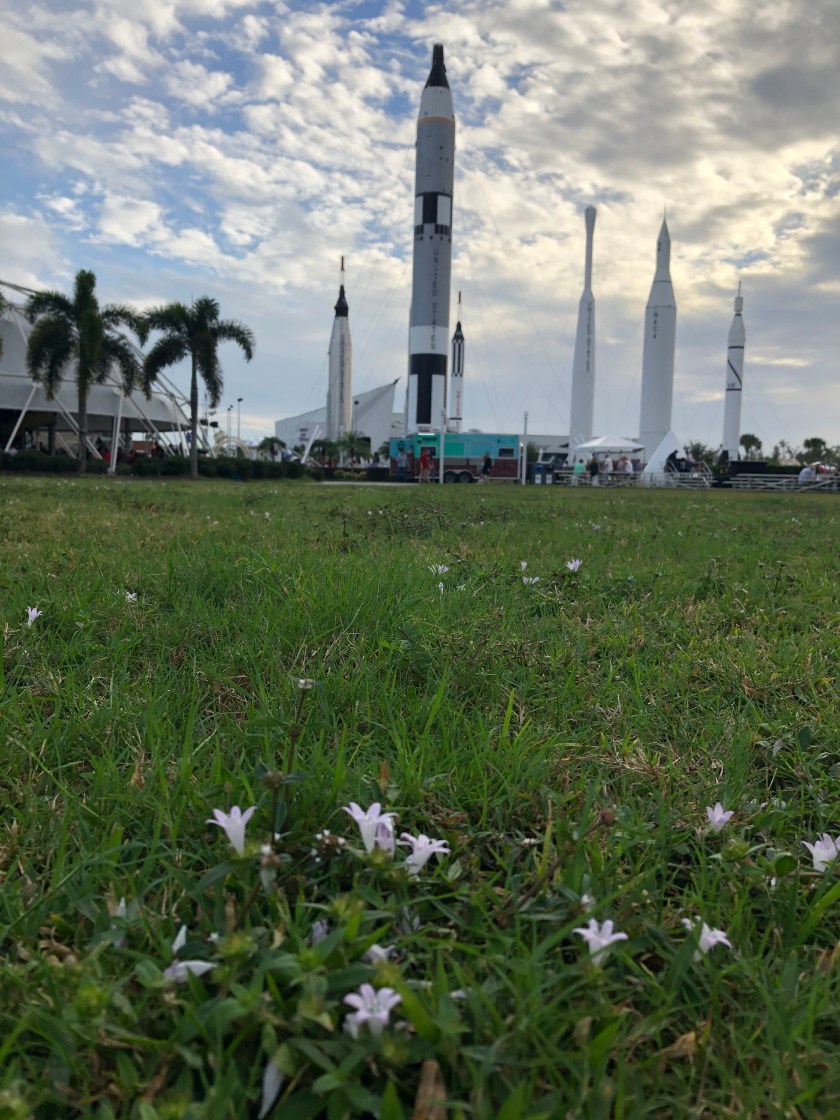
Saturated with the magic of life on this beautiful planet, we spent a day amidst the shots to space. Kennedy Space Center. The past merged with the magic of fairy-tales, the present beautifully thrumming with possibilities for conservation and conversation, and the future hits among the stars. Looking for possible planets for us to expand into.

It is marvelous to see we are on the cusp of a decade that holds so much promise. For among the young I saw in the parks, there will be quite a few starting their careers in the coming decade.

IMG-6125

The whole time, I was absorbing the atmosphere around me, little words were forming themselves into sentences. I was making my journey on the river of time and I was grateful for so many things. Some good sentences disappeared because I had not written them down, but I didn’t fret. It is often like this – playing with the words to relive my experiences.

Imagine how I felt then, when I read Ursula Le Guin’s essay on Writing. I felt the sage author’s words like balm, and nodded along. Writers are creators, but unlike potters and weavers, our products are less tangible. Our dreams are webs weaved in the magical recesses of the brain, and not all of it worth reading or sharing.

“Writing is a risky business. No guarantees. You have to take the chance. I’m happy to take it. I love taking it. So, my stuff gets misread, misunderstood, misinterpreted, – so what? If its the real stuff, it will survive almost any other abuse other than being ignored, disappeared, not read.”

When I read this piece in the essay though, I was grateful. I have written 800 posts over the past 14 years, and I would never have done that if not for the encouragement I have received from my dear friends and readers. It is magical. Encouragement like Love, is so fuzzy a thing to try to describe. For both the forces have the power to gently nurture, nudge, and poise for acceptance.

Thank you for all of that. Let the magical dreams weave on in the coming decade as well. Happy New Year and Happy New Decade – May the River of Time course on gently.

The Magic of Story-Telling

“Stop being a Jellyfish!” said the husband.
“I knew you were going to say that – you are such an open book yourself!” said I.

We both giggled like children at our own pathetic joke. T’was the time for hulking men with or without mustaches and serious women to quack like ducks, twirl like fairies, flex those non-existent abs, and find that little teeny bit of whimsy that adulthood so expertly hides away beneath the layers. Halloween was here.


1dc1cf17-3133-4989-93a7-08bcd65b2be5

T’is the time people astound you with their imagination. Who doesn’t like having 3 spidermen knocking on your door all at once? Or to see the twin toddlers dressed as Nemo & Dory? The super-heroes and ninjas cowering behind their larger siblings in Vampire clothing, or the witches cackling hard?

There is something so uniquely beautiful about Halloween – the one festival where we can display our idiosyncrasies with grace, be accepted for whatever we are. You want to be a skeleton? That should be fine. Here is some candy for you. Really, buddy? You want to go out in the world in that costume? Well, if this appeals to you, then I suppose you deserve some candy anyway!

How many times in our lives do we get that kind of universal approval?

The husband and I were very proud of our last minute Halloween costumes: an open book & a jellyfish.

The little fairy lights I had taped into place made the jellyfish glow, and I received many compliments – I must say I glowed all evening with the praise, though I did credit the Internet with it.

When people asked me where I got the inspiration from, I replied truthfully that I have always wondered what it must be like to live under the sea, and they invariably laughed at my answer.

But it’s true. Every trip to the aquarium rekindles the magic of another world – right here with us. Reading Gerald Durrell’s essay about scuba diving is enthralling.

I have often wondered how we would have adapted if we had evolved under the ocean. Would we have figured out the laws and physics of the Universe to the extent we have, or would the medium have made little difference in understanding. The Octopus’s evolution to have more neurons than us is truly astounding.

Quanta Magazine: What shape is the universe? Closed or Flat?

It is why I like reading about the intelligence of dolphins and whales: the fact that they have epics the sounds bits of which are roughly the equivalent of our Iliad is amazing. Quote from Carl Sagan’s essay on Whale song:

If the songs of the humpback whale are enunciated as a tonal language, the total information content, the number of bits of information in such songs, is some 10 to the power of 6 bits, about the same as the information content of the Iliad or the Odyssey.

What must their epics say? For all our anthropological worldview, I wonder whether humans figure in them at all. That will be a fine thing to hear – a Dr Dolittle who finally translates a Whale Epic, only to find their world far richer than our own.

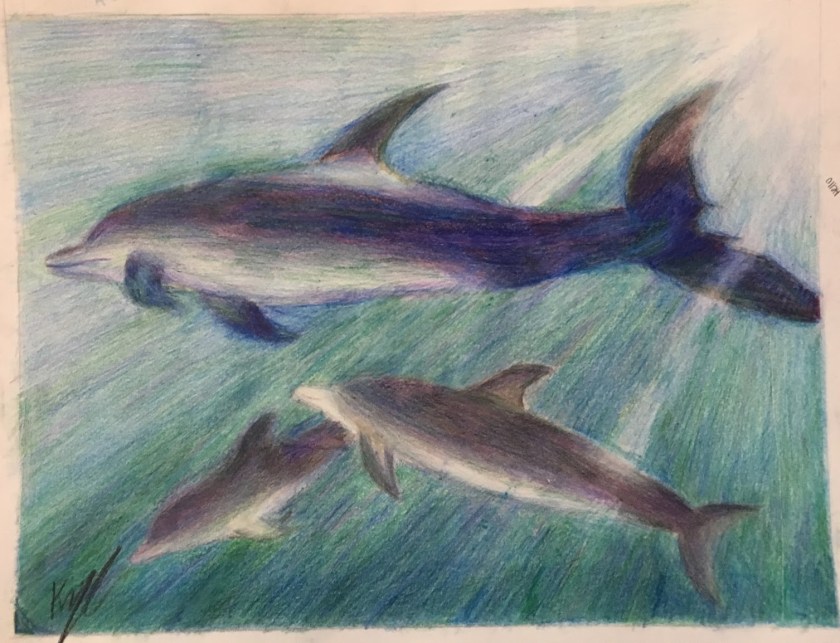
Keena_drawing
Art work by Daughter

I recently re-read the Voyages of Dr Dolittle by Hugh Lofting. I must say I thoroughly enjoyed visualizing myself sailing the seas with his motley group – either by skimming along like a porpoise, or better yet by getting a place inside the giant snail’s back as it sailed along smoothly churning the ocean as it went.

Swimming with Dolphins

We are all children of stories. We need epics and tales of fantasy. Our very own imaginations need an outlet, and Halloween gives us just that. I know my enthusiasm rubs off on the children as they go about planning their costumes. While I am out with a big smile on my face, a number of people give me an indulgent smile as if to say “Aren’t you a bit old for this?”

Mary Oliver gently reminds me to react with this nugget of wisdom:

“You must not ever stop being whimsical. And you must not, ever, give anyone else the responsibility for your life.” 

― Mary Oliver, Wild Geese

Privately, I am happy that our inner child never really leaves us.

Authors:

Running like Elephants

“Guys! Let’s hurry up a little. I like how we are dawdling, but the school bell waits for no ships to sail across the seas! ” I said. There had been a mild spattering of rain across the dry summer season. A few snails had popped out to enjoy the moist, and the son and his friends were looking at them as they chatted and made their way to school. Rain drops on the late summer roses and oleander flowers made the scene a rather endearing one.

img_3991-effects

The response from the children was predictable – they ran, and I ran shouting like a charioteer pulling the reins on the excited steeds, “Slow down! No running here – oncoming traffic!”
“But you asked us to hurry up!”
“Yes – run like Elephants!” I said.

I had told the children earlier about the Elephant’s gait, and they exchanged glances and started laughing. The snail they were studying looked startled and showed a leap of speed as it made its way back to the comfort of the garden bed.

Is this walking? *giggle*
Is this running? *giggle giggle*
Is this fast walking? * giggle giggle giputly duggle*
Is this slow running? *giggle puddle chuckle duffle*

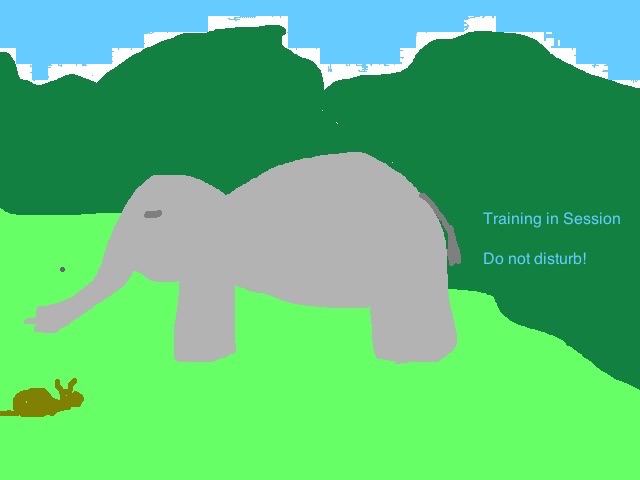
I smiled slowly. “Pretend you are Elephants teaching Snails to run.”

elephant_snail

I suppose that was a wrong metaphor altogether. By the time we arrived in the school, not only were we out of breath with the laughing, but we were also fashionably disconcerted. The legs seem to not remember how to walk straight or run properly, and were caught in this limbo of the Elephant’s Gait.

Later that week, I was sitting in the garden and watching the world go about its true business of living. I watched a hummingbird’s fast-paced wing movements up in the trees. A few butterflies were flitting hither and tither. A skein of geese were flying overhead in that beautiful v-shaped formation. Closer to the ground, a few snails were marking their slow way across the courtyard.

This combination of sitting in a garden, and watching life flit by had me take a hundred pictures with my phone. Pictures that may or may not be seen and appreciated again. I could capture the slow motion video of the humming bird whizzing up above or the butterflies in my midst. I could use time-lapse videos to capture the slow moving snails and a dozen pictures to capture the beautiful movement of the caterpillars.

As I sat there musing on the ease with which we capture movement these days, I could not help comparing and contrasting humanity’s struggle to capture that. I remember yawning in the Art galleries after seeing the n-th painting of a horse or the x-th statue of a horse drawn chariot.

But as I sat there that afternoon, I wondered whether I had appreciated them enough. After all, at the time of their making, studying movement was not all easy. One had to have an almost eidetic memory to understand the muscles and the way they moved.

Leonardo Da Vinci’s work is appreciated because of the lengths he went to study the anatomy of the creatures in his works. 300 years ago, movement must have been particularly hard to study.

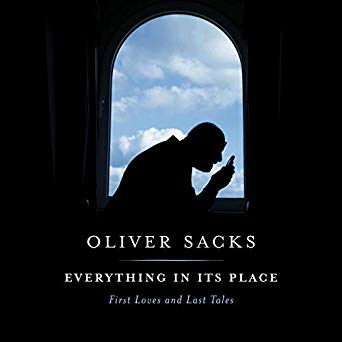
In Oliver Sacks’ essay on Elephant Gaits in the book, Everything in its Place, he writes about the problem of studying movement.

everything_place

More than a century ago, Etienne-Jules Marey had made a pioneering investigation of elephant gaits. Of course, he did not use video analysis then, but still photography. I quote: “Marey’s lifelong fascination with movement started with the internal movements and processes of the body. He had been a pioneer here, inventing pulse meters, blood pressure graphings and heart tracings – ingenious precursors to the mechanical instruments used in Medicine even today.

Later, he moved onto the animal movements and analysis.
For animal analysis he used pressure gauges, rubber tubes, and graphic recordings to measure the movements and positions of limbs. From these recordings, he rotated in a zoetrope, reconstructing in slow motion the movements of the horse.

Muybridge, a contemporary of Marey, however, a peripatetic artist as Sacks describes him used 24 cameras along a track where the shutter would be tripped by the horses themselves as they galloped past to capture the movements of the horse as they raced.

When a similar technique was used to analyze the fast movement of elephants, it was found that they neither walked nor ran, but rather a combination known as fast walking.

I remember a long ago conversation with a friend who was training for a marathon on the more recent study of leopards running, and how he had changed his running technique to take a few tips from the world’s fastest runner.

As we watch the world around us, I wish different creatures could teach us some of their marvelous techniques. The dragonfly and the humming bird for flight; mallards and coots for water locomotion. Doesn’t Biomimicry as a field of study sound more fascinating than ever before? I positively yearn to be Dr John Dolittle at times!

Books/Articles to be read/referenced in this post:

Leonardo Da Vinci’s Horse

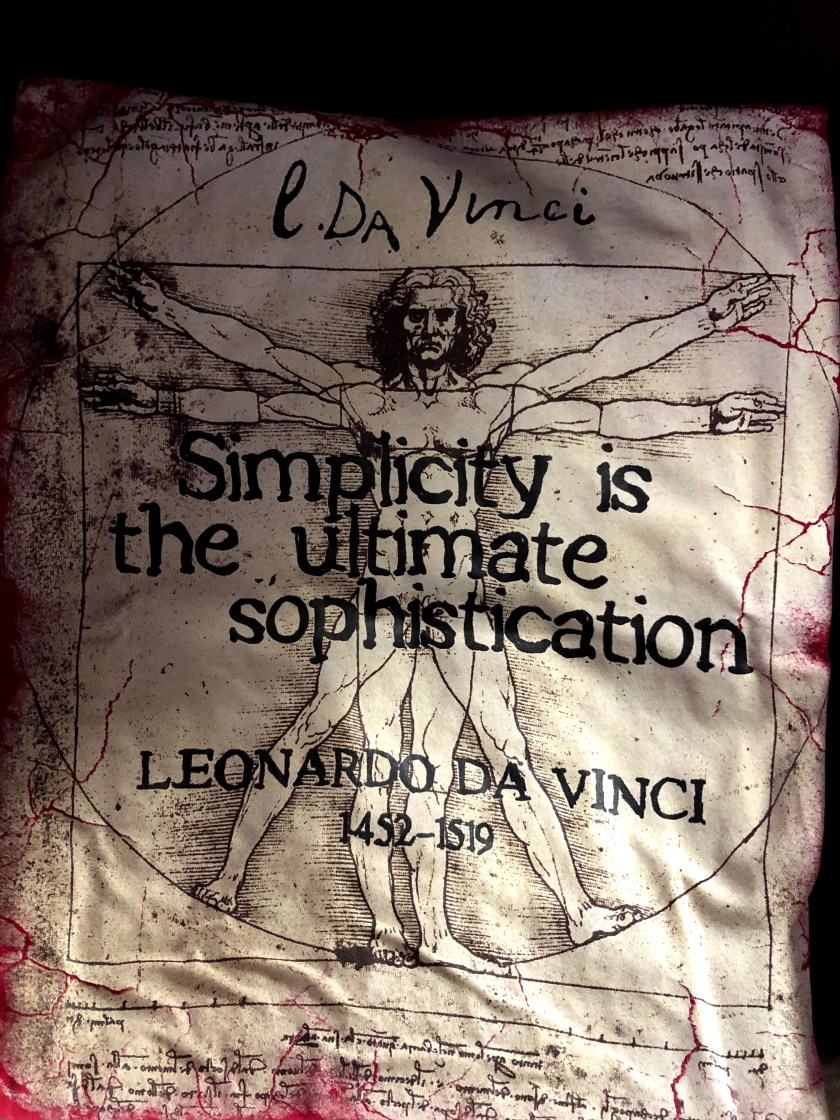
The husband was wearing a red t-shirt that had Leonardo Da Vinci’s drawing on it, that said, Simplicity is the ultimate Sophistication.

He was particularly fond of the t-shirt, especially as he was reading the biography of the great man.

img_4057

“Be like Leonardo Da Vinci guys. Be simple and eh… persistent.”, I said.

“Oh! I don’t know about that! Did you know about Leonardo Da Vinci’s horse? “, said the husband. He was reading the biography of Leonardo Da Vinci by Walter Isaacson, which is to say we almost read it. The book is a lengthy one, and as he made his way through it, he shared tidbits of things that fascinated him.

Time has probably been kind to the memory of Leonardo Da Vinci. Most of us only seem to be remember his genius in art, his legendary stature as a polymath, he said. The husband chuckled as he read and told us about Walter Isaacson’s portrayal of him – a tempestuous man who often did not complete the commissions given to him. Leonardo Da Vinci’s horse is an excellent example.

He then went on to relate the tale to much mirth and chuckling from the children. Apparently, what was commissioned to him was to build an epic statue of the Duke’s son riding a horse. He then went off to live on a farm, to study horses. The farm life yielded a treatise – an unpublished book, on different kinds of horses, equine surgeries to understand horse anatomy etc. He had originally planned to create a statue of a rearing horse.

This is an image that is much popular in the art forms at Italy, I remembered. The raw power of a horse rearing up on its hind legs is both attractive and magnetic. I am not sure how riders feel when they are about to be bucked off, but it makes for good Art. The prince would have to look brave while clinging onto dear life.

Study_for_the_Sforza_Monument
Abandoned Design. Image Courtesy: Public Domain, https://commons.wikimedia.org/w/index.php?curid=59580

Anyway, after a few years studying horses, their physiology, their movements etc, he started developing models for his statue. Clay, lead and bronze made its way from the armies to Da Vinci for his great statue. Then, he figured that the greatest statue of the magnitude he had in mind would not be supported by the hind legs structurally, and he went on to make it a standing horse. The prince riding the horse resplendently was forgotten!

These things took time, but it did not seem to perturb him. His sponsors may have been antsy, the bronze supplies may have been running low, the armies getting fidgety with not having enough new armor, but that was their problem, seemed to be his opinion.

In time, a large clay model of a beautiful horse may its way for the Duke’s inspection. The model won Da Vinci much critical acclaim. It truly was beautiful. If the Duke was slightly upset about not seeing his son on the horse, he did not show it. The royalty raise their children well.

Soon, war broke out, and no longer could his rich patron commission bronze and lead to be diverted to the most magnificent horse statue of all time. The clay model was put up in Milan, and was used as target practice by the young lads joining the army.

“But isn’t there a big horse in Milan or Florence? Da Vinci’s horse? I remember seeing a picture somewhere.” said I.

“Yes, but that was not done by him. Years later, somebody else finished it. “, said the husband.

By now, we were all laughing.

“What is remarkable is his insatiable curiosity and creativity however, and though he went off down rabbit holes, it was from a deep motivation to understand the world around him “, said the husband.

Read also : Gates Notes on Leonardo Da Vinci

“These days it is so easy to take a picture of a horse, model it, and run a simulation for structural evaluations. We sometimes forget how hard studying movement must have been!” I said, remembering the essay by Oliver Sacks on the Elephant’s Gait, in the book, Everything in its Place.

everything_place

He writes about how more than a century ago, Etienne-Jules Marey & Eadward Muybridge pioneered the study of animals running using 24 cameras along a track where the shutter would be tripped by the horses themselves as they galloped past to capture the movements of the horse as they raced.

Persistence comes in various forms, we all agreed. Muybridge and Marey were examples in a long list of people for whom a problem was intriguing enough to delve deeper and deeper into things that may or may not yield results.

But we never know the breakthroughs possible, and how things will change. That is why I am vary of futurists. A few centuries ago, to study the muscles straining for a horse running, one had to have an almost eidetic memory, along with a decent understanding of anatomy.

Today, photography has come so far as to allow us to snap a thousand pictures, take slow motion videos, and analyze everything from a butterfly flutter to the swift flying of hummingbirds. People are still extraordinarily creative with photography, and as long as we retain curiosity and creativity, I suppose we shall thrive.


For the Love of Libraries

“We are going to give you something special!” coo-ed the nieces as soon as I landed in India.
“What is it? I don’t really want anything, just time to spend with you lovely girls.” said I, ever the Aunt imparting Valuable Life Lessons.
They smiled it away without batting an eyelid. Life Lessons – pish tosh bigosh! If, as a child, you don’t know how to ignore that stuff, you’ve learnt nothing in life was the philosophical angle the children seemed to take and I appreciated them for it.
“Yes, yes we know. But you will really like what we have planned for you!” they said in unison. “It is an Experience!”

The children obviously knew where to get me, loop me with my own tune – Experiences are worth more than Possessions.

I grinned expecting a trip to the ice-cream store across the street. That was an experience for sure. There were flavors there that made me swoon. Could I have the coconut -lemon and the orange-watermelon and mango and jackfruit flavored ones?

Come evening, we all headed out. The nieces ,with touching sincerity, told me that they would forfeit their quota in my honor, given how much I would like where we are going. All highly puzzling so far.

When we finally made our way through the Gulmohar lined streets, the skies looking beautiful and benign over the towering apartment buildings, I stopped and watched the excitement build in their faces, as we turned the corner. Beaming at me in a small two-roomed store front tucked away near eateries and grocery stores, was a tiny library. I gave them a slow, wide smile. This was amazing. Off we went inside. I was grateful that the children had access to this small lending library.  (Yes – we stopped for ice-cream afterwards.)

bookworm_readingcorner.png

The lack of easy access to public libraries in India has always been a sore point with me. As long as we are in school and college, we have access to libraries in some form or another – the institutions themselves have them. Even if the Engineering college library lacked sorely in the Literature section, one could read IEEE journals to pass the time. I am immensely grateful to the librarians in my schooldays. During our school holidays, the librarian in my mother’s school, Mr Gandhi, would happily supply me with books enough to whet my appetite (Life’s blessings come in many forms – my mother’s school vacations did not coincide with ours, so their library was still open). Years later, when I came home with a broken leg to recuperate, Mr Gandhi, sent books that he thought I would like. That kind of care from anybody is touching. It is no wonder that one of my earliest career aspirations was to be a teacher and a librarian.

When first I moved to the big city, I felt unmoored without a library to frequent. I dedicated a Saturday morning every month for the trip across the city to the used books market, and pile up on books to read, making my way back with a teetering pile of books (I had no idea about the concept of copyright, how payments were made to authors etc). Most were in bad condition, not great authors or titles, but I took what I could. It was my only indulgence.

I read somewhere that people don’t really feel the need for Art if it was never a part of their life. But once exposed to the beauty and depth of any Art, if taken away, the void is there. An emptiness that you didn’t know existed. That resonated with me, for I feel the same way about libraries and access to good books.

I mourned the day the physical books stores went out of business in the United States. In every mall, every shopping street, I kept my eyes open for a place to dip into. There were none.

We bought clothing and fabrics simply because we were there and the clothes lured me through the shop windows.
We drank coffee because the coffee store was there.
We ate ice-cream b – well you get the gist.
But we didn’t read books with differing viewpoints and thoughts that could rejuvenate the brain because they weren’t there.

I chatted with the nieces once we were back here, and I asked them what they had checked out that week from their little sweet library. “Oh…they closed it now in the afternoons because they are using the space for English and Math tuitions.” they said, and I couldn’t help whimpering.

When we place so much importance on clothing that we change out everyday, shouldn’t we place more on thoughts that flit in and out even more constantly?

A quote from one of my favorite books, Fahrenheit 451, By Ray Bradbury:
There are worse crimes than burning books. One of them is not reading them.

I wish we all get to the chance to experience Ray’s Bradbury’s nugget of wisdom:

“You must write every single day of your life… You must lurk in libraries and climb the stacks like ladders to sniff books like perfumes and wear books like hats upon your crazy heads… may you be in love every day for the next 20,000 days. And out of that love, remake a world.”
Ray Bradbury

Also read :

Brain Pickings: Oliver Sacks on Libraries
Brain Pickings: How Libraries Save Lives

Duck, Duckling, Dolphin

I recently read a book titled Dolphin Parenting by Dr Kimi Shang. It was an antidote to the Tiger Parenting by Amy Chua book. Dolphins are intelligent, social and playful creatures, and therefore, we must model our behaviors after them is the gist of the book.

Keena_drawing
Art work by Daughter

Nature provides us with amazing parenting models every now and then.  Spring time is especially wonderful as this is the time for new life, a transformation of sorts. The butterflies are out and about, snail-lings venture forth, squirrels come out of their hibernation, eggs hatch and, in general all of life is abuzz with beauty and purpose. One day on a walk near our local lake park, I noticed Mrs Duck go to her nest, and Mr Duck gave her a nod as if to say, “Go on dear, I’ll ensure no one disturbs you.” Mr Duck then went on to aggressively protective their little nesting area by quacking loudly and doing sentry duty.

img_2341

Just in time for Earth Day, the ducklings have hatched, and they look beautiful. There is something in the innocent, puzzled looks on their little fuzzy bodies that tugs your heart. Of course, it is amazing to see Mr & Mrs Duck take care of them. I can watch them for hours. How they slowly introduce their young to the big, bad world; how they watch their little ones play for hours; and how they only intervene when important,  is a lesson in parenting for us.

They take them gingerly out into the shallow waters first, then as their little bodies grow stronger, take them for longer fishing trips. They teach them how to cross the road – the ducklings are protectively looked after by Papa & Mama Ducks. The parents in front and the rear, the line is a marvel. The noisy bunch then head on towards wherever they are going. I don’t know how disciplined the ducklings are when they grow up, but when babies, it is an adorable sight to see them toeing the line obediently and happily. 

It is that time of year to read Robert McCloskey’s adorable book, Make Way For Ducklings.

make_way_ducklings

The books starts off with Mr & Mrs Duck looking for a place to live and raise their babies. They fly great distances before they arrive at a little island that looks just right.

There, the ducklings hatch and the conscientious parents are busy in providing for the young, teaching them to survive in a tough world, and learn to be independent. 

ducklings_3

Once they are strong enough to swim longer distances, it is time to move to a bigger island, that involves a few perilous road crossings. Who should come to their rescue but the local policemen?

ducklings_4

A heart-warming tale that I can read any time for a quick dose of sunshine. Illustrated in a simple brown ink, it is a wonderful book for Parent Ducks and Ducklings alike.

I remember being amused and amazed when I first came to the United States on seeing Duck-Xing signs. Coming from India, where traffic flows on, and people cross on and share the road with dogs, cows and goats (nobody particularly stopping or giving precedence to another); it was wonderful to see that the traffic did not only stop for pedestrians crossings, but for ducks as well.

What is your Friend?

The din from the kitchen area was appalling. One of our favorite aunts was a-visiting and the nieces had gathered around for a day of fun, and laughter which she invariably ensured was there around her. 

“What is your day like Athai (Aunt) ? How do you pass time?” we asked.

This is one of the questions that I pose to those of the older generation often. I know boredom and loneliness can be a big problem for some people. However, there are a few in the older generation who somehow manage to retain their vibrant joie-de-vivre as they age, so that they are not just occupied but keep themselves happily occupied and stimulated. 

“I am occupied enough, “ she began. After she told us in loving detail of time spent with her family, particularly grandsons, she said with a smile. “I practice what I want to teach later in the day to my students, and I find the time flies past. Music is really a friend.“

It was true. I remember visiting this Aunt a few months ago, and heard her humming and practicing a particularly tricky song that she wanted to teach her student later that day. She was trying it as she cooked & cleaned and it made for a comforting background while we went about our day. 

Many I know find it heavy-going after retiring from their busy lives. Some find solace in the demands of religion, others find themselves watching a lot of television. A few, though, find ways in which to keep themselves intellectually stimulated and happy.  These people seem to me the kind of people who are not only in touch with their Eternal Selves, but also nourished and sustained it. They are the ones who quite unwittingly spread joy and happiness around them by virtue of being happy with their own state of being.

Mary Oliver’s, Upstream, is a book of many marvelous essays.  The essay, Of Power and Time, talks about the three selves in many of us:

  • The Child Self
  • The Social Self &
  • The Eternal Self.

Though in the essay, Mary Oliver, refers to the Eternal Self as the artistic self, I like to interpret it as the Creative self. 

  • The Child Self is in us always, it never really leaves us. 
  • The second self is the social self. This is the do-er, the list maker, the planner, the executer. 
  • Then, there is the third self: the creative self, the dreamer, the wanderer. 

upstream

Talking to people around me, I hear many who say that they would do this or that after retirement: I would take up gardening after retiring, I will take up reading after retiring. I am guilty of postponing  some of my desires to a golden time in my mind that is post-retirement ( I will learn to play an instrument after I retire).

But how would you know whether you like one activity over the other? The problem is finding that ‘something’ becomes more elusive the longer you deny it. 

Finding something that makes us want to do something without rewards is at once the least monetarily tangible and the most gratifying thing in the world. Not all of us can lead the life of an artist, but we each can devote small amounts of time consistently to find an artistic pursuit that sustains us. It may be in the creative process in things as varied as tinkering with wood, or analyzing the ebb and flow of economic market conditions. 

The essay ended on this note:

“The most regretful people on Earth are those who felt their own creative power restive and uprising, and gave to it neither time nor power.” – Mary Oliver

The Aunt who said “Music is a friend!” gave to her creative spirit time and power.

What is your friend?

Note: A version of the essay by Mary Oliver is found here: 

Mary Oliver: The Artist’s Task 

Brain Pickings – The Third Self

An Extraordinarily Ordinary Life

I read and re-read and read out this paragraph in the book, Brief Answers to the Big Questions by Stephen Hawking.

“I have led an extraordinary life on this life on this planet, while at the same time traveling across the universe by using my mind and the laws of physics. I have been to the furthest reaches of our galaxy, travelled back into a black hole and gone back to the beginning of time. On Earth, I have experienced highs and lows, turbulence and peace, success and suffering. I have been rich and poor, I have been able-bodied and disabled. I have been praised and criticized, but never ignored. I have been enormously privileged, through my work, in being able to contribute to our understanding of the universe. But it would be an empty universe indeed if it were not one the people I love, and who love me. Without them, the wonder of it all would be lost on me.”

This is one of the passages in the book by Stephen Hawking, Brief Answers to the Big Questions. The title is no empty boast, he really does take a stab at the big questions with the simplest language. The book’s forewords, and epilogue themselves make fascinating reading: A foreword by Eddie Redmayne who played Stephen Hawking in the movie based on his life, and Kip Thorne who worked with him at Caltech and one of the foremost players in the detection of gravitational waves (LIGO)

Related: Philosophers & Tinkerers

brief_answers

Some questions:

  • Is there a God?
  • Is there other intelligent life in the Universe?
  • Will we survive on Earth?

He touches upon climate change (Related: A Planet of Wizards & Prophets), and whether we have any option but to colonize space. It is written in layman’s terms, which suited me quite well.

Regular readers know how much I enjoy looking up at the night skies. It is the time I come closest to stoicism. I shiver and wonder what is out there among the great distances. I happily contemplate on the vast empty distances between the stars. I ponder on time and how we are seeing things that are no longer exactly like that. How a serendipitous sequence of events enabled us to be there to contemplate this beautiful universe.

milky_way_shree
Picture taken by a Friend – an amazing photographer

I marvel at our insignificance, I genuinely enjoy riding the thought sails through the night skies, and I look out the magic of it every chance I get. It is one of those times when I am in love with Being.

star_trails
Star Trails of the Milky Way Galaxy – Pic taken by my friend who is an amazing photographer among other things.

One of my friends on a nightly stroll with me once teased me that I will become a star when I pass on, and I laughed heartily. Her tone reminded me of how spoiled I am by my friends who indulgently put up with me as I moon about flowers, hills and stars.

It is extraordinary indeed that I should have read Brief Answers to the Big Questions so closely after I read this particularly fetching poem by Walt Whitman.

When I Heard the Learn’d Astronomer – By Walt Whitman
When I heard the learn’d astronomer,
When the proofs, the figures, were ranged in columns before me,
When I was shown the charts and diagrams, to add, divide, and measure them,
When I sitting heard the astronomer where he lectured with much applause in the lecture-room,
How soon unaccountable I became tired and sick,
Till rising and gliding out I wander’d off by myself,
In the mystical moist night-air, and from time to time,
Look’d up in perfect silence at the stars.

It is even rarer that I find the perfect illustration to go along with it. But Rob Gonsalves in the book, Imagine A World is the perfect one (Related: A Touch of the Eternal):

journey_to_stars

To me, the ability to enjoy these simple pleasures in an ordinary life constitutes an extraordinary one.