Sonder and Saudade: Reflections on Travel and Books

Sonder

Traveling anywhere in the holiday season brings this fact to the fore. Airports, railway stations, bus stops, freeways – every place is packed with people, more people and more and more people. It was faintly unnerving at times to see this many people out in the world, all seemingly busy doing their many things. How many of them thought deeply, what did they do to occupy themselves, earn a living, attend to their loved ones? How many of them were loving and giving, and how many selfish and cruel?

That feeling of realizing the sentience of our fellow beings can be especially acute when traveling in crowded places. There is a beautiful word for it: sonder.

But wherever you were: one thing was apparent. Business was thriving. Clothing stores, eateries, perfumeries, jewelry stores – they dotted every city, country and airport. One time, I remember gazing out the window as we rode from one end to the diagonally opposite end of the city, and seeing shops after shops after shops. There was an apparent unending need for clothing and electronics, for consumption. One cannot help wondering about the ecological impact of all this, but there you are. ‘Better’ means the old has to go somewhere, and make place for the new. Maybe the next wave of innovations will be in making biodegradable plastics, electronics and clothing. After all, the waste that we are generating now can hardly be a scalable problem.

Lack of book stores in all the airports, cities

Even as I gazed out through the window taking in the local sights though, one thing sent a pang through me: the lack of bookstores anywhere was truly tragic. I felt their absence keenly. I had asked my siblings to fit in a visit to the bookstore. The only one in the vicinity was a little like a wild goose chase. The shop had moved they said, you cannot see the billboard from road they said. When finally, we found it, the reason was apparent. It was tucked away underground, as if hidden away from population. Only if you truly had the magical three things, could you find it: the will, the means, and the luck.

The bookstore had a passionate but regretful owner. “No space madam. Only so many books!” He said, gesturing apologetically to the small collection he had. To be fair, the little store had a fair amount of shelf space for children’s books (maybe those are the ones people are actually buying), but other fare was slim pickings. They were a few translated classics (which was a new section I admit) – it was heartening to see A Hundred Years of Solitude translated into Tamil. We picked up some books including a Tamil version of 1984 to donate to our local library in the USA.

The Hidden Bookshops of Timbuktu

But it all felt like the hidden bookshops of Timbuktu.

https://en.wikipedia.org/wiki/Timbuktu_Manuscripts

How many malls, streets covered with stores, and yet for intellectual stimulation, one had to either go scrounging or online? It was the same in many airports too. Perfumes, alcohol, watches, jewelry, clothing, chocolates, coffee, burgers: you could find these everywhere you turned, but good old fashioned books were tucked away in a corner (if at all), and hard to find.

What would it take for every coffee store, every clothing store, every jewelry store to have a reading nook that people could browse and buy books if they wanted? Wouldn’t that be marvelous? A tiny art nook that one could spend time creating their own art and craft while others shopped? I know reluctant shoppers would gladly accompany their friends and family if they could be tempted with the right incentives.

Was that utopian thinking?

Image: The beautiful hotel in which we stayed in Zurich that had a large marvelous library in its lobby. My heart sang, my spirits danced, and my soul settled, here in the presence of greatness!
Saudade

Our own town in US lost its bookstores to the great Amazonian sweep a decade ago. But luckily stores like Target or Costco still have a small pecking section for those really wanting to buy books or see them before picking them up.

Oh books! When did you go from being ubiquitous to precious to rare?

Could this be referred to as Saudade? That feeling or yearning for lost experiences?

The Meaning of a Good Life

We went to visit our old school haunt – the home of our school days, and some of the best memories. If there is a utopia, I’d like to think it is very much like that place. There was plenty of ‘real’ life there too – It was by no means devoid of pain or jealousies or strife or suffering, but life still felt full of promise. Like the universe was conspiring and preparing us for a fantastic future. Maybe it was the optimism of youth, maybe it was the collective talent of the folks around us, or just the marvelous eucalyptus scented air around us in a beautiful location in the Nilgiri Hills.

Of course, one cannot help feeling like you’ve let down the school quite a bit, but what can you do? Luckily, most of our teachers have retired, but I felt I could feel their encouraging presence at every science lab and every playground. 

A visit there at this stage in life though, revitalized me in ways I did not comprehend till I had the quiet and solitude to mull things over after coming back to the USA. “You can still do a great many small things to make things better for the world around you, couldn’t you?”, a small voice whispered in my ears. Maybe after all these decades of striving, that is what you come to realize. That, as Mother Teresa said, there is greatness in small acts:

“Not all of us can do great things, but we can do small things with great love.”. – Mother Teresa

I asked my father what he thought at the time – he was a teacher there. Did he think any of his students would go on to win the Nobel Prize, or the Booker Prize or become the Finance Minister or make it big in the field of Arts/Drama/Acting?

He said that the markings of greatness were visible in few children at such a young age. Mostly, it was the potential that excited the teachers. You ask the pater a question, and he can turn it into an impromptu speech within seconds. So, I wrapped up and set off on a walk while talking to him. Always the best thing to do. He said,

To rephrase Shakespeare:

Some people are born into greatness, some acquire greatness, and some have greatness thrust upon them.

In good schools with well to do parents (by that I mean parents who not only have the means but also the interest to invest in the success and achievements of their children), many children belong to the first category. Success is expected of them, and the tools are there for the taking. Barring any major life events or health issues, these children can build a life for themselves – that is not to say there isn’t struggle. For those very expectations of greatness can be a burden to overcome.

The second category of talent comes up despite their circumstances – the distance they go in life, the differential between where they started and where they end up is the yardstick for their success. Many children from modest means who go onto achieve success belong to this category.

The last and final category can come from either of the categories above – but these people are tested beyond what normal people endure. Their hurdles are frequent, gargantuan and any progress they make is a success in and of itself. Health issues, career issues or relationship issues (sometimes all three) test them. Many break under the stress and strain of it, but those who are thrust into greatness endure, secure in their understanding that small victories and sustained mindsets often tide them over better.

Many are the stories and epics written about these characters. But more importantly, we all know friends and family in this category. Even if it isn’t obvious, even if we aren’s writing songs about them, they are truly heroes of their stories. Being a stable parent in a tumultuous relationship, navigating health hurdles, being a steady breadwinner through times of economic upheavals, being a steady person when all around you have lost their minds – that is their greatness.

IF – By Rudyard Kipling

If you can keep your head when all about you   

    Are losing theirs and blaming it on you,   

If you can trust yourself when all men doubt you,

    But make allowance for their doubting too; 

Yours is the Earth and everything that’s in it,   

    And—which is more—you’ll be a Man, my son!

Or more along the lines of: You’ll be a Human-being, my child!

The evening was drawing cold, and I knew I had to cut my walk short, even as I mulled on the father’s answer. Making the best of things, and Never Give In were the things they taught apart from Languages, Mathematics, Arts, Sports, Sciences and History. For those it served well, it was heartening that it had, and for those that it hadn’t, well there was still hope that they would learn to do so. That, right there, was the philosophy of a teacher in one grand stroke.

The walk made me reflect on two of my favorite speeches:

On The Importance of Failure and Imagination – By J K Rowling

Harvard’s 80 year old Study on Happiness and Success (Harvard Study Article)

Greatness is something we are told to pursue, without properly knowing what it means, at a young age. For many, the pursuit of a living (and maybe fame or renown) occupies time and energy. But life is far more complicated and richer than that. It means good and close relationships with family and friends, good health, good wealth, good pursuits (intellectual, spiritual and physical), purposeful work, the ability to feel joy, and so much more.

Maybe this is why school reunions and such are planned at a certain stage in life. The environs can stimulate thoughts and spur us on towards growth and meaning.

On Tyranny: Power and Compliance

On Tyranny

This book is a required reading for what’s coming.

on_tyranny

The book restricts itself to Twenty Lessons from the Twentieth Century, which is even better. For power hungry dictators have been there throughout human history, and the book may well turn out to be a treatise of its own, if not time-capped. Recent events are usefully analyzed from a technological and sociological view. After all, many of the fascists of the past century found themselves propped up through a democratic process, even if they refused to give up power democratically later on. 

One of the first topics in the book, On Tyranny – By Timothy Snyder Illustrated by Nora Krug caught my attention.

It talks about compliance without being asked to. 

“Do not obey in advance”

“A citizen who adapts in this way  is teaching power what it can do.”

  • On Tyranny – By Timothy Snyder

I found myself nodding along several times during the examples given from the Hitler regime, or sociological experiments conducted since, and was quite shocked to see it all play out again in recent times. 

For instance, the past week itself gave us examples of ‘Do not obey in advance’. It was in the flurry of news items about Meta – the mega social network bending over and showing what it is capable of doing for Donald Trump’s regime. The company removed the fact checking team, and essentially stopped DEI efforts.

Quote from article on removing the fact-checking intiative:

“Everyone is entitled to his own opinion, but not his own facts,” the late New York Sen. Daniel Patrick Moynihan memorably wrote four decades ago.

As far as DEI efforts go, to get to a point where a DEI team was necessary took many decades of work, mindset changes and progressive ideas. To remove it all in one stroke sets us back by at least two decades, does it not?

Now slowly think of all the programs and places in which progress has been painstakingly achieved through education, forward thinking initiatives etc, and the mind boggles on what lies ahead of us.

In the past few weeks, there were several discussions in which we wondered:

  • How do we know when a leader is likely to become a fascist ruler?
  • How do we know whether our systems designed to survive democracy will do so?
  • Which of the very institutions that help towards justice will be disbanded or at least thwarted in their efforts to do so?
  • And many more. 

The questions will answer themselves soon, shall they not?

Ganga & Kaikeyi : Retelling the Mahabharata & the Ramayana

During the holiday season I read two epics from different perspectives: The Mahabharata & The Ramayana.

The Mahabharata from the River Ganga & Bhishma’s perspective: 

The Goddess of the River – By Vaishnavi Patel

goddess

The book started off beautifully for I have always loved myths of rivers and streams and oceans, and the gods that embody them. How they interact with the human world is a leap of imagination and faith, and when told beautifully, never ceases to make me admire the human capacity for creativity and the beautiful gifts of our imagination. 

How River Ganga fell to the Earth from the cosmic skies, unbridled, full of energy and the strength of the universe behind her is a beautiful chapter, and even if told separately without the context of the Mahabharatha makes for a marvelous read bursting with magical realism. The river’s long continuing peeve against the Lord Shiva who broke her fall to the Earth, and contained her wild spirits to be nothing more than a river able to provide sustenance for humanity is well told. 

The story of her curse, and how she comes to bear a mortal form, and how she comes to marry King Shantanu, and sire him eight offspring ,killing them all – save one, Bhishma, is enthralling.

Points to Ponder:

🦌Fascinating as this all was, the birth of Bhishma Pitamaha, the grand uncle of the Kauravas and the Pandavas may have set the stage for the Mahabharatha. But, once the river returns to her goddess form, her perspective and narrative is not enough for an epic such as the Mahabharatha.

Bhishma is the grand uncle, yes, but he is still forced to take sides, and the sides of the Kauravas, if it needs empathy, needs more work. Grand villainy is not an easy side to tell. 

🦅The river is a river and even with divine powers is only able to be in the same plane so many times, unless she was worshipped and kept in little containers by all concerned. If everyone carried a bit of the waters of the River Ganges from whence she was able to observe, it might have worked. But as it was, from a narrative point, it might’ve worked if she stopped the story after Bhishma’s birth. The author was trying to tell the Mahabharatha from a female centric perspective, but truth be told, the best female perspective for the Mahabharatha is from the point of view of Draupadi – the princess who marries all five of the Pandava princes (Yudhisthira, Bhima, Arjuna, Nakula & Sahadeva). 

🦢She might have better selected the alternating perspectives of Gandhari & Kunti (the mothers of the Kaurava and Pandava princes’ respectively) That would have been a perspective I would have liked to read, for I have always wondered how the mothers felt about their sons and nephews initiating wars, and how their hearts must remain conflicted – for love can be confusing in its loyalties and moralities especially within families. They would also have been present at all the crucial points in the story – when Draupadi was gambled away, when the kingdoms were split unfairly, when they were exiled, and when they came to the inevitable war.

The Ramayana from Kaikeyi’s perspective:

Kaikeyi – By Vaishnavi Patel

kaikeyi

I had qualms picking this up because the previous one The Goddess of the River by the same author did not hold the same kind of sway for the epic it was trying to tell.  You see, the Goddess of the River was an attempt at Mahabharata from the Goddess of the river Ganga’s perspective, which was a severely limiting perspective. If you needed a female centric perspective on the Mahabharatha, the best one still seems to be Draupadi, which is already well-written and well-received in The Palace of Illusions by Chitra Banerjee Divakaruni.

But Kaikeyi was beautifully woven. The story of the warrior princess who saved her husband’s life on the battlefield and got herself two boons to use at any time. How did this particular queen manage to get on the battlefield and save her husband at a time and age when women were kept safe in their palaces at the time of war?

I always found a pang of sympathy for Kaikeyi – for I felt her life, who she was, where she came from, were all colored with the lens of  her choices that set the Ramayana in motion. (Asking for the boons: Rama to be exiled and her blood-son, Bharatha, to be coronated as King instead of Rama) Could she really have festered ambitions for her birth son all that long, even as the epic says Rama & Kaikeyi considered themselves as mother-and-son throughout?

Points to Ponder:

🦌The author wisely stopped the narrative after Rama, Sita & Lakshmana went on exile. This worked very well, for attempting to provide a peek into the Ramayana from Kaikeyi’s perspective would have very limited narrative points of view.

🦅As it was a story from Kaikeyi’s perspective, it also provided a peek into her life. In this book, Kaikeyi’s maid and nurse, Manthara, is not filled with malice as many versions of the epic seem to indicate. In this retelling, Kaikeyi bears full responsibility for what she does and manages to convince the reader of her thoughts and motivations for essentially what set the Ramayana into motion (the exile of Rama for 14 years, and placing Bharatha on the throne instead.)

🦢The relationships between the people in Kaikeyi’s life were well done. Her relationship with her husband, Dasaratha, her fellow queens, Kausalya and Sumitra, and her maids, Manthara and Asha, her sons, Bharatha, Rama, Lakshmana and Shatrughna, her younger brothers – in particular, her twin brother, Yudhajit.

All in all, these two made for good reads over the holiday season, with a trip to India in the mix.

Books – The Truest Brilliance of Humankind Captured

One of the most pleasurable tasks in December for me is to go back and wander over my reading lists for the past year. It is always a source of pleasure, and sets the intent and purpose for the year ahead at the same time.

Book Club:

This year, I joined a book club and that provided for many hours of companionship with an eye to discussing the books afterwards with your friends.

We managed to do a variety of genres in our book club too.

A broad array of topics can be discussed with this set of books, and the cups of tea, and the sparkling conversations were truly delightful. Feminism, colonialism, sexism, sense of purpose, and so much more.

Booklegger Books:

I volunteer from time to time in elementary school classrooms and the Bootlegger Volunteer program is one such where I get the opportunity to talk about and discuss books in classrooms.

  • Van Gogh Deception – By Deron Hicks 
  • Life in the Ocean – Oceanographer Sylvia Earle – By Claire Nivola (author of Wangari Maathai – Planter of 30 million trees in Kenya)
  • The man who dreamed of infinity – the life of genius Srinivasan ramanujan by Amy alznauer illustrated by Daniel miyares
  • The Firework Maker’s Daughter – by Philip Pullman
  • Firefly Hollow – by Allison McGhee
  • Tesla’s Attic – By Neal Shusterman & Eric Elfman

Guilty Pleasures:

It is the reason I pick up books and authors whose work feels like home every so often. There is familiarity in their worlds – a safe haven for those looking to be refreshed without too much effort. The worlds where humanity has all of the problems we do – only with an eye for humor, magic, and simplicity that we crave to build for ourselves in our real lives. Malgudi, Fairacre, Thrush Green, Hogwarts, Corfu, Blandings Castle, the idyllic worlds of Bertie Wooster and Jeeves, and many more. 

  • Miss Read
  • P G Wodehouse
  • J K Rowling and many fan-fiction authors who are frankly brilliant and so deserving. Many times, I’ve hoped I could know if they went on to write other books, for I knew I would read them.
  • R K Narayan
  • Gerald Durrell

Children’s Books:

I don’t know why people go in for self-help tomes when there are brilliant children’s books for all of us to enjoy and devour. Who was it who said, It takes a true genius to explain things simply? I agree with them.

Some of these authors and illustrators are truly unsung geniuses – I wish there was a way for all places of adult work such as financial hubs, hospitals, Houses of Parliament, civic offices, transportation hubs, technology companies, insurance companies, retailing outlets etc to have a good library with children’s books to dip and delve into for a quick refresher of spirits.

I used to work at a company with an exemplary work culture. (sadly the company is no longer there) The walls were adorned with beautiful artwork, we received books as gifts every now and then, authors came to visit, and we had library nooks – surrounded by excellent books in design, literature and philosophy. I have done some of my most rigorous work in these hallowed halls of the library.

If you had access to places like this, it is truly life-changing. Some noteworthy books:

  • The Shape of Ideas – By Grant Snyder
  • On Tyranny – By Timothy Snyder (in progress)
  • The Oboe Goes Boom – Boom – the band book on the kind of instruments and the brilliant way in which the names in each of the pages actually refers to a famous player of the instrument.
  • You Can Learn to be an Artist – this book was brilliant, but it made me want to cry. It made me want to rage against the world for creating AI and taking away that simple joy of art from humans – for those who say you can do the same with the screen and a prompt now, my response is, “Why can there not be any pursuits left to mankind that is not dependent on a screen?”
  • A Songbird Dreams of Singing – Poems about sleeping animals – by Kate Hosford – Illustrated by Jennifer M Potter
  • Astonishing Animals – Extraordinary Creatures and the Fantastic Worlds They Inhabit – Tim Flannery & Peter Schouten
  • Worldwide Monster Guide – By Linda Ashman, Illustration by David Small
  • Sometimes, I feel like an Oak – By Danielle Daniel & Jackie Traverse
  • My name is as long as a river – Suma Subramaniam
  • The fox and the star – Coralie Bickford Smith (brilliant artwork – sweet story – truly captures the loneliness of being – read again)

Understanding Ourselves

What makes us human? How do we know whether we are keeping healthy in our minds and bodies? These are topics that cannot be easily answered – and yet so many philosophers and writers attempt to do just that – understand our complexities.

Alternate Universes

“I do not miss childhood, but I miss the way I took pleasure in small things, even as greater things crumbled. I could not control the world I was in, could not walk  away from things or people or moments that hurt, but I found joy in the things that made me happy. The custard was sweet and creamy in my mouth” – Neil Gaiman in The Ocean at the End of the Lane

  • The Lefthand side of Darkness – By Ursula K Le Guin
  • Goddess of the River – Vaishnavi Patel
  • Our Missing Hearts – By Celeste Ng
  • The Ocean at the End of the Lane – By Neil Gaiman
  • Generosity – By Richard Powers
  • YellowFace – By R F Kuang ( about the publishing industry)

“If more of us valued food and cheer and song above hoarded gold, it would be a merrier world.” -J.R.R. Tolkien, The Hobbit

I would probably add books and nature to the list by Tolkien.

How Children’s Books Teach Life Lessons

I don’t know why we bother with thick repetitive self-help books, when children’s books can give us all we need with beautiful pictures, simple messages and heartwarming characters all at once.

I Can Be Anything – Don’t Tell Me I Can’t : By: Diane Dillon 

I Can Be Anything! Don’t Tell Me I Can’t

This book was such a surprise because it captured that inner critic in us so well. 

Don’t we all know that voice? Sometimes nasty, other times discouraging, but also quite ready to remind you that it’s there. Over time, we do try to overcome its influence, and try to rationalize with it, but still it rears its head every now and then. Evolutionarily, it may have saved us from trying to leap across high-ledged craigs better suited for mountain goats, but in our modern world, it simply tries to save us from failures. It is an important feature but only when called upon. 

The book captures it so well.

BeAnything

If you’d like to be an artist, the voice would ask you what you would do if you simply didn’t have the talent for it.

If you’d like to be an astronaut, an archaeologist, a president, it has something to say for every aspiration.

You don’t know what you want to be do you? Said the voice.

But I’m always with you, you know. Said the voice. No matter what you do.

You are a beautiful beginning

By: Nina Laden Illustrated by Kelsey Garrity Riley

You Are a Beautiful Beginning: Laden, Nina, Garrity-Riley, Kelsey: 9781250311832: Amazon.com: Books

Another beautiful book on the beauty of embracing You. As a child I found the message to be You very confusing. How could you know who You were? Were You a doctor, engineer, lawyer, or were You a leader, or were You a friend? 

It all got increasingly complex when people kept telling you to be this or that, or like him or her, how could you just be You? Was it enough?

It’s not about being cold, it’s about finding the warmth in the cold, or how it isn’t about losing, but about playing. 

beautiful_beginning

Simple messages with beautiful pictures. Every couplet in the book isn’t particularly life changing, but the book feels like a lovely reminder on what we strive to be. 

Isabella: Artist Extraordinaire – By Jennifer FosBerry, Illustrated by Mike Litwin

Isabella: Artist Extraordinaire: Visit Famous Art With This Inspiring Story About Creativity For Kids (Includes Guide To Art And Artists Like Van Gogh, Degas, And Warhol)

If we have to decide what separates humanity from the remaining species on this planet, I think the paradoxical nature of time and how we choose to occupy it must be the deciding factor. Most other creatures raise their young, spend time procuring their food, and spend the rest in seeming companionship of their fellow creatures. But humanity seems to be the only species where we want to be efficient about time, and also try and figure out how best to occupy it. Knowing how to be happy with yourself, your imagination, and using your time well has to be one of the greatest gifts to receive from the muses. 

In this book, Isabella has a day off from school, and her parents are giving her options on how to occupy it, saying that if she cannot decide on something, she may well have nothing to do but to stare at a starry sky. 

A day at the lake, or the park? A horse rodeo?

isabella

But then, Isabella shows them that all the inspiration she needs she gets from her own work on her art gallery. 

It is, of course, a beautifully illustrated book and the book shows the inspirations behind each of the images in the book.

There were quite a few other books – I wish I could write them all up, but even more, I wish you all have an equally exciting time in your library looking through these marvels.

Inspirations for Writing

Talented Inspirations

I recently read The Firework Maker’s Daughter by Philip Pullman

I’ve always wondered about the series of books that are titled thus: Galileo’s Daughter, The Clockmaker’s Daughter. The appeal of the daughters of men with interesting careers is an interesting premise. For so many years, women were denied the opportunity to consider interesting careers.

Like Elinor Dashwood (of Sense & Sensibility fame) says of women and careers:

“You talk of feeling idle and useless. Imagine how that is compounded when one has no hope and no choice of any occupation whatsoever”.

  • Jane Austen, Sense & Sensibility

If ever I am grateful for anything, it is that women’s talents are now nurtured and recognized. After all, talent does not distinguish between the crude lines drawn out by humanity – it does not care about race, caste, creed, sex, religion.

Fascinated as I was by the book, The Firework Maker’s Daughter,  I loved the colorful cast of characters, and  what is required from them to succeed in their profession. It also got me interested in the writing style of Philip Pullman – his was witty, whimsical, and oh-so-light.

Pullman on Writing (Source: Wikipedia)

I have stolen ideas from every book I’ve ever read. My principle for researching a novel is ‘Read like a butterfly, write like a bee,’ and if this story contains any honey, it is because of the quality of the nectar I have found in the work of better writers.” 

  • Philip Pullman

A better imagery for writing I could not think of. If one thinks about it, life itself presents all the inspirations we want. Even when is in the midst of the Thanksgiving week-end, and may be busier with spending time with family, friends, trips etc, the inspirations are all around us. 

If you are looking for that November spark, look at sparkling fireworks of Diwali, the colorful trees of the fall foliage around us, the many friends and family one meets during November’s Diwali & Thanksgiving  seasons to gain your sense of well-being, gratitude and inspirations!

Peeking out after the rains

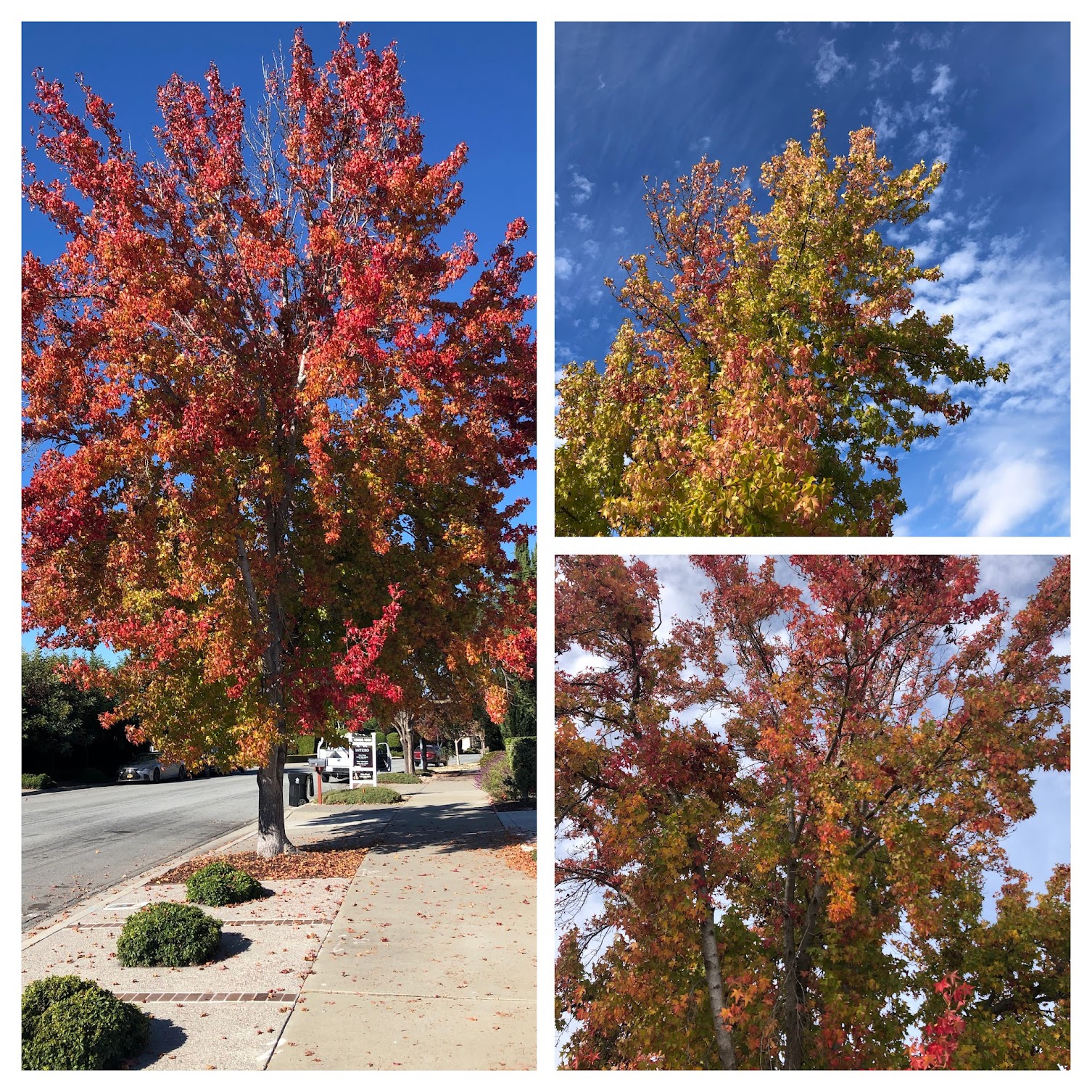
Novembers in the Bay Area are beautiful. It is the time when the world around us turns colorful – assures us that the seasons are turning. The fall colors, never as resplendent as in the East Coast, are inviting, and the son & I spent more minutes walking gleefully into crunchy leaves in the past few days than was necessary. We also gazed upwards into maple trees – the greens, yellows, reds and maroons like a beautiful artist’s palette in the world around us. 

Regardless of how we started out, we’d come back smiling widely and happy to be out in the world. The days drawing in closer also means that we had to really try to catch all of this in a narrow window before the skies draw the screens on them. That sense of urgency adds to the thrill. 

“She had always loved that time of year. The November evenings had a sweet taste of expectation, peace and silence.

And she loved most of all the quiet of her house when the rain fell softly outside.”

– Louisa May Alcott’s, Little Women.

The squirrels, deer, water rats – they all seem to be more at ease with the time-change than we are. Probably because they don’t peer at the clocks before heading out for a walk. They rise with the sun, and rest with the dark. There is a profound kind of philosophical simplicity there.

img_3794img_3793

Yesterday was Veteran’s Day and a holiday for schools. So, we decided to make a song-and-dance of it, and headed out for a walk after lunch. The rains had lashed down all morning – the first rains in November in the Bay Area always make me feel warm and special. By afternoon, the clouds were scuttling away, leaving a delicious moist, clean Earth behind. We walked around a lakeside – watching the pelicans, sanderlings, geese and ducks catch the sunshine after the rains too. 

There is a strange solidarity amongst creatures in that simple act. Peeking out after the rains.

img_3797

Multi-Generational Family Sagas

Multi-Generational Family Sagas

I read two family sagas this year spanning multiple generations, and several decades each. 

Both were highly acclaimed books, and written well. However, both of them suffered from meandering plots, and unnecessary diversions. Making them swollen at least by a few hundred pages. 

“It was a bit like listening to my father tell a story about some character in his village. He’d tell me all about this character, his relatives, his relative’s friends, and the marriages that made the whole thing impossible to untangle, and so much more. By the time he finished the story, you’d be wondering what the point of it was.” I said to my friends after finishing The Covenant of Water. 

I understand too how that can be a daunting task. The mother had seven siblings, the father nine. Their parents, I am not even sure, for I might have switched off in between.

The Covenant of Water – By Abraham Verghese

The writing is beautiful – lyrical, and his characters have endearing qualities to them – resilience, love, grace, flaws. Abraham Verghese is also a doctor by profession, and therefore the details of all the medical terms made for a depth even if the average reader does not need as much information (ex: how a particular surgery was being performed, or how the stent would have served better from a particular perspective) 

Set in Kerala, South India, the book spans the family of Big Ammachi (the matriarch of the family) between  1900 and 1977.

covenant_of_water

It would also have been nice to know a little bit more about the living conditions and life in that time period. For instance, there is a character, Uplift Master, who derives his purpose from getting the village around Perambil (the ancestral village in which the whole saga takes place) developed and to march into the twentieth century in style. Knowing the problems Uplift Master faced in terms of discrimination by the British Raj, or bribery would have been useful. 

Casteism is touched upon, the perils of life as a leper is well depicted. 

The plot itself could have been condensed. That apart, it is a good book.

Pachinko: Min Jin Lee

Pachinko is set in a similar time period in Japan(1910-1989). It outlines the generational problems existing between Koreans and Japanese. 

The story also spans multiple generations and revolves around the life of Sunja – a poor Korean who moves to the city with her husband, Baek Isak, and child from a previous tormented relationship.

pachinko

Reading about the effects of racism, poverty and war is never easy. Writing about them keeping the humanity of the characters intact is even harder. Min Jin Lee manages to do that with ease. It would have been nice to see how things were changing as the century progressed, but we do not see too much of it. 

The Tides of Humanity

The tides of humanity are apparent even if there are literally oceans separating the stories.

  • The Covenant of Water is set in Kerala, South India(1900-1977).
  • Pachinko is set in Japan(1910-1989)

They both deal with matriarchal characters (Big Ammachi alias Mariamma & Sunja) who do their very best by their kith and kin in difficult times. Providing love, trust, and hard work as tenets to a good life.

I think this line from Noa (Sunja’s firstborn) in Pachinko,  outlines the angst of humanity pretty well: 

Noa didn’t care about being Korean with anyone. He wanted to be, to be just himself, whatever that meant; he wanted to forget himself sometimes. She could not see his humanity, and Noa realized that this was what he wanted most of all; to be seen as human.

– Min Jin Lee, Pachinko

There is plenty to be learnt in life as a human, wherever one lives.

In the Covenant of Water, Philipose (Big Ammachi’s son) says it best:

“Ammachi, when I come to the end of a book and I look up, just four days have passed. But in that time I’ve lived through three generations and learned more about the world and about myself than I do during a year in school. Ahab, Queequeg, Ophelia, and other characters die on the page so that we might live better lives.”

Abraham Verghese, The Covenant of Water

Exploring Deepavali Through The Firework Maker’s Daughter

I glanced around me – it was Deepavali, and all of us children, parents, and grandparents at the  party, looked delighted. Who wouldn’t be? Many of us were clutching sparklers, and watching the tiny stars produced by them in awe. The beautiful fountain pot spouted its joy towards the world a few feet away, and the oohs-and-aaahs were enough to melt hearts. Deepavali fireworks, especially in the US, are not exactly spectacular, but it is joyful all the same. 

img_3753

Watching fireworks has always been magical. The little sparks ignite something else altogether in our spirits.  Watching everyone around me, I could well imagine the children of ancient China watching in wonder as the first gunpowder produced magical effects. Or the hobbits as they all watched Gandalf’s spectacular fireworks in Hobbiton. Every time we go to DisneyLand, waiting for the fireworks in the cold, with thousands of people, it is magical. 

I was so glad to have an equally delightful book  to read that week-end, The Firework Maker’s Daughter – By Philip Pullman.

The Firework Maker’s Daughter – By Philip Pullman

A delightful tale of adventure, replete with a plucky heroine (Lila), a hero (Chulak) with gumption, and a talking elephant (Hamlet, who is in love with the elephant at the zoo, named Frangipani). 

In the Firework Maker’s Daughter, the firework maker, Lalchand’s daughter, Lila, wants more than anything to become a fireworks maker. At a young age, Lila invented Tumbling Demons & Shimmering Coins.

“My father won’t tell me the final secret of fireworks-making, “ said Lila. “I’ve learned all there is to know about flyaway powder and thunder grains, and scorpion oil and spark repellant, and glimmer juice and salts-of-shadow, but there’s something else I need to know, and he won’t tell me.” 

firework_makers_daughter

But of course, the poor girl is not allowed to become a firework maker, for her father intends to get her married off. So, with the help of the white, talking elephant, Hamlet and his keeper, Chulak, she takes off to find the secrets of firework making all the same.

It is a whimsical book, and the descriptions of the fireworks in the end makes for a marvelous read.

If only the joys of learning to do these things (like making fireworks), were still available to us, instead of being locked behind factory doors, how wonderful it would be.  As I remembered all the different types of fireworks – the ones that burst into a thousand patterns in the sky, the ones that take their time like a rocket lift-off, the spinning chakras, the little pops of bursting noises, the ‘Lakshmi bombs’ ( the loud bombs), and the serial-wallahs,(the strings of explosive that went off for minutes at a time) – the imagination took off with the fireworks too.  How could it not? How inventive these firework makers must be.

I sat down willing to write about the marvelous joys of fireworks, but came up wanting. How can you capture the soaring of the heart in words? How can show  feel a definite lifting of the spirits when only you can feel it?