I vividly remember one Science class in which my teacher explained the solar system, our place in it, and how fast we were traveling through Space. It is an incredible concept, and when explained well, can spark interest and curiosity in a young child. I remember being flushed after that Science class, maybe because I was chosen to be the Earth. I had to rotate and spin around one of my best friends who was the Sun. What greater joy could there be?

As interesting as the lesson was, what sealed the memory in my mind is the fact that the chosen sun that day was exuberant, the chosen earth was joyous, and the rest of the class giggly and slightly jealous that they weren’t the ones to be given the chance to get up from their seats. The latter point gave way to some accusations about being picked by the teacher “How come you both were picked? Sitting right next to each other too?”
I saw their point. Usually, teachers are careful about picking volunteers or nominees from opposite ends of the classroom. These little dramas are part of what makes our time together memorable.
The little upset may have dampened our spirits somewhat, but we were quick to regain lost ground. To children who generally liked the joy of spinning, the morning lesson was a gift indeed. To those of you who have not experienced the heady giddy sensation of going round-and-round recently, please try it again. It is marvelous. If you can find a giggly companion, young at heart, please do so, and it enhances the experience in no small manner.
Hypothesis, Conclusions, Fact-Checking & Collaborations
I remember it was during our little spin-ney-spin-ney sessions that one of us had a question as to why we feel giddy when we spin. Science is full of people who came up with their hypotheses and then set out to prove it. Our little band of scientists was no less committed. I came up with a perfectly wrong explanation for the phenomenon and it shows the sturdy nature of my friends that no one laughed at me that day. Instead, they indulged me in an experiment.
“Maybe the Earth is already spinning and when we spin in the opposite direction, it makes us feel dizzy.”
There were some thoughtful nods at this – “Then we should be able to spin even faster if we were to go the same direction right? “ said one. There was only one way to check – spin in both directions and find out for ourselves if this was the right theory.
“Which direction does the Earth spin – do you know?” A collective wave of shoulders shrugged at the same time, but little things like this do not deter the determined. Someone said we will just time each other for 10 spins in each direction, adjust for right-handed, left-handed, ambidextrous, null-i-dexterous (the opposite word for being equally clumsy with both hands is called ambisinister, but I think null-i-dexterous sounds kinder) and we would be set.
That’s what we did. The exercise resulted in loud laughter, and the sound waves brought the earlier complainants to the fold wanting to join in the game too. All recent rancors forgotten, the experiments were done with rigor, encouragement and accuracy.
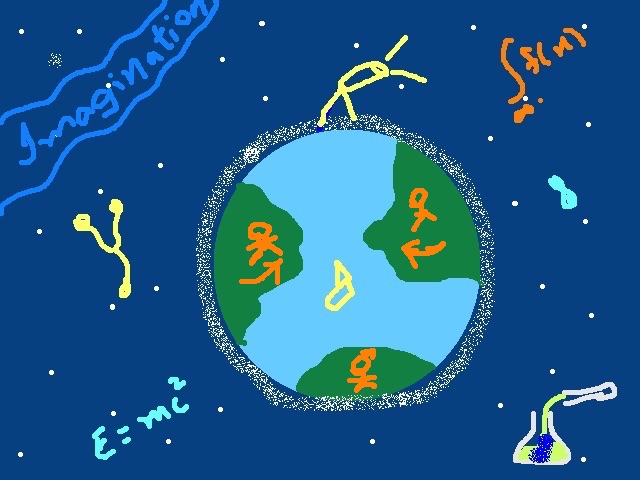
While we are always in awe of the creative thinkers who take us a leap forward with their works, I have always wondered how each moment came to be: how Thinking Man figured so much out. This is one of the best ways in which I have seen the sentiment expressed.
Excerpt from The Book That Nobody Read – Chasing the Revolutions of Nicholas Copernicus by Owen Gingrich
“The greatest of scientists have been unifiers, men who found connections that had never before been perceived. Isaac Newton destroyed the dichotomy between celestial and terrestrial motions, forging a common set of laws that applied to the Earth and sky alike. James Clerk Maxwell connected electricity and magnetism, and showed that light was electromagnetic radiation. Charles Darwin envisioned how all-living organisms were related through common descent. Albert Einstein tore asunder the separation between matter and energy, linking them through his famous E=mc^2 equation.”
Scientists do not always know what to expect and can sometimes be surprised at the results. That is what happened to us. The results were inconclusive and resulted in:
* One of us falling to the ground laughing heartily
* Another banging their head against a conveniently placed pole nearby
* Another giving off an inaccurate imitation of a drunkard, which was impressive given that this was happening prior to the Internet or Cable Television, and the child’s parents were teetotallers
* Two subjects crashing into each other mid-orbital, resulting in tummy aches and headaches together
Our motley band of scientists had by this time dissolved into a fit of giggles. Good naturedly, we shrugged off the theory, accepting with grace that it may be an erroneous hypotheses and moved on to the next thing to play together. Consensus, criticism, fact checking, and collaborations had been achieved with the greatest of unity and hilarity.
The Art of Play
In every problem, creativity and imagination are our solid allies. The simple act of playing together and collaborating to solve problems, keeping each other true is now more valued than ever. Today to see that school recess times have come down; children do not play out on the streets in free play mode anymore, but are rather being ferried up and down to supervised, classes with rigid rules of social conduct usually in the presence of adults; and the playgrounds in our neighborhood have become safe havens for spiders to spin their webs.
Could we add in structured unstructured time – so we can all benefit from free spirited Play once again?
Those who were never exposed to Play may not miss it, but those who know the beauty of it, will always feel the richer for it. Much like Art, Play is Art, and I pray we do not lose the Art of Play.











 Nourish-n-Cherish