Celebrating World Quantum Day: History and Fun Facts

World ⚛️ Quantum ⚛️ Day – April 14th

“Oh wow, ma! Today is Quantum Day!” said the son. Actually yelped the fellow, like the words were yanked out of him by the excitement coursing through him. For some weird reason, even as a young toddler, he loved the word, ‘Quantum’.

Maybe it was Iron Man or Ant-Man – that movie in which they use the word ‘Quantum’ every time they did not want to explain something. Or maybe it was the fact that we all liked watching The Big Bang Theory television series in the house so much when he was a child, or maybe the Cosmos shows by Carl Sagan, or the fact that I like reading about Physics

In any case, Quantum. He lights up when you mention Quantum-This or Quantum-That. 

I smiled at him, and said, “Wow! I didn’t know they had a day for that!”

2025 is also the International Year of Quantum as designated by the United Nations. 100 years since Quantum Mechanics became a part of higher education science and research. 

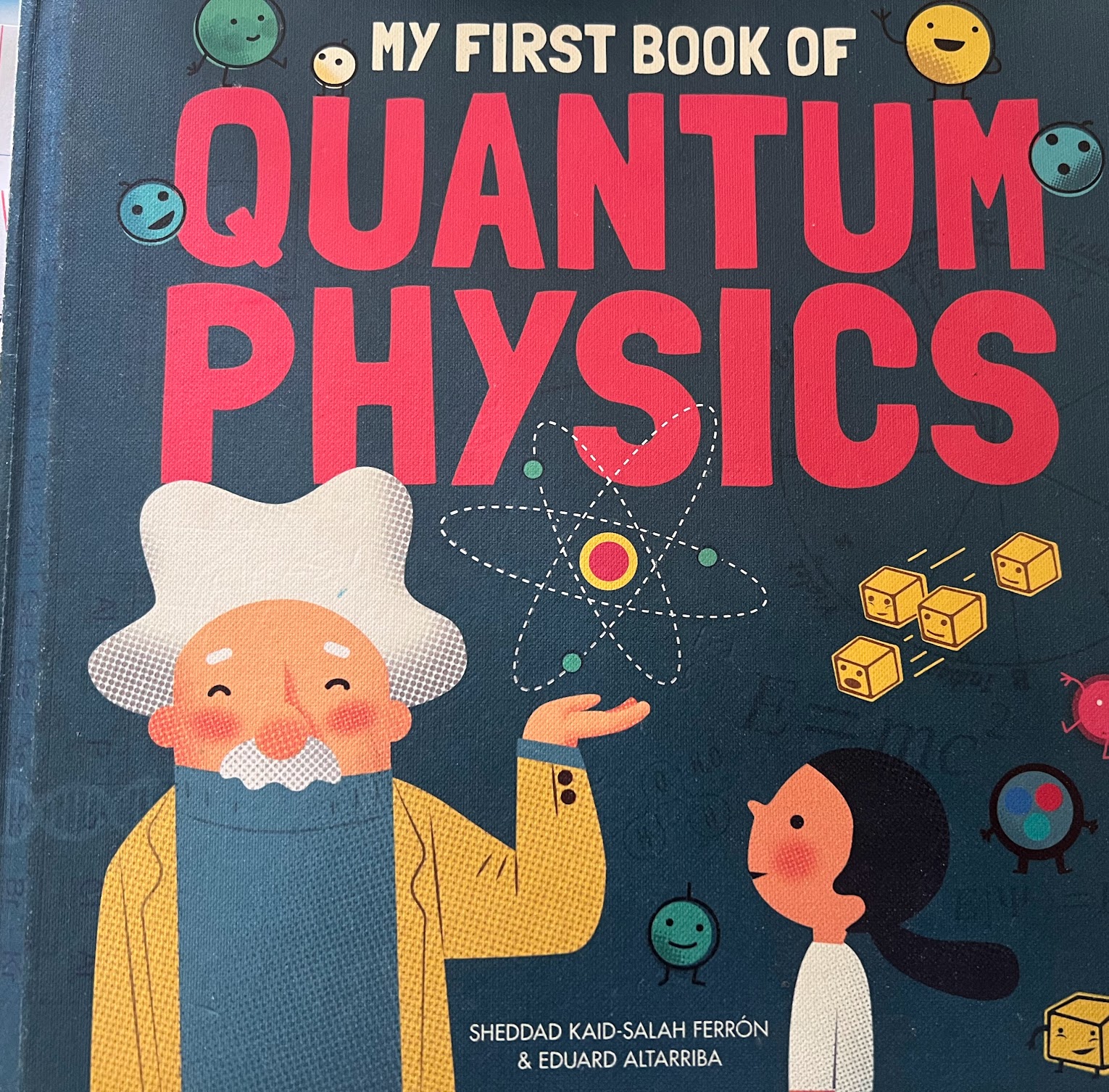
From Book: My First Book of Quantum Physics – by Sheddad Kaid-Salah Ferron & Eduard Altarriba

⚛️  My First Book of Quantum Physics ⚛️

This seemed to call for a little nostalgia. I opened a favorite book of ours – as a child, I remember getting this for him and he spent hours looking through the pictures. 

My First Book of Quantum Physics – by Sheddad Kaid-Salah Ferron & Eduard Altarriba

It really is a beautiful book. Sheddad Kaid-Salah Feroon & Eduard Altarriba do a fantastic job of the illustrations, explanations of difficult concepts and providing a general feel for the subjects.

It is why we were excited to visit the CERN supercollider in Switzerland.

Sheddad Kaid-Salah Feroon & Eduard Altarriba have a series of books covering topics such as: 

  • Quantum Physics
  • Relativity
  • Electromagnetism
  • Cosmos
  • Microbes
  • Evolution

Please check these books out if you get the chance. It is always fascinating. Especially, when in our everyday lives, even if we are professionals with science backgrounds, we hardly set aside the time for this type of shoshin (the wonder of the beginner’s mind)

In one time and place, when not observed, if we can find that joy of wonder, that would be Quantum, wouldn’t it?! Get it? Get it?!

From Science Fairs to Real-World Solutions

Almost everyday I am amazed at human potential and dismayed by what we choose to do with it. We are problem solvers, but we have enough folks who create them in the first place too. We have the ingenuity of using tools to forge ahead, and shortsighted enough to be thwarted by our own creations. We are a meticulous species, and a callous one. 

As I was musing thus, my thoughts were interrupted. “What if we run out of problems?” one of the children at the Science Fair asked me.

Problem Solvers or Creators?

I assured the worried children that as long as humans are around we will never run into that particular problem. We will always have problems to solve, and we will always ourselves to blame for creating most of them too. “So, you can choose to be problem solvers or creators – I think you kids are good kids who may land up becoming problem solvers” They beamed.

We were standing at the Alameda County Science and Engineering Fair, and the projects on display were truly inspiring and mind-boggling. “We created AI to solve many problems, but I assure you it will create some of its own too!” I said, “Then, we can set about solving them. We’ll be busy!” and they laughed nodding.

The AI Revolution

Over on the High School side, it seemed the children had taken the AI revolution to heart and attempted to solve almost everything with AI. 

Detecting lung cancer early, patterns of dyslexia, Parkinson’s disease, watering crops, even solving mathematical theorems. 

As I meandered slowly through the aisles looking at the display boards I took in as much as I could. The musings came later:

So what does AI predict for us? Especially if we are to use it for so many things? The Internet wave seems like one to play in at the beach compared to this surf wave.

Science Project Areas

It was fascinating to see all the areas in which the children had attempted to solve problems. Sustainability, environmental science, plant growth, reducing microplastics, hydro-farming, disease detection, water purification, working around the problem of microplastics in our soil and water, and so much more. 

One project on elder care had me hurtling back decades. It was a pill dispenser for the elderly. I thought of my grandmother, Visalakshi fondly. One day I caught her popping 15-16 pills at one shot, and was truly fascinated. Did she need that many to keep ticking? I was probably 7 years old at the time, and everyone with grey hair seemed impossibly old. Oh! Youth! She looked at me fondly when I asked her that, and said that she had merely forgotten the morning and afternoon doses. “Paati  – no! You can’t just eat them altogether!” I said, and she laughed like I was overreacting. I can see that particular project being quite useful, as I am sure that particular trait is not something that simply fades. 

I walked around the fair, admiring the vast variety of problems in front of us, and the many, many ones that did not even make it to the Science Fairs. The atmosphere felt promising, hopeful even. How could it not be? This is one of the places where the appeal of problem solving is showcased for all of us. The world doesn’t seem to be as bogged down by negativity and impossibility.

We need to teach our kids that it’s not just the winner of the Super Bowl who deserves to be celebrated, but the winner of the science fair.

Barack Obama

That is why he remains one of our favorite presidents.

How Reading Changes Our Understanding of the World

Reading, Absorbing, Retaining

We were discussing books and one of my friends said wistfully, “I like what I am reading, but I don’t know how much of it I will be able to retain afterwards.”

The rest of us nodded. It is a problem and one that I have yearned to be better at too. How marvelous it would be to quote with ease from our various influences! The internet truly is a savior for folks like me who have a vague idea. I don’t think stunning speeches are made by saying things like: “Remember that saying by Shakespeare where he said something about wise men knowing they are fools, and fools being very sure of their awesomeness? Or something like that?”

Aah….here it is:

“The fool doth think he is wise, but the wise man knows himself to be a fool”.  – Shakespeare

So, it is with knowledge. The more one yearns to learn about the world around us, the universe, and the lives we lead within it, the more one realizes how little one actually knows. There is no surer path to humility than learning.

“Even if that is the case, I suppose we retain things that appeal to us subconsciously.” I said.

The conversation meandered after that  but I found myself thinking back to that statement. It was true enough.

The OverStory – Subtle Influences

I read The OverStory by Richard Powers a few years ago, and loved many aspects of the book – its lyrical language, the poetry of the trees, the rich interweaving of nature in its stories etc so much that I wanted to read it again with my book club. It is when I started it again that I realized the Hoel family tradition of photographing their old chestnut tree must have appealed to me. Why else would we have started taking photographs of this particularly gorgeous maple tree every fall? I did not even realize this till we started re-reading the book, and I visualized the hundreds of pictures taken generation after generation. The only surviving chestnut tree for hundreds of miles in every direction. 

There is a timeless charm to a tradition like that.

Reading is a critical part of Becoming

Reading is a critical part of Becoming. Things we read voluntarily, can influence how we think. The characters in stories that appeal to us? They appeal to us for a reason. The actions of flawed individuals? They appeal to us for a reason – maybe we learn to be more forgiving towards follies – our own and of others when we catch them.

There are many studies proving fiction readers were generally more empathetic.

https://www.scientificamerican.com/article/novel-finding-reading-literary-fiction-improves-empathy/

Read Across America Week

It is Read Across America Week in schools honoring Dr Seuss’s birthday, and I found myself loving the rich world of stories once more. We each have a world of stories within us – stories that shaped our beliefs, joyously transported us to different realms, acted as escape mechanisms at times, stress busters at others, and just a marvelous source of shoshin otherwise.

Languages all over the world have a phrase or word for the vastness of knowledge, and I suppose I am grateful for it all.

Anantha gyana, gewaltiger umfang, enorm kunnskap, Abhijñā

Happy Read Across America Week – may we all read more about hopeful, brave, courageous, witty, humourous, compassionate, kind, vibrant personalities, and become like them.

🌲🌳🌴🎋Magic So Sublime 🌲🌳🌴🎋

“Do you see anything dramatically different today?” I quizzed the husband. He looked around him. We were standing outside the home before setting off on a walk. He looked blank, looked around, and then settled for his safe-bet. “Did you cut your hair? It looks good!”

I rolled my eyes. Honestly! 

“Nice try, but no!” Then, taking pity on him, I gave him a hint. “It is more to do with the immediate surroundings.”

He paused, looking up at the roof. Yesterday’s rains had us both rattled a bit. It isn’t often that we get up to the sounds of heavy rains lashing against our windows. It is a beautiful sensation, but a little fraught for us this time, since the last time, we found a pool of water had managed to seep in. This, after the roof repairman had stomped on the ceiling repairing things for sometime already. 

“Not the roof either! Look at the flora and fauna.” I said.

“Ahh – okay – that is easy.” Then went on to gabble on about flowers blooming, some plant surviving till I stopped his rambling, and said, “It is okay to give up, you know?”  

Then, with a dramatic flair, I pointed to the cherry blossom tree that only a day ago was fully white filled with blossoms. To be fair, I did not see it while it was raining. But one day later, it was there fully clothed in fresh green leaves – not traces of the tree in full bloom from just a day ago. 

How I wish the tree would tell us when it would do this? I would love to just set up a time-lapse video and sit watching it in slow rapture. When do you think the leaves actually sprout? Has anybody actually seen a leaf grow? This has to be some of the most sublime magic on the planet. 

🌸🌸🌸 Oubaitori in Spring Time 🌸🌸🌸

I felt a pang for the beautiful blooms of that tree – gone so quickly and completely, and then remembered that a month ago, it was bereft – a tree in abscission. Beautiful in its starkness, then resplendent in its white blossoms, and now lovely in its fresh greens. It is no wonder that cherry blossoms have captured the hearts and minds of philosophers for centuries – the simple lessons of enjoying the beauty of the moment, the oubaitori to bloom and sprout at your own pace.

A Reflection of The Rise and Fall of Tech Trends

Rise and Fall of Trends

“Well – sorry! That was a waste of time!” I said, looking a little sheepish. I had meandered through the walk with half-formed thoughts. Then I realized I had probably done what my writing process looks like – out loud. I had a vague nebulous idea and it sounded brilliant in my head, and by the time the walk was done, only a loving listener could have endured. Without the benefit of editing and moving sentences for clarity, it sounded terrible. When a friend suggested that I dictate my thoughts out to a vocal tonal converter, I was skeptical. Maybe this would become the next big thing, or it may be one of those things that fade out like the CD player (all the rage while it lasted and then sunk without longing)  

“In technology, buzzwords think they are all about being cool, but it really is just plain confusing! “ I said. “Really, two years ago, you thought you were a damp squib if you didn’t know this-or-that, now it is Agentic-AI-this and Kool-Aiding-AI-that.” 

Technology, Companies Vs Longevity 

The husband and I were discussing the rise and fall of great companies, right after the rise and fall of technological trends. It all started with the husband referring to a term that was popular all of two years ago, and was waning in popularity now, and I had blabbered on.

Tell the husband something like this, and he would launch into one of his explanations. I zoned out. We were out on a walk, and all of nature seemed to share a secret that we had long forgotten. There was more to life than technological advances. With technology, everything seemed to just become faster, and faster. The deer did not seem to have any of these problems. The river bank was green with grass after all. The next generation of deer probably just wish for the same thing: Give us green grass pastures and some space in which to raise our young.

Why were human-beings so finicky?

Book on reawakening after ages

“You know I cannot understand all these people who want to live forever and all that. I can barely keep up with the trends from yesteryear – why would you constantly feel like you have FOMO?” I said, invoking one of the terms of the college-going daughter (FOMO – Fear Of Missing Out).

I told him about a novelette I read recently, in which the hero and his family awoke after centuries and tried to figure out how they were to live. The whole time, I felt disconcerted. I feel disconcerted in rapidly growing cities – visiting after a few years of rapid growth can make you feel strange and lost, even if it was a street in which you roamed without needing maps previously. 

This need for billionaires to go into a cryogenic sleep, so they can revive when it is possible to live forever is a scary one. Would friendships be possible in your woken up world? Wouldn’t you miss your loved ones who accompanied you on your life’s journey?

I am fairly sure if I were to wake up today from just 25 years ago, I would be pretty lost. How to pay for things, how to listen to music, how to read? So many of these fundamental things have changed in the past two decades, imagine two centuries. 

With recent advances in technology, how many of the skills we pride ourselves on today would be obsolete? Art, writing, navigating: they are all up as potential candidates.

I tried explaining all of this to the husband and said, “Maybe there is a point to making the human brain gain clarity, but do you think we’d be any better?” I wondered how much longer I could go on walking – it was a beautiful night with breeze and stars after all.

The husband, wily man that he is, said with a smile, “Aah – another topic for another walk. Come in now!” and dragged me inside. Foiled in my ploy to take a longer walk. Again.

Gratitude and Intentions: Welcoming the New Year

Welcoming the New Year

It has long been tradition to welcome the new year. The hope of new beginnings, the ability to reset, taking stock of what needs to be done in the year ahead, what did not work in the year past, is always precious.

This year, I sat in an airport reading the beautiful meditations of Maria Popova on the symbolisms of the new year, and some blessings to begin the year with.  She says in her beautiful essay on new beginnings: 

Some Blessings to Begin with – The Marginalian

The universe didn’t owe us mountains and music, that we didn’t have to be born, and yet here we are with our physics and our poems and our ever-breaking, ever-broadening hearts.”

  • Maria Popova

I found myself nodding along at her evocative language, and the beautiful blessings she envisions.

Many times in the past, I have had discussions with the children, and nieces, on why I pray or meditate , and what blessings I hope to gain from it. I love having this discussion with them, for they know I am not a particularly religious person: so why do I pray? It also allows me a glimpse into the kind of personalities they wish to become.

Why do I pray?

I tell them I pray so I am able to set my intentions for what I hope to do with this life I am blessed with. Like setting resolutions for who we are becoming.

🐘 When I pray for health, it means, I would be cognizant of what I eat, how I exercise, how to keep my mind and body stimulated and healthy.

🐘 When I pray for prosperity, it means, I will subconsciously work towards a better life – not just for me, but for those around me too –  for when we all have better lives, we all prosper. (granted ‘better’ in itself is a nebulous term, and usually at different epochs in our lives, they mean different things) 

🐘 When I pray for continued success, it means I will work towards having goals, and try to cultivate the motivation and discipline required to achieve them. 

🐘 When I pray for good relationships, it means I would subconsciously avoid conflicts over little things, and work towards harmonious relationships. 

When I pray for….you get the gist. 

Do the same things then hold for blessings too?

I wonder. 

For some blessings can only be recognized as such after the fact.

image

What are the blessings I am grateful for?

I am grateful for the blessing of life, the fragile conditions that allow us to thrive on this tiny blue planet, the people in our lives who are crucial to our happiness, the microbes and bacteria that all do their part in keeping us functioning, the interconnectedness of the universe that enables the web of rapture to continue, the curiosities of our natures that help us continually improve and problem solve, the conditions of peace-time, the opportunities, the ability to find joy in our lives, the abundance of flora and fauna on this marvelous planet, and so much more.

So what are the blessings you are grateful for, and will they translate into prayers or resolutions for you?

Elevating Resolutions for the New Year Inspired by Some of Humanity’s Greatest Minds – The Marginalian

The Role of Seaweed in Reducing Methane Emissions

The Odds of Our Survival

I was listening to a podcast by Yuval Noah Harari (How humans came to rule the world) and he was saying that if he were to draw odds of survival in the wild against a lion or a zebra, he would not rate himself too highly at being in the race at all as much, but as a species we do seem to have gone above and beyond. It is true. While human-beings can be extremely frustrating , what humanity is capable of achieving is truly astonishing. The eradication of so many life-threatening diseases such as small-pox, continuing medical advances including the recent covid vaccination, and so much more.

Humanity never does seem to have a dearth of problems to solve too. Maybe it was one of the things that came out of Pandora’s Box too. This ability for every solution we create, we seem to have more problems to solve. The industrial revolution led us to climate change, increased technology and reliance on over-stimulation with social media etc is leading to increasing mental health problems. But still we persevere on. When industrialization swept the globe, many feared the end of meaningful work, but the nature of work has morphed and morphed into something our ancestors can hardly recognize as work. 

Climate Change

Take for instance all the ways in which we set about solving the climate change problem (after having caused it in the first place – true true! ) 

While talking to college going young adults, one of the majors that keeps popping up is environmental science, ecological preservation, green engineering – all fascinating fields related to tackling the increased effects and problems of climate change.

That is the redeeming quality too of our sometimes frustrating species. 

This piece of news make me rejoice in the capabilities of human-beings, and the beauty of our planet earth all at once. 

Feeding seaweed to cattle reduces their methane emissions by upto 40%. Considering that 40% of methane emissions are from cattle fodder, this is a huge step in the right direction indeed.

https://www.anthropocenemagazine.org/2024/12/scientists-just-took-one-step-closer-to-a-climate-friendly-cow/?utm_source=substack&utm_medium=email

The oceans coming to our aid again! Seaweeds – truly if there are deities in the universe, the ocean would have to be ours. 

Methane production from live fodder constitutes 40% of greenhouse gases, and if feeding cows seaweeds reduces that by 40%, we may very well have a significant dent on the problem (16% reduction in methane will be a significant dent if all cows are able to get on a seaweed diet.) 

I want a beautiful word for the interconnected-ness of the universe

Seaweeds 🙂 The beauty of it is astonishing and the more I think of all the wonders that bound us together on this small planet, the more I am astounded by it. The interconnectedness of it all sometimes has me breathless in awe. How did we get to call this planet home? 

I ramble, but it may well be tipping point for the planet.  If the doomsayers are to be believed, the breakthrough comes as a critical moment.

The Ocean Deities Defy Pandora

It is as if the ocean deities are having a laugh and teasing Pandora with this win, and and with wins right now – we should take all the logical and sensible ones while we can.

Halloween’s Influence: Understanding Fear in Stories

“Arrgh!” 

“Gosh! Dude! You scared me!”, I said, leaping neatly into the path of a bewildered looking biker on the trail. His eyes grew wide, and he wobbled spectacularly before regaining his poise and balance, and then smirked. 

I suppose it was funny. A scrawny fellow like the son is hardly the sort of fellow to make their mothers leap out of trail paths with their scary stories. But it is nearing Halloween and we were discussing the themes of horror in their English Literature class. 

“What are the elements of a horror story?” I asked.

His answer made me jump, leap into biker’s path, earn b.look from biker as he regained balance and then a smirk for additional points etc. 

I must admit that when it came to quakey finds, horrors take the biscuit. Stephen King is all very well in the daytime, with soothing cups of tea, warm music etc. But otherwise, no thank you! I still prefer the glow of humor, the comforts of friendships and love, good old fashioned topics like (science, nature, history, psychology, travel), and mild adventure in my reading fare.

Horror in Literature

What made the class interesting was their discussion on not just horror, but how it affected the different parts of our brains. The amygdala (the small pea sized piece of our brain) is known for the fear response – that is the piece we share with reptiles, he went on to say and I listened in awe. Our prefrontal cortex is where we process what the amygdala sends us, to appropriate a response. 

“I think you should research it up a bit more before quoting me though!” he said, giving me a stern look.

“What if I wrote that you asked me to research it, so folks know it isn’t the Gospel of NeuroScience instead?” I said, rolling my eyes, and he laughed at that and agreed. So here goes, folks: please research this piece on your own. 

How interesting to sit in a class, watching a 90’s cartoon show about Courage, The Cowardly Dog in the Chicken From Outer Space. 

Then to analyze how the different parts of the brain were affected by the fear response? I can’t think of a better way to spend a Wednesday afternoon. I would have loved to be a fly on the wall in that class (risking a horrified teenage set of kids screeching and swatting at flies notwithstanding), and I was full of admiration for their teacher who had taken the trouble to come up with a lesson like that close to Halloween.

Boggarts & Dementors

The whole conversation on fears and the horrors of our psyche reminded me of another conversation from a few days ago on boggarts and what shape each of ours would take. Harry Potter and the Prisoner of Azkaban has always been one of my favorite books – it addresses so many themes – how not to judge someone based on first impressions, how the truth can be life-altering, the importance of friendships, conscience, etc etc. But this book specifically addresses fear and our worst experiences in the form of boggarts and dementors.

This YouTube video on the SuperCarlinBrothers Channel on Why It Is Wise to Fear Fear is an amazing one in this context:

Harry’s WORST FEAR Explained | Harry Potter Film Theory

Halloween is the one time we acknowledge fear as a society. It also comes with a good antidote to fear: the ability to allow for whimsy and creatively live our lives.

We turned around after our walk, and the biker, much fortified after his own little fright, gave us a wan smile as he made off in the opposite direction too.

Exploring Happiness: Is It in Our Genes?

In what was an intriguing chat with the son last evening, we poked around the ethics of genetic modification. Apparently, that had been an area of discussion in their classroom, and the son was keen – the novelty of a discussion with multiple viewpoints at that age is amazing. I smiled and listened to him talk offering a question here, a hum there, an insight elsewhere.

“What do you want to do with human-beings if we are smarter?” I asked him.

“We could fly.”

“Cool! But then what?”

I took a deep breath and said as casually as I could. “Everyone wants to be smarter, for things to come more easily to them. So we wouldn’t have to spend so much time figuring things out. But – the thing is, if everything came easily, we would not know what to do with all the time we have on our hands. What do they say? An empty mind is a devil’s workshop? I don’t know – I think it could lead to more mental health issues – what do you think?”

He pondered this for a while, and said it was an intriguing thought. 

Who Survives?

It reminded me of another chat the husband and I had a few months ago – on the larger theme of the future of humanity. With smarter, faster, stronger, what would happen to humans? The husband took a moment to gather his thoughts, and said, “Well – it will come back to good old basics then, wouldn’t it? Survival of the fittest. Those humans who can learn to be peaceful with themselves will ultimately win out – that is the strain that will survive.”

I was impressed – yes, no matter what we had, it ultimately came down to temperament, attitude, and the ability to be happy, didn’t it?

Generosity by Richard Powers: The Happiness Gene

Incidentally the book I am currently reading: Generosity by Richard Powers, talks about a variation of this: The Happiness Gene.

The story tries to figure out the reason for Thassa’s happiness. Thassadit Amswar is a refugee who has fled the Algiers region. Her brother is still under house arrest in a totalitarian regime, her parents are dead after years in which they were stuck in the midst of a civil war that raged around them, and any which way you look at it, she should be morose, sad – not chirpy, cheerful, and full of light.

The whole set up reminded me of one of Rumi’s sayings that have been making its way around the instagram world: something to the effect of:

When the world around you is dark, you could very well be the light.

Rumi

In any case, somehow Thassa’s ability to be happy attracts attention – first from local friends, then a policeman, a local news report diagnoses her as having ‘Hyperthymia’ – a condition of overwhelming happiness, and goes on to attract those who want to auction and buy her eggs, decode her DNA, figure out the happiness gene. She finds herself unmoored by how people feel bad because she is happy, and having to navigate the horrors of fame.

In Essence

  • Is there a genetic component to being happy?
  • If so, can that be picked and chosen for our offspring in the not-so-distant future?
  • What issues would that create for mankind? For just as sure as we are of creating solutions, so too can we be sure for creating problems for ourselves, isn’t it?

Hum of Chitter-Chatter

I’d had a trying sort of morning – my attempts at speaking had come to nought. I was speaking English, folks around me were not. I asked for chips, they told me it was several hours for nightfall. I asked for honey, I was given a shrug and a look reserved for the village fool. I left the chips and honey – life is great without chips and honey, thank you.

So, I veered off civilization and went off to moon in the woods.

It isn’t often that we stop to revel in the orchestras of everyday life. That morning I did. When I did, I found myself transported. I had rarely seen this many hummingbirds together in one place and the noises they were making chittering together was music. What were they saying to one another? Were they discussing plans for the day? 

I smiled and reluctantly moved on – human beings had meetings of their own didn’t they? 

A few days later, I stopped listening to the chatter of the crickets starting up in the evening, even as the sun dipped into the horizon bathing the skies in robes of pink and orange. The deer grazing glowed, the blackbirds fluttered while singing, but the crickets were the loudest of them all. Enough to make you stop and wonder what they must all be saying to one another.

I exchanged glances with the son who’s come on a stroll with me, and we headed back musing.

Later we had a frenzy of celebrations planned – gatherings and people. I stopped to listen to the chatter around me. It was a feeling – not voices that I heard. It was a festive occasion, so all I heard was a pleasant hum – interest, friendship, camaraderie, laughter. 

What is it about communication that enthralls us so much? I remember reading a short story by Louisa May Alcott a while  ago in which a young girl acquired the ability to understand animals and birds for a short period of time. She is baffled to realize that they can actually communicate amongst themselves as well as amongst other species. A woodpecker could talk to a squirrel and understand each other perfectly. So, they could unite and we wouldn’t have a clue.

It was a beautiful touching story, for it helped me laugh once again at our own follies. It would serve us right if that was truly the case – too smart for our own good, but all the time being pitied by the wiser creatures of the Earth. Between all the languages we’ve managed to create as humans, it is truly humbling if that were the case. (No mishaps with honey and chips I assume.) 

It also made me stop and wonder what animals hear when they us jabbering. Many times on my walks, I come across people talking shop – serious talks on finance, technology trends (I live in the Bay Area – it is a way of life – you can’t throw a stone in any which direction without someone yelping ‘AI’ – whether as an expletive or not), movies, music, other people, offices, sports, etc.

What must they make of it? I wonder.