Snow Snuffles & Snuggles

The alarm went off at 5:50 in the morning. That moment of transition between sleep and wakefulness is a short, sharp one on certain days, and a dull, lingering one on others. That day, it was a swift rising.

The alarm tinkled with a naughty smile – “Snow snuffles and snuggles”, it said with a snowman and a snowflake thrown in for good measure.

img_2216

The husband was not awake yet. Would he have liked this alarm? I wondered as I hit a snooze, and gathered the flowing blankets around me for a quick snuggle in the warmth before padding out into the cold to start the day.

The alarm that day was meant to set the mood and it sure did. We had gone over for a quick ski trip in the mountains nearby, and while we all looked forward to a day in the snow, it was also a day that the weather app forecasted as having heavy snow in the upper reaches and rain in the lower reaches of the mountains.

Driving in the snow is not for everyone. The last time we were stuck in the middle of a snow storm , we found ourselves, car and all, whistling and gliding through the snow looking like reindeer chasing after blackberries and magic mushrooms. (Read here: In Boysenberry Jelly & Mistletoe Jam)

Obviously, I was worried.

Which meant, I sat straight backed, with my woodpecker nose lengthening in the rear view mirror as I drew agitated gasps. I was also doing an impressive amount of passenger-seat driving and botching up directions thoroughly ( we found ourselves losing our way at least twice and doing a u-turn with the snowflakes hurling at us with light-hearted gaiety). My frowning only seemed to make the snowflakes more frivolous and they seemed to dance and jig their way from the skies looking joyous and relaxed, while I twitched and tutted inside, restless for us to reach our destination.

inyo_snowstorm
Snow

All of that worry evaporated the moment the car was parked and we found ourselves out on the slopes however. My face split into a slow wide smile, and I raised my face to welcome the little flakes on my skin. I was wearing a black scarf, and the snowflakes against the scarf made for a wonderful sight. Never had I see them this closely, and I was mesmerized. Each of them had a beautiful symmetry and a unique shape. Some of them clung together giving them the shape of pinecones. Others landed gently on my scarf giving me the gift of observing their individual shapes.

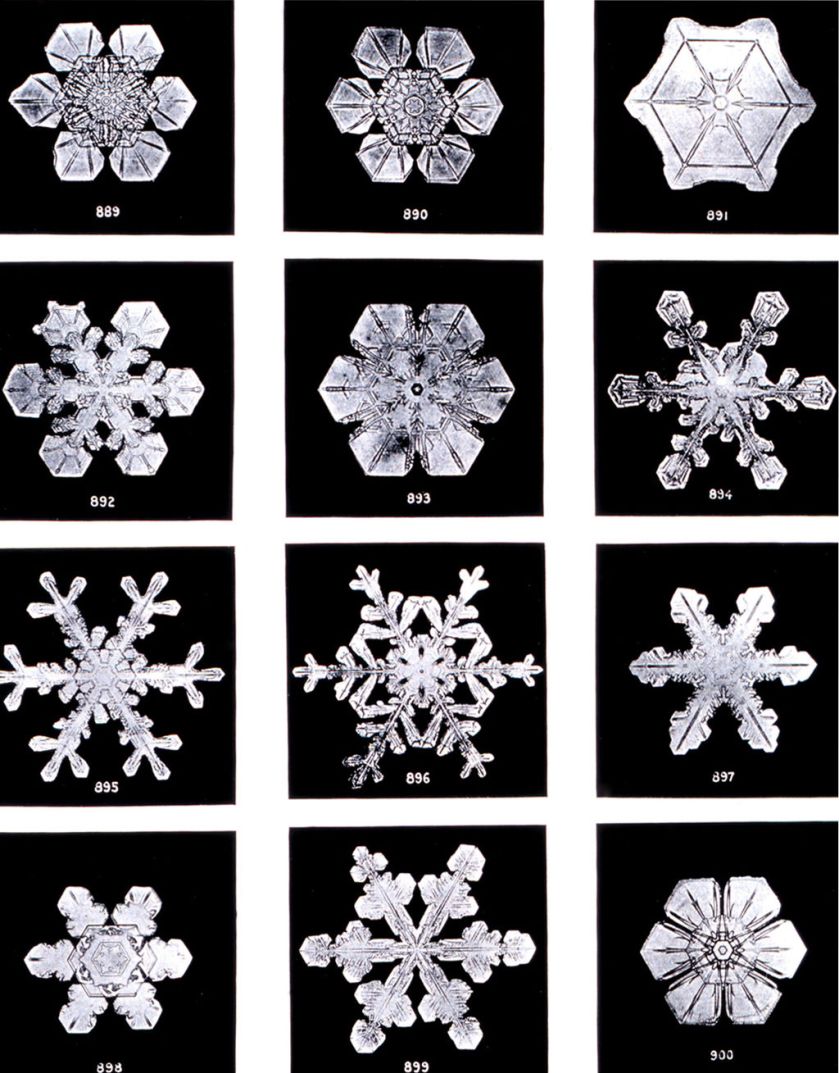
I have heard it said that no two snowflakes are the same. Every time in the snow I wonder how they possibly could have studied that. When millions are hurling down, what is the sample size that can make us reasonably assume that no two snowflakes are the same? It turns out the myth of the snowflake probably originated in 1885 in a remote farm in Virginia. A farmer, William Bentley, spent his winters photographing the snowflakes placed under a microscope. He spent years trying to photograph over 5000 flakes ( an extremely hard task given how quickly the snowflakes sublime.)

Wilson Bentley – The Farmer Who Gave Us Snowflake Images For The First Time (Wikipedia link)

Wilson Bentley's Snowflake Images
Wilson Bentley’s Snowflake Images

I had no idea I could enjoy seeing the snowflakes so much: Tiny versions of perfection, and joy. And I had with me perfect companions on this adventurous day – Children. Children, who had not yet lost their sense of wondrous joy, and they helped me enjoy these little models of perception and perfection almost with as much joy as their own, and to that I am grateful.

I recently read Rachel Carson’s, A Sense of Wonder, in which she says:
“If a child is to keep alive his inborn sense of wonder … he needs the companionship of at least one adult who can share it, rediscovering with him the joy, excitement, and mystery of the world we live in.”
—Rachel Carson

I hope I was that adult to these children, but the truth is that they were the ones who led to my inner child so surely and unerringly with their enthusiasm and joy. I learnt from them not to mind the discomforts of a blue nose or a shivering hand when I had at my disposal the enormous present of appreciating a snowflake’s beauty.

An Extraordinarily Ordinary Life

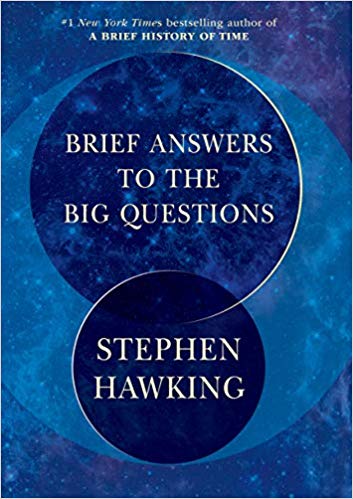
I read and re-read and read out this paragraph in the book, Brief Answers to the Big Questions by Stephen Hawking.

“I have led an extraordinary life on this life on this planet, while at the same time traveling across the universe by using my mind and the laws of physics. I have been to the furthest reaches of our galaxy, travelled back into a black hole and gone back to the beginning of time. On Earth, I have experienced highs and lows, turbulence and peace, success and suffering. I have been rich and poor, I have been able-bodied and disabled. I have been praised and criticized, but never ignored. I have been enormously privileged, through my work, in being able to contribute to our understanding of the universe. But it would be an empty universe indeed if it were not one the people I love, and who love me. Without them, the wonder of it all would be lost on me.”

This is one of the passages in the book by Stephen Hawking, Brief Answers to the Big Questions. The title is no empty boast, he really does take a stab at the big questions with the simplest language. The book’s forewords, and epilogue themselves make fascinating reading: A foreword by Eddie Redmayne who played Stephen Hawking in the movie based on his life, and Kip Thorne who worked with him at Caltech and one of the foremost players in the detection of gravitational waves (LIGO)

Related: Philosophers & Tinkerers

brief_answers

Some questions:

  • Is there a God?
  • Is there other intelligent life in the Universe?
  • Will we survive on Earth?

He touches upon climate change (Related: A Planet of Wizards & Prophets), and whether we have any option but to colonize space. It is written in layman’s terms, which suited me quite well.

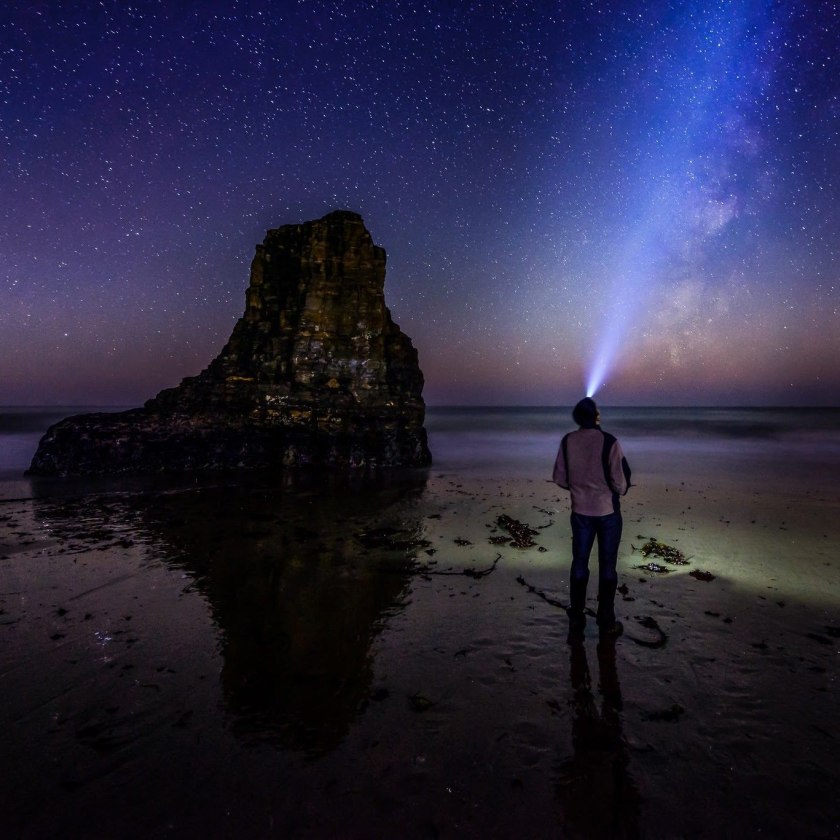
Regular readers know how much I enjoy looking up at the night skies. It is the time I come closest to stoicism. I shiver and wonder what is out there among the great distances. I happily contemplate on the vast empty distances between the stars. I ponder on time and how we are seeing things that are no longer exactly like that. How a serendipitous sequence of events enabled us to be there to contemplate this beautiful universe.

milky_way_shree
Picture taken by a Friend – an amazing photographer

I marvel at our insignificance, I genuinely enjoy riding the thought sails through the night skies, and I look out the magic of it every chance I get. It is one of those times when I am in love with Being.

star_trails
Star Trails of the Milky Way Galaxy – Pic taken by my friend who is an amazing photographer among other things.

One of my friends on a nightly stroll with me once teased me that I will become a star when I pass on, and I laughed heartily. Her tone reminded me of how spoiled I am by my friends who indulgently put up with me as I moon about flowers, hills and stars.

It is extraordinary indeed that I should have read Brief Answers to the Big Questions so closely after I read this particularly fetching poem by Walt Whitman.

When I Heard the Learn’d Astronomer – By Walt Whitman
When I heard the learn’d astronomer,
When the proofs, the figures, were ranged in columns before me,
When I was shown the charts and diagrams, to add, divide, and measure them,
When I sitting heard the astronomer where he lectured with much applause in the lecture-room,
How soon unaccountable I became tired and sick,
Till rising and gliding out I wander’d off by myself,
In the mystical moist night-air, and from time to time,
Look’d up in perfect silence at the stars.

It is even rarer that I find the perfect illustration to go along with it. But Rob Gonsalves in the book, Imagine A World is the perfect one (Related: A Touch of the Eternal):

journey_to_stars

To me, the ability to enjoy these simple pleasures in an ordinary life constitutes an extraordinary one.

What We Do

I bobbed among the sea of fresh laundry. The children were helping with the folding and sorting, while I cackled and rattled around like a mother hen. Mother hens don’t fold clothes, I know, but it is a metaphor, or a simile or an odious comparison when viewed from the angle of a hen. Anyway, the conversation was quicker than the folding and after some time, I patted them on a job well done, and sent them over for a spot of week-end television. They tumbled off clucking happily. A prized activity they seem to think it is, though they seem to watch the same programs over and over again. 

After some more cleaning, I took stock. True, there was loads of cleaning left to do, but that was always the case. For now, the boats of laundry were taken care of, the family fed, the kitchen scrubbed, the shoes, jackets and all the paraphernalia that is plopped all over the place were back where they belonged. The children were happily watching their week-end television, and the husband was pretending to do some work on the computer. All was well.

I gingerly stepped out for a breath of fresh air even though it was cold. As soon as I opened the door, the wind gently lifted my hair welcoming my foray into the quiet pleasures of a Winter day. I surveyed my flower pots weathering the wind, rain and still cheerfully raising their heads welcoming the end of Winter. If that isn’t an invitation for a stroll, I don’t know what is, I told myself and set off, an umbrella swinging on my arm, and my spirits slowly rising to meet the clouded skies above.

img_1995.jpg

I stopped to gaze up at the trees sprouting the early Cherry Blossoms every now and then. One particular tree looked marvelous: There seemed to be a luminous glow on the cherry blossoms, with the dew drops glistening on them, and I could not help standing there, and catching a respite from the never ending activity that swirled around me. Our tasks and accomplishments seem to be so loud and cantankerous compared to this marvelous phenomenon of early Spring don’t they? 

The blossoming of a flower. 

I stood there wondering how lovely it would be to see the flower blossom, to actually see it expand into a flower from a bud. I suppose you could show me hundreds of time-lapse videos, but I still wanted to see the real thing. In front of my eyes. 

That is the sort of thing that will try the Dalai Lama’s patience, and I am happy that the thought to at least try it crossed my mind, since I knew my limits when it came to stilling the mind. A monkey mind if ever there was one. 

Watching a flower bloom is a thought that has occurred to many before me, and will occur to many after me. All we need to do is stop and admire a flower. In the River of Consciousness by Oliver Sacks, he says that as a boy, he used time lapse photography using multiple photographs and frames to develop the blossoming of a flower. To play with time in a sense.

“I experimented with photographing plants. Ferns, in particular, had many attractions for me, not least in their tightly wound crosiers or fiddleheads, tense with contained time, like watch springs, with the future all rolled up in them. So I would take set my camera on tripod and take hourly photographs…and make a little flick book. And then, as if by magic, I could see the fiddleheads unfurl, taking a second or two, for what in real time took a couple of days.”

river_sacks

When seen this way, we are all time machines, slowly growing and morphing all the time, are we not? Unfurling with furious energy that detracts at times, but all of us unfurling all the time, hopefully evolving into what we shall and can be.

I gazed up at the flowers again and wondered whether self reproach, achievement, contentment, ambition, or any of the things that seem to matter so much to human beings meant anything in the grand scheme of things. I am reminded of one of my favorite quotes by Ursula Le Guin.

“Things don’t have purposes, as if the universe were a machine, where every part has a useful function. What’s the function of a galaxy? I don’t know if our life has a purpose and I don’t see that it matters. What does matter is that we’re a part. Like a thread in a cloth or a grass-blade in a field. It is and we are. What we do is like wind blowing on the grass.”

The rain picked up, and I opened up my umbrella. I had stood there a long time, and my feet and hands were numb. I went in to the home, and put my wet, cold hands against the warm cheeks of the children watching TV, and they squealed half in exasperation and half in fun as the rain drops trickled down their cheeks. They chided me, united in their purpose: “Walking in the rain – being nuts! again? You will catch a cold. Go and get warm. Now!”

It was lovely to see the chicks take charge, and get a glimpse of the unfurling.

Classical Whale Symphony

Soft instrumental music was lilting in the background, and the sun’s watery rays were streaking in through the recently rain-washed window-panes. It was a beautiful week-end morning, and the kitchen was bursting with activity. The children were helping by putting away the dishes as noisily as possible. I was making a mess of things by changing the menu nimbly depending on what my refrigerator had. (Grocery shopping had taken a backseat the past few days and rations were thin on the ground)

The children were giggling about something when the teenage daughter said to hearty nods from her little brother. “By the way, what is this blasted toing-toing music you are listening to?”

“Melodious and uplifting for the soul, my dears. Classical Instrumental Music. Changes the way neurons interact.”

She shook her head, “Changes the way my nerves react!”and changed it to something that made my eardrums pick up the dishes and bang them viciously inside my head, while she chatted. Teenagers, I tell you!

“Whales like Classical Music.” , I said weakly.

“Well, I’m not a whale am I?” said she giving me a fish-like look- not the fishy look, the glassy gleam. I saw the piscean divergence in the gene and agreed. Though she could be, given her favorite doodles are themes under the sea

Art work by the Daughter:

Ever since I read in Carl Sagan’s Cosmos about Whale Songs, I have been enamored with the language of music, and the myths of the whales.

Quote from Cosmos by Carl Sagan on the Humpback Whale songs:
These vocalizations are complex. If the songs of the humpback whale are enunciated as a tonal language, the total information content, the number of bits of information in such songs, is some 10 to the power of 6 bits, about the same as the information content of the Iliad or the Odyssey.

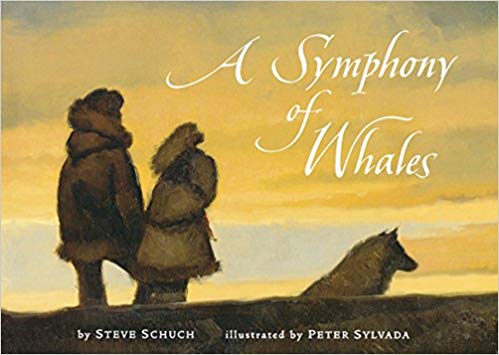
I was naturally was attracted to the book, The Symphony of Whales by Steve Shuch. It is based on a true story in a village near the Arctic circle. The onset of Winter had been swift, and a pod of whales found themselves iced in near Siberia. Unable to get out in time, the whole pod faced death in the iced-in waters.

symphony_of_whales

According to the book, a child, Glashka, who had always been blessed with the ability to hear Whale song heard them over the sound of the snowy storm. That night, they came to her in her dreams, and she knew they must be in trouble.

The next morning her father gathered the villagers and off they went to a sound over 30 miles away by dog sleigh looking for the pod of whales. It was true. The whales were in trouble. The pod had not anticipated the icing in of the waters so quickly, and were facing death. The villagers from all the neighboring villages started chipping at the ice to cut through the blocks of ice, so that the whales could surface and breathe.

“Look!”, said Glashka’s grandmother. “See how the whales are taking turns, how they give the younger ones extra time for air.”

The village elders had also radioed for help. A ship, an icebreaker, Moskva, was on its way to help.

The story, is based on a real incident that happened in the narrow Senyavina Straits of Siberia. Over 3000 beluga whales had been trapped by the rapidly freezing waters in 1984-1985. For seven weeks, the people of the Chukchi peninsula, and the crew of the Moskva risked their lives to save the whales.

The story does not end there. Once Moskva had cleared the way, the whales had to follow the ship out into the open seas, but they were reluctant to do so. The crew tried playing whale song to lure them. While they reacted to the music, they were not assured of human intent, and were still scared of the engine sound. They lurked in the waters.  Then they tried Classical Instrumental Music.

“The crew found some classical music. First, the sweet sounds of violin and violas, next the deeper notes of the cellos and, deepest of all, the string basses…and way up high, a solo violin…
Everyone fell silent as the music carried over the waters.”

That had done the trick. The ship’s engines started and the whales slowly followed the icebreaker out into the open ocean.

Would this heartwarming episode make it into Whale Song? That humans can be helpful too? I don’t know, but I do hope it makes it into our myths – maybe as one embracing a humane side to humans.

Dum inter homines sumus, colamus humanitatem – Seneca

As long as we are human, let us be humane

Read also:

Cosmic Nature of Living

Weaving The Sequins of Time

New York Times Archived Article on the Incident

Philosophers & Tinkerers

I picked up the book Black Hole Blues by Janna Levin partly because I was intrigued by the poetic title, and partly because I like reading about our dear Cosmos, and its many mysteries. The skies have given me endless joy, peace and continue to do so, even though light pollution in our suburban areas mean that we cannot see the stars, planets and stars as clearly.

black_hole_blues

Excuse me for a while, while I meander to a black hole of my own for a moment: I was appalled to note that a Russian startup intends to sell advertisements that can only be visible in the night sky. Are our products so important that we have to dwarf the shows the Cosmos puts up every night to sell toothpaste and whatever gawd-awful thing we contrive in our numerous factories? (I have a post clamoring and rattling in the brain waiting to get out on the number of contraptions that folks felt I must have, or I myself felt I must have, and now occupy valuable shelf-space in the home somewhere.)

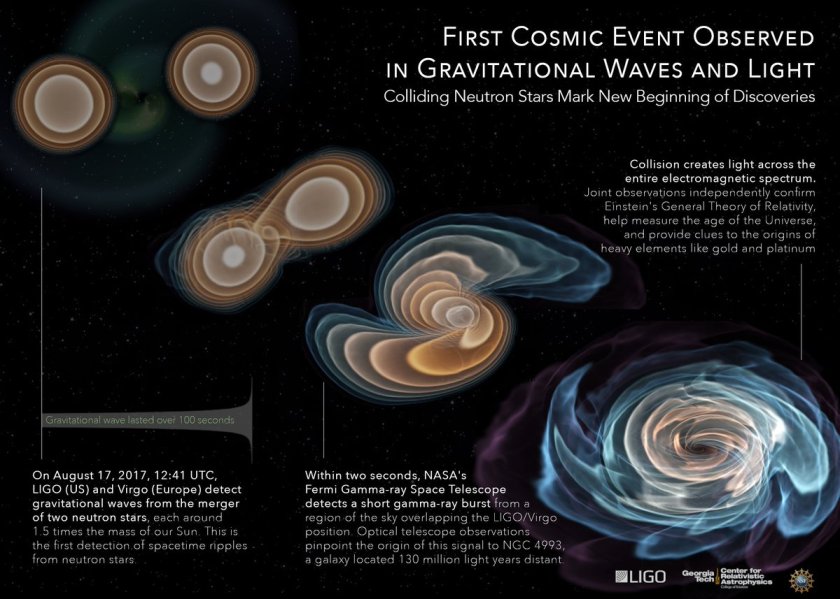
Climbing out of the black hole then, the cosmos has given me endless joy and I indulge in dipping into its mysteries every now and then. What surprised me about detecting gravitational waves is the immensity of human endeavors. Theorizing and coming up with the supporting Mathematics to validate the concept is in itself a phenomenal achievement, but conceptualizing an experiment of such magnitude as to detect a stirring as faint as gravitational waves emanating when two black holes collide millions of light years away is astonishing.

As Janna Levin says, it is a project to fulfill a fool’s ambition.

“An idea sparked in the 1960s, a thought experiment, an amusing haiku, is now a thing of metal and glass.”
― Janna Levin, Black Hole Blues and Other Songs from Outer Space

The LIGO (Laser Interferometer Gravitational-Wave Observatory ) is astronomical in scope and dimensions. Janna Levin’s book takes us into the human dramas and the corridors of Caltech and MIT where much of this played out. While I did feel the flow and structure of the book could have been more crisp, and less about the human politics that plague undertakings such as these, it was nevertheless interesting.

As I read, I was amused at how humans unfailingly bring drama into our existence. At the altar of Science, many have sacrificed their egos, had their egos bruised, and have propelled or obstructed the flow of Science, but like a river it flows on and hopefully propels our understanding forward, not always cognizant of the applications of Science (One of my favorite sayings of Ursula K Le Guin:

When you light a candle, you also cast a shadow).

After the monumental setbacks and roadblocks along the way, it is a satisfying end to the book that the experiment finally paid off. Twice, it detected Gravitational waves as they passed through the Earth from the collision of two massive black holes millions of light years away.

ligo.jpeg
(Image tweeted by @LIGO)

We do not yet know how this will change our understanding of the Universe, and its applications, but we can be rest assured that both are underway. We have come a long way from the Sun God riding the sky every morning on his chariot, though I am reading a fascinating book on this very myth at the moment.

Human-beings are philosophers and tinkerers at the very core, are we not?

Also read: Cranes of Hope (Essay of the Value of Science by Richard Feynman with A Thousand Paper Cranes by Eleanor Coerr).

The Queen of Espirit d’escalier

One cold January morning, I clutched at my tea for life giving support. I was sitting through the kind of gathering that happens across Corporate America when a calendar year rolls over. Executives suddenly pep up, and sit up looking important, and feeling purposeful. Like a pup in spring, who thinks he can play with the ball if only folks would toss it instead of gadding about.

aging

I sometimes like to watch these events. The actors change every so often, and the ones who remain have subtle changes in their motivations and ambitions too. The varieties of personalities we surround ourselves with is an ever fascinating experience, and we only really have the luxury of sitting back and watching occasionally. I suppose that is why the Dalai Lama is full of the milk of human kindness – he meditates, and observes.

Anyway, the gathering reached a place where credits were rolled and I noticed happily how people brightened when they were given credit for their work. It is true one should do the work without expectation of the reward, but how nice it was to see people get the credit where it is due. The meadow suddenly seemed spotted with frisking happy pups.

There was an amusing interjection when one team was accidentally left out of the credits, and claimed what was their due.

I smiled to myself thinking of this normal human tendency to crave recognition. We all do it. Just the other day, I bragged about how clean the kitchen floor looked: ‘gleaming like glass’ as I said, till I was reminded by the family almost gleefully that I had better stump it given that I had to clean up the glass I had broken, and therefore ‘gleaming like glass’ doesn’t really count.
“I am neither Jocelyn Bell Burner nor Alfred Russell Wallace. When I clean the floor, I want credit! “ is the quip that I would have liked to come up with.

But I didn’t.

I came up with the inelegant, “Well…I am eating the potato fry then!”, and stuck my tongue out at the children.

I am a queen of that phenomenon where you think of the perfect verbal comeback too late. I was delighted to note there is a word for that: Espirit d’escalier.(Wiki Link for the word, Esprit De Escalier) The link writes about the amusing origins of the word, please read it.

Where am I going with all this spirited Espirit d’espalier, potato fry stuff? One moment. Yes, Credit and Work and Meaning and all that.

Sitting there at the corporate meeting, and watching the team claim credit for their small part in the puzzle, I was reminded of Jocelyn Bell Burner and Alfred Russell Wallace.

Wallace, independently arrived at natural selection for the mechanism for evolution before Darwin did, but he jointly published the paper with Darwin. Darwin’s Origin of Species is vastly credited with the theory though. Did that make Wallace spout and keep the potatoes? No, he continued to travel the world, writing about injustice and social causes. He never stopped exploring or lost the joy of wonder or ceased writing on the causes that deeply appealed to him.

Jocelyn Bell Burner is another scientist whom I find admirable for this very reason. She was passed over for the Nobel Prize. Credited with detecting the first Pulsars in the universe ( she should have been a Nobel Prize recipient for Astrophysics in 1974). When asked how she felt that her Professor got the prize, and did not adequately exert himself to get her name on the nomination, she shrugged and said, “If you get a prize, it’s not your job to explain why you got the prize. ”

I read about these two stalwart scientists in the books, Lands of Lost Borders by Kate Harris and Black Hole Blues by Janna Levin. Every book teaches us different things. Even queens of Espirit d’escaliers can find a way to come back with Jocelyn Bell Burner & Alfred Russell Wallace and their phenomenal attitude towards recognition as it related to their work.


It makes me realize now what my stellar teachers were saying on those cold Assembly mornings when they dangled tantalizing pieces of wisdom in their morning speeches.

Bhagawad Gita on work without reward

Karmanye Vadhikaraste, Ma phaleshou kada chana,

Ma Karma Phala Hetur Bhurmatey Sangostva Akarmani

कर्मण्- ेवाधिकारस- ते मा फलेषु कदाचन।

मा कर्मफलहेतु- र्भूर्मा ते सङ्गोऽस्त्- वकर्मणि॥

Loosely meaning: Do not anticipate fruits while doing the labor, this was oft quoted by teachers trying to inculcate the importance of work.

The Degree of Shoshin

I wonder sometimes how the brain works. I mean, some references make us link to something else across the bridges of time and space where no ostensible link exists. Was astronomy the link? But that seems weak given that I ogle at the stars every opportunity I get. Could the 12 degree landing of Insight be the link? But the slopes that my mind linked to were at a 11 degree incline. And we were very proud that our little corner of the world could provide just the right 11 degree slope too – that is why I remember the incline so clearly.

Ignorant men raise questions that wise men answered a thousand years ago. Johann Wolfgang von Goethe

Maybe it was something to do with the specific angle at which the Insight can land on Mars that brought back memories of a trip to the Radio astronomy center in Mutthorai in Nilgiris – who knows?  The radio astronomy telescope on the slopes of the Nilgiris was magnificent and awe-inspiring. It still is. I remember hearing that the Tata Institute for Fundamental Research (TIFR) had scoured plenty of slopes in India and this humble village was deemed just the right one to capture radio waves. It had the right level of incline(11 degrees), minimum light pollution at nights, and we were proud of our unassuming Nilgiri hills for providing such a marvelous slope.

By Own work – Ooty Radio Telescope, CC BY 3.0, https://commons.wikimedia.org/w/index.php?curid=7463023


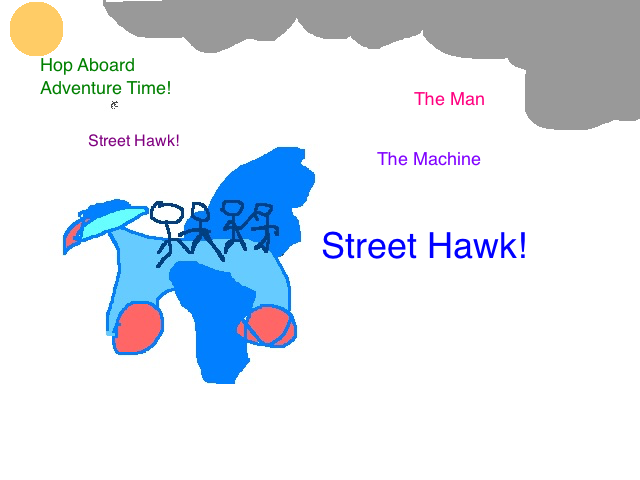
I remember going to visit the center with the father one rainy afternoon during the monsoon season. We often piled onto his scooter that the kids had lovingly nick-named Street Hawk given it tore through the streets with a ear shattering noise, even if we could run beside it. (I often wonder how it must feel for someone who goes to India for the first time from a country like the US or Canada, and sees a family precariously making their hazardous way through the haphazard traffic – obviously uncomfortable, but looking joyous and confident. Even cars here seem so cranky – “departing lane, departing lane” it goes on like a parrot on caffeine. Fine – relax! Talk about sticking to the straight and narrow path – sheesh kababs.)

Anyway that is how we toured the Nilgiris during our school holidays. We would start out on a supposedly clear day, the brother standing in front, his feet making sure not to come under the brakes foot pedal, the sister on the pillion seat, and self squashed between the driver’s seat and the pillion seat, my face turning a ninety degree angle to make sure I could breathe, and off we would go on our adventures. Sometimes, our Street Hawk could not quite pull up the intense slopes of the Nilgiris such as the Katteri falls, and we would all good-naturedly pile off, let the pater go up the slope on 1st gear, trudge up there, and pile on again. What was life without these little pleasures?

street_hawk

Invariably midway through our trips somewhere, the skies would attempt a volte-face: the sun would dip behind the clouds, a brisk wind would start around us, and the first raindrops would start. Sometimes, if the downpour got heavy, we would shelter at a random farm or village and nibble into the ample snacks packed for the trip, and head out again after the fierce downpour stopped. The dubious weather reports then were listened to with the amusing attitude of one indulging a child, and if it all went towards building the weather reporters’ confidence, it was time well spent was the general attitude. Ours was a forgotten corner of the world, and we loved it just the way it was. 

Off I went meandering around the countryside when I should have been sticking to the Radio astronomy tower as usual. The point is, I remember thinking as a child standing on that steep incline with the monsoon winds buffeting us from all directions, struggling to stay upright, and thinking for the first time how we must be standing at all. We are spinning on a very fast ball after all, gravity is all very well, but what would happen if Earth decided to just let us go for one instant? It was a terrifying thought, I clung a little harder to the pater’s solid hands and redoubled my wonder at how we exist at all. 

That is the beauty of space exploration isn’t it? It rekindles wonder. If retaining wonder in our day to day living is the mark of a meaningful existence to paraphrase the German philosopher, it is no wonder that we marvel childhood with its fresh perspectives, and its great capacity for wonder. The beauty of #Shoshin

“The highest goal that man can achieve is amazement.” ― Johann Wolfgang von Goethe

To All Astrophiles

“Did you know, the Voyager Insight is going to land on Mars tomorrow?” said an excited son. T’was the night before school reopened after a joyous 10 day Thanksgiving break, and the night before the much anticipated Insight landing on Mars. I looked at his shining face when it should have been a sleepy one.  The sparkle in his eyes did not smack of eyes wanting to make the journey into the Land of Nod any time soon. So, I sat down next to him and said, “Really? How do you know?”

That’s better, his posture seemed to indicate, and said, “Yes…Appa told me. It has to land at an 12 degrees angle it seems.”

“Why 12 degrees?” I asked intrigued. 

Space.com article : Mars Insight Landing

Quote from article:

“InSight hit the thin Martian atmosphere at about 12,300 mph (19,800 km/h), nailing its entry angle of exactly 12 degrees. If the lander had come in any steeper than that, it would have burned up; any shallower, and it would have skipped off the atmosphere like a flat stone across a pond.”

After chatting a little more on the impressive Mars voyage, I asked the little fellow if we should read a book on Space exploration. He nodded. Anything to keep from falling asleep.

So, we picked up the sweet little children’s book, “Also an Octopus” or “A Little Bit of Nothing” 

also_an_octopus
Also an octopus : or, A little bit of nothing / Maggie Tokuda-Hall ; illustrated by Benji Davies

Also an octopus : or, A little bit of nothing / Maggie Tokuda-Hall ; illustrated by Benji Davies

The book is about an octopus who plays the ukulele, and wants to get on a purple spaceship. Who can help it build one though? Why a rabbit scientist of course!


We laughed as we read the book. As different as it was from Counting on Katherine by Helaine Becker, Illustrated by Dow Phumiruk, it stretched one’s imagination in a thoroughly whimsical manner that made us giggle at the very thought of the Octopus on the spaceship. If ever we need to convince ourselves of the diversity of life that we seem to be threatening, we need look no further than the impressive marine life we host on Earth. 

counting_on_katherine
Counting on Katherine – by Helaine Becker, Illustrated by Dow Phumiruk

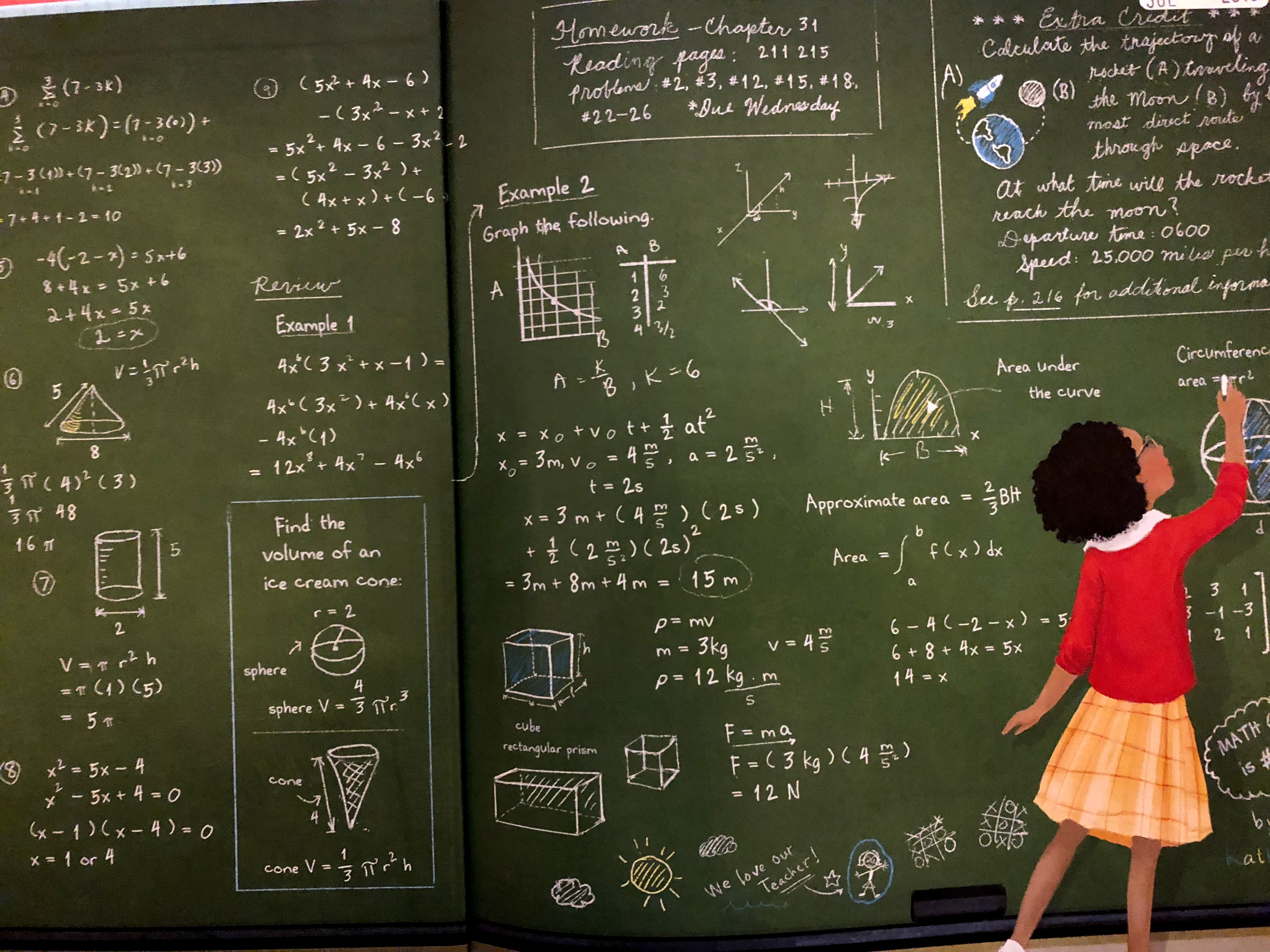
All space lovers should definitely read the beautifully illustrated children’s book, Counting on Katherine. Based on the scientists featured in Hidden Figures, Counting on Katherine illustrates the love for Mathematics and its application to space travels in the most endearing fashion. A child who has the inclination towards numbers cannot help deepen their fascination with them, and hopefully, those who do not share that fascination, will develop a curiosity towards them. I have always loved the look of a blackboard with neatly written mathematical formulae and calculations: this book captures the aesthetic beauty of the blackboard beautifully.

img_0287
Counting on Katherine – by Helaine Becker, Illustrated by Dow Phumiruk

Anyway back to Voyager Insight I said, “Do you think we can watch it land?” 

“Yes….it will be on You-tube.”, said the little fellow, positive that the image transmission from the Insight landing on another planet can make it to the nebulous internet without any trouble at all.

Here is a video link prepared by LockHeed Martin in collaboration with NASA’s JPL:

Automatically, my mind harked back to the old times when an image was work, precious work, with days in between clicking the pictures and getting them developed. When they came out, you saw the lighting could have been better the framing better, the shake a little less, and solemnly swore that you were up to no good, and waited it out till the next film roll proved it. 

I still marvel at any photographs we receive from Space. 

Human minds can adjust to improvements so easily – if only, we had the sagacity to adjust just as quickly to hardship.

Unicorn or Werewolf, I am Grateful

The day leading up to Thanksgiving has been a beautiful, beautiful day indeed. I cannot say I was calm and collected when I got up to see the earth scented with the first rains of the season. Even with the weather channels setting our expectations and all that, it was simply marvelous. I am a pluviophile and when we have gone this long without so much as a drizzle, I really cannot be blamed for a little overzealousness, can I? 

IMG_0726

The air quality over the past few days has been pegged down to ‘very poor air quality’. As a result of which, schools have closed early. The daughter has been rattling off statistics that the Air Quality Index indicated that it is the equivalent of inhaling 6 cigarettes a day or 8 cigarettes a day, leading to the most intriguing discussions between her and her elementary school going brother about smoking, second hand smoking, smog, and lung cancer. When I saw their faces one evening refusing to come out, I decided enough was enough and told them about how some children in highly polluted cities in China and India think the blue skies are some sort of poetic license, since they have never seen a clear blue sky. A smog-ridden world is not a beautiful one, I told them, but that doesn’t stop people from living, and finding joy; but only means we have to work towards finding a way to fix the problems.

Today, however, all of that was gone. We took deep breaths of the moisture filled air, looked afresh at the fall-colors – everything seems to be enhanced in its beauty. The earth seems cleaner, we can finally smell the pines and eucalyptus trees. I took the son out to play in the drizzle, inhale deeply and take a walk around the neighborhood.  The husband shot me indulgent looks, while the daughter gave me commiserating ones even as she patted my head, and said, “I know you love the rains Amma. Fine! I’ll come for a walk with you.” Sometimes, I really wonder who the child is.

img_0725

We spent the late afternoon in a golden daze (actually more of a silvery haze). As we headed home, the moon peeping through the scudding clouds made us all sigh once again, and I said I felt like a unicorn with all the magic in the air. The son, looked up at the skies, and said, “Don’t you mean a werewolf? It is a full moon remember?”

Werewolf or Unicorn, as long as we can enjoy the magic and feel grateful for all we are blessed with, I am happy. There is a reason Thanksgiving is one of my favorite holidays (the history of it aside), Gratitude is such a wonderful sentiment to celebrate. 

Happy Thanksgiving everyone.

The Cranes of Hope

Late one night, I read Sadako’s Thousand Paper Cranes by Eleanor Coerr. The book is based on the true story of a little girl called Sadako who contracts Leukemia ten years after the bombs were dropped on Hiroshima and Nagasaki. My heart attached itself to the lively, petite, friendly, active Sadako. Her energy is infectious and it leaps out of the pages and wants to make you skip too as you navigate the stairs and walk to school.

Sadako was two years old when the atom bomb was dropped in Hiroshima and Nagasaki. Ten years later, her body is wracked with the unmistakable signs of Leukemia, a disease her family knows as the ‘Atom-Bomb’ disease. Her friend gives her hope and says when she makes a thousand paper cranes, she will become better. Sadako’s older brother offers to hand the paper cranes for her and pretty soon, the soaring cranes of every hue and size adorn her hospital room.

Wiki Link: Sadako and the Thousand Paper Cranes

According to the book, she is on her 644th crane when she dies, but her brother says she really made 1400 paper cranes and some of her paper cranes are still available for viewing as a message for Peace. It is a poignant story, and just writing the summary brought back the details of a lively spirit forever taken from the world, and I was shaken.

sadako

The nuclear threat is ever there. Read: Butter Battle Book by Dr Seuss. Mindless tweets on the subject by dictators leave me in an uneasy state of mind: We have on Earth right now the power to annihilate all lifeforms and spread widespread suffering. How many Sadako’s does humanity have to lose before we embrace all encompassing peace? Isn’t One Sadako too many?

Compellingly told, it is a light book with a heavy message. Oh! How heartless is warfare and why oh why did humanity have to develop nuclear weapons? I said aloud – a loud lament with silence as an answer.

In a mutinous mood, I stormed into the concluding essay on the Value of Science in Richard Feynman’s What Do You Care What Others Think? book. What possible excuse had he for his work on the Nuclear bomb. (The essay doesn’t directly allude to his work on the atom bomb, but on the general value of Science.)

Much as I wanted to storm and rage, I found myself reading the whole essay. He started the essay with something he had heard from a monk in a Buddhist monastery once:

To every man is given the key to the gates of heaven; the same key opens the gates of hell.

It is a valuable essay and well worth reading. It reminded me of the beautiful saying by Ursula Le Guin in the Earthsea books,

“To light a candle is to cast a shadow…”


The value of science is similar – while it is hugely important for understanding our universe, solving medical problems etc, there is also the troubling underbelly of Science using the same understanding with mal-intent or certainly unintended intent. (Problem with the Like button?)

Troubling? Yes.

But did you know, said a small voice in my brain, paper cranes are a symbol of hope and peace in Japan? We can hope and have faith in our uncommon knack to find solutions even as we create more problems. (The Wizard & The Prophet)