Shoshin Seeking & Science Writing

Shoshin is a concept dear to me as regular readers know. Shoshin is the Zen Buddhist word for ‘beginner’s mind’, denoting the capacity to bring wonder and open-mindedness to learning anything.

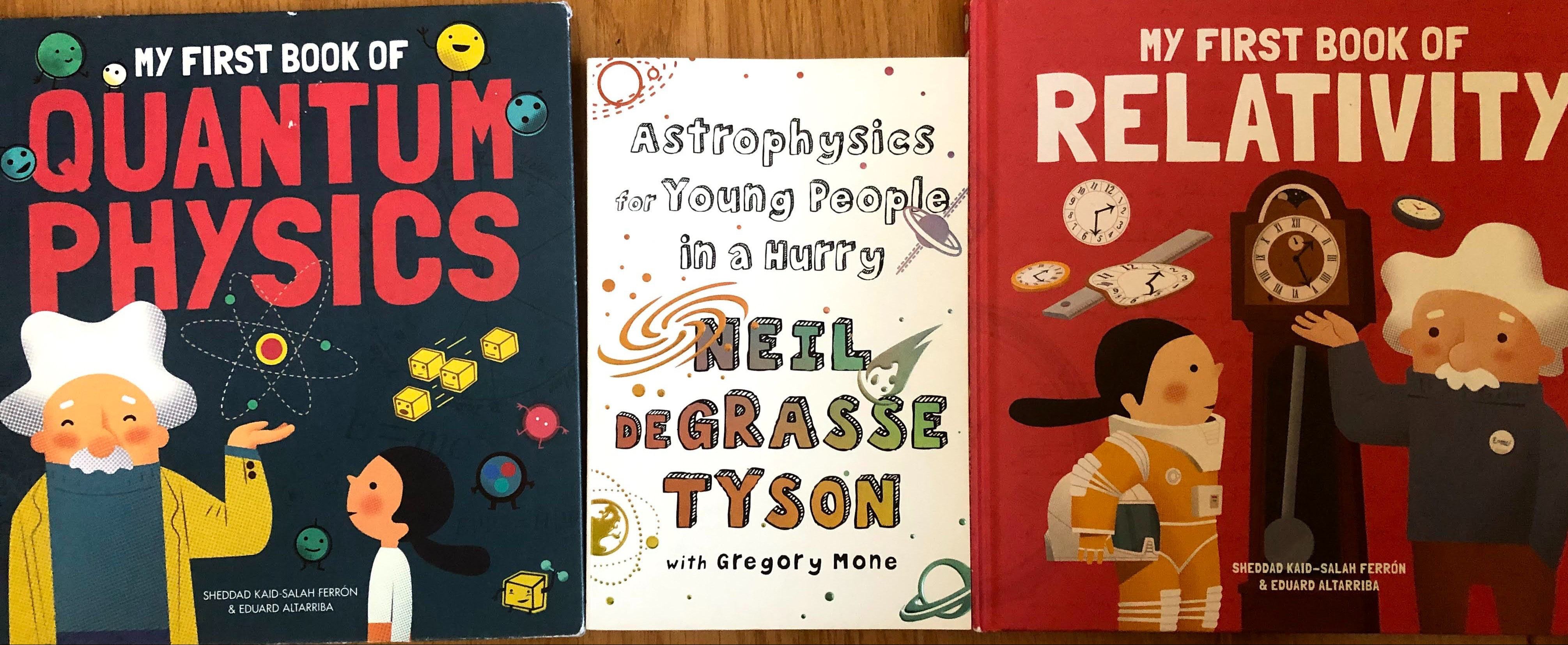
To continue the quest in Shoshin seeking,  I volunteered to take an online writing class with a focus on Science for elementary school children. 

img_1763

The idea for the class was inspired by multiple factors:

(1) A sense of wanting to be useful while doing the socially responsible thing of staying home during the Corona-virus shelter-in-place. 

(2) My brain after years of running around from Place A to Place B found a method to calm down from the frenzied lifestyle that modern man prides himself on (The Virus is a reminder of something lost long ago – an essay by Alan Lightman – a writer and physicist at MIT) 

(3) Combining the marvels of Science and keeping the wonder of Shoshin alive is pretty much what my writing has been about (at least in the past 1/2 a decade). An area of passion that I was happy to share with the children, from whom I learn Shoshin in spades.

(4) A love for children and young minds has me yearning to be like them on multiple levels. I live precariously through this yearning by reading children’s books, squabbling childishly with my own children, and much more.

The result of this was a marvelous month in which I went about reading topics that had long since been pushed to the back of the brain. I wondered as I prepared for the classes, how we wasted those marvelous moments of youth with all these fascinating subjects. I understood as the class went on:  sometimes the children were enthusiastic and wanted to write all about the topic under discussion. Other times, they liked the sound of music-like science lilting in their ears, and they nodded along sagely. The rays of the afternoon sun filtering in through the window made for warm, cozy sessions in which one saw one’s friends on the zoom call, and answered when one felt like being a part of the discussion. This was nothing close to the normal they knew, but they adapted with ease and their customary good sense. All in all, it made for a marvelous time, and with the children happy, so was I, their teacher. 

If post-Covid, some children recall sunny afternoons with thrilling science to a background of their classmates trilling in the background, while taking a leap of imagination, it is time well spent, in my opinion. 

I remember distinct moments when something piqued the children’s attention. The time I told them about giraffes in the savannah, or when we played the little game of hearing frequencies, or when we spun off pretending to be whales using sonographic techniques to unearth something really unexpected.

I am going to sign up for another 4 week session in which I hope to have as much fun, learn as much and enjoy the companionship of younger authors, who are by  virtue of their youth also leaps ahead in imagination and spirits.  Wish me luck!

Rainbow 🌈 Conscience

A few years ago when the son was in kindergarten, I attended a class room show-and-tell in which their works of art were displayed. Endearing pictures of zebras, horses and assorted flora and fauna painstakingly done, were being showed off brilliantly by the children. When I drew up close to the son’s painting, I paused. There in the corner of his painting were several people with rainbow colored faces. I loved the idea, and asked him why they had rainbow colored faces, to which he said, “Our teacher said to put colored people in our drawings.”

I turned to his teacher, and she nodded smiling, “Yes, I did for diversity, but I didn’t expect this!” My heart warmed at his interpretation.

I loved it! How beautiful and void of prejudice we are as children.

“No one is born hating another person because of the color of his skin, or his background, or his religion. People must learn to hate, and if they can learn to hate, they can be taught to love, for love comes more naturally to the human heart than its opposite.”

― Nelson Mandela, Long Walk to Freedom

I started reading Henry Thoreau’s book, Civil Disobedience, last week, and I must say the first chapter itself has me drawn in.  “The mass of men live lives of quiet desperation. What is called resignation is confirmed desperation.

A few sentences later he says again, “It is never too late to give up our prejudices. No way of thinking or doing however ancient can be trusted without proof.”

Savoring the sentences and thinking of the rainbow colored faces in the son’s drawing made me think. What would it take for us to learn what it is to be human? It seems to me like to understand deeper, we need to rely on Science: Science as a Candle in the Dark. Any phenomenon not readily understood suffers from the same problems. Could there be a better way to gauge our human-ness?

Structurally, we are containers for cells, possess neurons for consciousness, and use language for communication between one another. But this puts us in no different a category than octopus, dogs, elephants, whales or dolphins. Most marvelous creatures on Earth have evolved from the same set of conditions the planet has been subjected to, and are hence remarkably similar in these aspects. In fact, we are limited in so many abilities than our far-more abled canine friends or bird friends when it comes to smell, colors and noise frequencies.

Here is a fun game to be played by all age groups:
The High Frequency Hearing Game

Quoted from The Soul of an Octopus by Sy Montgomery:

Cambridge Declaration on Consciousness asserts that “humans are not unique in possessing the neurological substrates that generate consciousness”, and that “nonhuman animals, including all birds and mammals and many other creatures, including octopuses also possess these neurological substrates.”

Chemically speaking, I suppose we can attribute Oxygen, Nitrogen, Carbon etc as major components of the human body. But this too, is not unique to us on Earth. Many lifeforms use the same structural elements for life.
Composition of the Human Body

600px-201_Elements_of_the_Human_Body.02.svg
Image from WikiLink: OpenStax College / CC BY (https://creativecommons.org/licenses/by/3.0)

Culturally, we have ideologies so different, yet so similar. Most religions have stories of a big flood (starting from the epic of Gilgamesh, to the Matsya avatar in Hinduism, to Noah’s Ark), our mythologies have similar creatures (how then could we have dragons in Chinese mythology and Norse mythology?) The fossils found in each region seem to have contributed to the myths (Sankhu / Chakra myths originate from nautilus fossils found in the Himalayas). Is myth-making then the only human identifying factor (I don’t think so, for whales songs have tonal informational bits having the same length of an Iliad or Odyssey – some whale songs have been known to be taught from generation to generation and last over an hour long).

wind-in-the-reef

The differences in skin colors too, are no more than an evolutionary necessity – the UV light in different areas of the earth, and ability of the skin to absorb Vitamin D in areas of high or low sunlight is primarily the factors that determine these.

The Biology of Skin Color (The link between human evolution over time; the ability to adapt to different levels of UV  radiation in the tropics vs the poles; and its correlation with absorption of Vitamin D is explained in this video)

I come back to the question of what does it mean to be human? What is our unifying factor? On this globally unified Earth, can we all just find a way to get rainbow colored skin?

How Kindness Became Our Pleasure – By Maria Popova on Brain Pickings

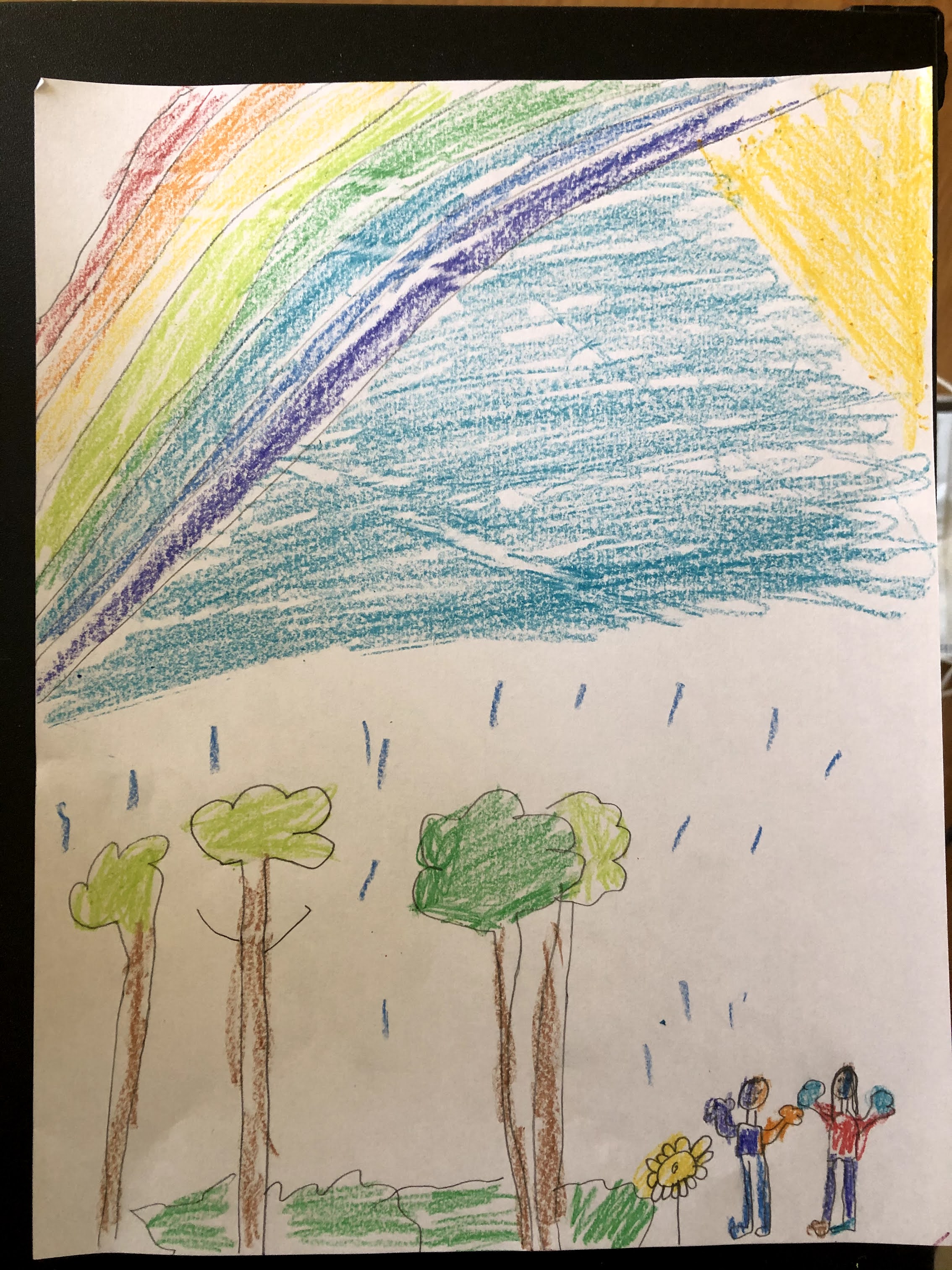
P.S: The son touchingly drew this drawing again when he saw me writing this post:

img_8613

How do we exist?

It had been another long day, and as the clock ticked towards midnight, the body yearned for sleep, but the mind looked longingly at the tsundoku pile, and craved for some quiet moments of solitude. I peeked out of the window, and the moon sailing high through the skies tugged at my heart. There is something so intensely beautiful about catching sight of our  lovely cosmic neighbor sending its mellow moonbeams through the leaves at night.

I looked for a word that captures the phenomenon, but there isn’t one.

There are two words in Japanese that come close (the Japanese language has such amazing words for admiring wondrous nature around us.)

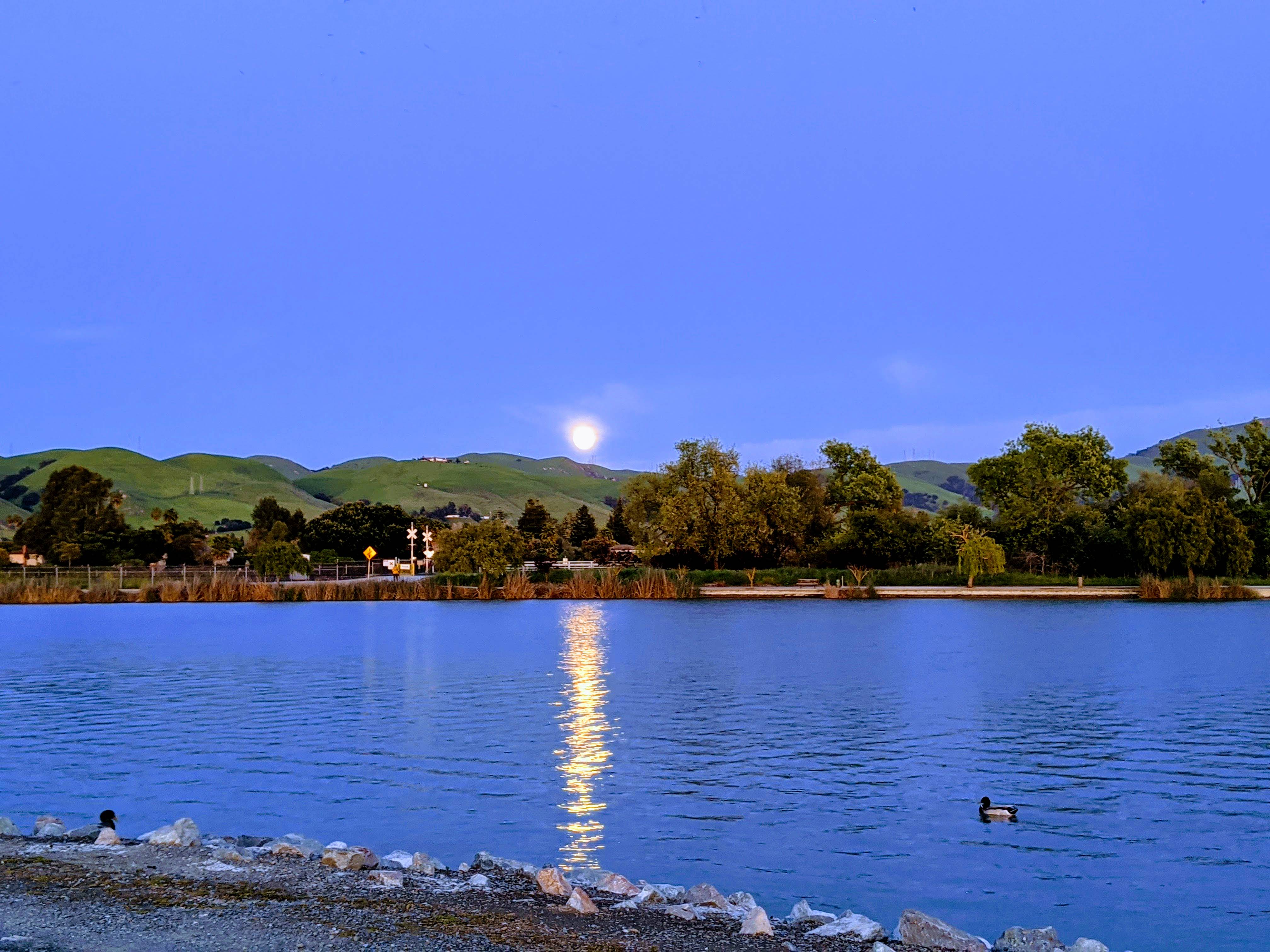
Kawaakari ( 川明かり – a word depicting the evening reflection of light on water, or in some cases can refer to the reflection of the moonlight off flowing water.

img_20200407_195324-effects

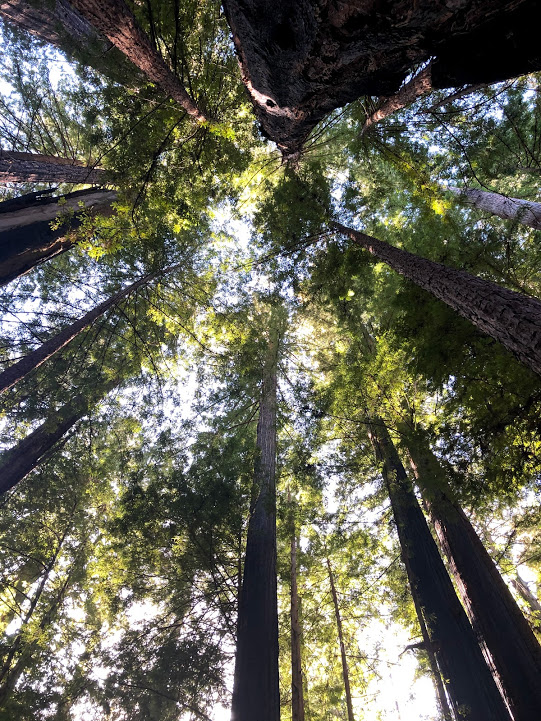
Komorebi (木漏れ日): Sunshine filtering through the trees.

trees_komerabi

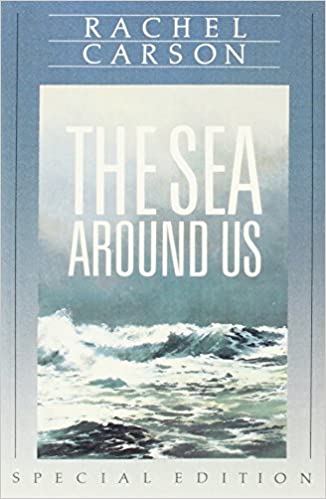
I had just started reading The Sea Around Us by Rachel Carson. In the first chapter, Rachel Carson takes us with her steady voice into a time on Earth before the seas were created. When the planet was still heaving and churning its metallic ores, hot searing waves of liquid settling into a semi-liquid state in its outer cores. She wonders then about the question, how were the oceans formed?
“So if I tell here the story of how the young planet Earth acquired an ocean, it must be a story pieced together from many sources and containing whole chapters the details of which we can only imagine.
For although no man was there to witness this cosmic birth, the stars and moon and the rocks were there, and indeed, had much to do with the fact that there is an ocean.”

Then, she leads us from this fiery place in the cosmos with the sun heaving its solar flares, the earth itself arranging itself into concentric spheres with hot, molten iron at its core, and an intermediate sphere of semiplastic basalt , the outer layers of granite and basalt. And then gently she lures us into the possibility of the moon and the ocean being related to each other.

The next time you stand on a beach at night, watching the moon’s bright path across the water, and conscious of the moon drawn tides, remember that the moon itself may have been born of a great tidal wave of earthly substance, torn off into space.

How can one not be mesmerized by the creation of the moon? Was it truly hewn from the surface of the earth (The moon’s density does match the density of the outer crust). The hypothesis that the moon was hewn away after massive solar tides exerting a pull on semi-molten Earth is based on the theory that the large portion thus hewn away left such a large scar on the surface of the Earth. A scar that would continue to shape Earth and its lifeforms for millions of years afterward: The Pacific Ocean.

Later, as the Earth cooled and clouds formed from the steam rising, the rains started. Pouring onto the hot earth for years – initially almost immediately evaporating into steam, but eventually collecting as water – forming the first oceans.

It is, of course, fascinating that we still do not know for sure how the moon was created. There are several theories – theories of violent impacts, random objects being attracted by gravity, and young earth managing to keep one satellite, while heftier ones like Jupiter acquiring 67 etc. This is a topic still under discussion.

https://www.space.com/19275-moon-formation.html

Nevertheless, the very first chapter had me wowed. I would never be able to look at our closest cosmic neighbor with the same eyes ever again. How often I have stood marveling at the moon? Out on walks, my heart always skips a beat when I catch sight of the beautiful, faithful satellite accompanying Earth as she tears through space. To think that there is a possibility that the very creation of our cosmic neighbor was crucial to our oceans is awe inspiring. I live on the Pacific Coast, and never can I see the bays, the ocean or the moon without reminding me of this book.

The Sea Around Us by Rachel Carson

sea_around_us

The skies hold the answers to our most philosophical stirrings. Why do we exist?

The seas, it seems, holds the answers to our most existential stirrings. How do we exist?

Missing Chemistry Lab?!

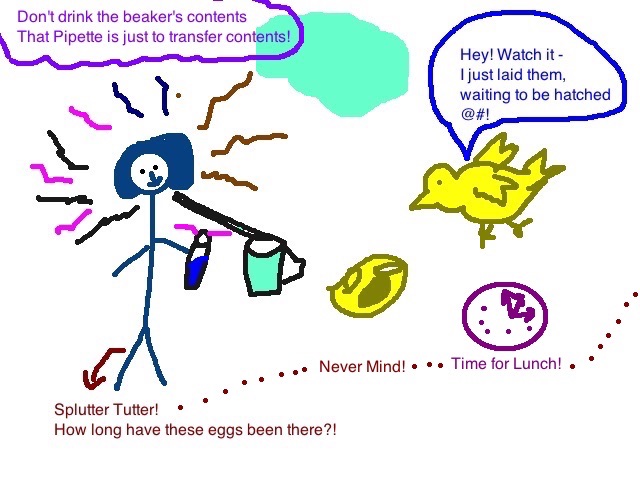
“How are you managing to do Science experiments during these Covid times?” I asked the daughter as she munched on a cookie while on a diatribe about her latest Chemistry assignment.

“Oh we do it online. You can tip stuff into test tubes with your mouse, and it shows you what happens.” she said with a shrug, and I must tell you, I paled.

Wasn’t the whole fun of Chemistry lab the hissing noises as two unlikely elements reacted? Or the joy of seeing the colors change inside the test tube as you held it up to be seen by the light? The bright copper sulphate blue, the lilac, the pinks and turning neutrally to white letting out fumes? What about the olfactory? The hydrogen sulphide that sent us gagging towards the windows with the rotten egg smells. (The fact that we made it straight to lunch after a Chemistry lab with H2and tucked in with an enormous appetite speaks volumes to the marvelous feeling of youth.)

Chem_lab

I said as much to the daughter, and she gave me the pitying look she reserves for me when she senses that I miss my school days. “It’s just Chem Lab, it will be fine! Don’t worry!”

“Should I just forget about those eggs I bought a while back, so you can experience the rotten egg smells to your heart’s content?!” I asked solicitous.

She roared with laughter at this and said, “Your cooking is Chemistry enough Mother!”

It was in part conversations like this that peppered my read of Oliver Sacks’ Uncle Tungsten, A Chemical Boyhood.

uncle_tungsten

His journey with the Sciences and his joyous epiphanies as he realized the neat order of things, and his poetic joy  as he traversed the Periodic table, gave me a new appreciation for the Periodic table too. In his words,

“Chemical exploration, chemical discovery , was all the more romantic for its dangers. I felt a certain boyish glee in playing with these dangerous substances, and I was struck in my reading, of the range of accidents that had befallen the pioneers. Few naturalists had been devoured by wild animals or stung to death by noxious plants or insects; few physicists had lost their eyesight gazing at the heavens , or broken a leg on an inclined plane; but many chemists had lost their eyes, limbs and even their lives, usually through producing inadvertent toxins or explosions.”

Chemistry, is tucked so far away in my consciousness, that I reveled in the beauty of it all almost anew. Glimpses of my committed Chemistry teachers in my youth came to me. I remember the feeling where their passion for the subject came through as they explained how the electrons revolved around the nucleus, the atomic weights, the inert gases and all the rest of it. I can vaguely begin to recognize how it must’ve felt to wax eloquent about the structural wonders in the world around us, to a bunch of mildly interested, if not completely indifferent, teenagers.

If ever there was a profession that was steeped in delayed gratification, teaching must be it. Why does it takes us decades to realize the stalwarts who did their best by us?! I tried putting all of this into words as I discussed the book with the daughter, and she said, “Yeah age makes you kooky I suppose. Must find the chemical reactions for that!” She laughed at her own wit while I  scowled. Slowly, she donned a far-off look, and said, “You know? Chem is just fine if he doesn’t keep having us go back and write out our mistakes for him so we show him why we made the mistake! Really! He is a grumpy old man and he is only twenty!”

I guffawed out loud at this – I must remember to ask about this Chemistry teacher of hers a few decades from now.

The Noble Accolades

The sun was up briskly rousing all of nature’s non-nocturnal creatures to rise and shine. I opened my eyes – the sun had nudged me half heartedly wondering whether I was to be classified as nocturnal or non-nocturnal that beautiful Sunday morning. I had after all spent a good part of the night reading several books late into the night. Covid-19 has wrought a strange change in reading habits and I found myself yearning for some uninterrupted time in which to get my reading done. I devoured two short stories by P.G.Wodehouse, read some tidbits of 3 other books and finally settled in for a long-ish snuggle with Uncle Tungsten by Oliver Sacks.

Bookworm_ReadingCorner

I felt strangely alive – with that beautiful feeling of youth-ish rebellion stealing over me as I read on. How long had it been since I had defied reasonable bed-times and gone on reading late  into the night? Moreover, I was reveling in the boyhood of the great Oliver Sacks – a boyhood steeped in Chemistry and his experiments with them.

But, there is a reason for such pesky things as sleep times. As a teen, the body shrugged off a night like that with a spot of tea, but I found the intervening decades did not take so kindly to this sort of treatment, and I was being given by the stink eye by the neurons in the brain that refused to wake up.

I dragged myself from bed the next morning and set some dish-pots on the stove for the afternoon meal. I don’t know what I plopped in there it terms of ingredients. I moped and moaned, “Oh with Covid, all these folks are posting these amazing pictures of their culinary adventures in Facebook, and I don’t even know what I am making!”

“Aww! Don’t worry ma! You always manage to make it palatable except when you get creative and experiment and stuff!” said the daughter eyeing me drooping over the kitchen counter. She shuddered and said, “Remember that bread pudding?!”

I maintained a dignified silence for post-bread-pudding, most people had to do the same as the pudding seem to get their jaws stuck. While the pot bubbled, I flopped over to the Uncle Tungsten book again, and started  reading. The chapter was about Eve Curie’s biography of Madame Curie. The book was given to Oliver Sacks when he was a ten year old boy by his mother and he had savored the copy over the years. 

uncle_tungsten

 I seemed to finally awaken as I read the passage below aloud to the children:

Eve Curie’s biography  of her mother – which my own mother gave me when I was ten –   was the first portrait if a scientist I ever read, and one that deeply  impressed me. It was no dry recital of a life’s achievements, but full of evocative, poignant images- Marie Curie plunging her hands into the sacks of pitchblende residue, still mixed with pine needles from the Joachimsthal mine inhaling acid fumes as she stood amid vast steaming  vats and crucibles, stirring then with an iron rod almost as big  as herself; transforming the huge, tarry masses to tall vessels of colorless  solutions, more and  more radioactive, and steadily concentrating these, in turn, in her drafty shed, with dust and grid continually getting into the solutions and undoing  the endless work.”

The book is full of footnotes, and annoying as this can be sometimes, this particular footnote was fun. 

Footnote:

In 1998 I spoke at a meeting for the centennial of the discovery of polonium and radium. I said that I  had been given this book when I was ten, and that it was my favorite biography. As I  was talking I became conscious of a very  old lady in the audience, with high Slavic cheekbones and a smile  going from one ear to the other. I thought, “It can’t  be!” But it was – it was Eve Curie, and she signed her  book for me sixty years after it was published, fifty-five years after I got it. 

The pot I had set on the stove sizzled over, and I charged to take control. When the dish was salvaged, I said, “See what all can happen when Eve & Madame Curie worked together dear? Madame Curie won the Nobel prize, and her daughter chronicled her! Imagine all that is possible if we were work together more sweetly in the kitchen together? I plop, you stir, I salt, you pepper. Maybe we could have our picture posted on Facebook as two smiling chefs who were never happier than when cooking together, and you can post the dishes-finale in your Insta account!” I said. 

The child did not even have to think before she shook her head. “Mom and daughter working together with chemicals and stuff! Oh they must’ve fought plenty. Besides! Think Mother! Is a Facebook photo worth all that?”

“You think!” I retorted. I have always been quick with dumb repartees.

She laughed and tousled my hair – she is now fully a head taller than my head and these days when I need to give her ‘the look’, I get the feeling of a meerkat peering at a giraffe. I suppose my noble culinary marvels will just have to wait for the Facebook accolades.

The Other Side of the Glass

There is a girlish delight in tucking oneself in the mode of Being, away from the duties of a Doing life on a Saturday morning. As I watch the minutes blend into hours, I sense my senses relax and delve deeply, calmly and yet completely enthralled at the prospect of indulging in my favorite pastimes of reading and writing. I feel the privilege in that sentence as I write it, for I recognize it for what it is: a luxury.

I hear the bees buzzing in the beautiful Spring day outside, a pair of blue jays have chosen a tree nearby to make their nest, and I watch the pair of them flit about busily during their days. Every now and then, one of them would come and peck on the window pane as if to check on me, though I know that comes from the human longing for self importance. The blue jays may just like the sound of the glass against their beaks, or probably; the reflection of themselves as they fly past. Whatever their motive, it is one of their many acts that I relish from the other side of the glass.

The other side of the glass.

What a wonderful way to observe the world? The internet is rife with jokes on humans sheltering in place with animals peeking at us, with their clever commentaries of us, and I must say I relish it. For once, we are all unanimously united in that state of achieving inner peace against the steady dripping of the news around us.

So, here I am sitting comfortably and reading the book, Uncle Tungsten – Memories of a Chemical Boyhood by Oliver Sacks.

The world as seen by the prolific writer and physician – his boyhood escapades with Chemistry and the influences of his life, are fascinating, full of learning and wonder, and makes one acutely alive to the fact that each life is a magnificent journey on its own. To those of us who are lucky to see life as an act of not just being, but becoming, it is a subtle reminder of the love of living.

uncle_tungsten

Every now and then, a passage takes you by surprise, such as this one. Oliver Sacks was born into a family of 4 siblings to physician parents, Dr Samuel Sacks and Dr Muriel Elsie Landau (one of the first female surgeons in England).

Reading has a way of taking us into worlds other than our own. I was delving into London of a century ago in his memoirs. The act of taking our consciousness with it to a different place and the ability to anchor us to the here and now, is a unique gift of reading. I found that strange juxtaposition in this passage:

“When it was time for my father to open his own practice, he decided, despite this early training in neurology, that general practice would be more real, more “alive”. Perhaps he got more than he bargained for, for when he opened his practice in the East End in September 1918, the great influenza epidemic was just getting started. He had seen wounded soldiers when he was a houseman at the London, but this was nothing to the horror of seeing people in paroxysm of coughing and gasping, suffocating from the fluid in their lungs, turning blue and dropping dead in the streets. A strong, healthy young man or woman, it was said, could die from the flu within three hours of getting it. In those three desperate months, at the end of 1918, the flu killed more people than the Great War itself had, and my father, like every doctor at the time, found himself overwhelmed, sometimes working forty-eight hours at a stretch.”

Just like that, I had moved to the other side of the glass. 100 years on, here we are, sheltering-in-place with the Coronavirus pandemic, and watching a similar situation of our good doctors being overwhelmed, and resources being stretched to their limits, as the virus sweeps through the world.

The other side of the glass.

Let’s care a whole lot!

T’was family movie night. An evening fraught with decisions, and everyone’s voice and opinion clanged over the dishes and sizzled over the noise from the stove.
Suggestions rose, opinions swelled and movies quelled.

“Uggghhh! No way!”
“That again?”
“What are you? A kid? Oh wait! Yes you are a kid! Okay never mind!”
“Nope! Too much for Amma! “
“What do you mean? It isn’t too much for me?!”
“You bawled last time for a movie that wasn’t even a tear-jerker, nope! How about this?”
“Star Wars!”

A collective moan went up. Finally, it was revealed that the youngest member of the family had no recollection of the Dr Seuss movie Lorax. He has read the book multiple times, and so we all settled in to watch Lorax.

The_Lorax

Dr Seuss is an inspiration, of course; but just how insightful his take on humanity is uncanny. From fresh air as a commodity, to a land without trees, to surveillance at every pore, his far sighted vision has so much to nod your heads at.

The Thneeds, created by the Once-ler, in his story are made from Truffle trees. Thneeds were fashion statements – doubling up from head scarves to sweater vests and shawls. (“But even he, it seems, could not envision a future where ripped jeans were fashion trends!”,  I said and drew a grudging chuckle from the teen with the ripped jeans. ) Eventually, of course, the Once-ler’s greed led to decimation of trees, habitat loss and a devastated landscape is all that is left.

“Wow – that was such a good movie Amma – though the movie had scenes that the book didn’t have.” was the verdict of the youngest.

“Really! Humans are impossible!” said the teenager, and discussion turned to conservation, Greta Thunberg and some you-tuber who talks about going green.

“Did you know the Lorax was banned in some schools in California because loggers felt it was not friendly to the ‘foresting industry’. ” I said.

I looked at their agonized faces with awe – how is it children get these things, and adults don’t; and I felt a surge of hope.

lorax

We were walking a familiar route through our neighborhood a few days later, stopping to see some of the felled trees as we do every so often. The rings in the pine trees show they must have been at least 80 years old, and to see the forlorn stumps reminded of the beautiful book, The Giving Tree.

img_7820

The book starts with friendships between a young boy and an apple tree. The boy plays and swings on the tree’s branches, but as he grows older demands more and more from the tree. He needs her apples to make money, cuts her down to build himself a house and a boat, and finally comes back tired and spent with life, when all the poor tree can offer is the stump to rest.

The Giving Tree, can be interpreted and discussed in many different ways. Givers & Takers, Need & Greed, Selfish & Selfless, but the most beautiful one is the simple one, the one where your children make a sad face at the end, and say, “Why doesn’t this boy/man/grandpa ever feel sorry for what he’s done?”

giving_tree

The boy reminds us of human’s relationship with nature. The human species can be broadly classified as takers: from the planet, & from our co-habitants on this planet. You might have seen this video clip of Man’s greed By Steve Cutts:

The Giving Tree too was banned interestingly for sending sexist messages – the tree was female and the little boy continued to take from her without ever giving back.

I just finished a book called Losing Earth – by Nathaniel Rich. The book, deals with the science, politics and action of climate change.

losing_earth

Despite humanity having the science locked down more than 50 years ago, little action has resulted. The closest we came to getting everyone to agree on unified action was the Paris Agreement where all countries agreed to work towards keeping emissions such that we not go above the 2 degree increase of temperatures world-wide. The largest emission offender for decades, United States, pulled out of the agreement when Donald Trump became President.

I was shocked to find that Climate Change as a topic has been banned in certain schools, skirted around in others and given a miss altogether elsewhere. The science behind Climate Change and the effect of our industries were long proved – as far back as 1970.

This April 22nd is the 50th anniversary of Earth Day with a special onus on Climate Action. Maybe this Earth Day, we can renew our commitment to the only pale blue dot that will harbor us. Let’s care a whole lot about our planet before all we are left with is the word ‘Unless‘ like in the Lorax story, or the tree stump in The Giving Tree.


no_garagepale_blue_dot

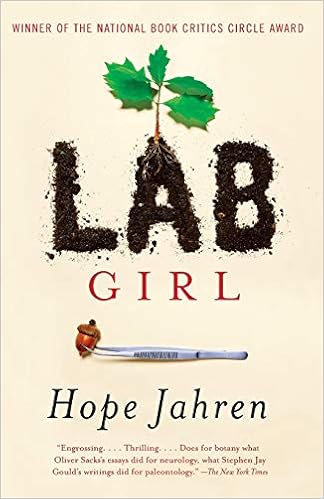
Read also: Are we to become Lab Rats?


The Rings of Life

We were walking a familiar route through our neighborhood, stopping to see some of the felled trees as we do every so often. The rings in the pine trees show they must have been at least 80 years old.

img_7820
For an impatient flitter such as myself, trees are truly sentient beings. Beings that teach me about holding still, of being sentient beings for the small time we spend on this beautiful planet. Like a butterfly flitting through the Earth for a day. You can replace tree for a star in the quote below and it would still hold when one sees redwood trees, sequoia trees and old banyan trees.

“From the point of view of a mayfly, human beings are stolid, boring, almost entirely immovable, offering hardly a hint that they ever do anything. From the point of view of a star, a human being is a tiny flash, one of billions of brief lives flickering tenuously on the surface of a strangely cold, anomalously solid, exotically remote sphere of silicate and iron.”

― Carl Sagan

As I was reading Life in the Garden by Penelope Lively, I stopped to relish the section on trees. Though the book is largely about gardens, she does make a foray into trees briefly:
“Tree rings are wonderfully eloquent; here is time stated, time recorded, time made manifest. Dendrochronology- the scientific method of dating based on the analysis of tree rings-can determine past climates, or the age of a building, it can be used to calibrate radiocarbon dating, or by art historians to determine the date of a panel painting. And all because a tree grows slowly, systematically, but laying down each year a memory of what that year was likes – usually wet, dry cold, hot-whether the tree flourished and grew, or held back, and how many years have passed. And the more I think about it, the more I have come to the conclusion that this is why trees invite anthropomorphism. They are sentient in a way that a building cannot be.”

octopus_tree

When I read this piece in Life in the Garden by Penelope Lively, I thought to myself, that Covid-19 would not register in the life of trees, would it? Droughts, wildfires, these may, but Covid-19 would not. The human suffering is acute – there is no doubt about it. The true heroes are the front-line workers, such as doctors, nurses, water and essential service providers, cleaners, mailmen, supply chain workers for groceries and medication who are braving the outbreak to keep society functioning as best as it can, while the virus takes it toll. The human toll is one thing, Covid-19’s economic ramifications is quite another, reminding us of the tottering pile we have built our societies upon: Stock markets indices, economies, international boundaries, – everything that a virus can thwart on a whim.

3D_medical_animation_coronavirus_structure

What would Covid-19 imprint in our psyches? It can be a time of transformation. A time of reflection. A time to prune the unnecessary, a time to nurture the necessary, a time to get to know ourselves and our loved ones better. A time to think of needs vs wants.  A time of quiet.

We may never have taken pandemic preparedness seriously. Covid-19 is teaching us about the importance of these things. What would we need to do for far more severe outbreaks, with water-borne or air-borne diseases in the future? I am sure these will never be treated with the same levity ever again.

“Nature is always more subtle, more intricate, more elegant than what we are able to imagine.”
― Carl Sagan, The Demon-Haunted World: Science as a Candle in the Dark

The more I think about it, the more I want to believe that we shall embrace Science as a Candle in the Dark. Many children will take up research in microbes. I hope we shall, from now on, invest in our infrastructure, in our research, in our general preparedness, and appreciate the fragility of life and our social ecosystems itself. Our rings in time will bear out the wisdom in the coming years if only we learn from it. One dark circle reverberating it’s learnings outward, and spreading light in the subsequent rings afterward.

“In its encounter with Nature, science invariably elicits a sense of reverence and awe. The very act of understanding is a celebration of joining, merging, even if on a very modest scale, with the magnificence of the Cosmos. And the cumulative worldwide build-up of knowledge over time converts science into something only a little short of a trans-national, trans-generational meta-mind.”
― Carl Sagan, The Demon-Haunted World: Science as a Candle in the Dark

References:

  • Life in the Garden – By Penelope Lively
  • The Demon-Haunted World: Science as a Candle in the Dark – Carl Sagan

Fascinating Hidden Worlds

The son sat next to me one evening as I was typing out this article and looking up the picture of the Corona Virus.

3D_medical_animation_coronavirus_structure

Image By https://www.scientificanimations.comhttps://www.scientificanimations.com/wiki-images/, CC BY-SA 4.0, https://commons.wikimedia.org/w/index.php?curid=86436446

We both sat looking at the image that showed up and he said, “Wow! Is this really the virus? It looks so lovely, doesn’t it?” I had to agree.

The unimaginable beauty of the microscopic world is so rarely stopped and admired. Who knew a blade of grass could be this spell-binding?

img_7653

This particular virus has caused such unimaginable disruption world over, it is humbling to see the world buckle on its knees against the onslaught of this virus. While, viruses and bacteria often come to the spotlight in scenarios such as these, the truth is that we need a multitude of them to survive on a daily basis. There are studies linking gut bacteria  to mental well-being for instance.

Theodor Rosebury, a microbiologist, wrote in 1928, during his research that:

“The knowledge that micro organisms can be helpful to man has never had much popular appeal, for men as a rule are more preoccupied with the danger that threatens their life than in the biological forces on which they depend. The history of warfare always proves more glamorous than accounts of co-operation.”

The Corona Virus has brought the rich world of microbes to the forefront for the world. To give us an appreciation of how many microbes we regularly thrive on for our living, consider these figures: There are an estimated 100 Trillion microbes in our bodies. The estimated number of stars in our galaxy is around 100 billion.

Many children growing up in these times may well be awed by the power microbes, bacteria and viruses exert on us, and go on to study Microbiology and change our understanding of the worlds within us in unimaginable ways.

The microscopic world is a marvelous one. Revealed to us 350 years ago by the talented man often hailed as the Father of Microbiology, Antony von LLeuwenhoek, his letter about animalcules was published by the Royal Society in London. As Ed Yong says in his book, I Contain Multitudes, his letters were published by the Royal Society in “an extraordinary monument to the open-minded skepticism of science“. LLeuwenhoek had no background as a scientist, yet he applied the scientific method to sampling and studying the world around him. In 1680, the draper cum businessman, whose curious mind and hobby led to the revelation of Microbiology was elected a Fellow of the Royal Society.

I Contain Multitudes – Ed Yong – Article from Brain Pickings

For those of you wanting a quick, fascinating glimpse into a Universe within our Universe, please check out the book, Hidden Worlds by Stephen Kramer with photographs by Dennis Kunkel.

hidden_worlds
Hidden Worlds

While Lleuwekhoeks early microscopes could only magnify upto 260 times, the images revealed in the book, Hidden Worlds magnify images by upto 1000,000 times. The resulting images are breath-taking.

The images revealed are only black-and-white by the microscopes. Scientists then use computer modeling to color in the images and the stunning pictures are better than works of Art. For instance, the picture below shows some common allergens and pollens that cause so many to sneeze all Spring.

The book briefly explains about SEM and TEM microscopes, the work that scientists typically do to prepare their specimens.

  • Transmission Electron Microscopes: TEM can magnify images by 1000,000 times
  • Scanning Electron Microscopes : SEM can magnify images by 10 – 300,000 times

Looking through the pictures in the book, we realize how marvelous life is, and what a fragile ecosystem we have to thrive in.

Covid-19 has also made us realize the importance of our normal lives. The gratitude to be alive and healthy, to be able to do the work that interests and moves the world forward, to be able to revel in the beautiful companionship of our friends and family.

“As the years pass, I am coming more and more to understand that it is the common, everyday blessings of our common everyday lives for which we should be particularly grateful. They are the things that fill our lives with comfort and our hearts with gladness — just the pure air to breathe and the strength to breath it; just warmth and shelter and home folks; just plain food that gives us strength; the bright sunshine on a cold day; and a cool breeze when the day is warm.” 
― Laura Ingalls Wilder, Writings On Wisdom and Virtues

References:

Candles in the Dark

I remember talking to a man who was our van driver in the Yucatan peninsula. His theories were astounding, and he seemed to have scoured the internet for the plausible and marvelous, completely ruling out the possibilities of evolution and what science proved to us. He was obviously a man whose love for the marvelous made him an interesting story-teller, and was probably well-received  at parties.

Here is a clip from his conversation:
’Ah! Evolution. I don’t believe in evolution as a theory. I have a theory’, said the van driver. ‘My theory is that aliens are responsible for life on earth. I think that the aliens had tried to see if life can flourish on Earth with dinosaurs.’
Four second pause.
‘And then they found them too big. The dinosaurs were too big, you know? I think that the asteroid that hit the Earth was nothing but a nuclear bomb sent by aliens. You see it all the time, don’t you?’

‘Eh… What do I see all the time?’ I asked. I have to come clean and admit that I don’t see dinosaurs all the time. Or aliens if you come to think of it, and definitely hope not to see nuclear bombs sent by the unseen aliens to hit the now extinct dinosaurs. I like a quiet life.

aliens_theory

I felt sorry for the man. His mind was after all curious, and he was obviously in awe of the marvelous. He wanted to know what happened to the dinosaurs, he wanted to know how we came to be. A Science education, half-heartedly imparted in the faraway days of his youth were hardly enough for him to find and keep the wonder in Science. Moreover, Science was a demanding master. Every hypothesis required proofs, validation by peers. It all proved too much for the man. He was happy enough believing that an alien race came and bombarded Earth with their nuclear missiles when they felt dinosaurs were of no use to them. We could do the same to another planet, couldn’t we?

I am currently reading Science as a Candle in the Dark – In a Demon Haunted World by Carl Sagan.

In his usual manner Carl Sagan had hit the problem on its head:
We have arranged a global civilization in which most crucial elements – transportation, communications, and all other industries; agriculture, medicine, education, entertainment, protecting the environment; and even the key democratic institution of voting – profoundly  depend on science and technology. We have also arranged things so that almost no one understands science and technology. This is a prescription for disaster.  ”

I found myself nodding along as I read: One the one hand, while we know about Machine Learning and how it is used to change our ways  of life, we do not always understand all the variables involved and how each value affects the outcomes. We do not really know the chemistry behind the medicines we take and why they work  on our biological systems, and so much more.

On the other hand, somebody had shared yet another spurious discourse given by a religious figure. This time, the man spoke glibly – his half baked theories about the nature of the Universe had his audience enthralled. The man spluttered forth a jumble of high-sounding words, and the audience cheered and applauded.

Again, the audience was looking for nothing more than understanding a complex world. A world made more complex everyday with our technologies and applications.

The truth is the world is a complicated place. Grants determine research, enabling rich businesses and corporations to drive and set the tone for research (Remember the studies where the Sugar industry completely misguided the population by funding research related to Fats instead? ) Big money corporations also have the ability to have their own research facilities, and they are not always going to watch out for the common man. (Privacy concerns by Ethicist Tristan Harris – the  former employee at Google)

More than ever, we need to find a way to incorporate Science as a way of life, and equip ourselves with Baloney Detection Kits as Carl Sagan named them. We need to enlighten ourselves – maybe light ourselves a candle in the dark.

Books: Science  as a Candle in the Dark – Demon Haunted  World – By  Carl Sagan