A Break from Breaking News : Please!

A few months ago, I was discussing the concept of a column with an editor. She suggested ‘It’s Not Breaking News’ – seeing as that was the theme of the writing on my blog. I felt inordinately proud at that. I loved that my blog was perceived as such.

It got me thinking of all the things I looked forward to reading in newspapers as a child. My brother went for the Sports and Automobiles column, I went for the Humor and Science sections in The Hindu. It is why I still love the Open Page section of The Hindu and was so proud to have been published in it as an adult. Who said dreams did not come true?

I remember smiling at the Slice of Life column written by V Gangadhar every week. After all these decades, I may have forgotten the content of his columns, but I remember how it made me feel. Combined with the illustrations by R K Laxman, this was week-end magic – reminding us of the joys of human living.

“I’ve learned that people will forget what you said, people will forget what you did, but people will never forget how you made them feel.”

― Maya Angelou

Jane Austen

I read in a book of essays on Jane Austen’s works, a few years ago, that one of the reasons for her enduring popularity is not because love and affairs of the heart were a novelty, or because there was no other material to choose from, but because of the gentle reassurance of the warmth of humanity.

Which makes sense. Since it wasn’t as though the world was peaceful or even that her own world was idyllic. I think her choice of theme was powerful – she chose the best themes of humanity to write about. After all, she lived in a time of slavery, spice wars, economic upheaval, and before antibiotics came on the scene – which meant there must have been plenty of personal tragedy in her circles as well.

A Jane Austen Education

Incidentally , it is her 250th birthday today, and I find myself thinking fondly of her humorous characters and wondering whether a snippet of Emma or Sense & Sensibility is on the cards for viewing – even if only for 20 minutes. Let me try my luck with the family. 

P G Wodehouse

The same can be said about P G Wodehouse’s choice of theme. Young love, satire about economic classes, and gentle mockery of perceived classes among human-beings. He lived through the horrific 1st and 2nd World wars. He was interned in 1942, and taken to Germany, where he lost over 60 pounds and in his own words, ‘looked like something  a carrion crow had bought in ‘ – a scarecrow. He lived through the most horrific times. He also experienced personal tragedy after losing his step-daughter Leonora – a daughter he adored. 

Do Not Hate in the Plural

Any of these writers could have taken any of the less savory topics – poverty, slavery, war, crime, misery, hunger, disease, imperialism – name your pick. But they chose to focus on the light, on the rewarding, on the beautiful nature of the human spirit that looks for happiness and peace.

When Humor Jumped in Neptune’s Pool

As Stephen Fry said on P G Wodehouse:

He taught me something about good nature. It is enough to be benign, to be gentle, to be funny, to be kind.

– Stephen Fry on P G Wodehouse

Please! No Breaking News!

In some ways, I think I try to do the same on my own modest scale with my writing. When the news is relentless. When I receive Breaking News multiple times a day, I think I yearn to give myself a small dose of what is important, and what is worth working towards – finer qualities of humanity and their spirit, nature, humor, friendship, camaraderie, family, books. 

I wish we could embrace more of these, so that we can find a way to get properly outraged when something horrific happens. As such, it is a brutalizing cycle of normalizing outrage. When the shooting at Brown University became news, how can the leader of a free country come out and say, “Things happen.” ?

Fallout after Trump’s critical statement about Rob Reiner

https://www.usatoday.com/story/news/politics/2025/12/15/donald-trump-brown-university-shooting/87772785007/

Why are we not more affected by it? 

A voice in my brain answers logically: Because the desensitization is deep.  Because you cannot be angry and upset all the time. Because action means nothing. Because this. Because that. Because.

What is the best medicine?

Then I stop to pause and reflect. The warm qualities of humanity is the best antidote. It is the only thing that matters in the end isn’t it?

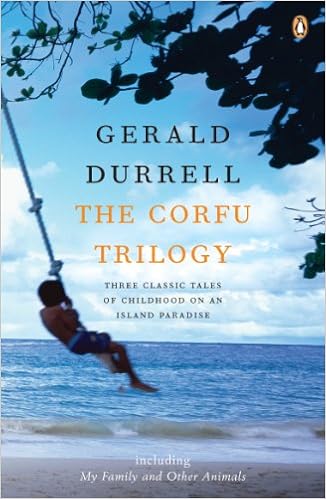
It is why 250 years later, we still relish a Jane Austen movie’s nth remake. It is why we still laugh at the absurdities of life as outlined by P G Wodehouse, Jerome K Jerome, Miss Read, R K Narayan, Gerald Durrell and stalwart authors who do the difficult job of finding light and keeping us hopeful through it all.

Breaking News is bleh. The lack of Breaking News is what we have to strive for.

“Be the reason someone smiles. Be the reason someone feels loved and believes in the goodness in people.”
― Roy T. Bennett, The Light in the Heart

So, my questions for you:

  • What is the source of reading that serves as the light in your life?
  • What is it that you look forward to rather than dread?
The Joys & Jams of Plum Picking

Feeling Plum?

“Go on! Ask me How I am feeling.”

Eye roll.

“Just ask.”

“Fine! How are you feeling?”

“Plum!”

Then I laughed, and the children exchanged concerned glances at each other. Completely lost on them, of course. So, I set about explaining Plum minutiae to a mildly uninterested audience.

I have been thinking of P G Wodehouse during plummy times. (P G Wodehouse was called Plum by his close friends and family)

I have been thinking of little passages from Miss Read’s books as she wrote about making jams and chutneys for bazaars from the excessive plums and marrows during summertime.

How lucky country children are in these natural delights that lie ready to their hand! Every season and every plant offers changing joys. As they meander along the lane that leads to our school all kinds of natural toys present themselves for their diversion.

– Miss Read

I told the children about eating so many berries as children in the countryside in the Nilgiris, it made us slightly sick.  But, I also told them about how it was the most fulfilling thing in the world, and they rolled their eyes again.

An Excess of Plums

You see? We are having an excess of plums.

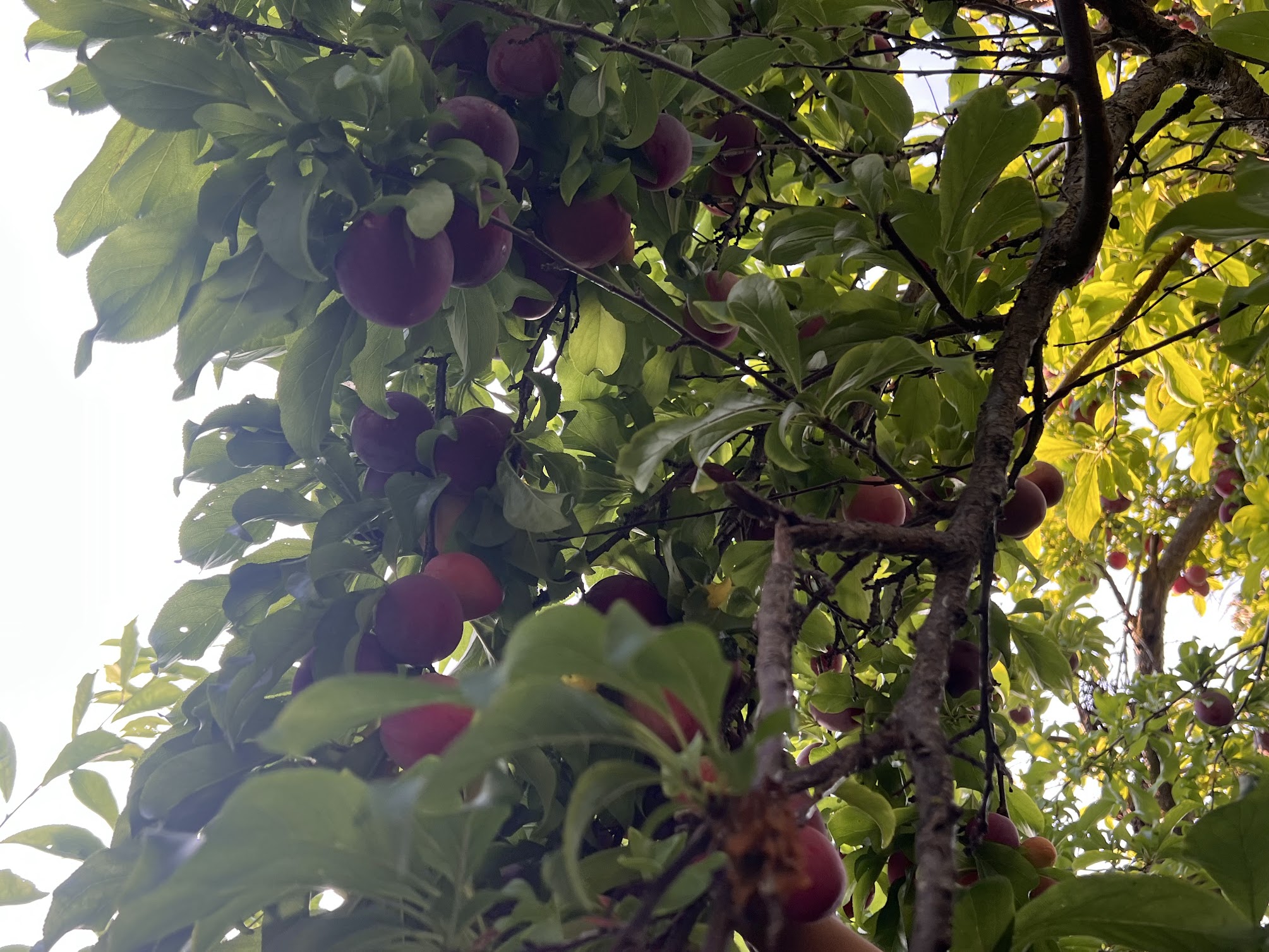
Some days I would gaze up at the branches – grateful for the bounty. Other days, I would step into a mushy one that plopped into my path and spattered and mutter to myself. Plum season is upon us, and nobody is spared. Neighbors, gardeners, cleaners, household helpers, friends, family. Everybody is gifted with plums. 

I stood one evening determined to make the best of the plum bounty, and set about making batches of plum pickle, plum jam, plum chutney, and plum juice. I also might’ve eaten a few plums. It was beautiful. The evening light was streaming in through the kitchen bay windows bathing all the world in a luminous glow. The plums were freely squirting their juices into the stovetops, the floors, the kitchen counters, my clothes, and the children stood around helplessly in the melee. 

“Amma – you’re going cuckoo! Can’t you just leave the plums?!”

I gasped for dramatic measure and said that prudent folks saved the excess. 

“Another 10 have fallen from the tree since you came in ½ an hour ago. Let it go!” said the daughter. Seeing that lunatic obstinate look on my face, she decided that the best thing to do was to leave me alone and took mocking videos of me instead.

I sorely regretted this plummy splash of enthusiasm a few hours later. I had sticky juice everywhere, a jar of jam, a jar of pickle and two bottles of sour juice. But I also had the back-breaking task of cleaning up the kitchen. The mops ran red, the washcloths turned pink, the tissues soaked and cleaned like they had never done before, and yet the kitchen was nowhere close to done.

I tell you. 

Black & Blue & Plum

The next day, I plucked and picked more plums and gave them to my friends. “Err…it’s okay! I have some!” they said.

“Oh! Sure – that’s nice. Don’t worry – I’ll walk over and give them to you.” I said smartly, putting the phone down before they could say no, and walked over.

“Would you like some blackberries?” said one of them, and I beamed at her. 

“Oooh! That’d be a nice change of pace from plums!” I said, and set about picking the blackberries and popping them in the mouth. The friend peeked into the bag and said, “Plums might make a change from blackberries!”

We looked at each other – lips stained with blackberry and plum juice and started laughing so hard, it was hard to stop. 

I’d call that a fruitful week-end, wouldn’t you?

A Lament for Short Stories

Give me short stories over real news or fake news any day

The clouds are wondering whether or not to drizzle. It is the perfect weather for musing and meandering thoughts.

I wonder how I meander to the thoughts on short stories – maybe a recent conversation. But I feel the short story is one of the most poignant losses of literary fiction. As children, magazines were filled with short stories and the thrill of finding a short piece contained in and of itself providing the nourishment of the soul was brilliant. What happened to short stories these days?

Give me short stories over real news or fake news any day. Please.

Stories in their natural length: stream, or rivulet, or tributary, or river

I’ve read stories stuffed into tweets – threatening to spill over, and bulging in all the wrong places.

And Then.

I’ve read stories watered down and stretched into novels. The original essence there, somewhere perhaps, but too watered down like homeopathic medicine.

What I’d like is a story – at its length. No fluff. No dilution. Just essence.

If a story is meant to dance and spurt joyously like a stream, let it. If it settles in, and flows like a river, let it. If it is a tributary and wants to join the main river, let it. If it is vast and encompasses depth adn breadth and expands into an ocean, let it.

Kindle Singles came up with the idea – I wonder what happened to it. They fizzled out.

There are anthologies – but they are few.

Reading the first half of The Overstory by Richard Powers made me yearn for short stories again. I think it is time to revisit Golf stories by P G Wodehouse or a little visit to Malgudi to reacquaint myself with all the characters. Tales from a Village School would be welcome too, wouldn’t it? Miss Clare Remembers is a wonderful book of short stories all woven around the fallen giant – the elegant, thin, straight-backed kind teacher, Dolly Clare.

Give me short stories when my attention is wandering. Enough to keep me stimulated, and wanting more.

Recommendations Please

Are we losing another art-form altogether? What would Somerset Maugham say, what would Alice Munro say? I remember the thrill of liking an author’s story, and then finding a whole book written by them. How marvelous it would be to crack open any magazine and find short stories there?

If you do read short stories, which magazines do you get your source from? Apart from The New Yorker I mean.

P.S: I have written a collection of short stories of my own too – both singles & themed collections. Written to its natural length, and savored from time to time by Yours Truly, but otherwise waiting – wondering where they can be published. So, if you have any recommendations of publications for short stories, please let me know.

Books – The Truest Brilliance of Humankind Captured

One of the most pleasurable tasks in December for me is to go back and wander over my reading lists for the past year. It is always a source of pleasure, and sets the intent and purpose for the year ahead at the same time.

Book Club:

This year, I joined a book club and that provided for many hours of companionship with an eye to discussing the books afterwards with your friends.

We managed to do a variety of genres in our book club too.

A broad array of topics can be discussed with this set of books, and the cups of tea, and the sparkling conversations were truly delightful. Feminism, colonialism, sexism, sense of purpose, and so much more.

Booklegger Books:

I volunteer from time to time in elementary school classrooms and the Bootlegger Volunteer program is one such where I get the opportunity to talk about and discuss books in classrooms.

  • Van Gogh Deception – By Deron Hicks 
  • Life in the Ocean – Oceanographer Sylvia Earle – By Claire Nivola (author of Wangari Maathai – Planter of 30 million trees in Kenya)
  • The man who dreamed of infinity – the life of genius Srinivasan ramanujan by Amy alznauer illustrated by Daniel miyares
  • The Firework Maker’s Daughter – by Philip Pullman
  • Firefly Hollow – by Allison McGhee
  • Tesla’s Attic – By Neal Shusterman & Eric Elfman

Guilty Pleasures:

It is the reason I pick up books and authors whose work feels like home every so often. There is familiarity in their worlds – a safe haven for those looking to be refreshed without too much effort. The worlds where humanity has all of the problems we do – only with an eye for humor, magic, and simplicity that we crave to build for ourselves in our real lives. Malgudi, Fairacre, Thrush Green, Hogwarts, Corfu, Blandings Castle, the idyllic worlds of Bertie Wooster and Jeeves, and many more. 

  • Miss Read
  • P G Wodehouse
  • J K Rowling and many fan-fiction authors who are frankly brilliant and so deserving. Many times, I’ve hoped I could know if they went on to write other books, for I knew I would read them.
  • R K Narayan
  • Gerald Durrell

Children’s Books:

I don’t know why people go in for self-help tomes when there are brilliant children’s books for all of us to enjoy and devour. Who was it who said, It takes a true genius to explain things simply? I agree with them.

Some of these authors and illustrators are truly unsung geniuses – I wish there was a way for all places of adult work such as financial hubs, hospitals, Houses of Parliament, civic offices, transportation hubs, technology companies, insurance companies, retailing outlets etc to have a good library with children’s books to dip and delve into for a quick refresher of spirits.

I used to work at a company with an exemplary work culture. (sadly the company is no longer there) The walls were adorned with beautiful artwork, we received books as gifts every now and then, authors came to visit, and we had library nooks – surrounded by excellent books in design, literature and philosophy. I have done some of my most rigorous work in these hallowed halls of the library.

If you had access to places like this, it is truly life-changing. Some noteworthy books:

  • The Shape of Ideas – By Grant Snyder
  • On Tyranny – By Timothy Snyder (in progress)
  • The Oboe Goes Boom – Boom – the band book on the kind of instruments and the brilliant way in which the names in each of the pages actually refers to a famous player of the instrument.
  • You Can Learn to be an Artist – this book was brilliant, but it made me want to cry. It made me want to rage against the world for creating AI and taking away that simple joy of art from humans – for those who say you can do the same with the screen and a prompt now, my response is, “Why can there not be any pursuits left to mankind that is not dependent on a screen?”
  • A Songbird Dreams of Singing – Poems about sleeping animals – by Kate Hosford – Illustrated by Jennifer M Potter
  • Astonishing Animals – Extraordinary Creatures and the Fantastic Worlds They Inhabit – Tim Flannery & Peter Schouten
  • Worldwide Monster Guide – By Linda Ashman, Illustration by David Small
  • Sometimes, I feel like an Oak – By Danielle Daniel & Jackie Traverse
  • My name is as long as a river – Suma Subramaniam
  • The fox and the star – Coralie Bickford Smith (brilliant artwork – sweet story – truly captures the loneliness of being – read again)

Understanding Ourselves

What makes us human? How do we know whether we are keeping healthy in our minds and bodies? These are topics that cannot be easily answered – and yet so many philosophers and writers attempt to do just that – understand our complexities.

Alternate Universes

“I do not miss childhood, but I miss the way I took pleasure in small things, even as greater things crumbled. I could not control the world I was in, could not walk  away from things or people or moments that hurt, but I found joy in the things that made me happy. The custard was sweet and creamy in my mouth” – Neil Gaiman in The Ocean at the End of the Lane

  • The Lefthand side of Darkness – By Ursula K Le Guin
  • Goddess of the River – Vaishnavi Patel
  • Our Missing Hearts – By Celeste Ng
  • The Ocean at the End of the Lane – By Neil Gaiman
  • Generosity – By Richard Powers
  • YellowFace – By R F Kuang ( about the publishing industry)

“If more of us valued food and cheer and song above hoarded gold, it would be a merrier world.” -J.R.R. Tolkien, The Hobbit

I would probably add books and nature to the list by Tolkien.

The Ease & Malaise of Literature

The Literature Malaise

There was a strange sense of malaise and I could not put my finger on it. It had nothing to do with the body – a blood test could’ve told you that. It had something to do with the literature I was reading.

I have felt like this many times in the past – especially when reading some writer who has the gift of ripping our hearts out, crushing it, and then putting the raw, bleeding thing in gingerly again. You gasp to regain control over the poor organ again, and soothe it back into action: “Never mind – that was just a book!” and the heart contracts, beats, pumps and does its thing again. How the writers themselves write it, I do not know.

Then, there are books that take one particular theme: shame, guilt, horror, anxiety, or grander themes like social injustice, and play on the heart-strings. J M Coetze’s Disgrace comes to mind.

That was how this particular book was. The narrative tone is never upbeat. It is  wrought with anxiety.  The reader is quite caught up in the frenzy of the social media world, its harsh realities of unraveling reputations, and the fate of the protagonist in YellowFace – by R F Kuang. ‘The mechanics behind the popularization’, as she puts it in her novel. The world of popularity has always been a high-stakes game (Or at least as far as I’ve read about. I wouldn’t know.) It is interesting to see the publicity stakes in the publishing industry . The book says something to the effect of : Best sellers are chosen long before they make it to the stores.

The illusion of an image built up through social media engagement can be a frightening monster indeed. For how do you find the imaginary?

I had decided to dedicate the week-end to catch up on some reading, and was I reading?!

After a few hours, I stepped outside. The world outside was basking in the summer sunshine. The bees were buzzing around my shaggy lavender patch. The patch needs trimming, but right then, the faint smell of lavender was soothing, and oddly endearing. It was a tug to reality, a reality in which not everything felt so grim as in the book. That was grounding – I took charge.

bee_in_roseroses

I made a cup of tea, and shook myself like a dog after a swim. Literally – I went for a swim and shook myself as I got out of the water. I had been drowning in the book all morning, and the cool swim in the hot sunshine worked wonders.

The Joy in Literature

I mused to the husband. “It is like Nobel Prize winning literature. You have to be serious-minded, have plenty of  suffering and drama. You cannot bung in humor and hope and write about light and all that and expect to find literary acclaim, can you? “

Why can’t people write like P G Wodehouse? I said forlorn. What was it that P G Wodehouse said on Writing?

https://claremontreviewofbooks.com/frivolous-empty-and-perfectly-delightful/

“I go in for what is known in the trade as ‘light writing’ and those who do that – humorists they are sometimes called – are looked down upon by the intelligentsia and sneered at.” – P G Wodehouse

So what is it about taking ourselves so seriously that appeals to humankind so much? I’d like a serious response please.

The book was critically acclaimed -a lot of serious books are, you’ll notice. It is like the world is looking to see – “Ahh – this particular kind of anxiety and loneliness, let’s see which writer can crush the essence of that most succinctly.”

So, I did what I do best:  I bull-dozed through the book, sitting up till 4 in the morning, finishing the book, before soothing the heart to sleep. I refused to put myself through another day with that feeling.

Something Fresh – By P G Wodehouse

The next evening, I resolved to do the opposite. I picked up books where the overpowering mirth or joy of the writer exudes from the pages and envelopes the reader in a warm, cocoon. A trip to Blandings Castle seemed nice

“This is peculiarly an age in which each of us may, if he does but search diligently, find the literature suited to his mental powers.”

P.G. Wodehouse, Something Fresh

 I laughed, and I grinned at the turn of phrase. I anticipated the next laugh – because I had read the book several times of course, and I still hung on. Laughing – matching the glorious summer outside. Later that night, the son & I thumbed through an illustrated copy of a favorite book as the silvery light of the full-moon filtered in through the night. 

All was well. Knowing all will be well in a book is a wonderful feeling. It is why I turn to authors like Miss Read, P G Wodehouse, R K Narayan, Alexander McCall Smith, Jacqueline Winspear etc like plants turn towards the sunlight.

Recommendations Please

Please recommend some authors you turn to for light, joy, hope, optimism and magic.

🌸🌸🌸 Oubaitori in Spring Time 🌸🌸🌸

Spring is here, and with it, the delightful uncertainties of the weather. 

Would it be a cold, bright, cloudless day, or a cold, cloudy day, or a warm sunny day? The possibilities are endless. Sometimes, I feel like a lamb in spring-time ready for a spot of prancing and rollicking in the hills, other times, like a caterpillar not yet ready to shed the cocoon.

Springtime is a fantastic excuse to wear a silly hat and chase after unicorns, wouldn’t you agree?

– Uncle Fred in the Spring Time – By P G Wodehouse

With the increasing length of our days, it is a beautiful feeling to step out into the sunset at the end of the day, The golden hour seems more radiant, and seems to even linger more, though that just may be due to the fact that the body has had the time to sip a cup of tea at the end of the day before sunset. 

One evening, I stopped to savor a fat plop of a raindrop on my face, and saw that the cherry trees had leaves on them. The flowers had all but gone. They were there two days ago. I peered at another tree not far away, still resplendent in its floral beauty, and another one that had a good smattering of brown leaves along with their pinkish blossoms. Once again, that longing to capture the blooming and blossoming in slow-motion came over me. How lovely it would be to sit and watch for the leaves to come in? 

Ah! What little things give us pause?! 

I read about a beautiful Japanese concept, Oubaitori

The ancient Japanese idiom, Oubaitori, comes from the kanji for the four trees that bloom in spring: cherry blossoms, plum, peach, and apricot. Each flower blooms in its own time, and the meaning behind the idiom is that we all grow and bloom at our own pace.

img_0119

A few days later, I went on another walk, this time peering up at a clear blue sky, and no jacket, only to notice the young gingko trees in the neighborhood beginning to sprout their light green leaves of beauty. I remembered the large gingko tree we’d long admired. That large tree, over a century old, fell in the winter storms this year, and I felt a pang. The patch on which it stood was overgrown with fresh grass, and a meadow full of yellow flowers. Nature’s lessons and epiphanies are rarely novel, but always welcome. 

Making a mental note to go for a short hike in the beautiful green hills nearby, I reluctantly headed home. 

Spring time is nature’s way of saying, ‘Let’s Party’!

– Uncle Fred in the Spring Time – By P G Wodehouse

Maybe it is time for a spot of springtime laughter with the maestro, P G Wodehouse himself.

Mystery of the Missing Keys

In P G Wodehouse novels, he often says that when people look at these sleepy country cottages they assume nothing happens. But come night, and it is a seething place of action. I felt the same in our sleepy quiet suburb. The lads and lasses in San Francisco, Los Angeles and New York had retired for the night at 12:30 a.m. but No Sir! Not in our neck of suburbia.

T’was around the time Olaf & Anna sang “It’s Summer! It’s Summer” while yours truly went to work.

The house was filled with more plans than time or people to accomplish them. But the busy buzz of possibility was everywhere. Grandparents planned elaborate delicacies, aunts indulged the senior and junior citizens with games and food along with rigorous hiking plans, children made plans for movies and outings, older children made plans for hanging out with fellow teens. 

The household functioned like an orchestra – high notes and low tones harmoniously blending into one and another. Sometimes the violinist was missing, other times the banjoist, but the orchestra went on anyway. T’was during those one of those evenings when the count for those who planned to stay for dinner was fluid, that plans were made for teen nephew #1 who sweetly told his mother to leave the keys in ‘the usual hiding place’ for him as he planned to be a ‘little late’. 

So the fellow’s mother came to me knitting her hands and giving me meaningful looks. The pair of us before heading to bed hid the keys in ‘the usual place’, told the grandparents of all concerned and hit the sack. It was well past midnight. 

The phone call came even later. Nephew #1 was trying to keep the accusatory note out of his voice when he said the usual place was devoid of keys or any metal really, or wood for that matter, or crowbars. #Mysterious 

Filing the mystery of the missing keys for the morning, the fellow was let into the fortress. 

Now, I don’t know what you’ve heard about senior citizens – the ones I’ve seen on television are sanguine, snoring by 10, and up at 7 am for their spot of coffee and hot water. Not that party bunch in our home however. The trio partied late into the night well after we went to bed.

It was after the seniors had switched off their hearing aids and started snoring that the phone call came. The nephew, the poor fellow who had asked for the keys so he would not be left out on the porch was standing out on the porch in the night, looking like he had eaten a bush or two, climbed a tree or two, and scoured off a raccoon or two, all in search of a good key. 

After murmured sympathies, the fellow was let into the home, locked and padlocked like a fortress I might add. The next morning, I took it upon myself to solve the mystery of the missing keys. 

It turned out that one of the hearing aid wearing grandparents had a malfunction when the information about the nephews arrival was broadcast. So, they dutifully went about locking, padlocking and triple locking the doors before going to bed. Forget the keys – they would have been no use in a case of locked doors such as this one. All the grandfather had refrained from doing was pushing an almirah against the door. 

Hogwarts did a poor imitation of it when they secured the castle in The Prisoner of Azkaban.

“Who do you think is going to come and rob the place?” I asked taking my first sip of coffee for the day in.

A sputter of answers poured forth, none of them satisfactory.

I held up my hand, and stemmed the flow.

“Let me get this straight. You senior citizens partied well into the night – way past midnight seeing that we only went to bed at half past midnight. 

Then, before heading to bed, you barricaded the doors and windows so that so much as a moth couldn’t enter the house. 

And you were up at 6 a.m. to make coffee anyway. 

So when do you think any fellow can rob the house?! They had a slim hour in which to make an entry and even that was thwarted by nephews arriving. No wonder the thieves are all moaning and talking of a change in profession!” 

The household started laughing and all chagrin forgotten went about another day in which summer thrived in ‘leisured cosiness’.

The cup of tea on arrival at a country house is a thing which, as a rule, I particularly enjoy. I like the crackling logs, the shaded lights, the scent of buttered toast, the general atmosphere of leisured cosiness.

P. G. Wodehouse

Is this Pearl a Gem?

The daughter was looking for pearls to go with her dress. I moaned. Jewelry was not my specialty. Pearl jewelry even less so.  I remember, decades ago, going to one of those famed pearl stores in San Francisco and being completely bewildered by the array that met me. I told the husband quite honestly that I had no idea what I had bought and whether they were worth it, but I liked how they looked and that ought to do. Things had not changed much on the pearl front in the intervening decades.

So, off I went looking for pearls in the best place I knew. Not the oceans to hobnob with oysters and occasional mollusks to see how they were doing with the irritants of the sand against their skin and all that, but to that one place you go to check to buy anything from ‘bear goggles for toddler swimmers’ to ‘jellyfish tees for teens’: Amazon.

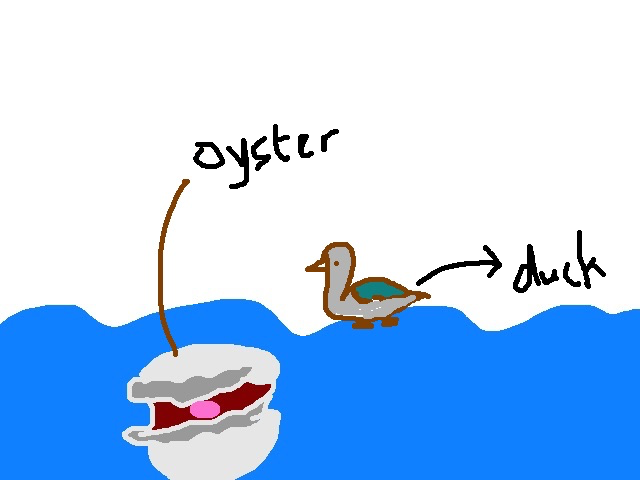
It was while deciding between a $20 piece and a $50 piece that I threw my hands up in the air. The pictures looked amazing. My keen, discerning eye that had helped me spot a heron in the riverbed before anyone else could, could make out no difference between the $20 ones and the $50 pearls. Scratch any of those observations you have seen me make on the birds nearby. With pearls, I was an oyster chasing a duck.

A little rabbit hole related reading later, I emerged with this tidbit: freshwater pearls require our oyster friends to make the pearls after they are injected with an irritant, while artificial ones could be coated with oil-pearl like substances to get the sheen you need. 

With that, I was content and bought something that she wore gleefully. It was $20 well spent. I asked her if her friends thought they were $2000, and she gave me a throaty gargle. “No ma! They know me, and they know you and jewelry too! But they said it looked nice!”

The Smithsonian on how pearls are made – in case you are interested

Imagine my surprise then when I decided to get a spot of light reading in and picked up the book, Jeeves and the Feudal Spirit by P G Wodehouse, I learnt more about these gems. Jeeves, the narrator Bertie’s valet, that trusted man whose intellect shaped his head, taught me about endoscopes and how to determine real pearls from the ones I’d bought on Amazon a few days ago.

Usually, it is risky business to hinge a whole novel on one concept viz knowing how to tell a real pearl from a dud. But P G Wodehouse, that master of the sublime, pirouetted a whole novel around this knowledge. Starting slowly like an oyster does when it’s making its pearls, the novel meanders and swishes with the ocean water, slowly grating and building the pearl.

‘The genuine pearl has no core.’ says Jeeves and then goes on to enlighten his master, Bertie Wooster.

“Core sir. In its interior, the cultured pearl has a core….Nature’s own irritant is invariably so small as to be invisible, but the core in the cultured imitation can be discerned as a simple rule by holding the object before a strong light. This is what I did with Mrs Travers necklace. I had no need for an endoscope.”

The endoscope, is also something doctors (not just endocrinologists) use to plumb your systems and to get a good view. An endoscope is an instrument that can also be used to “peer into the cultured pearl’s interior to discern the core.”

Jeeves, being Jeeves, never leaves us with just this information, but goes on to give us something about the Moh’s scale of hardness that can be used to determine a true diamond. 

After reading that piece, I chuckled to myself. When next I wear my pearls, I intend to keep away from bright lights and endoscopes and all should be well. 

Snail Tales

When R K Narayan said, writing is like a yoga, I suppose he didn’t quite envision the exact pose in which inspiration would strike. For me, it seems to be in the Shavasana(sleeping or corpse) pose. Take Saturday night for instance. I had mooned about the hills early in the am. Happy  cows, and cheeky turkeys hobnobbed with nervous cows and pesky humans to great delight in the misty dews of the morning. 

A morning out in nature is usually balm enough to get the old inspiration going. I spent the whole day with wisps of little sentences floating in and out of the brain. Sentences that would make amazing epiphanies, little witticisms that I yearn for when trying bite-size nuggets of wisdom, they all paid a visit.

Throughout the day, inspiration seemed to come along just when I was slicing the onions, or grumbling about the crumbs with the old vacuum cleaner in hand. I had no access to put some of these words to paper. Then, early evening came, and I sat down to write, when the beautiful full moon rose – hanging like a large golden orb over the Earth. Poets swooned, artists swelled, and writers bloomed. I rushed in, opened my laptop, and had one of the dullest writing sessions possible. 

I teased and pleaded – trying to gather the wisps into a cotton ball of candy, but nothing happened. I wrote the dullest set of sentences conceivable and decided to not fight the muse anymore, and headed to bed. 

I opened , Over Seventy, by P G Wodehouse, (his autobiography) and there was a section written by P G Wodehouse on how he would hesitate to use snails as subjects.

“As a writer I have always rather kept off snails, feeling that they lacked sustained dramatic interest,. With a snail, nothing much ever happens, and of course, there is no sex angle. An informant I can rely says they are ‘sexless or at least ambivalent… Obviously, the snail-meets-snail, snail-loses-snail, snail-gets-snail formula will not help you and this discourages writers from the start.”

Over Seventy – P G Wodehouse – Essay on Bridges, Snails and Meteorites

Well, what do you think this innocuous paragraph did? It started the brain off on a most interesting snail trail. I harked back to the book, Birds, Beasts & Relatives, by Gerald Durrell, where he dedicates a good portion of his musings on myrtle forests to snails, and what an interesting love subject it proved to be.

He writes with such obvious rapture on the mating ritual of snails, that I wonder why entire sonnets aren’t dedicated to this marvelous endeavor. He had the good fortune of finding the slow blisters stirred into action after a freak thunderstorm got them going. 

Sure enough, on a myrtle branch there were two fat, honey- and amber-coloured snails gliding smoothly towards each other, their horns waving provocatively.

… This freak storm had obviously awakened them and made them feel gay and romantic. 

So, there they were, side by side attached to each other by the two little white cords. And there they sat like two curious sailing ships roped together. This was amazing enough, but stranger things were to follow. The cords gradually appeared to get shorter and shorter and drew the two snails together. They stayed rapturously side by side for some fifteen minutes and then, without so much as a nod or a thank you, they glided away in opposite directions, neither one displaying any signs of darts or ropes, or indeed any sign of enthusiasm at having culminated their love affair successfully.”

Birds, Beasts, and Relatives – By Gerald Durrell – Essay on Myrtle Forests

I closed the book, and an image from the early evening, with the skies pink in the setting sun arose. I had just watered the plants. The children and I had squealed at the moisture at the end of the hot day, and stood there enjoying the little rainbows created by the water sprays, when I spotted a snail clinging to the succulents, and making a slow but hard climb towards the lavender patch. The children gathered around to see the beautiful creature too. Was the snail’s sentience relishing the sunset skies too?

Sluggish thoughts indeed, but rather the best for a drift into sleep. Where old P.G.Wodehouse was stumped with the snail-as-dramatic-love-interest angle, old Gerald Durrell had spun a yarn with the very angle. I yawned one of those jaw-breaking ones, and resolved to write about snails instead. So, here we are.

The Laughing Life

The son tumbled out of his room with yet another joke. His teachers apparently tell them a joke every now and then, and he repeats them to me if he finds them really funny, or remembers to. One of the many gifts of the Covid lifestyle are little snippets like this.

I stood there waiting and wondering what today’s j would be about.

“Why did the skeleton not go to the party?”

“I don’t know – because it had too many bones to pick?”

“Ha! Good one. But no.”

“Umm…don’t know. Why didn’t the skeleton go to the party?” I said a little impatience in the tone. I had to get to that next meeting.

“Because it had nobody to go with. Get it? Get it? No Body to go with?!”

I moaned and laughed at the same time. A lovely feeling of warmth spread through the being as I headed off. 

Later that day, I sat musing about humor and how marvelous a gift it is to humankind.

My Family and Other Animals is a marvelous book by Gerald Durrell. This book has the distinction of being the first book that I read belonging to the Humor genre. I remember it as though it was yesterday. Sitting in class 8-B, the sun was shining outside, there was a butterfly in the lawns outside, but our English teacher seemed to prefer the miracle of the written word to the fluttering butterflies outside. She put on her glasses and whipped the book out of her handbag in one elegant motion and said we were going to read the book.

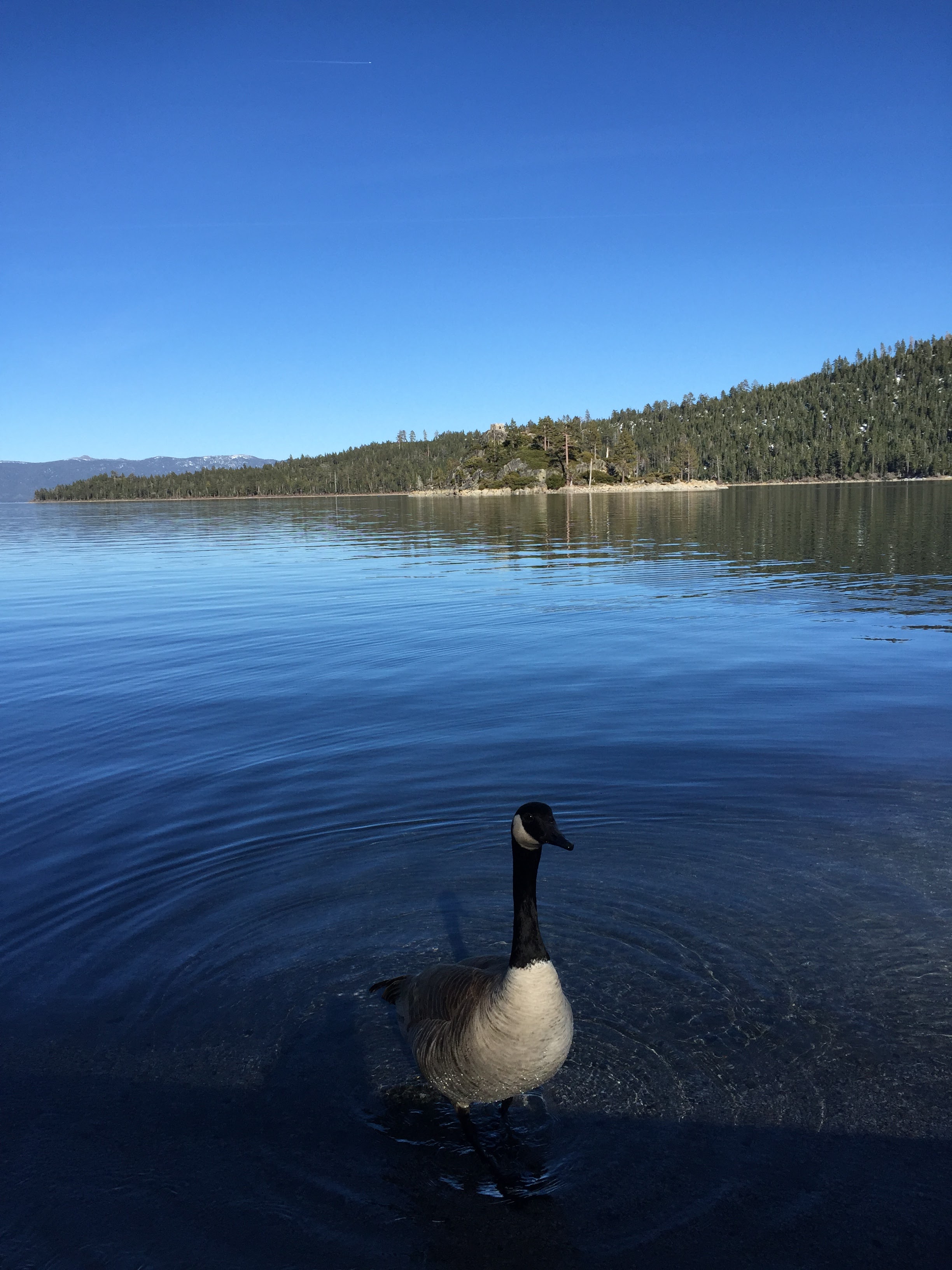
My Family And Other Animals: See how the author makes you laugh when you read the title itself? she said. We must have looked like Canadian geese being tickled for the first time, for she proceeded to explain the humor in the title. I don’t know whether you have tried tickling a Canadian Goose. I haven’t, but I think they would react the same way. Stern looking creatures Canadian Geese.

IMG_2223

Anyway, I hope for my teacher’s sake that we loosened up as the reading progressed. But, now that I look back, it was one of the first books that made me look for humor in daily situations. Mark Twain – especially the little story of Tom Sawyer painting the wicket gate was another. Swami and Friends by R K Narayan was equally memorable. I remember reading somewhere that R K Narayan when asked about his inspiration for Malgudi – that eternally inviting town that beckons you every now and then, said, he just watched life pass him by and that was all there was to Malgudi.

Pickwick Papers was slow going initially, but the humor in the book was unmistakable. These are the times I am thankful for growing up in a pre-Internet, pre-on-demand television era. I might not have stuck with Pickwick Papers otherwise. 

The ultimate guide was of course P G Wodehouse. When in high school, I changed upon P G Wodehouse, I did not immediately appreciate it. It took a few readings, but oh! What a gift?! What a gift! 

The father, of course, was and remains a constant reminder to find joy in every day life. His jokes were not always appreciated by the mater, but he could take a the rough with the smooth. Life was funny, curious, interesting and not always serious if only we stopped to admire the humor in them. The husband, the daughter and the son all joined the bandwagon too. My Family and Other Animals was taking shape in the Nourish-N-Cherish household.

Where am I going with all of this?! Oh yes! The blog itself. Nourish & Cherish started as an act of whimsy 16 years ago. It is a place that I regularly choose to don the sunny side up mentality in life.  As I started to write down this little skeleton joke, I mused on the thousands of little jokes that did not make it to the blog. For of course, I am guilty of thinking about writing and reading about writing far more than writing itself. But I am glad for the ones that did make it.

In over 900 posts over the past 16 years, life has taught me time and again, that you can choose the sunny side up.

To infinity and beyond!