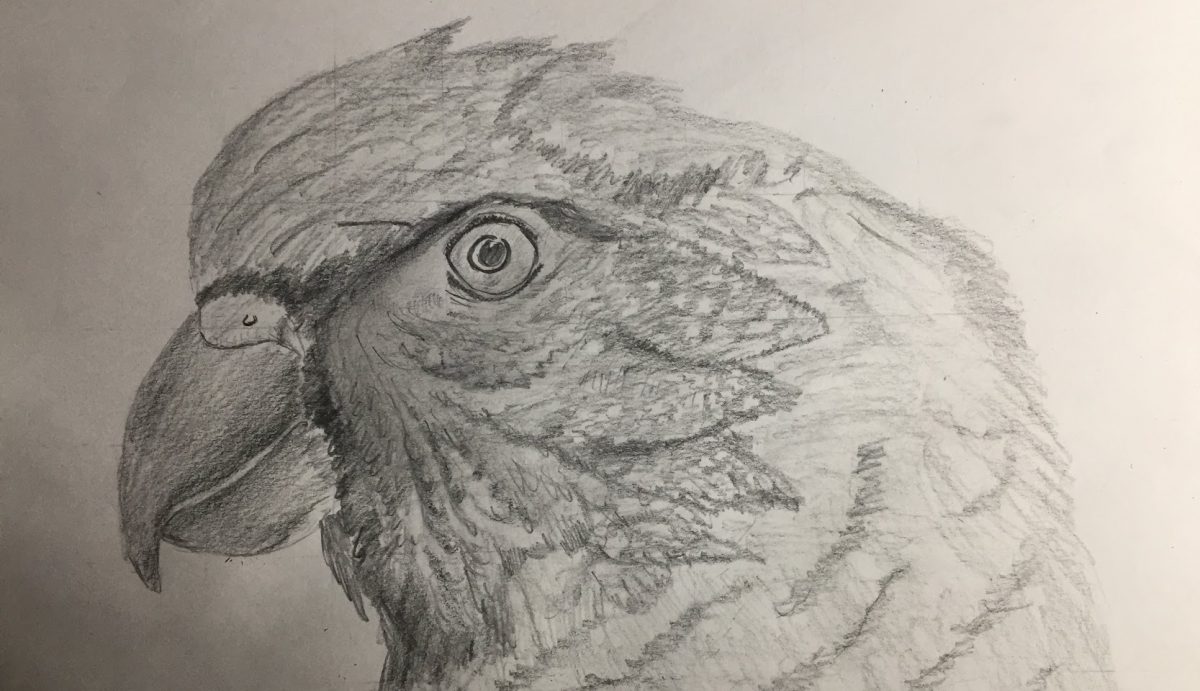
The Gingko Trees 🌳

“Did you know about the Gingko trees?” I said, knowing fully well the reaction it would elicit from the daughter.

“Oh Please! There is no need to tell everyone you meet about the Gingko trees you know?” she said.

“But there is! Maybe I will write about it.” I said. The gingko trees have given me no end of pleasure , and I must say, a certain amount of anticipation tinged with a spot of trepidation, during the past few months. The one interesting fact I know about them has been beaten to mythical status and back like the shedding and revival of the seasons.

“Are you seriously telling me that you haven’t written about the blasted Gingko trees yet?” the daughter’s voice was tinged with laughter and embarrassment. The conversation was happening in front of her friends after all.

If you really want to embarrass your teenage child, please take them for a walk explaining obscure horticultural facts along the way. Touch the leaves of the Gingko trees, tell them the scientific name is Gingko Biloba, take them back to the time when the dinosaurs roamed feeding off these very leaves and the time travel is bound to work wonders on them.

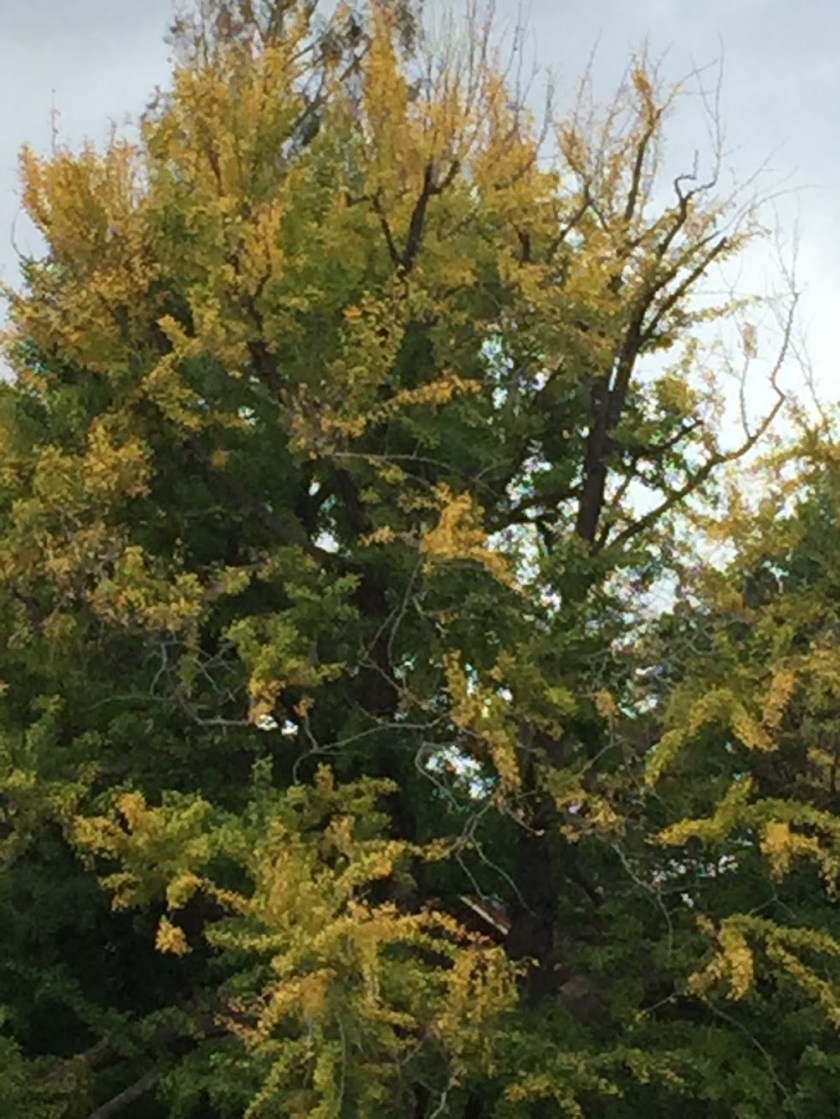
Only the teenager most proud of their parents is bound to glow like the dew drops glistening on a Gingko tree at the first rays of the sun. Mine looked like a cross between a beetroot and a maple 🍁 . I stood there poetically exclaiming that the beautiful Gingko trees had shed their golden tresses after all; happy that the interesting fact had been borne out truly by the sturdy trees.
gingko_2.jpg

Months before, as the colors of the leaves changed from olive green to golden yellow, I had told her about the fact that Gingko trees shed their leaves all at once.

“Don’t they all?!” she said being clever, but I had my answer ready.

“No they don’t as the crunch parties we have all of October and November show you. But the Gingko trees in the vicinity all shed together on one day in November apparently.” I said. “It is like the day of the party, and they somehow decide the day between themselves. Nature’s signals are truly quixotic!”

“Did you also know that Gingko trees have been around from the days of the dinosaurs?”
“And how do you know that?” the family asked looking at me curiously, as if my age was finally becoming clear to them. I did not like where this was going, and hastily assured them that paleontologists seemed to have found fossils and put their necks on the line with that fact.

Ever since, throughout November, we watched the Gingko trees with fascination, and self with a tinge of dread, for I had bored the family stiff with tales of the Gingko tree ever since I read the essay by Oliver Sacks in the book, Everything in its Place. He wrote of his learnings from the Horticultural Society of which he was a part, and he had said quite categorically that the Gingko trees party was one day in mid November.
gingko

Mid November came and went, and the yellow leaves swung their tresses proudly as the cold winds coursed through them. Rains lashed at them, and they swished them some more. Haughty Princesses they’d make, I thought to myself.

Thanksgiving came and went, and the family was now baring their fasts at me. “After all those months with the blasted gingko tree, if they don’t shed, you’ve had it Mother dear!” they said. I said that November in New York probably meant December in California, but I also prayed a little. You see, I had made a bit of a pest of myself over the past few months, and I knew it. Oh the horror if they didn’t!

December came, and I went out of the state for a couple of weeks. I cannot say that the Gingko trees were in my thoughts for very long during this time. Year end work-travels don’t give time to think of Gingko trees.

I came back, and I had come for the walk with the girls, when the Gingko trees swam into my thoughts again. Luckily for me, Oliver Sacks, was an astute man. Though, I don’t know whether they had all shed their leaves on the same day, when I saw them, all the Gingko trees in the vicinity, young and old, were bare. Their leaves lay in a heap around their trunks, and I looked vindicated. Thank you Oliver Sacks and Thank you Gingko Trees! I said privately heaving a sigh of relief.

I told the girls about the whole thing: the pest I’d made of myself, and how the solid trees had helped me after all, and they laughed heartily. “I told you my mom is a nature kook! ” said the daughter, but there was laughter there – I seemed to have redeemed myself in front of her friends.

I am not sure when I will be willingly invited next: I’d better get going on some Spring facts to dazzle the lot.

everything_place

Book: Everything in its Place

By: Oliver Sacks

Essay: The Night of the Gingko

Biophilia

Oh! What a surprise amma?! The book, Nature’s Fix appeals to you.” said the daughter peals of laughter barely concealed in the sentence.

“I know right?! I always keep an open mind to see how else I can improve, my dear!” I said not to be undone in the sarcasm department. 

“You are cooped up in a dull office building in the bustling city – you need a change. I get it! But I am quite happy and young enough to not ‘stretch my limbs’ in nature walks! Nature kook is what you are! I suppose you will now use bits of the books to convince us to come on walks with you. I’ve got homework to do, bye! ” said she mock-straining at my tug to come on a walk with me. But she came. 

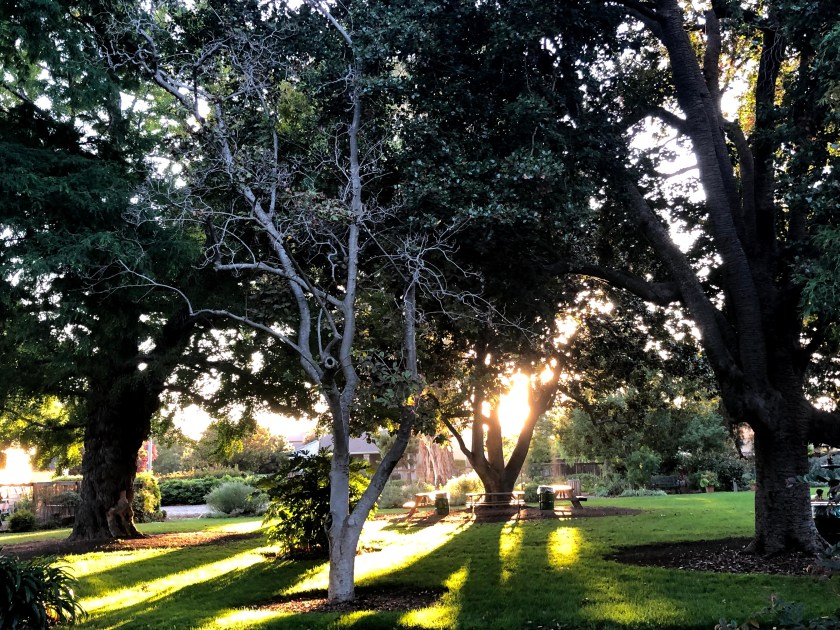
As we walked around our neighborhood, watching the leaves slowly turn colors, birds making their way home against the brilliant sunset, children playing and biking, I felt calm. How much of that was due to the fact that I could take the time for a walk at the end of the day, and how much of it was Nature’s work, I am unable to say, but I felt a wonderful shiver as I watched the evening breeze rustle through the large trees in the neighborhood. Slowly, as I watch the wave of leaves tremble in the wind, some of them shaking loose, and others just swaying to the orchestra of the evening, there is a definite sense of belonging to this wonderful planet.


As I move around the office or often when I am walking to and from work in the city, I feel a concrete shudder. We are so proud of concrete as a structural material, we pour it everywhere. I feel a lonely stab when I see our gleaming imperfections reflected back to us in the gleaming glass panes of the concrete structures. Even the trees on our city sidewalks seem to be lonely, surrounded by concrete footpaths, and millions of people jostling by them everyday. 

Screen Shot 2019-10-25 at 2.00.13 PM.png

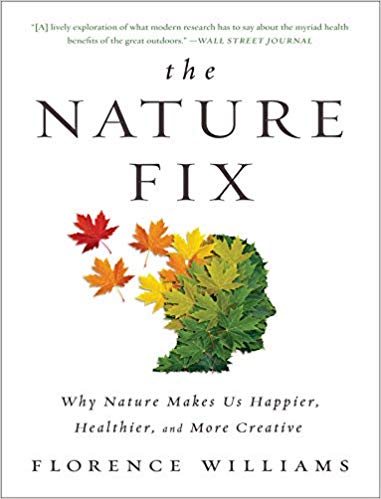
The book, The Nature Fix by Florence Williams, details studies taken up in Japan and South Korea around the effects of nature. It studies blood pressure, release of  how long the effects of nature remain with us – does it only last as long as we are with nature, or does a weekly hike contribute to our wellness over a period of time? More interesting questions such as these are handled in the book. 

I was lured into the book reading about the concept of Shinrin Yoku & Salim Yok(Forest bathing in Japanese & Korean respectively) The Japanese are also probably the only people in the world who have a word for commute hell – Tsukin Jigoku.

nature_fix

Excerpt:

Study in the Nippon Medical School:

Qing Li is interested in nature’s effect on mood states and stress as manifested in the human immune system, Specifically, he studies natural killer immune cells called NK, which protect us from disease agents and can, like cortisol and hemoglobin, be reliably measured in a laboratory. 

Only in 2016 did we officially became an urban species – for the first time, population in cities outnumbered population in rural areas. As we cluster around in larger numbers, it is even more important to study the effects of nature on ourselves. After all, our biophilia has evolved over millennia and this abrupt change from it is bound to bring changes in the ways we can adapt.

Definition of biophilia. : a hypothetical human tendency to interact or be closely associated with other forms of life in nature.

Is Nature the next wave after Meditation, Exercise and Organic Foods? 

There have been days when I have wondered how the children found out whether I indulged in a spot of meditation. 🧘‍♀️ 🧘‍♀️ I might have, but did they find out because I had taken the time to meditate and therefore already in a better mood, or did the meditation itself help with specific stressors? Nature studies have similar questions, though I am truly grateful for its personal influence on our well-being. Whether it is because of my beliefs or something else, Nature soothes.

Read also: Music & Gardens by Oliver Sacks

img_4005

The joy and importance of walking – Solvitur Ambulando – It is Solved by Walking


Moonbeams in the Morning

The morning alarm trinkled: Dawn’s misty summons. I got up, wondering why the nights passed so quickly, hoping for a little more precious sleep in the mornings. I stepped out of my bed and gingerly peeked out the window. Dawn was doing the same thing – trying to sleep in a little more, while the moon shone high above the tree tops, bathing the surrounding clouds in a magical shroud of moonbeams. The dew drops on the trees glistened in the same benign light. I stood there shivering a little for the night temperatures had dipped, and there had been a mild drizzle.

IMG_3869

The moon is there every night, the sun rises every morning, and yet the moments of quietly standing there before the hustle and bustle of our days started made me appreciate everything a little more sharply. When the son woke up, I held a finger to my lips not ready to start talking just yet, and made him peek out at the fine moon too. His eyes widened a little at the beauty of the morning, dew drops, trees, clouds and the moon. He chattered in his bright tones that sent the waves of sleep flying from him, “Did you know? We may not be able to enjoy the view of the moon for very much longer?”

“Why?” I asked in spite of myself.

“Well… we are already working on building colonies on the moon. Soon, the moon will be full of houses just like ours, and then who knows how the moon will look from here?”

“Who told you that?”

“No one!”

“Okay….where did you read that?” So much for quiet mornings bathed in contemplation.

“In the Time for Kids magazine. It seems we are already planning on moving there.” he said a tinge worried that I hadn’t received his original memo in my sleep addled state.

“Well…for all the things we have built on Earth, from outer space, it still looks beautiful you know? Maybe it will be the same for the moon. Although, I am not sure I am happy with the idea of looking in on someone’s home like that. Wouldn’t it be creepy?!”

He laughed.

I was reminded of the essay by Oliver Sacks in the book, Everything in its Place: Who Else Is Out There?

everything_place

In it, he starts with his thoughts on the book, First Man on the Moon by H.G.Wells.
Anybody Out There?- Oliver Sacks essay
One of the first books I read as a boy was H.G.Wells First Man on the Moon. The two men, Cavon & Bedford lie in an apparently barren and lifeless crater just before the lunar dawn. Then as the sun rises, they realize there is an atmosphere – they spot small pools and eddies of water, and then little round objects scattered on the ground. One of these , as it is warmed by the sun, bursts open and reveals a sliver of green.’A seed! “says Cavor, and then, very softly, says ‘Life!”.They light a piece of paper and throw it into the surface of the moon. It glows and sends up a thread of smoke indicating that there is oxygen.
This was how Wells conceived the prerequisites of life: water, sunlight (a source of energy), and oxygen. “A Lunar Morning” was my first introduction to astrobiology.

While it is interesting for us to dream of conquering alien worlds and expanding our footprint with habitable planets, such as K2-18b circling a red star called M Dwarf; it is also highly interesting to see that even on Earth that is our original home, we require a very specific set of circumstances for our life to thrive. We need our oxygen levels to be exactly right, our carbon dioxide levels to not rise too much, we need our microbiomes to be in a particular state of harmony with the larger ecosystem.

Read: Good Food Mood

Take for instance, this excerpt from cosmonaut Alexei Leonov – the first man to walk in space for 12 minutes. Excerpt :
“I decided to drop the pressure inside the suit … knowing all the while that I would reach the threshold of nitrogen boiling in my blood, but I had no choice” Leonov said

I enjoyed Oliver Sacks’ footnote, for in one sentence, it reconciled both the resilience and delicate nature of our entire species.

“If Wells envisaged the beginning of life in the The First Man on the Moon, he envisaged its ending in The War of the Worlds. where the Martians, confronting increasing desiccation an loss of atmosphere on their own planet, make a desperate bid to take over the Earth (only to perish from infection by terrestrial bacteria). Wells, who had trained as a biologist, was very aware of the both the toughness and the vulnerability of life.”

How many species have left behind their fleeting impressions on the cosmic playground? Our own are laughably recent. Will the Quod-liop-tukutuk-sfaunusaurus call us by the same name when they dig up our remnants millennia from now?

Books:
The First Man on the Moon : H.G.Wells
War of the Worlds : H.G.Wells
Astronaut Alexei Leonov: First Man to Space Walk
Everything in its Place : Oliver Sacks

Running like Elephants

“Guys! Let’s hurry up a little. I like how we are dawdling, but the school bell waits for no ships to sail across the seas! ” I said. There had been a mild spattering of rain across the dry summer season. A few snails had popped out to enjoy the moist, and the son and his friends were looking at them as they chatted and made their way to school. Rain drops on the late summer roses and oleander flowers made the scene a rather endearing one.

img_3991-effects

The response from the children was predictable – they ran, and I ran shouting like a charioteer pulling the reins on the excited steeds, “Slow down! No running here – oncoming traffic!”
“But you asked us to hurry up!”
“Yes – run like Elephants!” I said.

I had told the children earlier about the Elephant’s gait, and they exchanged glances and started laughing. The snail they were studying looked startled and showed a leap of speed as it made its way back to the comfort of the garden bed.

Is this walking? *giggle*
Is this running? *giggle giggle*
Is this fast walking? * giggle giggle giputly duggle*
Is this slow running? *giggle puddle chuckle duffle*

I smiled slowly. “Pretend you are Elephants teaching Snails to run.”

elephant_snail

I suppose that was a wrong metaphor altogether. By the time we arrived in the school, not only were we out of breath with the laughing, but we were also fashionably disconcerted. The legs seem to not remember how to walk straight or run properly, and were caught in this limbo of the Elephant’s Gait.

Later that week, I was sitting in the garden and watching the world go about its true business of living. I watched a hummingbird’s fast-paced wing movements up in the trees. A few butterflies were flitting hither and tither. A skein of geese were flying overhead in that beautiful v-shaped formation. Closer to the ground, a few snails were marking their slow way across the courtyard.

This combination of sitting in a garden, and watching life flit by had me take a hundred pictures with my phone. Pictures that may or may not be seen and appreciated again. I could capture the slow motion video of the humming bird whizzing up above or the butterflies in my midst. I could use time-lapse videos to capture the slow moving snails and a dozen pictures to capture the beautiful movement of the caterpillars.

As I sat there musing on the ease with which we capture movement these days, I could not help comparing and contrasting humanity’s struggle to capture that. I remember yawning in the Art galleries after seeing the n-th painting of a horse or the x-th statue of a horse drawn chariot.

But as I sat there that afternoon, I wondered whether I had appreciated them enough. After all, at the time of their making, studying movement was not all easy. One had to have an almost eidetic memory to understand the muscles and the way they moved.

Leonardo Da Vinci’s work is appreciated because of the lengths he went to study the anatomy of the creatures in his works. 300 years ago, movement must have been particularly hard to study.

In Oliver Sacks’ essay on Elephant Gaits in the book, Everything in its Place, he writes about the problem of studying movement.

everything_place

More than a century ago, Etienne-Jules Marey had made a pioneering investigation of elephant gaits. Of course, he did not use video analysis then, but still photography. I quote: “Marey’s lifelong fascination with movement started with the internal movements and processes of the body. He had been a pioneer here, inventing pulse meters, blood pressure graphings and heart tracings – ingenious precursors to the mechanical instruments used in Medicine even today.

Later, he moved onto the animal movements and analysis.
For animal analysis he used pressure gauges, rubber tubes, and graphic recordings to measure the movements and positions of limbs. From these recordings, he rotated in a zoetrope, reconstructing in slow motion the movements of the horse.

Muybridge, a contemporary of Marey, however, a peripatetic artist as Sacks describes him used 24 cameras along a track where the shutter would be tripped by the horses themselves as they galloped past to capture the movements of the horse as they raced.

When a similar technique was used to analyze the fast movement of elephants, it was found that they neither walked nor ran, but rather a combination known as fast walking.

I remember a long ago conversation with a friend who was training for a marathon on the more recent study of leopards running, and how he had changed his running technique to take a few tips from the world’s fastest runner.

As we watch the world around us, I wish different creatures could teach us some of their marvelous techniques. The dragonfly and the humming bird for flight; mallards and coots for water locomotion. Doesn’t Biomimicry as a field of study sound more fascinating than ever before? I positively yearn to be Dr John Dolittle at times!

Books/Articles to be read/referenced in this post:

Leonardo Da Vinci’s Horse

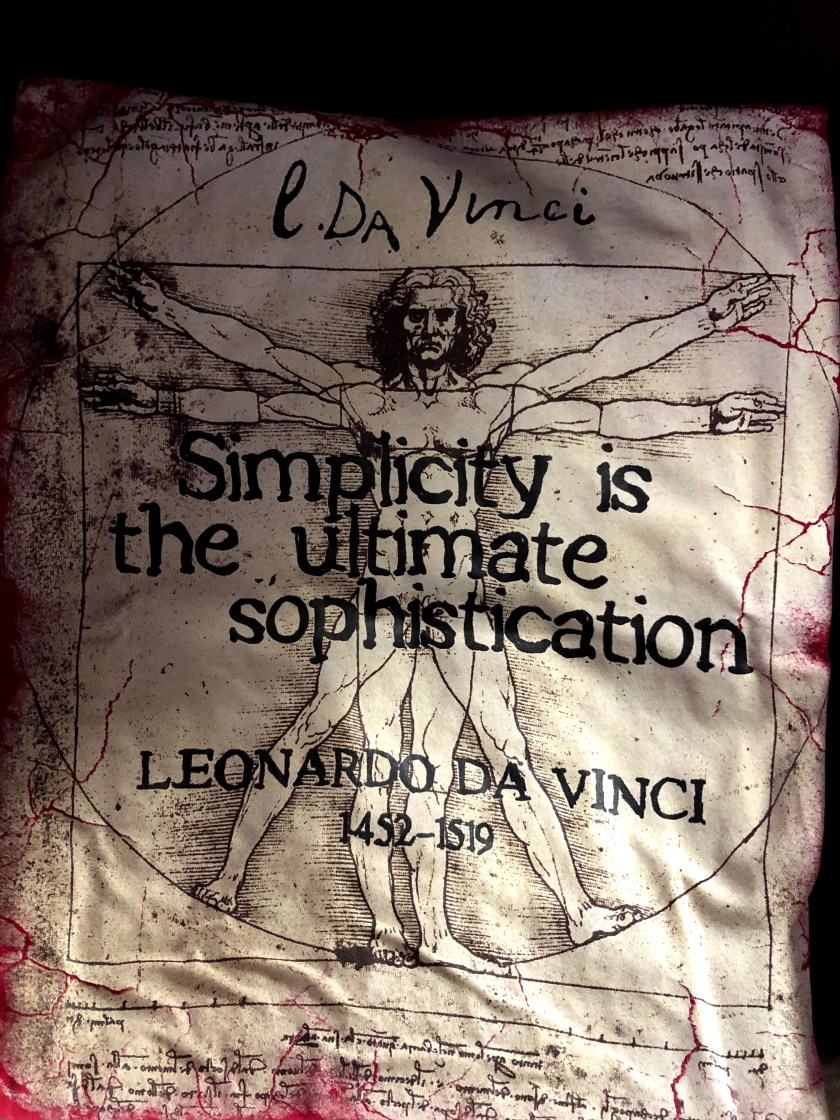
The husband was wearing a red t-shirt that had Leonardo Da Vinci’s drawing on it, that said, Simplicity is the ultimate Sophistication.

He was particularly fond of the t-shirt, especially as he was reading the biography of the great man.

img_4057

“Be like Leonardo Da Vinci guys. Be simple and eh… persistent.”, I said.

“Oh! I don’t know about that! Did you know about Leonardo Da Vinci’s horse? “, said the husband. He was reading the biography of Leonardo Da Vinci by Walter Isaacson, which is to say we almost read it. The book is a lengthy one, and as he made his way through it, he shared tidbits of things that fascinated him.

Time has probably been kind to the memory of Leonardo Da Vinci. Most of us only seem to be remember his genius in art, his legendary stature as a polymath, he said. The husband chuckled as he read and told us about Walter Isaacson’s portrayal of him – a tempestuous man who often did not complete the commissions given to him. Leonardo Da Vinci’s horse is an excellent example.

He then went on to relate the tale to much mirth and chuckling from the children. Apparently, what was commissioned to him was to build an epic statue of the Duke’s son riding a horse. He then went off to live on a farm, to study horses. The farm life yielded a treatise – an unpublished book, on different kinds of horses, equine surgeries to understand horse anatomy etc. He had originally planned to create a statue of a rearing horse.

This is an image that is much popular in the art forms at Italy, I remembered. The raw power of a horse rearing up on its hind legs is both attractive and magnetic. I am not sure how riders feel when they are about to be bucked off, but it makes for good Art. The prince would have to look brave while clinging onto dear life.

Study_for_the_Sforza_Monument
Abandoned Design. Image Courtesy: Public Domain, https://commons.wikimedia.org/w/index.php?curid=59580

Anyway, after a few years studying horses, their physiology, their movements etc, he started developing models for his statue. Clay, lead and bronze made its way from the armies to Da Vinci for his great statue. Then, he figured that the greatest statue of the magnitude he had in mind would not be supported by the hind legs structurally, and he went on to make it a standing horse. The prince riding the horse resplendently was forgotten!

These things took time, but it did not seem to perturb him. His sponsors may have been antsy, the bronze supplies may have been running low, the armies getting fidgety with not having enough new armor, but that was their problem, seemed to be his opinion.

In time, a large clay model of a beautiful horse may its way for the Duke’s inspection. The model won Da Vinci much critical acclaim. It truly was beautiful. If the Duke was slightly upset about not seeing his son on the horse, he did not show it. The royalty raise their children well.

Soon, war broke out, and no longer could his rich patron commission bronze and lead to be diverted to the most magnificent horse statue of all time. The clay model was put up in Milan, and was used as target practice by the young lads joining the army.

“But isn’t there a big horse in Milan or Florence? Da Vinci’s horse? I remember seeing a picture somewhere.” said I.

“Yes, but that was not done by him. Years later, somebody else finished it. “, said the husband.

By now, we were all laughing.

“What is remarkable is his insatiable curiosity and creativity however, and though he went off down rabbit holes, it was from a deep motivation to understand the world around him “, said the husband.

Read also : Gates Notes on Leonardo Da Vinci

“These days it is so easy to take a picture of a horse, model it, and run a simulation for structural evaluations. We sometimes forget how hard studying movement must have been!” I said, remembering the essay by Oliver Sacks on the Elephant’s Gait, in the book, Everything in its Place.

everything_place

He writes about how more than a century ago, Etienne-Jules Marey & Eadward Muybridge pioneered the study of animals running using 24 cameras along a track where the shutter would be tripped by the horses themselves as they galloped past to capture the movements of the horse as they raced.

Persistence comes in various forms, we all agreed. Muybridge and Marey were examples in a long list of people for whom a problem was intriguing enough to delve deeper and deeper into things that may or may not yield results.

But we never know the breakthroughs possible, and how things will change. That is why I am vary of futurists. A few centuries ago, to study the muscles straining for a horse running, one had to have an almost eidetic memory, along with a decent understanding of anatomy.

Today, photography has come so far as to allow us to snap a thousand pictures, take slow motion videos, and analyze everything from a butterfly flutter to the swift flying of hummingbirds. People are still extraordinarily creative with photography, and as long as we retain curiosity and creativity, I suppose we shall thrive.


Music & Gardens

It is always a delight to pick up a set of essays written by prolific writers  who are also curious intellectuals. These authors make me feel like I am reading the perspective of polymaths, and that in itself makes for a wondrous experience. The latest book that had me thinking and reading about things I had not thought about for a long time was the book, Everything In Its Place by Oliver Sacks.

everything_place.jpg

Excerpt from Wikipedia:

Oliver Wolf Sacks, CBE FRCP (9 July 1933 – 30 August 2015) was a British neurologist, naturalist, historian of science, and author. He believed that the brain is the “most incredible thing in the universe.”[1] 

He reminds us in broad strokes of his pen, the number of areas in which we can be curious. He reminds us about the vast capabilities of the human brain, even while reflecting on this particular author’s exceptional one. Reading about the brains many failings and flaws is both fascinating and eye-opening. (Oliver Sacks was a Neurologist who specialized in many neurological disorders, and writes from a place of curiosity and compassion for his patients).

His description of Tourette’s syndrome, for instance, certainly makes me think less critically of people I encounter on the public transit who have the need to shock the whole compartment with their absurd, rude and obnoxious statements, every few minutes. Sufferers of Tourette’s syndrome often find themselves cursing and shouting loudly, without being to help themselves. The shocked attention they gather seems to be the reward for their impulses.

He writes about a certain individual who exhibited severe symptoms in Vietnam and would make shocking exclamations in Vietnamese every now and then. But when he moved to the United States, his Tourette’s calmed down because people did not react as much as he thought they would in a country where his language was not understood.

I can now learn to see the person different from their symptoms, and for that I am grateful.

How can I not be fascinated as I read his sure voice confess that as a neurologist the only therapies he knows to work surely are Music & Gardens? I read his meditations on Why We Need Gardens and the words Biophilia and Hortophilia leap out and grab my attention. Nature is my soother, has always been my favorite soother, and it is refreshing to hear his perspective on the effect of nature.

img_3991-effects

Clearly, nature calls to something very deep in us. Biophilia, the love of nature and living things, is an essential part of the human condition. Hortophilia, the desire to interact with, manage, and tend nature is also deeply instilled in us. The role that nature plays in health and healing becomes even more critical for people working long days in windowless offices, for those living in city neighborhoods without access to green spaces, for children in city schools…..

The effects if nature’s qualities on health are only spiritual and emotional but physical and neurological, I have no doubt that they reflect deep changes in the brains physiology, and perhaps even its structure.

As he says in one essay, his patients even in advanced states of dementia always look forward to an hour outside amidst nature, and not one of them has ever planted a sapling upside down when given a sapling. It is almost as if we intuitively know what to do and our learnings from time may fall away from us, but our affinity to nature will not. 

In fact, he writes of one of his close friends, Lowell, who suffered from Tourette’s syndrome, that while hiking in the deserts of Arizona, his ticks and urges almost completely disappeared.

https://www.brainpickings.org/2019/05/27/oliver-sacks-gardens/ : Oliver Sacks

In forty years of medical practice, I have found only two types of non-pharmaceutical “therapy” to be vitally important for patients with chronic neurological diseases: music and gardens

What We Do

I bobbed among the sea of fresh laundry. The children were helping with the folding and sorting, while I cackled and rattled around like a mother hen. Mother hens don’t fold clothes, I know, but it is a metaphor, or a simile or an odious comparison when viewed from the angle of a hen. Anyway, the conversation was quicker than the folding and after some time, I patted them on a job well done, and sent them over for a spot of week-end television. They tumbled off clucking happily. A prized activity they seem to think it is, though they seem to watch the same programs over and over again. 

After some more cleaning, I took stock. True, there was loads of cleaning left to do, but that was always the case. For now, the boats of laundry were taken care of, the family fed, the kitchen scrubbed, the shoes, jackets and all the paraphernalia that is plopped all over the place were back where they belonged. The children were happily watching their week-end television, and the husband was pretending to do some work on the computer. All was well.

I gingerly stepped out for a breath of fresh air even though it was cold. As soon as I opened the door, the wind gently lifted my hair welcoming my foray into the quiet pleasures of a Winter day. I surveyed my flower pots weathering the wind, rain and still cheerfully raising their heads welcoming the end of Winter. If that isn’t an invitation for a stroll, I don’t know what is, I told myself and set off, an umbrella swinging on my arm, and my spirits slowly rising to meet the clouded skies above.

img_1995.jpg

I stopped to gaze up at the trees sprouting the early Cherry Blossoms every now and then. One particular tree looked marvelous: There seemed to be a luminous glow on the cherry blossoms, with the dew drops glistening on them, and I could not help standing there, and catching a respite from the never ending activity that swirled around me. Our tasks and accomplishments seem to be so loud and cantankerous compared to this marvelous phenomenon of early Spring don’t they? 

The blossoming of a flower. 

I stood there wondering how lovely it would be to see the flower blossom, to actually see it expand into a flower from a bud. I suppose you could show me hundreds of time-lapse videos, but I still wanted to see the real thing. In front of my eyes. 

That is the sort of thing that will try the Dalai Lama’s patience, and I am happy that the thought to at least try it crossed my mind, since I knew my limits when it came to stilling the mind. A monkey mind if ever there was one. 

Watching a flower bloom is a thought that has occurred to many before me, and will occur to many after me. All we need to do is stop and admire a flower. In the River of Consciousness by Oliver Sacks, he says that as a boy, he used time lapse photography using multiple photographs and frames to develop the blossoming of a flower. To play with time in a sense.

“I experimented with photographing plants. Ferns, in particular, had many attractions for me, not least in their tightly wound crosiers or fiddleheads, tense with contained time, like watch springs, with the future all rolled up in them. So I would take set my camera on tripod and take hourly photographs…and make a little flick book. And then, as if by magic, I could see the fiddleheads unfurl, taking a second or two, for what in real time took a couple of days.”

river_sacks

When seen this way, we are all time machines, slowly growing and morphing all the time, are we not? Unfurling with furious energy that detracts at times, but all of us unfurling all the time, hopefully evolving into what we shall and can be.

I gazed up at the flowers again and wondered whether self reproach, achievement, contentment, ambition, or any of the things that seem to matter so much to human beings meant anything in the grand scheme of things. I am reminded of one of my favorite quotes by Ursula Le Guin.

“Things don’t have purposes, as if the universe were a machine, where every part has a useful function. What’s the function of a galaxy? I don’t know if our life has a purpose and I don’t see that it matters. What does matter is that we’re a part. Like a thread in a cloth or a grass-blade in a field. It is and we are. What we do is like wind blowing on the grass.”

The rain picked up, and I opened up my umbrella. I had stood there a long time, and my feet and hands were numb. I went in to the home, and put my wet, cold hands against the warm cheeks of the children watching TV, and they squealed half in exasperation and half in fun as the rain drops trickled down their cheeks. They chided me, united in their purpose: “Walking in the rain – being nuts! again? You will catch a cold. Go and get warm. Now!”

It was lovely to see the chicks take charge, and get a glimpse of the unfurling.

The Secret To Blooming Like a Flower

I gabbled on about the beautiful Kurinji flower over a distinctly sub-par dinner one night. Sometimes the rhythms of cooking are too frequent. “Do we really need to eat every few hours?!” I said drowning out the sound of “You haven’t cooked in 3 days!”

The children listened – one with ardent curiosity bursting with questions and the other cloaked in teenage blasé that belies the true interest behind the flowers. ( “Cool!” – only a little wag of the ear indicating possible interest).

“Can you believe the Kurinji blooms without alarms and clocks to set store by? Every 12 years like clockwork!”

The questions that followed were better than the answers:

  • Do all of them bloom at the exact same time?
  • What about plants that grew later, won’t they all flower at different times?

My answers are not answers that would have pleased Charles Darwin perhaps, but if he wanted to answer right, he should’ve been there, not let me field them is my stout reply to this.

Interesting aside:
The River of Consciousness by Oliver Sacks starts off with an essay on Darwin and the Meaning of Flowers.

river_sacks

I could see why Darwin liked his flowers so much. This was long after his magnum opus, The Origin of Species, was completed. He actually spent the last decades of his life pottering about his green house, setting the children in his life to chart the course of the bees, studying orchids and their flowering patterns etc, and was therefore immensely better prepared than yours truly.

His joy was evident in his letters:

“You cannot conceive how the Orchids have delighted me .. What wonderful structures! … Happy man, he [who] has actually see rows of bees flying around Catasetum, with the pollinia sticking to their backs! .. I never was more interested in any subject in all my life than in this of Orchids.”

He went on to write the book with the fascinating title: On the Various Contrivances by Which British and Foreign Orchids Are Fertilized by Insects

Meanwhile, the kurinji flower was still blooming in the home: the river of questions on What Is Time flowed on:
What is Time when you are a flower?
What is Time when you are a squirrel?

The husband had a bemused and half-exasperated expression on his face, as he heard me talk about alarms, time and biological clocks. He watched me squirm and the urge to tut came to me. I knew what was going on in that optimistic mind of his. He hopes I will have the sense of a Kurinji flower someday.

I feel bad for the old boy.

The thing is, I set beautiful poetic alarms, replete with soothing ringtones to go with it, place them on his side of the bed, and then proceed to sleep like a blessed bear in the winter.

If we need to get up at 6 a.m., I set the alarm for 5:30 a.m. thereby allowing me to snooze a few times, and then go back to dozing the doze of the blessed. It is marvelous to get that snooze time, and some of my best snoozes are at this time. This vague time of day between wakeful consciousness and blissful unconsciousness.

If everything in the universe follows a pattern, how do we determine what ours is, without the aid of all our poetic alarms? There is a beauty to seeing the natural things around us, for they soothe us in ways quite unknown to our hectic way of life.

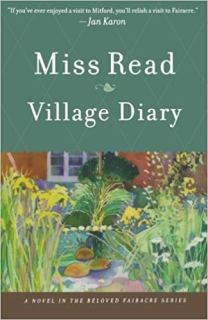
I was reading Village Diary by Miss Read for the n-th time (like a flower knows when to bloom, I know when it is time for a Miss Read re-read), and I admired yet again the simple way in which she had set a truth about humanity in her beautiful language.

village_diary

Quote:

As I ironed, I amused myself by watching a starling at the edge of the garden bed. He was busy detaching the petals from an anemone…

This short scene, I thought as I pressed handkerchiefs, is typical of the richness that surrounds the country dweller and which contributes to his well-being. As he works, he sees about him other ways of life being pursued at their tempo – not only animal life, but that of crops and trees, of flowers and insects – all set within the greater cycle of the four seasons. It has a therapeutic value, this awareness of myriad forms and varied pace of other lives.

So, maybe that is the secret to blooming like a flower. Set our patterns to the natural rhythms of the world around us rather than to the dictates of productive days.

“Hmm … when would you naturally feel like doing stuff? Like cooking! Just asking!” said the teen rolling those eyes of hers. The loud guffaws that accompanied this were appreciation enough for a chef.

I think I will take after that Kurinji flower after all.

Books:

  • River of Consciousness – by Oliver Sacks
  • Village Diary – by Miss Read
  • Origin of Species – Darwin
  • On the Various Contrivances by Which British and Foreign Orchids Are Fertilized by Insects – Charles Darwin