How To Be a Good Companion

Simba who was introduced me around a decade ago passed away last week. This post was there in my drafts for over a year since I read My Family and Other Animals by Gerald Durrell. Simba’s passing made me acutely aware for the gratitude I feel for these furry friends.

Ask Sanku, Simba, Bogie, Luna, Timothy, Sanku, Tinky and Bolu, and they will all unanimously tell you that I may be a good sort in general, but the best past-time they have is to see me when in their midst. Sanku, Simba, Bogie and Luna have been introduced to me later in life, and though they may not believe it possible when Timothy tells them, they are seeing a mellowed person of years.

Timmy, named after Timothy, the dog in the Famous Five Adventure Series by Enid Blyton. (Timothy (The Famous 5 one) was a raucous, energetic dog who would have done anything for his 4 human companions. ) Having such an illustrious name to live upto, you would think Timmy would have been a better companion to me. Instead, he was a vicious little yip who forever found me atop bushes or gates, where I had scrambled in my haste, squeaking like a rat waiting for help. Timothy has seen the hot stuff. ‘Hot dogs!’, he used to say to himself and go ‘bow-wow-wow’, lackadaisically, sometimes not even bothering to stir from his kennel (which I helped build lovingly with wood panels and nails by the way), and I would find myself scrambling through hedges with spiders in my hair, looking demented and scrappy.

timothy_me_on_fence

One flip of a puppy, Bolu (I remember thinking that self respecting mice would scoff at the name), had me charging up 67 steps at such a scorching pace that the physical education teacher leaning on a tree nearby chatting with his friends, promptly placed me on the relay team, where my performance was nowhere close to what it was with Bolu on my case.

The daughter yearns for a dog, and would gladly give Bolu & Timmy a sharp kick for giving their mother this unreasonable fear of dogs. But my recent canine companions have done much to help me overcome the fear.

Simba, Sanku, Bogie and later Luna, have been marvelous in their quest to make me become less eccentric around them.


I have often wondered how I would react to people who made it clear that they were uncomfortable in my presence. Would I leave them alone, and feel bad at such a seemingly irrational reaction? I must say the deportment of my canine friends in later years have put me to shame. If anything, they have taken the discomfort with sagacity and a grace that we will do well to learn from. They taught me with patience, and took me under their wing with the understanding of having to deal with a dim-witted student.

Patiently, they initiate me into the art of relaxing in their presence. First a small wag to indicate they think I am a good-ish sort, and then a little curiosity followed by an affectionate brush up against my leg was their method. They instinctively seem to know how to be a good companion.

How can one be a good, even perfect, companion? This excerpt from My Family and Other Animals comes close to addressing the question.

My Family & Other Animals is a wonderful read for anyone looking to experience the wondrous world around us with humor and candor. I admire the work of naturalists as regular readers know. The author wrote of his life in Corfu near Greece, and his adventures on the island were magically transformed by his deep affection for his dog, later dogs. He writes:

pets


(Pic my own)

In those early days of exploration Roger was my constant companion. Together we ventured farther and farther afield, discovering quiet, remote olive groves which had to be investigated and remembered. He was the perfect companion for an adventure, affectionate without exuberance, brave without being belligerent, intelligent and full of good humored tolerance for my eccentricities.

family_other_animals

He goes on to say about Roger – who sounds like the ideal companion anyone could wish for, that:
If I slipped when climbing a dew shiny bank, Roger appeared suddenly, gave a snort that sounded like suppressed laughter, a quick look over, a rapid lick of commiseration, shook herself, sneezed and gave me his lopsided grin. If I found something that interested me – an ant’s nest, a caterpillar on a leaf, a spider wrapping up a fly in swaddling clothes of silk – Roger sat down and waited until I had finished examining it.

Reading about Roger almost makes me wistful for a companion like him during my nature saunters in my youth. But in later years, Simba, Bogie and occasionally Sanku have come with me on hikes, and I have never felt more alive in the natural world than around them. No sniff was too blasé for them to consider, no dog they met on the trail deserved the ignominy of no-greeting. The trails came alive with them around. The flowers, grass, insects and squirrels were granted the same courtesy of curiosity and unflagging acknowledgement. When their human companions flagged in energy, they made their intentions known – “You can do it. I am with you.”


How to be a good creature by Sy Montgomery is a children’s book in which the Author writes of what different creatures taught her. The essays on her Dogs and her Pig are particularly good reading.

good_creature

Simba passed away last week, and his passing has made me consider the fundamental question: How to be a good companion?

Classical Whale Symphony

Soft instrumental music was lilting in the background, and the sun’s watery rays were streaking in through the recently rain-washed window-panes. It was a beautiful week-end morning, and the kitchen was bursting with activity. The children were helping by putting away the dishes as noisily as possible. I was making a mess of things by changing the menu nimbly depending on what my refrigerator had. (Grocery shopping had taken a backseat the past few days and rations were thin on the ground)

The children were giggling about something when the teenage daughter said to hearty nods from her little brother. “By the way, what is this blasted toing-toing music you are listening to?”

“Melodious and uplifting for the soul, my dears. Classical Instrumental Music. Changes the way neurons interact.”

She shook her head, “Changes the way my nerves react!”and changed it to something that made my eardrums pick up the dishes and bang them viciously inside my head, while she chatted. Teenagers, I tell you!

“Whales like Classical Music.” , I said weakly.

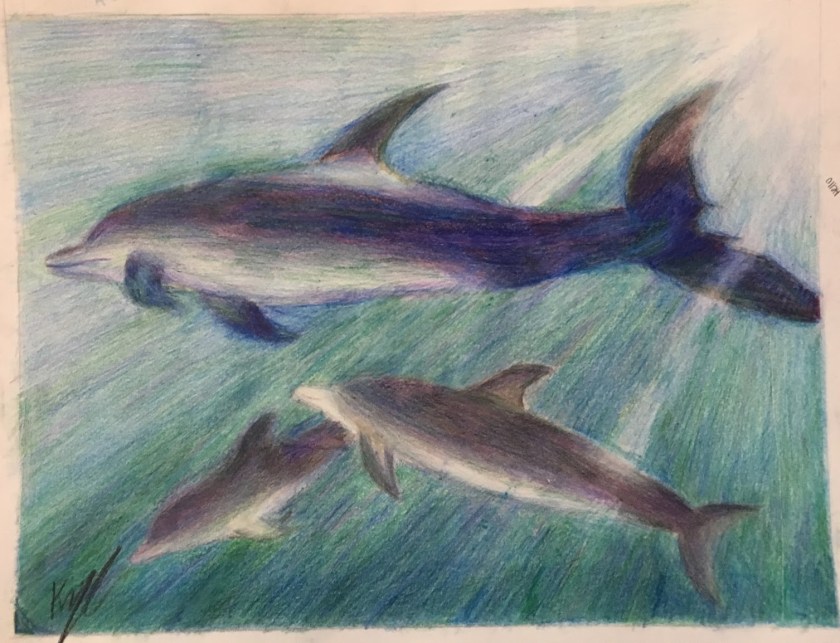
“Well, I’m not a whale am I?” said she giving me a fish-like look- not the fishy look, the glassy gleam. I saw the piscean divergence in the gene and agreed. Though she could be, given her favorite doodles are themes under the sea

Art work by the Daughter:

Ever since I read in Carl Sagan’s Cosmos about Whale Songs, I have been enamored with the language of music, and the myths of the whales.

Quote from Cosmos by Carl Sagan on the Humpback Whale songs:
These vocalizations are complex. If the songs of the humpback whale are enunciated as a tonal language, the total information content, the number of bits of information in such songs, is some 10 to the power of 6 bits, about the same as the information content of the Iliad or the Odyssey.

I was naturally was attracted to the book, The Symphony of Whales by Steve Shuch. It is based on a true story in a village near the Arctic circle. The onset of Winter had been swift, and a pod of whales found themselves iced in near Siberia. Unable to get out in time, the whole pod faced death in the iced-in waters.

symphony_of_whales

According to the book, a child, Glashka, who had always been blessed with the ability to hear Whale song heard them over the sound of the snowy storm. That night, they came to her in her dreams, and she knew they must be in trouble.

The next morning her father gathered the villagers and off they went to a sound over 30 miles away by dog sleigh looking for the pod of whales. It was true. The whales were in trouble. The pod had not anticipated the icing in of the waters so quickly, and were facing death. The villagers from all the neighboring villages started chipping at the ice to cut through the blocks of ice, so that the whales could surface and breathe.

“Look!”, said Glashka’s grandmother. “See how the whales are taking turns, how they give the younger ones extra time for air.”

The village elders had also radioed for help. A ship, an icebreaker, Moskva, was on its way to help.

The story, is based on a real incident that happened in the narrow Senyavina Straits of Siberia. Over 3000 beluga whales had been trapped by the rapidly freezing waters in 1984-1985. For seven weeks, the people of the Chukchi peninsula, and the crew of the Moskva risked their lives to save the whales.

The story does not end there. Once Moskva had cleared the way, the whales had to follow the ship out into the open seas, but they were reluctant to do so. The crew tried playing whale song to lure them. While they reacted to the music, they were not assured of human intent, and were still scared of the engine sound. They lurked in the waters.  Then they tried Classical Instrumental Music.

“The crew found some classical music. First, the sweet sounds of violin and violas, next the deeper notes of the cellos and, deepest of all, the string basses…and way up high, a solo violin…
Everyone fell silent as the music carried over the waters.”

That had done the trick. The ship’s engines started and the whales slowly followed the icebreaker out into the open ocean.

Would this heartwarming episode make it into Whale Song? That humans can be helpful too? I don’t know, but I do hope it makes it into our myths – maybe as one embracing a humane side to humans.

Dum inter homines sumus, colamus humanitatem – Seneca

As long as we are human, let us be humane

Read also:

Cosmic Nature of Living

Weaving The Sequins of Time

New York Times Archived Article on the Incident

The Three Selves

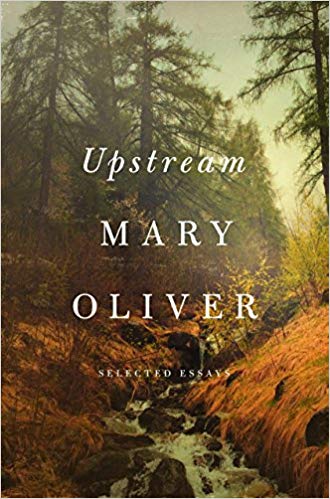
Mary Oliver’s, Upstream, is a book of many marvelous essays. One in particular stood out: Of Power and Time. This one is about the three selves in many of us:

  • The Child Self
  • The Social Self &
  • The Eternal Self.

upstream

Reflecting upon the piece, I realized we should know this by now, and we probably do at some level, but it takes a clairvoyant writer to set it out so neatly.

The Child Self is in us always, it never really leaves us. I completely identify with that. I am decades away from my childhood, but I can dip into it like I only just grew up.  Everything felt keener and sharper as children, and that is part of the reason why The Child Self never really leaves us, I suppose. (Probably the reason why I forget the name of the person I met yesterday, but remember the names of my friends from when I was 5 years old : What is Time?)

While young, I yearned to grow up, and in the words of L M Montgomery realize that growing up is not half as fun as it is purported to be.

“That’s the worst of growing up, and I’m beginning to realize it. The things you wanted so much when you were a child don’t seem half so wonderful to you when you get them.”
― L.M. Montgomery, Anne of Green Gables

The second self is the Social Self. This is the do-er, the list maker, the planner, the executer. The one, in short, that most of us find ourselves trapped in for the most part of our lives. This is “the smiler and the doorkeeper” as Mary Oliver so elegantly puts it. This self I am familiar with: metaphorically the whirlpool, the swift horses of time, the minute  keeper.

“This is the portion that winds the clock, that steers through the dailiness of life, that keeps in mind appointments that must be made. Whether it gathers as it goes some branch of wisdom or delight, or nothing at all, is a matter with which it is hardly concerned. What this self hears night and day, what it loves beyond all other songs, is the endless springing forward of the clock, those measures strict and vivacious, and full of certainty.”

The social, attentive self’s surety is what makes the world go around as she says.

Then, there is the third self: The Creative Self, the dreamer, the wanderer.
“Certainly there is within each of us a self that is neither a child, nor a servant of the hours. It is a third self, occasional in some of us, tyrant in others. This self is out of love with the ordinary, it is out of love with time. It has a hunger for eternity.”

The essay goes on explain the regular, ordinary self in contrast to the creative self. The Creative Self – the one that is out of love with the ordinary, out of love with the demands of time or the regular routines of life, is concerned with something else, the extraordinary. This is the self, she says, that makes the world move forward.

“The extraordinary is what Art is about. No one yet has made a list of places where the extraordinary may happen and where it may not. Among crowds, in drawing rooms, among easements and comforts and pleasures it is seldom seen, It likes the out-of-doors. It likes the concentrating mind. It likes its solitude.”

img_1781-effects

The essay was eye-opening in many ways. For I know many, including myself, have to fill our days with the demands of the clock. It is also easier to be the do-er, so that we may not have to enter that difficult place of teasing, figuring and wrestling the extraordinary out; to give shape to the nebulous clouds skirting in the recesses of the brain.

There is nothing wrong with succumbing to the demands of the clock, but it is a valuable lesson to teach ourselves to take our brains for a tease and see what results, isn’t it? We may land up surprising ourselves if only we give it the chance.

The essay ended on this note:

“The most regretful people on Earth are those who felt their own creative power restive and uprising, and gave to it neither time nor power.”

What do we do to ensure that there is enough time in our lives to ensure the nurturing of the Eternal Self? (Read: The Art & Charm of Shoshin) I don’t know the answer yet, but when I do, I shall hop on social media and share it right away.

Note:

A version of the essay is found here: 

Mary Oliver: The Artist’s Task 

Brain Pickings – The Third Self

The Touch of the Eternal

The daughter came hurtling into the room bursting with something to share, her brother in quick pursuit. I was sprawled on my stomach across the bed surrounded by a bunch of books.  She looked surprised at finding me indoors instead of hustling people to come and enjoy the outdoors, and said “How come you aren’t flitting with the butterflies?” 

The skies were blue, the air pure, the trees outside looked splendid and inviting, the first shy cherry blossoms were peeping out, the first of my tulip shoots were making their way out of the ground much to my delight.

I snorted and said, that just because the day looks awesome outside does not mean that I have to ‘flit like a butterfly’. Besides, it was perfect Gluggavedur weather. (Gluggavedur is a delightful Icelandic word that signifies, ‘Window weather’ – beautiful from the inside, but too cold to go outside.)

I know I have yearned for the right word many times. (A word for the cool breeze that hits your face when you run down a mountain for instance: Zephyr Tales) This book, What a Wonderful Word, taps into that feeling with words from many cultures across the world.

Book: What a Wonderful Word – By Nicola Edwards & Luisa Uribe

Anyway, where was I? Oh yes: I looked dignified and mature. It is done by setting the chin at an awkward angle, and giving the impression of one finding a skunk when one lifted the bushes to find a squirrel.

“A mature adult can do many things!” I said.

“Like reading children’s books?” said she.

I laughed hard and she joined in. Mature indeed! 

One time she found me doing Yoga with a beautiful Children’s book open, and checking out the illustrations from various angles. This act of whimsy earned me the loving and coveted label that teenagers award rarely, “You are SO weird! That is such a you-thing, why am I not even surprised?”

Much later when I read Upstream by Mary Oliver, I was glad to see that I was doing something right – the whimsical part at least.

“You must not ever stop being whimsical. And you must not, ever, give anyone else the responsibility for your life.” 

― Mary Oliver, Wild Geese

Some of my favorite things to do is flip through children’s books. The illustrations on some of them made me admire the books on wholly different levels.

How an artist comes up with conceptualization, the drawings themselves, and the whole process that goes into making children’s books is amazing. Every book is a testament to creativity, teamwork, solidarity, the calling of the eternal, and so much more. When asked to critique a piece of Art, I would trip up on a few things like techniques, styles, brush strokes, paint colors, paint directions, canvas quality etc. But I can appreciate good Art when I see it, and describe it with the word, Beautiful.

I was book-flitting like butterflies, very happy with the set of books I was flitting through.

“See! See this book – how can people even conceptualize a piece like this? Hmm…what would we do without Children’s books?”

I was surprised she had no snarky comeback – it is seldom so. Blessed as she is with sharp wit, it is usually me that has Espirit D’Escalier episodes. I looked up, and saw her immersed in the beautiful drawing in the children’s book I showed her. She spends a good amount of her time doodling and definitely with more success than Yours Truly. 

Rob Gonsalves book, Imagine A World, was definitely mesmerizing. The almost seamless transitions within the Art that hid multiple layers and concepts was work of genius. A sample piece shown below  – you can also head on over to his site that has more Art work. 

img_1863
Rob Gonsalves work Book: Imagine a World

The book reminded me of Mary Oliver’s Quote:

“Keep some room in your heart for the unimaginable.” 

― Mary Oliver

Magical Realism is Gonsalves’ speciality, and I am so glad to have picked up the book. It is easy to see the pictures over and over again – being immersed in them over again.

imagine_a_world

I am the first to admit that I am no Art Critic, just a child admiring the work of artists whose touch of the eternal we are blessed to see. 

Also read: Dr Seuss’s Art

The Queen of Espirit d’escalier

One cold January morning, I clutched at my tea for life giving support. I was sitting through the kind of gathering that happens across Corporate America when a calendar year rolls over. Executives suddenly pep up, and sit up looking important, and feeling purposeful. Like a pup in spring, who thinks he can play with the ball if only folks would toss it instead of gadding about.

aging

I sometimes like to watch these events. The actors change every so often, and the ones who remain have subtle changes in their motivations and ambitions too. The varieties of personalities we surround ourselves with is an ever fascinating experience, and we only really have the luxury of sitting back and watching occasionally. I suppose that is why the Dalai Lama is full of the milk of human kindness – he meditates, and observes.

Anyway, the gathering reached a place where credits were rolled and I noticed happily how people brightened when they were given credit for their work. It is true one should do the work without expectation of the reward, but how nice it was to see people get the credit where it is due. The meadow suddenly seemed spotted with frisking happy pups.

There was an amusing interjection when one team was accidentally left out of the credits, and claimed what was their due.

I smiled to myself thinking of this normal human tendency to crave recognition. We all do it. Just the other day, I bragged about how clean the kitchen floor looked: ‘gleaming like glass’ as I said, till I was reminded by the family almost gleefully that I had better stump it given that I had to clean up the glass I had broken, and therefore ‘gleaming like glass’ doesn’t really count.
“I am neither Jocelyn Bell Burner nor Alfred Russell Wallace. When I clean the floor, I want credit! “ is the quip that I would have liked to come up with.

But I didn’t.

I came up with the inelegant, “Well…I am eating the potato fry then!”, and stuck my tongue out at the children.

I am a queen of that phenomenon where you think of the perfect verbal comeback too late. I was delighted to note there is a word for that: Espirit d’escalier.(Wiki Link for the word, Esprit De Escalier) The link writes about the amusing origins of the word, please read it.

Where am I going with all this spirited Espirit d’espalier, potato fry stuff? One moment. Yes, Credit and Work and Meaning and all that.

Sitting there at the corporate meeting, and watching the team claim credit for their small part in the puzzle, I was reminded of Jocelyn Bell Burner and Alfred Russell Wallace.

Wallace, independently arrived at natural selection for the mechanism for evolution before Darwin did, but he jointly published the paper with Darwin. Darwin’s Origin of Species is vastly credited with the theory though. Did that make Wallace spout and keep the potatoes? No, he continued to travel the world, writing about injustice and social causes. He never stopped exploring or lost the joy of wonder or ceased writing on the causes that deeply appealed to him.

Jocelyn Bell Burner is another scientist whom I find admirable for this very reason. She was passed over for the Nobel Prize. Credited with detecting the first Pulsars in the universe ( she should have been a Nobel Prize recipient for Astrophysics in 1974). When asked how she felt that her Professor got the prize, and did not adequately exert himself to get her name on the nomination, she shrugged and said, “If you get a prize, it’s not your job to explain why you got the prize. ”

I read about these two stalwart scientists in the books, Lands of Lost Borders by Kate Harris and Black Hole Blues by Janna Levin. Every book teaches us different things. Even queens of Espirit d’escaliers can find a way to come back with Jocelyn Bell Burner & Alfred Russell Wallace and their phenomenal attitude towards recognition as it related to their work.


It makes me realize now what my stellar teachers were saying on those cold Assembly mornings when they dangled tantalizing pieces of wisdom in their morning speeches.

Bhagawad Gita on work without reward

Karmanye Vadhikaraste, Ma phaleshou kada chana,

Ma Karma Phala Hetur Bhurmatey Sangostva Akarmani

कर्मण्- ेवाधिकारस- ते मा फलेषु कदाचन।

मा कर्मफलहेतु- र्भूर्मा ते सङ्गोऽस्त्- वकर्मणि॥

Loosely meaning: Do not anticipate fruits while doing the labor, this was oft quoted by teachers trying to inculcate the importance of work.

Turtlish Thoughts

When the children are hanging out nearby, I am amused to see they take the phrase literally. I find them hanging upside down from trees looking like bats wondering why the world cannot be more topsy-turvy on occasion. One day, I found them on the monkey bars like this: one fellow upside down, the other swinging wildly. One child cart-wheeling on the floor, (hop, skip, jump, cartwheel),and chatting about Turtles. I don’t think they realize how the scene must seem to adults who have long given in to the expectations of the adult world, and walk upright at a reasonable speed and acceptable gait. I grinned at the unusual scene and they smiled and waved, before resuming their chats.

The scene reminded me of the Kung Fu Panda movie. Thoughts of Monkey, Mantis, Viper, Crane, Tigress , Shifu, Po and Oogway are always welcome.

kung-fu-panda

Sometimes, when a bunch of stuffed shirts are droning on in self-important tones at the tail-end of an exhausting meeting, I think wanly how much more fun it would have been if we had jumped up and down, cart-wheeled a few times and hung from tree branches while discussing ‘Strategic Improvements to Aid And Abet The Committee’. Every bit helps.

That night, with the wind whipping up a mean rhythm outside, I suggested visiting our old friends in the Valley of Peace, and embrace the challenges of the Jade Palace again. The Kung Fu Panda series has long been a favorite in the household, and we all nodded. Movie nights are never an easy democratic process, but I was glad we all agreed on ‘Kung Fu Panda‘ that night.

Oogway, the turtle, holds a special place in our hearts, partly because, measured and slow is not something we do – we are forever racing from one place to another, hanging upside down with friends on monkey bars, competing to deliver the quickest quips and generally making quick pests of ourselves in the home. Oogway, on the other hand is the coolest dude. The turtles: Oogway of Kung Fu Panda fame, Crush of Finding Nemo fame and Toby of Kindergarten fame, have all been much loved and have taught us so much.

img_4965

It was no surprise then that we reached for the ‘Always Remember’ book by Cece Meng and Illustrated by Jago.

It is a beautiful book that talks about an old turtle. After the turtle dies, all of his friends remember him lovingly in their own way. It is a lovely book showing us how far and wide our impacts can be by living a fruitful and useful life, sticking to simple tenets of compassion, loyalty and friendship.

0

The marine worlds always make for the best illustrations, but even so, Jago’s work in he book is mesmerizing. The characters (dolphins, starfish, baby turtles, whales, sea otters) remember Old Turtle, the compassionate companion, the adventurer, the teacher, the explorer. We, by our very being, mean different things to different people and this beautiful multifaceted aspect is illustrated in pictures splashed across the ocean in hues of blue and green.

Side note: For adults, a similar book about the far and wide reaching impacts we have on others, is a book by Miss Read, Emily Davis. A school teacher by profession, her life is remembered fondly by those whose lives she affected. Often times, we think of these large sized impacts but the most powerful ones are right by us all the time.

miss_clare_remembers

Our companions on Earth have always fascinated us. I remembered fondly watching a baby turtle sun itself on the rocks in Spring  a few months ago. A friend once told me that once we start paying attention to the world around us, it tells us in so many ways what we need to hear and how.

So, what does it mean when a turtle enters your thoughts so apparently suddenly and steadily? Does it mean that we need to synchronize our movements with the animal companions that are paying us visits? In this case, s..l..o..w……d..o..w..n ? Well, my turtle teachers will be proud of me indeed to see me following their example so well. I am sitting cosily in bed as I write about these dear creatures, and look forward to slowly drifting into a world of quiet contemplation, and gently falling asleep while the Earth slowly but steadily hums and thrums on outside. The flowers may bloom or they may not, the shoots may grow or they may not.


“Your mind is like this water my friend. When it is agitated, it becomes difficult to see. But if you allow it to settle, the answer becomes clear. “ – Oogway

Nature’s Shows

This article was published in The Hindu Open Page: The Art & Charm of Shoshin

If anyone has spent time watching pebbles make ripples across ponds, they will know what I am talking about. If not, I encourage you to take on your person a couple of pebbles and hike up the high hills and mountains, or cut through the pristine forests, in search of a puddle, pond or lake of reasonable size to cause ripples. Then, with the hand held flat, proceed to skip the pebbles into the water. The skillful amongst you may get the pebble to skip and skim the waters in the first few attempts causing beautiful rippling waves as they go along. I did not. Watch for the word skilled in the sentence – pebble throwing is an art that isn’t appreciated enough.

The son attempted a large stone throw and I held onto him lest he launch himself with the stone. Size matters: large stones and small boys could cause the cannon to fly with the missile. This is the kind of thing that would have made Newton come up with complex mathematical calculations to support the theory of pebbles and ripples, missiles and cannons, and extend it to comets and stars. We, on the other hand laughed, and substituted a flattish stone is his hand. Father and son threw pebbles and I sat watching mesmerized at the beautiful rippling effect it had on the water.

img_1781-effects

It was a lovely bright day, one of those gems that present itself in the midst of a rainy stormy week. Much as I adore watching the storm rage around me, and the wind whip the bare branches to breaking point, it doesn’t make conducive walking environments. I tried. I went out for a walk during the raging storm that had flights circling the air space multiple times before attempting to land, and I must say that I was wetter than water. It took 3 days for my shoes to start feeling damp again. The daughter shook her head sternly and said I was going to come down with a pneumonia if I continued on this idiotic path of loving the rain. “Are Pluviophiles Pneumoniophiles?” I asked her, and told her to be crazy and feel the rain, love the rain and watch the rain. She watched me with love, and a strong feeling that I was crazy. Oh well.

IMG_0726

I raised my face upwards towards the sun and my thoughts drifted once again. As I sat there thinking of this and that, a beautiful thing happened. The mind snapped out of the mundane and omnipresent things that occupied it, and went into a lovely, meditative state. Watching the sun sparkles drift meditatively on the waters was marvelous. The world seemed to be throwing these tiny diamonds into the water for our enjoyment and they drifted obligingly with the tiny waves, Little shimmers bobbing up and down, dancing and shining in the sun’s rays, set to the perfect rhythm of the breeze rustling through the bare winter branches of the trees nearby. The earth was bursting with new shoots and moss lined pathways.

Ducks, coots pelicans and geese were bobbing on the waters in the distance. Birds were chirping and swooping -I enjoyed the swift elegant swoops of swallows as much as the impressive regal swoops of the hawks overhead. Some people were biking, some others walking. The clouds – white today, drifted lazily across the skies, as though they too enjoyed the sunshine and did not want to hide the sun. The air smelt fresh and clean with little wafts of eucalyptus and fir scented drifts.

img_1769-effects

Nature’s shows are marvelous. For a moment I forgot about the to-do lists, the worries and tensions that a concept of a New Year brings, and enjoyed the free show in front of me feeling revived and refreshed in spirit with every passing moment. All my senses keen, alert and marveling at the wonder around me. I looked at the little fellow enjoying himself by the waters, and hoped that he would remember these simple pleasures as he grows and takes his place in this frenetic world.

img_1763

Edit: After I wrote this post, I saw this excerpt by Mary Oliver on one of my social media feeds: it is from the book, Upstream, and I look forward to reading the book, but this piece of writing spoke to my heart (bolding my own):

Teach the children. We don’t matter so much, but the children do. Show them daisies and the pale hepatia . Teach them the taste of sassafras and wintergreen. The lives of blue sailors, mallow, sunbursts, the moccasin flowers. And the frisky ones-inkberry, lamb’s quarters, blueberries. And the aromatic ones-rosemary, oregano. Given them peppermint to put in their pockets as they go to school. Give them the fields and the woods and the possibility of the world salvaged from the lords of profit. Stand them in the stream, head them upstream, rejoice as they learn to love this green space they live in, its sticks and leaves, and then the silent, beautiful blossoms.

Attention is the beginning of devotion.

My hope is for everyone to savor a moment like that every now and then, to keep the capacity to wonder alive in us. The beauty of Shoshin.

Existential Angst or Gelato?

Every block of stone has a statue inside it and it is the task of the sculptor to discover it.
“Michelangelo Quotes on BrainyQuote”

As we walked past the thousands of statues displayed in the Roman corridors and roadsides, it is astounding and humbling to see the thousands of hours of creative labor that survives. The Vatican alone houses so many art forms and pieces of art, that we were quite naturally hurrying along if we did not wish to spend a good decade in there admiring every piece.


The Roman Empire is probably the most famously chronicled and studied empires in the world. The human condition across millennia has sought peace, temperance, a cultivation for the finer aesthetics even while battling the evils of war, famine and barbaric practices, and nowhere is that more apparent than in Ancient Rome.

Many portraits and statues were commissioned by the noble wanting to cast a sliver of their mortal presence into the immortal. The legacy of their lives as they might have seen it. But in works such as these, who endures? The person whose statue was carved, or the work of the sculptor whose ability enabled it? (See this picture drawn by my friend, of a statue)

Is it the Artist or the Object of the Art who endures?

head_bust_suresh
Image by Suresh (SureshSketches)

It isn’t hard to imagine the artist with a philosophical bent of mind when one sees the thousands of head busts carved out of stone. The busts themselves may be of emperors and powerful men, but they were carved by the skilled artisans who were not all famous. I’d like to imagine that the artisan who carved Caligula’s head had his laugh by secretly carving a statue of Caligula’s favorite horse, Incitatus. (Incitatus was made a senator, and was granted a place at the royal dinner table. ) Claudius, the one everyone assumed to be the local fool turned out to the successor to Caligula in the end. His head bust stands right next to Caligula’s in the hall of head busts in the Uffizi gallery.

claudius_bust

So, who endures and who doesn’t? It was Claudius’ writing that showed us all about the dangerous, mad tyranny of Caligula after all. ( The book, I, Claudius by Robert Graves is an excellent peek into Ancient Rome)

Walking past the arrays of the head statues, I could not help thinking of the Tamil poem by Bharathiyar that the husband quotes often:

Pirappal pala pizhaigal seidhu …
narai koodi kizhaparuvam eidhi …
Verum kootrukku eraiyagum pala vedikkai manidharai polae
Naanum vizhuvaen endru ninaithaayo?

“பிரப்பால் பல பிழைகல் செய்து
நரை கூடிக் கிழப்பருவ மெய்தி
கொடுங் கூற்றுக் கிரையெனப்பின் மாயும்
பல வேடிக்கை மனிதரைப் போலே
நானும் விழுவேன் என்று நினைதாயொ?”

Loosely translated it means:
Did you think I too would live the life that wracks ordinary human beings?
That I would sport grey hair, grow old, be small enough to talk pettily about people, and fall at the hands of fate?

The angst that has wracked mankind for centuries is apparent in the poem, and in the head busts and portraits by which I was surrounded. So, what is it we hope to leave as our legacy and for whom? We should aspire to be a thread holding the tapestry of life together while alive, but beyond it, what do we crave?

After the 160th picture of non-smiling faces, 100 head busts, and the n-th depiction of the crucifixion and the nativity scene, I knew what we craved for: Gelato.

“Before we go though, let’s go to the next floor. There is a gallery of musical instruments of the time.” said the husband. The children groaned, but I was intrigued. Music is a beautiful anthropological constant. We even sent a recording of whale song, Beethoven, Bulgarian folksongs and so much more on  the Golden Record  when we sent it out into space aboard the Voyager. NASA did not want to waste the space, but Carl Sagan, saw the poetic touch to it. The need for space exploration was to learn and connect, and what better mode to connect than through music?

cd

The image of a man playing the harp in a city square, as people walked by tingled in my brain, and I rose happily, urging the children on. “That man playing a harp could be from the 12th century or the 16th or the present. How beautiful is that?” I said to musical groans.

man_harp_today

After we climbed up the flight of steep stairs, however, we found ourselves peeking into another floor of more paintings. I looked around confused. The husband pointed to the sign there: Piano Secondo:

piano_level

‘Piano’ in Italian means ‘Floor’, and not a collection of pianos. He looked sheepish, but happy to be the person who relieved the tension, and off we went in an indecent hurry looking for gelato. Anthropological musings and existential angst can wait, Gelato cannot.

Una buona immagine

“Amma – you were sleep talking so much last night – it was hilarious!” said the daughter. The children and the husband giggled. In my defense, it had been a rather long few days. Roaming around in Rome had taken the wind out of my sails.

“I must have been tired!” I said. “ I had dreams of the weirdest nature. I dreamt the horses ran out of the picture, and out into the gardens that had the whomping willow type of tree.” (Pitti Palace & Boboli Gardens which are perfectly delightful to behold: A lovely spot of nature in Florence)

“Yes we know. And you sat up in bed sending Sabrina to get the horses back! Poor lady doesn’t have enough work in the reception, you have to send her galloping behind horses!”  I laughed with them. Sabrina had saved us considerable time by getting us a slot of time to visit the Uffizi Gallery.

I was trying to extricate the strands of weave from the coagulated mess in the brain. A number of galleries collapsed in the various chambers of the brain leaving the paintings smushed together. Waddling through the galleries with a coat hanging off one hand, a child off another and a bag on my shoulders, I wandered through the works of Leonardo Da Vinci, Michelangelo and Raphael – entire galleries devoted to Renaissance artists. I naturally gravitated towards pictures featuring the rich myths, with a whiff of the beautiful Italian countryside in the background. The Birth of Venus, Primavera et al were as beautiful as everybody said, and had I known the nuances of art could have enjoyed it more.


I felt like one of those canvases that inspired the starry night by Van Gogh. All the different colors flowing into each other, forming a confused mess of colors, but having a unique kind of beauty in itself.

Art can never exist without naked beauty displayed - William Blake.

The first time we spotted a picture featuring a nude, the son tugged at my hand, and giggled, “Why isn’t he wearing any clothes?”

I giggled with him. Do you think this is what William Blake had in mind? The renaissance era with its developments in the anatomy and study of the human figure really did go overboard on the whole human body thing. Considering that it was winter in Italy, there we were dressed in thermals, sweaters, jackets, caps, gloves and socks, looking upon the stone cold statues of apparently virile, strong men with muscles exploding out of their bodies, and not a thread of clothing on them. It was amusing, and the pair of us giggled like children in the pristine halls of the museums.

statues

Standing outside a fountain on the way from one gallery to another, I posed for a photograph. I smiled and asked if the picture was okay. Apparently, it wasn’t.

The teenaged daughter took a deep breath and with the air of explaining basics to an idiot child started instructing me on the best method to pose for a photograph. Apparently, smiling like I am happy to be in the photograph is out.
“Go for this look.” she said, and looked morose, angry, pensive all at once. “And those shots of you standing in front of a place is so third century! Look at this one, “ said she showing me a picture of a person with a sharp nose in a red coat overlooking a ruin.

If it weren’t for the fact that she was looking stylish in my coat, I could barely have recognized her, and that, she said, was the angle you have to go for.

I am not sure I will get it entirely. I come from a generation that saw as many people crowded together in one frame as possible, and all of us smiled at the the count of three – with at least one blinking at the opportune moment. From there to this sort of “Don’t even show your best face, and please don’t smile” slide is a bit quick.

But after looking at the numerous pictures in the galleries across Rome, Florence & Venice, I can see the impulse. I mean this trend probably came from too many pictures. It is probably why Madonna looks apathetic holding a babe Jesus in her hands, who displays no curiosity in his surroundings or joy or mischief. It was quite disquieting to see picture after picture like this with frozen expressions. Was the smile frowned upon so much? I can understand the looks of anguish in the scenes of the crucifixion, but even in the more joyous pictures of Madonna and Child, can one not introduce a motif of joy?


That’s what our million pictures must look like isn’t it? Frozen expressions  “capturing the moment”. If we are capturing frozen expressions, I don’t mind jumping on those galloping horses out into the gardens from the painting with a wild look of freedom and joy on my face any day.

So that brings me back to the basic question of what constitutes a good picture (una buona immagine). Does every picture need to tell a story? Why is Mona Lisa so famous, and not the beautiful pictures of these ladies?


Please recommend books on the art of appreciating Art.

The Roman Holiday

“Can you believe we are going to roam around in Rome?” said the excited son. He was very proud of his homophone.

“Isn’t it funny? Roaming around in Rome?”

“Yes! You bobble head! I said it was funny the first time you said it.” said the teenaged daughter pulling an I-can’t believe-this little fellow face. I laughed, knowing this was only setting the stage for at least another 108 times we would have to endure the phrase in Rome, and I was not mistaken. The nourish-n-cherish household is proud of its jokes.

“Have you done your homework? Did you spend some time trying to figure out the places to see?”

The husband’s I-love-my-wife-but-I-know-what-she-doesn’t-do-well tone deepened.

Setting aside the dismal feeling of being caught in school, I told him (patiently),
“Relax – I got the itinerary from my colleague who went there for his honeymoon, and it has a pretty good list of things to do including details on where to catch a sunset.” I said winking. “I even prepared a doc and shared it with you.”

He looked surprised, but right enough, when he opened the doc, he discovered entries like:
Check out the colosseum, if there is enough time, also add Palantine hill, and the Piazza Navona.
On the way back,  spend some time on the Spanish steps, and near that is Trevi Fountain.

I am no trip advisor, and when I generally send people on their way, I give them a vague list like above, keeping a wide margin for ducking into random stores that attract one’s fancy, stopping at random spots that demand one’s attention, looking at people scurrying about their business, tucking in an extra gelato, dribbling along and finding a couple of boys play football – it is all good fun.

roman_list

I like to blame my list-making on being one of those staunch believers in the super power of Serendipity, and the gift of winging it. For instance, the taxi driver the previous night told us not to miss the Piazza Venizia.  Piazza Venizia, as it turned out, was one of the most grandiose buildings I have seen. Built recently by Roman standards, it is only a century old among ruins millennia old, but the views from up above of the sprawling city of Rome,  Colisseum and the Palantine Hill were brilliant.

rome-aeriel

The Romans didn’t believe in skimping on the grandeur. Glancing skywards and finding flying chariots bearing regal men atop their chariots was so novel that we found ourselves gawking like fish seeing Poseidon’s horses swishing through the seas for the first time.
“Poseidon was a Greek God, his Roman equivalent, Neptune, wasn’t as powerful because the Roman Navy wasn’t very powerful then”, said the mythology expert, the teen- queen in her mythical world.

Rick Riordan has done a marvelous job in getting tens of thousands of teenagers interested in the Greek and Roman myths, and our tour guide at the Vatican, told us she wrote up a Percy Jackson tour that was hugely popular. I could well imagine it. The city burst with myths. Flying chariots, fountains of fortune, serpents of evil, winged harbingers of war or prosperity jostled along with busts of statues of philosophers, kings, and senators.

1920px-piazza_navona_0956_2013
Bengt Nyman [CC BY 2.0 (https://creativecommons.org/licenses/by/2.0)%5D, via Wikimedia Commons
It was also slightly disconcerting to read about the forms of entertainment in early Rome. We have heard stories of the slave, Androcles, who was not mauled by the hungry lion remembering a past kindness, seen movies of the era etc, but there is something disconcerting about standing amidst the ruins of the Coliseum and reading about the manslaughter, the barbaric practice of skinning people alive etc. A place where hundred of years ago,  people watched this gore as a form of entertainment raises goosebumps.

coliseum

If that is the kind of evolution mankind has had to come through, we have come a long way, but we also still have several ways to go.

What was that poem about “Miles to go before I sleep” ? by Robert Frost.

Walking among the ruins, you are intensely aware of the fact that toga-clad Roman senators walked the same path 2000 years ago, and if you are even slightly distracted, there are thousands of tourists, their phones, and their respective tour guides to remind you of the significance. In spite of that, it felt strange to see the husband looking at the GPS to figure out directions beside a ruin that was literally thousand years old. What if a spirit from that age were to spring in our paths then and there?

Maybe one did, for the husband saw a chain lying across the road, and attempted his boyish skip across the chain. He underestimated its height and went sprawling face-down on the pavement. After the initial shock wore off, he started laughing, and the son said, “Appa tripped on the trip. Hey! Appa tripped on the trip while roaming around in Rome. Get it? Get it?”, and we all laughed.

Our jokes! Well, they need to evolve too.