Navigating by the Starlight

Navigating by the Starlight – Listen on Spotify

Rest, nature , books, music, such is my idea of happiness.

– Leo Tolstoy

I sat looking out at the lake, with a book on life in the Oceans by Sylvia Earle in my hand. I was not exactly reading. That in itself was worth musing about: with a book in a quiet spot, but not reading. Usually I can zone into a book within seconds. It is a source of being teased in the home. But that day, I found thoughts fleeting, the mind elsewhere: it’s this pace of life, I told myself sagely. Not much time for nourish-ing and cherish-ing. I chuckled at that (I know! )

I had been on a brisk walk at the campsite a few hours from where we lived. The drive up there was relaxing in itself.  The long, solitary drive gave me the space to make a few phone calls, listen to some music and an audiobook. It was perfect. This kind of solitude is rarely available and I was determined to enjoy it.  

Where was I? Yes – sitting and doing nothing but taking deep breaths and looking lazily out at the lake in front of me. 

img_7039

The Eye of the Earth quote playing on my mind. Looking across the lake, I saw a bush of greenery that reflected so beautifully in the lake as so resemble a human eye. Some boys were skipping stones lazily across the lake, and faint music was heard elsewhere. 

Later that night, the skies opened up. At first the faint light did not reveal the nightly glory – the cosmic dance that plays out every night. But by 11 p.m., there was no escaping the stage of the heavens. In our heavily populated urban areas we rarely see this skies like that:  The Milky Way in all its glory. There was the international space station circling the Earth, and thousands and thousands of stars, with familiar shapes of the constellations that our ancestors mapped over the ages.

At one point, I had to walk from point A to point B, and found that I had lost my way amidst a thicket of trees. I felt a strange sense of unease – How did birds migrate by the starlight? I looked up, enthralled, my breath stolen from me in a gasp of wonder, but also acutely aware navigating by the stars is tougher than it looks.

I read a while ago, that birds align with the electromagnetic patterns of Earth and then use that to orient and navigate against the stars. From the magical birds who sense the Earth’s magnetic field for their migration journeys to the fish who are able to navigate by the position of the stars from deep under the ocean, we each have our own unique way of living. Of Life.

In Dr Oliver Sack’s book, Musicophilia, he says:

“Every act of perception, is to some degree an act of creation, and every act of memory is to some degree an act of imagination.”

Oliver Sacks, Musicophilia: La musique, le cerveau et nous

https://www.nytimes.com/1958/10/17/archives/study-finds-birds-guided-by-stars-migrating-flocks-are-led-by.html 

All this may be fine. But how was I to get back? My electromagnetism wasn’t helping, and the stars seemed to be twinkling and having their little joke up high in the skies. It is then I caught glimmer of the starlight reflected in the lake down below, and like a thirsty wildebeest pushes towards the water, did the same, urging the body to orient itself with the lake and the paths around it like I had done earlier during the day.

One day, I shall have to take lessons from the birds and learn to navigate by the stars instead. “Stop using the GPS while driving first!” said a little voice of truth, and I chuckled. Yes – baby steps. Driving first, and then flying. 

Oh Canada!

Any time we see a license plate for an out-of-state car in California, the son gets excited. I assumed it is part of his being this boy who spent his early years watching the Disney movie Cars. I must say though, if I had tried to envision life a decade on, and saw ourselves still being excited by license plates, I might have  been a little worried. Yet, here we are, and still excited by license plates. Oh well!

This time, we weren’t even going to see out of state license plates. We were going to see Canadian license plates. 

All we knew about Canada is that it is a beautiful country – vast, and the people a gentle populace. Well, that, and they have a sense of humor, probably good at winter sports – ice hockey, curling, skiing, that sort of thing. May not even count as trivia. In fact, most of this ‘knowledge’ seems to have come from talk shows, sitcoms, particularly one that is very popular in the nourish-n-cherish household: Corner Gas which is set in Saskatchewan, Canada. Or Anne of Green Gables by L M Montgomery set in Prince Edward Islands.

Every country is like a particular type of person: Canada is like an intelligent, 35-year-old woman.

Douglas Adams

Anyway, there we were hopping on our left and right feet excited to go to Calgary – the airport closest to arguably the most beautiful national parks in Banff. We expected to be wowed by the natural beauty of the mountains, the lakes, and the rivers fed by glacial melt.

IMG_6497-COLLAGE

But we had not planned on being this excited by license plates.

The first time we saw the license plates of a car from Saskatchewan, the son and I pointed excitedly to each other. Hey! Look! Land of the Living Skies, Saskatchewan. We stopped admiring the license plates. Sub consciously, we glanced up at the blue skies and the large white-and-black magpies that flew past looked amused. We could imagine the beautiful skies of Saskatchewan, could we not?

“Ha! Maybe he stopped by the Corner Gas station to fuel up!” We found this hilarious after a long flight, and filed it under sleep deprived delirium.

There really was no excuse though when we were just as excited by the license plates of British Columbia, Alberta, Manitoba, Ontario. License plates of states in the United States do not have a catchy slogan for each state. 

canadian_license_plates

🥀 Wild Rose Country Alberta

🚸Friendly Manitoba

🌌 Land of Living Skies Saskatchewan

🏔Yours to discover Ontario 

🪷 Beautiful British Columbia

I wonder what each state in the United States would have as license plate slogans. That’d be an interesting exercise wouldn’t it?

Earth’s Eyes

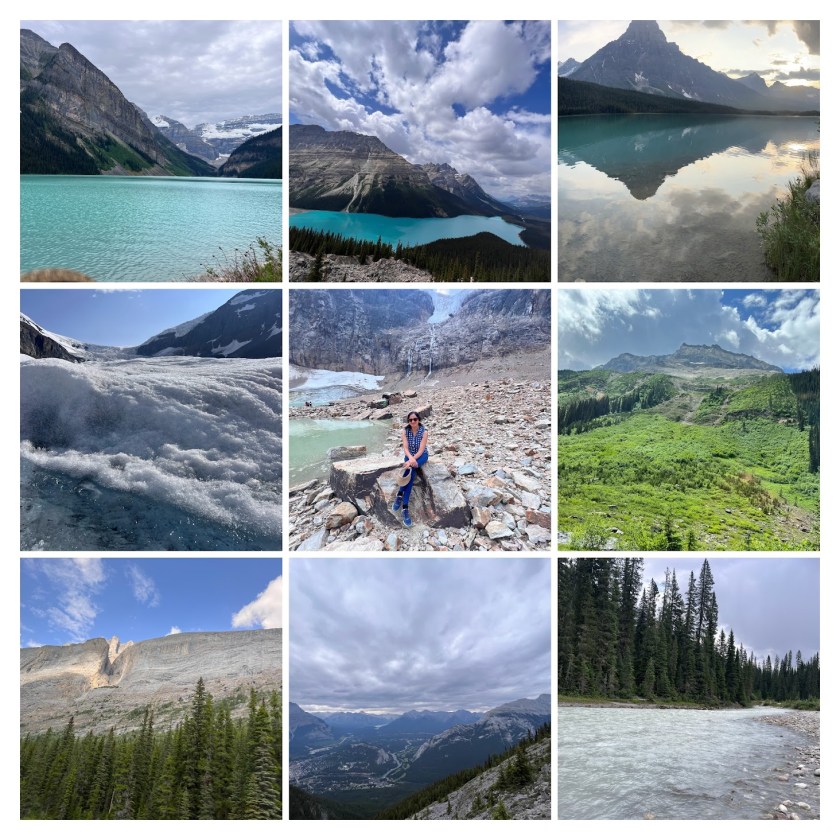
Canadian summers are generous. 

The week we were there, we were blessed with ample sunshine, full rivers gushing waterfalls, millions of evergreen trees, tiny pinecones, open skies, harsh rock faces, long days and every hue of blue in the waters of the land. 

IMG_6497-COLLAGE

When we told anyone that we were planning to visit Banff, Canada, we heard about the Blues. In gushing tones, awed expressions, faraway looks as if transplanting themselves momentarily to a place with blue waters, and peace. I liked that. It must have been something if everyone had the same things to say, shouldn’t it? I have been to several lakes, and am always in awe of them. I remember somebody saying something to the effect of a lake being a planet’s eye, or something like that. Awfully poetic I thought then. Must find the quote.

Ah – here it is. It is our reliable ol’ Henry David Thoreau on Walden Pond. 

“A lake is a landscape’s most beautiful and expressive feature. It is Earth’s eye; looking into which the beholder measures the depth of his own nature.” 

Henry David Thoreau, Walden

Anyway, so off we went expecting to see blue lakes. Emerald green waters, turquoise waters, and all the hues in between. Pictures do not prepare you for the surreality of it all, we knew that. We were hiking around the famous Lake Louise when the daughter piped up with her usual candor. “It looks pretty and all, but I don’t want to swim in it. It doesn’t feel right. Do you think it has some kind of algae, in it?”

lake_louise

I looked at her and then nodded. I understood that feeling. I had not been able to express quite that way yet, but there it was. It didn’t help that I was reading The Three Body Problem by Cixin Liu, Translated by Ken Liu, and somewhat agitated by the other worlds mentioned in the book. 

51pHYR3yHaL

But when we stopped to take breath a few meters on, I sucked in a deep breath. It was beautiful especially from our current vantage point. We were at least a thousand feet above and hiking around it in an elaborate trail that allowed us glimpses of the turquoise blue waters in between. So, what did make these waters this unnatural shade of blue? Why didn’t lakes in Iceland, Switzerland, Philippines, New Zealand, or the United States have the same color? 

Professor Google says it is because of the particular kinds of glacial silt that is deposited in the waters with glacial melt, and not algae. Up close, the waters looks transparent near the shores, and the canoes seem to enjoy the peace and quiet of it all. 

We canoed in ‘a lake that looks like more like an earthly lake’ as we delicately put it. But this lake too had spots of emerald green waters turquoise spots and the transparent blues. I took photos that I thought would wow the world. Of course, they looked like I shook my hands and poured tea into the lens instead.

IMG_6722

I was nervous about the canoeing. I was nervous about the hues of the waters. But as the daughter and I shared a canoe, I was somewhat heartened. She is calm, reliable and more capable than Yours Truly at steering canoes towards shores as she demonstrated to me that day. We stopped mid lake, peering into the depths below. The calm beautiful waters holding the promise of the winter snow in its depths.

IMG_6727

Earth’s eye that day assured me that to imagine yourself in a different world, if only a moment, is fascinating and necessary. We couldn’t really see the Loch Ness monster, or the myriad fishes in the beautiful waters even as sunlight pierced through to the bottom maybe a hundred feet deep. But I am sure these lakes were home to plenty of lifeforms – how could they not be?

Sometimes, humans are so caught up in our own trivialities in this universe, I wonder whether our fellow habitants are the same. Maybe. Maybe not. We would never know. 

Yes, Aunt Alberta

Alberta sounds like a fussy old aunt who sews quilts, and asks you if you’d like some warm milk before turning in for the night. Yet, Wild Rose County, Alberta, is anything but. There is nothing domestic or warm about its mountain peaks, or its glacial rivers, or its expansive valleys, plains and lakes. 

Every peak has a distinct…

Actually, it feels droll to use words like ‘distinct’ to describe the peaks of the Canadian Rockies. Majestic, unconventional, foreboding maybe? But it still does not capture the raw power these mountains exude. The peaks truly do appeal to the fanciful too. As we drove towards Banff in Canada, the car was filled with tales of the kind that must’ve inspired the folklore of American Indians for centuries. I resolved to go and look for some of these legends later. 

img_6362

“See those mountains? Don’t they all look like old men?”

“Yes! They are all wizards who went against nature, and then the rivers and lakes learnt of their treachery, cursed them to watch over them as penitence.”

“Ooh! Nice one!”

“Those must be the mountains where the goats learnt their footing.”

And so it went. Through the traffic and amidst the trees with the towering cliffs of mountains on all sides.

“Look at these little bridges? With trees and plants growing on them. Like little bridges for wildlife to cross the highway.”

“Yes! That is exactly what it is!”

wildlife_bridge

“Like the stuff mentioned in the West Wing episode?” asked the son wide-eyed. His interest in all things constitutional seems to be on the rise these past few months, and so we have started watching West Wing again. It makes for wonderful entertainment. If Aaron Sorkin was able to make a series like that based on a Presidency like Bill Clinton’s, I wonder what he would be able to do with a Donald Trump one. (But that saga wrote itself.) 

Anyway, this is the clip in which the wildlife crossing is mentioned: Wolf’s only highway featuring Pluie the Wolf

Driving along the Canadian highways with nothing (miles of no human habitation) and everything (bounteous, gorgeous, fabulous nature) on all sides is surreal, and a change that we were grateful for. 

IMG_6497-COLLAGE

The Biochemistry of Attraction

“What are you reading?”, asked the daughter. 

The pair of us found ourselves enjoying a quiet Saturday morning and we were determined to make the best of it. I had been reading the Manga’s Guide to Biochemistry with little luck. Try as I might the fascinating area remains a mystery. Cellular structures and how they interact, how they power our bodies. The concepts are explained well enough. But it still did not seem to answer the fundamental questions of energy disparities among people. How is it some of us are bursting with energy and others not? How do healthy doses of sleep and diet help with these biochemical processes and our own system?

 I am sure many eighth graders know it all well enough, and they’d roll their eyes at my interest in these matters. 

The Manga Guide to Biochemistry by Masaharu Takemura , Kikuyaro, et al.

1593272766.01.S001.LXXXXXXX

‘The Manga Guide to Biochemistry’ , I said lifting the book helpfully to show her. 

She swirled her eyes – not just rolled them. 

“Who spends their Saturday mornings reading about Biochemistry?”, she said.

“Those who didn’t spend enough time in school reading about Biochemistry!” 

“Ah ha! So you accept you weren’t a saint in school!” I laughed. I admit I may have written myself out to be a Mary Sue when I wanted to talk myself up to the children. A Mary Sue, I learned recently, is a form of wish fulfillment by authors when they write idealized versions of themselves as characters in the story. 

Quote from wikipedia:

A Mary Sue is a character archetype in fiction, usually a young woman, who is often portrayed as inexplicably competent across all domains, gifted with unique talents or powers,…, unrealistically free of weaknesses, …, innately virtuous, and/or generally lacking meaningful character flaws.

“Guilty as charged. But really though: I like this book. I am not even sure I understand half of it, but it is still nice to try!” I said. 

She gave me an indulgent look and said, “Fine! But no doing that thing you do and reading out interesting bits of it out to me, understand?” I nodded. 

“And may I ask the same of you my dear? I am not sure I want to know how the count’s first kiss felt on her cold cheeks or whatever it is you are reading now.”

She snorted, but had the decency to look abashed at the evident enjoyment of her little rom-com : It’s in His Kiss by Julia Quinn. “It is now a TV series – Bridgerton. Actually, you may like it. “ she said, and I perked up. I had heard the series was very good. 

“Oh amma! How quickly you go from disdain to curiosity?!” 

“Maybe I will understand the biochemical processes associated with attraction first huh?” I said laughing.

Love, Actually: The science behind lust, attraction, and companionship

Perpetual Kindness

“Nothing can make our life, or the lives of other people, more beautiful than perpetual kindness.”
– Leo Tolstoy.

I am not sure whether Tolstoy had met a persona such as Nithya Cherian Mathai, but it seems that Tolstoy referred to him. Unfailingly kind, I remember him teaching us to be gentle with everybody and everything around us: our friends, the staff, the helpers, the trees, stray dogs and plants.

Teenaged children can be complete menaces. I am almost amazed that he hardly ever lost his temper with us.

He gently encouraged those of us who showed an interest in working hard. He gave us books to read, engaged us in discussions, and did his very best as a teacher. He gave me a biography of John Adams to read during one particularly slow monsoon vacation. I ploughed through the 600 page book. He asked me what I thought of it when I finally finished and returned the book to him. I told him the truth: It was fascinating, but did they have to write so much?! He laughed – that gentle rasping sound that invited you to join in.

Tell me your favorite part, he said, and I told him. I use this tactic with the young folks I interact with now. It gives me a little window into their perspectives and is always enjoyable.

He lent me many books – he would emerge from his archives with a copy that I might like. I returned them in pristine condition for he was a man who loved his books. You could see that.

When the school archives found a lovely sunny room in the Arts & Crafts building, I felt happy for him. He deserved a place like that. When I picture him there, I imagine him content: doing the things he loved, in the place he loved the most, surrounded by people he loved and who loved him back.

Every single student, when they remember NCM years afterward, remember him with a fondness and an amazement that his sensitive spirit not only thrived but influenced those around him to value empathy and kindness. Thank you, dear NCM, for all your years of dedicated giving to the schools and its students.

How can one be so gentle and kind even after decades of living in a harsh world?

NCM showed us that we have a responsibility to look after the softer and sensitive aspects of our personalities, so that we may take our part in making the world around us a gentler and happier place.

Hemlock Hitch

I squinted as I walked through the summer grasses – browning in places, laced against the relentless green of the hemlock. I did not know it was hemlock of course. I just admired the beautiful shapes of its flowers and the structure of its leaves. 

img_6114

“What plant is this?”, asked the husband and I found out. It was the hemlock. They must be a favorite of the bunny rabbits in the vicinity – since I see them hopping in and out looking very pleased with themselves as they do so. 

“Did you know Hemlock was what was used to poison Socrates?”, asked the husband and I was curious to hear that. Obviously, my horticultural knowledge is nothing to bet a chocolate on, but still to see that the innocuous, gentle and beautiful looking hemlock was capable of such treachery to the human system was shocking. 

It was true. It was one of the oldest secrets of humankind by the looks of it. Only they seem to have forgotten to whisper it in my ears when I grew up. I may have eaten those leaves – I said shocked, earning me a stern glance from the husband. “That is why, you do not eat wild plants. Go to a store, and buy what you need.” 

“The tried-and-vetted”, I sighed. Yes – but where was the sense of adventure in having a beautiful tale to tell? “Are you sure though? The hemlock?”

So, I rushed home and saw that Elizebeth Blackwell in her extremely well researched book on Botany lists out Hemlock too. 

https://en.wikipedia.org/wiki/Conium_maculatum

“Imagine! The rabbits may eat them!”, I said still a bit shocked at how ubiquitous the plants were. But then I stopped and wondered – I had never seen the little ones eat them. They would hop in and out of the bushes, but never have I seen them munching their leaves or nibbling at the carrot like roots.

Curious.

🐶🐾🐕 Spot Goes Splash! 🐶🐾🐕

“Don’t even think about it!” I said almost casually. I had the son in my peripheral vision as I took in the gorgeous sunset, played (s)word volley with the daughter, and screwed up my face at the husbands unnecessarily loud enjoyment at the latest the daughter had said. 

“Oh my gosh! Did you see that? She totally knew what he was going to do!” The daughter laughed half-admiring, half-worried.

“Like it’s a big surprise. Sprinklers going off and spraying cold water on the lawns, and your brother loping towards it as if without a conscious thought?! Right.” I drawled.

“I mean – look at him, I bet he’s still going to try.”, she said and I laughed. 

The subject in question, meanwhile, was wracked between playing the rebel and getting himself wet or making a joke and having a comfortable walk the rest of the way. It was a lovely summer evening – this close to the summer solstice, everything is a joy and the daughter agreeing on coming for a walk clinched the evening. So there we were.

“How’d you know he was going to try and run into the sprinklers?”, she pressed.

“Well – I raised you, remember? “ Then, looking at the husband, I shuddered a bit and said “Remember that New York trip? What was that book we’d read to her? Spotty loves the rain? Or Spot like to go Splashing? Spot Goes Splash! That’s the one.

spot

“A book about a little pup that loves to splash about in rain puddles. It rained for the entire duration we were in New York that visit and you were two years old! You thought you were too big to sit in a stroller, and we knew you were too heavy to carry around. Still – I had only 1 pair of shoes for you. Appa carried you on his shoulders almost the whole time to save us all the trouble. His shoulders have never been the same!” I said giving him a squeeze and a look that said, “My Hero!” 

spot_goes_splash

“Gosh! Now there are some parenting gaffes I’ll keep away from!” Said the daughter. She prides herself on being – well whatever teenagers who think they are better than their parents pride themselves on. 

The husband rolled his eyes and guffawed at this so loudly, that a pair of doves took flight squawking alarmingly. That got us all laughing, and he said, “Ha! Just for this – we’ll accompany you when you have your little ones and just stand around and laugh pointedly instead of helping.”

“I’ll write it all down so we remember to do that!” I said laughing helplessly as well.

Her brother, in the meanwhile, had opted for a compromise between running full-pelt into the water sprinklers and had splashed in the water puddles nearby instead and was trying to hide how uncomfortable wet sandals were. 

The summer solstice made for an elongated sunset and we took the time trying to see how a thread from the past could stretch into the present and be used in beautiful circle of life years later.

Spot Goes Splash!

🐘🐘🐘What Elephants Know 🐘🐘🐘

The book starts with the Zen teaching: 

Sooner or later we have to see that what we do and what happens to us are the same thing.

A curious saying that, I am sure, has a fair number of interpretations. I was not sure I liked the ones that came to my mind seeing that I was thinking about agency, free will, and opportunities from a few different angles over the past few days. 

Intrigued, I ploughed on, and read the first sentence:

“My mother is an elephant and my father is an old man with one arm. Strange, I know, but true.” 

– What Elephants Know – By Eric Dinerstein

For a few paragraphs, I could not help but wonder: was the protagonist an elephant or a human? Either would’ve made sense of course: it is a children’s book after all. 

elephants_know

Elephants have always occupied a special kind of love among beings for me. The home is littered with tiny elephant figurines, and soft toys. Hailing from the Indian subcontinent, this is not peculiar or unheard of. It is, in fact, quite common. Intelligent, empathetic, wise, loving beings with a range of emotions, and wisdom, I feel lucky to share the planet with these gentle giants of the land. So obviously, when I saw the book What Elephants Know written by Eric Dinerstein, with glowing reviews from none other than Jane Goodall herself, I picked it up. 

I am so glad I did. 

Set in the beautiful borderlands of Nepal, this book is told from the first person POV of a young child, Nandu, whose mother is Devi Kali, the benevolent matriarch of the royal stables of the King of Nepal, and father is Subba Sahib, the head of the royal elephant stables. Devi Kali, is the elephant who found the child, Nandu, abandoned in the forests. Nandu was taken in, and raised by Subba Sahib. Thus, begins a gentle lilting story of a magical childhood. The child has his perspectives broadened by education, his keen natural senses honed by a naturalist who collects specimens and conducts research for the Smithsonian museum. 

It is a rare pleasure to be able to relate to a young boy, and feel his love for the nature surrounding him. How Nandu manages to save the elephant stables from closure forms the rest of the tale. 

img_3588

Most importantly though, this book evoked a sense of having spent time amidst nature ourselves. That is the biggest achievement of the book – for several times in the week following, I found myself sighing and bringing up the imagery of the thick forests of Nepal. Something that not even the best documentaries manage to do. Maybe it is something to do with the slow creation of the imagery in our minds as we conjure up the descriptions and a version of the forestlands, but it is a worthwhile read.

The creatures of the land, the many birds, and life of naturalists is gently shown to us.

How Daughters Protect Planets

The daughter is home, brimming with chatter and tales from college. I cannot deny that we have been counting down days to have her come home. The house feels different, quieter somehow without her, and I listened happily as she jabbered on a few miles a minute, and gushed and laughed with her little brother. I sat there letting all the flurry blanket me, and smiled. 

“What are you smiling about?”, she said.

I said ‘something soppy’ about being happy that she is home again. She looked at me appraisingly and said, “Oh Amma! Look at you. You’ve mellowed into this sad thing who is ‘just happy to have her her daughter home’! What happened to you? What happened to the fierce woman who flew about the place?” 

“I am still fierce!” I said. 

“Nah! These days – I think she is going to just say something sharp, and she takes a deep breath and shrugs! She really does miss you!”, said her little brother, and I gave him a reproachful look. 

A few hours later, she had convinced us to settle down to a week-end movie night of Our Planet II – a Netflix documentary on the state of the planet, narrated by David Attenborough. It is an excellent program of course, and this particular episode veered from the whale sharks in the Persian Gulf to the wildebeest and zebras in the Savannah to the bees in search of their home with equal ease. We sat there mesmerized by the images, occasionally commenting on how hard it must’ve been to capture some of these shots. It had apparently taken 4 years to film and we could well understand why. 

“But think about it! Most species are absorbed with staying alive – finding food, reproducing and life resets, for the next generation, right?” I yawned sleepily.

“Yes – Amma & I were talking about that. I mean, if you are a duck: have ducklings, feed yourselves and them, and make sure they are safe. That’s it. That’s their whole life.”

“Yeah!”, the daughter said, laughter ringing in her voice, “Low-key simple, but also every day is just survival! Dog-eats-dog-world. I mean look at us. Tucked into our blankets on reclining couches, watching this on TV, and popping chips into our mouths.”

“We are a spoilt species.  “ I agreed. “But I am also glad that we have sentience and energy enough to ponder on more than survival, don’t you think?” I yawned again, ready to head up to a comfortable bed, and thought about that. This extra brain power is probably a double-edged tool. If we hadn’t this extra bandwidth, would we have been happy with survival, and learned to shake down down with our cohabitants better, or can we use this extra bandwidth in ways other than what we have done thus far? Maybe there has to be another leap in our understanding and way of life to truly protect our home and those we share it with. 

IMG_5618

Documentaries, and books certainly help us along that path, I mused, but a true awakening and action? I yawned another jaw splitting yawn, and decided that my brain power just then had about enough to contemplate sleep and relish in the thought of getting up to no alarms the next day (a rare gift in our busy lives). 

As I drifted off to sleep, I thought of the likes of Jane Goodall, Sylvia Earle, Rachel Carson, Gerald Durrell et al, who are voices that help us see the importance of ecosystems. I thought of the question that Sylvia Earle brings up in her book on Oceans: She was asked by a journalist as she stood staring into the vast ocean on the Australian shores, “What would happen if the oceans were to just dry up?”

Flabbergasted, she attempts an answer of the all-encompassing need for the oceans for our survival. Wouldn’t we go the way of lifeless and barren Venus and Mars without the waters of our beloved oceans and its ability to nurture life?

But all of us cocooned in our daily lives of earning our living, and living our lives, and raising our children do not stop to wonder why the jellyfish, and whale sharks are important to us do we? 

That is why we need daughters to come home from college. To ponder on the beauty of life, and what we must do to sustain and protect our lovely home: Earth.