A Break from Breaking News : Please!

A few months ago, I was discussing the concept of a column with an editor. She suggested ‘It’s Not Breaking News’ – seeing as that was the theme of the writing on my blog. I felt inordinately proud at that. I loved that my blog was perceived as such.

It got me thinking of all the things I looked forward to reading in newspapers as a child. My brother went for the Sports and Automobiles column, I went for the Humor and Science sections in The Hindu. It is why I still love the Open Page section of The Hindu and was so proud to have been published in it as an adult. Who said dreams did not come true?

I remember smiling at the Slice of Life column written by V Gangadhar every week. After all these decades, I may have forgotten the content of his columns, but I remember how it made me feel. Combined with the illustrations by R K Laxman, this was week-end magic – reminding us of the joys of human living.

“I’ve learned that people will forget what you said, people will forget what you did, but people will never forget how you made them feel.”

― Maya Angelou

Jane Austen

I read in a book of essays on Jane Austen’s works, a few years ago, that one of the reasons for her enduring popularity is not because love and affairs of the heart were a novelty, or because there was no other material to choose from, but because of the gentle reassurance of the warmth of humanity.

Which makes sense. Since it wasn’t as though the world was peaceful or even that her own world was idyllic. I think her choice of theme was powerful – she chose the best themes of humanity to write about. After all, she lived in a time of slavery, spice wars, economic upheaval, and before antibiotics came on the scene – which meant there must have been plenty of personal tragedy in her circles as well.

A Jane Austen Education

Incidentally , it is her 250th birthday today, and I find myself thinking fondly of her humorous characters and wondering whether a snippet of Emma or Sense & Sensibility is on the cards for viewing – even if only for 20 minutes. Let me try my luck with the family. 

P G Wodehouse

The same can be said about P G Wodehouse’s choice of theme. Young love, satire about economic classes, and gentle mockery of perceived classes among human-beings. He lived through the horrific 1st and 2nd World wars. He was interned in 1942, and taken to Germany, where he lost over 60 pounds and in his own words, ‘looked like something  a carrion crow had bought in ‘ – a scarecrow. He lived through the most horrific times. He also experienced personal tragedy after losing his step-daughter Leonora – a daughter he adored. 

Do Not Hate in the Plural

Any of these writers could have taken any of the less savory topics – poverty, slavery, war, crime, misery, hunger, disease, imperialism – name your pick. But they chose to focus on the light, on the rewarding, on the beautiful nature of the human spirit that looks for happiness and peace.

When Humor Jumped in Neptune’s Pool

As Stephen Fry said on P G Wodehouse:

He taught me something about good nature. It is enough to be benign, to be gentle, to be funny, to be kind.

– Stephen Fry on P G Wodehouse

Please! No Breaking News!

In some ways, I think I try to do the same on my own modest scale with my writing. When the news is relentless. When I receive Breaking News multiple times a day, I think I yearn to give myself a small dose of what is important, and what is worth working towards – finer qualities of humanity and their spirit, nature, humor, friendship, camaraderie, family, books. 

I wish we could embrace more of these, so that we can find a way to get properly outraged when something horrific happens. As such, it is a brutalizing cycle of normalizing outrage. When the shooting at Brown University became news, how can the leader of a free country come out and say, “Things happen.” ?

Fallout after Trump’s critical statement about Rob Reiner

https://www.usatoday.com/story/news/politics/2025/12/15/donald-trump-brown-university-shooting/87772785007/

Why are we not more affected by it? 

A voice in my brain answers logically: Because the desensitization is deep.  Because you cannot be angry and upset all the time. Because action means nothing. Because this. Because that. Because.

What is the best medicine?

Then I stop to pause and reflect. The warm qualities of humanity is the best antidote. It is the only thing that matters in the end isn’t it?

It is why 250 years later, we still relish a Jane Austen movie’s nth remake. It is why we still laugh at the absurdities of life as outlined by P G Wodehouse, Jerome K Jerome, Miss Read, R K Narayan, Gerald Durrell and stalwart authors who do the difficult job of finding light and keeping us hopeful through it all.

Breaking News is bleh. The lack of Breaking News is what we have to strive for.

“Be the reason someone smiles. Be the reason someone feels loved and believes in the goodness in people.”
― Roy T. Bennett, The Light in the Heart

So, my questions for you:

  • What is the source of reading that serves as the light in your life?
  • What is it that you look forward to rather than dread?

Inspirations for Writing

Talented Inspirations

I recently read The Firework Maker’s Daughter by Philip Pullman

I’ve always wondered about the series of books that are titled thus: Galileo’s Daughter, The Clockmaker’s Daughter. The appeal of the daughters of men with interesting careers is an interesting premise. For so many years, women were denied the opportunity to consider interesting careers.

Like Elinor Dashwood (of Sense & Sensibility fame) says of women and careers:

“You talk of feeling idle and useless. Imagine how that is compounded when one has no hope and no choice of any occupation whatsoever”.

  • Jane Austen, Sense & Sensibility

If ever I am grateful for anything, it is that women’s talents are now nurtured and recognized. After all, talent does not distinguish between the crude lines drawn out by humanity – it does not care about race, caste, creed, sex, religion.

Fascinated as I was by the book, The Firework Maker’s Daughter,  I loved the colorful cast of characters, and  what is required from them to succeed in their profession. It also got me interested in the writing style of Philip Pullman – his was witty, whimsical, and oh-so-light.

Pullman on Writing (Source: Wikipedia)

I have stolen ideas from every book I’ve ever read. My principle for researching a novel is ‘Read like a butterfly, write like a bee,’ and if this story contains any honey, it is because of the quality of the nectar I have found in the work of better writers.” 

  • Philip Pullman

A better imagery for writing I could not think of. If one thinks about it, life itself presents all the inspirations we want. Even when is in the midst of the Thanksgiving week-end, and may be busier with spending time with family, friends, trips etc, the inspirations are all around us. 

If you are looking for that November spark, look at sparkling fireworks of Diwali, the colorful trees of the fall foliage around us, the many friends and family one meets during November’s Diwali & Thanksgiving  seasons to gain your sense of well-being, gratitude and inspirations!

The Crafting of Characters

Development of our Characters

Book: Normal Rules Don’t Apply – By Kate Atkinson

I was reading a book (predictably), the son and husband fiddling about with their laptops. The short stories in the book,  Normal Rules Don’t Apply – By Kate Atkinson, were good. Really – we need more short stories than large novels of our lives, and this particular story was proving it so.

kate_atkinson

Quote:

“Good looks didn’t count for much with Franklin, he was the handsome child of handsome parents and had witnessed at firsthand the havoc that could be wrought by the pursuit of beauty without truth.”

A simple sentence – borne out generation after generation, and still as relevant in its truth.

In fact as I am writing this post, I thought of the variation of the quote in Jane Austen’s Emma:

“Vanity working on a weak head produces every sort of mischief.”

Jane Austen, Emma

Many of us remember the struggle (or continue to struggle depending on age, sex, race, nationality etc) of perception against self-esteem – I suppose it is hard to escape that. Society has improved by spades, but yet I do still see the expectations of eternal youth and raving beauty all around us. It is there in the filters that apps like instagram offer, it is there in the AI generated models’ and their definitions of beauty. It is there in the cosmetics, the advertisements, and even if most folks aren’t consumed by it, they are at the very least affected by it.  

Character Building

The building of character, the shaping and becoming of our authentic selves, however is a harder journey, and therefore, that much more satisfying, was it not? Luckily that is where the short story was heading towards. I read on, and stopped to read this piece twice. 

“Franklin spent his life under the impression that one day he would be tested, that a challenge would appear out of the blue- a war, a quest, a disaster-and that he would rise to this challenge, and not be found wanting. It would be the making of him, he would come into his own. But what if this never happened, what if nothing was asked of him? Would he have to ask it of himself? And how do you do that?” 

I remember writing a short story as a child. It was of a young girl, influenced by adventure books of Enid Blyton, looking for an adventure to prove their worth – their bravery, loyalty, their ‘goodness’ in the world. It was, in hindsight, partially autobiographical. For adventures seemed to come to these protagonists in stories, but seldom on such grand scales to ordinary beings such as us. I asked the middle schooler in our midst about the adventures they had, and he sighed somewhat wistfully, and said, ‘Ugh! Most days, The biggest stuff is whether to run via the library to PE, or return the book after PE, but risk getting to the next class late, amma! There aren’t any adventures! That’s Harry Potter stuff, not for us!”

We laughed and I told him about the story of the girl I wrote as a girl. But I continued musing that night. 

Everyday Choices & Grand Tests

Was a Grand Test better than the somewhat lackluster set of everyday choices and conundrums that shaped our characters?  

🪅Do you let your friend copy your homework? 

🎋Do you give in to the temptation of an extra toffee knowing your sibling will lose their share? 

🎏Do you sheepishly confess to being the person responsible for not finishing that group project on time?

Would we welcome the dramatic or realize that solid, everyday security was more difficult to achieve?

‘Dramatic things always have a bitterness for someone.” – L M Montgomery, Rilla of Ingleside, Anne of Green Gables series

Whether by dramatic events or small everyday events, we are constantly becoming – as long as we look into the mirror and like the character reflected to us, does it matter?

What do you think? Do you feel our small everyday choices help us take on the dramatic when they do happen, or do we find something within us that we didn’t know existed when the dramatic happens?

Analyzing Love

The niece & I were discussing the what-ifs, what-abouts, and why-nots of life. A vibrant character, she is also blossoming into a lovely young lady, and I told her so. She laughed.

“So do you believe in soul-mates?” she asked reminding me intensely of the sort of things the daughter would throw my way in terms of conversation.

“Yes!” I said without hesitation. I hope all of us have had that tug of friendship or love where we do not know why exactly we love a person, but we do. People name it different things: wavelength match, soul mates etc.

She tried narrowing it down though, to whether there is a soul-mate, whether destiny plays a role in determining our love lives and so on.

After a chatty session in which I got to enjoy the perspectives of the younger generation , I finally threw up my hands and said, “I don’t think we should analyze love too much. Just be glad that we can give and receive love.” 

She was kind enough to not roll her eyes at that, but I knew what it must’ve cost her to do so. “That is love!”, I said, and this time she did roll her eyes. 

All the talk about love and destinies and soul-mates and what not got me thinking on what a messy business life and love is. 

img_0494

Love in Literature

In the book, Forest of Enchantments, Chitra Banerjee Divakaruni talks about all the different things love makes us do. This is a retelling of the epic saga, Ramayana, from Lord Rama’s wife and consort, Sita’s point of view.  

“My first lesson on nature of love was that in a moment it could fulfill the cravings of a lifetime, like a light that someone might shine into a cavern that has been dark for a million years.”
― Chitra Banerjee Divakaruni, The Forest of Enchantments

It is true:

Love anchors us, and unhinges us at the same time

It refines, and sometimes defines us

Love is predictable 

It also makes us do unimaginable things

Love keeps us rational

It also makes us behave irrationally

As quixotic and frustrating as it all is

Love is our only hope

I thought of all the heartbreak and hurt feelings that Love leaves in its wake,  of all the great stories of love that play out in our lives. Every single person around us has been affected by love or the lack thereof. We only need ask, and they only need tell.

It is my fervent hope that we all feel the positive and nourishing powers of love – whether from a friend, parent, uncle, aunt, teacher, guide, maid –  at some point or the other. Every loving interaction has contributed to who we are, and why we are the way we are. 

As Jane Austen says,

There are as many forms of love as there are moments in time.”

-Jane Austen, Mansfield Park

Even the love we feel for each person is defined by moments in time.  So how can we rationalize, predict, counteract, and otherwise analyze this marvelous force? There is only one thing for it – be grateful.

It is why most of our literature, songs, ballads, and poems all need either love or war to make it enduring, as the daughter so eloquently put it, a few weeks ago.

War & Peace, Love & Power

The Quixotic Birthday Gift

Family and friends enveloped me with love and showered their kindness on me for my birthday. In the words of Oliver Gold Smith, I often think our lives are lived out in what is called the ‘vale of obscurity’, but this essence of living and giving bathes me in gratitude. This Thanksgiving, I counted my blessings with joy, thanked everyone for enabling a fruitful life and continued to ponder on the mysterious power of love.

I don’t care what physicists have to say about it, or whether the teenagers in my life roll their eyes, it is love that makes the world go around.

“So, what do you want as a birthday gift?”, asked the children dancing around me excited. I had seen and marveled their cards, and they looked on expectantly as I struggled to find a wish they could fulfill.

IMG_7166.jpg

Finally, I said,  “Sometime this year, I want to go a national park I have never been to before.

“Ugh! I don’t want to go another national park!”, moaned the daughter.

“Well…thank you for that marvelous gift my dear. Like Jane Austen says: They are much to be pitied who have not been given a taste for nature early in life. ”, I said.

She had the grace to blush and said, “Good job at the sarcasm Amma! But another nature themed vacation? Seriously?”

I nodded unabashed at this less than enthusiastic response. I had my eyes set on two national parks that I had been planning and dropping for the past 10 years: Zion National Park and Bryce Canyon National Park.

“Why? It will be lovely, we can go hiking, running and playing.”, said her little brother skipping at the prospect of the great open.

“Oh please!” was the only response she deigned to grace us with. Not one to mince words, she made it clear that she was a reluctant camper, and that I had pulled a low trick in asking for a National Park trip as a birthday gift. I chuckled. A grunt told me that the matter was under consideration, and I left the matter to rest for the time being.

The next morning we scrambled to school in the usual fashion. One snack pack lay forgotten on the kitchen counter, two clean socks had flown through the car window hitting the car-driver squarely in the cheek (Appa! Duck your head, Socks incoming!) , and three sheets of loose paper trailed the way to the car. I tootled cheerfully as the car left the garage, ‘Have a nice day! Remember – next week is off!’

Leaving For School
Leaving For School in the morning

That evening, the daughter came back beaming benevolently. Nibbling on a cheese sandwich of her own making, she said, “You know? It might be lovely in Zion national park this time of the year. “

The son and I exchanged quizzical looks at this volte-face.

Apparently, one of her close friends in school had said that the national parks in question were beautiful and that she would love an opportunity to go back there again. That evening, the banal national-parks-again tune had changed to a vibrant symphony of Zion-is-beautiful, but Bryce-is-much-prettier. I smiled to myself. Oh! The beauty of friendship. I only hope she continues to have level headed and smart friends, was my private thought.

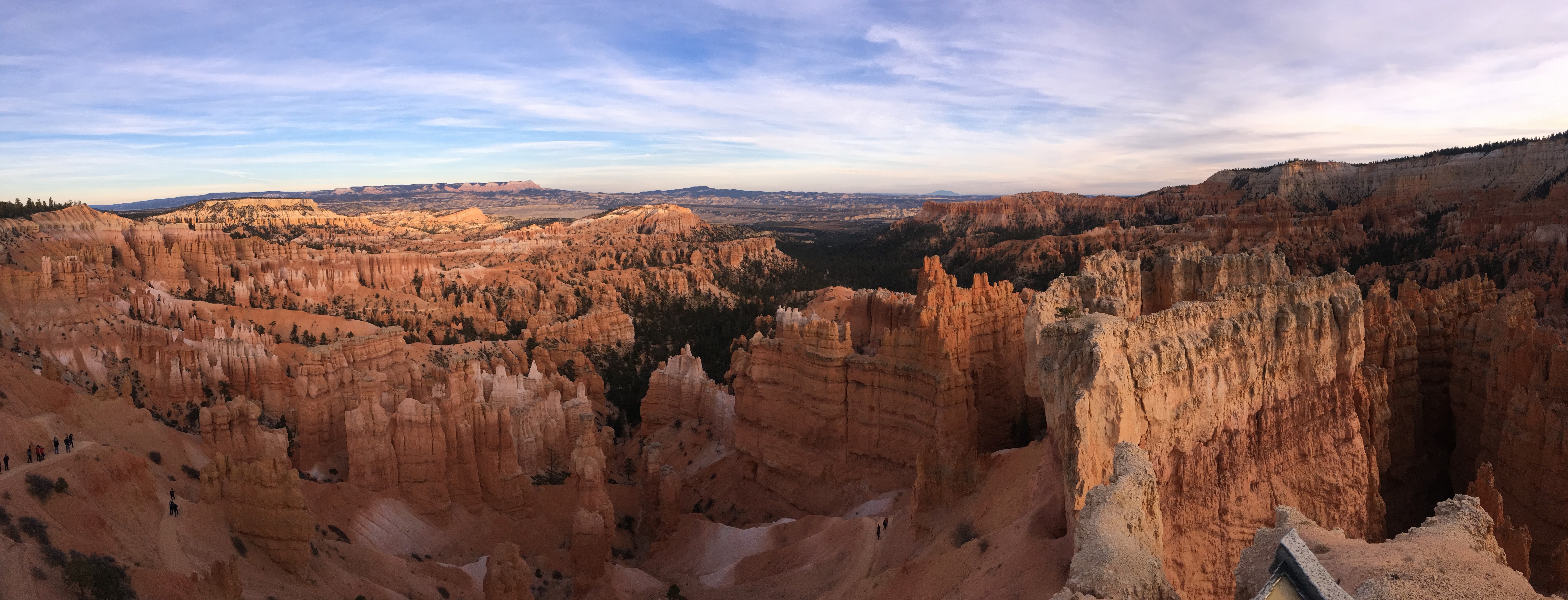
The daughter’s friend was right: Zion had a majestic grandeur to it,  while Bryce Canyon can only be described as breath-takingly beautiful. I had never imagined sparse vegetation and sheer rock face to be this splendid.  I have always been more a lover of trees, and streams. But Zion and Bryce made me think of beauty in a whole other manner. It was as if in one short trip across 4 states(CA, NV, AZ & UT), we had been transported to another planet.

IMG_4979.jpg

A land where hoodoos made magnificent shapes against the blue sky, 

A place where bristlecone trees cling to cliffs

Towering over the abyss of erstwhile marine trenches, 

Where overhead, peregrine falcons swoop swiftly upon their prey 

Hundreds of feet below in the rust colored labyrinths. 

It is a vibrant diorama sparkling underneath the weak wintry sun in the desert

An ecosystem that has seen it all, and still persists. 


Historically Speaking …

I looked at the delectable pile of books by my side waiting to be read. The top of the pile was the beautifully annotated ‘Jane Austen’s History of England. –

Just the sort of history book that appeals to me. Written by Jane Austen when she was 16 years old, the book bears the hallmark of her humor.

Screen Shot 2017-07-06 at 1.26.31 PM

I sat smiling at some of the things written about Henry the 8th & Anne Boleyn.

The book certainly sounded like some of the answer papers of my youth.

I have always felt that History was one of those subjects that was calculated to freeze my brain. Good though my teachers in the subject were, bless them, they could not but help say that the Second Battle of Panipat was fought in 1556. Inside my brain, this simple fact would start a whistling train of thought:

1556. Hmm … funny number.

How to remember that number?

55 in the middle and 6-1 = 5. 

Why not 6551? Because that is in the future.

Very clever. But what about the number 6? Why 6 and not 7?

Maybe, History is the sixth period(?)

But only on Wednesdays.

If only it were 1596, 15*6=90  and then add 6

“Can anybody tell me what happened to Akbar after that battle?” These teachers have voices that have a way of cutting through the most interesting meanderings of the mind.

“What battle?”, I’d write on the side margin, and slip it across to my friend. There she would be, sitting by my side at the wooden desk with a vacant expression on her face biting her pencil. But at this urgent message, she’d stoutly pull herself together and write back, “The Battle of Panipuri, I think.”

Then the exams would roll along, and after days spent cramming the dates and emperors, I would come to the conclusion that all emperors who sought to reign should be made to stand in line in shorts and recite the dates of all those who aspired to power before them.  If they still want to reign, may their shorts fall while they lead the charge – that should teach them not to add to that horribly long list.

To make matters worse, the rumor mills during examination time worked overtime:

(a) The teachers likes diagrams, one person would say, stating emphatically that whatever you do, make sure you draw a diagram for it.

Feverishly, we would start drawing Africa maps, and label the Gold Coast, and the Sahara desert, throwing in the Kilimanjaro for luck. Never mind that the question was about Egypt.

(b) The more you write, the better will be your marks.

So, we would write double-spaced and add spice to the Spice Wars.

history

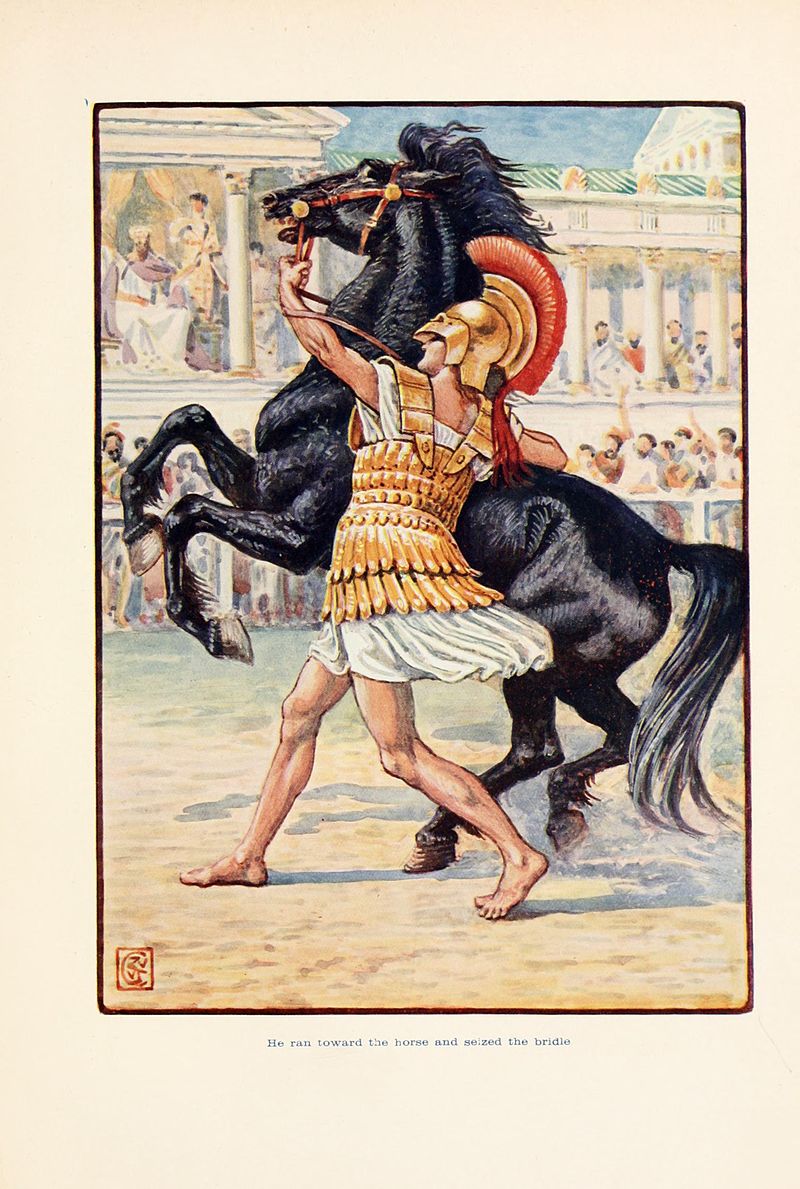
One time I remember writing about Alexander’s Horse. Our History teacher had on one occasion told us about the fine breeds of horses that emperors prided themselves on. My brain tick-tocked away with Alexander’s Horse, and I found to my amazement that the brave stallion was heroic beyond what History books knew. I imagined the horse pulling his great emperor across the blizzards of the mountains one day just by trusting its instinct. The marvelous animal found a stream of fresh flowing water for its emperor. I wrote about 16 sentences on the virtues of the horse, borrowing heavily from my recent reading of Black Beauty (also a black horse with a star on its forehead, duh!) I wrote of its aching muscles, its loyalty that was much admired, and how stable managers had a job that was olfactorily unsatisfactory maybe, but really quite a prestigious one, if it meant looking after the emperor’s horse. I also gave him a name, Macedonia, if I remember right – sealing my understanding of the reign once and for all. (Alexander’s Horse, Bucephalus, would have turned in his grave and asked ‘Is she talking about me? Neigh! ‘ )

He_ran_toward_the_horse_and_seized_the_bridle
By Walter Crane – The story of Greece : told to boys and girls

“15 more minutes.” the examiner said, and I looked to see that while the paper had a brilliant character sketch of the horse, it had very little about Alexander the Great.

I hastily started another paragraph on the the horse’s rider and finished up the paper. I came out into the brilliant sunshine from the exam hall when my friend said looking at me in admiration, “How much you wrote! I saw you taking two extra sheets! I am sure you are going to ace it!”

I shrugged off this undue praise guiltily, feeling a little sorry for the teacher who had to read such drivel.

It was years later that I read “I, Claudius”, the historical fiction book written by Robert Graves,  and came upon Incitatus, Caligula’s horse. Whether it was fiction or not I cannot say, but this was the horse that the Roman ruler, Caligula, sought to make a senator, and invited to State dinners.

http://www.history.com/news/ask-history/did-caligula-really-make-his-horse-a-consul

The truth is stranger than fiction, but it is because Fiction is obliged to stick to possibilities; Truth isn’t. Mark Twain

I smiled at these pleasant memories, and opened the book in my hand.


Jane Austen said,

Edward the 4th

This monarch was famous only for his Beauty & his Courage of which the Picture we have here given of him, & his undaunted behavior in marrying one Woman while he was engaged to another are sufficient proofs. His Wife was Elizabeth Woodville, a Widow who, poor Woman! was afterwards confined in a Convent by that Monster of Iniquity & Avarice Henry the 7th. One of Edward’s Mistresses was Jane Shore, who has had a play written about her, but it is a tragedy & therefore not worth reading. Having performed all these noble actions, his Majesty died, & was succeeded by his son.

A Jane Austen Education

 I like to draw relaxation from the joy in little things. The ability to stop and look at a flower or amble along with friends and family discussing the little matters of life that make up the notes of music as we hum along in our lives.

IMG_7466 (1)

The ability to feel like it is okay to not be driven by this high sense of purpose, but living a useful life all the same.

There is no power on Earth that can neutralize the influence of a high, simple and useful life. - Booker. T. Washington
There is no power on Earth that can neutralize the influence of a high, simple and useful life. – Booker. T. Washington

When people talk about good stories, they are usually pumped up about plot, drama and suspense. I am all for plot, drama, suspense, mystery, hot-cold love and so on. But our lives don’t always turn out that way, nor should it. That is why I recharge myself with writings of Miss Read, Jane Austen and P.G.Wodehouse. When I read these authors, I can assure myself that it is perfectly okay to lead lives that will not get a dramatist to reach for his recording device, but one that is joyful enough in its pursuits and activities to make it an interesting one.

Every time, I unwind with a Jane Austen movie, the nourish-n-cherish family rolls its eyes and flees the television area. Now that I think about it, it seems to be the only way for me to get some air time with the television. Hmmm (Evil laugh with gleam in eyes). But I hope one day to be able to get them to enjoy the movies with me.

I am reading ‘A Jane Austen Education’ by William Deresiewicz, that is essentially all the life lessons that her writings have for us to imbibe. Such a delightful book! There are some things that are clearly just the author’s perspective of applying her writing to his life. Not to mention that this book was written by a man, so it is only natural that his and my perspectives vary. 

The books starts with my favorite book of hers: Emma.

Little nuggets of writing like this spot the whole book and make me want to open it up at random and read again.

Jane Austen was about a year old when another English Author wrote a statement that could serve as a motto for all her books. “Life is a comedy for those who think”, said Horace Walpole,  “and a tragedy for those who feel.”. Everyone thinks and feels, but Jane Austen’s question was, which one you are going to put first? Comedies are stories with happy endings. I could grow up and find happiness, Austen was letting me know, but only if I was willing to give up something very important. Not my feelings, but my belief in my feelings, the conviction that they were always right.

Another one:

Being happy and feeling good about yourself are not the same thing.

A dictum that Mansfield Park reveals, that is as good today or even more apt today than any other day in the past.

Perpetual amusement leads only to the perpetual threat of boredom.

 I can tell you that it was truly a shocking revelation to me, that a recent study said we reach for our phone 221 times a day. (http://www.nybooks.com/articles/2016/02/25/we-are-hopelessly-hooked/)

Imagine that. More than 200 moments in time when we could be observing (anything at all really) spent checking a digital device. Are we not just as guilty as the Crawfords in Mansfield Park for needing that kind of continuous stimulation? It is no wonder that Digital Addiction is a real thing  requiring treatment.

http://www.gq.com/story/video-game-rehab?utm_source=nextdraft&utm_medium=email

It reminds me of this article:

Anyone with any degree of mental toughness,” artist Georgia O’Keeffe wrote in contemplating life and the art of setting priorities, “ought to be able to exist without the things they like most for a few months at least.

A sobering thought indeed.