How To Be a Good Companion

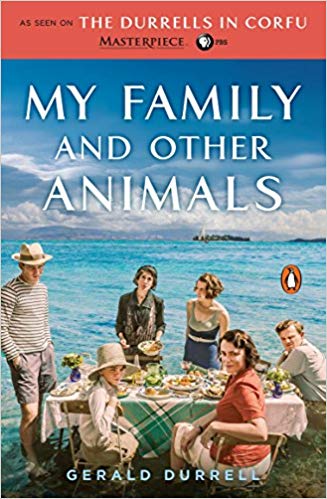
Simba who was introduced me around a decade ago passed away last week. This post was there in my drafts for over a year since I read My Family and Other Animals by Gerald Durrell. Simba’s passing made me acutely aware for the gratitude I feel for these furry friends.

Ask Sanku, Simba, Bogie, Luna, Timothy, Sanku, Tinky and Bolu, and they will all unanimously tell you that I may be a good sort in general, but the best past-time they have is to see me when in their midst. Sanku, Simba, Bogie and Luna have been introduced to me later in life, and though they may not believe it possible when Timothy tells them, they are seeing a mellowed person of years.

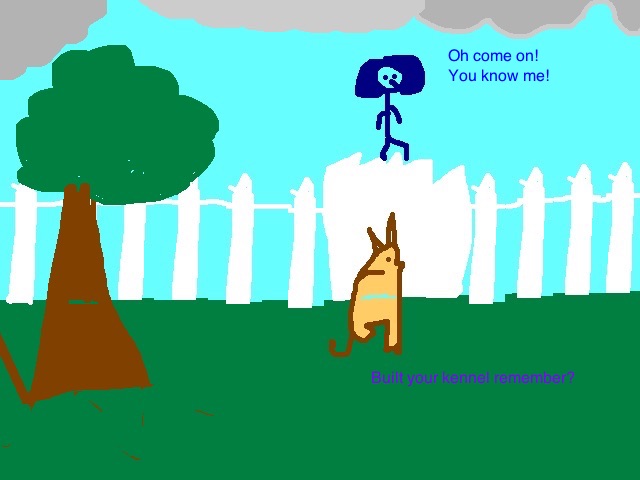
Timmy, named after Timothy, the dog in the Famous Five Adventure Series by Enid Blyton. (Timothy (The Famous 5 one) was a raucous, energetic dog who would have done anything for his 4 human companions. ) Having such an illustrious name to live upto, you would think Timmy would have been a better companion to me. Instead, he was a vicious little yip who forever found me atop bushes or gates, where I had scrambled in my haste, squeaking like a rat waiting for help. Timothy has seen the hot stuff. ‘Hot dogs!’, he used to say to himself and go ‘bow-wow-wow’, lackadaisically, sometimes not even bothering to stir from his kennel (which I helped build lovingly with wood panels and nails by the way), and I would find myself scrambling through hedges with spiders in my hair, looking demented and scrappy.

timothy_me_on_fence

One flip of a puppy, Bolu (I remember thinking that self respecting mice would scoff at the name), had me charging up 67 steps at such a scorching pace that the physical education teacher leaning on a tree nearby chatting with his friends, promptly placed me on the relay team, where my performance was nowhere close to what it was with Bolu on my case.

The daughter yearns for a dog, and would gladly give Bolu & Timmy a sharp kick for giving their mother this unreasonable fear of dogs. But my recent canine companions have done much to help me overcome the fear.

Simba, Sanku, Bogie and later Luna, have been marvelous in their quest to make me become less eccentric around them.


I have often wondered how I would react to people who made it clear that they were uncomfortable in my presence. Would I leave them alone, and feel bad at such a seemingly irrational reaction? I must say the deportment of my canine friends in later years have put me to shame. If anything, they have taken the discomfort with sagacity and a grace that we will do well to learn from. They taught me with patience, and took me under their wing with the understanding of having to deal with a dim-witted student.

Patiently, they initiate me into the art of relaxing in their presence. First a small wag to indicate they think I am a good-ish sort, and then a little curiosity followed by an affectionate brush up against my leg was their method. They instinctively seem to know how to be a good companion.

How can one be a good, even perfect, companion? This excerpt from My Family and Other Animals comes close to addressing the question.

My Family & Other Animals is a wonderful read for anyone looking to experience the wondrous world around us with humor and candor. I admire the work of naturalists as regular readers know. The author wrote of his life in Corfu near Greece, and his adventures on the island were magically transformed by his deep affection for his dog, later dogs. He writes:

pets


(Pic my own)

In those early days of exploration Roger was my constant companion. Together we ventured farther and farther afield, discovering quiet, remote olive groves which had to be investigated and remembered. He was the perfect companion for an adventure, affectionate without exuberance, brave without being belligerent, intelligent and full of good humored tolerance for my eccentricities.

family_other_animals

He goes on to say about Roger – who sounds like the ideal companion anyone could wish for, that:
If I slipped when climbing a dew shiny bank, Roger appeared suddenly, gave a snort that sounded like suppressed laughter, a quick look over, a rapid lick of commiseration, shook herself, sneezed and gave me his lopsided grin. If I found something that interested me – an ant’s nest, a caterpillar on a leaf, a spider wrapping up a fly in swaddling clothes of silk – Roger sat down and waited until I had finished examining it.

Reading about Roger almost makes me wistful for a companion like him during my nature saunters in my youth. But in later years, Simba, Bogie and occasionally Sanku have come with me on hikes, and I have never felt more alive in the natural world than around them. No sniff was too blasé for them to consider, no dog they met on the trail deserved the ignominy of no-greeting. The trails came alive with them around. The flowers, grass, insects and squirrels were granted the same courtesy of curiosity and unflagging acknowledgement. When their human companions flagged in energy, they made their intentions known – “You can do it. I am with you.”


How to be a good creature by Sy Montgomery is a children’s book in which the Author writes of what different creatures taught her. The essays on her Dogs and her Pig are particularly good reading.

good_creature

Simba passed away last week, and his passing has made me consider the fundamental question: How to be a good companion?

Classical Whale Symphony

Soft instrumental music was lilting in the background, and the sun’s watery rays were streaking in through the recently rain-washed window-panes. It was a beautiful week-end morning, and the kitchen was bursting with activity. The children were helping by putting away the dishes as noisily as possible. I was making a mess of things by changing the menu nimbly depending on what my refrigerator had. (Grocery shopping had taken a backseat the past few days and rations were thin on the ground)

The children were giggling about something when the teenage daughter said to hearty nods from her little brother. “By the way, what is this blasted toing-toing music you are listening to?”

“Melodious and uplifting for the soul, my dears. Classical Instrumental Music. Changes the way neurons interact.”

She shook her head, “Changes the way my nerves react!”and changed it to something that made my eardrums pick up the dishes and bang them viciously inside my head, while she chatted. Teenagers, I tell you!

“Whales like Classical Music.” , I said weakly.

“Well, I’m not a whale am I?” said she giving me a fish-like look- not the fishy look, the glassy gleam. I saw the piscean divergence in the gene and agreed. Though she could be, given her favorite doodles are themes under the sea

Art work by the Daughter:

Ever since I read in Carl Sagan’s Cosmos about Whale Songs, I have been enamored with the language of music, and the myths of the whales.

Quote from Cosmos by Carl Sagan on the Humpback Whale songs:
These vocalizations are complex. If the songs of the humpback whale are enunciated as a tonal language, the total information content, the number of bits of information in such songs, is some 10 to the power of 6 bits, about the same as the information content of the Iliad or the Odyssey.

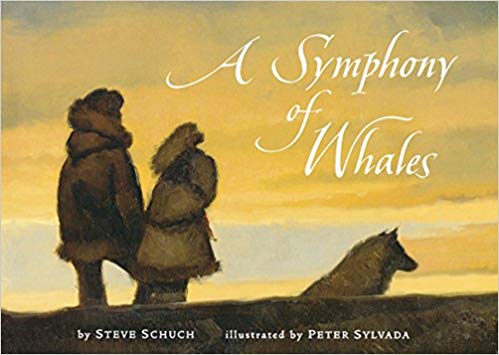
I was naturally was attracted to the book, The Symphony of Whales by Steve Shuch. It is based on a true story in a village near the Arctic circle. The onset of Winter had been swift, and a pod of whales found themselves iced in near Siberia. Unable to get out in time, the whole pod faced death in the iced-in waters.

symphony_of_whales

According to the book, a child, Glashka, who had always been blessed with the ability to hear Whale song heard them over the sound of the snowy storm. That night, they came to her in her dreams, and she knew they must be in trouble.

The next morning her father gathered the villagers and off they went to a sound over 30 miles away by dog sleigh looking for the pod of whales. It was true. The whales were in trouble. The pod had not anticipated the icing in of the waters so quickly, and were facing death. The villagers from all the neighboring villages started chipping at the ice to cut through the blocks of ice, so that the whales could surface and breathe.

“Look!”, said Glashka’s grandmother. “See how the whales are taking turns, how they give the younger ones extra time for air.”

The village elders had also radioed for help. A ship, an icebreaker, Moskva, was on its way to help.

The story, is based on a real incident that happened in the narrow Senyavina Straits of Siberia. Over 3000 beluga whales had been trapped by the rapidly freezing waters in 1984-1985. For seven weeks, the people of the Chukchi peninsula, and the crew of the Moskva risked their lives to save the whales.

The story does not end there. Once Moskva had cleared the way, the whales had to follow the ship out into the open seas, but they were reluctant to do so. The crew tried playing whale song to lure them. While they reacted to the music, they were not assured of human intent, and were still scared of the engine sound. They lurked in the waters.  Then they tried Classical Instrumental Music.

“The crew found some classical music. First, the sweet sounds of violin and violas, next the deeper notes of the cellos and, deepest of all, the string basses…and way up high, a solo violin…
Everyone fell silent as the music carried over the waters.”

That had done the trick. The ship’s engines started and the whales slowly followed the icebreaker out into the open ocean.

Would this heartwarming episode make it into Whale Song? That humans can be helpful too? I don’t know, but I do hope it makes it into our myths – maybe as one embracing a humane side to humans.

Dum inter homines sumus, colamus humanitatem – Seneca

As long as we are human, let us be humane

Read also:

Cosmic Nature of Living

Weaving The Sequins of Time

New York Times Archived Article on the Incident

The Three Selves

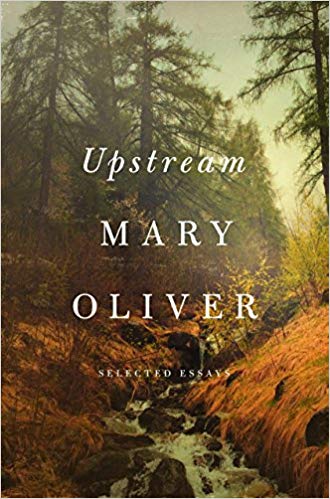
Mary Oliver’s, Upstream, is a book of many marvelous essays. One in particular stood out: Of Power and Time. This one is about the three selves in many of us:

  • The Child Self
  • The Social Self &
  • The Eternal Self.

upstream

Reflecting upon the piece, I realized we should know this by now, and we probably do at some level, but it takes a clairvoyant writer to set it out so neatly.

The Child Self is in us always, it never really leaves us. I completely identify with that. I am decades away from my childhood, but I can dip into it like I only just grew up.  Everything felt keener and sharper as children, and that is part of the reason why The Child Self never really leaves us, I suppose. (Probably the reason why I forget the name of the person I met yesterday, but remember the names of my friends from when I was 5 years old : What is Time?)

While young, I yearned to grow up, and in the words of L M Montgomery realize that growing up is not half as fun as it is purported to be.

“That’s the worst of growing up, and I’m beginning to realize it. The things you wanted so much when you were a child don’t seem half so wonderful to you when you get them.”
― L.M. Montgomery, Anne of Green Gables

The second self is the Social Self. This is the do-er, the list maker, the planner, the executer. The one, in short, that most of us find ourselves trapped in for the most part of our lives. This is “the smiler and the doorkeeper” as Mary Oliver so elegantly puts it. This self I am familiar with: metaphorically the whirlpool, the swift horses of time, the minute  keeper.

“This is the portion that winds the clock, that steers through the dailiness of life, that keeps in mind appointments that must be made. Whether it gathers as it goes some branch of wisdom or delight, or nothing at all, is a matter with which it is hardly concerned. What this self hears night and day, what it loves beyond all other songs, is the endless springing forward of the clock, those measures strict and vivacious, and full of certainty.”

The social, attentive self’s surety is what makes the world go around as she says.

Then, there is the third self: The Creative Self, the dreamer, the wanderer.
“Certainly there is within each of us a self that is neither a child, nor a servant of the hours. It is a third self, occasional in some of us, tyrant in others. This self is out of love with the ordinary, it is out of love with time. It has a hunger for eternity.”

The essay goes on explain the regular, ordinary self in contrast to the creative self. The Creative Self – the one that is out of love with the ordinary, out of love with the demands of time or the regular routines of life, is concerned with something else, the extraordinary. This is the self, she says, that makes the world move forward.

“The extraordinary is what Art is about. No one yet has made a list of places where the extraordinary may happen and where it may not. Among crowds, in drawing rooms, among easements and comforts and pleasures it is seldom seen, It likes the out-of-doors. It likes the concentrating mind. It likes its solitude.”

img_1781-effects

The essay was eye-opening in many ways. For I know many, including myself, have to fill our days with the demands of the clock. It is also easier to be the do-er, so that we may not have to enter that difficult place of teasing, figuring and wrestling the extraordinary out; to give shape to the nebulous clouds skirting in the recesses of the brain.

There is nothing wrong with succumbing to the demands of the clock, but it is a valuable lesson to teach ourselves to take our brains for a tease and see what results, isn’t it? We may land up surprising ourselves if only we give it the chance.

The essay ended on this note:

“The most regretful people on Earth are those who felt their own creative power restive and uprising, and gave to it neither time nor power.”

What do we do to ensure that there is enough time in our lives to ensure the nurturing of the Eternal Self? (Read: The Art & Charm of Shoshin) I don’t know the answer yet, but when I do, I shall hop on social media and share it right away.

Note:

A version of the essay is found here: 

Mary Oliver: The Artist’s Task 

Brain Pickings – The Third Self

The Touch of the Eternal

The daughter came hurtling into the room bursting with something to share, her brother in quick pursuit. I was sprawled on my stomach across the bed surrounded by a bunch of books.  She looked surprised at finding me indoors instead of hustling people to come and enjoy the outdoors, and said “How come you aren’t flitting with the butterflies?” 

The skies were blue, the air pure, the trees outside looked splendid and inviting, the first shy cherry blossoms were peeping out, the first of my tulip shoots were making their way out of the ground much to my delight.

I snorted and said, that just because the day looks awesome outside does not mean that I have to ‘flit like a butterfly’. Besides, it was perfect Gluggavedur weather. (Gluggavedur is a delightful Icelandic word that signifies, ‘Window weather’ – beautiful from the inside, but too cold to go outside.)

I know I have yearned for the right word many times. (A word for the cool breeze that hits your face when you run down a mountain for instance: Zephyr Tales) This book, What a Wonderful Word, taps into that feeling with words from many cultures across the world.

Book: What a Wonderful Word – By Nicola Edwards & Luisa Uribe

Anyway, where was I? Oh yes: I looked dignified and mature. It is done by setting the chin at an awkward angle, and giving the impression of one finding a skunk when one lifted the bushes to find a squirrel.

“A mature adult can do many things!” I said.

“Like reading children’s books?” said she.

I laughed hard and she joined in. Mature indeed! 

One time she found me doing Yoga with a beautiful Children’s book open, and checking out the illustrations from various angles. This act of whimsy earned me the loving and coveted label that teenagers award rarely, “You are SO weird! That is such a you-thing, why am I not even surprised?”

Much later when I read Upstream by Mary Oliver, I was glad to see that I was doing something right – the whimsical part at least.

“You must not ever stop being whimsical. And you must not, ever, give anyone else the responsibility for your life.” 

― Mary Oliver, Wild Geese

Some of my favorite things to do is flip through children’s books. The illustrations on some of them made me admire the books on wholly different levels.

How an artist comes up with conceptualization, the drawings themselves, and the whole process that goes into making children’s books is amazing. Every book is a testament to creativity, teamwork, solidarity, the calling of the eternal, and so much more. When asked to critique a piece of Art, I would trip up on a few things like techniques, styles, brush strokes, paint colors, paint directions, canvas quality etc. But I can appreciate good Art when I see it, and describe it with the word, Beautiful.

I was book-flitting like butterflies, very happy with the set of books I was flitting through.

“See! See this book – how can people even conceptualize a piece like this? Hmm…what would we do without Children’s books?”

I was surprised she had no snarky comeback – it is seldom so. Blessed as she is with sharp wit, it is usually me that has Espirit D’Escalier episodes. I looked up, and saw her immersed in the beautiful drawing in the children’s book I showed her. She spends a good amount of her time doodling and definitely with more success than Yours Truly. 

Rob Gonsalves book, Imagine A World, was definitely mesmerizing. The almost seamless transitions within the Art that hid multiple layers and concepts was work of genius. A sample piece shown below  – you can also head on over to his site that has more Art work. 

img_1863
Rob Gonsalves work Book: Imagine a World

The book reminded me of Mary Oliver’s Quote:

“Keep some room in your heart for the unimaginable.” 

― Mary Oliver

Magical Realism is Gonsalves’ speciality, and I am so glad to have picked up the book. It is easy to see the pictures over and over again – being immersed in them over again.

imagine_a_world

I am the first to admit that I am no Art Critic, just a child admiring the work of artists whose touch of the eternal we are blessed to see. 

Also read: Dr Seuss’s Art

Philosophers & Tinkerers

I picked up the book Black Hole Blues by Janna Levin partly because I was intrigued by the poetic title, and partly because I like reading about our dear Cosmos, and its many mysteries. The skies have given me endless joy, peace and continue to do so, even though light pollution in our suburban areas mean that we cannot see the stars, planets and stars as clearly.

black_hole_blues

Excuse me for a while, while I meander to a black hole of my own for a moment: I was appalled to note that a Russian startup intends to sell advertisements that can only be visible in the night sky. Are our products so important that we have to dwarf the shows the Cosmos puts up every night to sell toothpaste and whatever gawd-awful thing we contrive in our numerous factories? (I have a post clamoring and rattling in the brain waiting to get out on the number of contraptions that folks felt I must have, or I myself felt I must have, and now occupy valuable shelf-space in the home somewhere.)

Climbing out of the black hole then, the cosmos has given me endless joy and I indulge in dipping into its mysteries every now and then. What surprised me about detecting gravitational waves is the immensity of human endeavors. Theorizing and coming up with the supporting Mathematics to validate the concept is in itself a phenomenal achievement, but conceptualizing an experiment of such magnitude as to detect a stirring as faint as gravitational waves emanating when two black holes collide millions of light years away is astonishing.

As Janna Levin says, it is a project to fulfill a fool’s ambition.

“An idea sparked in the 1960s, a thought experiment, an amusing haiku, is now a thing of metal and glass.”
― Janna Levin, Black Hole Blues and Other Songs from Outer Space

The LIGO (Laser Interferometer Gravitational-Wave Observatory ) is astronomical in scope and dimensions. Janna Levin’s book takes us into the human dramas and the corridors of Caltech and MIT where much of this played out. While I did feel the flow and structure of the book could have been more crisp, and less about the human politics that plague undertakings such as these, it was nevertheless interesting.

As I read, I was amused at how humans unfailingly bring drama into our existence. At the altar of Science, many have sacrificed their egos, had their egos bruised, and have propelled or obstructed the flow of Science, but like a river it flows on and hopefully propels our understanding forward, not always cognizant of the applications of Science (One of my favorite sayings of Ursula K Le Guin:

When you light a candle, you also cast a shadow).

After the monumental setbacks and roadblocks along the way, it is a satisfying end to the book that the experiment finally paid off. Twice, it detected Gravitational waves as they passed through the Earth from the collision of two massive black holes millions of light years away.

ligo.jpeg
(Image tweeted by @LIGO)

We do not yet know how this will change our understanding of the Universe, and its applications, but we can be rest assured that both are underway. We have come a long way from the Sun God riding the sky every morning on his chariot, though I am reading a fascinating book on this very myth at the moment.

Human-beings are philosophers and tinkerers at the very core, are we not?

Also read: Cranes of Hope (Essay of the Value of Science by Richard Feynman with A Thousand Paper Cranes by Eleanor Coerr).

The Queen of Espirit d’escalier

One cold January morning, I clutched at my tea for life giving support. I was sitting through the kind of gathering that happens across Corporate America when a calendar year rolls over. Executives suddenly pep up, and sit up looking important, and feeling purposeful. Like a pup in spring, who thinks he can play with the ball if only folks would toss it instead of gadding about.

aging

I sometimes like to watch these events. The actors change every so often, and the ones who remain have subtle changes in their motivations and ambitions too. The varieties of personalities we surround ourselves with is an ever fascinating experience, and we only really have the luxury of sitting back and watching occasionally. I suppose that is why the Dalai Lama is full of the milk of human kindness – he meditates, and observes.

Anyway, the gathering reached a place where credits were rolled and I noticed happily how people brightened when they were given credit for their work. It is true one should do the work without expectation of the reward, but how nice it was to see people get the credit where it is due. The meadow suddenly seemed spotted with frisking happy pups.

There was an amusing interjection when one team was accidentally left out of the credits, and claimed what was their due.

I smiled to myself thinking of this normal human tendency to crave recognition. We all do it. Just the other day, I bragged about how clean the kitchen floor looked: ‘gleaming like glass’ as I said, till I was reminded by the family almost gleefully that I had better stump it given that I had to clean up the glass I had broken, and therefore ‘gleaming like glass’ doesn’t really count.
“I am neither Jocelyn Bell Burner nor Alfred Russell Wallace. When I clean the floor, I want credit! “ is the quip that I would have liked to come up with.

But I didn’t.

I came up with the inelegant, “Well…I am eating the potato fry then!”, and stuck my tongue out at the children.

I am a queen of that phenomenon where you think of the perfect verbal comeback too late. I was delighted to note there is a word for that: Espirit d’escalier.(Wiki Link for the word, Esprit De Escalier) The link writes about the amusing origins of the word, please read it.

Where am I going with all this spirited Espirit d’espalier, potato fry stuff? One moment. Yes, Credit and Work and Meaning and all that.

Sitting there at the corporate meeting, and watching the team claim credit for their small part in the puzzle, I was reminded of Jocelyn Bell Burner and Alfred Russell Wallace.

Wallace, independently arrived at natural selection for the mechanism for evolution before Darwin did, but he jointly published the paper with Darwin. Darwin’s Origin of Species is vastly credited with the theory though. Did that make Wallace spout and keep the potatoes? No, he continued to travel the world, writing about injustice and social causes. He never stopped exploring or lost the joy of wonder or ceased writing on the causes that deeply appealed to him.

Jocelyn Bell Burner is another scientist whom I find admirable for this very reason. She was passed over for the Nobel Prize. Credited with detecting the first Pulsars in the universe ( she should have been a Nobel Prize recipient for Astrophysics in 1974). When asked how she felt that her Professor got the prize, and did not adequately exert himself to get her name on the nomination, she shrugged and said, “If you get a prize, it’s not your job to explain why you got the prize. ”

I read about these two stalwart scientists in the books, Lands of Lost Borders by Kate Harris and Black Hole Blues by Janna Levin. Every book teaches us different things. Even queens of Espirit d’escaliers can find a way to come back with Jocelyn Bell Burner & Alfred Russell Wallace and their phenomenal attitude towards recognition as it related to their work.


It makes me realize now what my stellar teachers were saying on those cold Assembly mornings when they dangled tantalizing pieces of wisdom in their morning speeches.

Bhagawad Gita on work without reward

Karmanye Vadhikaraste, Ma phaleshou kada chana,

Ma Karma Phala Hetur Bhurmatey Sangostva Akarmani

कर्मण्- ेवाधिकारस- ते मा फलेषु कदाचन।

मा कर्मफलहेतु- र्भूर्मा ते सङ्गोऽस्त्- वकर्मणि॥

Loosely meaning: Do not anticipate fruits while doing the labor, this was oft quoted by teachers trying to inculcate the importance of work.

The Roman Holiday

“Can you believe we are going to roam around in Rome?” said the excited son. He was very proud of his homophone.

“Isn’t it funny? Roaming around in Rome?”

“Yes! You bobble head! I said it was funny the first time you said it.” said the teenaged daughter pulling an I-can’t believe-this little fellow face. I laughed, knowing this was only setting the stage for at least another 108 times we would have to endure the phrase in Rome, and I was not mistaken. The nourish-n-cherish household is proud of its jokes.

“Have you done your homework? Did you spend some time trying to figure out the places to see?”

The husband’s I-love-my-wife-but-I-know-what-she-doesn’t-do-well tone deepened.

Setting aside the dismal feeling of being caught in school, I told him (patiently),
“Relax – I got the itinerary from my colleague who went there for his honeymoon, and it has a pretty good list of things to do including details on where to catch a sunset.” I said winking. “I even prepared a doc and shared it with you.”

He looked surprised, but right enough, when he opened the doc, he discovered entries like:
Check out the colosseum, if there is enough time, also add Palantine hill, and the Piazza Navona.
On the way back,  spend some time on the Spanish steps, and near that is Trevi Fountain.

I am no trip advisor, and when I generally send people on their way, I give them a vague list like above, keeping a wide margin for ducking into random stores that attract one’s fancy, stopping at random spots that demand one’s attention, looking at people scurrying about their business, tucking in an extra gelato, dribbling along and finding a couple of boys play football – it is all good fun.

roman_list

I like to blame my list-making on being one of those staunch believers in the super power of Serendipity, and the gift of winging it. For instance, the taxi driver the previous night told us not to miss the Piazza Venizia.  Piazza Venizia, as it turned out, was one of the most grandiose buildings I have seen. Built recently by Roman standards, it is only a century old among ruins millennia old, but the views from up above of the sprawling city of Rome,  Colisseum and the Palantine Hill were brilliant.

rome-aeriel

The Romans didn’t believe in skimping on the grandeur. Glancing skywards and finding flying chariots bearing regal men atop their chariots was so novel that we found ourselves gawking like fish seeing Poseidon’s horses swishing through the seas for the first time.
“Poseidon was a Greek God, his Roman equivalent, Neptune, wasn’t as powerful because the Roman Navy wasn’t very powerful then”, said the mythology expert, the teen- queen in her mythical world.

Rick Riordan has done a marvelous job in getting tens of thousands of teenagers interested in the Greek and Roman myths, and our tour guide at the Vatican, told us she wrote up a Percy Jackson tour that was hugely popular. I could well imagine it. The city burst with myths. Flying chariots, fountains of fortune, serpents of evil, winged harbingers of war or prosperity jostled along with busts of statues of philosophers, kings, and senators.

1920px-piazza_navona_0956_2013
Bengt Nyman [CC BY 2.0 (https://creativecommons.org/licenses/by/2.0)%5D, via Wikimedia Commons
It was also slightly disconcerting to read about the forms of entertainment in early Rome. We have heard stories of the slave, Androcles, who was not mauled by the hungry lion remembering a past kindness, seen movies of the era etc, but there is something disconcerting about standing amidst the ruins of the Coliseum and reading about the manslaughter, the barbaric practice of skinning people alive etc. A place where hundred of years ago,  people watched this gore as a form of entertainment raises goosebumps.

coliseum

If that is the kind of evolution mankind has had to come through, we have come a long way, but we also still have several ways to go.

What was that poem about “Miles to go before I sleep” ? by Robert Frost.

Walking among the ruins, you are intensely aware of the fact that toga-clad Roman senators walked the same path 2000 years ago, and if you are even slightly distracted, there are thousands of tourists, their phones, and their respective tour guides to remind you of the significance. In spite of that, it felt strange to see the husband looking at the GPS to figure out directions beside a ruin that was literally thousand years old. What if a spirit from that age were to spring in our paths then and there?

Maybe one did, for the husband saw a chain lying across the road, and attempted his boyish skip across the chain. He underestimated its height and went sprawling face-down on the pavement. After the initial shock wore off, he started laughing, and the son said, “Appa tripped on the trip. Hey! Appa tripped on the trip while roaming around in Rome. Get it? Get it?”, and we all laughed.

Our jokes! Well, they need to evolve too.

In the Land of Dreams

I often have the privilege of reading books that require re-reading, thinking passively about the book every now and then, and then re-open and rekindle the feelings of the first reading, thereby making it a layered experience. Every once in a while, I find myself in the extremely fortunate position of having read several such books at once or in close proximity, and though the next set of books are no less interesting to the brain, I am stuck re-reading sections of the ones I have read.

reading
A picture of a man sitting and reading in a park

2018 was a year that started off on a promising note, and went on to delight and stretch my reading in all directions. In over 100 books, there are a few that I really did want to share. The links to the nourish-n-cherish articles in the brackets)

While I enjoy all forms of reading , and happily wade through tomes, fiction and non-fiction alike, the ones that truly uplift my spirit are Children’s books. Whether it is the magnificent imagination at work, or the illustrations, or the simple act of making one think deeply with the minimum of words, I cannot tell, but I feel a soaring of spirit every time I pick up a children’s book. A few notable ones in 2018 that I would happily pick up again to read are:

  • Louis I, King of Sheep – by Olivier Tallec
  • Here we are – Oliver Jeffers
  • Sadako and the Thousand Paper Cranes – Eleanor Coerr (The Cranes of Hope)
  • One Fun Day with Lewis Carroll – Kathleen Krull and Julia Sarda (Zephyr Tales)
  • Wangari Maathai – Green Belt Movement
  • Counting on Katherine – By Helene Becker and Dow Phumiruk (To All Astrophiles)
  • A Symphony of Whales – Steve Schuch

To enable all of this reading, one must have a frame of mind that works out the curious and whimsical muscle of the brain. So, of course, I had a healthy dose of P.G.Wodehouse, Miss Read, Gerald Durrell and R.K.Narayan mixed in to all of this.

Here is to another year of varied and marvelous reading.

Happy New Year!

The Domestic Explorer

There are things every explorer wants to do. Whether it is as drastic as Thoreau spending 2 years, 2 months and 2 days in a cabin in the woods, or Kate Harris finding herself in the process of exploring the Silk Road, there are aspirations for us to reach that state of mind where we can look past the hustle and the bustle of our daily lives. A form of reflection that one gets to experience once in a while, but has no idea how to sustain. (At least I have had no luck at it.)

Quote from Lands of Lost Borders:

“I’m not sure where I go when I spin wheels for hours on end like that, except into the rapture of doing nothing deeply.”

I think Kate Harris’s moving, poignant, lyrical, poetic, beautiful meditations on being, belonging, and living is well on it’s way to becoming one of my favorites. I have re-read sections of it soon after finishing it. Hers is a marvelous mind (I am grateful she penned her thoughts and found a publisher for us to enjoy). It does make me wonder sometimes how many others there are out there, who have similarly exalted thought processes, a Being larger than being squashed into narrow compartments that we seem to slot ourselves into: A Higher Order Thinker.

Kate Harris’s work is one for every traveler’s soul. Every body who has ever dreamed of adventures, ever dreamt of being bigger than your circumstances, hers is an invitation to sample what is possible. For everyone who is unable to sample the world with all its worries and problems, Lands of Lost Borders is there.

lands_of_lost_borders

The author writes of her journey across the oldest and possibly most famous road in the World, The Silk Route. Wanting to lose herself in the other worldly, she lands up finding herself on the oldest roads known to civilization.

Along with her friend Mel, the two women cycle through Turkey, the Stan-countries after Russia’s disintegration (Turkemistan, Kyrgystan, Uzbekistan), China, Tibet, Nepal and finally India – camping along the way, accepting the kind hospitality of friends and strangers along the way, navigating authorities, paper work and visa restrictions that make us want to throw our hands up in despair. A true voice of an explorer.

Her voracious reading sparkles in the form of quotations and anecdotes – Carl Sagan, Marco Polo, Charles Darwin, Russell Harris, Wright brothers are all in attendance adding their rich experience to the journey. Her clear heart blurs borders while sizing up people. Sitting up in bed with the wind roaring outside, the rains lashing, it is bliss indeed to pedal relentlessly through the high mountains, past lakes, punishing deserts and sketchy neighborhoods. Two women alone in an alien world.

As she quotes every so often,

“Every explorer dies of heartbreak.”

This is one of those books that will stay with me for a long time. I had the privilege of reading this book alongside another of Miss Read’s comfortable, cozy book. This book of travel and adventure was the perfect pairing to the domestic pleasures that a Miss Read book conjures up.

In Miss Clare Remembers, Miss Read writes about a young child of 8 or 9, who was excited and flushed after seeing the snowdrops when they went out on a school nature walk. Afterwards inside the home of the local farmer, where the farmer’s wife had kindly laid out biscuits, milk and cut fruit for the hungry children, she realizes how much she requires both pleasures in order to thrive. With a clairvoyance that children sometimes possess, she appreciates the vast spaces that nature provided for her soul to soar; and the cozy domestic pleasures where she can feel nurtured and at home. A safe haven from her flights of adventure.

Quote from Emily Davis – By Miss Read:

“One was her nest. The other was the place in which she stretched her wings, and soared, as effortlessly as the lark outside, into a different dimension.”

miss_clare_remembers


I felt that way while reading the Lands of Lost Borders together with a Miss Read book. I savored the stars kindly drawing the constellations out for the explorers to reach out to every night; as much as I enjoyed the domestic problems of a normal life. Ensconced in the modern comforts of living, reading both the books in parallel left me with a deeply delighted sense of having both adventure and comfort, and feeling grateful for it.

I am not sure my blogs can do justice to the books, but it seems a perfect way to begin winding down the year.

Boarding the Flight of Fancy

A version of this post was published in The India Currents Magazine: On a Flight to a Land Without Borders

I boarded the flight at the end of a long week. I was going to be away for a week, and I had spent weeks trying to get things in order for the week I was gone. It felt good to finally stretch one’s legs (as much as an economy seat would allow anyway), relax one’s senses, and stretch one’s mind.

The flight was strangely beautiful. It left in the evening, and as it took off, I left behind a sparkling firework of lights. The vast, urban sprawling city and surrounding areas looked kindlier from above. The freeways glowed like veins throbbing with cars as they crammed their way home for the week-end along the packed highways. I have watched ants with interest as they scurry about their daily duties and I felt we must look the same if someone were to be observing us. Maybe those monitoring satellites do have the feeling every now and then.

Bay area at night is beautiful from an airplane, however else it feels when one is on the road.

img_08171

I fell into an uneasy slumber once we passed the populated sections and darkness fell. I looked out the window hours later, to be pleasantly surprised by the beauty that greeted me. The plane was gently reverberating with the satisfied sighs of sleep from most passengers. A few were watching the brightly glowing screens. I peered out of the window, at first unable to see anything since my eyes took some time adjusting to the sudden lack of light. Once I did though, it was marvelous.

I have always loved gazing at the moon while traveling. The feeling of us moving, and our beautiful cosmic neighbor giving us company even though we are moving so fast is surreal.

I could not see the moon just yet, but I recognized the belt of Orion. We were flying along side the big hunter as he made his way in his pursuit of the seven sisters across the skies. It is a strange feeling to watch the stars and a familiar constellation accompany us on the trip while we journey through the stars.

cd

The Pale Blue Dot, as Carl Sagan so beautifully christened our lovely, if sometimes crazy planet, seems wonderful from high above. It helps us forget how judgmental, critical, harsh and war-mongering a species we are. While up there, borders and countries seem like a strange concept, like a tiger marking its territory. Can the tiger determine where life can flourish, where the weeds grow, or how many gusts of wind may swish through the bamboo groves? Our borders mean much the same especially when surveyed from the stratosphere: Meaningless asks from an arbitrary marking.

Musings from the wonderful book, Lands of Lost Borders by Kate Harris, took me to an uneasy land of half slumber in which strange dreams accompanied unknown stars through a flight that even a 150 years ago was nothing but a flight of fancy. Kate Harris’s work is one for every traveler’s soul.

lands_of_lost_borders

I got up to see the moon looking slightly alarmed at still being up and about when the sun was rising. The pink, and orange skies twinkled benignly upon the clouds below, and all the world was still full of promise and expectant. The blush of joys unknown.

flight_clouds.jpg