“What?! Dancing in the kitchen?!”, said the son smiling his dignified smile of indulgence. “I haven’t seen you this happy for a long, long time!”
“Yes! I am dancing young man! You dance in the kitchen when you have a dignified President! You dance when a woman’s ambition is finally rewarded. You dance in the kitchen, you dance in the streets, you dance in the woods, you just dance !” I said kicking my feet up in the air.
The men smiled at each other exchanging significant glances.
“We are going to throw the drishti pumpkin out! Oooh yeah! ”
“What?!”
“Well!” I said, catching my breath after the dance routine and proceeded to talk about pumpkins, evil eyes and the evil eyes of the pumpkin.
It isn’t uncommon to see a pumpkin out on the street: During Halloween, , in the United States, but anytime on the streets in India.
I remember being shocked the first time I saw a pumpkin being flung out on the streets as a young girl. I was less than a decade old, and had wrestled my little brother, and then out-debated him in a secret language to get to the window seat as we travelled from the Nilgiris to my grandmother’s village near Trichy. The entire 8 hour journey is a picturesque one. As the bus winds its way down the Nilgiris, and then slowly descends into the plains, the air gets warmer and warmer, and the scenery changes from misty hillsides to lush green plains with the final stretch of road between Karur & Trichy by the river Cauvery. For several hours, the trees on either side of the road tip their branches together and whisper little messages to each other across the road as the buses, trucks, jeeps, cars, motorcycles and cycles rustle by underneath trying to get a wisp of the whispers above. The river flows on murmuring at places, serenely flowing along at others, but always providing a pleasing backdrop to life in these South Indian plains. The little villages along the way, could be Malgudi, and just peeking out is enough to provide a R K Narayan-ish story.
I was daydreaming in the bus looking out and imagining a myriad things when I saw a sizable pumpkin lying squashed outside a house. Coming from a family that frowned upon wasting food of any form, I wondered what they would say about this great waste of a large pumpkin?
It turns out, that certain pumpkins are meant to be thrown out. That particular pumpkin, I was surprised to learn, was there to ward off the evil eye, and needed to be thrown out. The ‘evil eye’ or drishti is one of those things of folklore in India. There are many rules, laws, workarounds and theories at work here – it is dubious, but entertaining nevertheless:
When something bad happens, it may be a good thing, for it offsets the evil eye.
When something good happens, then one must remember to throw out a pumpkin to ward off the evil eye. (#Prevention better than #1?!)
When nothing happens, you squash a lemon or a smaller pumpkin to ward off the evil eye that slowly accumulates – like dental plaque I suppose.
When lots of things happen at once, and one cannot figure out whether it is good or bad, you trash a pumpkin just in case.
Now, many times in the past few years, I have referenced the pumpkin used to ward off the evil eye. If the United States has spent so much time being the world leader, championing climate change, leading scientific research and helping democracy thrive in different parts of the world, it must’ve accumulated oodles of drishti mustn’t it? When the 45th President, Donald Trump won in 2016, I cried. I cried not because I am particularly close to any policies or any such thing. But because such a great country would elect a boorish bumpkin like Donald Trump: a man hellbent on thwarting democracy.
This must be our drishti, I thought. Well, how does one know that? Refer to rule #1.
“The gods grow jealous of too much contentment anywhere, and they show their displeasure all of a sudden.”
― R.K. Narayan, Malgudi Days
Today, it is time to throw the drishti pumpkins, carved with those evil eyes, out.
Today, it is time to dance like no one is watching for the whole world is watching us reclaim our dignity.
There’s a little something that we have been treasuring in our home. It isn’t so much a secret as a quirk really. But it is something that our hearts have grown fond over, an idea that we share with close friends with a stab of joy, pride and a laugh that acknowledges the un-normal-ness of it all. But by doing so, we have invited you into our little circle of joy and keeping our spirits up.
So, why do I share this now, here on the blog. My answer to it is, “I feel it will help us all cope in these times of uncertainty. ” Practiced over small doses, it can be comfortable or not depending on how much you have used this part of your personality before. But it is possible. I know it. For on the sternest of days, when life seems to be boxed into a little screen, and the slings and arrows of fortune come by taking straight swings at us, and the mind struggles for an outlet, this tiny act of will works its way into a part of the brain that senses wonder and magic. It seeps in.
I will need to take you back into our world for a bit. So, please come on over.
I was trying not to fall asleep one afternoon. The leaves were rustling outside in the soft afternoon breeze, our stomachs were full with a week-end meal, and I had retired for a space to read a book. I had only just managed to let the book slide out of my hands as a wave of sleep crashed over me, when I heard sounds of battle from within the home.
“Bwoooshhh! Swoosh…aahh…guhgh, brwooosh!”
This sizzling sound effect was followed by dull thumps, and a moan. A moan not of defeat, but of acknowledging a hard task that needs to be done. If ever a moan was cloaked in determination and strategy, this was it.
“What are you doing?” I hollered.
“Just imaginating!”, the reply came from the young son, and the samurai, dragon, ninja, or jedi warrior went about his business of setting his world to rights. Sometimes, electrons and quarks swoop in to change the nature of the opponent.
I smiled sleepily trying to figure out the latest battle he was fighting.
The dragons were slowly gaining ground and judging from the throaty cries, and the swift roll-ups being performed by the other side, lightsabers were running out of energy and quickly needed recharging, if anything were to be done about the dragon menace. They were taking over the mountainsides , gaining speed and traction even worse than the wildfires that raged in the area just a few days ago. Weather monsters are only one kind of monster.
In our home, the act of pure imagination has been given a verb-form all on its own. Imaginating, we call it, and go about our business of imagination without batting an eyelid.
When the son came up with the word as a toddler, I was amused. Here is a word that documents insist on underlining in squiggly red as unrecognized, and yet, this word feels right. It feels like a word that belongs.
Imaginating evokes the act of imagination sure, but it is an imagination with power and force. Imaginating in the face of tyranny, imaginating in the throes of uncertainty, and imaginating in the relentless negativity of news cycles, seems to be just the panacea to set our world to rights. It is an act of our will, and to quote L M Montgomery from Anne of Green Gables,
“Because when you are imagining, you might as well imagine something worthwhile.”
When hopelessness clouds my day, I shall imaginate,
Just like the tree that imaginates itself to be a bird. I shall imaginate!
Lewis Carroll, a man known for inventing words, would love to hear the word from the son, were he alive. So, here is the secret of imaginating and I am sure it is a necessary one in a world in which we are all mad.( To quote the Cheshire Cat in Alice by way of explaining Wonderland to her, “We are all mad here.”)
So why not have fun imaginating with it, and reserve them for special occasions such as our unbirthdays. (Lewis Carroll’s word for every special day that isn’t a birthday, which means we all get to have 364 of them every year).
P.S: The story has been put to rights by the hero of the imaginating sequence. That afternoon, it was pirates he was fighting off, and not dragons. So, they weren’t gaining ground, but they were gaining water. What else did I think those squishes and swooshes were? It was obviously the sounds of water splashing against the stern of the ships as he bravely fought off them pirates. Moreover, he wasn’t on an intergalactic space adventure to use his lightsaber, he was simply using his dark matter sword. Duh!
The first day of fall was here, and it felt like the first day of spring.
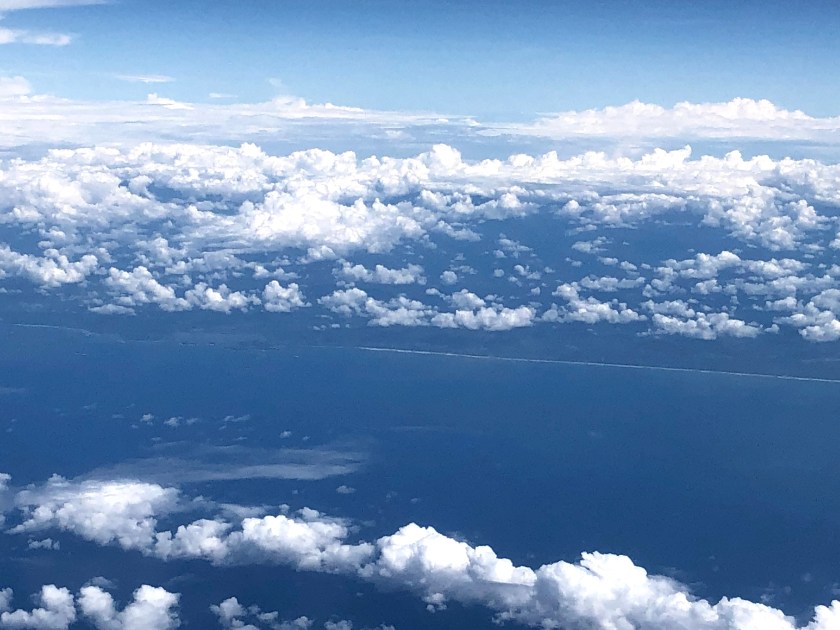
I stepped out to see a blue, blue sky with some cumulus clouds flecking the ocean above with froth. My heart soared like the eagle above. High and higher still. The air felt fresh like it does after the Earth has had a good rain. Even though it hadn’t rained, the Earth sparkled. The effect the clear blues, mellow temperatures and cumulus clouds have on our temperaments is remarkable. The Californian blue jay chirped, the squirrels tittered, the hummingbirds frisked and the hawks soared. Even I burst into song, and poured my joyous nonsensical lyrics into the world.
But duty beckoned. I had a string of meetings awaiting me, and though my heart soared and flew with the eagles, clouds and all that, I headed inside musing all the while on how marvelous a blue sky is.
I read somewhere that the smog in some polluted cities is so bad that children growing up there think a ‘blue sky’ is a poetic liberty, for the skies are never blue. I could empathize with the poor children so far away. It was similar to that in California over the past few weeks. Wildfires burning over millions of acres hundreds of miles away drew a smoggy veil across the skies, and cast a pallid gloom at times, made for brilliant sunsets at others, but through it all, there was an air of impending doom.
That feeling fell away on the first day of autumn. Fall in California are not as drastic and spectacular as autumn in north-east or north-west parts of the United States, but it is beautiful nevertheless. The gingko leaves have started turning from their brilliant green to a golden yellow, and the maple leaves are turning colors slowly. The air is not nippy yet – in fact, we are bracing for another hot spell.
Meanwhile, inside the house, I was feeling a trifle boxed-up after a continuous string of meetings, in which people had showed up with varying amounts of enthusiasm and optimism. Some of them had managed to retain that cumulus cloud effect, others matched the brilliant blue skies outside – uplifting and promising, and some others retained the pallid gloom of the smoggy fire-ridden days. I glanced outside the window and could identify with the young pupils of Miss Read, who taught her on a beautiful Spring day that words and pictures are but imitations of the real thing. I reached out for the essay in Tales from a Village School from my newly acquired bookshelf (a gift from the dear husband for he could not stand the piles of books everywhere in the house).
Tales from a Village School – By Miss Read
Titled ‘The Real Thing’, the short essay evoked the essence of Spring in one breathtaking stroke of a page. She writes of a Spring morning she started to read The Wind in the Willows to her class.
“I had planned to start ‘The Wind in the Willows’ next term, but what more fitting occasion than this could be found for beginning such a spring song?”
“The Mole had been working very hard all the morning spring cleaning his little home…” but after a page or two, I am conscious that Henry’s restlessness is infectious,
‘Say’, he urges loudly, ‘lets go out!’
There is a shocked silence. What madness is this? Will it make me fly right off the handle?
The essay lilts on with ease and ends on the sagacious note:
It was he, the babe among us, who led us befuddled elders to reality when he cut straight to the heart of the matter with those three words, ‘Let’s go out!’
I heeded the clarion call of the essay, and briskly stepped out. Standing outside on that glorious day in September made me doubly grateful for things as normal as a blue sky and a breath of fresh air. May we continue to be blessed with these normalities! May we never complain about what a delight an ordinary day is!
“Autumn is a second spring when every leaf is a flower.” ― Albert Camus
The week has been a blur. The son bounced into lunch the other day, and said, “Do you have a meeting at 12:30?”
Seeing us shake our heads, he said, “Yes! Finally I have a zoom meeting at 12:30! Gosh – it is so good to have something to do again, right? I mean, I was always the vetti one.” (vetti in this context means jobless one)
I love it when Tamil words and phrases creep into their conversations like this, and I said so. The children scoffed. “Oh stop already with this know-more-than-English thing. Indian people are so annoying!”
“Well, I know my Chinese friends speak Mandarin at home, and go to Mandarin classes. My friends and colleagues from Russia have their kids learn a smattering of Russian. So …” I said shrugging my shoulders.
The children exchanged glances that said “Parents will be parents! Let it go!”, and I smiled.
School has reopened in completely virtual mode, and the children have been thrilled. I feel bad that the usual back-to-school euphoria is muted with zoom calls, and not the raucous meeting of friends after a long summer ritual. The children felt it too.
“I would have liked to meet my friends and the classroom amma. I mean, now, it is like looking at our pictures instead of us – you know the people?”
I laughed at the description, for it was true. The e-world has managed to make two dimensional beings out of us. Entire personalities squashed into a grid on the screen.
On the second day of school, he spent the minutes prior to the zoom call getting things ready for the day: A Dr Seuss book, one of his comic book creations (with illustrations of superheroes fighting valiant battles with super magnetic force-fields against a turbulent tornado crusher etc), an Avengers action figure, his microscope and binoculars.
I looked amused at this collection of objects laid out by his computer. He saw me looking at these and said, “Oh! The teacher said she wants us to know each other better. So, I am looking for things that best describe what I like to do.”
I gave him a huge smile and thumbs up and awaited the news at lunch time. Say what you will about the Covid-situation, I am grateful to be home when school is done. It is a luxury I have seldom had, and the outpouring of chatter when they let out has been marvelous for me. My own batteries are not drained by a meaningless commute eating into my day, and I am more receptive to what they have to say.
“You know how we were supposed to get to know each other and bring stuff that represents us?! One fellow brings a football, because he likes football, and then he brings a basketball because he likes basketball, and then points to his shirt – a baseball shirt since he likes baseball. Really – you like Sports, we get it!” he said and looking at the smile on his face as he said it, I could see he already liked this fellow.
“I heard what you told your teacher! Really kid?! Sour patch candies and Pirates Booty?!” said the teenage older and supposedly-wiser daughter.
There was a train of giggles at this and the fellow gurgled on about how his teacher asked him if he knew more than 1 language and told him to practice speaking Tamil at home, so he doesn’t forget it. The words of wisdom coming from a teacher’s mouth meant that he took it to heart, and I could see him sprinkling in a couple of words here and there.
I spoke to my school teacher-parents later that day and told them how their teacher had tried different things to get to know them, and my father said, “Poor teachers and students ma! Most dedicated teachers come to the profession because of the joy of being surrounded by young people: their energy and personalities are truly a joy to be with. To have that replaced by a series of zoom meetings seems so sad! It will be okay soon. Don’t worry da kanna – you will get to see your school mates soon okay?” the grandfather’s voice boomed over the oceans like a foghorn of wisdom to his grandson, and he smiled and said, “Thanks Thaatha! So, when are you coming here?”
Well, in the words of Miss Read:
“Life went on. No matter what happened, life went on … But somehow, in this continuity, there were the seeds of comfort.” ― Miss Read, Emily Davis
While I sincerely hope the children’s social aspects are not unduly affected by social distancing, I am grateful for what interactions they do get. While I have my gripes about technology, I am also grateful for it.
Life is full of paradoxes and that is as it should be.
I felt a surge of amusement when I made cauliflower last time. The grocery lists needed love, and the results were showing.
“Yay Cauliflower!” yipped the young son, beaming like the early rising golden moon at this wonderful treat. Moments later, the moon face drifted under the clouds and his face looked disappointed as he looked at the pale muck of a curry that had been ladled onto this plate. “This isn’t Cauliflower curry! Isn’t it usually golden?” he said.
“Yeah ma – this one looks so pale. Like it needs some Vit D or something – should I take it for a walk in the sun?” said the daughter.
I laughed at their reaction. Running a home can be tricky business in the best of times. My grocery lists are not things one writes home about even then (newspaper articles maybe but not to one’s mothers). In Covid times, I beam when we get by with everyone fed at reasonable times. Of course, this means I had to throw 2 tantrums since nicely asking did not seem to work. (I know!)
Tantrum#1:
Venue: work
Subject: No meetings between 12:30 & 1:15!
Result: Sheesh kebabs reactions but people finding ways to accommodate this unreasonable ask
Tantrum #2:
Venue: home
Subject: All people requiring daily sustenance will come to eat between 12:30 & 1:15!
Result: Jeez-whats-with-her flavored eye rolls, followed by expressions as if indulging the local idiot
Anyway, what happened was that we had run out of turmeric powder. As any decent south-indian cook will tell you, this simplest of spices is a must in almost everything that makes its way to a stove-top. It was only when one does not have the little sprinkling does one realize the joy and gaiety in the dishes thanks to it. It is like a drop of sunshine in the blobs of goo, and the children picked up on that.
For the next few days, I quietly turned up more discolored dishes. The jokes became more raucous. Even the taste seemed altered. It is curious how tuned our sensory systems worked: taste seemed better if we liked how they looked, they even smelled more appetizing when they looked that scintillating yellow. Seeing that the world seemed a less vibrant place sans turmeric, the husband quietly made a special grocery run after the third day of discolored dishes.
That day, I felt like a particularly gifted potion maker working her magic with the spices:
“…The beauty of the softly simmering cauldron with its shimmering fumes, the delicate power of liquids that creep through human veins, bewitching the mind, ensnaring the senses…” – Professor Severus Snape – Harry Potter and the Sorceror’s Stone.
I am glad to say that the folks seated around the table glowed from the rays of the yellow mellow sun at this meal.
“Wow! Everything is golden and sunny again!”
“Yep! Appa got turmeric at the grocery store!” I said, and the children cackled.
“Who’d have thought we would miss turmeric?” said the daughter.
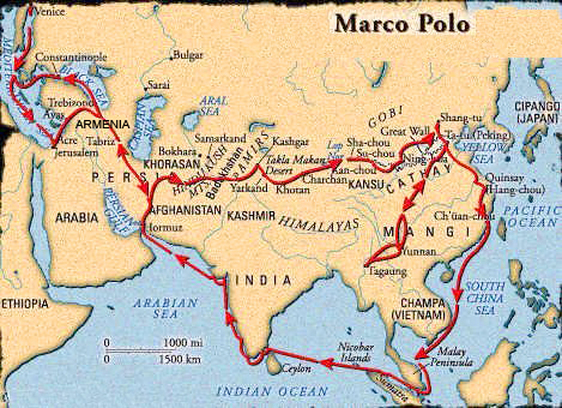
“Well Marco Polo certainly did!” I said. “The world was altered thanks to turmeric, pepper and ginger! So, I suppose it is okay to miss it.” I could see the little titbit had their interests piqued, and they listened in spite of themselves.
The Travels of Marco Polo
“Many explorers started out in the medieval ages trying to find newer and better routes to the Indian subcontinent for spices. Marco Polo attempted an exploration that lasted almost 24 years . He made his way from Venice in Italy through the Mediterranean seas, past the harsh climates of the deserts in the middle east and the Himalayas in the north and north-east, as he went on past modern-day Tibet all the way to the Gobi Desert in China. His travels along the silk road were published in 1298 and are still sought after – The Travels of Marco Polo! “
“I did not write half of what I saw, for I knew I would not be believed” ― Marco Polo, on his deathbed
“So, you see – It is probable that this brave explorer in search of turmeric, pepper and other spices, altered world history and our grocery lists forever!” I said.
The discussion then turned to European explorers setting out to find new routes to the Indian subcontinent, silk roads and trade routes. The history of the world, and how we have always been more interconnected on this planet than we realize, is fascinating.
The golden dishes took on an extra flavor with the story of the spices, and I sat back contented and grateful for a good meal in these times of the pandemic.
Driving through the Pacific North Western coast can be lovely. Even though the vast areas around us shimmered in the heat, we were upbeat inside the car- the Umpqua river was keeping us company on the drive. Umpqua river – What a river! What a name! It was beautiful as the roads snaked and curved and we never once knew on which side the river would emerge.
Looking at people trying to get their canoe afloat on the river that afternoon reminded me of Three Men in a Boat by Jerome K Jerome again, and I resolved to read it again soon. With Covid rampant everywhere, the world around us seemed more muted, but the river seemed to assure with its little gurgles, eddies, swirls, and bubbles that life will go on. This too shall pass and any number of things we tell ourselves when in need of lifting our spirits.
The truth is that Californian summers in the Bay Area can mean slim pickings with vibrant rivers. The Oregon coast was different – the Umpqua river was full, mature with the strength of the waters from the melting snows of the Cascades and we were driving right alongside its path as it made its way into the Pacific Ocean.
As the road rose over the ridge carrying us over the valley of the Umpqua, the mists gradually rolled in signaling one thing – we were nearing the oceanfront! The trees were towering over us, and my spirits rose on that mist-filled afternoon.
“The hills are alive with the sound of music! “
I bleated along as we drove through the hills, and the children exchanged a look that confirmed their worst suspicions. Their Mother Nature was with them. And with this Mother Nature in attendance, there would be no dawdling and letting things be. This would mean hiking and looking at things, and singing along. Sure enough, I ended my bleat on a howling note with great pride and turned around to see the cubs splitting with laughter. I coaxed and under the threat of more of my own singing, they relented.
Pretty soon, there we were, playing a weird version of Antakshari – we took a word or theme of the last few words we sang and started off the next one. Sometimes, the sentiment was enough. We were off trying to coax musical notes from made-up lyrics, singing with mesmerizingly accurate actions to our imaginary orchestra, and completely off-tune.
“The wind never bothered me anyway….Let it go! Let it go! “ I said drawing in a wisp of the wind by lowering the window,
The daughter piped up from behind:
“The cold never bothered me anyway…”
“What?”
“It’s not the ‘wind’, it’s the ‘cold’.” Said the daughter and I said, “Yes dear – that’s what I meant. “
“MA! You can’t just change up words when you are singing them and say that is what I meant! ”
The husband and daughter are wizards at memorizing the lyrics. Yours truly, on the other note, is only magical when it comes to making up nonsense to fill in the tunes.
“Yes you can! I sang nonsense to you kids all the time when you were babies!” I said
“Yep! Yay! And see how well that worked out!” said the daughter – sarcasm dripping from her voice, and we all burst into laughter. Say what you might, it seemed a perfect philosophy for a lovely life given all our little imperfections.
“Let your boat of life be light, packed with only what you need – a homely home and simple pleasures, one or two friends, worth the name, someone to love and someone to love you, a cat, a dog, and a pipe or two, enough to eat and enough to wear, and a little more than enough to drink; for thirst is a dangerous thing. ”
I feel like I must say something witty about boats of life, and how it is the very thing that could turn into your life-boat, etc, but the lyrics elude me at the moment. Stay tuned – for you never know when inspiration will strike.
“Hmm…how Covid has changed things right Amma?” said the daughter when I walked into her room one day, and spotted ‘Greece’ sprawled across the whiteboard. She has been spending her summer making minor changes to the decorations in her room. As most teens do, she has a fond attraction to her room, and one day I found her looking at the pictures she had printed out to make a sort of picture collage. Her teenage eye-roll and monosyllabic answers fell awayas soon as I showed an interest in the choice of pictures she had laid out on the floor arranging and rearranging them to see the best patterns.
How do you see the best patterns in a kaleidoscope? Everything seems beautiful, everything seems fine, and yet the artistic piece of her fussed with the layout and order of the pictures. There were pictures of happy people, little cafes, books, beaches, forests, city lights, quotations, rainbows, flowers, and small towns. The collage was eclectic enough to interest me. She gurgled and burst forth with the thought that went into them. I listened amused.
By then, her excited voice had attracted her little brother and fond father into the room. Her brother painstakingly wrote ‘Mars’ below ‘Greece’.
“Mars! Seriously dude- next thing we know you will be lugging us into black holes and having us all burst into all the tiny starry bits like your Avengers or Star Wars superhero dudes in their adventures! No! No space travel!”
“Just yet”. I added and she gave me a look that indicated that this idiocy with space is because I indulge him with this stuff. I laughed out loud, and the children joined in too.
“And while we are at it,no fictional or mythical places either. Only places that we can locate on a known map of the world.”
Cautiously, like deer in a prairie, we approached the topic of places we’d like to visit, ready to scurry back to Covid restrictions. Slowly, the name scrawled on a whiteboard set the stage. In the safe company of just the four of us, it felt good to take a peek into travel dreams again. It was done at first soberly – how happily we had taken international travel for granted? How happily we had taken good health for granted? Disconcerting as the Covid situation has been, it has also made us sit up and take notice of the beautiful things surrounding us on Earth.
Once we started talking of lands beyond our day-to-day, a different energy gripped the room. Within moments, distances melted away, and the globe-trotters threw names on the board with no thought to distance or expense. Exactly how dreams should be.
Looking at the list on the board reminded us, however, that our lifetimes were not enough for this sort of ambition. How does one fit in a hike in the Himalayas for a zen feel, with a sort of Darwin-esque trip to the Galapagos? How can one fit the journey of civilization in Greece and Peru, to the pure sounds of nature as yet untouched by mankind? I suppose travel still has a lot to teach us, and post-covid, the world will start to cautiously explore once more.
We started, therefore, with a couple of day trips taken mostly on a week-day taken off from work, so we could avoid crowds. We looked for wide trails on which to get our dose of nature and exercise in. While for the first time thinking of a 2-3 day trip, we looked for godforsaken places. Places people do not usually go to for a vacation. But the house was a good one, pitched atop a hill with the nearest neighbor miles away. There was aJane Austen-esque feel to the whole thing. It reminded me of the poem by Wendell Berry: The Beauty of Wild Things.
I set about the evening meal after the long drive there, while the children ran to find board games to be played that night. I cradled a cup of tea in my hands, as I set the water to boil, and rummaged the contents I had packed with me so as to minimize exposure to the outside world.Slowly, the kitchen’s essence wafted around the room – smells, heat, textures all dancing together in an exquisite symphony of the senses. A symphony was playing as I cooked, and talked to the children. Here was a lively room packed with energy, activity, witty comments, and chaos that strangely translates to calm.
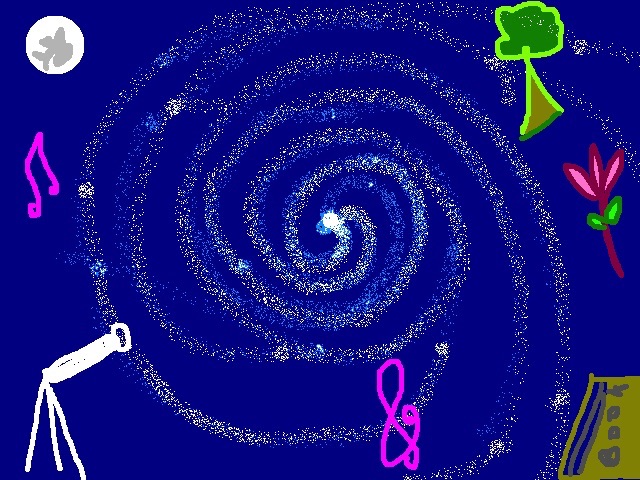
Inside this house overlooking a river valley, I felt the kaleidoscope of our life on Earth lap at me in waves. Watching the objects in the room around me evoked a strange sense of livingon this earth: the telescope, the books ,the music, the keyboard that promises the best music to those willing to invest in it, the creature comforts of a well-built house with the furnishings about us, the deer grazing in the hillside by us, the beautiful moon, the thousands of stars visible because of the distance from populated areas.
The Peace of Wild Things: By Wendell Berry
I come into the peace of wild things…
And I feel above me the day-blind stars waiting with their light.
The daughter’s pictures had indeed done a good job of capturing life on earth.
There are places where walking is no longer allowed. Especially in densely populated areas where the coronavirus is raging and ravaging the population. Talking to my parents the other day, the father sounded strangely dull. A little prodding revealed that the evening walk was cut from his list of allowed activities for a few days, and I felt keenly for him. I, like him, enjoy nothing more than tying my hands behind my back (unladylike as my mother often said when I was growing up), and taking in the sights, smells and sounds of the air around me. Often, I don’t remember where all my mind has wandered during these walks, but I always come back strangely uplifted, the day’s conundrums a little clearer, and life’s perspectives a wee bit sharper.
I sympathized with the father and told him that all we could do was to make the best of the situation. For instance, I told him,I had not enjoyed tea in my backyard for all this time. My work spot is a good 50 miles away from where I live, and I spent many an hour getting to and from work. Silently sipping my tea in the backyard before the day at work began the other day, I felt strangely grateful for this time – the time that I would ordinarily have been rattling to work on a crowded train. But that morning as I sat under the cypress trees, watching the sycamore sway in the breeze outside, I slowly raised my head upwards and was dazzled at the most beautiful blue that greeted the eyes.
The father lightened up at this little piece of my day that I shared with him, for he enjoys our backyard too when he visits, and spoke fondly of the squirrels. The squirrels really are admirable as a means of entertainment. They titter, run and make merry all day long in the fruit trees, and before you know it, a pleasurable time has been had by the entertainers and entertained alike.
Walking makes philosophers of us. How many times have I admired the mallard ducks and the geese for their spirit? All these little creatures that we share the Earth with have to be the most engaging lesson-givers in the world. Squirrels, cats, butterflies, dogs, geese, ducks, and blackbirds – they are all marvelous teachers to the philosopher willing to take in lessons.
We fell into discussing the joys of walking, and he spoke of Thoreau and a number of writers who were known for their musing during their daily walks. We laughed at how some of our best ideas after hours of walking were nothing short of ordinary, while these authors of whom he spoke so highly had truly world-changing ideas at the end of theirs. One day at the end of a long walk, I came back with an epiphany about ducks, I said, and I wasn’t joking.
T’was one evening after a nice long walk, I sat by a lake. The waters were clearly more than 20-30 feet in depth, and I remember wondering whether ducks felt any qualms about plunging into waters that deep. Do they examine their toes studying the webbing and decide to swim? Do they stretch their legs knowing it is waddle-worthy? I have watched the ducks hatch their little ducklings countless times in the spring, and watched them teach their young to take to the waters. But how do they know their capabilities? Do they stretch their wings knowing it is intended for flight?Ducks have to be the most admirable creatures for they adapt to any medium with ease, and seem to enjoyit. They waddle, swim and fly with ease.
How about that?
“Anyway, why don’t you watch what you eat since your daily walks are also cut?” I said taking a large dollop of ice-water and pouring it over his igloo.
The mother came hissing into the phone like a queen bee in-charge of delivering the daily news updates to the BBC at this, and said, “As if! Now, because he is bored, he eats almost continuously from 4-8 p.m!” . We all landed up laughing at this.
“Must see how these ducks control their diet Appa. But now that I got the chance to observe squirrels, I don’t think they control their diets very much. Munching on fruits all day long, and talking bites out of them and flinging them to the ground without even properly polishing them off!” I said.
And on this note, we said toodle-oo to each other. I continued on a walk grateful that I could indulge in this activity though my mask made me feel sweaty and hot. He went to make himself some coffee to go with his mid-morning snack. We both pondered on life.
I don’t know if you have tried comet chasing every night for a week. A week in which photographers from the world over posted photographs that suggested a flaming, brilliant torch tearing past our heavens with an urgency that made you realize life was short, our journeys spectacular, and a whole lot of poetic asides.
The husband, the bright matter energy source in the household, if anything, shored up even more bright matter to counteract all the dark matter in the universe. His resolve only wiggled a bit when he saw these brilliant flaming pictures of the comet as though it was an olympic torch blazing through the heavens, when in reality, the comet looked like a Pluto after a good cry. (After the astronomer’s good cry, not Pluto’s!)
The son, kept his running commentary on photons, light years, superclusters, cosmic addresses, and the pair of us dreamt on.
The daughter, pragmatic as ever, squashed The Poetic Outlook like a bug under a hippo’s knee. Some teenagers may find it cool to tag along with their parents on adventures chasing 💫 comets: ours rolled her eyes, and the drag of the eye roll did resemble a comet’s tail.
I’d like to think that I was the calm influence that steered the boat into the cosmic oceans. The husband turned to give me an amused look, the son’s laughing rattled the comet to go back into hiding, and the daughter pulled her coolest teenage look of scorn and said the all-encompassing word, “kook!”.
“You know? I don’t see why people are wasting so muchtime with the skies. I mean, if youdo seethe comet, I suppose it is nice and all, butwhat’s the point of sitting there for hours on end and trying to find something hurtling through space. Huh-hmm!” she said, her lips thinning just the way her grandmother’s would.I love it when the mannerisms of her grandmothers slip into her speech in unguarded moments like these, and couldn’t help smiling.
“Imean – what sort of career is that? And what use is it?!” she cried, clearly asking for it.
The son & I, inferior debatecompanions as we are to her sharp tongue, rose up to the occasion.
“Heyhey hey! Going at the rate we are, scanning the skies may give us an opportunity to find another habitable planet to expand into. The same can be said of all kinds of research – the actual research does not immediately yield results, but every little bit of understanding advances usa little bit further.”
“Yeah – also we need to know where we are in the universe! Are we in MilkyWay, Virgo Supercluster, Observable Universe:what is our address?” said the son.
The daughter’s tongue could havesliced an apple in an instant as she rattled off our home address and said, “Why do we need to know huh? I mean, here we are. This is it. Live here, what is all this knowing where-we-are stuff? Waste of time. What is it going to do for us?”
The son & I blanched. You see: the pair of us are dreamers, standing beneath the stars, and endlessly wondering whether we belong to the Lainakea supercluster (is it the same as the Virgo supercluster?) After the observable universe, then what? What if all the observable universe in inside a massive black hole, and time is onlysomething in this space?
“But we are made of star stuff – isn’t that magical? Star stuff!” said the son wistfully.
“Yeah – duck poop is is also star stuff – deal with it!” said the daughter. The son wilted under this argument. The daughtercaught sight of my eye looking like an angry comet, and mollified the little poetic fellow. “But duck poop is good star stuff! Heh??!!”
I cannot say the debate went anywhere. It was a disappointing bunch of evenings after all, and the teenager felt it keenly. I mean, when one has postedto one’s friends that they are going comet gazing, and then come back after hours, havinggrazed on half a luna-bar, there is bound to be a dearth of the poetic.
The illustrations in this book make it an absolute treasure. In the past few days, after a clearly disappointingcomet gazing experience, I found myself gazing at the marvelous pictures in the book instead.
The past few days have been a flurry of activity with tiny little bursts of stardust and magic spun into the day.
We traipsed home tired, sleepy but triumphant. This was a Sunday morning well spent: we had finally sighted the elusive comet, 💫 Neowise. The previous morning, we had run outside at a similar time, and stood pinching our eyes, squinting at a resplendent Venus and thinking that if you cocked your head to one angle, and yawned loudly enough to get tears in your eyes, you could spot the tail. This technique made for some hilarious moments, but comets don’t seem to care much for sentient beings on some transient planet trying to catch sight of them in the wee hours of their morning, and we had to accept defeat and head home.
The next morning, however, we had managed a grainy sighting of the comet and we were jubilant. When the chocolate drink was gulped, and the little fellow was tucked into bed again, I lay in bed thinking of the comet 💫 . I could not shake the beautiful image from my mind’s eye.
To the naked eye, it looked nothing like the images taken by setting one’s camera to a long exposure, but it was there alright. The burning star with a yearning, a lone star shining its torch as it scorched its way by numerous stars treading a path it had set for itself. An unconventional celestial object. Compared to the systemic order of the rest of the universe, there was a object that was definitely unconventional , a trail blazer (get it, get it?) Why an elliptical shape, and why 6800 years?
I went about the days after the comet sighting with a faint gasp in my demeanor. Imagine, as we are holding all these important meetings, combating pandemics, and trying to protest against all things unjust, here was an icy blob just spinning away on its own elliptical. 6800 years before it can peek at us again. Often as I went about my day, I wondered whether there was a possibility of sentient life evolving on comets. Comets and asteroids have been known to be microbe transporters, seeding the possibilities of life as they hurtle through the vast dark emptiness.
Do extremophiles have what it takes to feel?
I mean, if we were to have evolved on a comet rather than a planet, would we have had such success in determining the nature of physics and the laws that holds the cosmos and the universe within which we thrive? How would time be measured on a comet? If rhythms helped us discern music, what would music have been in a comet-ic life? Our own days on Earth are neatly sliced into hours, minutes, and these days blend into weeks, months and years. Before we know it, we have made one full circle around the sun, and the seasons have changed along the way in predictable ways.
But none of that would be true if sentient life such as ours had evolved on a comet instead. There would be no days, no seasons, no predictable cyclical rhythm to our days. The sense of adventure as we drew near other stars and planets would probably fill the time. But time itself may have no more meaning, or much more meaning depending on how one perceived it.
These musings were sources of mild amusement, while life itself marched on with a comforting rhythm down here on Earth – dawns, days, dusks, nights, weeks.
Did the seagulls, deer and ducks think of such things?