That is the Earth!

“Do you know what this is?”

“That is the Earth! From the moon.” said the son matter of factly. “I saw it before!” he said in response to my awed expression.

We were looking at the back jacket of a book, that I flipped to the last page first.

this_is_earth

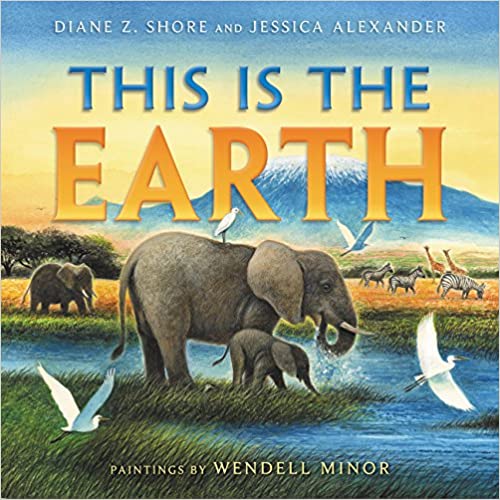
This is the Earth, by Diane Z Shore & Jessica Alexander with paintings by Wendell Minor.

It was a picture of the Earth rising on the Moon’s horizon.

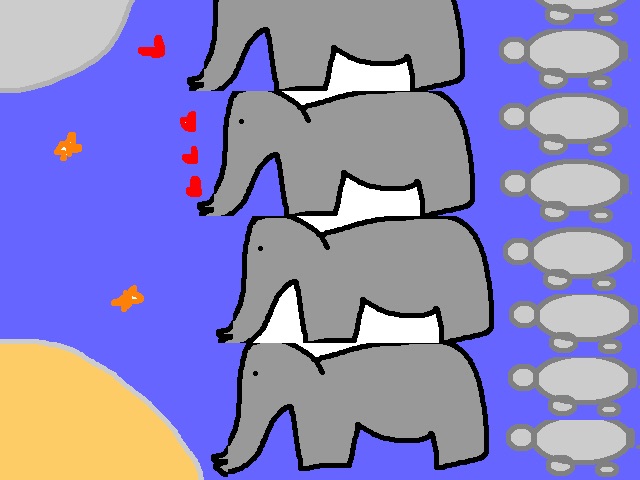
A picture that generations of humans for millennia could only have imagined, and never really gotten close to the sheer beauty of it. Our myths are at once rich and limiting in its reach. They have imagined Earth as being elephants on elephants, turtles on turtles all the way down, flat discs, imagining heavens above and hells below.  

earth_myth


The picture was taken by an astronaut, Bill Anders, aboard the Apollo 8 spacecraft in 1968. I looked on mesmerized at the picture.

1200px-NASA-Apollo8-Dec24-Earthrise

Bill Anders / Public domain

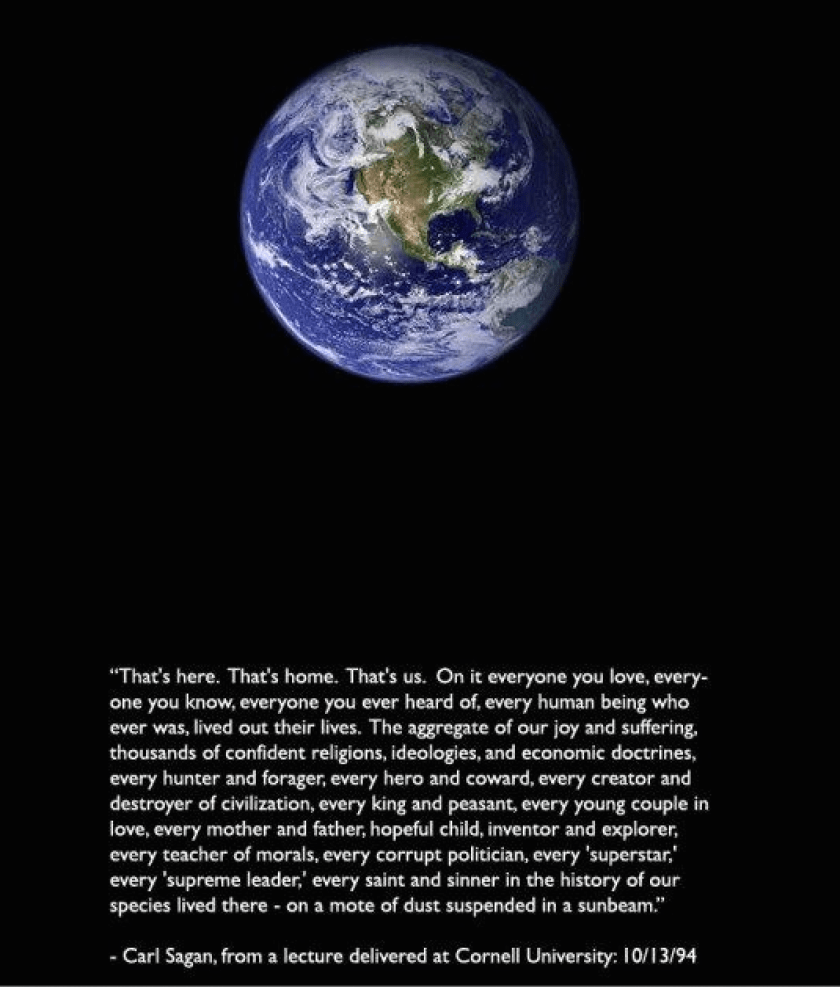
But this picture is truly astounding. The pale blue dot when seen from the Moon is a brilliant, blue orb, suspended in space, intriguingly spattered with clouds, oceans, landmasses, not really depicting the billions of lives it fosters, or the number of ecosystems it has in its fragile balance. 

Bill Anders said: “We came all this way to explore the moon, and the most important thing is that we discovered the Earth.”

What a lovely statement that is, and together with his Earth Rising image, contributed to the concerns around Planet Earth that led to founding of Earth Day in 1970.

50 years later, we have made rocky starts and gains towards conservation. But this April 2020, 50 years later, purely coincidentally, Covid-19 has the world on lockdown, not just imagining a life of bare necessities but embracing it for the social good. We, the people, now have the time to observe our fellow inhabitants.

Heart warming tales of peacocks making its foray into the deserted cityscapes of Mumbai; turtles coming ashore to hatch in the beaches along the Bay of Bengal; seeing the Himalayas from a 100 miles away once the smog fog lifted; deeming the waters of the Ganges near Rishikesh fit for human consumption again without all the factories along the way dumping its wastes into the flowing water;or bears enjoying their natural habitats unhindered by human presence in Yosemite National Park, are surfacing, and it has my heart lifting again. I have often enough lamented on this blog about the poor attention we pay to the Planet that nurtures our fragile selves and egos. 

Watching the even more fragile ego of the stock market indices, it seems to me that we can very well have the world function this way, by having a month off every year in which everything stops but essential services. An Earth Month every year to reflect, slow down, plan and recoup our staggering impact to the environment. After all, the stock market seems to have a life of its own and seems only to want some stolidity in its expectations. So, we anticipate a month with no major events, no excessive or unnecessary travel, and only essential services operating. The notion isn’t that far-out either. 100 years ago, no one thought we could have 5 day work-weeks. Yet, here we are, in state where it is the norm now. 

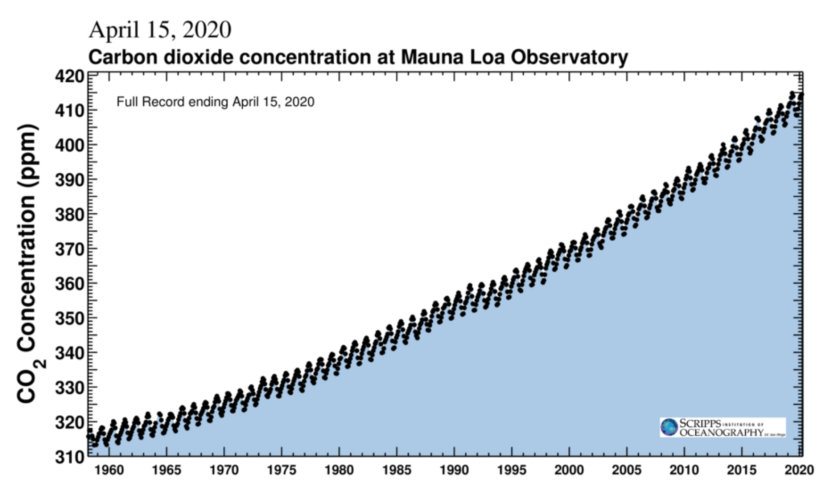
Maybe this could be the measure we take for Earth Day to slow the rise of Carbon Dioxide levels in the atmosphere.

Screen Shot 2020-04-16 at 6.33.29 PM

Please go this site to see the curve over 2 years and over 200  years Keeling Curve – Scripps UCSD

If you look at the extrapolated curve from the 1700’s, it has risen exponentially. It is probably too soon to see the effect of Covid-19 on CO2 levels in the atmosphere.

Could, Earth Month become the new normal for us. So children matter of factly accept that Earth Month as essentials month in the coming generations?

Let’s care a whole lot!

T’was family movie night. An evening fraught with decisions, and everyone’s voice and opinion clanged over the dishes and sizzled over the noise from the stove.
Suggestions rose, opinions swelled and movies quelled.

“Uggghhh! No way!”
“That again?”
“What are you? A kid? Oh wait! Yes you are a kid! Okay never mind!”
“Nope! Too much for Amma! “
“What do you mean? It isn’t too much for me?!”
“You bawled last time for a movie that wasn’t even a tear-jerker, nope! How about this?”
“Star Wars!”

A collective moan went up. Finally, it was revealed that the youngest member of the family had no recollection of the Dr Seuss movie Lorax. He has read the book multiple times, and so we all settled in to watch Lorax.

The_Lorax

Dr Seuss is an inspiration, of course; but just how insightful his take on humanity is uncanny. From fresh air as a commodity, to a land without trees, to surveillance at every pore, his far sighted vision has so much to nod your heads at.

The Thneeds, created by the Once-ler, in his story are made from Truffle trees. Thneeds were fashion statements – doubling up from head scarves to sweater vests and shawls. (“But even he, it seems, could not envision a future where ripped jeans were fashion trends!”,  I said and drew a grudging chuckle from the teen with the ripped jeans. ) Eventually, of course, the Once-ler’s greed led to decimation of trees, habitat loss and a devastated landscape is all that is left.

“Wow – that was such a good movie Amma – though the movie had scenes that the book didn’t have.” was the verdict of the youngest.

“Really! Humans are impossible!” said the teenager, and discussion turned to conservation, Greta Thunberg and some you-tuber who talks about going green.

“Did you know the Lorax was banned in some schools in California because loggers felt it was not friendly to the ‘foresting industry’. ” I said.

I looked at their agonized faces with awe – how is it children get these things, and adults don’t; and I felt a surge of hope.

lorax

We were walking a familiar route through our neighborhood a few days later, stopping to see some of the felled trees as we do every so often. The rings in the pine trees show they must have been at least 80 years old, and to see the forlorn stumps reminded of the beautiful book, The Giving Tree.

img_7820

The book starts with friendships between a young boy and an apple tree. The boy plays and swings on the tree’s branches, but as he grows older demands more and more from the tree. He needs her apples to make money, cuts her down to build himself a house and a boat, and finally comes back tired and spent with life, when all the poor tree can offer is the stump to rest.

The Giving Tree, can be interpreted and discussed in many different ways. Givers & Takers, Need & Greed, Selfish & Selfless, but the most beautiful one is the simple one, the one where your children make a sad face at the end, and say, “Why doesn’t this boy/man/grandpa ever feel sorry for what he’s done?”

giving_tree

The boy reminds us of human’s relationship with nature. The human species can be broadly classified as takers: from the planet, & from our co-habitants on this planet. You might have seen this video clip of Man’s greed By Steve Cutts:

The Giving Tree too was banned interestingly for sending sexist messages – the tree was female and the little boy continued to take from her without ever giving back.

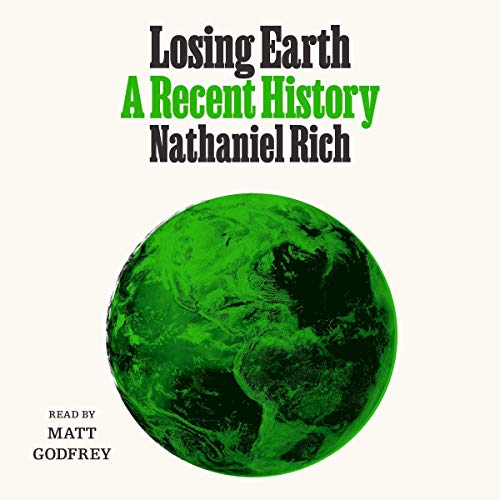
I just finished a book called Losing Earth – by Nathaniel Rich. The book, deals with the science, politics and action of climate change.

losing_earth

Despite humanity having the science locked down more than 50 years ago, little action has resulted. The closest we came to getting everyone to agree on unified action was the Paris Agreement where all countries agreed to work towards keeping emissions such that we not go above the 2 degree increase of temperatures world-wide. The largest emission offender for decades, United States, pulled out of the agreement when Donald Trump became President.

I was shocked to find that Climate Change as a topic has been banned in certain schools, skirted around in others and given a miss altogether elsewhere. The science behind Climate Change and the effect of our industries were long proved – as far back as 1970.

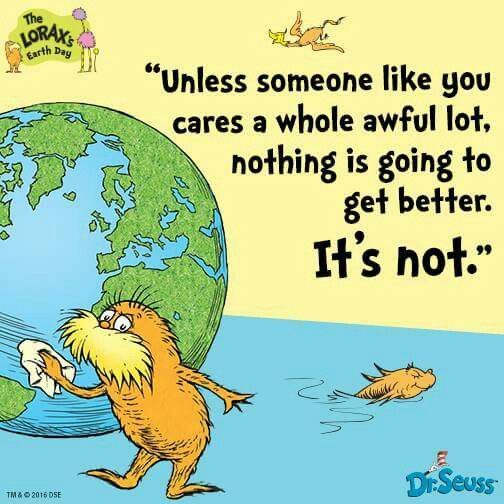
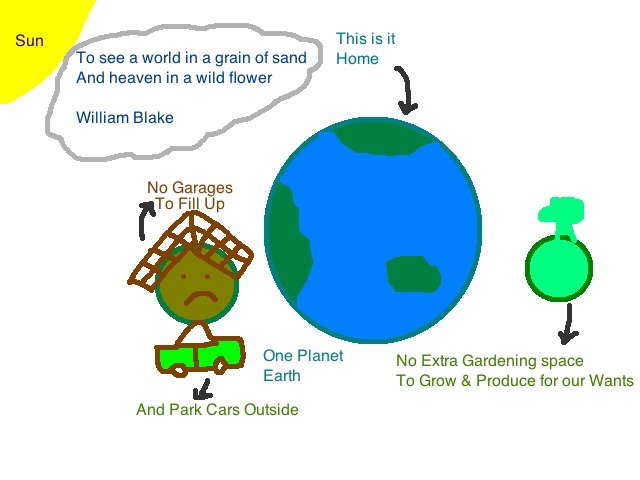
This April 22nd is the 50th anniversary of Earth Day with a special onus on Climate Action. Maybe this Earth Day, we can renew our commitment to the only pale blue dot that will harbor us. Let’s care a whole lot about our planet before all we are left with is the word ‘Unless‘ like in the Lorax story, or the tree stump in The Giving Tree.


no_garagepale_blue_dot

Read also: Are we to become Lab Rats?


The Rings of Life

We were walking a familiar route through our neighborhood, stopping to see some of the felled trees as we do every so often. The rings in the pine trees show they must have been at least 80 years old.

img_7820
For an impatient flitter such as myself, trees are truly sentient beings. Beings that teach me about holding still, of being sentient beings for the small time we spend on this beautiful planet. Like a butterfly flitting through the Earth for a day. You can replace tree for a star in the quote below and it would still hold when one sees redwood trees, sequoia trees and old banyan trees.

“From the point of view of a mayfly, human beings are stolid, boring, almost entirely immovable, offering hardly a hint that they ever do anything. From the point of view of a star, a human being is a tiny flash, one of billions of brief lives flickering tenuously on the surface of a strangely cold, anomalously solid, exotically remote sphere of silicate and iron.”

― Carl Sagan

As I was reading Life in the Garden by Penelope Lively, I stopped to relish the section on trees. Though the book is largely about gardens, she does make a foray into trees briefly:
“Tree rings are wonderfully eloquent; here is time stated, time recorded, time made manifest. Dendrochronology- the scientific method of dating based on the analysis of tree rings-can determine past climates, or the age of a building, it can be used to calibrate radiocarbon dating, or by art historians to determine the date of a panel painting. And all because a tree grows slowly, systematically, but laying down each year a memory of what that year was likes – usually wet, dry cold, hot-whether the tree flourished and grew, or held back, and how many years have passed. And the more I think about it, the more I have come to the conclusion that this is why trees invite anthropomorphism. They are sentient in a way that a building cannot be.”

octopus_tree

When I read this piece in Life in the Garden by Penelope Lively, I thought to myself, that Covid-19 would not register in the life of trees, would it? Droughts, wildfires, these may, but Covid-19 would not. The human suffering is acute – there is no doubt about it. The true heroes are the front-line workers, such as doctors, nurses, water and essential service providers, cleaners, mailmen, supply chain workers for groceries and medication who are braving the outbreak to keep society functioning as best as it can, while the virus takes it toll. The human toll is one thing, Covid-19’s economic ramifications is quite another, reminding us of the tottering pile we have built our societies upon: Stock markets indices, economies, international boundaries, – everything that a virus can thwart on a whim.
3D_medical_animation_coronavirus_structure

What would Covid-19 imprint in our psyches? It can be a time of transformation. A time of reflection. A time to prune the unnecessary, a time to nurture the necessary, a time to get to know ourselves and our loved ones better. A time to think of needs vs wants.  A time of quiet.

We may never have taken pandemic preparedness seriously. Covid-19 is teaching us about the importance of these things. What would we need to do for far more severe outbreaks, with water-borne or air-borne diseases in the future? I am sure these will never be treated with the same levity ever again.

“Nature is always more subtle, more intricate, more elegant than what we are able to imagine.”
― Carl Sagan, The Demon-Haunted World: Science as a Candle in the Dark

The more I think about it, the more I want to believe that we shall embrace Science as a Candle in the Dark. Many children will take up research in microbes. I hope we shall, from now on, invest in our infrastructure, in our research, in our general preparedness, and appreciate the fragility of life and our social ecosystems itself. Our rings in time will bear out the wisdom in the coming years if only we learn from it. One dark circle reverberating it’s learnings outward, and spreading light in the subsequent rings afterward.

“In its encounter with Nature, science invariably elicits a sense of reverence and awe. The very act of understanding is a celebration of joining, merging, even if on a very modest scale, with the magnificence of the Cosmos. And the cumulative worldwide build-up of knowledge over time converts science into something only a little short of a trans-national, trans-generational meta-mind.”
― Carl Sagan, The Demon-Haunted World: Science as a Candle in the Dark

References:

  • Life in the Garden – By Penelope Lively
  • The Demon-Haunted World: Science as a Candle in the Dark – Carl Sagan

Time in the Garden

Regular readers know how much I enjoy nature and gardens. It is one of life’s ironies that my plants only thrive despite my loving care, and  many is the time I have made bloomers in the little patch I tend to. However, never one to shy away from blooming from the bloomers, I picked up this book, Life in the Garden, By Penelope Lively. 

life_garden

Lively begins by examining the gardens in Literature starting with the Garden of Eden, and working  her way through other fantastical gardens in the books, The Secret Garden, Alice in Wonderland and the beloved gardens of dear, absent-minded Lord Emsworth’s at Blandings castle. 

She examines the writing and finds out which of the writers are gardeners themselves and which of them have merely picked up the scenery from a gardening catalog. She teases the co-ordination of colors, the seasonality of the plants themselves in the landscapes and has given me an entirely different appreciation of gardens. 

Some passages are especially endearing and made me want to read them again. Especially her meditations on time, the gardener and the garden itself. 

I quote from her book: 

“To garden is to elide past, present and future; it is a defiance of time. You garden today for tomorrow; the garden mutates from season to season, always the same, but always different. … In autumn, I plant up a pot of “Tete-a-Tete” daffodils, seeing in the minds eye what they will look like in February. We are always gardening for a future we are supposing, assuming, a future. I am doing that at eighty-three; the hydrangea paniculata “Limelight” I have just put in will outlast me, in all probability, but I am requiring it to perform while I can still enjoy it.”

“The great defiance of time is our capacity to remember – the power of memory. Time streams away behind us, and beyond, but individual memory shapes for each of us, a known place. We own a particular piece of time; I was there then, I did this, saw tear, felt thus.”

She goes on to say, 

“A garden is never just now; it suggests yesterday, and tomorrow; it does not allow time its steady progress. “

Certainly, for me, part of the appeal of gardening is this ambivalent relationship with time; the garden performs in cycles, it reflects the seasons, but it also remembers and anticipates, and in so doing takes the gardener with it.”

As I look out the window at my clover-filled backyard with some foxgloves looking happy amidst the narcissi blossoms and the newly sprouted cherry leaves after their spectacular show of cherry blossoms, and the rose buds ready to burst forth in a few weeks,I cannot help feel the lessons nature is teaching us. Be forward looking – always, nurture what is important, and enjoy the passage of time. One moment at a time. Every flower has its chance to bloom and fade.

do-nothing-garden_1

Gardens are enduring lessons in hope. I cannot tell you the number of times, I have planted something in October and been surprised when they bloom in April, or the number of times, I have been pleasantly surprised that something  thrived  at all. 

“Hope” is the thing with feathers –

That perches in the soul –

And sings the tune without the words –

And never stops – at all – 

Emily Dickinson – Hope

I am lackadaisical at best with my gardening and it shows. I have a minuscule patch that seriously  has more air-time on the blog than the square feet it occupies. Yet, it gives me immense pleasure, peace and calm. Spurred on by the book, I went outside to take a more active role in the tending of my plants. I have been admiring the sweet peas plants that have sprouted in the garden. Some time ago, I got a packet of sweet  pea seeds from our local library. Thrilled at finding them, I scattered them by the apricot tree and forgot about them. The plants are thriving now, quite tall, and seem to be sagging. So, I went – “Coming dears! Here I am to take care  of you!”, I said, in my best nurturing voice and tried to prop up the plants as best as I could, in the process, breaking off one of the plants’ main stems.

If the plants in my patch could talk, they would’ve chorused – “Go inside – we know you  love us, just let us thrive! Breaking off our stems indeed!”

The Gingko Trees 🌳

“Did you know about the Gingko trees?” I said, knowing fully well the reaction it would elicit from the daughter.

“Oh Please! There is no need to tell everyone you meet about the Gingko trees you know?” she said.

“But there is! Maybe I will write about it.” I said. The gingko trees have given me no end of pleasure , and I must say, a certain amount of anticipation tinged with a spot of trepidation, during the past few months. The one interesting fact I know about them has been beaten to mythical status and back like the shedding and revival of the seasons.

“Are you seriously telling me that you haven’t written about the blasted Gingko trees yet?” the daughter’s voice was tinged with laughter and embarrassment. The conversation was happening in front of her friends after all.

If you really want to embarrass your teenage child, please take them for a walk explaining obscure horticultural facts along the way. Touch the leaves of the Gingko trees, tell them the scientific name is Gingko Biloba, take them back to the time when the dinosaurs roamed feeding off these very leaves and the time travel is bound to work wonders on them.

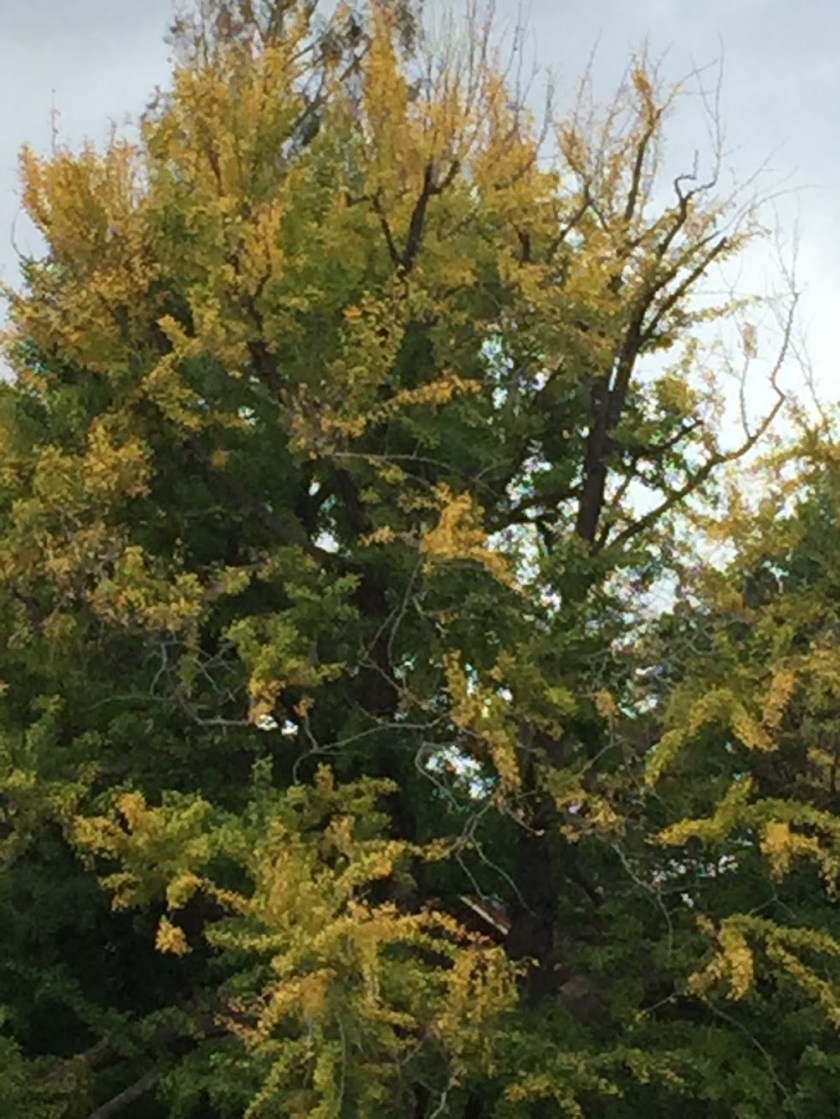
Only the teenager most proud of their parents is bound to glow like the dew drops glistening on a Gingko tree at the first rays of the sun. Mine looked like a cross between a beetroot and a maple 🍁 . I stood there poetically exclaiming that the beautiful Gingko trees had shed their golden tresses after all; happy that the interesting fact had been borne out truly by the sturdy trees.

gingko_2.jpg

Months before, as the colors of the leaves changed from olive green to golden yellow, I had told her about the fact that Gingko trees shed their leaves all at once.

“Don’t they all?!” she said being clever, but I had my answer ready.

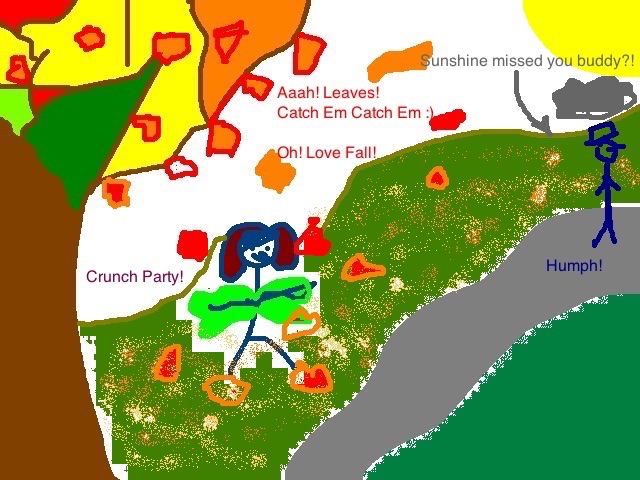
“No they don’t as the crunch parties we have all of October and November show you. But the Gingko trees in the vicinity all shed together on one day in November apparently.” I said. “It is like the day of the party, and they somehow decide the day between themselves. Nature’s signals are truly quixotic!”

“Did you also know that Gingko trees have been around from the days of the dinosaurs?”
“And how do you know that?” the family asked looking at me curiously, as if my age was finally becoming clear to them. I did not like where this was going, and hastily assured them that paleontologists seemed to have found fossils and put their necks on the line with that fact.

Ever since, throughout November, we watched the Gingko trees with fascination, and self with a tinge of dread, for I had bored the family stiff with tales of the Gingko tree ever since I read the essay by Oliver Sacks in the book, Everything in its Place. He wrote of his learnings from the Horticultural Society of which he was a part, and he had said quite categorically that the Gingko trees party was one day in mid November.

gingko

Mid November came and went, and the yellow leaves swung their tresses proudly as the cold winds coursed through them. Rains lashed at them, and they swished them some more. Haughty Princesses they’d make, I thought to myself.

Thanksgiving came and went, and the family was now baring their fasts at me. “After all those months with the blasted gingko tree, if they don’t shed, you’ve had it Mother dear!” they said. I said that November in New York probably meant December in California, but I also prayed a little. You see, I had made a bit of a pest of myself over the past few months, and I knew it. Oh the horror if they didn’t!

December came, and I went out of the state for a couple of weeks. I cannot say that the Gingko trees were in my thoughts for very long during this time. Year end work-travels don’t give time to think of Gingko trees.

I came back, and I had come for the walk with the girls, when the Gingko trees swam into my thoughts again. Luckily for me, Oliver Sacks, was an astute man. Though, I don’t know whether they had all shed their leaves on the same day, when I saw them, all the Gingko trees in the vicinity, young and old, were bare. Their leaves lay in a heap around their trunks, and I looked vindicated. Thank you Oliver Sacks and Thank you Gingko Trees! I said privately heaving a sigh of relief.

I told the girls about the whole thing: the pest I’d made of myself, and how the solid trees had helped me after all, and they laughed heartily. “I told you my mom is a nature kook! ” said the daughter, but there was laughter there – I seemed to have redeemed myself in front of her friends.

I am not sure when I will be willingly invited next: I’d better get going on some Spring facts to dazzle the lot.

everything_place

Book: Everything in its Place

By: Oliver Sacks

Essay: The Night of the Gingko

Charming Blooming Murmurations

It was a lovely morning before the rains set in. The hillsides definitely looked like they could do with some rain. The parched Earth still looked beautiful in the early rays of the sun. We saw a hawk at such close quarters eyeing a trip of rabbits down below that I felt a surge of its power course through the hills.

We were out on a hike and the son was ebullient. The morning air had lifted his spirits, and he was happily talking of this and that and taking us up steep hillsides.

On we went, through troughs and peaks, listening for the sounds of animals, birds and inhaling the fresh air. On top of one of the peaks, we stopped to catch a breath. I mock held my hips and said “Oh have a heart and give your old mother a break!” He guffawed and pointed out the next steep hill with gusto. I smiled, and held a finger to my lips – it was as we were standing there atop a hill overlooking a bay that we heard the murmur above. A susurration of starlings flying this way and that, forming and reforming beautiful circles in the sky.

A group of starlings are aptly called a Murmuration of Starlings.

I don’t know how often we have stood close enough to hear a whole flock of birds wings flock together – if you haven’t, it is truly magical.

A few days later, we were heading to Monterey Bay Aquarium? After tucking into their mac-n-cheese, which is apparently the best, we meandered our way through the place. Marine biology, research, conversation of species and all the noble things follow a splendid Mac N Cheese. The clouds were out gamboling in the blue skies. They had reason to. They had been grey and full of themselves for the past few days, They had made terrible whooshing noises as the rains thundered through the Bay Area. Having taken their load off though, they looked lovely in the skies.

“Hey amma! Do you see that one? Just the top of it looks like a dog!”
“Whoops! Now it is changing shapes to become a shark!”

Watching a billow of clouds is always a magical experience.

Later that day in Monterey Bay Aquarium, Nature showed us beautiful species of fish that could collectively shoal and swarm forming beautiful shapes as they swam in large numbers together.

Clip from Wiki:
During the sardine run, as many as 18,000 dolphins, behaving like sheepdogs, herd the sardines into bait balls, or corral them in shallow water. Once rounded up, the dolphins and other predators take turns ploughing through the bait balls, gorging on the fish as they sweep through. Seabirds also attack them from above, flocks of gannets, cormorants, terns and gulls.

Sardines
By TANAKA Juuyoh (田中十洋) – sardines / 鰯(いわし), CC BY 2.0, https://commons.wikimedia.org/w/index.php?curid=7998525

A bloom of jellyfish is enough to fill one’s heart with joy for hours – floating seemingly aimlessly, their pulsing, electrifying bursts are nothing but therapeutic.

img_5165

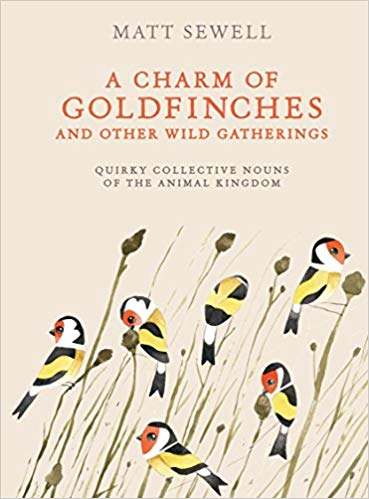
A Charm of Goldfinches by Matt Sewell is a marvelous book outlining why we have the collective nouns that we do. Why do a Trip of Rabbits thrill us? Why are Charms of Goldfinches so charming?

With beautiful illustrations, it is a charming book indeed.

charm_goldfinches

I remembered a game we played on a car trip some time ago. It had to do with the one big super power we could wish for. While there were things like Lightning Blasters, I think the one that took everyone’s fancy that day was Shape Shifters.

We are so corporeal in our bodies that we rarely of even think of things we can shift into. But this kind of species shifting shapes at will collectively and in a coordinated manner is not just fascinating, it is mesmerizing.

Watching clans of humans though, not so much!

The Magic of Story-Telling

“Stop being a Jellyfish!” said the husband.
“I knew you were going to say that – you are such an open book yourself!” said I.

We both giggled like children at our own pathetic joke. T’was the time for hulking men with or without mustaches and serious women to quack like ducks, twirl like fairies, flex those non-existent abs, and find that little teeny bit of whimsy that adulthood so expertly hides away beneath the layers. Halloween was here.


1dc1cf17-3133-4989-93a7-08bcd65b2be5

T’is the time people astound you with their imagination. Who doesn’t like having 3 spidermen knocking on your door all at once? Or to see the twin toddlers dressed as Nemo & Dory? The super-heroes and ninjas cowering behind their larger siblings in Vampire clothing, or the witches cackling hard?

There is something so uniquely beautiful about Halloween – the one festival where we can display our idiosyncrasies with grace, be accepted for whatever we are. You want to be a skeleton? That should be fine. Here is some candy for you. Really, buddy? You want to go out in the world in that costume? Well, if this appeals to you, then I suppose you deserve some candy anyway!

How many times in our lives do we get that kind of universal approval?

The husband and I were very proud of our last minute Halloween costumes: an open book & a jellyfish.

The little fairy lights I had taped into place made the jellyfish glow, and I received many compliments – I must say I glowed all evening with the praise, though I did credit the Internet with it.

When people asked me where I got the inspiration from, I replied truthfully that I have always wondered what it must be like to live under the sea, and they invariably laughed at my answer.

But it’s true. Every trip to the aquarium rekindles the magic of another world – right here with us. Reading Gerald Durrell’s essay about scuba diving is enthralling.

I have often wondered how we would have adapted if we had evolved under the ocean. Would we have figured out the laws and physics of the Universe to the extent we have, or would the medium have made little difference in understanding. The Octopus’s evolution to have more neurons than us is truly astounding.

Quanta Magazine: What shape is the universe? Closed or Flat?

It is why I like reading about the intelligence of dolphins and whales: the fact that they have epics the sounds bits of which are roughly the equivalent of our Iliad is amazing. Quote from Carl Sagan’s essay on Whale song:

If the songs of the humpback whale are enunciated as a tonal language, the total information content, the number of bits of information in such songs, is some 10 to the power of 6 bits, about the same as the information content of the Iliad or the Odyssey.

What must their epics say? For all our anthropological worldview, I wonder whether humans figure in them at all. That will be a fine thing to hear – a Dr Dolittle who finally translates a Whale Epic, only to find their world far richer than our own.

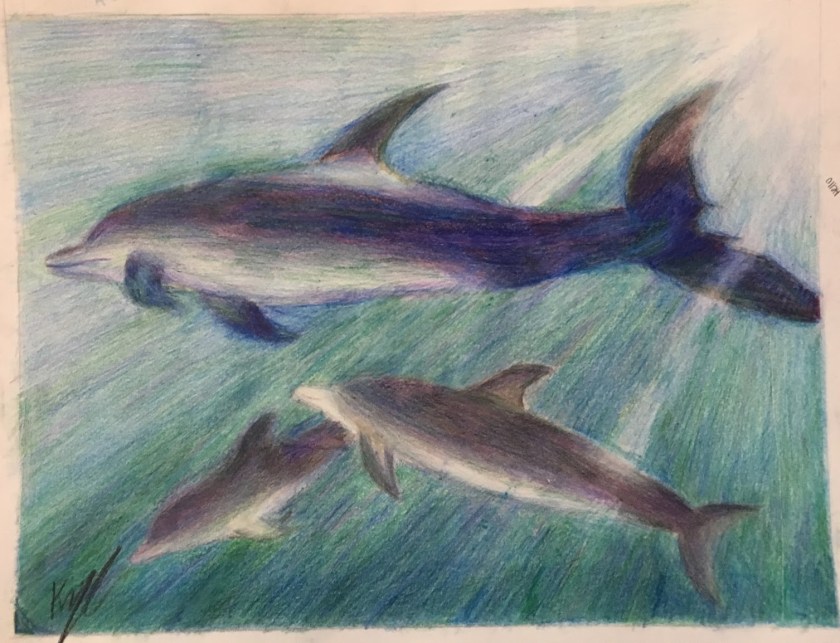
Keena_drawing
Art work by Daughter

I recently re-read the Voyages of Dr Dolittle by Hugh Lofting. I must say I thoroughly enjoyed visualizing myself sailing the seas with his motley group – either by skimming along like a porpoise, or better yet by getting a place inside the giant snail’s back as it sailed along smoothly churning the ocean as it went.

Swimming with Dolphins

We are all children of stories. We need epics and tales of fantasy. Our very own imaginations need an outlet, and Halloween gives us just that. I know my enthusiasm rubs off on the children as they go about planning their costumes. While I am out with a big smile on my face, a number of people give me an indulgent smile as if to say “Aren’t you a bit old for this?”

Mary Oliver gently reminds me to react with this nugget of wisdom:

“You must not ever stop being whimsical. And you must not, ever, give anyone else the responsibility for your life.” 

― Mary Oliver, Wild Geese

Privately, I am happy that our inner child never really leaves us.

Authors:

The Great Quivering of Autumn

“I just witnessed the Great Quivering of 🍂🍁🍃 Autumn!” I said as I stepped into the house flushed with the exercise and thrilled with the beauty of a blustery day. “Luckily, I checked the weather before heading out.” I said taking off my light jacket.

“What’s she saying?” said the daughter, raising her sleepy head from the couch, and pulling her teeth out of a bagel.

“Its windy outside!” said her little brother, already practicing that teenage eye roll, and the art of turning poetry into the prosaic.

I rolled him up and said, “You too buddy?! Come here – you would have loved it. you know that? I saw so many hawks – I have never seen so many of them soar up together in great big circles like this. All of nature quivered. Trees shook, branches swayed, waves lapped at the shores of the lake, and leaves, oh my goodness – so many leaves went quaking to the floor. I stood with my arms apart like this and just stood there!”

“In the middle of the road?! Appa, I told you not to let her out alone!” moaned the teenager, and we all laughed.

scrunch_party

No amount of pictures and videos will do the least bit of good when you catch glimpses of the rays filtering through the quivering leaves, or feel the light caress of falling leaves against your skin or catch the beautiful leaves of all colors against the blue skies. How does one capture the beauty of seeing a dozen hawks soar overhead, or the awe of seeing the pelicans do their little ballet dance of fishing, or the susurration of the leaves murmuring in the wind. There is a word for this: Psithurism.

As I gathered my little brood around me for a hot cup of tea after that invigorating walk, I shushed them to peek outside to see what I meant. The leaves were fluttering down in our garden, but there was another creature up and about at work regardless of the winds. 

“Bulby!” said the son excited.

“You named the squirrel? He can give you rabies you know that?”

“He can, but he won’t, and certainly not for naming him! You talk as though he is yearning for our company. I assure you, he isn’t. Just watch what he does. Bulby never fails to entertain.” I said, and the son nodded fervently. 

After sometime, we all burst out laughing at the squirrel’s antics. We have seen him hide great nuts in the soil every now and then, he nibbles and gnaws at the fruit on our trees, I have seen him scamper on seeing us sometimes, other times he watches us as though he doesn’t mind allowing us to enjoy a spot of nature with him. Today, he dug up my recently planted flower shoots, and dug something out, looked at us and furtively patched the garden up as though nothing had happened, and scurried. He had something on his mind, maybe a gut feeling of what was to come.

The morning out amidst nature, and finishing up with Bulby’s antics made me think of one of Mary Oliver’s poem:

From the Book of Time – By Mary Oliver

I rose this morning early as usual, and went to my desk.
But its spring,

and the thrush is in the the woods,
somewhere in the twirled branches, and he is singing.

And so, now, I am standing by the open door.
And now I am stepping down onto the grass,

I am touching a few leaves.
I am noticing the way the yellow butterflies
move together, in a twinkling cloud, over the field.

And I am thinking: maybe just looking and listening
is the real work.

Maybe the world, without us,
is the real poem.

The wind whipped and whooshed around all day. By evening, the winds had gathered speed alarmingly, trees that had swayed earlier in the day were lying broken, roads closed, emergency responders were keeping the populace further up North informed about the situation, power was down. It astounds me every time how forceful nature can be. But it also made me stop and think – the hawks had been more fitful than usual that morning, the squirrel was bustling more too. The animals knew we were in for a rough time, and responded, while we waited by our gadgets to give us the news.

img_4362

It is marvelous how Mary Oliver puts her finger on the pulse of the Earth :
Maybe just looking and listening is the real work,
Maybe the world without us is the real poem.

Running like Elephants

“Guys! Let’s hurry up a little. I like how we are dawdling, but the school bell waits for no ships to sail across the seas! ” I said. There had been a mild spattering of rain across the dry summer season. A few snails had popped out to enjoy the moist, and the son and his friends were looking at them as they chatted and made their way to school. Rain drops on the late summer roses and oleander flowers made the scene a rather endearing one.

img_3991-effects

The response from the children was predictable – they ran, and I ran shouting like a charioteer pulling the reins on the excited steeds, “Slow down! No running here – oncoming traffic!”
“But you asked us to hurry up!”
“Yes – run like Elephants!” I said.

I had told the children earlier about the Elephant’s gait, and they exchanged glances and started laughing. The snail they were studying looked startled and showed a leap of speed as it made its way back to the comfort of the garden bed.

Is this walking? *giggle*
Is this running? *giggle giggle*
Is this fast walking? * giggle giggle giputly duggle*
Is this slow running? *giggle puddle chuckle duffle*

I smiled slowly. “Pretend you are Elephants teaching Snails to run.”

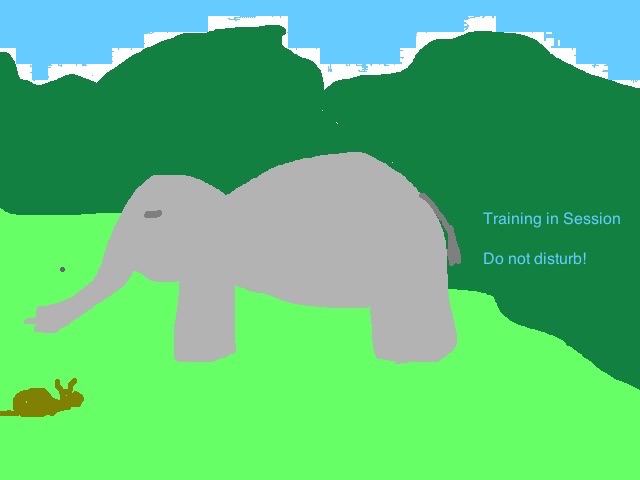
elephant_snail

I suppose that was a wrong metaphor altogether. By the time we arrived in the school, not only were we out of breath with the laughing, but we were also fashionably disconcerted. The legs seem to not remember how to walk straight or run properly, and were caught in this limbo of the Elephant’s Gait.

Later that week, I was sitting in the garden and watching the world go about its true business of living. I watched a hummingbird’s fast-paced wing movements up in the trees. A few butterflies were flitting hither and tither. A skein of geese were flying overhead in that beautiful v-shaped formation. Closer to the ground, a few snails were marking their slow way across the courtyard.

This combination of sitting in a garden, and watching life flit by had me take a hundred pictures with my phone. Pictures that may or may not be seen and appreciated again. I could capture the slow motion video of the humming bird whizzing up above or the butterflies in my midst. I could use time-lapse videos to capture the slow moving snails and a dozen pictures to capture the beautiful movement of the caterpillars.

As I sat there musing on the ease with which we capture movement these days, I could not help comparing and contrasting humanity’s struggle to capture that. I remember yawning in the Art galleries after seeing the n-th painting of a horse or the x-th statue of a horse drawn chariot.

But as I sat there that afternoon, I wondered whether I had appreciated them enough. After all, at the time of their making, studying movement was not all easy. One had to have an almost eidetic memory to understand the muscles and the way they moved.

Leonardo Da Vinci’s work is appreciated because of the lengths he went to study the anatomy of the creatures in his works. 300 years ago, movement must have been particularly hard to study.

In Oliver Sacks’ essay on Elephant Gaits in the book, Everything in its Place, he writes about the problem of studying movement.

everything_place

More than a century ago, Etienne-Jules Marey had made a pioneering investigation of elephant gaits. Of course, he did not use video analysis then, but still photography. I quote: “Marey’s lifelong fascination with movement started with the internal movements and processes of the body. He had been a pioneer here, inventing pulse meters, blood pressure graphings and heart tracings – ingenious precursors to the mechanical instruments used in Medicine even today.

Later, he moved onto the animal movements and analysis.
For animal analysis he used pressure gauges, rubber tubes, and graphic recordings to measure the movements and positions of limbs. From these recordings, he rotated in a zoetrope, reconstructing in slow motion the movements of the horse.

Muybridge, a contemporary of Marey, however, a peripatetic artist as Sacks describes him used 24 cameras along a track where the shutter would be tripped by the horses themselves as they galloped past to capture the movements of the horse as they raced.

When a similar technique was used to analyze the fast movement of elephants, it was found that they neither walked nor ran, but rather a combination known as fast walking.

I remember a long ago conversation with a friend who was training for a marathon on the more recent study of leopards running, and how he had changed his running technique to take a few tips from the world’s fastest runner.

As we watch the world around us, I wish different creatures could teach us some of their marvelous techniques. The dragonfly and the humming bird for flight; mallards and coots for water locomotion. Doesn’t Biomimicry as a field of study sound more fascinating than ever before? I positively yearn to be Dr John Dolittle at times!

Books/Articles to be read/referenced in this post:

Sketching Freedom

It fell to the teenaged daughter to keep her little brother and nephew in line during our forays into the forest. While they generally listened to her, they also enjoyed pulling her leg. Smarty pants that she is with me, it is sweet indeed to see her stumped by her little brothers. One such time when she was speechless, she said something wise and insightful. I looked at her with awe – “So, you finally got around to reading Marcus Aurelius’ Meditations I see!” I said beaming. Pride shone through my pores though I tried my best not to show it.

“Nope – still boring! Siri told me.” said she and laughed at my expression.

“Confucius, Buddha,  Marcus Aurelius, and a thousand other philosophers in your Kindle, and you go for Siri?”

I shook my head and went off to do some philosophizing of my own. The walking philosopher if ever there was one. I walked into the sunset philosophizing, as I said.

Sunsets are beautiful things anywhere – enjoy them with a rustic feel, and they can be few things more poetic or romantic. That evening’s sunset had been particularly fruitful – it isn’t everyday that one gets to see a dozen peacocks take flight into the horizon, witness the chirp-filled fooling around of parrots, cuckoos and at least a dozen different kinds of birds, and encounter the folly of frogs skipping and narrowly avoiding one’s feet.

I traipsed indoors, happy with life, still rattling on about the beautiful image of the peacocks and parrots taking flight together in the evening light. “I wish I could be a bird sometimes! So Free!” I said, and walked straight into the trap.

“What is Freedom for you Amma?” said the daughter. She was sitting on the bed, looking happy and sketching.

“Well…errmm, eh?” After this coherent response, I decided something more was warranted and fumbled a bit more. ” Well…umm…it is the ability to be able to live without fear I suppose. ”

“So, is a free country a place where people aren’t scared?”

I paused – my answers were shaky. Why did I think birds were free? Because they could take to the skies when they wished? But they also take flight when startled or scared. Hmm. I have never been one of those lawyer types who could cover all angles, and espouse something that if examined from all angles will hold water. This needed thought.

So, I did the next best thing, and reached into the recesses of my teenage brain. I remember a song we used to sing at morning assembly in school, and a particular set of phrases that I liked at the time without fully realizing the impact of it all. It went something like this:
Blah Blah Blah-dee-blah
Freedom from Want & Fear
Freedom of Worship
Freedom of Speech & Thought
Blah-Blah-Blah

That was it. The husband said – “Hmm – good answer!” with the tone of one who wished he had thought of the answer himself.

Pretty soon, the discussion on Freedom took on multiple angles, and the whole family was there weighing in with their take on the concept of Freedom.

Is Freedom of Choice a thing?
What of the rules and laws required for a free society?
What about Freedom to Live? Is Immortality a worthy goal then? If so, is the opposite a freedom as well?
Freedom to Dream? Is there a limit on one’s dreams?

I remembered Trevor Noah’s narrative in Born a Crime on dreams,

“We tell people to follow their dreams, but you can only dream of what you can imagine, and, depending on where you come from, your imagination can be quite limited.”

Born_a_Crime_by_Trevor_Noah_(book_cover).jpg

The concept of our Imaginations being limited by our circumstances is an interesting and clairvoyant one. It got us discussing the dreams of women in far flung places like the toothless old lady we had met earlier that evening – what were her dreams for her life? In her book, Moment of Lift, Melinda Gates gives us a sneak peek into the lives of hard working women struggling in remote places. What were their dreams and ambitions? Do our dreams all follow Maslow’s triangle and what then for those who have reached the zenith – is there more at the end of it.

moment_of_lift


The daughter continued sketching looking strangely amused by the heated and fast pace at which Freedoms were galloping in the laid back villages of South India. It seemed to be the only thing galloping at the moment.

“So why do you ask about Freedoms my dear?” I asked.

“Oh, I was thinking of drawing a girl who was free, and I kept imagining a happy one. But free is not always happy, is it?!” said she.

I looked around at the serious faces of the gathered folks and burst out laughing. “Really! Gotten us arguing on freedom to dream and imaginations and the Lord knows what else. You sketched us all having a good go I suppose – Well, my dear, what did Wise Siri tell you that Freedom was?” I said

She laughed raucously, and swished her long hair freely.

“Show us what you’ve got and we’ll see which face looks Free!” I picked two random ones from the 5 or 6 she showed us.

Which one looks free?