Star 🌟 Stuff?!

I don’t know if you have tried comet chasing every night for a week. A week in which photographers from the world over posted photographs that suggested a flaming, brilliant torch tearing past our heavens with an urgency that made you realize life was short, our journeys spectacular, and a whole lot of poetic asides.

The husband, the bright matter energy source in the household, if anything, shored up even more bright matter to counteract all the dark matter in the universe. His resolve only wiggled a bit when he saw these brilliant flaming pictures of the comet as though it was an olympic torch blazing through the heavens, when in reality, the comet looked like a Pluto after a good cry. (After the astronomer’s good cry, not Pluto’s!)

The son, kept his running commentary on photons, light years, superclusters, cosmic addresses, and the pair of us dreamt on.

The daughter, pragmatic as ever, squashed The Poetic Outlook like a bug under a hippo’s knee. Some teenagers may find it cool to tag along with their parents on adventures chasing 💫 comets: ours rolled her eyes, and the drag of the eye roll did resemble a comet’s tail.

I’d like to think that I was the calm influence that steered the boat into the cosmic oceans. The husband turned to give me an amused look, the son’s laughing rattled the comet to go back into hiding, and the daughter pulled her coolest teenage look of scorn and said the all-encompassing word, “kook!”.

“You know? I don’t see why people are wasting so much  time with the skies. I mean, if you  do see  the comet, I suppose it is nice and all, but  what’s the point of sitting there for hours on end and trying to find something hurtling through space. Huh-hmm!” she said, her lips thinning just the way her grandmother’s would.  I love it when the mannerisms of her grandmothers slip into her speech in unguarded moments like these, and couldn’t help smiling.

“I  mean – what sort of career is that? And what use is it?!” she cried, clearly asking for it.

The son & I, inferior debate  companions as we are to her sharp tongue, rose up to the occasion.

“Hey  hey hey! Going at the rate we are, scanning the skies may give us an opportunity to find another habitable planet to expand into. The same can be said of all kinds of research – the actual research does not immediately yield results, but every little bit of understanding advances us  a little bit further.”

“Yeah – also we need to know where we are in the universe! Are we in Milky  Way, Virgo Supercluster, Observable Universe:  what is our address?” said the son.

Location_of_Earth

Andrew Z. Colvin / CC BY-SA (https://creativecommons.org/licenses/by-sa/4.0)

The daughter’s tongue could have  sliced an apple in an instant as she rattled off our home address and said, “Why do we need to know huh? I mean, here we are. This is it. Live here, what is all this knowing where-we-are stuff? Waste of time. What is it going to do for us?”

The son & I blanched. You see: the pair of us are dreamers, standing beneath the stars, and endlessly wondering whether we belong to the Lainakea supercluster (is it the same as the Virgo supercluster?)  After the observable universe, then what? What if all the observable universe in inside a massive black hole, and time is only  something in this space? 

“But we are made of star stuff – isn’t that magical? Star stuff!” said the son wistfully.

“Yeah – duck poop is is also star stuff – deal with it!” said the daughter. The son wilted under this argument. The daughter caught sight of my eye looking like an angry comet, and mollified the little poetic fellow. “But duck poop is good star stuff! Heh??!!”

I cannot say the debate went anywhere. It was a disappointing bunch of evenings after all, and the teenager felt it keenly. I mean, when one has posted  to one’s friends that they are going comet gazing, and then come back after hours, having  grazed on half a luna-bar, there is bound to be a dearth of the poetic. 

“You know young lady, I have just the book to cure you of this disappointment.” I said and gave her the book, The Stuff of Stars by Marion Dane Bauer Illustrated by Ekua Holmes

The illustrations in this book make it an absolute treasure. In the past few days, after a clearly disappointing  comet gazing experience, I found myself gazing at the marvelous pictures in the book instead. 

stuff_of_stars

Annus Confusionis

His voice  quivered with excitement as he read the page out to us. 

Never mind that it was early in the morning, and he did not yet know that the  morning tea was working its way slowly through the cells waking them up. The cells were hitting snooze like the body they reside in usually does with the alarm clock. Yes, things  were getting off to a slow start in the old body. The son, in sharp contradistinction, woke up like a light bulb switched on to full power with the opening of the eyelids. He shone brightly, and his vocal chords took on the  timbre of the morning bugle as he trumpeted the queer finding on Time. 

“Can you imagine a year with 445 days?”

“uhhhhnnnhhhuuujn” 

To this legible response, he prattled on reading aloud to us from his Encyclopedia of Queer Facts.

“Yeah! It was in the year 46 B C, King  Julius Ceaser corrected the lunar  calendar.  This year became known as the annus confusionis or the year of confusion, since the year  had 445 days! Imagine how our  school must have felt!” he said looking up from the thrilling page. 

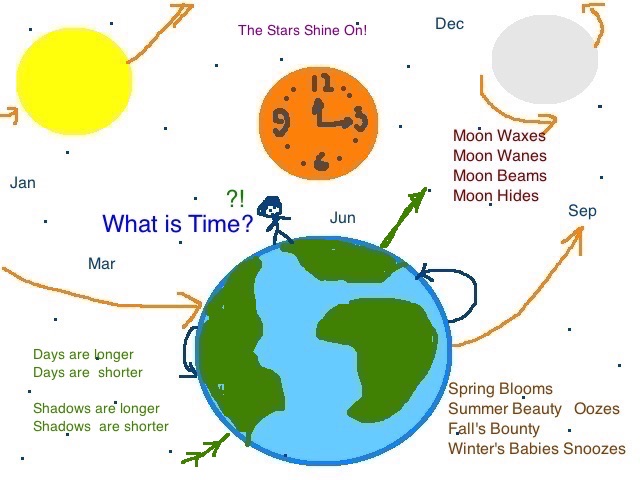
Time has always excited him – what  it is, how do we measure it, why does it always flow forward and never backwards? 

Time

I poked my cells up into waking up – it seemed the decent things to do in the presence of such excitement.  

“Exciting huh?! Would they have increased the number of school holidays  (a 5 month summer vacation) or the number of school days?”

It must have been enthralling.  Only, school as we know it today was not in session then – schooling as we know it today only came into existence about   200 years ago to equip people with the ability to sit in one place and learn to get used to it.

So they probably continued with their statue making and war-ring even though the seasons were completely out of whack with what was happening around them. What did they name the months? It must  have been an exciting time to be on the committee determining such things! I wish I could go back in time and be a fly on the  wall for those meetings, instead of the ones I  usually go to. 

“Isn’t it amazing the  kinds of things human beings  have figured out?” I said, “And, then we used this knowledge to build on it, and build some more. I suppose it will only truly get boring when we  have nothing to keep us curious. Thinker & Tinkers!”

This was probably the conversation that inspired me to read about Nicholas Copernicus.

I have often marveled at how Thinking Mankind figured out our place in the Cosmos, the fact that Earth  is round, rotates on its axis, and so much more. After all, there were no spacecraft beaming pictures back to us then. The irony was not lost on me, that had we not figured out these things, the spacecraft could not have been built at  all. How  would we  know escape velocities and  thermodynamic thrusts and gravitational pulls in the first place?

This year is a leap year, and a reminder that we can figure out when we need years  of confusion, and when we need to just  look upon  the years of confusion benignly  to  stir ourselves towards better things. Like Jane Goodall said:

“Only when our clever brain and our human heart work together in harmony can we achieve our true potential.”  – Jane Goodall

Posts referenced in this post:

Books:

Ants in a Cosmic Universe

The children peered into the list of ideas I had for my blog while on the whirlwind trip to the other side of the world. Predictably, some of my better ideas drew a smirk from the teenager. When pried she rattled her laugh and said, “Maybe add an article or two on lame titles? Really! What is all this with the Ants and the Cosmic Universe? Who writes stuff like that?”

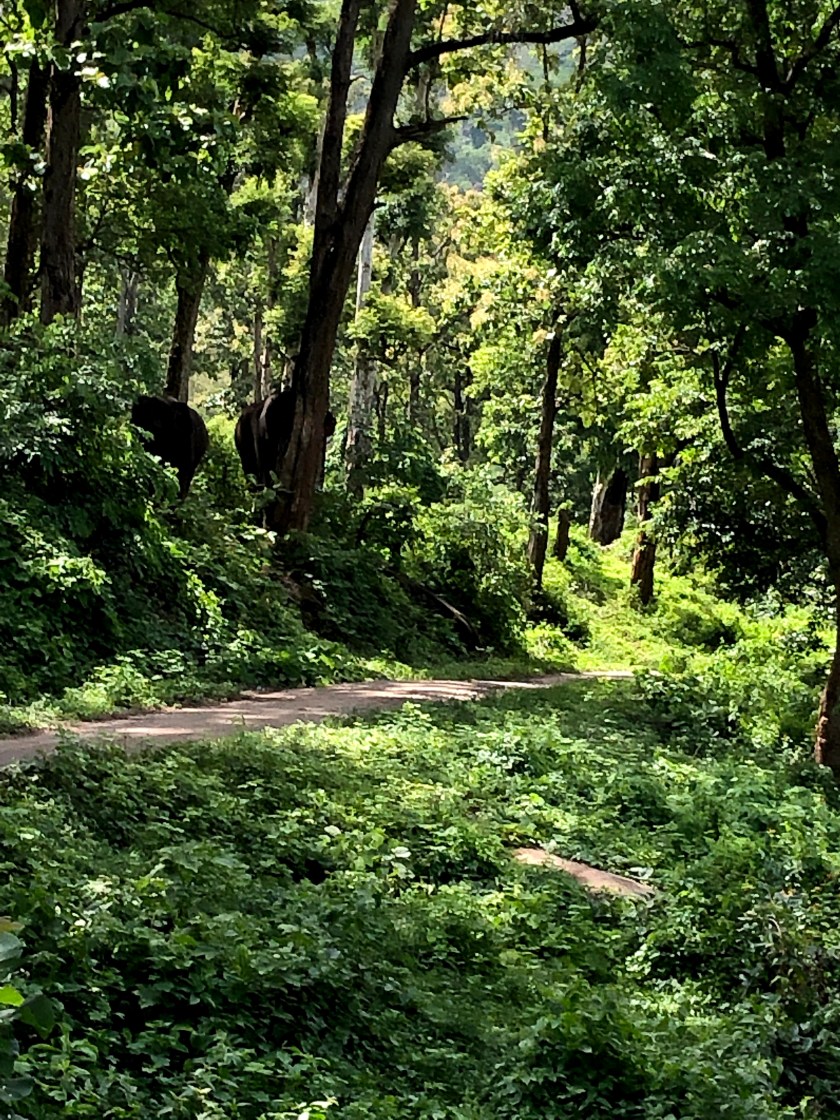
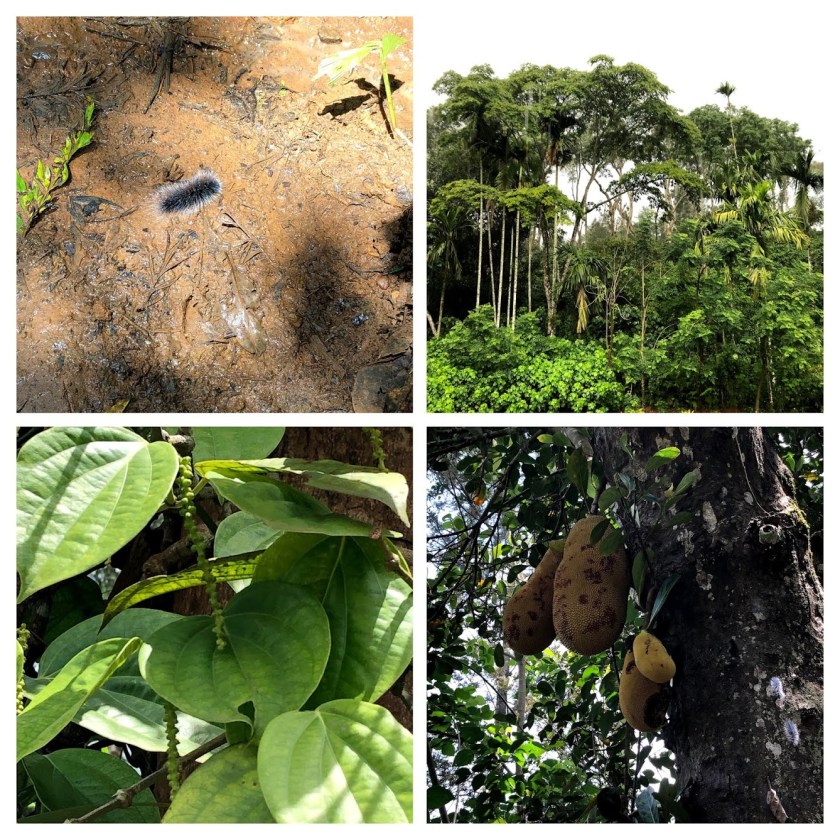
“I do!” I said. “I was pretty happy that morning when I got up early and went a-walking through the woods by the resort. There were jackfruit trees, pepper wines and uh, many other trees.”

I threw my mind back happily to that early morning saunter in the Western Ghats. How beautifully the little creatures had turned my haughty look skywards to ground wards and then back again? The saunter of humility it turned out to be.

img_3587

The best part of the walk was the fauna that was up with the sun ready to greet a new day. There I was sleepy still, but happy that I had not wasted this glorious morning in bed. I had to do a double take when I saw dry leaves croaking and leaping about. Was I dreaming that I was up and walking while snuggling up cozily in bed? It has happened before. (When one wakes up and finds that that early morning jog by the lake never actually happened except in one’s dreams, it is disappointing.) It turns out these were clever frogs who had mastered the art of camouflage. They were the ones who attracted my attention ground-ward.

Till then, my spirits and outlook were sky bound – admiring the suns rays filtering through the tree tops, looking for butterflies, and the clouds flitting lazily. The clouds had opened up a few minutes earlier, drenched the hills, and then having done their job, decided to flit and laze for a while.

The teeming life on a tropical forest floor is endlessly entertaining. The temperatures were not too high yet, and many creatures had decided to get their spot of exercise, fresh air and Vitamin D before it became too much Vit D. The ants were bustling. Really, if ever we need motivation on a dull day, look no further than the role ants play in this cosmic universe.

They bustle, they plan, execute and deliver, they seem goal-oriented even when walking off with your bread crumb two hundred times their own weight from under your nose. Hundreds of them, in apparent harmony, with a shared vision of some kind, and an indomitable spirit.

This remarkable combination of spirited vision and lack of personal ambition is a balm to souls who mire themselves in the human world. Humans value competition as the means to make us better, but in the grand scale of the cosmic universe, wasn’t shared vision a loftier goal? I suppose Leaders try to cry themselves hoarse with speeches dripping with this sort of guff, but their own personal ambition thwarts the message somehow.

Everyone must spend a day every now and then in the forest re-aligning our spirits, and learning a thing or two from every single organism.

I said something like this to the children, only not as coherently and got another eye-roll as a response. I tried another angle.

star_trails
Star Trails of the Milky Way Galaxy

Imagine these ants come out at night, and probably admire the stars. The beautiful canopy that changes. That was us isn’t it? Even as recently as a few hundred years ago, even while territorial battles were being fought, we admired the changing skies and built myths around it. “The myths you guys seem to enjoy so much!” I said.

“Remember, I came back from the walk and pulled all you children out for a walk through the woods? To see the beautiful forest in its glory?”

“Yes! We remember! There were no cosmic universes – just Appa giving his flora and fauna tour. He didn’t even know the names, just making up some stuff, and pointing to the dry leaves and saying – Imagine these as frogs.”

“Well, by the time you guys came, the frogs had gone back into their burrows or wherever? I don’t know – where do frogs live? ” Soon, we were discussing the abodes of frogs and I told them, “But you saw so many more butterflies!”
coorg-COLLAGE

“So, Butterflies in a Cosmic Universe?”

“Or, moths in a cosmic universe more like. The butterflies go to bed. Where do you think butterflies live? Their cocoons must long be gone.”

I decided to let things rest. We are in a Cosmic Universe. We must live and let live and you know, share.

The Epic of Whalayana

The mother has been reading The Ramayana. She is especially fond of the Sundarakandam. For a few months, any good is attributed to the Sundarakandam readings. Anything bad is soothed away with the assurance that her Sundarakandam chantings will make it better. It takes her several weeks to make it through a complete reading. The Ramayana is a long epic, and lilts rhythmically. Reading this epic soothes her, and every now and then with touching belief, she has a go at it.

I like the Ramayana too for its main storyline, and its myriad side stories. I do think Sita could have been a pluckier heroine, but then I remember that these tales were passed down from one generation to the next, each one, quite probably, embellishing the epics a little to make sure their ideal version of the woman is subtly inserted in there. (Another post for another day)

It is interesting to think of how our epics and ballads have helped shape human history. Artifacts and natural phenomena shaped our myths, and particularly gifted story-tellers were always a treasured people. We truly believed that story-telling was the single distinguishing feature of our species. After all, imagination is a task much higher on the cognitive scale than living & feeling. 

‘Did you know? We used to have a Professor who could chant every verse and explain it so beautifully? From memory! In those days, our professors used to remember Shakespeare, entire Sanskrit texts, and eloquently recite from memory. ‘ said the father, and waxed as eloquently about the good old days; his fervor growing as he spoke of the stellar nature of his professors, about how they learnt and memorized Shakespeare and the Sanskrit texts from their forefathers. 

I smiled at the pride in his voice when he thought of his long-dead professors. For millennia we thought we were the only ones capable of passing on this kind of generational wisdom and knowledge. But that is not the case. Take the enormously intelligent whales and dolphins for instance. Carl Sagan, the physicist, writes about these intelligent creatures often. In his essay on dolphin sounds, he writes of Elvar the Dolphin who knows up to 50 English sounds and can use them in context. 

IMG_7634.jpg

Quote from Cosmos by Carl Sagan:

Some whale sounds are called songs, but we are still ignorant of their true nature and meaning. They range over a broad band of frequencies, down to well below the lowest sound the human ear can detect. A typical whale song lasts for perhaps 15 minutes; the longest about an hour. Often it is repeated, identically beat for beat, measure for measure, note for note. 

Very often, the members of the group will sing the same song together. By some mutual consensus, some collaborative song-writing, the piece changes month by month, slowly and predictably. These vocalizations are complex. If the songs of the humpback whale are enunciated as a tonal language, the total information content, the number of bits of information in such songs, is some 10 to the power of 6 bits, about the same as the information content of the Iliad or the Odyssey.

I would love to hear and understand the generational wisdom that these large benevolent creatures have for living in the oceans. The ever changing oceans must be a rich source of material. Do they have heroes vs villains, good vs evil, or things much more complex and intriguing than simple story lines like that? 

wind-in-the-reef

Quote:

They have no manipulative organs, they make no engineering constructs, but they are social creatures. They hunt, swim, fish, browse, frolic, mate, play, run from predators. There may be a great deal to talk about.

If human beings have a fault, it is assuming our anthropomorphic abilities are the pinnacle of what is possible. I must remember that until recently, we did not know whale songs existed. 

The sea is as near as we come to another world. – Ann Stevenson

Coming up next: The Inner Life of Animals

Cephalopods

The husband had an amused expression on his face as he walked into the kitchen and saw me reading while making dinner. His eyes were set to roll, and his lips had already started on the journey to upward curvature that results in an indulgent smile. I told him so.

“Your neurons, it seems, are all controlled by one brain – tut tut! Not the case with Cephalopods. Take octopi or octopuses for example. They have neurons tingling all over their many arms, and each arm can function almost independently of another. Severed arms have been known to collect food on their own you know?”

“What are you reading now?”, asked the husband.

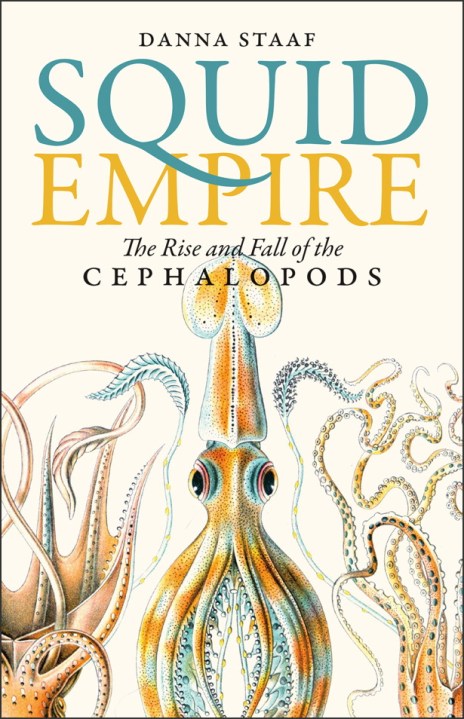
“Squid Empire by Danna Staaf. It is a book about squids, octopuses, and some other creatures called nautiluses and ammonoids, coleoids and cuttlefish and god-knows-what-else. Apparently, they are all called Cephalopods.” I said beaming happily, while slowly roasting the dinner. It made me feel like an eight armed goddess myself just reading about these fascinating creatures, and cooking at the same time. Never mind that I was making the most gawd-awful hash at both these tasks.

SquidEmpireCover

“Did you know? The humble garden snail is descended from the ammonoids and squids?” I said.

“Well….I will leave you to it then.” said he squiggling out of the kitchen like an octopus out of a tank.

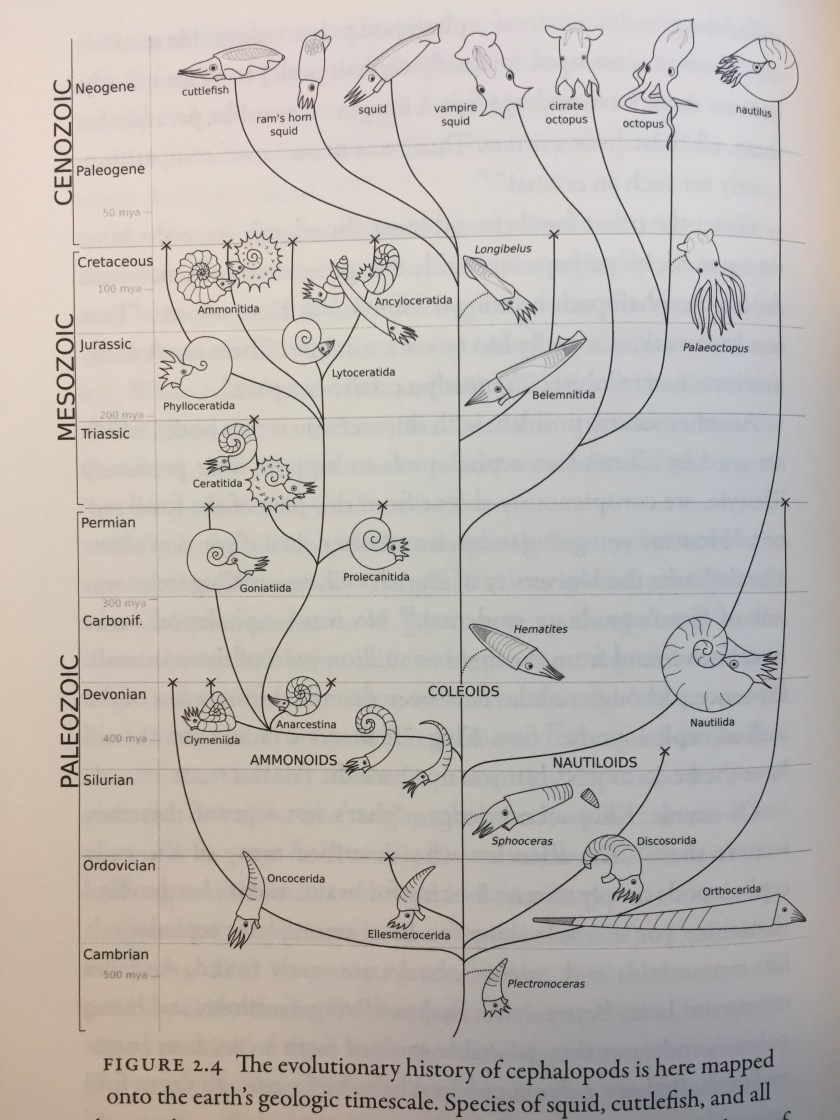
I went back to the book and though I was at times confused by the various scientific terms, I enjoyed the read. It yanked me through the ages, and took me to a time in Earth’s history well before dinosaurs or life on land had started. It was intriguing to see how they formed shells, and how those very shells helped them move from the ocean floor to the central zones of the ocean where they could swim and live with no apparent threat till the whales and larger fish evolved to eat them. The shells secreted a liquid less salty than the surrounding sea water, and this helped them float and remain buoyant instead of being brought down by the heavy shells.

IMG_8046.jpg
The Evolutionary History of Cephalopods from the book, Squid Empire

Why did I pick up a book on Squids?

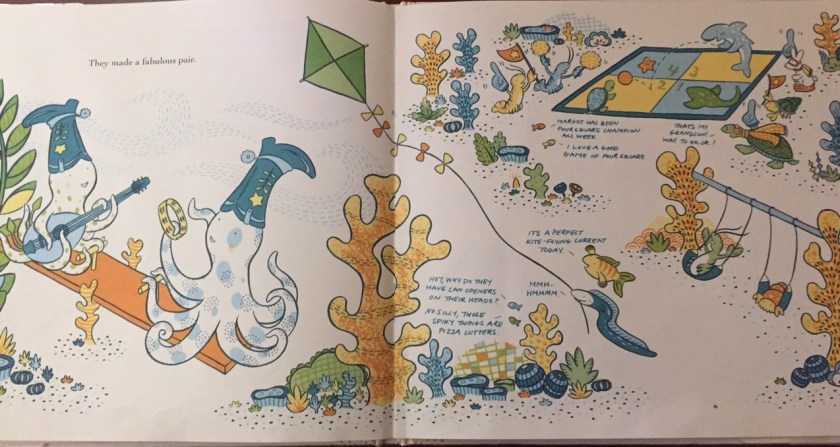
I don’t really know, except that I loved the children’s book, Octopus and Squid by Tao Nyeu. A book that the son and I read every now and then for its beautiful friendship between two seemingly different creatures.

Imagining
Squid and Octopus by Tao Nyeu

Then, a few months ago, I read The Soul of an Octopus by Sy Montgomery

Cosmic Nature of Living:

Quoted from The Soul of an Octopus by Sy Montgomery:

Cambridge Declaration on Consciousness asserts that “humans are not unique in possessing the neurological substrates that generate consciousness”, and that “nonhuman animals, including all birds and mammals and many other creatures, including octopuses also possess these neurological substrates.”

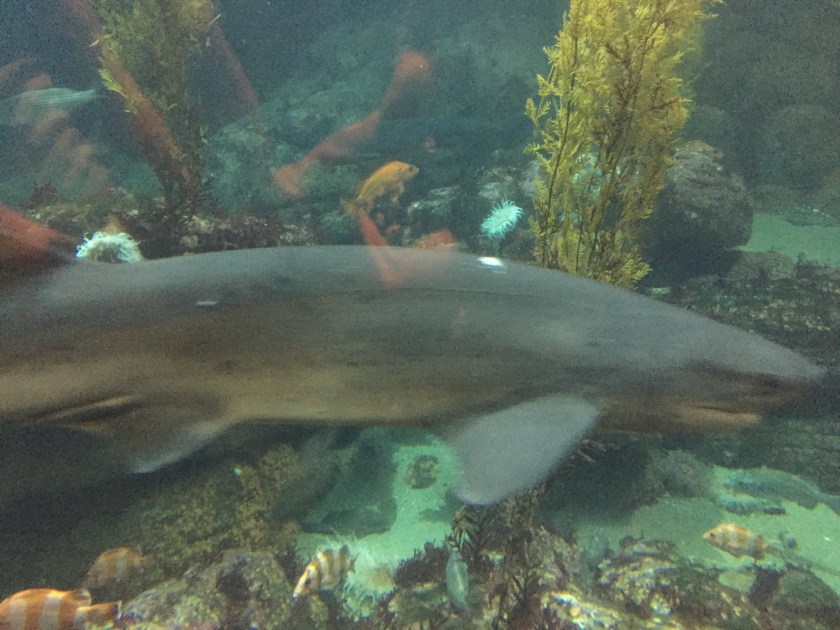
Now, I felt it was time to get acquainted with Squids. I don’t distinctly remember a squid – I must have seen them at the Monterey Bay Aquarium.  Their evolution is fascinating. The book is written by a genuine marine lover (Danna Staaf’s site is here: cephalopodiatrist), and her love for these creatures shines through in the book. I only wish the book had more pictures. I had to keep looking up pictures on the internet. Pictures of nautilus, cuttlefish, squid and octopus obtained from Google search below:

I had never used the word, Cephalopod, before, and I was glad to learn so much about another way of life, even if I may never fully comprehend what it means to have consciousness so permeable, so distributed, and yet co-ordinated.

If there is magic on this planet, it is contained in water. Loren Eiseley

jelly

Cosmic Nature of Living

We have several friends who are whiz-kids behind the lens, and rise before larks to photograph that first ray of sunlight through the crevice of the rock and so on. We are grateful to their creative labors, for the pictures show the artist behind the lens, and one needs only look at them to get an instant nature spa. We, on the other hand, forget to take cameras, or if we do, leave them behind in the car before getting out. Plans for sunrises are often derailed by the low trick the sun plays on us by beaming on us and waking us up with his rays before we beat him to it.

So, it is no doubt that armed with nothing but our cellphones, we had no method of capturing the brilliance of the Milky Way galaxy.

star_trails
Star Trails of the Milky Way Galaxy

Every time we have the luxury of traveling out of our urban areas swathed in artificial light, we try to step out at night to indulge in star gazing. The winter skies over Zion national park did not disappoint. The wisps of cloud that had floated in during the sunset to show us a more resplendent sunset had flitted away obligingly so that we may take in the iridescent brilliance of the Milky Way galaxy unobstructed.

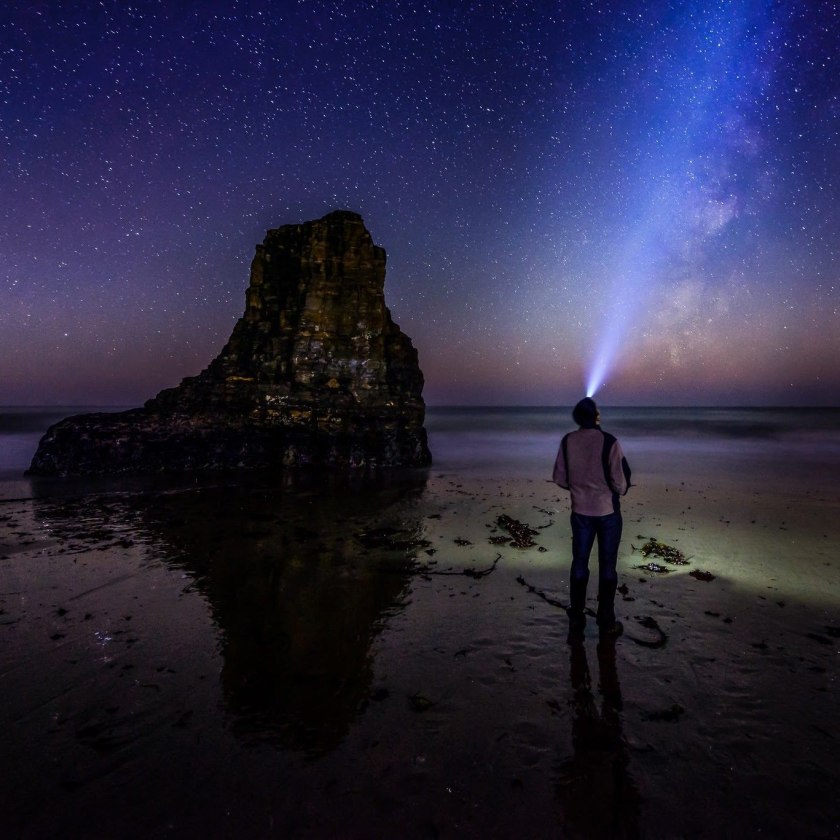
A friend most kindly took a picture of the husband gazing up at the skies that had me yearning to see the sky like that.

milky_way_shree

Photographers will tell you something about shutter speed, and exposures and frames per second: Lark that always has me looking like a glazed doughnut at t+2 of the discourse. Therefore, I produce slightly alarming results that has physicists going back over their calculations to see how the focal length with the curvature and the light ray divided by exposure rate gave rise to the image that I seem to have obtained. (Just a moment: f/1.4 should blur that background, how did it blur the subject?)

I meander as usual. The point is: I thought we required post processing and superior photographic techniques like make-up on a set to be able to see that night sky. However that night at Zion national park, we had no need to resort to these advanced techniques to see the nebulous cloud of the Milky Way. The skies split open, and the stars poured their celestial brilliance upon us. If this was the show our ancestors enjoyed every night, it is no wonder that we have such wonderful myths and shapes in the ‘ever changing panorama of the skies’ (James Woodforde Parson).

As we looked up, we could not help wondering how the desert beauty in the canyons was so different from the beauty of the seaside and yet so unlike the snowy mountain plains. If this many vagaries of nature could exist on one planet, the mind boggles on what exists in the vast cosmos out there. We rarely stop to think of the skies in any color than the ones we are blessed with. It takes children to imagine that. I remember the childrens’ essays in first grade where they were asked to imagine another world, and their skies looked nothing like ours. They opened our minds to the possibility of having rust colored night skies, with swirling colorful gusts of wind and rainbow colored days. When asked to imagine extra terrestrial life, we are so limited by our imaginations that we seldom look beyond the slightly changed human form.

Yet on this very planet, we know that octopuses have a level of consciousness radically different from our own.

For a long time, we thought that being conscious was something unique to human-beings, then Jane Goodall paved the way for several scientists to study animals and not fear being accused of anthropomorphizing their subjects. Finally, in the 1970’s, Jennifer Mather’s work was acknowledged.  Quoted from The Soul of an Octopus by Sy Montgomery:

Once overlooked or dismissed outright, Jennifer’s work now is respected and cited by cognitive neuroscientists, neuroanatomists, and computational neuroscientists so that the Cambridge Declaration on Consciousness asserts that “humans are not unique in possessing the neurological substrates that generate consciousness”, and that “nonhuman animals, including all birds and mammals and many other creatures, including octopuses also possess these neurological substrates.”

Days filled with the daily business of living truly and fully demand our attentions so that we often forget the vibrant universe in which we float. The night view from our planet, ‘ a tiny mote of dust suspended in a sunbeam’ as Carl Sagan so elegantly put it, is the best cure for arrogance there exists. Instead of taking our place among the harmonious orchestra of the universe, if all our dictators are fighting over, is a small patch in this tiny speck on a remote planet, we must feel sorry indeed for ourselves.

Can Mammoths Stop Thawing Arctic Permafrost?

“Let’s not watch this – it is depressing, and some of that stuff makes my blood curl.”, I said as the daughter suggested some gothic fiction. It was the week-end before Halloween, and we were picking our Friday evening entertainment. Never an easy task.

“Fine! What do you want to watch?”

Cosmos” I said without flipping a heart beat. (Watch the you-tube video introducing Cosmos here)

To her eye-roll, I said “No really! You see, there are so many things in there that I wanted to understand as a student.  I plodded along to the library and I got to admit, the Physics books in there. “ I gave a shudder here, and I fully meant it. “I suggest you curl up with one of those tomes in our library looking jaundiced, pale, and excellent cures to Insomnia. I thought some of them needed vitamins, sunshine and exercise to regain what Doctors call a healthy glow. “

geek_world

So, we sat together and watched a Cosmos episode by Neil deGrasse Tyson on global warming. In his slow, sure voice, he rumbled like the volcanoes on Venus that set the poor planet into an irreversible green house cycle.

The World Set Free (Cosmos: A Spacetime Odyssey)

http://channel.nationalgeographic.com/cosmos-a-spacetime-odyssey/episodes/the-world-set-free/

We have twenty years at the current rate to stop us from going into an irreversible state like Venus.

The daughter gave me a significant look .I gave her a more sig. look, and we sat there looking like stuffed frogs with s. looks etched on our faces digesting the info. “How could you think this was okay to watch, but that movie was too scary. This is the scariest thing I have ever seen. How do you think it will all end?” said the daughter sounding worried, and deeply stirred.


A few days later, I read out a passage from the book I was reading. Woolly: The True Story of the Quest to Revive One of History’s Most Iconic Extinct Creatures. (Related post: Mankind trying to resurrect the woolly mammoth by impregnating Asian elephants with mammoth genes.)

Screen Shot 2017-10-27 at 4.37.00 PM

Pleistocene park  – Using 160 square kilometers of Siberian Tundra given to him by the Russian government, Zimov’s goal was repopulating the area with modern equivalents of prehistoric animals that had adapted to Arctic conditions (moose, Yakutian horses, Finnish reindeer and even North American bison.) … To re-create the effects of the Woolly Mammoths on the land, he’d bought in a World War II tank …. Punching holes in the snow, … , using the tank treads to mimic the continual stomps of Mammoth feet, he’d worked the land, year after year. And along the way, he’d accumulated data that were staggering in their implications.

Within his 16- square kilometers refuge, he had lowered the permafrost temperature by an average of fifteen degrees. 

We change the world just be being. I remember watching a video by National Geographic in which they chronicle how 41 wolves introduced in the Yellowstone park, changed the ecology and even the physical structure of the park.

Introducing Wolves in YellowStone National Park – National Geographic Video

If that was the case with 41 wolves, what would introducing Mammoths do? Would it save us from the brink of extinction or introduce problems of the kind we hardly envisioned?

We never know the ramifications of our creations. I mean we are a species who has unintended consequences from a ‘Like’ button on Social Media.

Cybotic Leaders or Alien Invasions?

I am reading a book called Mind, Life and The Universe: Conversations With Great Scientists Of Our Time. It is a compilation of interviews with scientists. It is fascinating reading. Holding one book letting one know so many areas in which one knows nothing is nothing but humbling.

One interview is with Jane Goodall. She says that what struck her as horrifying while studying chimpanzees was the fact that they could identify with a clan and go on to attack, maim or kill fellow chimpanzees belonging to a different clan. Similar to what human beings do to each other. Somewhere along the evolutionary cycle, our genes seem to have mutated thus – to identify race and religion and any number of extra associations and look down upon others.

Carl Sagan, in his book, The Cosmic Connection, writes about how if an alien civilization were observing us now, they would think that what we value most is violence. For that is what is available as entertainment and that is what being streamed into our homes everyday, and what our children engage in, in the form of video games.

(https://nourishncherish.wordpress.com/2015/10/09/the-wind-in-the-reefs/)

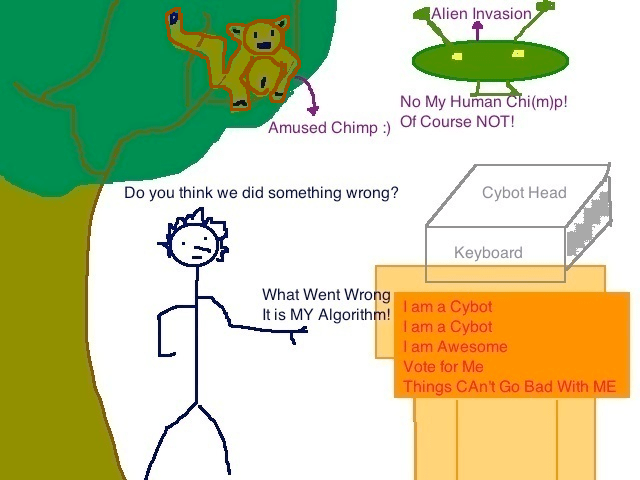
Last week, we did not need aliens to observe and see what is taught to us. A twitter bot, Tay, written by humans was let loose in the internet to learn and respond like a real user (The future is not far when a good cybot becomes the President of a country). Within 24 hours, we had turned Tay into a racist, misogynist, abuse-spewing user. Who can blame Tay for learning to be a racist jerk in one day? If that is what we are teaching twitter bots, could it be what we are teaching our children in a slower, sturdier manner?

I quote from article below:
http://www.cnbc.com/2016/03/30/tay-microsofts-ai-program-is-back-online.html

“Unfortunately, in the first 24 hours of coming online, a coordinated attack by a subset of people exploited a vulnerability in Tay,” Lee explained. “As a result, Tay tweeted wildly inappropriate and reprehensible words and images.”

How do we teach an algorithm empathy? As Jane Goodall said, “Only when our clever brain and our human heart work together in harmony can we achieve our true potential.”

https://www.brainpickings.org/2014/09/30/jane-goodall-empathy/

I remember a P.G. Wodehouse book, Right Ho Jeeves, in which Jeeves (that all-knowing butler who saves his young, idiotic, but thoroughly good-natured master, Bertie Wooster many times over) says, that the best way to unite warring factions is to introduce a common enemy.

chimp

It looks like an alien invasion might save us from ourselves. If those aliens are only 0.1% percent more evolved than us, we can be their chimps.