Ephemeral Fashion: The Humor in Childhood Wardrobes

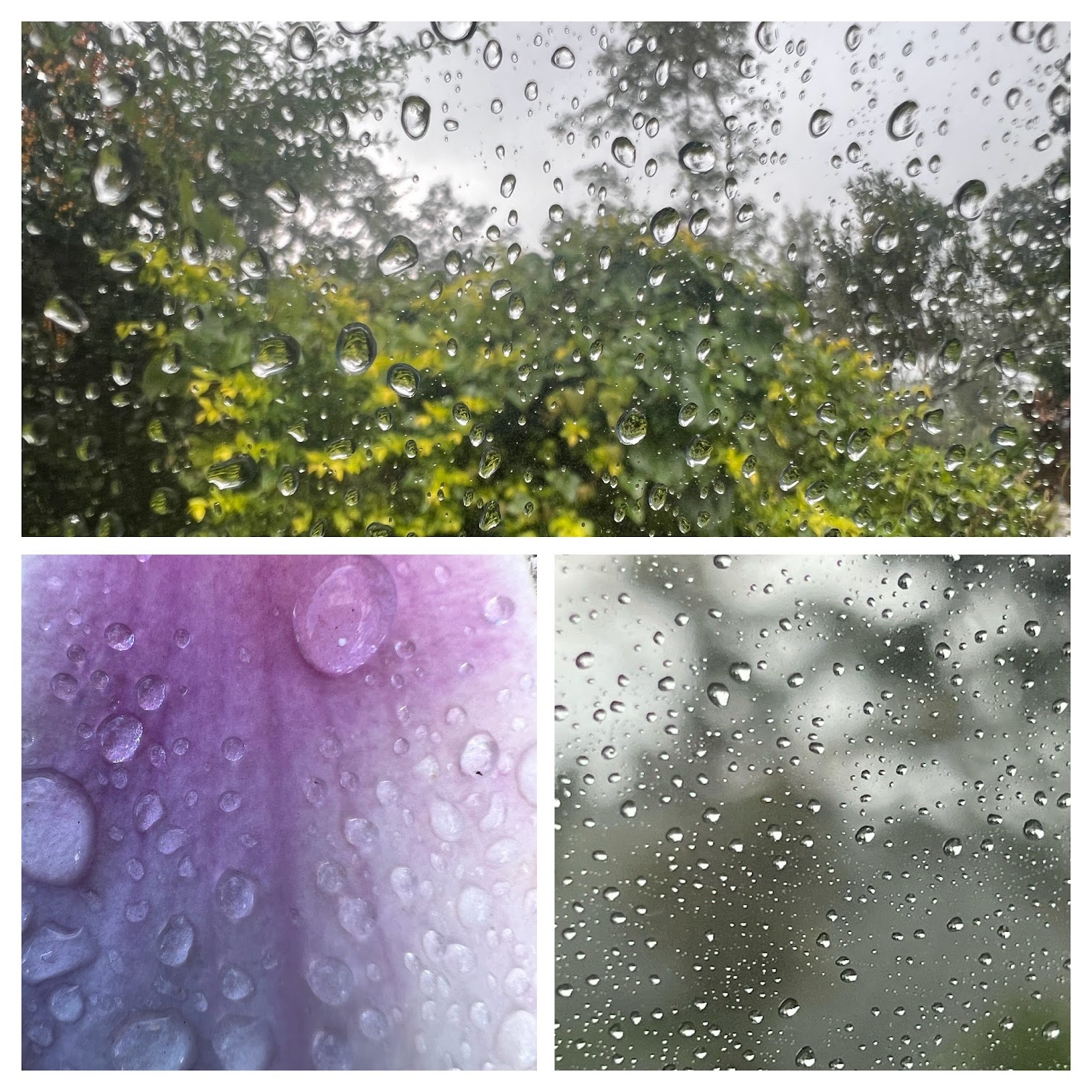
We were sitting around waiting for an event to start, huddled under a shamiyana-like structure. The rain was pouring – the way it pours in the Nilgiris. All the metaphors and mythos of Great Rains seem very likely, and just like that the skies clear up, and one wonders what happened. Where the rains went and how life goes on as though nothing happened. Dramatic skies are truly nature’s mystics. 
Anyway, there we were, sitting around under a canopy waiting for the event to begin, when a young fellow walked past us in his too-big uniform. The seams of his pants were getting wet from the puddles from the recent rains, his shoes a size bigger, his blazer two sizes bigger, and I couldn’t help smiling. 

I caught the smile on my friends faces too, and we exchanged a quiet moment of reflection. How as children, we were really never properly dressed. All our new clothes were slightly big. Prudence, economic necessity, environmental concerns – whatever the name given, ‘too big’ was the style. 

Goldilocks Style

There was a phase in life when we were dressed in either too-big-new-clothes or too-small-old-clothes. Goldilocks could’ve had a philosophical lesson or two if she’d stopped by and seen us. Life truly taught us the beauty of ephemeral pleasures with clothes – that brief, all-too-quick time when your clothes fit perfectly is never long enough to feel well-dressed. Sigh. 

“Those dreaded hand-me-downs!” I said and shuddered, exchanging a look with the sister, and she gave me one of her joyous cackles. You see? The sister and I have very different bone structures. Hers was what my mother approved of and called Healthy. Mine, on the other hand, made my mother scrunch up her nose, and wonder about what she could be doing better to help things along. But such is fate. The sister’s hand-me-downs, therefore, swamped my scrawny frame (Oh! How I miss those days of being nonchalantly petite and being able to tuck into stacks of buttered toasts without a second thought?!). I perennially looked like I was dressed in pillow covers. Very house-elfish fashions for Yours Truly. 

Nostalgia

That’s how we found ourselves going down the path of “Oh gosh – do you remember?”

And “It should’ve been outlawed. Remember when …” 

The mother was a self taught seamstress and she spent her evenings after school (she was also a high school Physics and Maths teacher) sitting and stitching all manner of clothes for her children and herself. The father escaped. Men’s fashions were where she drew the line. The lucky man! 

https://nourishncherish.org/2012/06/12/what-the-well-dressed-man-is-wearing/

It was a matter of great pride for my mother who learnt tailoring so she could stitch our clothes, alter them when necessary etc.

Frilly Fashions

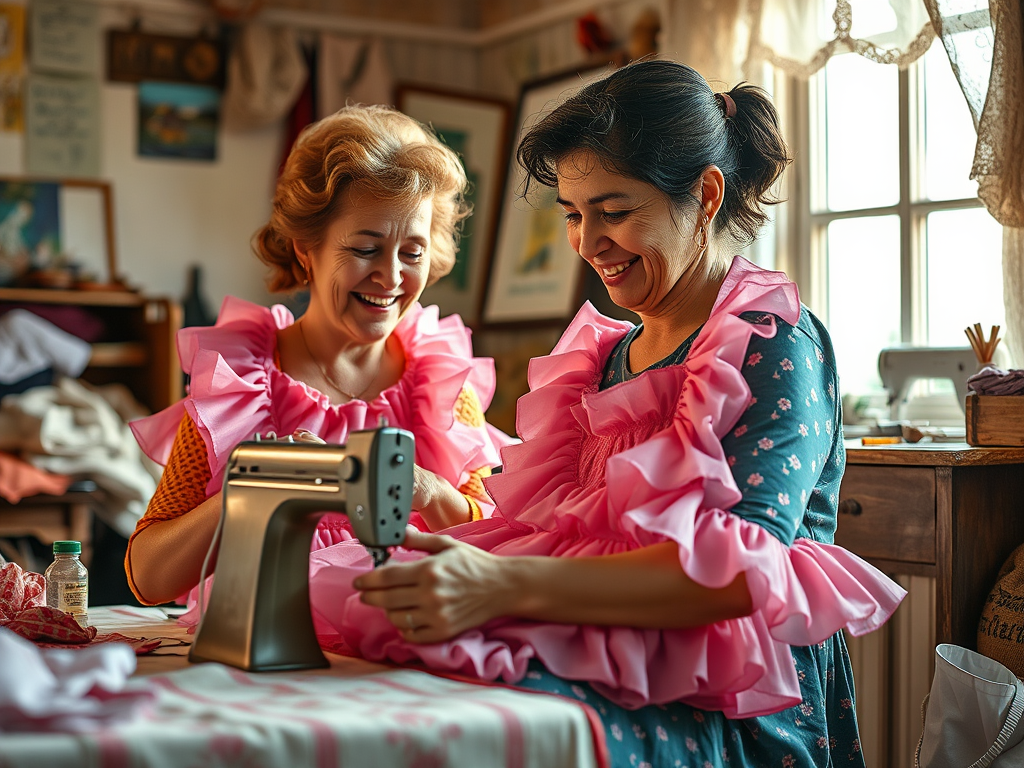
The mother had no access to fashion magazines, and in those days of Doordarshan, one could not get many inspirations from television either. So there we were. There was a phase when she learned how to stitch Frills. Victorian tailors couldn’t compete when she was in this phase. All our clothes had frills all over.  Years later, I pointed to one monstrous pink dress in a photograph, and asked her what she was thinking of, and she looked confused. 

“Frills made you look bigger and better. “ she said.

Obviously. No irony, no sarcasm. I didn’t have the heart to tease her then. She was still so proud of her frills. Never mind that it made me look like a strawberry in pineapple clothing.

When finally I put my foot down and refused any more of her creations, she conceded to have the school tailor, Paada, stitch our clothes. A distinct improvement but still not exactly fashionable. Where would he get ideas in a village nestled in the Nilgiris with a population of less than a 1000 people?

I can’t tell you how grateful I was for uniforms. As we sat there looking at growing children dressed in slightly loose and big clothes, I felt like the universe really does have a sense of humor.

I truly understand now Bertie Wooster’s pride in his article he submitted to Aunt Dahlia’s newspapers on ‘What the Well-Dressed Man is Wearing’. Trying to capture the ephemeral is what Art is all about, isn’t it?
The Meaning of a Good Life

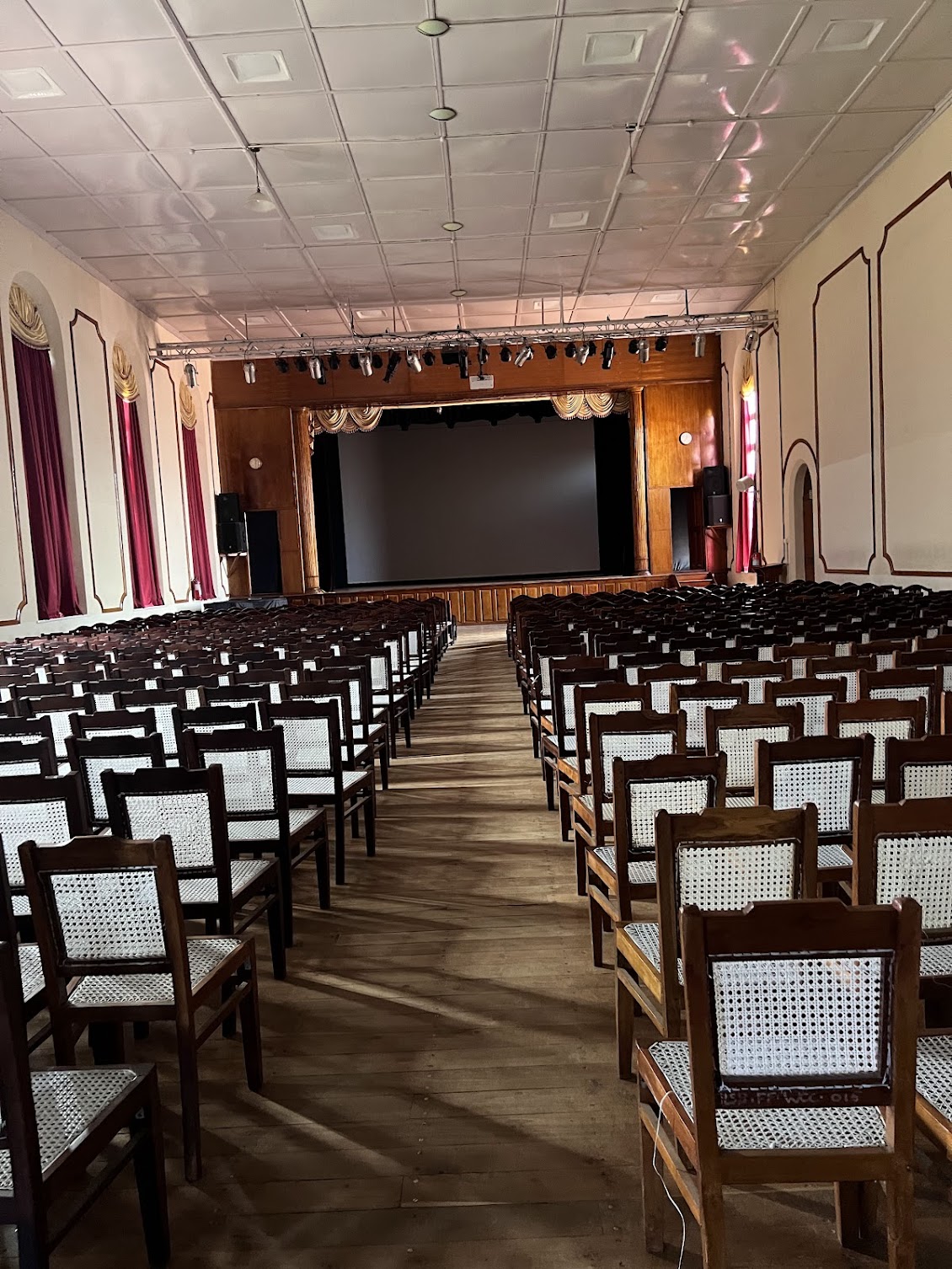
We went to visit our old school haunt – the home of our school days, and some of the best memories. If there is a utopia, I’d like to think it is very much like that place. There was plenty of ‘real’ life there too – It was by no means devoid of pain or jealousies or strife or suffering, but life still felt full of promise. Like the universe was conspiring and preparing us for a fantastic future. Maybe it was the optimism of youth, maybe it was the collective talent of the folks around us, or just the marvelous eucalyptus scented air around us in a beautiful location in the Nilgiri Hills.

Of course, one cannot help feeling like you’ve let down the school quite a bit, but what can you do? Luckily, most of our teachers have retired, but I felt I could feel their encouraging presence at every science lab and every playground. 

A visit there at this stage in life though, revitalized me in ways I did not comprehend till I had the quiet and solitude to mull things over after coming back to the USA. “You can still do a great many small things to make things better for the world around you, couldn’t you?”, a small voice whispered in my ears. Maybe after all these decades of striving, that is what you come to realize. That, as Mother Teresa said, there is greatness in small acts:

“Not all of us can do great things, but we can do small things with great love.”. – Mother Teresa

I asked my father what he thought at the time – he was a teacher there. Did he think any of his students would go on to win the Nobel Prize, or the Booker Prize or become the Finance Minister or make it big in the field of Arts/Drama/Acting?

He said that the markings of greatness were visible in few children at such a young age. Mostly, it was the potential that excited the teachers. You ask the pater a question, and he can turn it into an impromptu speech within seconds. So, I wrapped up and set off on a walk while talking to him. Always the best thing to do. He said,

To rephrase Shakespeare:

Some people are born into greatness, some acquire greatness, and some have greatness thrust upon them.

In good schools with well to do parents (by that I mean parents who not only have the means but also the interest to invest in the success and achievements of their children), many children belong to the first category. Success is expected of them, and the tools are there for the taking. Barring any major life events or health issues, these children can build a life for themselves – that is not to say there isn’t struggle. For those very expectations of greatness can be a burden to overcome.

The second category of talent comes up despite their circumstances – the distance they go in life, the differential between where they started and where they end up is the yardstick for their success. Many children from modest means who go onto achieve success belong to this category.

The last and final category can come from either of the categories above – but these people are tested beyond what normal people endure. Their hurdles are frequent, gargantuan and any progress they make is a success in and of itself. Health issues, career issues or relationship issues (sometimes all three) test them. Many break under the stress and strain of it, but those who are thrust into greatness endure, secure in their understanding that small victories and sustained mindsets often tide them over better.

Many are the stories and epics written about these characters. But more importantly, we all know friends and family in this category. Even if it isn’t obvious, even if we aren’s writing songs about them, they are truly heroes of their stories. Being a stable parent in a tumultuous relationship, navigating health hurdles, being a steady breadwinner through times of economic upheavals, being a steady person when all around you have lost their minds – that is their greatness.

IF – By Rudyard Kipling

If you can keep your head when all about you   

    Are losing theirs and blaming it on you,   

If you can trust yourself when all men doubt you,

    But make allowance for their doubting too; 

Yours is the Earth and everything that’s in it,   

    And—which is more—you’ll be a Man, my son!

Or more along the lines of: You’ll be a Human-being, my child!

The evening was drawing cold, and I knew I had to cut my walk short, even as I mulled on the father’s answer. Making the best of things, and Never Give In were the things they taught apart from Languages, Mathematics, Arts, Sports, Sciences and History. For those it served well, it was heartening that it had, and for those that it hadn’t, well there was still hope that they would learn to do so. That, right there, was the philosophy of a teacher in one grand stroke.

The walk made me reflect on two of my favorite speeches:

On The Importance of Failure and Imagination – By J K Rowling

Harvard’s 80 year old Study on Happiness and Success (Harvard Study Article)

Greatness is something we are told to pursue, without properly knowing what it means, at a young age. For many, the pursuit of a living (and maybe fame or renown) occupies time and energy. But life is far more complicated and richer than that. It means good and close relationships with family and friends, good health, good wealth, good pursuits (intellectual, spiritual and physical), purposeful work, the ability to feel joy, and so much more.

Maybe this is why school reunions and such are planned at a certain stage in life. The environs can stimulate thoughts and spur us on towards growth and meaning.

Peeking out after the rains

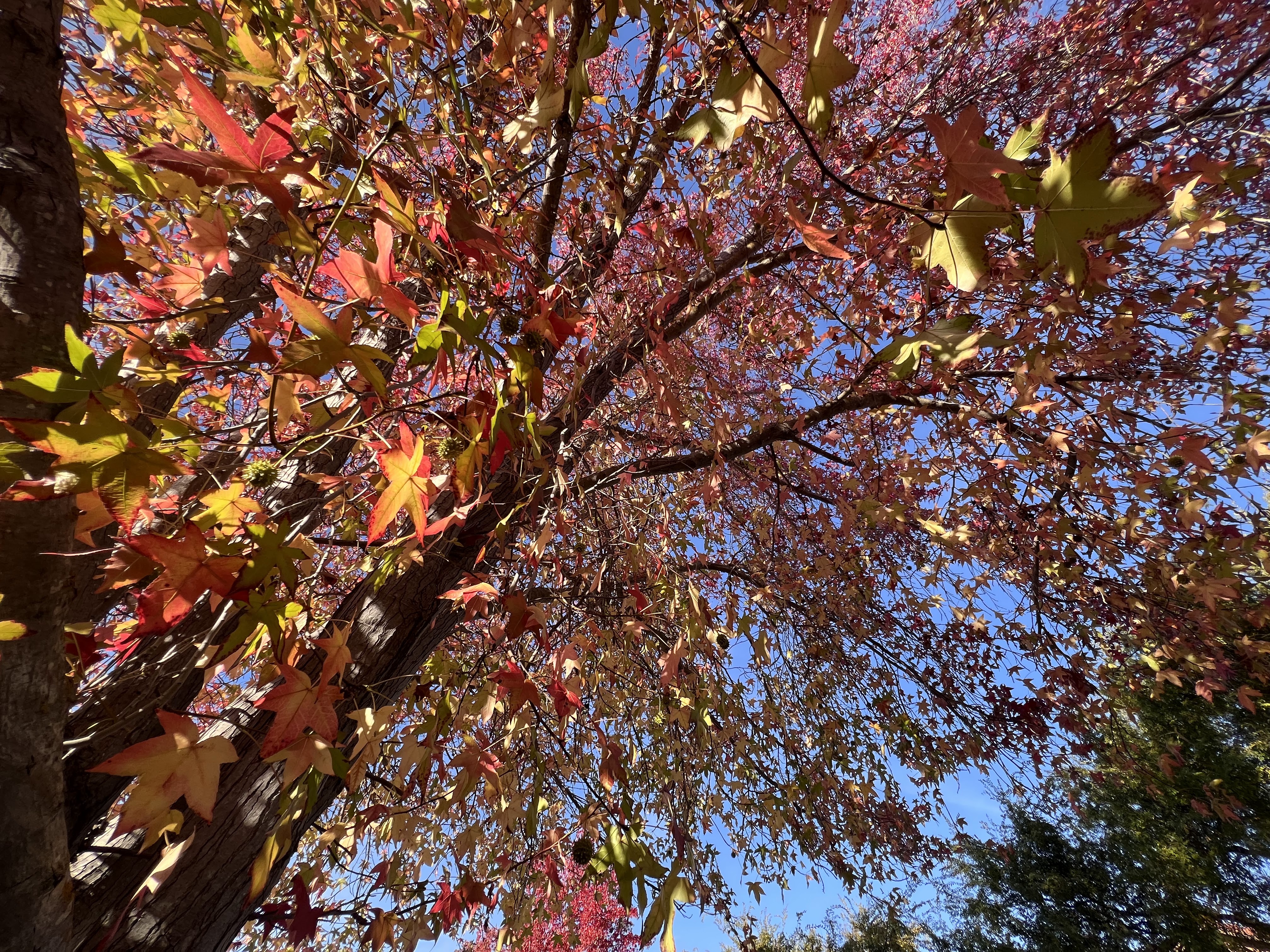
Novembers in the Bay Area are beautiful. It is the time when the world around us turns colorful – assures us that the seasons are turning. The fall colors, never as resplendent as in the East Coast, are inviting, and the son & I spent more minutes walking gleefully into crunchy leaves in the past few days than was necessary. We also gazed upwards into maple trees – the greens, yellows, reds and maroons like a beautiful artist’s palette in the world around us. 

Regardless of how we started out, we’d come back smiling widely and happy to be out in the world. The days drawing in closer also means that we had to really try to catch all of this in a narrow window before the skies draw the screens on them. That sense of urgency adds to the thrill. 

“She had always loved that time of year. The November evenings had a sweet taste of expectation, peace and silence.

And she loved most of all the quiet of her house when the rain fell softly outside.”

– Louisa May Alcott’s, Little Women.

The squirrels, deer, water rats – they all seem to be more at ease with the time-change than we are. Probably because they don’t peer at the clocks before heading out for a walk. They rise with the sun, and rest with the dark. There is a profound kind of philosophical simplicity there.

img_3794img_3793

Yesterday was Veteran’s Day and a holiday for schools. So, we decided to make a song-and-dance of it, and headed out for a walk after lunch. The rains had lashed down all morning – the first rains in November in the Bay Area always make me feel warm and special. By afternoon, the clouds were scuttling away, leaving a delicious moist, clean Earth behind. We walked around a lakeside – watching the pelicans, sanderlings, geese and ducks catch the sunshine after the rains too. 

There is a strange solidarity amongst creatures in that simple act. Peeking out after the rains.

img_3797

The Fascinating Behavior of Songbirds: A Morning’s Musings

It was one of those mornings in May – clear skies, the sun’s rays dancing through windows, and replacing moans quickly with sharpness and dedication.

I stood there wondering how it was so thoroughly that we transition from a supine, sleepy form to an alert, going-about-the-day form. The demands of the clock are relentless indeed. 

For an instant, I stopped to hear the beautiful voice of the songbird on our garden fence. It was trilling and beautiful, and I could have sworn just a little inspired – that last note a little higher than a human would have envisioned for that piece. 

It was as I was musing thus, that I noticed the son charging down the driveway to get to school on time – a sock hanging in one hand, a school project in another, and off we went. The songbird flew from my mind as we navigated the traffic, spoke of this-and-that, and chose music for the ride there. 

When I came back, the songbird was still flitting about here and there. I stood mesmerized by the little flashes of movements that my phone camera would not be able to capture anyway, and listened as it chirped, and went about gathering its breakfast.

I remembered a book that I had from the library – patiently waiting its turn.

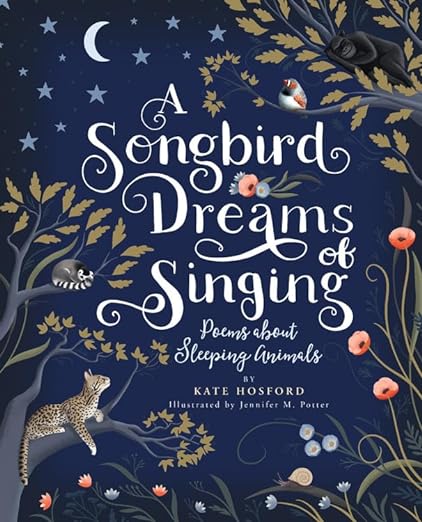
A Songbird Dreams of Singing – By Kate Hosford, Illustrated by Jennifer M Pottersongbird

I flicked open the book. The poem about the songbird was there:

Other birds may dream of worms 

Or flower beds or thunderstorms 

But every night this bird performs 

A concert in his mind.

How marvelous to imagine a songbird rehearsing and getting better at its craft subconsciously – every night.

The book goes on to talk about research made about sngbirds:

In the case of songbirds, scientists at the University of Chicago have done studies on zebra finches demonstrating that the males practice and refine their songs while dreaming, adding little flourishes to make their version of the song unique. Zebra finches are diurnal birds who rest in the afternoon and sleep for about ten hours a night. Like many other songbirds, when they awake in the morning, they sing with particular enthusiasm in what is known as the dawn chorus.

Children’s book illustrators are so wonderful at their craft. This book too has beautiful illustrations, color schemes, and an overall look and feel of a book that is all set to send us to our worlds of dreams too.

So, what should we dream about, and subconsciously try to get better at?

Suma’s A Bindi Can Be

Suma Subramanian

I have been waiting for Asian Heritage Month to review the brilliant books of Suma Subramaniam. I yearn for books that hold a nod for us. I know what it is like to be the only child wearing a bindi in a classroom full of non-bindi wearing children – and so does my daughter I am afraid. 

Despite this, whenever I could, I looked for bindi patterns. Beautiful patterns – so elegantly thought out and shaped. Tiny little spots of art that you could stick on, to transform a face. I have a special kinship to bindis that probably deserve a separate post. I didn’t realize how much bindi related material there is in my head till I started writing this post. I have at least 3 posts worth just with reading one book!

Pottu, my doll

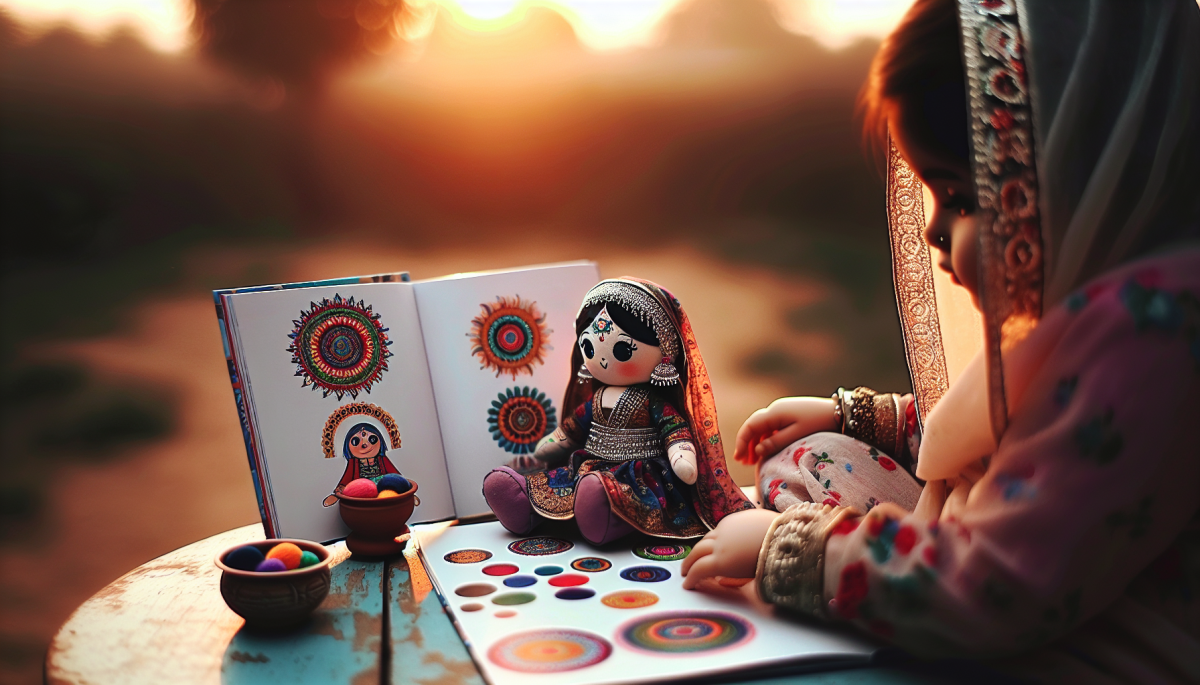
For instance, I had a marvelous doll named ‘Pottu’ – actually the doll was marvelous, it was made to look quite horrendous with all the bindis I gave her. I drew magnificent bindis on her everyday – one day, the sun, another day a palm tree, one day – I’d fill her forehead, face and forearms with bindis. But Pottu was my doll, and there she resides in my long-term childhood memory – a small part of our identity that only those who knew about bindis could understand. 

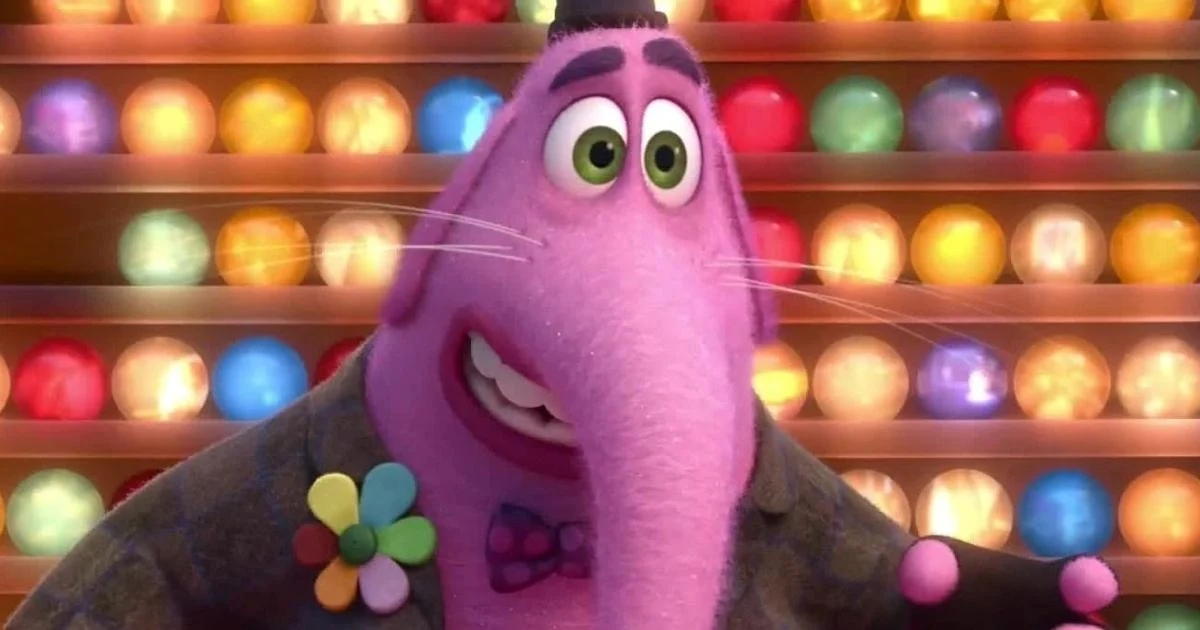
pixar elephant

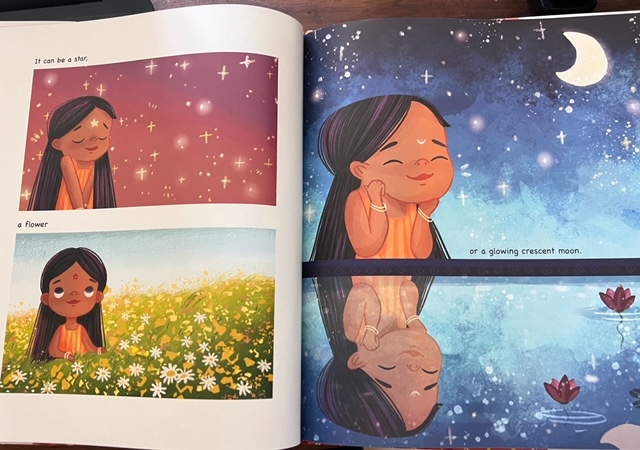
Here was an aspect of ourself that I finally saw in a book. When my daughter showed her baby pictures to her friends, they’d ask about the drishti pottu, or the pottu on her forehead. Finally, children can show their friends what a bindi is – in a book, in an American library. I am proud of that. Like the book coming out gave us bindi-lovers a tiny nod of belonging. You can wear a sari, and a bindi, and you can just Be. 

IMG_1254

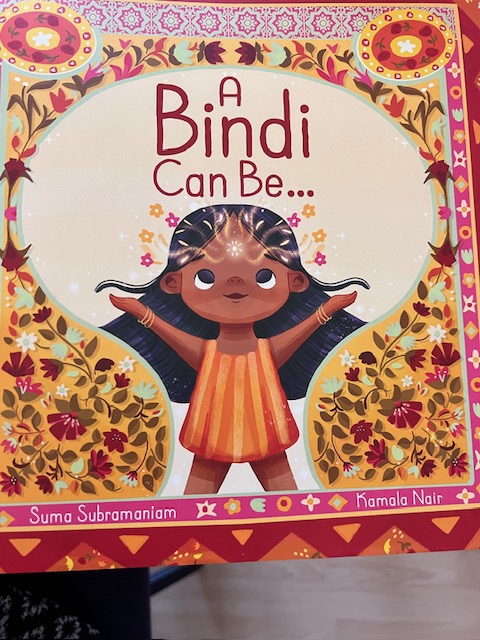
Picture from: A Bindi Can Be – By Suma Subramaniam, Illustrated by Kamala Nair

Thank you Suma! 

A Bindi Can Be – Written by Suma Subramaniam, Illustrated by Kamala Nair i

Now on to the book itself, A Bindi Can Be – Written by Suma Subramaniam, Illustrated by Kamala Nair it is a marvelous read. The pictures are vibrant. The joy of bindis is evident. The essence of the small dot transforming you is brilliantly done. 

67273848-1671-40B0-992C-E3C82AFDF5D4

Thank you Suma – for all those children who have had the joy of drawing their beautiful bindis, or having a marvelous bindi collection, or felt curious about a friend’s bindi, this book satisfies them all.

The moon in the willows

With the full moon approaching, the beautiful waxing gibbous moon was often visible – a pale disc, even as the sun is setting, and sending hues of oranges and pinks sky-over. It is a beautiful time of year. November fall colors are in full glory, the occasional rains make for good cloud cover, and the nip in the air makes for an energetic walk whether we start that way or not.

On one such evening, as I frisked about, I looked up at the sky. In one breath taking moment, there was the moon shining through the spilling branches of the willow trees. I took a picture, but of course, it captured nothing of that moment.

img_8560

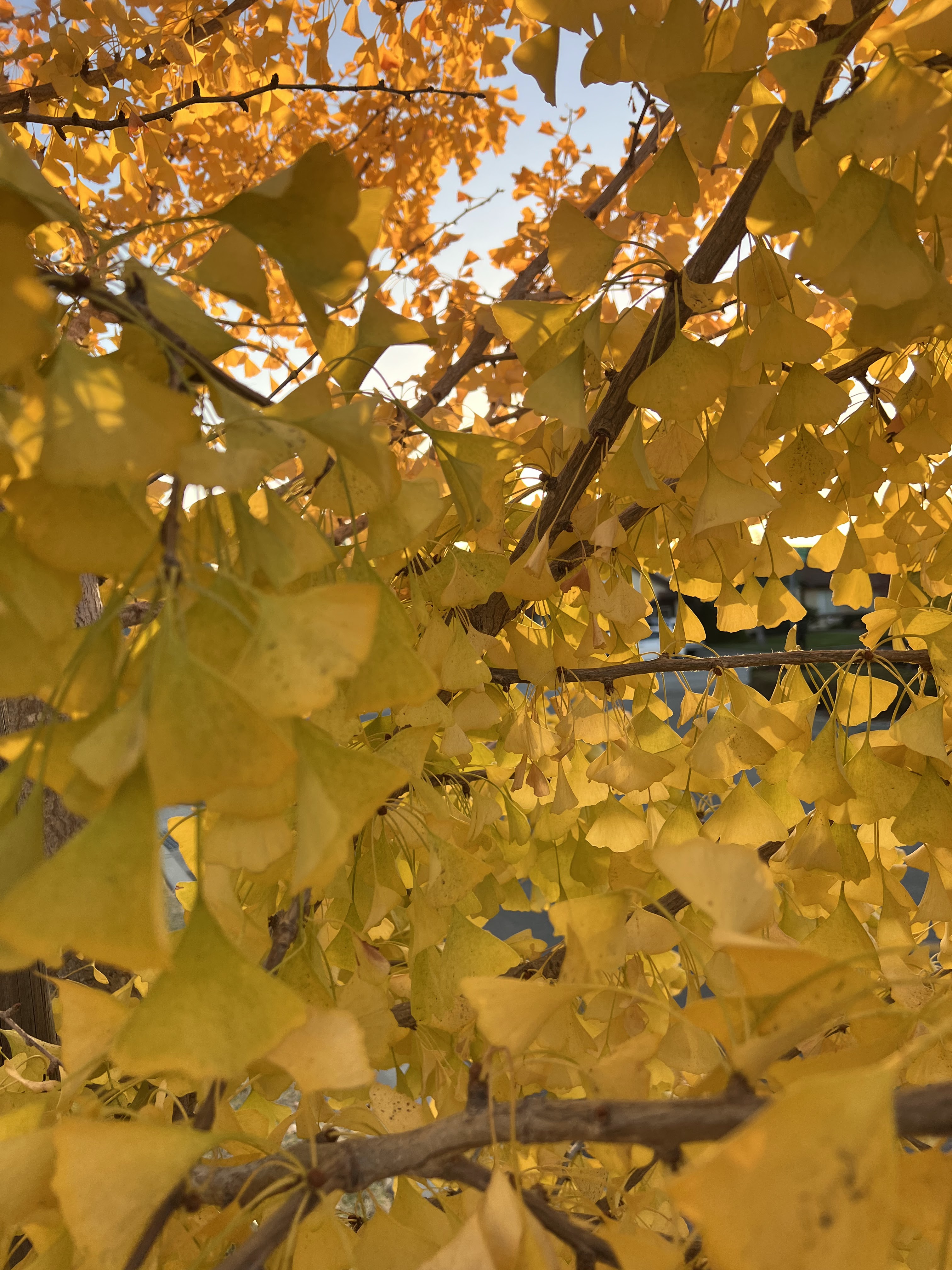
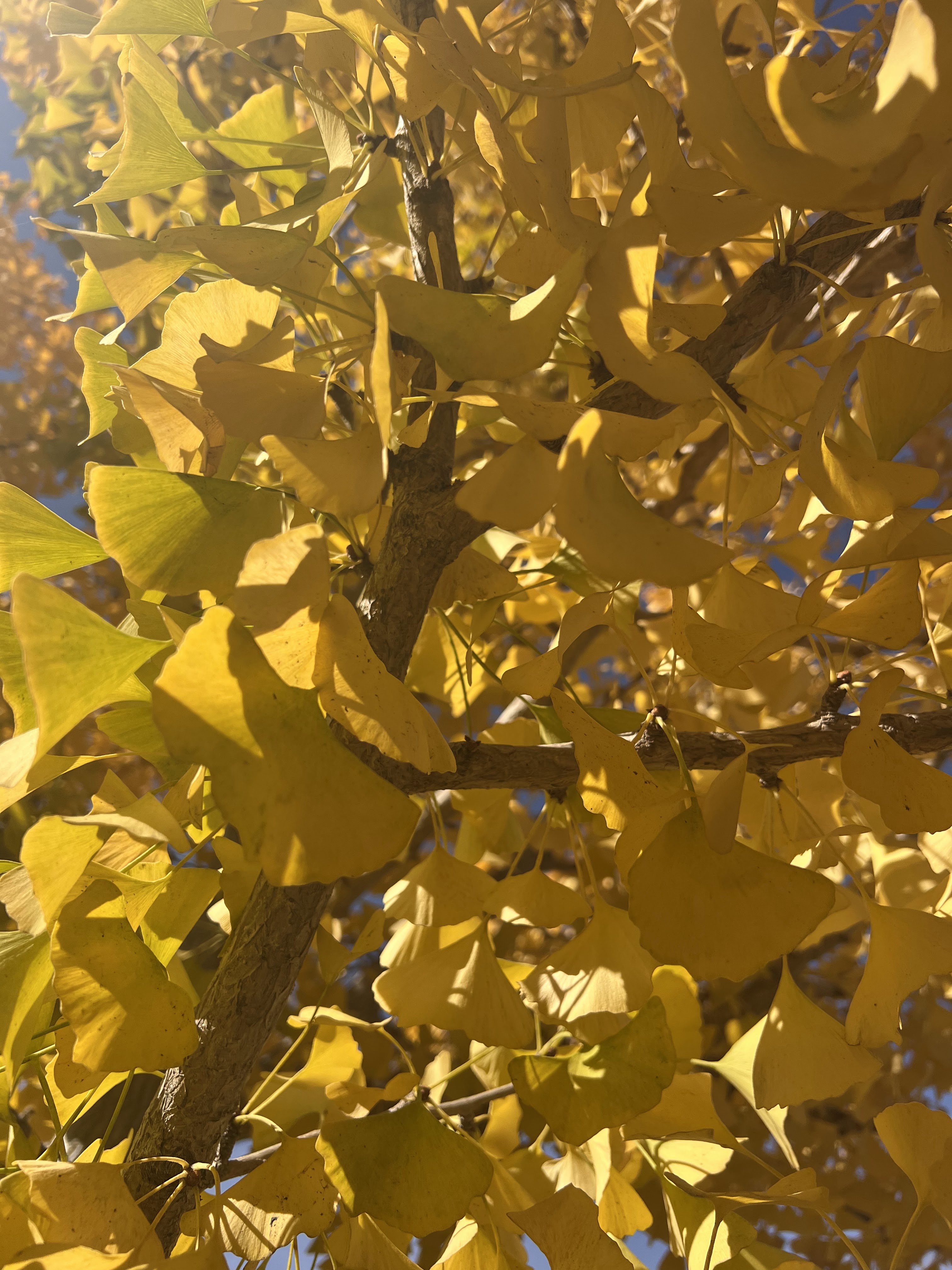
A few steps on, I smiled as a small wren pipped in and out of the gingko trees. The gingkos are all cloaked in a golden yellow. All of them are waiting: waiting for an older gingko who has still not changed colors completely. In Oliver Sacks essays, he writes of the communication patterns between these beautiful trees who have lived to tell us tales from the time dinosaurs roamed the earth to now. 

Read also: The night of the Gingko : By Oliver Sacks in the New Yorker magazine.

img_8501

It must be marvelous dipping in and out of the fall colored foliage like that. Imagine living in a nest surrounded by the golden glow of a gingko tree, or the multicolored heaven of a maple tree. Oh! To be a shape sifter would be marvelous.

Back home, I nursed a cup of hot coffee as I peered into the sunshine outside. I shushed the daughter as she came over to see what had me quiet. There it was: a big fat brown rat, sunning itself. “Ugh! Go away! Go away!” the daughter said, but the rat did not think it necessary to budge. I tried opening the door loudly, and it moved towards the shadows of the trees  hesitantly. The daughter gave me a stern look, “What would you do if it ran inside Mother?” 

I admit I had not thought of that possibility. “In my experience with rats, they scamper away, not towards you. Unless, of course, you were a cat, and the rat was infected by toxoplasma gondii.”

I looked at her with what I call a winning smile. She ignored this, and went her way. I let the rat be, and went about composing a little poem in my head. What I mean to say was it was a marvelous day to be outside. Thanksgiving can come in various forms. It can come in the form of 

The moon in the willows

The bird in the gingkos, and

The rat in the shadows.

Once Upon a Goat

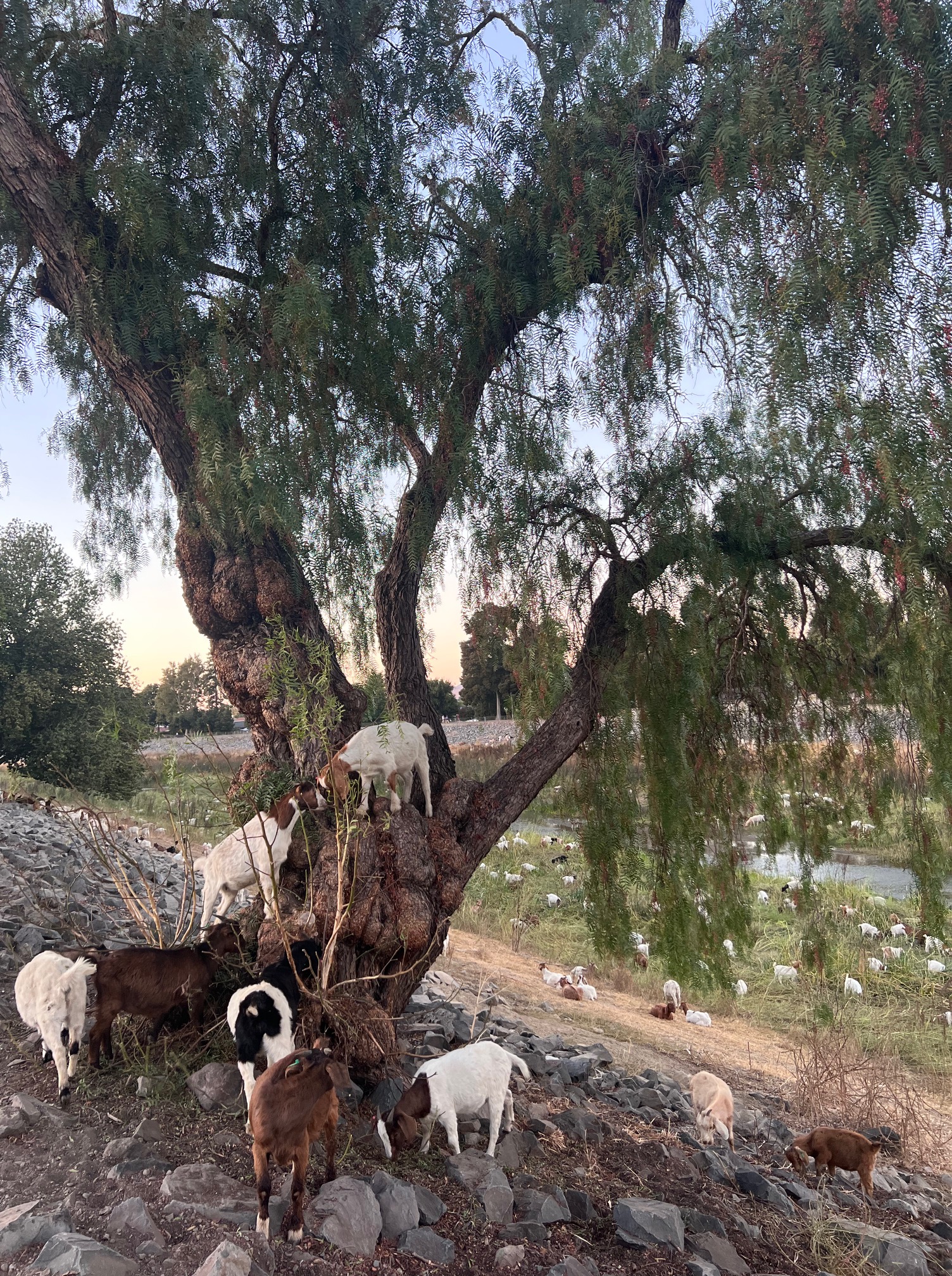
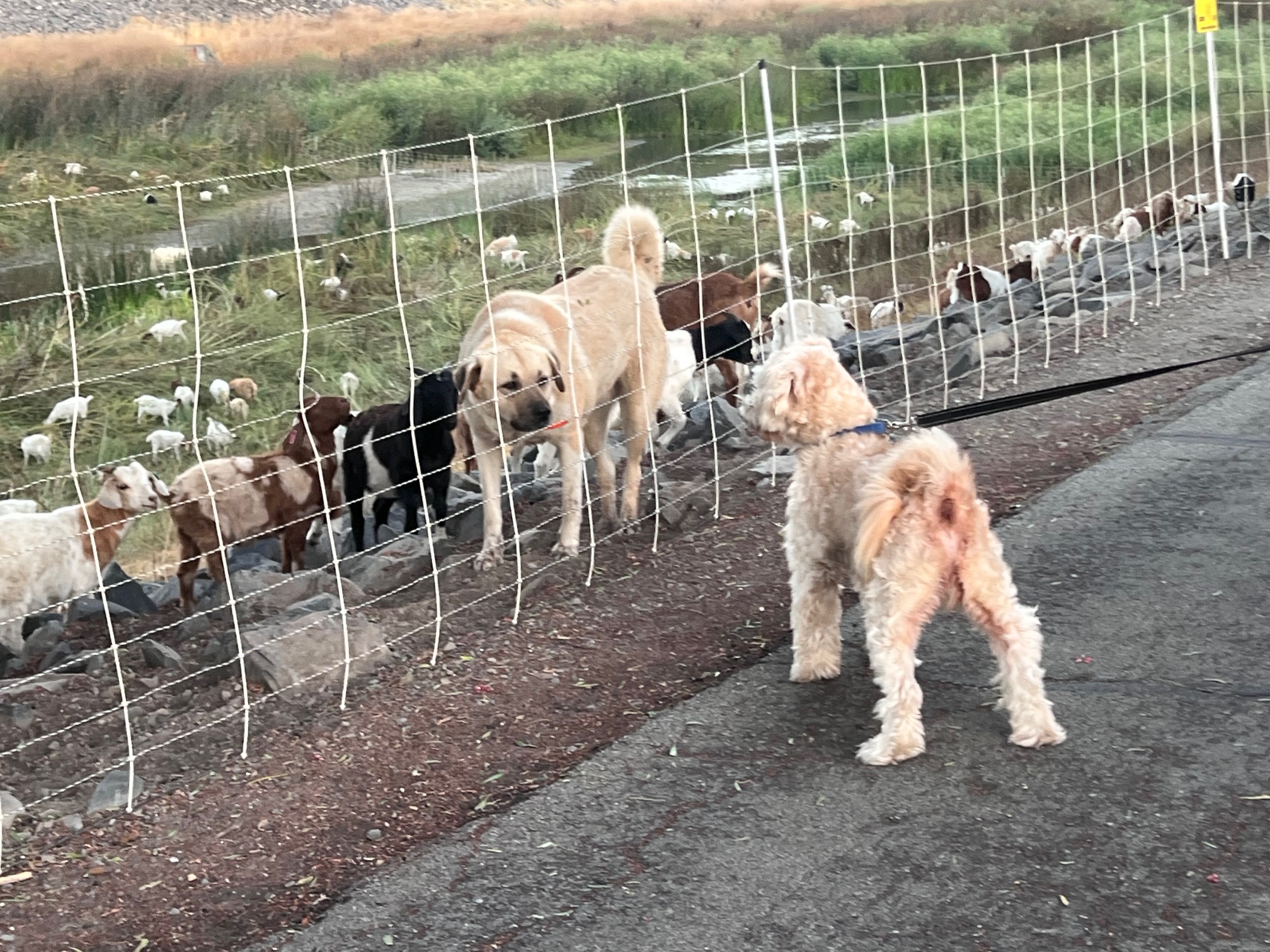
The son and I stood by the river bed near our home once more gazing upon the goats in the riverbed. An endlessly fascinating pastime, we always return smiling and shaking our heads fondly at the kids and goats, and a little awe at the sheep dog whose job it is to herd them all.

75AA2498-E9FE-4C9F-B211-BFFB9F499459

One evening, we saw two dogs gaze into each others eyes with an understanding that seemed to acknowledge their respective roles in life, while the goats gathered around looking curiously at the new dog behind the fence.

5E935F80-BB6D-40C3-8DE6-667BFCC5A791

“Hmm – maybe you should write about the goats huh?!” Said the son one day after we had spent a few minutes chuckling at their antics. I agreed. I had written a rather serious post by my standards, and I was in the mood for something light, something that shows the lightness of being, joie-de-vivre and all that. Goats seemed like a good option.

As luck would have it, the first book I had to read that evening was a children’s book on goats. I picked it off the shelf, and the son chuckled approvingly. “Oh – this is such a good book, right?”

“Yep! I love it too!” I said grinning too.

Children’s books are such a reliable source of light. Where else in this world would you be able to find as unalloyed a source of whimsy, fun, and a sheer exaltation of the nonsensical?

This book seemed to tick all of the above.

Once Upon a Goat – By Dan Richards, illustrated by Eric Barclay

once_upon_a_goat

A king and a queen want to start a family and ask the fairy godmother for a kid who has “glowing skin, bright eyes and hair like ocean waves”.

I did wonder how they arrived at this combination to ask for in lieu of a hundred other qualities, but remember this is a fairy godmother asking them what they’d want. I suppose I’d be flustered too. What would you ask for?

Anyway, the fairy godmother, busy with hundreds of wishes like these I hope, grants them a kid with just these qualities. Only it is a goat kid and not a human one. The king and queen are flabbergasted, but go on to accept and love the goat kid anyway. Their lives are more messy than they’d have liked perhaps, and their rose bushes suffer a bit maybe, but otherwise, they are a happy family.

It is when the fairy godmother stops by to check on how the little family is faring, that she realizes her folly. In the meanwhile, a human baby is being raised by goats in the countryside. 

What follows makes for a hilarious take on families, and acceptance.

Hint: A large heart makes for great joy and from generosity of spirit stems more happiness.

Who knew goats would play such a big part in our laughter that day?

🐶🐾🐕 Spot Goes Splash! 🐶🐾🐕

“Don’t even think about it!” I said almost casually. I had the son in my peripheral vision as I took in the gorgeous sunset, played (s)word volley with the daughter, and screwed up my face at the husbands unnecessarily loud enjoyment at the latest the daughter had said. 

“Oh my gosh! Did you see that? She totally knew what he was going to do!” The daughter laughed half-admiring, half-worried.

“Like it’s a big surprise. Sprinklers going off and spraying cold water on the lawns, and your brother loping towards it as if without a conscious thought?! Right.” I drawled.

“I mean – look at him, I bet he’s still going to try.”, she said and I laughed. 

The subject in question, meanwhile, was wracked between playing the rebel and getting himself wet or making a joke and having a comfortable walk the rest of the way. It was a lovely summer evening – this close to the summer solstice, everything is a joy and the daughter agreeing on coming for a walk clinched the evening. So there we were.

“How’d you know he was going to try and run into the sprinklers?”, she pressed.

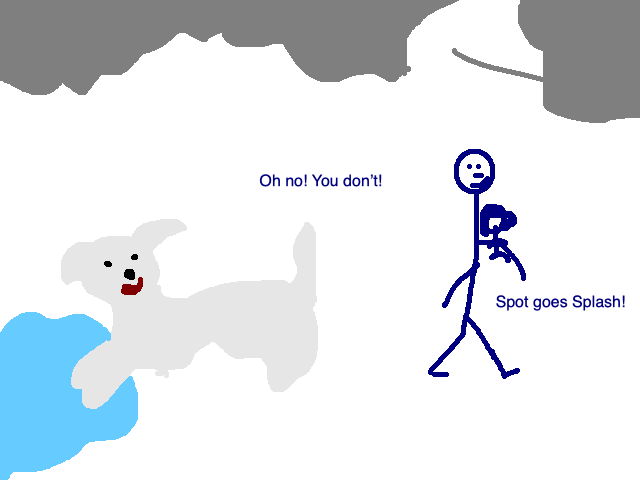
“Well – I raised you, remember? “ Then, looking at the husband, I shuddered a bit and said “Remember that New York trip? What was that book we’d read to her? Spotty loves the rain? Or Spot like to go Splashing? Spot Goes Splash! That’s the one.

spot

“A book about a little pup that loves to splash about in rain puddles. It rained for the entire duration we were in New York that visit and you were two years old! You thought you were too big to sit in a stroller, and we knew you were too heavy to carry around. Still – I had only 1 pair of shoes for you. Appa carried you on his shoulders almost the whole time to save us all the trouble. His shoulders have never been the same!” I said giving him a squeeze and a look that said, “My Hero!” 

spot_goes_splash

“Gosh! Now there are some parenting gaffes I’ll keep away from!” Said the daughter. She prides herself on being – well whatever teenagers who think they are better than their parents pride themselves on. 

The husband rolled his eyes and guffawed at this so loudly, that a pair of doves took flight squawking alarmingly. That got us all laughing, and he said, “Ha! Just for this – we’ll accompany you when you have your little ones and just stand around and laugh pointedly instead of helping.”

“I’ll write it all down so we remember to do that!” I said laughing helplessly as well.

Her brother, in the meanwhile, had opted for a compromise between running full-pelt into the water sprinklers and had splashed in the water puddles nearby instead and was trying to hide how uncomfortable wet sandals were. 

The summer solstice made for an elongated sunset and we took the time trying to see how a thread from the past could stretch into the present and be used in beautiful circle of life years later.

Spot Goes Splash!

Life is Elementary

It is when I look back upon the past few years as an adult that I realize how much I have enjoyed the elementary school years of the children. The immigrant experience enriched this time in my childrens’ life for me. I am also extraordinarily grateful for the fact that the schools allowed us to volunteer in the PTA, classrooms and as chaperones during field trips. It gave me a glimpse of their lives with their friends. A chuckle, a phrase filled with colloquial nuance, or just jokes that don’t mean anything to anyone but themselves were all welcome windows into their lives. 

I have had a wonderful 12 years of elementary school to enjoy thanks to the age gap of the children. My younger one finished elementary school this year, and now, I feel bereft. There is a little part of me that wants to cling to the innocence and optimism of elementary school. I have always been a clinger – to good memories, to possibility, to energy. 

I am also constantly trying to reach for that infinite sense of possibility and curiosity of children. Even if it is hard. Especially since it is hard. Maturity is all very well – but I am not sure I like its jaded companions: caution and realism / pessimism, very much.

Even though the son’s elementary school years were fragmented and bizarre – thanks to the Covid years in  between, the children themselves adapted beautifully.  

It is in elementary school that the children were happy to see their parents volunteer in their classroom, come on fields trips with them etc, and I loved it. I took every opportunity to interact with young minds and always came far more refreshed than I expected. It is especially easy when the children’s teacher is around, for the children listen to their teachers and behave marvelously. All one has to do then is show up and take in the joys. 

image

I got to read stories, articles, and excerpts from books to the children, and these have been some of my happiest memories in the classroom. I shall be forever grateful to it. Even as a teenager who taught in school during my summer holidays, this story-telling aspect of it has been a joy. I pray that I continue to get these opportunities.

“You aren’t just given happiness, you have to pick it up here and there all through the day.” 

Miss Read, Fresh from the Country

We, The People; On This, Our Earth

One evening, the son and I were milling around the kitchen making dinner. It was one of those rare evenings for no reason. Like a short pause between tides. The winter months fading and yawning before waking into energetic spring. The son was working on a school project on Egypt on the dining table while I pottered around with the onions and spices chattering of this and that. 

These are some of my favorite times. 

Finally, the curry simmering on the stove, I went and sat by him at the dining table peering into his notes for the project. 

He had done a sincere job, researching diligently and writing more notes than was required. That made me proud of him and I said so. He smiled and then it turned into a grin, and asked, “Shall we watch TV today then? Just today – you know as a gift?” The little rascal!

I threw my head back and laughed, almost ready to yield. What else was there to do? It was rainy and dark outside. School work done, just the two of us at home. But I caught myself in time. Somehow, it did not feel like a good time to zone out in front of the Television. This rare, quixotic feeling of solitude in each other’s company. So, I shook my head and said no. I saw the twinge of disappointment in his face anticipating indulgence just a moment ago, and said, “How about we read something interesting and funny out to each other?” I said pointing to The Thrifty Guide to Medieval Times – A Handbook for Time Travelers – By Jonathan W Stokes.

He agreed enthusiastically – and I loved him for it. A petulant fuss would’ve ruined the evening. This carefree acceptance of an alternate plan was amazing.

I started reading about Doctors in Medieval Europe and we both shuddered a bit. The book was written in a manner that was just enough gruesome and just enough brevity to stave off utter misery, and a good deal of humor where you least expect it. So, we had a good time rotating dismay, shock, horror and laughter in turns. 

On our recent trip to Europe, there was many a time when the mind wandered back a few centuries to Medieval Europe. While we stood there admiring the relics and artifacts saved from those truly Dark Ages, I remember thinking how we were able to passively look at the best of the Dark Ages through a museum visitor’s lens. Setting aside the utter misery of the times. Art truly did pull humankind through those times if only by a shred. 

I remember a passionate History teacher from our school days who told us about the Dark Ages, Crusades, the endless years of disease and religious warfare. As children these were disturbing. But they were also distant echoes from the past in a geography barely imaginable by school children in the South of India at the time. Many of us had never traveled past our own country or state. 

But as life went on, I understood more and more of the horrifying acts of evil that humankind is capable of: the Dark Ages become a euphemism for unspeakable things. We had heard of witch hunting but when one finds out that Pope Innocent was responsible for making it a bloody sport and sent 1000’s of innocent women to their shrieking deaths, what excuse is there really for religion or piety or righteousness?

A Handbook for Time Travelers – By Jonathan W Stokes

medieval_times

Over the next few evenings, we followed a similar routine. We read about 

  • Jeanne de Clisson – the French pirate nicknamed the Lioness of Brittany, who you definitely want to steer clear of, if invited to dinner at her place.
  • The brutality of Genghis Khan – there truly are no words, though there are thousands of words written about him.
  • Marco Polo and his explorations that gave many people a breath of fresh adventure and unheard of places – a little bit of magic in their otherwise terrible lives. 
  • The ferocity of Attila the Hun
  • The deadly female fighters of the Middle Ages
    • Blance of Castile, Queen of France
    • Countess Pertonilla of Leicester
    • Nicola de la Haye
    • Empress Matilda
    • Melisende, Queen of Jerusalem
    • The Order of the Hatchet 

It sometimes takes books such as these to journey to another horrible time and space in order to appreciate what we have now. I was grateful for that. 

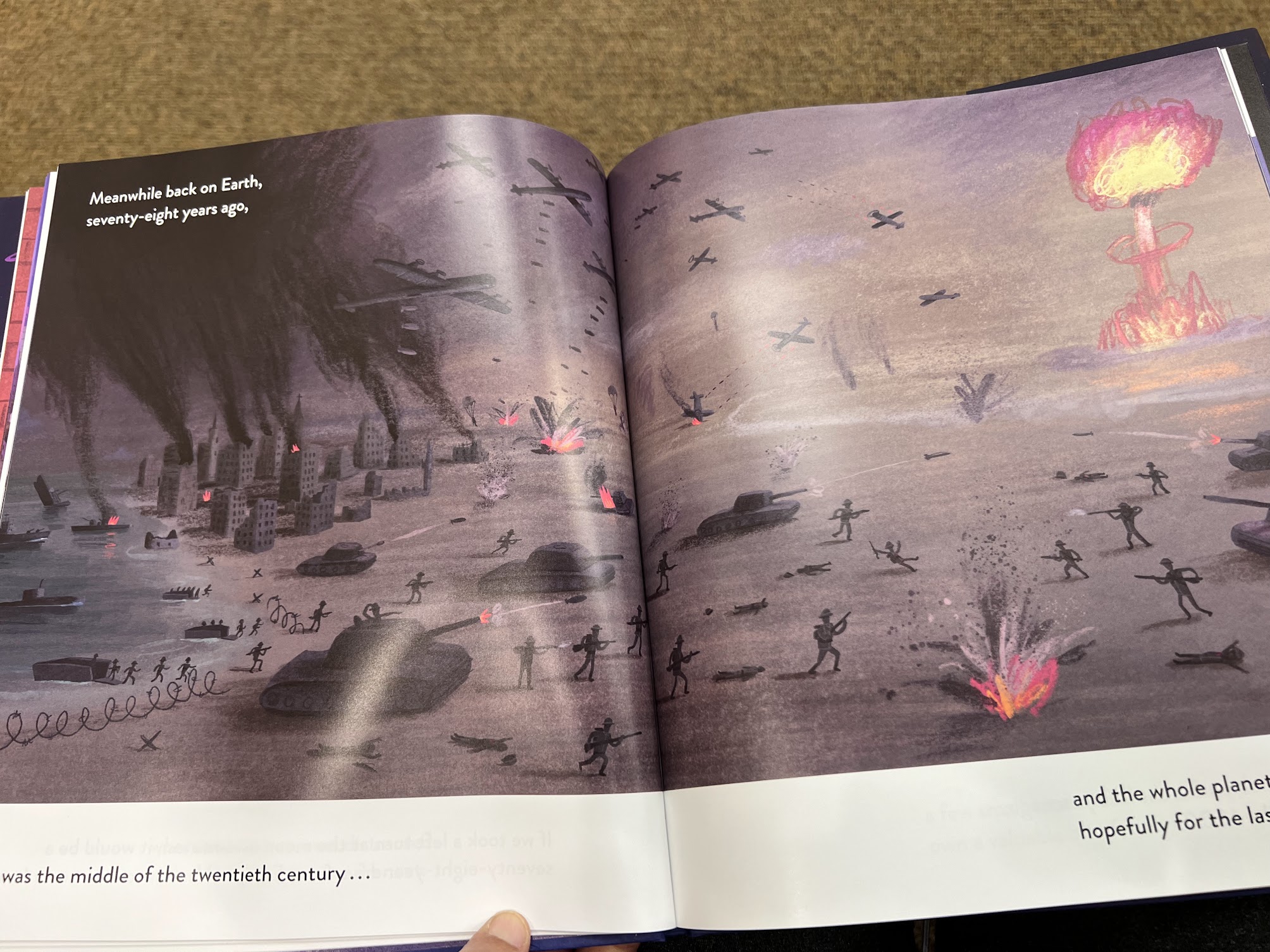
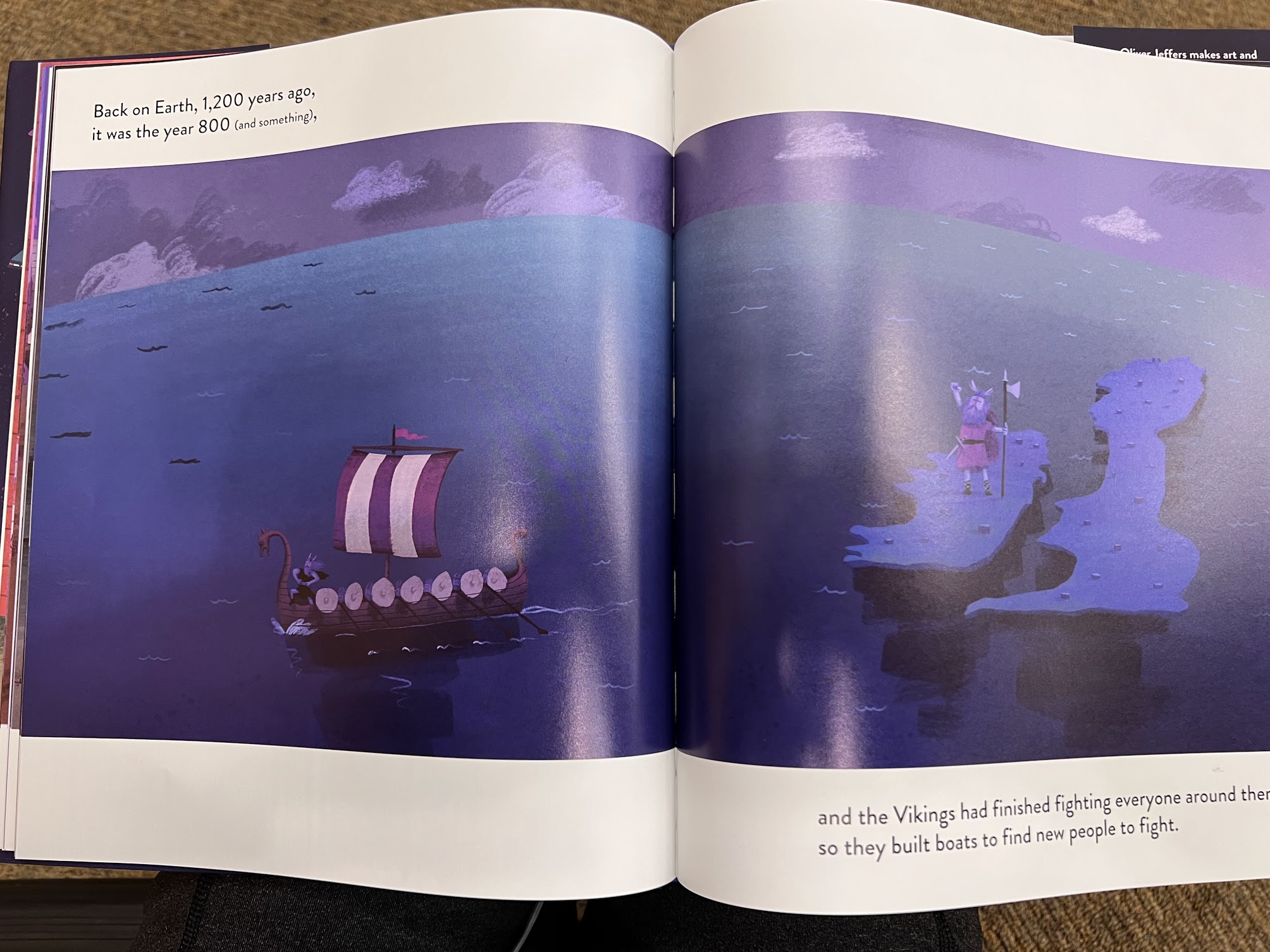
It also reminded me of the children’s book, Meanwhile Back on Earth . . .: Finding Our Place Through Time and Space

back_on_earth_cover

  • 1000 years ago – when there was a conflict between x and y
  • 500 years ago – war between rats and zebras
  • 100 years ago – war between everyone

The history of our planet in conflict. It makes for sobering reading, but along with Oliver Jeffers’ artwork, a required reading too.

back_on_earth_2back_on_earth

“Nice to see what all we did in spite of all the fighting huh?” , said the son, pointing to his project on Egypt, and pulling me back from my thoughts. He had written about the culture, ways of life and the many achievements of the ancient Egyptian civilization, and I nodded. We truly are a species worth studying. The sheer potential for good. The very qualities of good fanning our bad:  ambition for instance. 

How do we constantly remind ourselves that we are remarkable in our creative quests, and not use it for anything destructive? But don’t they go hand-in-hand? I peered at the dancing Nataraja statue in the home symbolizing just that, and felt very humble indeed. Nothing new. We are all just discovering and learning. Just figuring out how to belong on our Earth.