Mermish Dreamish

“Ohhhwwwnn! What do you want us to get you from the labally?”, the son’s voice wafts upstairs to his teenage sister. She cannot make it to the library and her little brother feels bad for her, like she has been denied candy on Halloween. 

“Anything on Mermaids dobucles! From the Teen section.” 

The son and I exchange knowing smiles. 

“Okay!” 

I watch amusedly as the half teen swells with self importance: Oh! The glory of being given the esteemed task of picking out books for his teenaged sister from the teen section. 

“Mermaids! Really? Again? Still?” I ask, and I get a “Yessss!” accompanied by an eye roll, that I cannot see but can imagine, in response as we head off. 

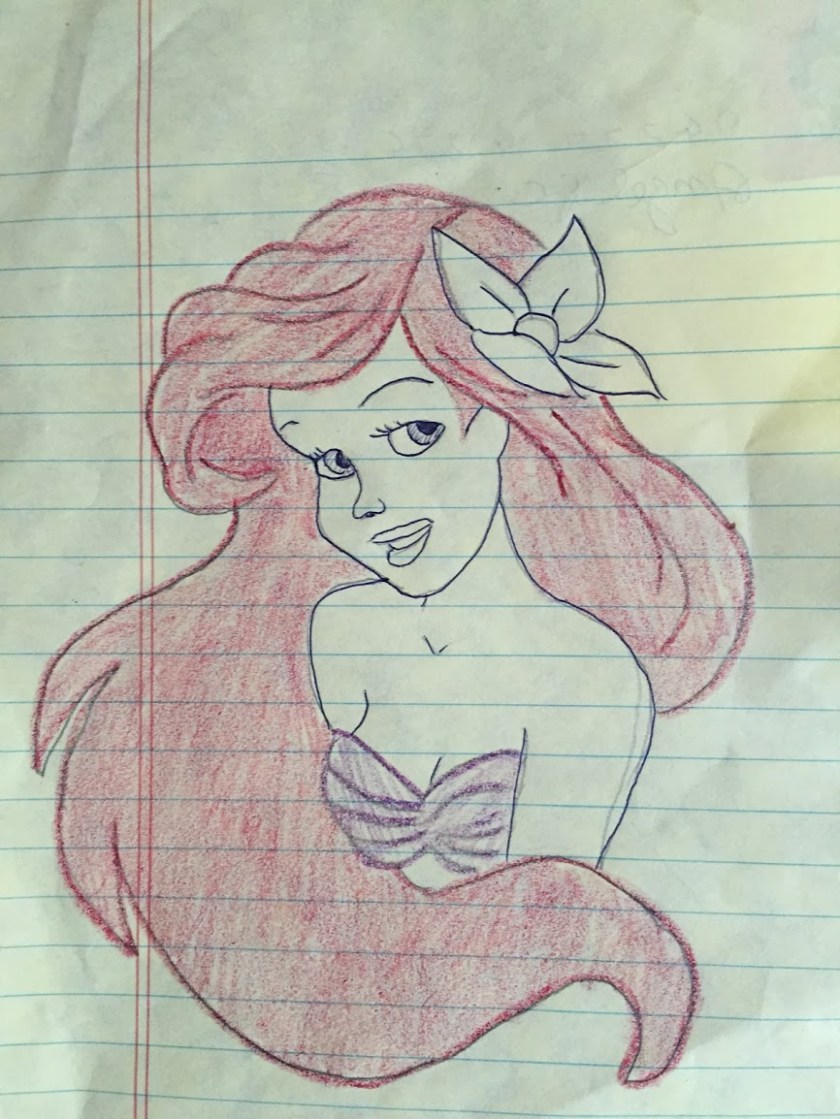
keena_mermaid_doodle
A random doodle by the daughter when she was knee-high

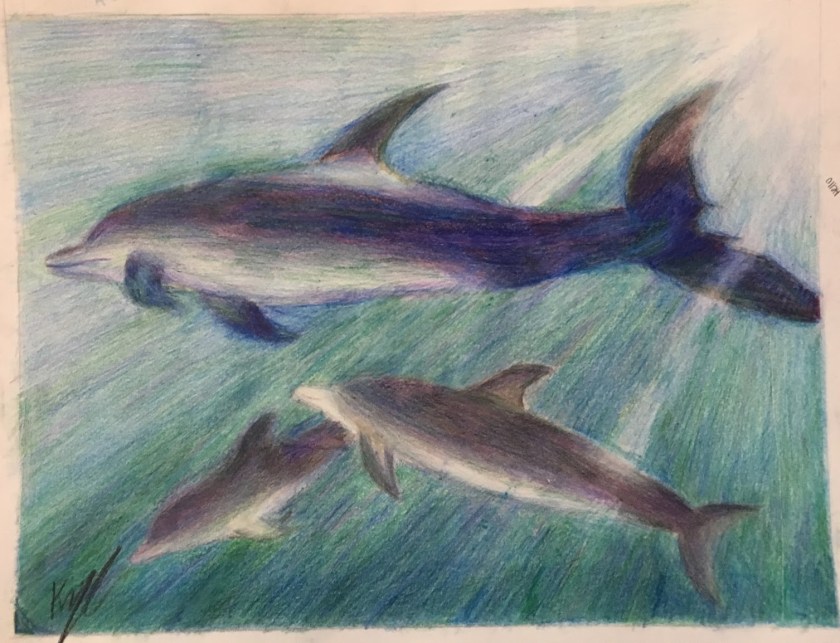
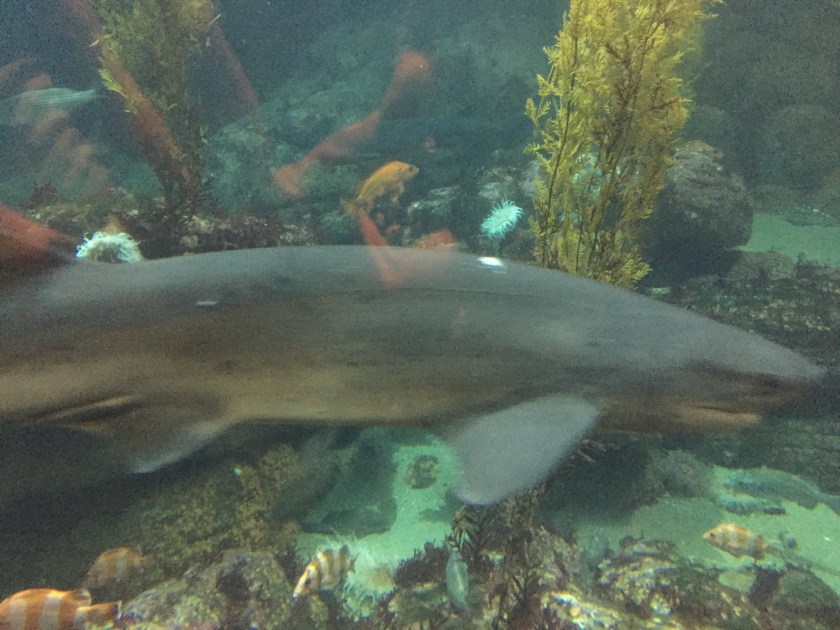
The oceans and seas enthrall her, they exert an influence on her like no other. And it started young. Thousands of viewings of Finding Nemo, hundreds of The Little Mermaid later, her first choice for drawing anything is still marine. 

Keena_drawing

I can hardly blame her, I find the oceans fascinating myself.
Gerald Durrell’s Enchanted World Essay
Carl Sagan’s Essay on his interactions with Elvar The Dolphin
Epic of Whalayana – Carl Sagan

I have been seeped in books on Whales of late. Ever since I read Carl Sagan’s beautiful notes on these gigantic, intelligent and curious creatures, I have become half mermaid myself. I see the allure that sets the daughter’s heart beating. Regular readers know that I have often described that child as one who should have been born a mermaid.

Nick Pyenson : Spying on Whales:

Astronomy and Paleontology are sibling fields really: they take human imagination to places where no person has ever been.

Some writers have the knack of saying the most profound things in passing. 

It is true isn’t it? The reason we gaze longingly at the night skies, charting out the constellations, having myths that surround them is the same reason we have stories of oceanic splendor. The reason we listen in awe about Noah’s Ark, Mastya avatar, Kurma avatar and myths of a milk churning ocean coughing up ambrosia for things that seemed nigh impossible like immortality is the same reason we imagine The Great Big Hunter going after the seven sisters. It is magnificent and unimaginable.  

“This must be something to do with the Sea. It has the word Tempest on it and there is a mermaid like thingy on the front. “, said the little fellow handing me the book he had picked out for his sister. 

“Should we get one or two more just in case?” 

We agreed and off we went looking for mermaid like ones, oceanic tales. I fell back upon Twenty Thousand Leagues Under The Sea by Jules Verne in case all else failed. That was the choice that earned me a loving “MOM!” look.

We needn’t have worried, the little fellow was given glowing tributes for selecting the best mermaid book, and we all settled down to read that evening. 

Taking a deep breath we dived deep into the rich oceans. 

I was trying my best to keep up with Nick Pyenson and his colleagues as they tried to find and relocate some of the largest whale fossils on record. More than 2 million whales had been lost to Whaling in the beginning of the 20th century, and only about 200,000 remained. What have we done? Another silent lament in my mind that will not have an answer. 

The son had a thoughtful crease after reading his book, A Symphony of Whales by Steve Schuch. I could well imagine his feeling. It is one of those books that in ten flips of the page leaves you wondering and marveling at so many things – the climatic conditions because of the geography of the story, the sounds of nature surrounding the little village, and the sounds of the living in the churning waters calling out to little Glashka who is a little girl blessed with the ability of hearing different frequency voices like the song of the whales stranded in the bay and iced in. Accompanied by illustrations that take you to the little Arctic village, this book was the perfect marine choice for the little fellow.


Little yawns appeared on our faces and we smiled sleepily. When we resurfaced from the waters, feeling refreshed after a cool dip in the oceans, we slept dreaming the dreams of the unimaginable. It was marvelous.

The sea is as near as we come to another world. – Ann Stevenson


Hero-Worship, Nicomacean Ethics & Baloney Detection Kits

I have heard friends rave about Dune by Frank Herbert many times over the past few years. I finally got to read the book, and I feel richer in mind and thought for it. The book was long and at times hard to keep track of (especially in the beginning). This is one of those times when I realize how my mind flutters with attention spans that drive calm butterflies to frenzy. But slowly, steadily, I settled into the book, and there were multiple moments when I felt like I must grab a pen and start writing (but that stern butterfly gave me a look, and kept me at my the task of reading). This, is probably the reason I have forgotten half the things I wanted to write about (This is where I glare back at the butterfly guardian who kept me reading)

Dune-Frank_Herbert_(1965)_First_edition
First Edition Cover – Image from Wikipedia

One of the many things that appealed to me in the Dune was the fact though there were vague references made to technology and the number of technological devices used by those living at the time, it is not a mainstay.

The book is a multi-layered piece of literature with over-arching themes of ecology, the art of war, religion, philosophy and politics. There is a particular quote that stuck with me in the Prologue written by Brian Herbert, Frank Herbert’s son, about the dangers of hero worship.

Quote:

As Liet Kynes lay dying in the desert, he remembered the long ago words of his own father: “No more terrible disaster could befall your people than for them to fall into the hands of a Hero.”

Having studied politics carefully, my father believed that heroes made mistakes…mistakes that were simplified by the number of people who followed such leaders slavishly.

In many ways, hero worship is what leads people to choose leaders who then turn into despots and dictators. Adulation affects everyone, and those with fragile egos are the most prone to its lure.

Towards the end of the book, Paul Atreides recognizes that he is being hailed as the Messiah and regardless of his acceptance of the title, there is a holy jihad in his future. He can either lead to the best of his abilities like his able and excellent father, Duke Leto or simply be the mascot of a movement that has already gathered momentum – a force that is much larger than him. This sort of trusting faith in one human being is never a good sign, and is a malady that has affected us for centuries. 

I quite agree with how Aristotle describes the nobility required of politicians: he opines that politicians should take an oath, almost as sacred as a Hippocratic oath, to remain fair and mete out justice. From the Nicomachean Ethics – By Aristotle. 

The lecture on Aristotle and Socrates on How Does One Live The Good Life? From 36 Books That Changed The World (Chapter 8) is an excellent listen.


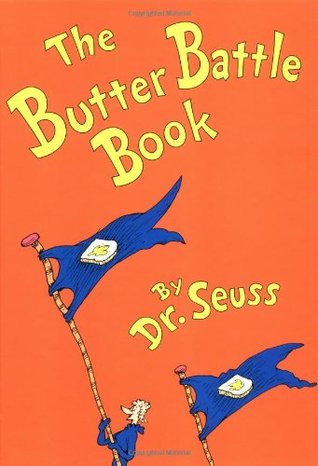
There are no initiation courses for politicians. No training. Though, I have a suggestion to have every politician complete the Butter Battle Course, it is unheeded. (The Butter Battle Course is an excellent course consisting of childrens’ books not more than a few pages each, and should only take a few moments of every leader’s time):

butter_battle

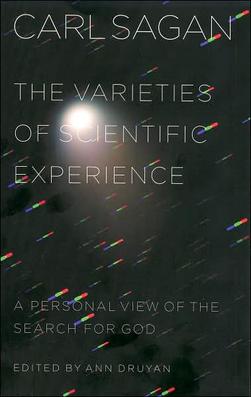
However, till politicians start taking their careers to truly be in service of humanity, we need to equip ourselves with Carl Sagan’s excellent Baloney Detection Kit from the book: The varieties of scientific experience : a personal view of the search for God / Carl Sagan ; edited by Ann Druyan. This book contains the Gifford lectures given by Carl Sagan in 1985.

The_Varieties_of_Scientific_Experience
By Source, Fair use, https://en.wikipedia.org/w/index.php?curid=28513011

When someone asked Carl Sagan after his lecture what we can do when the governments do not act in our best interests, he advised us to have Baloney Detection Kits handy.

Quote:

“I would say that the first thing to do is realize that governments, all governments, at least on occasion, lie. And some of them do it all the time – some of them do it only every second statement-but, by and large, governments distort the facts in order to remain in office.

And if we are ignorant of what the issues are and can’t even ask the critical questions, then we’re not going to make much of a difference. If we can understand the issues, if we can pose the right questions, if we can point out the contradictions, then we can make some progress. There are many other things that can done, but it seems to me that those two, the baloney detection kit and use of the democratic process where available are at least two things to consider.”

This seems to be age old wisdom: our oldest myths write about flaws in heroes, what brings about the downfall of the most powerful tyrants  etc; and yet, the reminder for our own Baloney Detection Kits is a timely one.

Books:

  • Dune – Frank Herbert
  • Varieties of Scientific Evidence  – Carl Sagan 
  • Nicomachean Ethics – Aristotle
  • 36 Books That Changed The World – Lectures on Great Courses
  • Butter Battle Book – Dr Seuss

Radiance of a Thousand Suns

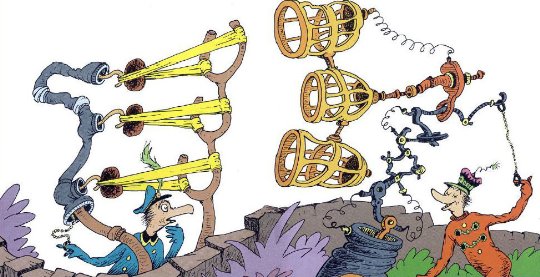
The children and I were reading the Butter Battle Book, by Dr Seuss again: A marvelous book that never fails to enlighten : the bigociously atrocious weapons we are capable of creating, how littlyfully small-minded we are when we come to self righteousness,  and the idiotic ends to our means. It makes me want to take our brains apart to see where bravado and ego reside and short circuit them, to see if it results in a fuzzy ice-cream show in the pupils. 

butter_battle


Written in 1984 this book is a simple parody of the nuclear arms race, and is chillingly relevant today.

The book is about Yooks and Zooks: The Yooks eat their bread with the butter side up, while the Zooks eat their bread with the butter side down. This leads to escalating differences and a long curvy wall is built between the two lands.

butter_battle_2

Soon, both sides start fighting by using weapons of increasing grandeur and magnitude starting from the Tough Tufted Prickly Snickle Berry Snitch to the Eight Nozzled Elephant Toted Boom Blitz. The book finishes with the Yooks and Zooks sitting on either side of a wall threatening to drop the Bitsy Big-Boy Boomeroo, signifying the nuclear threat.

Around the same time that Dr Seuss came out with this brilliant book for children, another one of my favorite writers delivered  a series of Gifford Lectures. Titled ‘The Varieties of Scientific Experience : A Personal View of the Search for God’ , Carl Sagan goes on to explain in one lecture how we fail to comprehend the true magnitude of the nuclear problem ahead of us. 

The_Varieties_of_Scientific_Experience
By Source, Fair use, https://en.wikipedia.org/w/index.php?curid=28513011

Quote:

The bombs that destroyed Hiroshima and Nagasaki – everybody’s read about them, we know something about what they did-killed some 1/4 million people … The planet Earth today has 55000 nuclear weapons, almost all of which are more powerful than the bombs that destroyed Hiroshima and Nagasaki and some of which are, each of them, a thousand times more powerful.* Some twenty to twenty-two thousand of these weapons are called strategic weapons, and they are poised for as rapid delivery as possible, essentially halfway across the world to someone else’s homeland.

*By 2006, the world nuclear arsenals had been reduced to about 20,000 weapons-still roughly ten times what would be necessary to destroy our global civilization. the principal reductions since 1985 were due to the 1993 Start II Treaty between the United States and Soviet Union.

“Twenty thousand strategic weapons in the world is a very large number. For example: lets ask how many cities there are on the planet Earth. If you define a city as having more than 100,000 people in it, there are 2,300 cities on the Earth. So the US and  Soviet Union could, if they wished, destroy every city on the Earth and have eighteen thousand strategic weapons left over to do something else with.

These lectures were delivered in 1985, the numbers have definitely been revised from thereon. A number of countries have also harnessed the power of nuclear weapons, even though there have been treaties and agreements to restrict its use. 

Robert Oppenheimer, credited as being the ‘father of the atomic bomb’, when he witnessed the test of the nuclear bomb over the desert in New Mexico was supposedly reminded of a text in the Bhagawad Gita.

If the radiance of a thousand suns
Were to burst at once into the sky
That would be like the splendour of the Mighty One…
I am become Death,
The shatterer of worlds.

With the rise of autocracy the world over, what would it take for us to save ourselves this time around? For all our brilliance in developing the bomb, we have yet to develop sound defenses against it.


The Epic of Whalayana

The mother has been reading The Ramayana. She is especially fond of the Sundarakandam. For a few months, any good is attributed to the Sundarakandam readings. Anything bad is soothed away with the assurance that her Sundarakandam chantings will make it better. It takes her several weeks to make it through a complete reading. The Ramayana is a long epic, and lilts rhythmically. Reading this epic soothes her, and every now and then with touching belief, she has a go at it.

I like the Ramayana too for its main storyline, and its myriad side stories. I do think Sita could have been a pluckier heroine, but then I remember that these tales were passed down from one generation to the next, each one, quite probably, embellishing the epics a little to make sure their ideal version of the woman is subtly inserted in there. (Another post for another day)

It is interesting to think of how our epics and ballads have helped shape human history. Artifacts and natural phenomena shaped our myths, and particularly gifted story-tellers were always a treasured people. We truly believed that story-telling was the single distinguishing feature of our species. After all, imagination is a task much higher on the cognitive scale than living & feeling. 

‘Did you know? We used to have a Professor who could chant every verse and explain it so beautifully? From memory! In those days, our professors used to remember Shakespeare, entire Sanskrit texts, and eloquently recite from memory. ‘ said the father, and waxed as eloquently about the good old days; his fervor growing as he spoke of the stellar nature of his professors, about how they learnt and memorized Shakespeare and the Sanskrit texts from their forefathers. 

I smiled at the pride in his voice when he thought of his long-dead professors. For millennia we thought we were the only ones capable of passing on this kind of generational wisdom and knowledge. But that is not the case. Take the enormously intelligent whales and dolphins for instance. Carl Sagan, the physicist, writes about these intelligent creatures often. In his essay on dolphin sounds, he writes of Elvar the Dolphin who knows up to 50 English sounds and can use them in context. 

IMG_7634.jpg

Quote from Cosmos by Carl Sagan:

Some whale sounds are called songs, but we are still ignorant of their true nature and meaning. They range over a broad band of frequencies, down to well below the lowest sound the human ear can detect. A typical whale song lasts for perhaps 15 minutes; the longest about an hour. Often it is repeated, identically beat for beat, measure for measure, note for note. 

Very often, the members of the group will sing the same song together. By some mutual consensus, some collaborative song-writing, the piece changes month by month, slowly and predictably. These vocalizations are complex. If the songs of the humpback whale are enunciated as a tonal language, the total information content, the number of bits of information in such songs, is some 10 to the power of 6 bits, about the same as the information content of the Iliad or the Odyssey.

I would love to hear and understand the generational wisdom that these large benevolent creatures have for living in the oceans. The ever changing oceans must be a rich source of material. Do they have heroes vs villains, good vs evil, or things much more complex and intriguing than simple story lines like that? 

wind-in-the-reef

Quote:

They have no manipulative organs, they make no engineering constructs, but they are social creatures. They hunt, swim, fish, browse, frolic, mate, play, run from predators. There may be a great deal to talk about.

If human beings have a fault, it is assuming our anthropomorphic abilities are the pinnacle of what is possible. I must remember that until recently, we did not know whale songs existed. 

The sea is as near as we come to another world. – Ann Stevenson

Coming up next: The Inner Life of Animals

Cosmic Nature of Living

We have several friends who are whiz-kids behind the lens, and rise before larks to photograph that first ray of sunlight through the crevice of the rock and so on. We are grateful to their creative labors, for the pictures show the artist behind the lens, and one needs only look at them to get an instant nature spa. We, on the other hand, forget to take cameras, or if we do, leave them behind in the car before getting out. Plans for sunrises are often derailed by the low trick the sun plays on us by beaming on us and waking us up with his rays before we beat him to it.

So, it is no doubt that armed with nothing but our cellphones, we had no method of capturing the brilliance of the Milky Way galaxy.

star_trails
Star Trails of the Milky Way Galaxy

Every time we have the luxury of traveling out of our urban areas swathed in artificial light, we try to step out at night to indulge in star gazing. The winter skies over Zion national park did not disappoint. The wisps of cloud that had floated in during the sunset to show us a more resplendent sunset had flitted away obligingly so that we may take in the iridescent brilliance of the Milky Way galaxy unobstructed.

A friend most kindly took a picture of the husband gazing up at the skies that had me yearning to see the sky like that.

milky_way_shree

Photographers will tell you something about shutter speed, and exposures and frames per second: Lark that always has me looking like a glazed doughnut at t+2 of the discourse. Therefore, I produce slightly alarming results that has physicists going back over their calculations to see how the focal length with the curvature and the light ray divided by exposure rate gave rise to the image that I seem to have obtained. (Just a moment: f/1.4 should blur that background, how did it blur the subject?)

I meander as usual. The point is: I thought we required post processing and superior photographic techniques like make-up on a set to be able to see that night sky. However that night at Zion national park, we had no need to resort to these advanced techniques to see the nebulous cloud of the Milky Way. The skies split open, and the stars poured their celestial brilliance upon us. If this was the show our ancestors enjoyed every night, it is no wonder that we have such wonderful myths and shapes in the ‘ever changing panorama of the skies’ (James Woodforde Parson).

As we looked up, we could not help wondering how the desert beauty in the canyons was so different from the beauty of the seaside and yet so unlike the snowy mountain plains. If this many vagaries of nature could exist on one planet, the mind boggles on what exists in the vast cosmos out there. We rarely stop to think of the skies in any color than the ones we are blessed with. It takes children to imagine that. I remember the childrens’ essays in first grade where they were asked to imagine another world, and their skies looked nothing like ours. They opened our minds to the possibility of having rust colored night skies, with swirling colorful gusts of wind and rainbow colored days. When asked to imagine extra terrestrial life, we are so limited by our imaginations that we seldom look beyond the slightly changed human form.

Yet on this very planet, we know that octopuses have a level of consciousness radically different from our own.

For a long time, we thought that being conscious was something unique to human-beings, then Jane Goodall paved the way for several scientists to study animals and not fear being accused of anthropomorphizing their subjects. Finally, in the 1970’s, Jennifer Mather’s work was acknowledged.  Quoted from The Soul of an Octopus by Sy Montgomery:

Once overlooked or dismissed outright, Jennifer’s work now is respected and cited by cognitive neuroscientists, neuroanatomists, and computational neuroscientists so that the Cambridge Declaration on Consciousness asserts that “humans are not unique in possessing the neurological substrates that generate consciousness”, and that “nonhuman animals, including all birds and mammals and many other creatures, including octopuses also possess these neurological substrates.”

Days filled with the daily business of living truly and fully demand our attentions so that we often forget the vibrant universe in which we float. The night view from our planet, ‘ a tiny mote of dust suspended in a sunbeam’ as Carl Sagan so elegantly put it, is the best cure for arrogance there exists. Instead of taking our place among the harmonious orchestra of the universe, if all our dictators are fighting over, is a small patch in this tiny speck on a remote planet, we must feel sorry indeed for ourselves.

Sailing The Solar Winds

“So, you are saying that we have no method of seeing the images on the CD now?”

“Not without a Windows machine. We have an external CD drive that we can mount, but if you do not have a Windows machine, you cannot install the software to load those particular images – yes.”

The husband looked sheepish. He is the tech enthusiast between the pair of us – a mellow one compared to some of our friends, I will grant him that. But I felt sorry for the fellow as he said we will not be able to install and retrieve the images on the disk. He is the one who feels elated when a new breakthrough happens that will disrupt storage as we know it, and all that lark.

I was holding a CD that contained some images that could be retrieved by the software also on the CD. I had been given the disc in 2017, and I was attempting to see the images in 2017. I could not. I live in a home spotted freely with software engineers. We trip over cables, hunt for laptops and so on.

I looked at the CD disc in my hand, and burst out laughing.

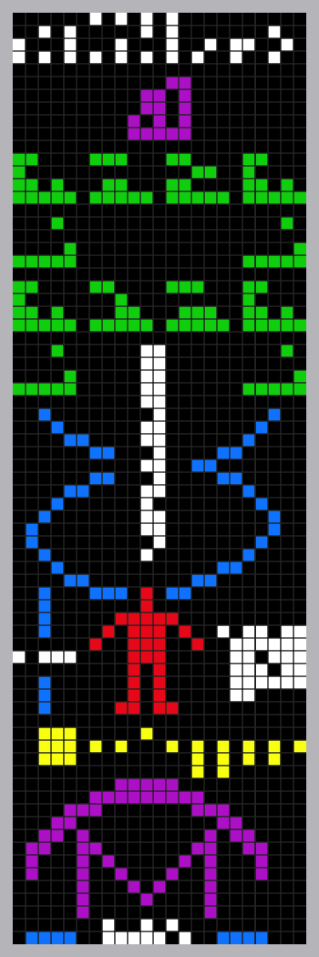
To think that we sent the Arecibo message to a star cluster some 25,000 light years away hoping that extra terrestrial life will receive and interpret it. Carl Sagan and an impressive set of folks came up with a message that showed humans, a double helix, numbers, elements and so much more. Read all about it here:

Arecibo Message

Arecibo_message.svg
Image attribution: By Arne Nordmann (norro) – Own drawing, 2005, CC BY-SA 3.0, https://commons.wikimedia.org/w/index.php?curid=365130

How confident we are that if intelligent beings do receive some radio messages, they will have the technology to extract it in the format we sent it to them in forty years ago. Just for fun, I’d like to see what would happen if that dratted message were to flop back onto Earth because of a series of mis-bumps along the way. We would first drive ourselves into a tizzy that beings of another planet reached out to us, and then I am not sure we would be able extract our own message.

I was reading an article recently about human beings sending a probe to our nearest galactic neighbor, Alpha Centauri.

$100-Million Plan Will Send Probes to the Nearest Star

The article talks about using “light sails” to ride those beams to other stars. I quote:

Although they have no mass, the photons in a sunbeam do carry momentum. In sufficient numbers they can push objects around in the vacuum of space. Bounce enough photons off a large reflective spacecraft and light alone can continuously accelerate it without the need for any onboard fuel, much like a sailboat catching a ride on the wind. Such spacecraft are called “solar sails.” This elegant idea goes back more than 400 years, to the German astronomer Johannes Kepler, who noted that a wind seemed to blow comet tails away from the sun, and that it might someday be harnessed to push a celestial vessel through the “heavenly air.”

The explanation makes my head swim somewhat. They plan to send the probe that will zoom past Alpha Centauri in 20 years time, and hope to see images of an earth-like planet orbiting the star.

But hopefully we catch something worth catching, since as Stephen Hawking so elegantly put it:

Stephen Hawking explained his support for the project as less about science and more about survival. “Earth is a wonderful place, but it might not last forever,” Hawking says. “Sooner or later, we must look to the stars. Breakthrough Starshot is a very exciting first step on that journey.”

Now what took me on this interstellar, intergalactic quest you ask me. This is where you see me scratching my head, looking goofy, and mumbling something about googling on how to see images in a CD that I hold in my hand.

cd

Swimming With Dolphins

The daughter and I were lazing around one night a few months ago: she, reading me snippets from her Harry Potter book and gushing about Patronus charms, and self, reading out snippets from mine, The Cosmic Connection By Carl Sagan.

I was reading the fascinating piece on Elvar the Dolphin. The daughter’s favorite animal is a Dolphin. She has drawings of mermaids with Dolphins everywhere. The sea fascinates her in ways that amuse us. Dolphins, mermaids and narwhals enchant her mind, and her endeavor is to become one if possible.

So, obviously, I read the whole piece out to her.

wind-in-the-reef.jpgElvar had the brilliant scientist stumped after a brief interaction. Elvar-the-dolphin and Sagan-the-human, on being introduced, started playing a game initiated by Elvar wherein he swam to Sagan, and thumped his tail completely drenching Sagan. When after the fourth splashing, Sagan refused, the dolphin swam up to him and said ‘More’. Completely flustered with this turn of events, Carl Sagan ran to his fellow neuroscientist friend and said he might have heard the Dolphin say the word, ‘More’. To which the neuroscientist said that Elvar the Dolphin knew upto 50 words in English, and could use them in context.

It is of interest to note that while some dolphins are reported to have learned English — up to fifty words used in correct context — no human being has been reported to have learned dolphinese. – Carl Sagan

A marvelous essay that only serves to remind us about the virtues of humility. We can barely understand other languages that fellow humans speak, and are quick to erect barriers between ourselves, but here was a dolphin willing to pick up English in order to engage with human-beings.

“You know Amma? Dolphins are so lovely right?”

I nodded. I did love the little flubberty gibbets.

“I think I know what my patronus is – My patronus must be a dolphin. I love them amma. They are so magical and real too.”, she said her eyes gaining that dreamy quality that often accompanies magic.

So, imagine how we felt when on our recent vacation to Mexico, the husband had booked a ride with Dolphins.

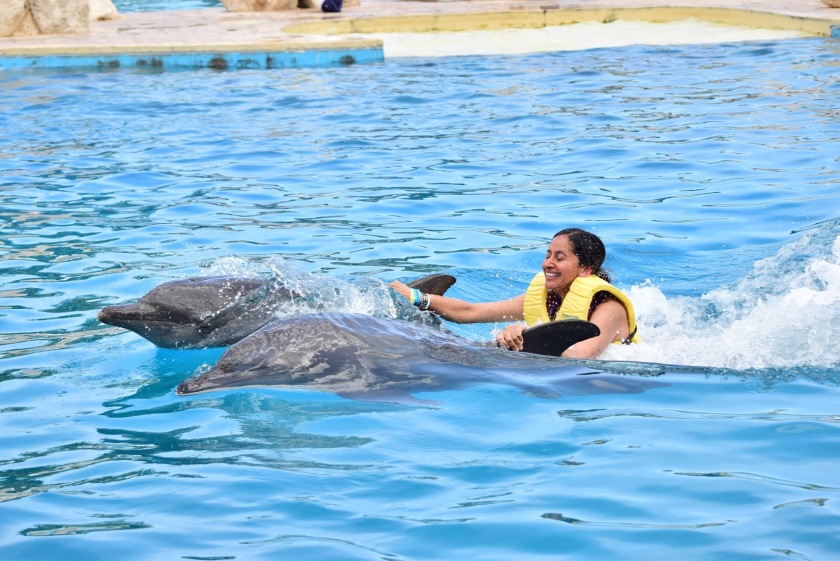
We were first introduced to a pair of dolphins – a charming male and female, called Manta and Sole. We hugged, patted and kissed them. I have never in my life touched something that soft, warm, and plush pulsing with the robust health of life. I coo-ed with that tone of voice I use around babies, and the daughter tried her best to distance herself from me in embarrassment, unlike the dolphins, who seemed to enjoy the attention.

‘Would you like to ride with them?’, asked the instructor, and I got to tell you that I was apprehensive. I mean – weigh the facts. Dolphins can swim at the stupendous rate of 20 miles per hour. I swim, if you can call it that, at the rate of 2 strokes a minute, stopping to gulp water in between, spluttering a bit, gasping, coughing and rasping, then regaining my breath before taking another deep gulp to sustain myself for 2 strokes.

Would a Dolphin for the first time experience condescension? I had to find out.

It took me what felt like 20 minutes to swim a couple of hundred meters out to where the dolphins could meet me. I huffed and puffed, and flawlessly executed the gulped-water, sputter and choke routine before I felt able to say I was ready. The moment I nodded, she gave them the signal.

In under a second, I felt the dolphins streak toward me under water, and they were there wiggling their fins under my arm and assuring me in their playful way that all was well. Their faces looked like they were smiling which I suppose is a gift they are born with. Their demeanor indicated none of that condescension or judgment that I was dreading, but simply an amused curiosity.

In another second or two, they had deposited me on the shallow end. The pictures reveal an ecstatic look on our faces as we were carried gently ashore by the dear creatures. My heart was bursting with joy. Maybe my patronus changed to a Dolphin too.

dolphin_swim

If we truly were smarter than Dolphins, we would be totally giving you the works in Dolphinese. What I can do is to dance like they did for us.

I only hope their interaction with us was a happy one too. Boink – Thank-You in Dolphinese.

Cybotic Leaders or Alien Invasions?

I am reading a book called Mind, Life and The Universe: Conversations With Great Scientists Of Our Time. It is a compilation of interviews with scientists. It is fascinating reading. Holding one book letting one know so many areas in which one knows nothing is nothing but humbling.

One interview is with Jane Goodall. She says that what struck her as horrifying while studying chimpanzees was the fact that they could identify with a clan and go on to attack, maim or kill fellow chimpanzees belonging to a different clan. Similar to what human beings do to each other. Somewhere along the evolutionary cycle, our genes seem to have mutated thus – to identify race and religion and any number of extra associations and look down upon others.

Carl Sagan, in his book, The Cosmic Connection, writes about how if an alien civilization were observing us now, they would think that what we value most is violence. For that is what is available as entertainment and that is what being streamed into our homes everyday, and what our children engage in, in the form of video games.

(https://nourishncherish.wordpress.com/2015/10/09/the-wind-in-the-reefs/)

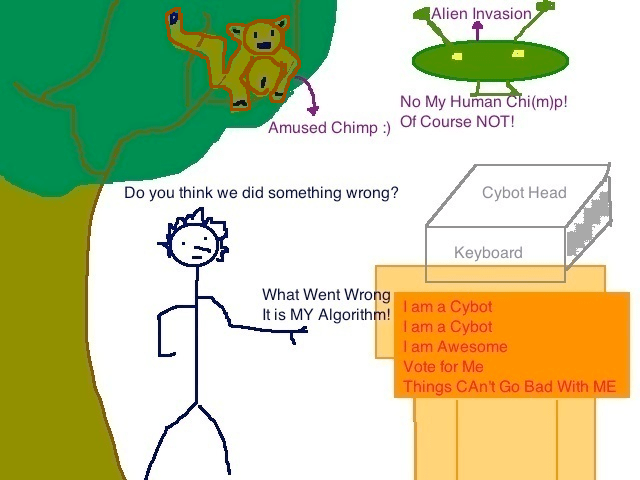
Last week, we did not need aliens to observe and see what is taught to us. A twitter bot, Tay, written by humans was let loose in the internet to learn and respond like a real user (The future is not far when a good cybot becomes the President of a country). Within 24 hours, we had turned Tay into a racist, misogynist, abuse-spewing user. Who can blame Tay for learning to be a racist jerk in one day? If that is what we are teaching twitter bots, could it be what we are teaching our children in a slower, sturdier manner?

I quote from article below:
http://www.cnbc.com/2016/03/30/tay-microsofts-ai-program-is-back-online.html

“Unfortunately, in the first 24 hours of coming online, a coordinated attack by a subset of people exploited a vulnerability in Tay,” Lee explained. “As a result, Tay tweeted wildly inappropriate and reprehensible words and images.”

How do we teach an algorithm empathy? As Jane Goodall said, “Only when our clever brain and our human heart work together in harmony can we achieve our true potential.”

https://www.brainpickings.org/2014/09/30/jane-goodall-empathy/

I remember a P.G. Wodehouse book, Right Ho Jeeves, in which Jeeves (that all-knowing butler who saves his young, idiotic, but thoroughly good-natured master, Bertie Wooster many times over) says, that the best way to unite warring factions is to introduce a common enemy.

chimp

It looks like an alien invasion might save us from ourselves. If those aliens are only 0.1% percent more evolved than us, we can be their chimps.