Froide a Paris avec Gezellig

The husband planned a meticulous trip to 3 different countries in Europe for the nourish—n-cherish household. Left with all the rest of the work, I stood in front of my bookshelf dilly-dallying on the reading material. Finally, I chose Bill Bryson’s Neither Here Nor There: Travels in Europe, which was an excellent read.

Neither here nor there: Travels in Europe by [Bill Bryson]

Bill Bryson started off his travels with catching the Northern lights in Norway. We chose France. But believe me, by the time we landed and made our way to the Airbnb , I felt like I was at the North Pole. The high temperatures of the day were 32F or OC. One night while standing by the Seine river watching the Eiffel Tower from a distance, I was so cold, I may have seen the aurora borealis over Jupiter. The daughter’s eyelashes froze, the son with no extra fat reserves froze too. The Seine miraculously flowed on.

Luckily, T’was the most wonderful time of the year!

This feels the time when overuse of the word , “T’was” is a requirement. Europe in Christmas time is a joy. The store fronts in tourist locations have marvelous decorations put up for Christmas and we couldn’t stop admiring the many ways in which people think to spread cheer. It was irresistible to stop and take a few pictures, very well knowing that I may never look at them again.

xmas_decor

Cities in Europe have a charm to Christmas time that is hard to capture. There is music in the air, there are musicians in subway stations, lights strung up everywhere in artistic and beautiful garlands like little bubbles of joy through the cold winter scene outside. Finally, there is a purposeful stride to people as they walk swiftly in their heavy coats looking sprightly, even though we seemed to feel lumberous with all the layers of thermal wear.

Our warm flight attendant on the KLM flight told us that the Dutch have a word similar to Hygge for this particular feeling:

It is called Gezellig.

She said the word was not easily translated, as it encompasses all warm feelings associated with the yuletide spirit (but is not restricted to Christmas or winter imagery) – just read the link above, will ya?

Every now and then, we would encounter a quiet fascinating residential street with plenty of trees. On one such charming street that windy day, the last few leaves from the trees above floated down and I went chasing after them in glee. No surer way to lift one’s spirits or body temperatures in my books!

The ones who impressed us the most though , were the relentless joggers of Paris. In case, any of you missed the gist thus far – Paris – beautiful but biting cold in winter. Yet, here they were, zipping through the streets in shorts and light jackets. I ain’t going to lie : that takes a special sort of determination and dedication and I would’ve taken my hat off to them if I didn’t think my brain would freeze.

Walking past a little pond that had frozen over, we stopped to watch the ducks standing on the frozen waters. Had their other duck friends flown onto warmer climes in Africa or Argentina, while these poor ducks were stuck here? I thought of that passage by Bill Bryson on his winter trip to Oslo to see the aurora borealis: I suppose this was one of those times when I truly felt grateful to be a visitor and not have to live there. I could already feel my feet freeze through the thick boots, and woollen socks, and couldn’t wait to get back to the room to take a warm shower. How were these poor birds standing on frozen water without socks, coats or caps? Yet, they seemed peaceful enough. They did not seem to be anticipating the World Cup Football Finals match later that evening, they did not seem to think anything of the rain forecast later that night.

frozen_ducks

“Are you coming or not? Freezing here – let’s get to a warm restaurant for the match!” , said the husband and I hurried along tucking away my little interlude with the ducks of France. It was time to cheer with the people of France for the football World Cup. France Vs Argentina.

After the freezing days of Paris, as we were bundling ourselves up in layers (yet again) for our small foray to find food, I said somewhat severely to the husband. “I think I’ve had enough of European vacations. Next time, we explore other places – Africa, South America, Australia: so many continents to explore! After a few museums, a half a dozen cathedrals, and a few hundred pieces of art, I am done.”

The husband smiled one of his crafty smiles and agreed, for he knew that I will be the one craving a European vacation first. He just had to sit by, observe, and make bets with the children on the timing. Much like watching a football game.

The Artists at Paris

The husband planned a meticulous trip to Europe for the nourish-n-cherish household. Trips to Europe are rarely complete without museums and so, off we went with our admiring hats on. I do not know the different periods in European art, and after several trips find that I am astounded by how much there is to learn and appreciate.

I do not know why Claude Monet spent 30 years in his garden in France painting the lily pond. I am even less capable of recognizing a Monet from a Chagall. But I am glad that Monet’s masterpiece with the lily ponds in his estate in France have a home designed specifically to appreciate the art like he intended it to be (The Orangerie Museum: Musée de l’Orangerie). How many artists get to have that particular claim to fame?

lily_pond

After the Louvre, the Orangerie museum was a treat. The Orangerie museum was a beautiful little museum tucked away near the most historically magnificent palace grounds in Paris. (Fun fact: apparently,  the word orangery refers to a protected ground in large palaces in Europe :   a greenhouse for growing oranges, lemons and other citrus fruits in cool climates.)

IMG_1701

We each went our ways and did not have to worry about getting lost. It was a small, compact museum with works of a few artists, and it was all very done. Really – the way Europe reveres its artists and preserves its art history is admirable. In about 3 hours, we were done and ready to explore the rest of Paris by foot. As we walked on, we fell to discussing Art – the Renaissance, the rise of cubism, and all the rest of it. 

How some artists chose lighter subjects such as Auguste Renoir in these paintings of the girls bonding over music, or whispering a secret together.

Or the beautiful nature filled works of Sam Szafran where the human is but a tiny part of the intricate patterns of nature

IMG_1730-COLLAGE

As we trundled away from the Orangerie museum towards the Eiffel Tower in Paris, it was irresistible to stop and take a few pictures, very well knowing that I may never look at them again.

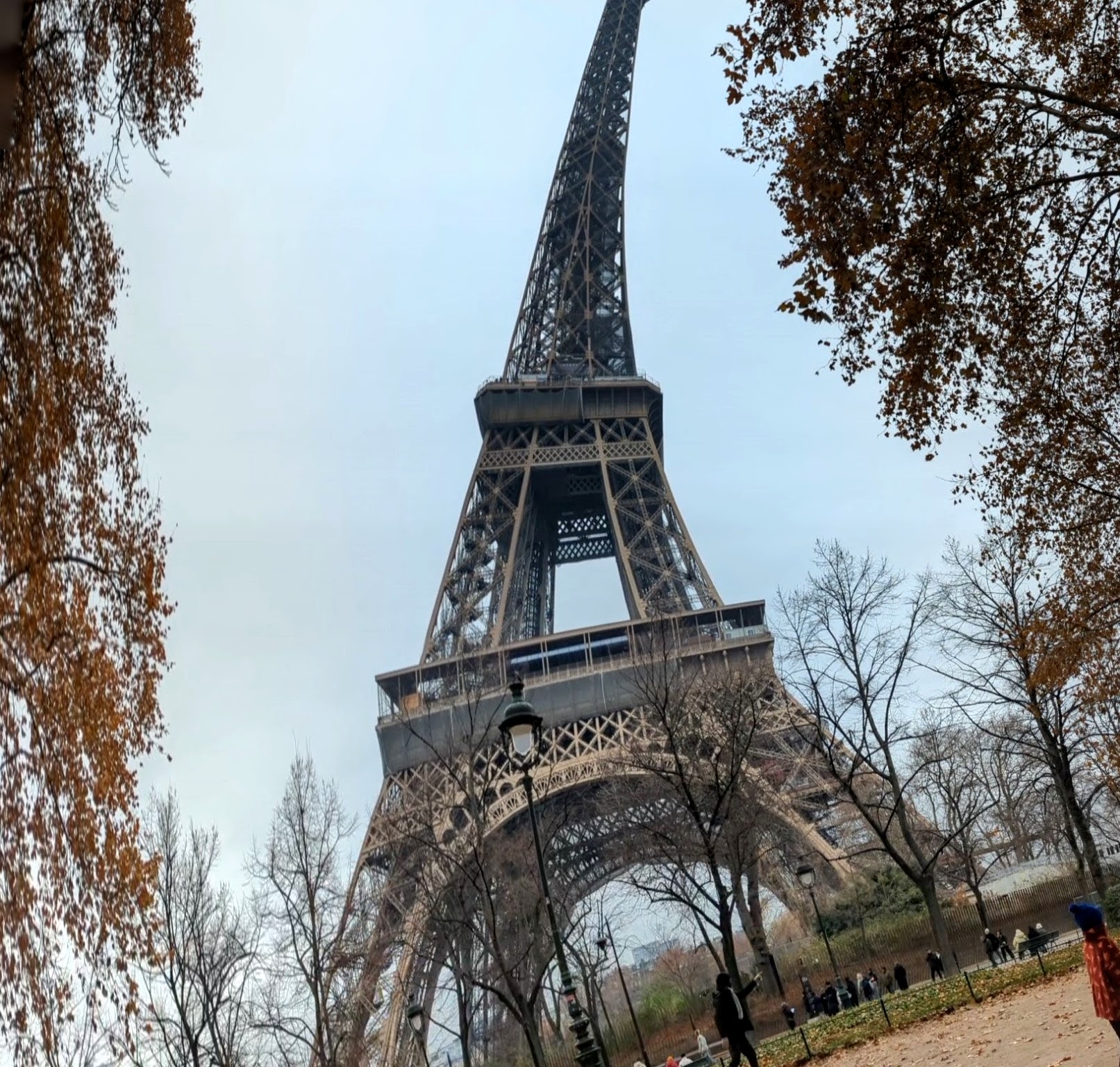
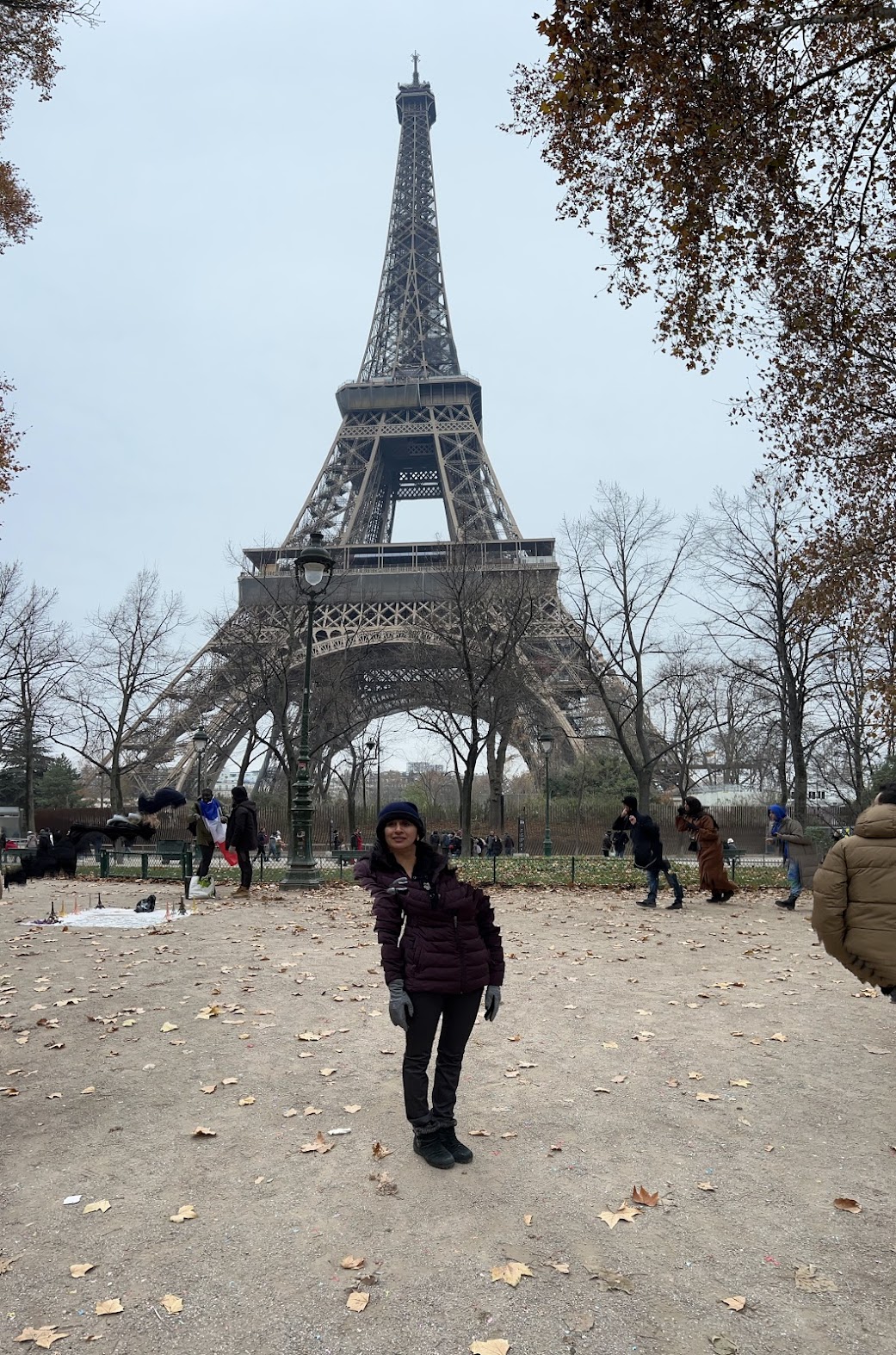
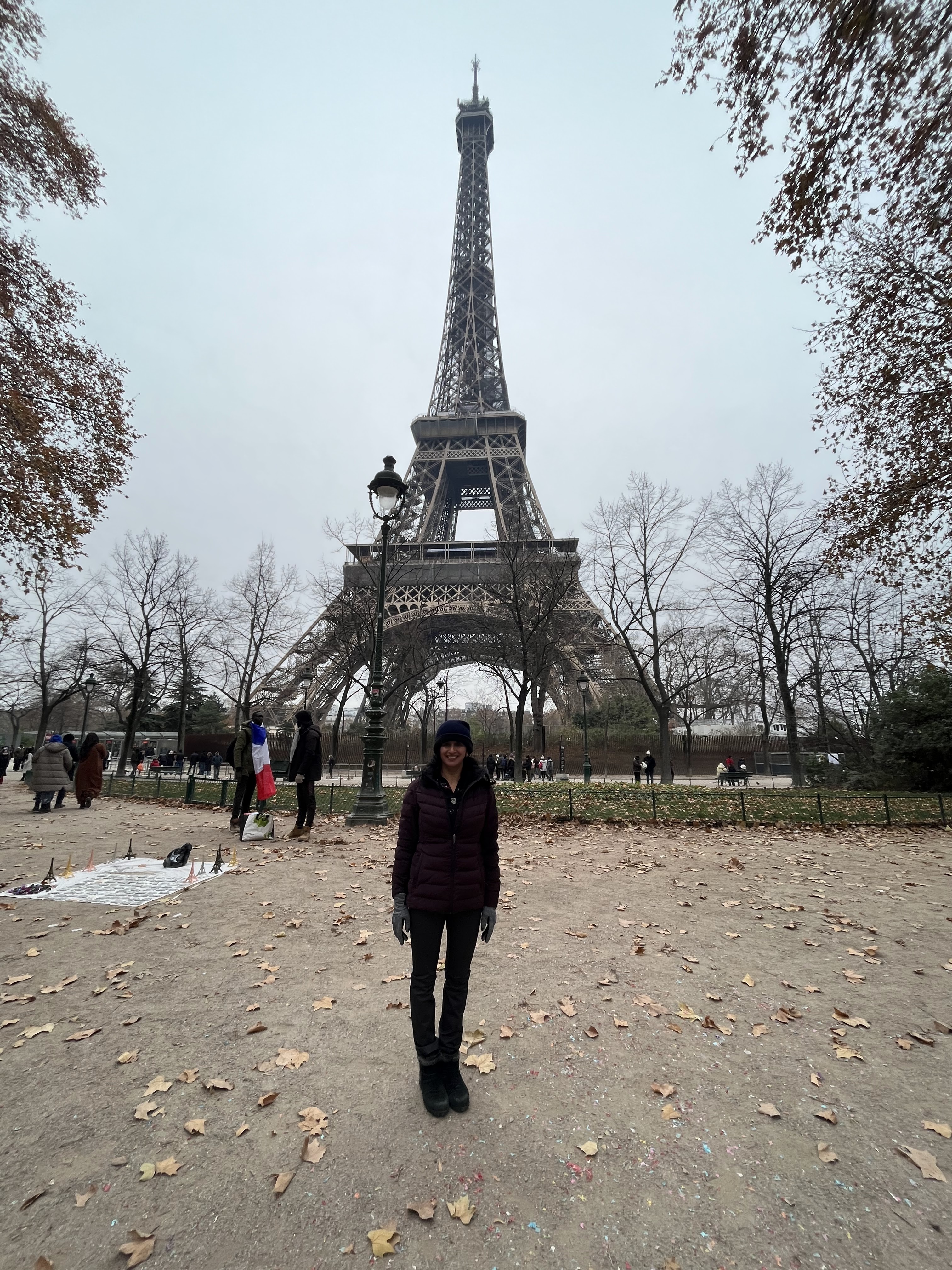
We ended up in due course, after our glacial progress through the streets of Paris, at the foothills of the Eiffel Tower. It was there that the many perspectives of Art we’d just learned about became apparent. The son tried taking pictures using the vertical panorama technique that I had shown him.

eiffel-1

He showed us cubism.

eiffel_cubism

We even have a picture of me pulling off the invisibility cloak after apparating to the foot of the Eiffel Tower. I wonder why these art forms do not deserve their place in museums of modern art.

eiffel-invisbility

How better for our artists to capture the true magic of a European vacation?

Temple of the Mind?

We’d been on a short trip to catch some European magic. We started off in Paris. In order for us to experience a proper European winter, the 1st day in Paris started off with a brisk walk to the Louvre at 8 in the morning when the temperature was still 24F. As we stood there, waiting for the rest of the tour group to join us on the marvelous walking tour through the Louvre, I felt a sudden stab of pity for all those who had lived before our times. 100 BC, 500 AD, 1500 AD, 1700 AD. None of these poor folks had indoor heaters that hummed and thrummed the way the museum indoors sounded welcoming. They didn’t have access to 32°Heat products that were brilliantly designed thermal wear designs – nor were they commonly available after mass production. With three layers of clothing, if it was still this cold, how on this marvelous Earth a mere 100 hundred years ago had people endured this time of the year? The thousands who died in the cold winters in the trenches, on the war fronts, in concentration camps. I shuddered and this time not from the cold. 

As I stood there, thinking of the little history I did know, I wondered why we never learnt from them. Why did we not recoil from war, sense divisive forces and squash them? Maybe this humanity’s path – bring ourselves to the brink of annihilation with our madness multiple times over and then miraculously survive till the one time when we don’t. Who knew? Wars and enmity don’t seem to end. 

Mercifully, our rag-tag tour group assembled after about 1/2 an hour that felt like 2. We walked into the Louvre like frozen zombies hoping to thaw out with the artworks inside. How did that sculptor bring himself to work on the marble statue of Venus dated 120 BC through these cold winters?

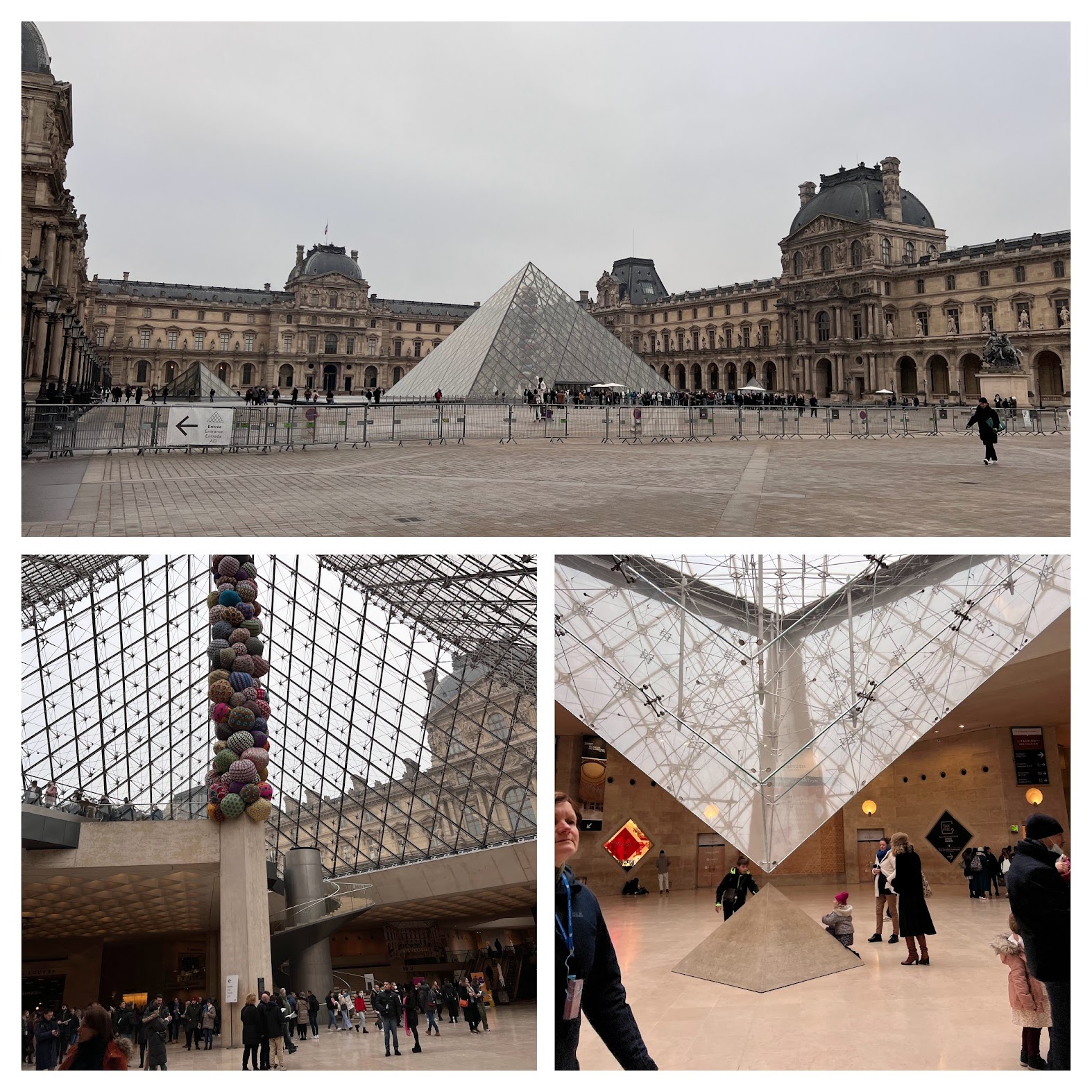
We started off at the famous prism inside where those who read or watched the Da Vinci code. It was beautiful and really, who thought of putting up bean-bags on that pole of the prism? It started the tour of with touch of a whimsy before the academic aspects of the museum unleashed itself.

IMG_1430-COLLAGE

If I were to describe the Louvre and the Vatican in one stroke of a brush, it would be: Too many artworks to properly appreciate each one.

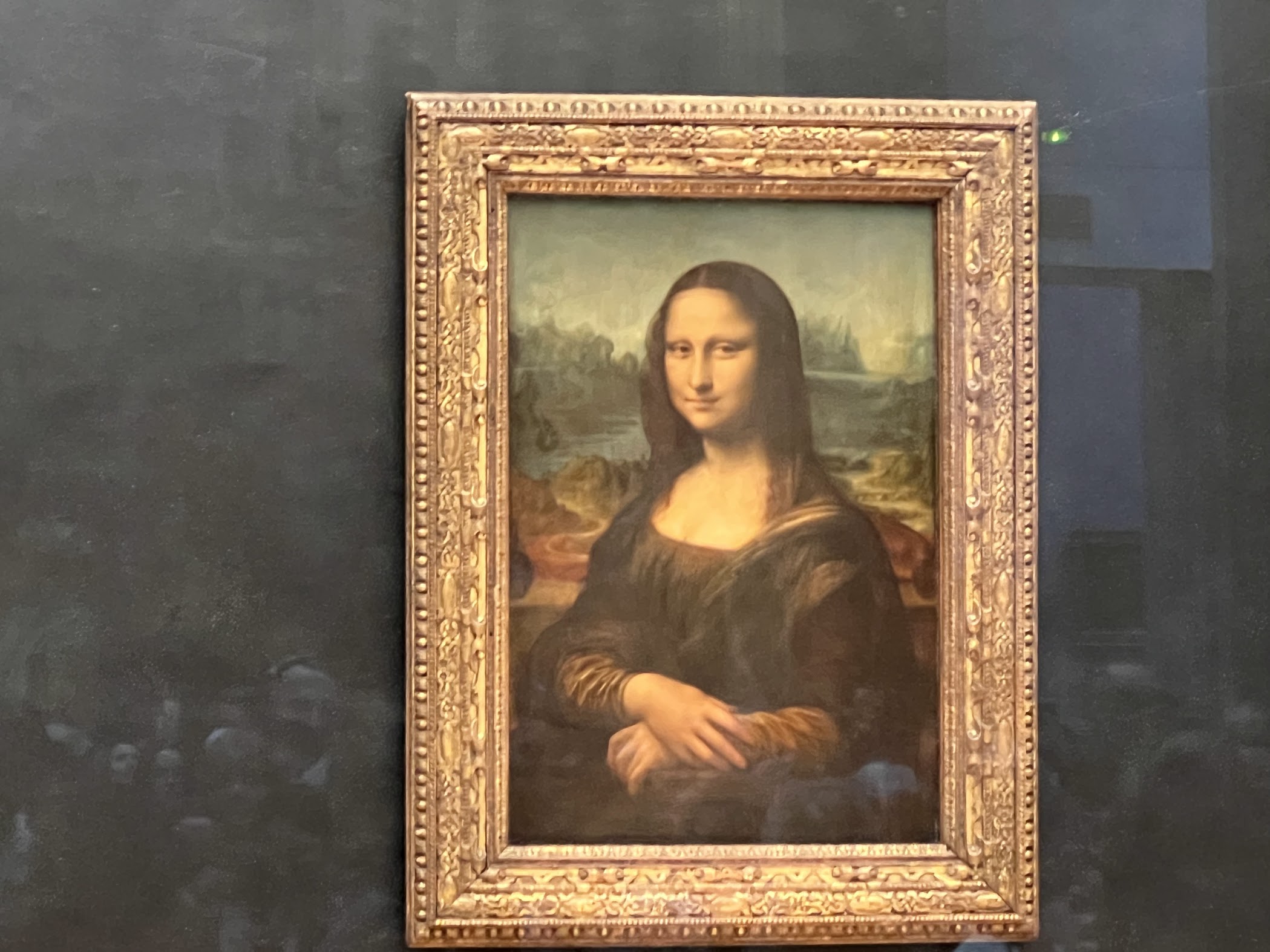
Though, our tour guide, Maria, tried her best. There were 38,000 pieces of art in there. The Vatican (70,000 of which 20,000 are on display). With all the hundreds of artists at the time, why did only a few achieve lasting fame? Maria explained many things about art that we ought to have known, but didn’t. Things such as  the angle of the light, the imaginative aspects of landscape, the differences in perspective, the kind of face that seemed to have appealed to Leonardo Da Vinci

monalisa

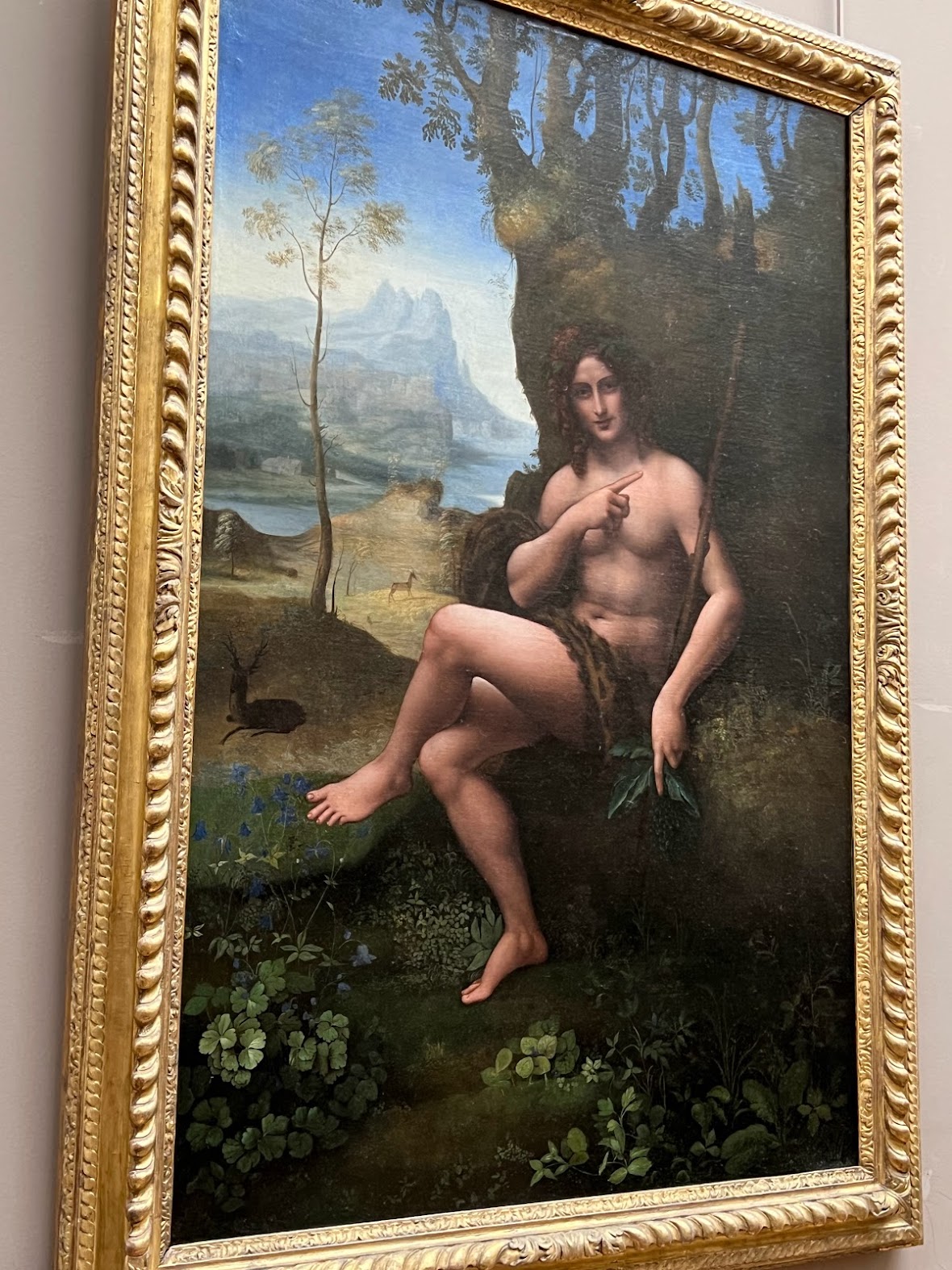
Did that famous, but thoroughly over-rated face of Mona Lisa have a glint of Leonardo Da Vinci’s favorite student? (shown below?)

IMG_1469

I keep clicking pictures of the pieces that appealed to me as she gave us salient features. I remember standing in the museum and thinking that I must not let art escape me in the daily humdrum of life. Corporate life, especially, had no time baked in to appreciate the finer aspects of life such as literature, art & music the way schools do. So, how do we make an appreciation of art a daily ritual, so there is always a little of the artistic in us? Oh! So many lofty thoughts. If Leonardo Da Vinci were witness to my thoughts that morning, he might’ve taken me on as a student, grandly overlooking my lack of talent, just for the touching sincerity.

But a mere 48 hours later as I write this, I am distressed to say that I cannot remember why I took half of the pictures I did. 

There was something about a picture of the maternal (Maria said Leonardo Da Vinci did not have a mother or someone who set a maternal example in his life, and thus the picture was doubly important). And something appealed to me. But what? 

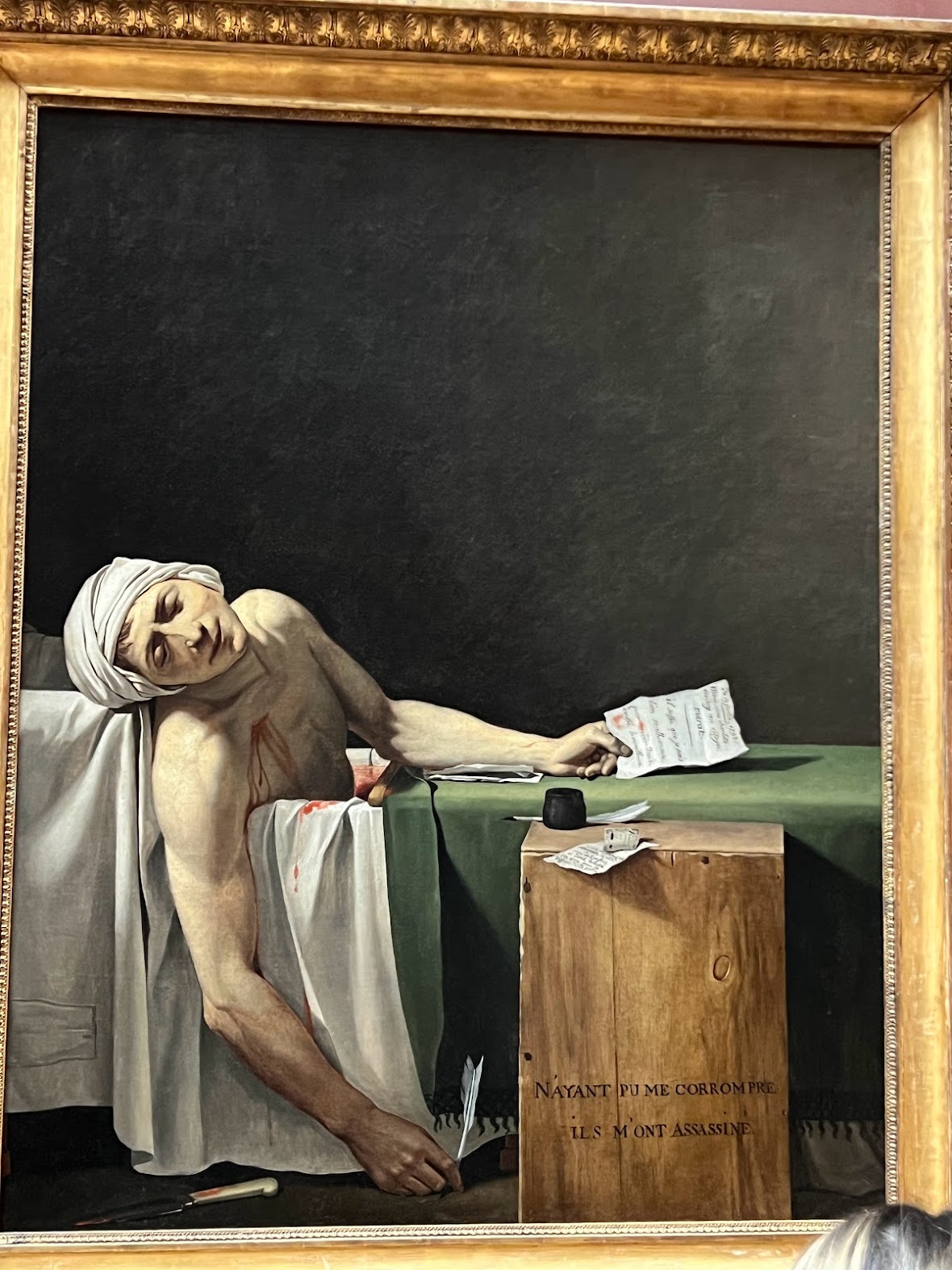
This one appealed to me as a writer. The early journalist who felt he had to say his truth and was murdered for it.

journalist

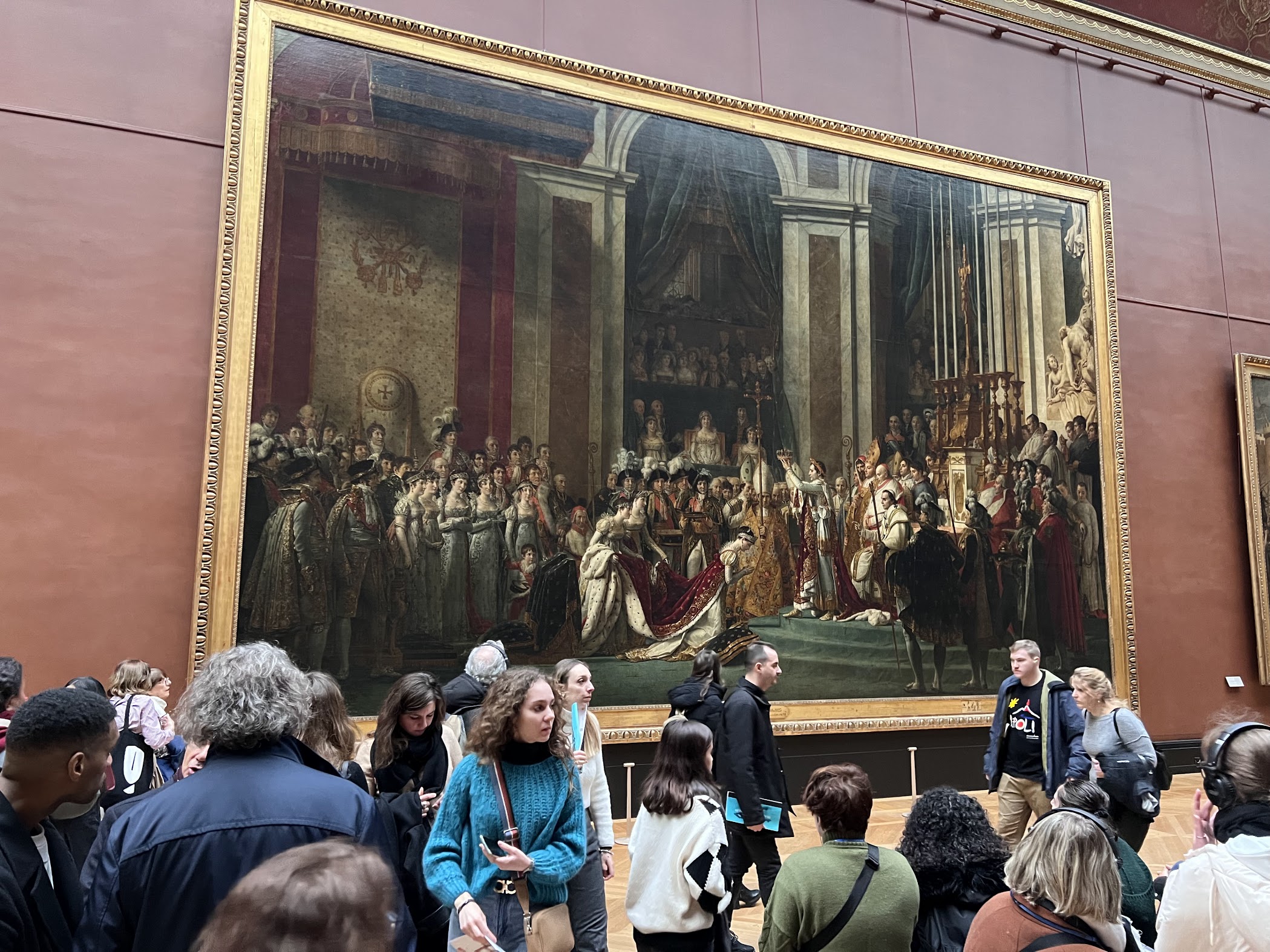
Or the coronation of Napoleon. Here was promise that megalomaniacs existed, continue to exist, and will continue to wreak havoc. In the absence of social media, this was Napolean’s attempt at portraying the coronation to the masses like he wanted – the truth be damned. Hundreds journeyed to the Louvre to get a glimpse of Napoleon and his bride, at the coronation. Apparently, Napolean’s mother did not accept his choice of bride and refused to attend the ceremonies as a result (there is a nice piece of continuity through the ages), but she is there in the painting. The Pope was invited and snubbed, but he looks happy behind the king. Maria pointed out many such discrepancies which I am afraid have evaporated since. Those art aficionados who do know the details have obviously written them out in detail in hundreds of books, blogs and YouTube videos for souls like myself.

coronation

And those statues of Venus – already promising womankind with all sorts of torment thanks to the impossible standards of beauty (the tall vertebrae, the perfect ratios between head, legs and girth, that seldom seem to bless breathing and living souls as we live out our lives on Earth.) Did the lovers of the sculptors of Venus feel the pressure, or were simply not bothered about the grandiose perfectionism as they had to tend to the business of living?

Venus de Milo on display at the Louvre

So many inspirational, marvelous wisps floated in at the Louvre. Maybe that is the vibe of museums: the wisps of imagination and insight from the millions of people over hundreds of years all hanging together illuminating the souls who dare to dip their toes into these journeys of the mind.

Our own temple of the minds.

Magique Français

There is a charm to traveling at this time of the year. We had decided on an Europe trip with 3 countries thrown in to the mix. Which is to say that the rest of the nourish-n-cherish household of spoilt folks enjoyed a trip planned meticulously by the husband. Left with all the rest of the work, I stood in front of my bookshelf dilly-dallying on the reading material. Finally, I chose Bill Bryson’s Neither Here Nor There: Travels in Europe, which was an excellent read. 

The whole way to the Airbnb from the Paris airport, the radio was on and the hosts chattered on in French. Considering that I was the only passenger in the car who had ‘learnt’ French, I must say I was aghast that I remembered almost nothing of the beautiful language (except for tidbits such as – one mustn’t pronounce the last consonant, unless the next word starts with a vowel, or the river is feminine while the museum is masculine) I have always been little lost with languages that attribute a gender to everything. 

Is a croissant masculine or feminine? I don’t know. 

Both Le Croissant and La croissant sound right to me, but DuoLingo assures me that croissants are masculine and therefore Le Croissant is correct. Sigh.

I must say languages and brains are curious things. I was sincere, if not successful, in my attempts to learn French in 11th and 12th grade. I would’ve thought that some things would surface through the foggy decades as I heard the spoken language, or saw the words written in the menu cards in the little French cafes. But nothing happened. I recognized ‘avec’, ‘le’, ‘la’, ‘and words that had a passing semblance to the English language and could thus be fathomed. As I stumbled my way through the language  I realized that I had never really spoken French, though I seemed confident enough to butcher the pronunciations. For instance, I confidently addressed the Louvre as the ‘Loo-v-rrrr’. 

Apparently, I had it all wrong. 

Humbled by this revelation of my poor French, one day on the metro, I was trying my best to listen to the announcements and map the name of the stations to the pronunciation. I can understand my not getting a name like Champs-Élysées – Clemenceau or Maisons-Alfort – Les Juilliottes, but I didn’t get Grands Boulevard. That hurt. Now see, I pronounce it is Grand-ss Boo-lay-vard (so no letter is offended or feels less important). But the French pronounce it as Gron Boolevaar. With the overhead crackling that is a requirement for most metro systems,  I heard it as ‘groan bole’, and was looking around at people before the husband said it was time for us to get out and hustled us out.  I leaped out before the doors closed behind me and was rattled till the sortie (exit).

The French trip you up in more ways than one. I trust it is their way of having fun with us poor sods who haven’t a clue about the language. For instance, there were so many names that sounded like food, it was astonishing. Who wouldn’t like to get out at Madeleine station? I found myself drooling a bit about the buttery m-s and missed Grands Boulevard. 

I remember the husband telling me for an entire hour that we had to go to Rue Ravioli. I thought to myself and smiled that I had never seen this many streets named after food in any other country. I mean how often have we seen a Hamburger boulevard, or a Tomato-Bisque Road? Even in countries that enjoy their foods so much like India, I had never seen a Roti Street or Dosa Boulevard.  As I was feeling cleverer and cleverer with the inspired line of thought, I found that the husband was truly hungry was all. It was Rue-de-Ravoli, not Rue-de-Ravioli (the cheese filled pasta).

Nevertheless, the names had a marvelous ring to them. 

Liberte

Bonne Nouvelle

Strasbourg – Saint-Denis (a big hyphen followed by a small hyphen)

I found myself nodding vigorously and agreeing vociferously (making the French doubt my capabilities even more) as I read Bill Bryson’s Neither here nor there: Travels in Europe.

Bill Bryson on French:

I took 3 years of French in school, but learned next to nothing. The problem was that the textbooks were so amazingly useless. 

They never told you any of the things you would need to know in France. They were always tediously occupied with classroom activities : hanging up coats, cleaning the blackboard, opening the window, setting out the day’s lessons. Even in seventh grade I could see that this sort of thing would be of limited utility in the years ahead. How often on a visit to France do you need to tell someone you want to clean a blackboard? How frequently do you wish to say: “It is winter. Soon it was will be spring. “

In my experience, people know this already.

Bill Bryson

But language has a way of morphing and conjoining, and by the end of the day, the daughter was speaking in lilting French accents, and I was very impressed with her, and unimpressed with myself for I understood next to nothing. Then, she chuckled and told me that she was just spinning her Spanish in French accents. I tell you! The nourish-n-cherish household really knows how to capture the magique francais.

As it was, so it shall be!

It was the day after the storm. The white and blue of the skies above belied the battering of the previous two days. The torrents of rain lashing down, and the dark clouds seemed like a dream.

As much as I love a rainy day adventure, the day after the rainy day has an appeal of its own. The world seems sparkling and clean, the air still has a lingering moisture in the air somehow making it smell fresher and sweeter. The glistening droplets on the flowers and treetops make for interesting interludes if they happen to drip on your upturned face, and the birds, oh the birds! They make up for everything. Their trilling is fuller, and richer – maybe they are relishing the sweet fresh Earth too.

This particular morning, I looked up at the blue skies with perfectly designed and placed fluffy clouds. There was even a Mickey Mouse shaped one to remind me to smile and think of the happiest place on earth (right then, it was there watching that cloud and taking in all the world around me).

My heart skipped along joyously when I was stopped my tracks by a California blue jay chipping away at the last remaining fruit in a fruit tree. 

I know this statement seems unremarkable. But when philosophers tell you savor every moment, I think they mean moments like this one. There was nothing special or remarkable about it. But it had that ethereal ability to capture the past, present and the future in one shining bubble.

All the leaves had fallen with the last storm, the bird was dry and trying to get at its food. This one poignant image sticks with me – of all the hundreds of photographs taken, this moment was one I did not capture. Yet, it seemed to hold the storm, life after the storm and hints of life during the storm in it.

As it was, so it shall be.

What does one say for moments such as this one? I don’t know. Maybe the reason I enjoyed the moment so much was because I had that childlike wonder of shoshin in me when I stepped out that morning, or maybe it was because the warmth of the sun after a cold, wet few days was striking. Regardless, there we are sloshing through life, and when we stop to admire a blue jay on a bright morning, it seems like all will be well.

The Wonder of Sonder

“Travel is fatal to prejudice, bigotry, and narrow-mindedness, and many of our people need it sorely on these accounts. Broad, wholesome, charitable views of men and things cannot be acquired by vegetating in one little corner of the earth all one’s lifetime.”

 Mark Twain, The Innocents Abroad / Roughing It

I found myself reveling in this quote as I traveled recently to the opposite side of the globe.  I had been to Jaipur, India. It was a part of India that we normally do not visit on our little family trips, and was thus a novel, beautiful experience for me. Truly, Incredible India has many surprises up its sleeve. UNESCO sites dotted the place, the vibrant active city co-mingling easily amidst centuries of history was more heartwarming than ever. 

We had visited the Amer Fort near Jaipur and our guide’s narrative views on the socio-economic views of those who had lived in the fort were well worth mulling over.

It was while we were discussing the flow of information that I got to musing on the nature of truth. There was a version of events presented to us over time. There was a version of these events that people lived through. The victors and the vanquished of all those battles, I am sure there were spies, untruths, noise, and chatter back in the days of royalty as well. Human beings have always been a complicated species, and the abilities to sort through what is right, what is factual and what needs benefit-of-doubt and so on have been questions that have wracked generations. More so, in ours, thanks to the speed and efficiency of information spread. 

To have a conversation about Twitter in the palace of the Maharaja of Jaipur, Sawai Jai Singh, was both amusing and exotic.

While, ancient ruins do have an appeal of its own, a thriving populace right alongside all of these historical sights makes for an even more interesting narrative in our heads. Just imagine the number of people who’d walked past this very strip of land: kings, queens, princesses, princes, soldiers, charioteers, jutka-pullers, robe-makers, royal jewelers, sculptors, artists, musicians, dancers, ministers, priests, philosophers, poets, maids, chefs, dhobis, plumbers, architects, animal trainers, army generals, court jesters, astrologers, astronomers, physicians, scientists, software engineers, surgeons, guides, shopkeepers, memorabilia makers and sellers, mobile phone operators, tuk-tuk drivers, bus drivers, journalists, advertisers, local influencers, and social media influencers.

How many more new professions would get to traipse along these very sands as they try to take in the long and incredibly short history of homosapiens? It is all highly fascinating when we stop to think of these things amidst all the noise and chaos that surrounds us. That is what I did that day:  imagined one of those fast-forward sequences with all the different folks who make up our society as they navigated life in this city over the past 295 years. 

Not unlike one of those sudden disorienting sensations that the persons we see going past us are just the same as we are: All people with bursts and spurts of emotions surging, thoughts swirling, ambitions burning, life calling, livelihood beckoning, creativity surging, peace loving, adventure liking, love yearning souls straddling the demands of life on the sands of time. 

There is a word for that.

Sonder — noun. the realization that each random passerby is living a life as vivid and complex as your own.”

So, there you have it. I had a moment of sonder on the other side of the globe that really we are one, and the wonder of that unifying feeling was one of the many many revelations of travel.

Royalty – No Thanks! RoyalTea Please!

I had the opportunity of visiting Jaipur and while there, a friend was kind enough to take me to the Ajmer Fort. It was a beautiful day for the fort and after the initial haggling and nuisance of guide badgering, we managed to find a guide who could explain things in English to us. 

The visit was a welcome one. For all of us are mired in our daily lives, our problems looming large over the horizon, sometimes enveloping us. However, a short sojourn into the lives of those who lived a couple of centuries ago is revelatory. A spot of time travel is all it takes: Our problems do not go away but something shifts in our perspective to handle them. 

Standing there, atop a hillside and looking down at the Queen’s palaces, the guide told us about the political rivalry between the queens themselves. The king, he was telling us about, had 12 queens. Each queen had her own staff (each had at least 38 maids according to the maids quarters), and obviously had diplomatic relations with her fellow queens. A delicate balance of power, respect, and information exchange ought to have existed in these very spaces. The queens were leaders in their domains: their aristocratic birth and training only able to account for their fate till they got to become queens of the raja. After that, they had to keep up their image, fight their own battles, live with the fact that they could lose their sons & husbands to war anytime, and figure out a method of survival or not if they found themselves at the mercy of the invading army. 

I suddenly felt overwhelmed at the problems of their day. I am sure they received the best guidance available to them at the time, but nevertheless, they lived hard, admirable lives. To ensure that one received the right amount of attention from their king was part of the puzzle. How could you be just enticing enough for the king, and continue to be liked by the other queens? Budgets, staff management, administrative duties, leadership training for the young princes’ and princess’s . 

As we stood there taking in the stories of the guide, I felt a shift in perspective with respect to my own career. It is life after all. Every one had trials and tribulations to carry on. I understood vaguely what people meant when they said that each life is an illusion (not that we suffer any less because people tell us this).

As our guide marched on through the palace quarters, he told us about various aspects of royal life. The scented waters, the mechanisms used to keep cool in a desert, the entertainment choices, the staff who protected them and finally the baths where they could relax and rejuvenate. As I peered into the bath-tub of centuries ago, I could imagine them being waited on by their female attendants, and getting dressed with 42 different pieces of jewellery, before they could present themselves in public. 

That evening, when I stepped into the shower for a quick rinse off, I felt a wave of gratitude. The water was hot, and the plumbing perfect. The clothing I had ensured I made it for dinner downstairs in the hotel in 10 minutes. What’s more? There were no diplomatic connotations to the color of the jeans I wore.

I felt an enormous sense of how far we’d come! Royalty may have been all well, but I think we have it better. My Royal Tea awaited downstairs and I bounded downstairs with no queenly dignity.

Rustic Rumblings

I hadn’t met my siblings and siblings-in-law in 3 years and this unexpected trip to see them was rejuvenating. They had all taken a week-day off to spend the day with me, and had traveled hundreds of miles to see me. I was already on cloud nine and chittering happily when the brother added the icing on the cake: he was going to take the sister, nephew, pater and yours truly, on one of his legendary off-roading trips. As his car nosed its way past the city limits into rural Karnataka, a serenity seemed to descend amongst its occupants too. 

It was a day on which the North West monsoons were in zest. The riversides and little lakes the brother drove us through were swollen with the recent rains. He nosed the car towards lesser known off-roading trails. They seemed to beckon him through slippery slush and muddy muck. His staunch car wheeled and plunged into the side roads with gusto.

The old pater, not usually invited along to adventures in off-roading, had consented to come, and he ticked the brother off for needless adrenaline. 

“It is all your fault!”, said the brother chuckling at the far away memory of 3 decades ago when the pater would pile the three of us on his scooter and take to the steep roads of the Nilgiri Hills

The little brother,( then knee-high) would stand in front between his father’s arms peering out at the road ahead over the handlebars, myself (waist-high) between the sister and the father in the back seat looking sideways, and off we’d go on our school holidays. (The pater was a school teacher and enjoyed the same vacation schedule as we did.) As we reminisced about the good old days, the nephew pointed to a little girl clutching on to her father on a scooter nearby and asked if I was that girl. We all laughed. Yes I was. She even had her hair tightly plaited the same way, and had a maroon sweater on. More than that, she had joy writ large on her face as she felt the wind on her face. I felt like a little girl on an adventurous ride with her father again. (With the tens of pictures I clicked during that off-roading trip, the image that I retain the most vividly is this one and I did not click a picture. So much for visual diaries!) 

The number of waterfalls, steep hillsides and hamlets we’ve passed are too many to count.  We’d stop in small villages for a cup of tea amidst hospitable villagers in the tiny tea shops and learn of the local life. Grandmothers and mothers were present during the days, the men worked locally, and somehow every seemingly tiny village bustled with life. 

“So much has changed, hasn’t it?”, I said. We were out on a weekday too, but the work spots nearer the city were bustling. “I wonder whether the villages would look deserted. That would be so sad!” I said ever the nostalgic

The brother gave me an amused grin and said we’d soon find out as he had not gone out driving through these villages on a weekday either. The trail he was taking us on, apparently weaved through an extremely small village street – right through the main artery of the village – “almost like you’re driving through someone’s house” –  as he put it. 

I took pictures of bright little temples nestled under large banyan trees, cows, goats, and birds as they flitted in and out of the fields and wet trees. A little way off, we arrived at the village he was speaking of. 

As we inched our way past the narrow village street, we stopped. His car was not made for these streets. There was a bike parked on one side and it proved to be too narrow for the car to pass through. While the issue was being sorted out, I waved out of the car at the ladies sitting on their verandahs nearby. They smiled back even though they seemed to be sharing an internal joke as to why people needed such fat cars. My heart warmed to the gentle laughter and kind smiles flashed back at us. This village was not deserted at all. The mothers, grandmothers were all in attendance. The men too seemed to be at work in the local fields and the scene heart-warming. I asked them in my broken Kannada if I could take pictures, and they smiled and said ‘yes’.  

It was then a girl asked us in Kannada whether we’d like to stop and have some coffee. We thanked her and said we should be getting on our way, but such hospitality is the charm of rural India.

We fell to discussing similar stories of hospitality extended in various parts of India. The brother spoke of a time when he landed up haggard and dust-beaten at a restaurant on a bike trip of hundreds of miles in Northern India hoping for some food, but found out that the venue was closed off for external visitors as it was hosting a wedding that day. As he sheepishly apologized and tried to leave, the hosts would hear nothing of it. How could a guest leave hungry? Not only did they take in their dusty wedding guest heartily, but also gave him the full wedding meal planned for the family and friends in the village. 

The sister told us similar stories in Africa when she’d traveled on business years ago. 

I am not sure how this charm can be held as we swell in population and crowd together more closely. For I found myself wondering that the cities do seem to have lost this particular sense on more than one occasion. But if we do, then I am sure we shall bumble along with that undefinable quality of humaneness and humanity in spite of all our avarice and problems. 

“For though we may come from different places, our hearts beat as one.”

Albus Dumbledore – in the movie, Harry Potter and the Goblet of Fire.

Aphonia

I hadn’t met my siblings and siblings-in-law in 3 years and this unexpected trip to see them was rejuvenating. I found myself in a bit of a jitter as I boarded the airplane. My stellar siblings, nieces, nephews, parents and parents-in-law had all come to Bangalore to spend a few days with me, and I felt my heart bursting with gratitude and anticipation.

Covid travel made for strange times, and though I was enormously grateful for video calls, phone calls, and all the different modes of communication, the ability to see and be with those you love was going to be special. Accordingly, it was an excited  chronicler of lives who stepped out into Bangalore airport.

The next few days were a blur of activity. 

I felt myself talking so much my jaws hurt. One particular night when the chats went late into the night, I felt my voice crack. It just sort of gurgled and went hoarse. It had to – there is such a thing as too much talking. It was a malady that struck us all this week. I suppose it happens to those who talk or sing for a living. It was a curious phenomenon for me. 

a·pho·ni·a (Pronunciation: /āˈfōnēə,əˈfōnēə/)

loss of ability to speak

I was told by Dr Google about the causes for Aphonia, and I nodded along – that last part was the cause:

What causes aphonia? The main causes of voice loss are: Diseases of the respiratory system: a cold, laryngitis, cough, tonsillitis, nodules, allergies, throat cancer. Misuse of the voice: straining the voice too much or shouting.

Dr Google

The next day as I coughed my way into the morning, my voice refused to wake up – the teas, ginger-lemon hot waters, nothing seemed to work.  I was told (with some glee if I might add) that it might be a good idea to keep quiet. I nodded wondering how I was going to do that when in a few hours, I was going to see my sister after 3.5 years. 

I was correct in my apprehensions, for the next night went into the same mode. The sister and I had sore throats the next day. We croaked and moaned our way through the day, and still kept talking. It was as if a dam had broken loose and the word torrents wouldn’t stop. Finally, it had reached a point of hopeless whispering and we were still going strong.

I had a strange feeling wash over me the following day -maybe this is what a hangover feels like. Fits of good girl-i-ness overcame me and I said to the sister that, “I want to be serene and above mere emotions! You know? One of those strong and silent types who are able to convey emotions with a mere grunt and a nod. The populace listens, the masses oblige, and the powers that be execute.” 

She gave me one of her looks, and chuckled, “No you won’t! To say you want to speak less, you used 3 sentences. You’re not going to be the strong and silent type. Besides, we want this one – not a buddha who nods and sshhh-es!”

With that I had to be content. 

The author can be found sipping hot water and lemon teas with her heart full and throat sore for the next couple of days.

The Origin of Dreams

It was a mild day in Jaipur. This time of year means one can walk among the structures of the Jantar Mantar without being fried to a crisp. The guide was explaining the scientific relevance of the structures in front of us. He explained how the latitude and longitudes were determined by the astronomers of centuries ago. As we stood there calculating the angle of the sun and subtracting it from the Indian Standard Time and so on, I missed the son. This is a place that would have interested him enormously – his unswerving curiosity and awe about the cosmos and the nature of time notwithstanding, it was also a propitious time for such musings. 

Earlier that day, I had cheered along with him as we sat on opposite sides of the world and watching the Artemis 1 launch and take off to the moon. Every time the launch had been delayed, he had had a small pang of disappointment. But this time, his eyes shone: “Amma, even if you have a meeting, please just make sure that you watch it. It will be at …”, and he went ahead and calculated the local time for me. Accordingly, I sat in my room watching the launch and cheering with the fellow.

https://www.nasa.gov/press-release/nasa-to-share-artemis-i-update-with-orion-at-farthest-point-from-earth

Image credit: Bill Ingalls: Image Source: https://www.nasa.gov/exploration/systems/sls/artemis-i-launch-0.html

His eyes shone, triumphant as he caught the excitement of the launch with periodic updates from NASA. I told him that I was going to a place that he would really like later that day and he asked me to enjoy it on his behalf. An astronomical marvel from centuries ago. A place where astronomers had mapped the skies with accuracy and skill. 

As I stood there watching the different structures and listening to our guide as he explained how each worked, I also derived small pleasures in seeing that his own narratives often confused astrology and astronomy. (Humans have always been wracked by problems: If, along the way, they tried to understand the sources of their trials and tribulations as something beyond them, who could blame them? ) Nevertheless, it was humbling to see how the astronomers of centuries ago had managed to get their recordings and data accurate to such a high degree. 

That rocket launch of a few hours ago was a cumulative building of dreams and imagining worlds beyond what is known to us. Dreams that started with the ancient homosapiens wondrously mapping the skies, and millennia of human evolutionary interest in the heavens. 

Carl Sagan quote :

“Imagination will often carry us to worlds that never were. But without it we go nowhere.”

– Carl Sagan

How many such dreams are being hatched as we speak? I read a children’s book: Ara, The Dream Innovator – By Komal Singh, that tried to capture the importance of Dreams. It was business-oriented even for a children’s book. The startup language of funding and patents and all the rest of it somehow did not quite capture the magic of dreams, but it was a good book nevertheless. 

We do not know how many dreams are being hatched today that have the potential of being realized in the near or far future. So, I am all for going to places that nurture these fantastical sojourns into our dream consciousness.

To infinity and beyond!