Rediscovering the Art of Play: Exploring the Wonders of the Solar System

I vividly remember one Science class in which my teacher explained the solar system, our place in it, and how fast we were traveling through Space. It is an incredible concept, and when explained well, can spark interest and curiosity in a young child. I remember being flushed after that Science class, maybe because I was chosen to be the Earth. I had to rotate and spin around one of my best friends who was the Sun. What greater joy could there be?

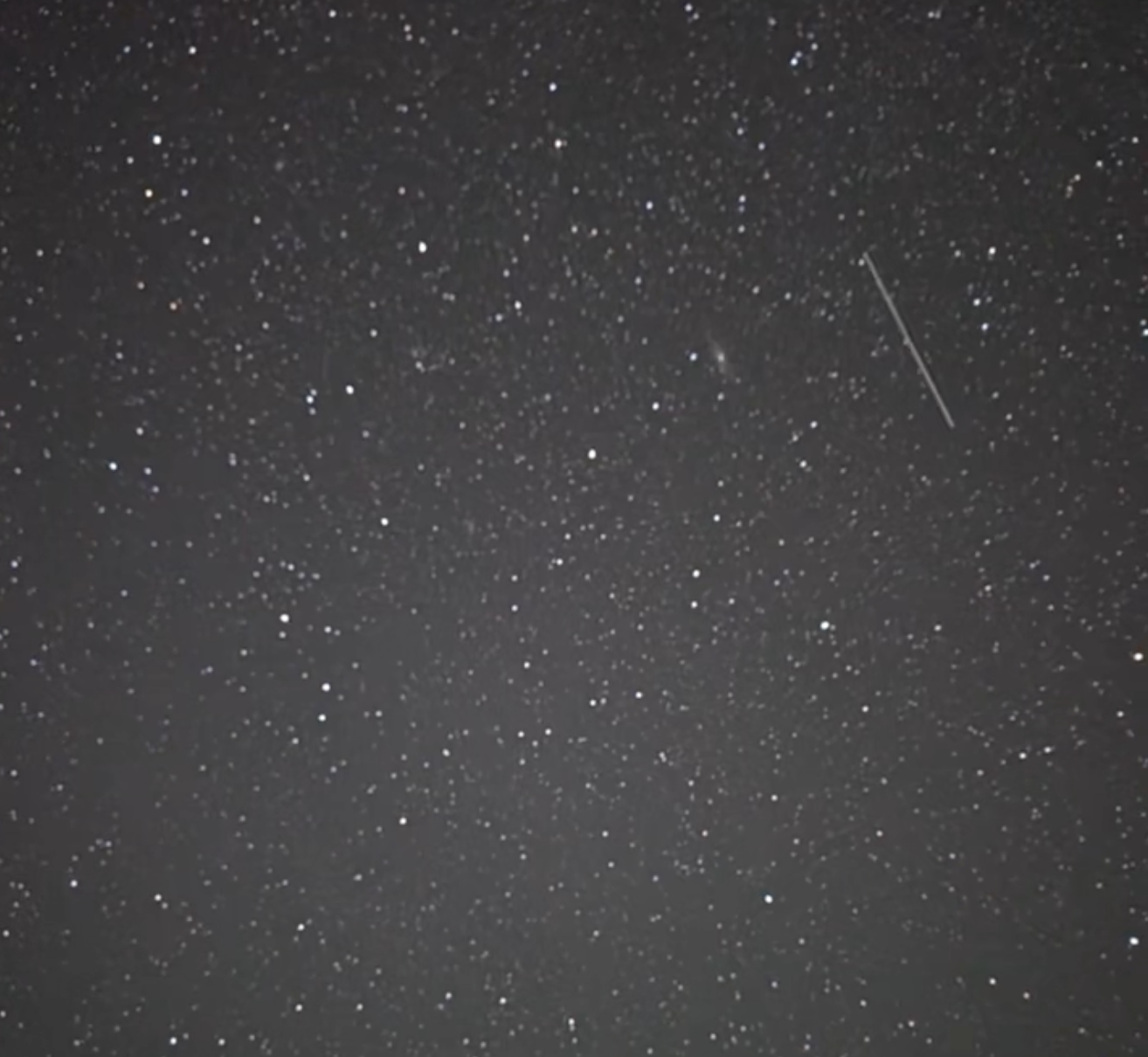
man_in_stars

 As interesting as the lesson was, what sealed the memory in my mind is the fact that the chosen sun that day was exuberant, the chosen earth was joyous, and the rest of the class giggly and slightly jealous that they weren’t the ones to be given the chance to get up from their seats. The latter point gave way to some accusations about being picked by the teacher  “How come you both were picked? Sitting right next to each other too?”

I saw their point. Usually, teachers are careful about picking volunteers or nominees from opposite ends of the classroom. These little dramas are part of what makes our time together memorable.

The little upset may have dampened our spirits somewhat, but we were quick to regain lost ground. To children who generally liked the joy of spinning, the morning lesson was a gift indeed. To those of you who have not experienced the heady giddy sensation of going round-and-round  recently, please try it again. It is marvelous. If you can find a giggly companion, young at heart, please do so, and it enhances the experience in no small manner. 

Hypothesis, Conclusions, Fact-Checking & Collaborations

I remember it was during our little spin-ney-spin-ney sessions that one of us had a question as to why we feel giddy when we spin. Science is full of people who came up with their hypotheses and then set out to prove it. Our little band of scientists was no less committed. I came up with a perfectly wrong explanation for the phenomenon and it shows the sturdy nature of my friends that no one laughed at me that day. Instead, they indulged me in an experiment. 

“Maybe the Earth is already spinning and when we spin in the opposite direction, it makes us feel dizzy.”  

There were some thoughtful nods at this – “Then we should be able to spin even faster if we were to go the same direction right? “ said one. There was only one way to check – spin in both directions and find out for ourselves if this was the right theory.

 “Which direction does the Earth spin – do you know?” A collective wave of shoulders shrugged at the same time, but little things like this do not deter the determined. Someone said we will just time each other for 10 spins in each direction, adjust for right-handed, left-handed, ambidextrous, null-i-dexterous (the opposite word for being equally clumsy with both hands is called ambisinister, but I think null-i-dexterous sounds kinder) and we would be set.

That’s what we did. The exercise resulted in loud laughter, and the sound waves brought the earlier complainants to the fold wanting to join in the game too. All recent rancors forgotten, the experiments were done with rigor, encouragement and accuracy.

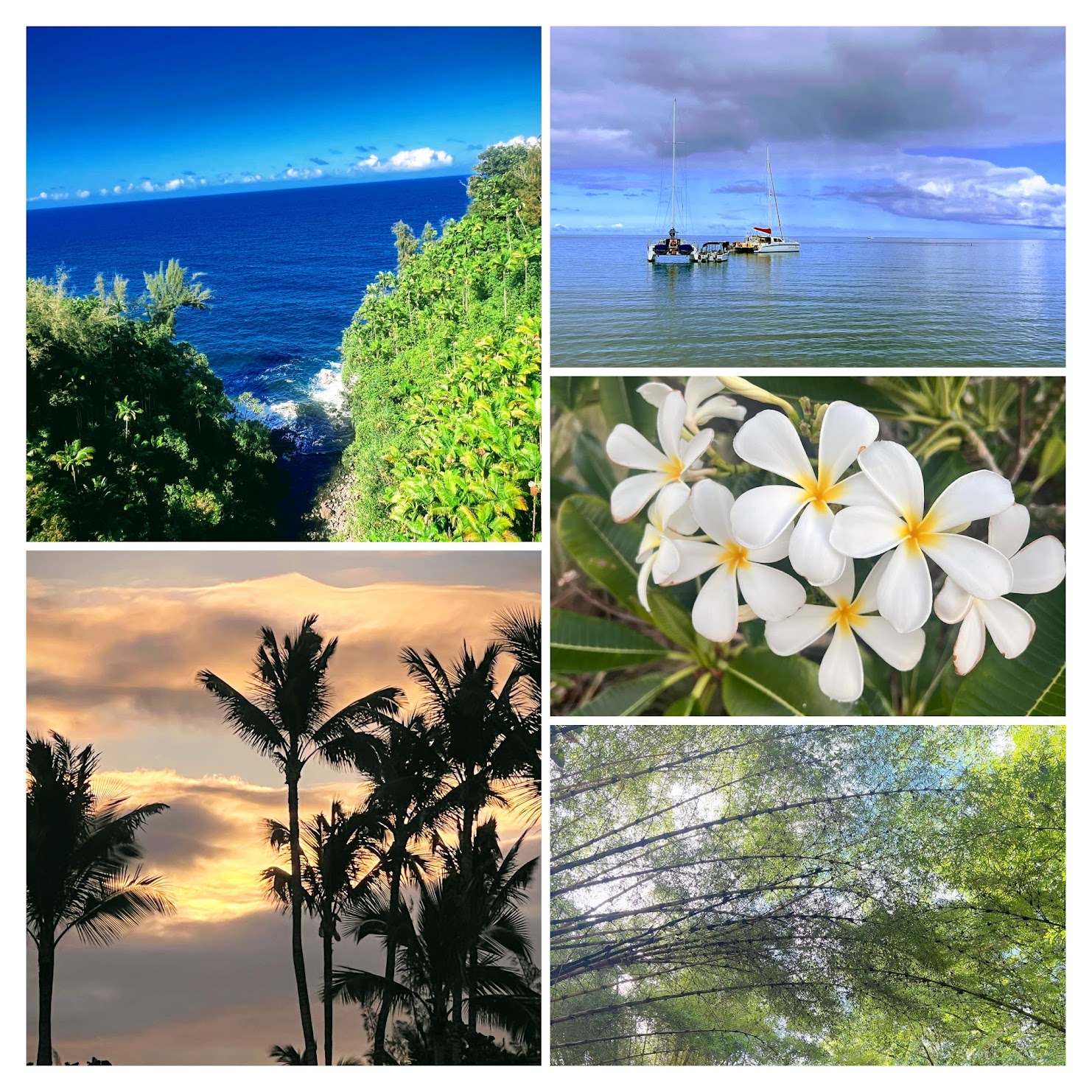
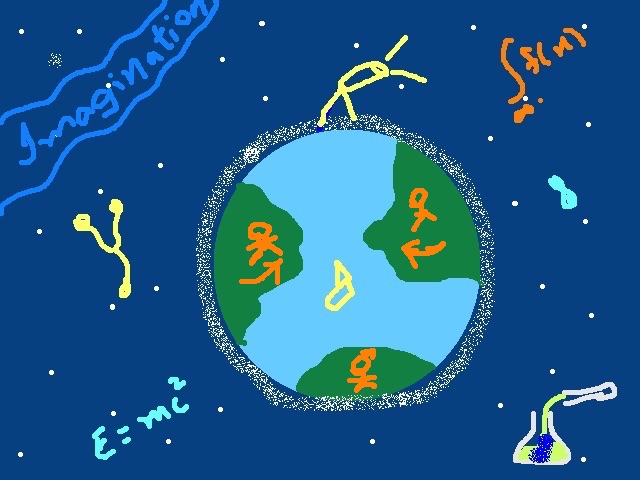
the_world_playground

While we are always in awe of the creative thinkers who take us a leap forward with their works, I have always wondered how each moment came to be: how Thinking Man figured so much out. This is one of the best ways in which I have seen the sentiment expressed.

 Excerpt from The Book That Nobody Read – Chasing the Revolutions of Nicholas Copernicus by Owen Gingrich

“The greatest of scientists have been unifiers, men who found connections that had never before been perceived. Isaac Newton destroyed the dichotomy between celestial and terrestrial motions, forging a common set of laws that applied to the Earth and sky alike. James Clerk Maxwell connected electricity and magnetism, and showed that light was electromagnetic radiation. Charles Darwin envisioned how all-living organisms were related through common descent. Albert Einstein tore asunder the separation between matter and energy, linking them through his famous E=mc^2 equation.”


Scientists do not always know what to expect and can sometimes be surprised at the results. That is what happened to us. The results were inconclusive and resulted in:

* One of us falling to the ground laughing heartily

* Another banging their head against a conveniently placed pole nearby 

* Another giving off an inaccurate imitation of a drunkard, which was impressive given that this was happening prior to the Internet or Cable Television, and the child’s parents were teetotallers

* Two subjects crashing into each other mid-orbital, resulting in tummy aches and headaches together 

 Our motley band of scientists had by this time dissolved into a fit of giggles. Good naturedly, we shrugged off the theory, accepting with grace that it may be an erroneous hypotheses and moved on to the next thing to play together. Consensus, criticism, fact checking, and collaborations had been achieved with the greatest of unity and hilarity. 

The Art of Play

In every problem, creativity and imagination are our solid allies. The simple act of playing together and collaborating to solve problems, keeping each other true is now more valued than ever. Today to see that school recess times have come down; children do not play out on the streets in free play mode anymore, but are rather being ferried up and down to supervised, classes with rigid rules of social conduct usually in the presence of adults; and the playgrounds in our neighborhood have become safe havens for spiders to spin their webs. 

Could we add in structured unstructured time – so we can all benefit from free spirited Play once again?

Those who were never exposed to Play may not miss it, but those who know the beauty of it, will always feel the richer for it. Much like Art, Play is Art, and I pray we do not lose the Art of Play.

The Birds of Heaven

“Do you think we’d have seen at least fifteen species of birds?” the husband said, huffing and puffing beside me on his bicycle. 

We had biked up a little hillock, and even though it looked like the sort of thing we’d have torn up while playing hide-and-seek as ten year olds, it proved to be a huffer just a few decades later, Curious how life reminds you about the passage of time and all that right?

“Easily!”  I said, and started listing them off.

  • Hawaiian stilts
  • Terns
  • Avocets
  • Pelicans
  • Geese
  • Ducks (green necked, wood ducks)
  • Quails
  • Egret
  • Heron
  • Green heron
  • Blackbirds
  • Turkeys
  • Turkey vulture
  • Red tailed hawks
  • Grebes
  • Cormorants
  • Coots

The huffing and humming had stilled, and I turned around to see what had happened. The husband grinned sheepishly – “Oh! Yes – might’ve stopped listening after you started listing the birds.”

I laughed. 

It was a beautiful ride by the bay. The colors of the bay combined with the golden light of the evening made for a fantastic setting for all these birds. There was a time when the soft cooing of the birds, the lapping sounds of the waters around us and the flapping of wings was all that could be heard for miles. If there was a heaven, would these birds be there too? I would hope so.

img_2249

The Tales of Birds

I am sure the falcons and the avocets have the stories of their lives. That pesky crow that annoys the hawk must have their heroic tales. With their enhanced senses, I have often wondered the world through their lenses.  

In any case, we were racing against the sunset, and time was showing it’s presence with every passing minute. 

The elongated shadows of our bikes finished as my long-nosed shadow hit the garage entrance. “Made me think of all the long-beaked friends we saw today.” I said laughing.

It was true – especially down by the bay where we see many birds fishing, long beaks seem the norm: avocets, terns, pelicans, curlews, herons, egrets. They all have sharp beaks that give them decisive looks. I wonder every time I look at them what goes through their mind as they hunt for their food, look after their young and build their nests. This is, after all, what most of the lifeforms on Earth do. And yet, each does so differently, unique to their species, unique to their abilities, and unique to their habitats.

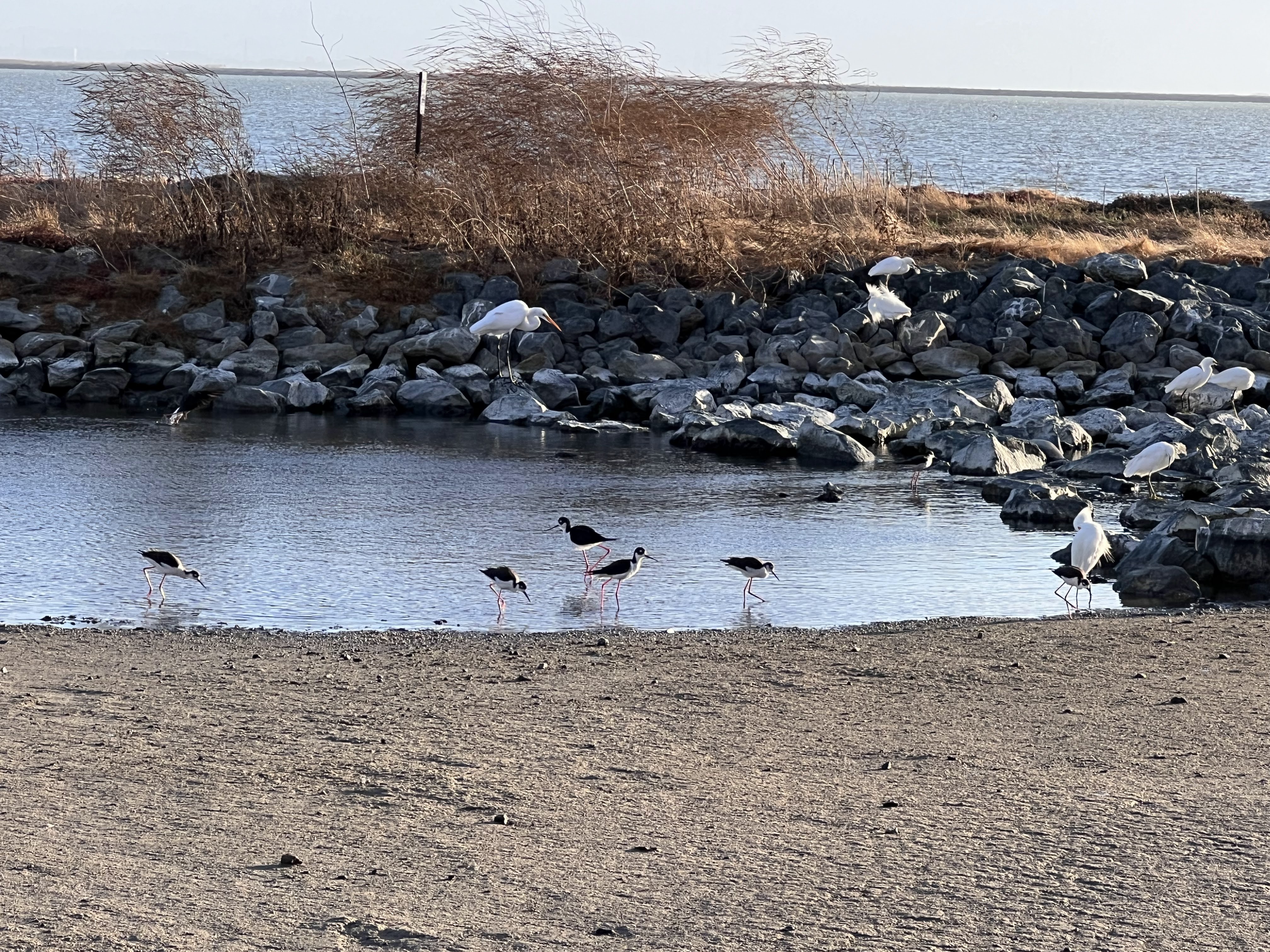
The last birds I stopped to admire in our race against the sunset were the Hawaiian stilts (curiously these birds were once on the endangered list, but have since made a comeback and I am so glad. ) They are a joy to watch in the sunset’s glorious light, with their pink legs, their sharp beaks, and the black-and-white contrasts.

img_2264

Time is a Curiosity

Each of these birds surveys the life beneath the waters differently, and with the deft skills of an archer plunges in for their kill. Their groups merging and reforming with the bay’s tides. Time is a curiosity in these settings, and one can spend hours in these environs, filling the soul.

The trail we are lucky to have access to is beautiful, and every time we set out to catch a little ride by the waters come back more peaceful, filled with gratitude at the marvelous forms of life we share the planet with. I have tried describing rides like this and come up with no one word that can capture it all. Maybe a feeling of abundance? Serenity? In our human existence of intense craving, the ride and what it offers pales in comparison. It is slow, it is present, and it somehow exemplifies your horizons. 

“When we go down to the lowest of the low tide lines and look down into the shallow waters, there’s all the excitement of discovering a new world. Once you have entered such a world, its fascination grows and somehow you find your mind has gained a new dimension, a new perspective — and always thereafter you find yourself remember[ing] the beauty and strangeness and wonder of that world — a world that is as real, as much a part of the universe, as our own. “

– Rachel Carson

The Magic of Waves, Birds and Beach Theories

August rolled around, (and well, a week into August, ) I realized that I had not written a single post. As I racked my mind to see what I’d like to write about, I found my brain in a blissful state of blank.

You see, as August rolled in, we found ourselves welcoming the month lolling on beaches, in art fairs, and in friends’ backyards playing games, chatting and soaking in the summer sunshine. All perfectly pleasant, remarkably blaze, and highly recommended activities. 

Wave Theories

One day at the beach, we walked – a jagged path dodging waves, chatting of wave dynamics and such. The predictions on the reach of small waves, vs the bigger ones proved to be a particularly engaging activity. It was curious to see how many times the smaller waves reached the farthest as though they didn’t believe in bravado and overt shows of strength, but simply did what needed to be done. The big waves made huge splashes, but fizzled out quicker. Very few were impressive in both size and reach. 

It also led to some hilarious moments remembering old professors drone on about Wave Theory.

Bird Theories

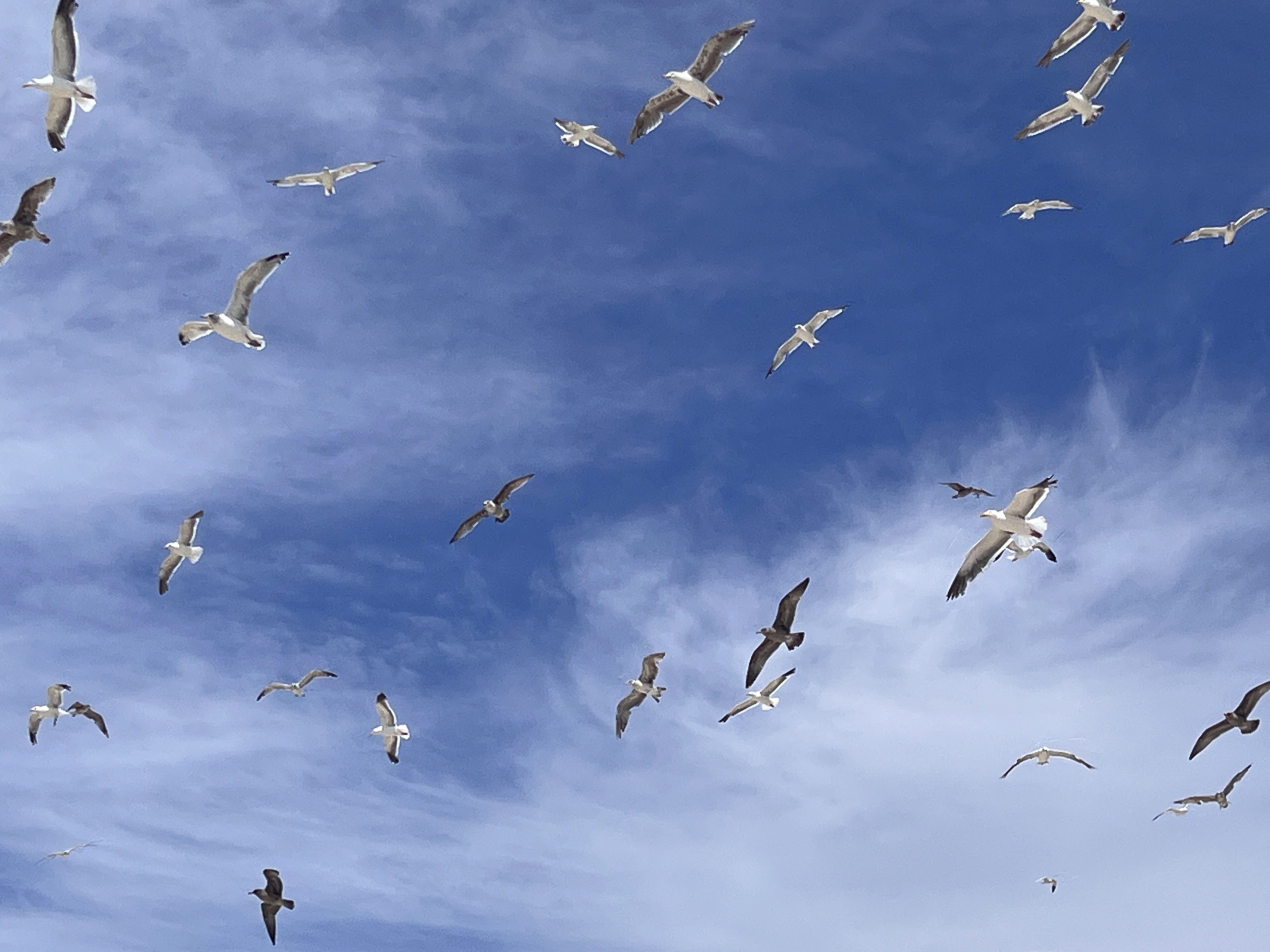
We watched hundreds of seagulls take to the skies for no apparent reason, and come back together for the same reason.

  • Could there have been a call to duty that was rendered unnecessary?
  • Were there portals for the gullible opening? (Get it? Get it?)
  • How much we creatures need to communicate with one another.

img_2164img_2166

Books at the Beach

I also found myself reading my first book by Salman Rushdie:Two Years, Eight Months, & Twenty Eight Nights

I found the book a good one to read at the beach: It feels possible to imagine jinns who made love with humans 800 years ago, and magic portals opening up to let the worlds in, while there. After all, there is an infinite sense of possibilities while lying calmly on a beach and reading. 

Sand Castle Theories

After all, it is where we build sand castles, and let our imaginations run wild:

  • Could it be as a volcano erupting 300 years ago?
  • The moats around the castle could have been the battlefield of a thousand troops. 
  • The secret passageways within the sand castles could be the architects way to ensure people could flee.

Oceansides and beaches may just be the magic we all need in our lives every now and then.

“The sea can do craziness, it can do smooth, it can lie down like silk breathing or toss havoc shoreward; it can give gifts or withhold all; it can rise, ebb, froth like an incoming frenzy of fountains, or it can sweet-talk entirely. As I can too, and so, no doubt, can you, and you.”

― Mary Oliver, A Thousand Mornings: Poems

Emotion in Art: Unveiling the Power of Creativity

Art is about capturing a feeling 

T’was a few days before the Inside Out 2 movie was released. The husband was making me watch a thought-provoking interview. (He knew the distractions at hand on a beautiful summer evening. I needed to watch bees flit, deer graze, geese squawk, herons fish, dogs bark. As I cradled my evening cup of tea wondering when to get out on my evening walk, he swooped in. “Won’t take longer than the time it takes to gulp your tea” he said cheerfully and I gave him a skeptical look. I do not take ½ an hour to drink tea.)  

image-2

Anyway, in the interview, they spoke of suffering and how one needed that pain in order to emote well as an artist. It is not a new sentiment. I remember listening to an interview by J K Rowling or Stephen King (I don’t remember which) that one needs to have had a sufficiently terrible time as a teenager if they were to write anything worth writing at all. 

Problems Are Steady

I am not sure I agree with that. Suffering can be acute, agonizing and astonishing in its effects even as adults. In fact, much like our boggarts tend to change through life, so too does our ability to imagine and empathize, don’t they? Also, for many of us, problems tend to be a steady stream in life – we get jittery and nervous if there aren’t any. Can it really be that we are having a perfectly peaceful time – do you think something awful is going to happen? This can’t be true. Maybe I should call the children, see if they are okay.  Oh – what about the old parents, the siblings, the nieces, the nephews, our friends, colleagues, neighbors? Work? No? All well – is this really so?

Then, you tend to the heart like an overwrought bee in summer and soothe it down. “Yes my dear – there really are flowers everywhere! Believe it or not, managing plenty is as much work as managing long distances for some nectar. Just relax, will you?!” Problems like to steadily hum along like background music. We all need problems at some level, do we not? At least that’s what I tell myself when things get a bit clammy. 

Does Art Capture Emotion?

So, does art need to be about capturing emotion – whether through direct suffering or empathetic suffering? I thought Starry Night by Vincent Van Gogh was brilliant because it captured the frenzied anxiety of the artist’s mind. But, was that what everyone thought? How about those moments of bliss, joy, anger, disgust, repulsion, serenity, contentment, love, and all the ones that Pandora so generously released from her little box of troubles. Hope?

Screenshot 2024-06-29 at 3.32.19 PM

A couple of days later when we went to watch Inside Out 2, we sat spellbound as the movie captured Anxiety’s frenzy so perfectly in this animated movie. How Riley’s imagination spewed up every little thing that could go wrong and let her sense of self develop into a skewed sense echoing, “I am not good enough!” was tragic and Oh! So Well Done!

Screenshot 2024-06-29 at 3.28.31 PM

When you observe a piece of art, do you concentrate on how it makes you feel? Or do you appreciate it for the skill of the artist? 

P G Wodehouse on Art

What’s a post on Art without one of my favorite quotes by P G Wodehouse – only I feel a little like Bertie Wooster himself writing this – it has something to do with a painting looking like ‘summer blew up in your face’ – but I cannot remember it. Gemini threw up its hands and said: P G Wodehouse is not an art critic, but an humorous writer, without a trace of irony. I did spend an enjoyable few hours since then

(a) looking for the quote and reading several good ones on the internet,

(b) perusing my own PG Wodehouse collection opening books at random looking for the quote

Which is to say that I had a marvelous time, but still not find the quote. If anyone remembers it, please let me know. But the art of remembering the quote and imagining the painting itself made me laugh, made me feel joyous, so by that standard, it is already a piece of art. What do you think?

I would love to hear all the different ways in which you appreciate Art.