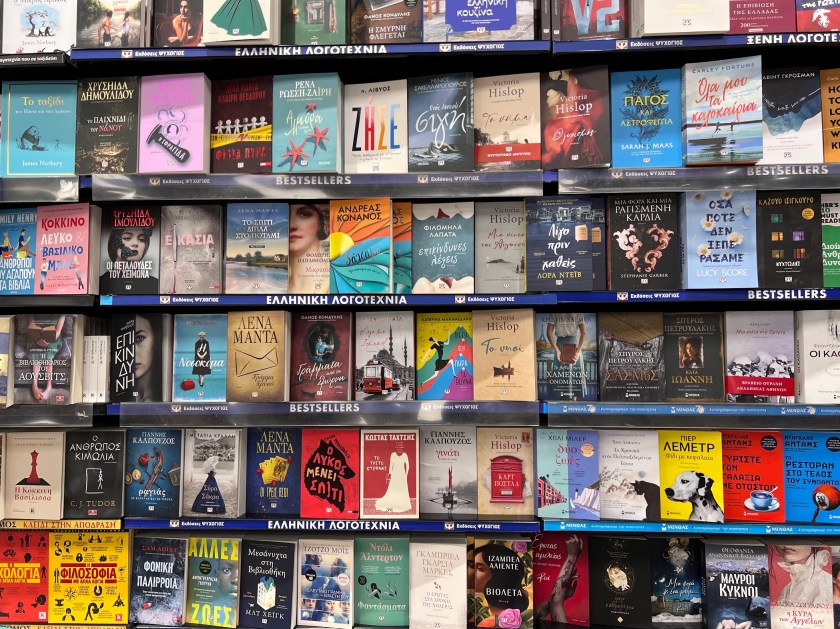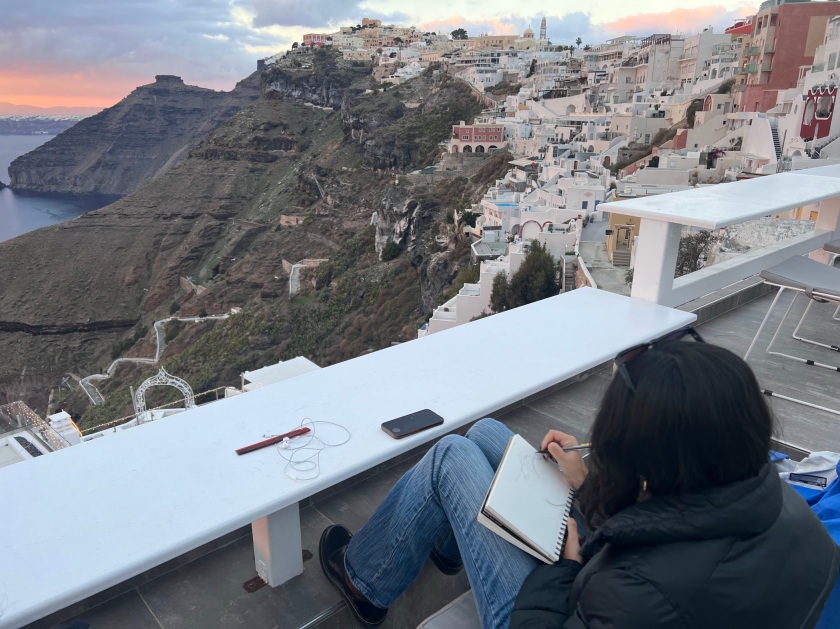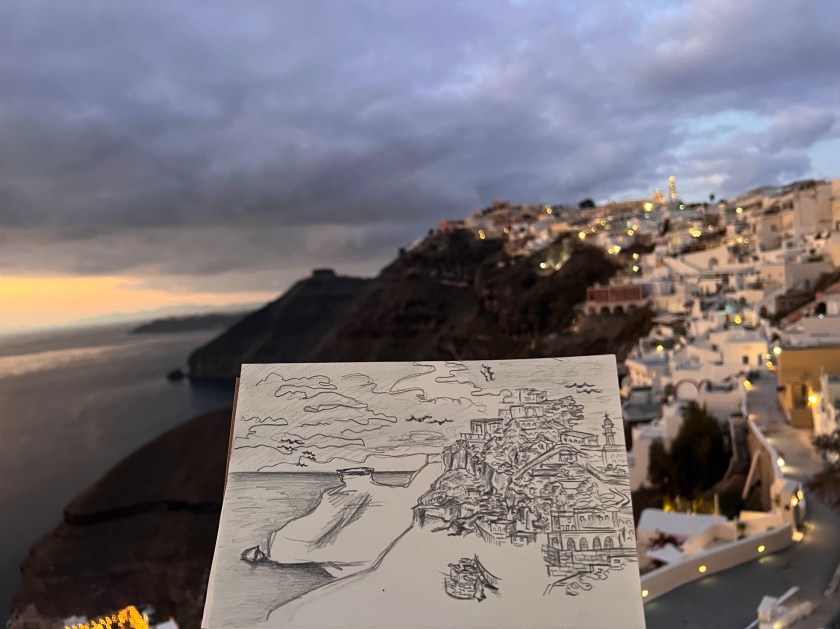
Philhellenism – the love of Greek culture

After the freezing days of Paris, as we were bundling ourselves up in layers (yet again) , I said somewhat severely to the husband. “I think I’ve had enough of European vacations. After a few museums, a half a dozen cathedrals, and a few hundred pieces of art, I am done.”

The husband smiled one of his crafty smiles and agreed, for he knew that I will be the one craving a European vacation first. He just had to sit by, observe, and make bets with the children on the timing.

So, it was that we boarded our flight to Athens. Athens, the weather app promised us ,would be warmer, but still cold. It was expected to be between 40F & 65F (a difference of almost 15 degrees).

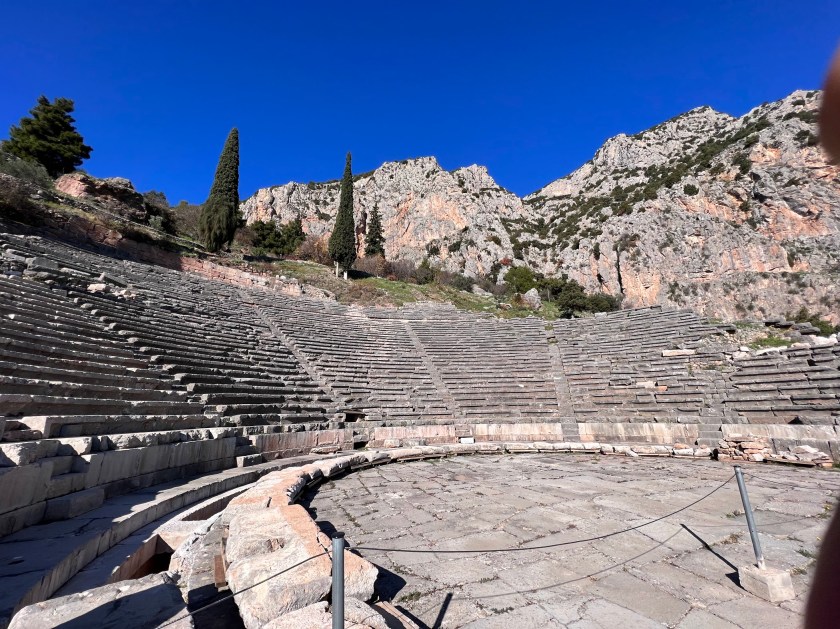
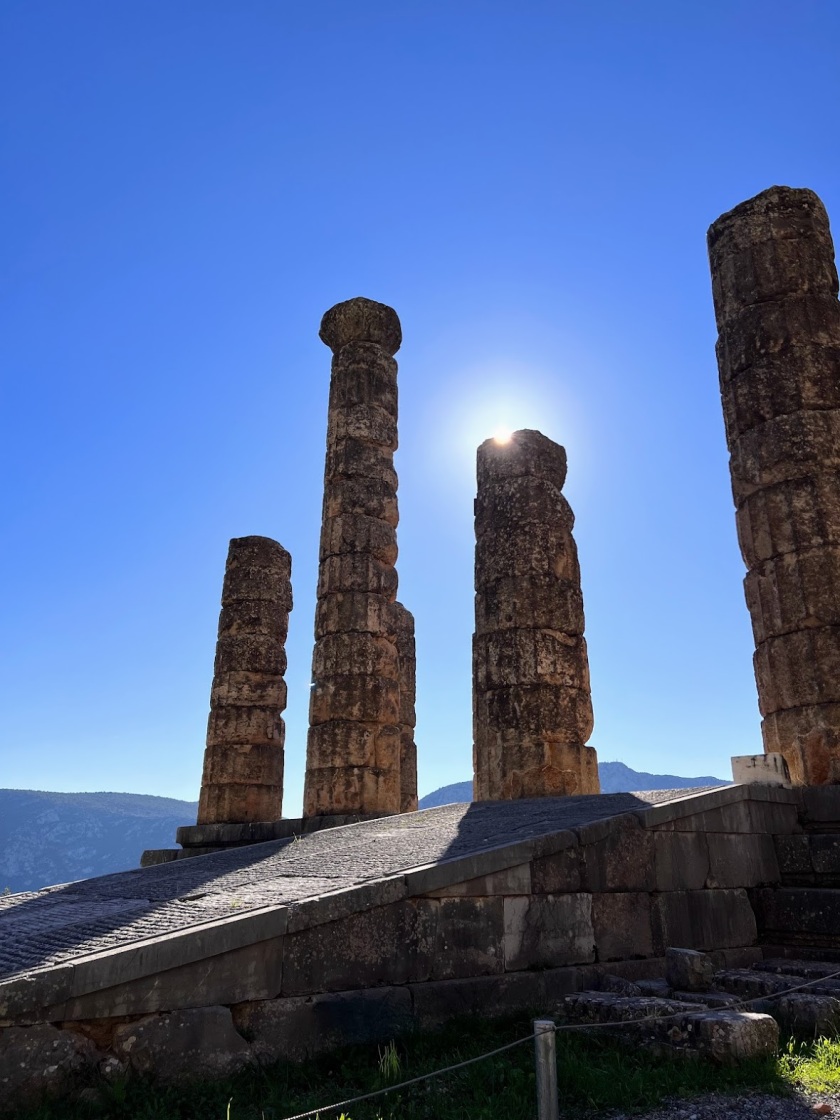
It was like every mile added not just warmth, but a different tinge to the culture. We had no idea on what to expect in Greece. It was our first time. A destination chosen by popular vote since the children are great fans of greek myths and have devoured all the books by Rick Riordan multiple times over. The husband had even booked a mythological tour to surprise them. But apart from this, our idea of Greece was based on A Big Fat Greek Wedding, Greek Myths by DeLaurailes, Gerald Durrell’s Corfu trilogy: My Family and Other Animals, Farther Afield by Miss Read, and all the different tidbits we knew about Greek philosophers, and mathematicians through the ages. 

As you can see, we had no idea, which was marvelous, for we were thoroughly unprepared for what happened next. We fell in love! In love with the city of Athens, the country of Greece, and the Greeks themselves.

After the professional intellectualism of Paris, Athens was like walking into a theme park – here you can have philosophy, art, literature and all the little marvels of the mind, but only if you agree to lighten up, have fun, and stay curious. The gentle humor and warmth with which the Greeks speak to each other and to the tourists is to be seen to be believed. They are a fun-loving, smart, and kind people. It is no wonder that this small country tucked away in the Mediterranean Sea gave us so much of the foundations of Western philosophy and culture. If Democracy had not been chanced upon here, I doubt it would’ve survived or chanced upon at all. As it is, it has so many assaults on it, it is fragile enough that we protect it. Greece is like the Disneyland of Europe. It reminds you of life as it should be: ambitious and lofty in our goals, but reminding us at every turn with their jolly, vivacious myths, of our humanity, our sense of community, and the importance of humility. 

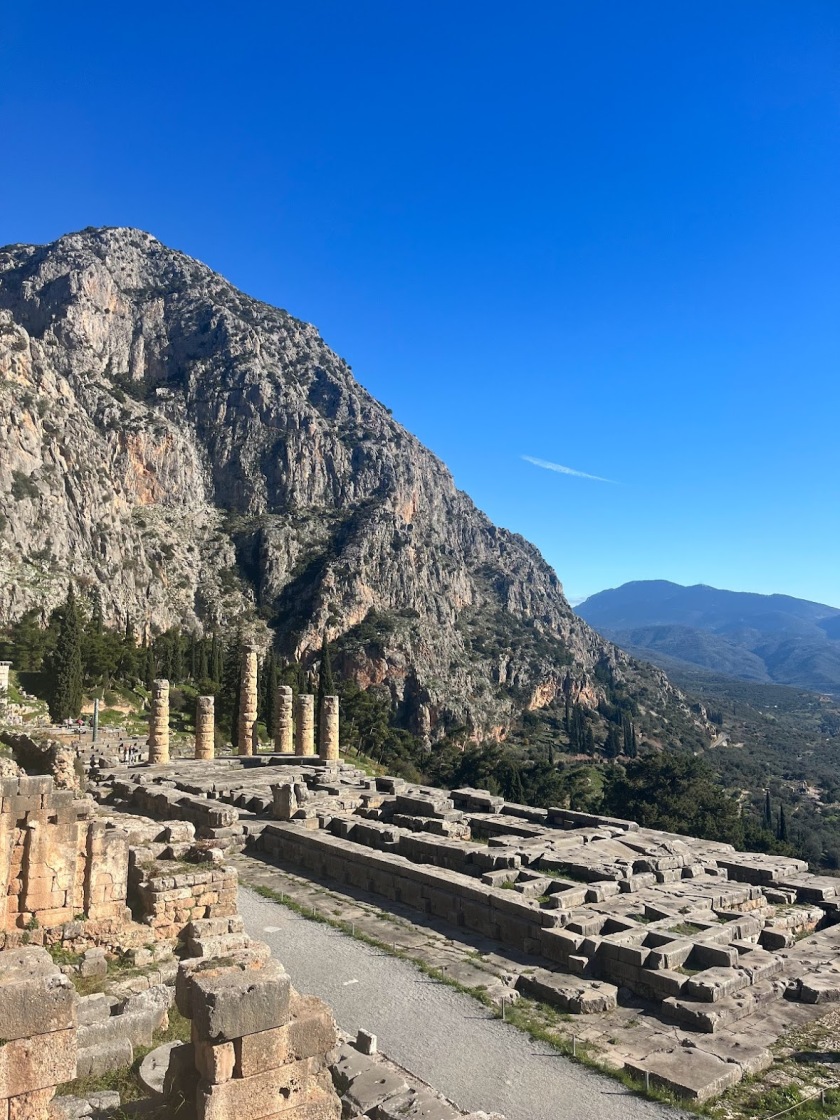
I hung out of the window in the chill morning peering at the Acropolis. Those buildings were from the 5th century BC. Athens (the Greek call their beloved city, Athina after the goddess Athena) has been continuously populated over the past 6000 years. This showed up in little things such as drainage systems, rebuilding efforts and such (we found to our surprise that toilet paper cannot be flushed in Greece, and water bidets are not installed everywhere either).

It is hard to not get up in the morning and think that you are but a butterfly in the passage of time. On the mythological tour, Denai (our mythological tour guide) was informative and thoroughly impressed with the son’s knowledge of the Greek myths. I strutted along ( a proud parent) and learning so much of the mythologies that helped shape our way of the world, that I must say the cold forgot to bother me.

Who cannot be awed by the story of the Temple of Zeus being destroyed multiple times in history and the latest one by lightning? If that was not a sign from Zeus – the god of lightning himself, the Greeks did not know what was.

Or that wonderful story about how the city of Athens got its name. Apparently, it was such a popular place that even the Gods fought for the place. So Zeus tired of this bickering asked Poseidon & Athena to decide via a popular vote. Each had to give a gift to the populace and the people could decide.

  1. Poseidon – the god of the oceans, gave them water, signifying naval power and thus prosperity as a port city. This gift appealed to the men of the land.
  • Athena – the goddess of wisdom and strategy, gave them the olive tree, signifying the change from hunter-gatherer mode to prosperity from the land. The women liked all the different uses from the olive tree (olives, light from the lamps lit using olive oil, the wood etc).

The citizens chose Athena’s gifts – for  according to myth, women outnumbered men at the time of the vote and Athena won. This made Poseidon angry and to mollify him, the temple of Poseidon overlooks the city of Athens, while Athena’s temple overlooks the oceans. It was also why women were not allowed to vote from then on (again a myth, since it was never obvious that women had the vote in Greece. According to wikipedia – women gained the vote in Greece as late as 1952. But it was a crafty way to deny women their voting rights and have a story around it.

In the parliament square, the temple of Athena stood alongside that of Hephaestus, signifying that intellectual work was just as important as physical work. This was the place the philosophers gathered alongside the farmers to decide, debate and vote on the important matters of the day. Both types of people had to be in harmony for a prosperous society.

Thus it went in Greece. Wherever you went, there was a little story, involving the mighty gods, and their follies, all narrated by the populace with gentle humor.

And yet. While the myths are everywhere, there is a surprising and thoroughly lovable lack of reverence to these gods. They are gods – sure. But they have flaws – big ones. Much bigger than our own flaws since they are so much more popular and powerful.

I think it has to do with the complete dissociation of religion from the mythology. Indian mythology is just as broad, diverse and intricate – but since it is intertwined with Hinduism, good luck trying to be flippant about any aspect of it no matter how justified.

“Next time we come to Europe, we must stay longer in Greece, so we can go to the countryside and visit the little villages that dot Greece, maybe visit the island of Crete and Corfu.”, I said at the end of the glorious day in which we had eaten far too much delicious food, enjoyed far too many myths, and been far too enamored by the music and language of the greeks.

“Twenty-four hours!”, said the husband exchanging knowing winks with the children. They all guffawed.

“Amma – you said – No more Europe! Africa calls, and Australia sings and all that, 24 hours ago!”

What was there to say?  That’s how people fall in love with a country. It is no wonder they have a word for it. Philhellenism – a love of Greek culture!

Froide a Paris avec Gezellig

The husband planned a meticulous trip to 3 different countries in Europe for the nourish—n-cherish household. Left with all the rest of the work, I stood in front of my bookshelf dilly-dallying on the reading material. Finally, I chose Bill Bryson’s Neither Here Nor There: Travels in Europe, which was an excellent read.

Neither here nor there: Travels in Europe by [Bill Bryson]

Bill Bryson started off his travels with catching the Northern lights in Norway. We chose France. But believe me, by the time we landed and made our way to the Airbnb , I felt like I was at the North Pole. The high temperatures of the day were 32F or OC. One night while standing by the Seine river watching the Eiffel Tower from a distance, I was so cold, I may have seen the aurora borealis over Jupiter. The daughter’s eyelashes froze, the son with no extra fat reserves froze too. The Seine miraculously flowed on.

Luckily, T’was the most wonderful time of the year!

This feels the time when overuse of the word , “T’was” is a requirement. Europe in Christmas time is a joy. The store fronts in tourist locations have marvelous decorations put up for Christmas and we couldn’t stop admiring the many ways in which people think to spread cheer. It was irresistible to stop and take a few pictures, very well knowing that I may never look at them again.

xmas_decor

Cities in Europe have a charm to Christmas time that is hard to capture. There is music in the air, there are musicians in subway stations, lights strung up everywhere in artistic and beautiful garlands like little bubbles of joy through the cold winter scene outside. Finally, there is a purposeful stride to people as they walk swiftly in their heavy coats looking sprightly, even though we seemed to feel lumberous with all the layers of thermal wear.

Our warm flight attendant on the KLM flight told us that the Dutch have a word similar to Hygge for this particular feeling:

It is called Gezellig.

She said the word was not easily translated, as it encompasses all warm feelings associated with the yuletide spirit (but is not restricted to Christmas or winter imagery) – just read the link above, will ya?

Every now and then, we would encounter a quiet fascinating residential street with plenty of trees. On one such charming street that windy day, the last few leaves from the trees above floated down and I went chasing after them in glee. No surer way to lift one’s spirits or body temperatures in my books!

The ones who impressed us the most though , were the relentless joggers of Paris. In case, any of you missed the gist thus far – Paris – beautiful but biting cold in winter. Yet, here they were, zipping through the streets in shorts and light jackets. I ain’t going to lie : that takes a special sort of determination and dedication and I would’ve taken my hat off to them if I didn’t think my brain would freeze.

Walking past a little pond that had frozen over, we stopped to watch the ducks standing on the frozen waters. Had their other duck friends flown onto warmer climes in Africa or Argentina, while these poor ducks were stuck here? I thought of that passage by Bill Bryson on his winter trip to Oslo to see the aurora borealis: I suppose this was one of those times when I truly felt grateful to be a visitor and not have to live there. I could already feel my feet freeze through the thick boots, and woollen socks, and couldn’t wait to get back to the room to take a warm shower. How were these poor birds standing on frozen water without socks, coats or caps? Yet, they seemed peaceful enough. They did not seem to be anticipating the World Cup Football Finals match later that evening, they did not seem to think anything of the rain forecast later that night.

frozen_ducks

“Are you coming or not? Freezing here – let’s get to a warm restaurant for the match!” , said the husband and I hurried along tucking away my little interlude with the ducks of France. It was time to cheer with the people of France for the football World Cup. France Vs Argentina.

After the freezing days of Paris, as we were bundling ourselves up in layers (yet again) for our small foray to find food, I said somewhat severely to the husband. “I think I’ve had enough of European vacations. Next time, we explore other places – Africa, South America, Australia: so many continents to explore! After a few museums, a half a dozen cathedrals, and a few hundred pieces of art, I am done.”

The husband smiled one of his crafty smiles and agreed, for he knew that I will be the one craving a European vacation first. He just had to sit by, observe, and make bets with the children on the timing. Much like watching a football game.

The Artists at Paris

The husband planned a meticulous trip to Europe for the nourish-n-cherish household. Trips to Europe are rarely complete without museums and so, off we went with our admiring hats on. I do not know the different periods in European art, and after several trips find that I am astounded by how much there is to learn and appreciate.

I do not know why Claude Monet spent 30 years in his garden in France painting the lily pond. I am even less capable of recognizing a Monet from a Chagall. But I am glad that Monet’s masterpiece with the lily ponds in his estate in France have a home designed specifically to appreciate the art like he intended it to be (The Orangerie Museum: Musée de l’Orangerie). How many artists get to have that particular claim to fame?

lily_pond

After the Louvre, the Orangerie museum was a treat. The Orangerie museum was a beautiful little museum tucked away near the most historically magnificent palace grounds in Paris. (Fun fact: apparently,  the word orangery refers to a protected ground in large palaces in Europe :   a greenhouse for growing oranges, lemons and other citrus fruits in cool climates.)

IMG_1701

We each went our ways and did not have to worry about getting lost. It was a small, compact museum with works of a few artists, and it was all very done. Really – the way Europe reveres its artists and preserves its art history is admirable. In about 3 hours, we were done and ready to explore the rest of Paris by foot. As we walked on, we fell to discussing Art – the Renaissance, the rise of cubism, and all the rest of it. 

How some artists chose lighter subjects such as Auguste Renoir in these paintings of the girls bonding over music, or whispering a secret together.

Or the beautiful nature filled works of Sam Szafran where the human is but a tiny part of the intricate patterns of nature

IMG_1730-COLLAGE

As we trundled away from the Orangerie museum towards the Eiffel Tower in Paris, it was irresistible to stop and take a few pictures, very well knowing that I may never look at them again.

We ended up in due course, after our glacial progress through the streets of Paris, at the foothills of the Eiffel Tower. It was there that the many perspectives of Art we’d just learned about became apparent. The son tried taking pictures using the vertical panorama technique that I had shown him.

eiffel-1

He showed us cubism.

eiffel_cubism

We even have a picture of me pulling off the invisibility cloak after apparating to the foot of the Eiffel Tower. I wonder why these art forms do not deserve their place in museums of modern art.

eiffel-invisbility

How better for our artists to capture the true magic of a European vacation?

2022 Reading

It is that time of year when we

  1. cannot believe another year has gone by and
  2. simultaneously ponder on what a long year it was.

The quixotic nature of time – once again making a fool of us all.

It is also the time I look back fondly on the books that lit up my inner world, and take a moment or two to jot down all the notable titles, read other people’s lists, and make jolly to-read lists for the coming year, and so much more.

I thought I was scatter-brained, had a lot going on, and therefore, my reading took a hit. But it seemed to be the other way round. Reading, once again seemed to have worked its magic in helping me through 2022.

Non-Fiction

There were quite a few books in this genre. Only mentioning the ones that stood out in my mind for various reasons. (Not because of the content alone, but also time of year when it seemed to have been relevant, how much I managed to absorb of new ideas etc)

Fiction

  • The Alice Network – Kate Quinn (this one is a fictional account of real life events of female spies who used to smuggle messages across borders at considerable peril to themselves.) The daughter told me that Audrey Hepburn’s (Of Roman Holiday fame) was  also well known for her efforts during this period when she held underground ballet concerts and so on to help people during the miserable times of the Second World War, and many times risked being caught and hoping to get off easily because of her diminutive stature and size.
  • Women of Troy – Pat Barker
  • A Blizzard of Polar Bears – Alice Henderson (A good racing thriller for airport reading) 
  • Akimbo and the Elephant – Alexander McCall Smith 
  • The Blue Book of Nebo – Manon Steffan Ros (What happens after a nuclear war – I am sure many of us have pondered what the aftermath of an apolcalypse would be like. This book that does just that.)
  • Young Mozart – William Augel (hilarious! )
  • Plus my standard dose of R K Narayan, Miss Read & P G Wodehouse  whose wise and irreverent view of the world, I find refreshing and a regular tonic to life. 

Science Fiction:

  • Project Hail Mary – Andy Weir
  • Daughter of the Deep – Rick Riordan
  • Bewilderment – Richard Powers (This is one of the best books I’ve read – highly recommended. Stays with you for a long time)

Special Children’s Books:

Poetry:

How can there be no magic in the list?

Please share your reads with me. Would love to get started on my reading list for 2023.

Temple of the Mind?

We’d been on a short trip to catch some European magic. We started off in Paris. In order for us to experience a proper European winter, the 1st day in Paris started off with a brisk walk to the Louvre at 8 in the morning when the temperature was still 24F. As we stood there, waiting for the rest of the tour group to join us on the marvelous walking tour through the Louvre, I felt a sudden stab of pity for all those who had lived before our times. 100 BC, 500 AD, 1500 AD, 1700 AD. None of these poor folks had indoor heaters that hummed and thrummed the way the museum indoors sounded welcoming. They didn’t have access to 32°Heat products that were brilliantly designed thermal wear designs – nor were they commonly available after mass production. With three layers of clothing, if it was still this cold, how on this marvelous Earth a mere 100 hundred years ago had people endured this time of the year? The thousands who died in the cold winters in the trenches, on the war fronts, in concentration camps. I shuddered and this time not from the cold. 

As I stood there, thinking of the little history I did know, I wondered why we never learnt from them. Why did we not recoil from war, sense divisive forces and squash them? Maybe this humanity’s path – bring ourselves to the brink of annihilation with our madness multiple times over and then miraculously survive till the one time when we don’t. Who knew? Wars and enmity don’t seem to end. 

Mercifully, our rag-tag tour group assembled after about 1/2 an hour that felt like 2. We walked into the Louvre like frozen zombies hoping to thaw out with the artworks inside. How did that sculptor bring himself to work on the marble statue of Venus dated 120 BC through these cold winters?

We started off at the famous prism inside where those who read or watched the Da Vinci code. It was beautiful and really, who thought of putting up bean-bags on that pole of the prism? It started the tour of with touch of a whimsy before the academic aspects of the museum unleashed itself.

IMG_1430-COLLAGE

If I were to describe the Louvre and the Vatican in one stroke of a brush, it would be: Too many artworks to properly appreciate each one.

Though, our tour guide, Maria, tried her best. There were 38,000 pieces of art in there. The Vatican (70,000 of which 20,000 are on display). With all the hundreds of artists at the time, why did only a few achieve lasting fame? Maria explained many things about art that we ought to have known, but didn’t. Things such as  the angle of the light, the imaginative aspects of landscape, the differences in perspective, the kind of face that seemed to have appealed to Leonardo Da Vinci

monalisa

Did that famous, but thoroughly over-rated face of Mona Lisa have a glint of Leonardo Da Vinci’s favorite student? (shown below?)

IMG_1469

I keep clicking pictures of the pieces that appealed to me as she gave us salient features. I remember standing in the museum and thinking that I must not let art escape me in the daily humdrum of life. Corporate life, especially, had no time baked in to appreciate the finer aspects of life such as literature, art & music the way schools do. So, how do we make an appreciation of art a daily ritual, so there is always a little of the artistic in us? Oh! So many lofty thoughts. If Leonardo Da Vinci were witness to my thoughts that morning, he might’ve taken me on as a student, grandly overlooking my lack of talent, just for the touching sincerity.

But a mere 48 hours later as I write this, I am distressed to say that I cannot remember why I took half of the pictures I did. 

There was something about a picture of the maternal (Maria said Leonardo Da Vinci did not have a mother or someone who set a maternal example in his life, and thus the picture was doubly important). And something appealed to me. But what? 

This one appealed to me as a writer. The early journalist who felt he had to say his truth and was murdered for it.

journalist

Or the coronation of Napoleon. Here was promise that megalomaniacs existed, continue to exist, and will continue to wreak havoc. In the absence of social media, this was Napolean’s attempt at portraying the coronation to the masses like he wanted – the truth be damned. Hundreds journeyed to the Louvre to get a glimpse of Napoleon and his bride, at the coronation. Apparently, Napolean’s mother did not accept his choice of bride and refused to attend the ceremonies as a result (there is a nice piece of continuity through the ages), but she is there in the painting. The Pope was invited and snubbed, but he looks happy behind the king. Maria pointed out many such discrepancies which I am afraid have evaporated since. Those art aficionados who do know the details have obviously written them out in detail in hundreds of books, blogs and YouTube videos for souls like myself.

coronation

And those statues of Venus – already promising womankind with all sorts of torment thanks to the impossible standards of beauty (the tall vertebrae, the perfect ratios between head, legs and girth, that seldom seem to bless breathing and living souls as we live out our lives on Earth.) Did the lovers of the sculptors of Venus feel the pressure, or were simply not bothered about the grandiose perfectionism as they had to tend to the business of living?

Venus de Milo on display at the Louvre

So many inspirational, marvelous wisps floated in at the Louvre. Maybe that is the vibe of museums: the wisps of imagination and insight from the millions of people over hundreds of years all hanging together illuminating the souls who dare to dip their toes into these journeys of the mind.

Our own temple of the minds.

Magique Français

There is a charm to traveling at this time of the year. We had decided on an Europe trip with 3 countries thrown in to the mix. Which is to say that the rest of the nourish-n-cherish household of spoilt folks enjoyed a trip planned meticulously by the husband. Left with all the rest of the work, I stood in front of my bookshelf dilly-dallying on the reading material. Finally, I chose Bill Bryson’s Neither Here Nor There: Travels in Europe, which was an excellent read. 

The whole way to the Airbnb from the Paris airport, the radio was on and the hosts chattered on in French. Considering that I was the only passenger in the car who had ‘learnt’ French, I must say I was aghast that I remembered almost nothing of the beautiful language (except for tidbits such as – one mustn’t pronounce the last consonant, unless the next word starts with a vowel, or the river is feminine while the museum is masculine) I have always been little lost with languages that attribute a gender to everything. 

Is a croissant masculine or feminine? I don’t know. 

Both Le Croissant and La croissant sound right to me, but DuoLingo assures me that croissants are masculine and therefore Le Croissant is correct. Sigh.

I must say languages and brains are curious things. I was sincere, if not successful, in my attempts to learn French in 11th and 12th grade. I would’ve thought that some things would surface through the foggy decades as I heard the spoken language, or saw the words written in the menu cards in the little French cafes. But nothing happened. I recognized ‘avec’, ‘le’, ‘la’, ‘and words that had a passing semblance to the English language and could thus be fathomed. As I stumbled my way through the language  I realized that I had never really spoken French, though I seemed confident enough to butcher the pronunciations. For instance, I confidently addressed the Louvre as the ‘Loo-v-rrrr’. 

Apparently, I had it all wrong. 

Humbled by this revelation of my poor French, one day on the metro, I was trying my best to listen to the announcements and map the name of the stations to the pronunciation. I can understand my not getting a name like Champs-Élysées – Clemenceau or Maisons-Alfort – Les Juilliottes, but I didn’t get Grands Boulevard. That hurt. Now see, I pronounce it is Grand-ss Boo-lay-vard (so no letter is offended or feels less important). But the French pronounce it as Gron Boolevaar. With the overhead crackling that is a requirement for most metro systems,  I heard it as ‘groan bole’, and was looking around at people before the husband said it was time for us to get out and hustled us out.  I leaped out before the doors closed behind me and was rattled till the sortie (exit).

The French trip you up in more ways than one. I trust it is their way of having fun with us poor sods who haven’t a clue about the language. For instance, there were so many names that sounded like food, it was astonishing. Who wouldn’t like to get out at Madeleine station? I found myself drooling a bit about the buttery m-s and missed Grands Boulevard. 

I remember the husband telling me for an entire hour that we had to go to Rue Ravioli. I thought to myself and smiled that I had never seen this many streets named after food in any other country. I mean how often have we seen a Hamburger boulevard, or a Tomato-Bisque Road? Even in countries that enjoy their foods so much like India, I had never seen a Roti Street or Dosa Boulevard.  As I was feeling cleverer and cleverer with the inspired line of thought, I found that the husband was truly hungry was all. It was Rue-de-Ravoli, not Rue-de-Ravioli (the cheese filled pasta).

Nevertheless, the names had a marvelous ring to them. 

Liberte

Bonne Nouvelle

Strasbourg – Saint-Denis (a big hyphen followed by a small hyphen)

I found myself nodding vigorously and agreeing vociferously (making the French doubt my capabilities even more) as I read Bill Bryson’s Neither here nor there: Travels in Europe.

Bill Bryson on French:

I took 3 years of French in school, but learned next to nothing. The problem was that the textbooks were so amazingly useless. 

They never told you any of the things you would need to know in France. They were always tediously occupied with classroom activities : hanging up coats, cleaning the blackboard, opening the window, setting out the day’s lessons. Even in seventh grade I could see that this sort of thing would be of limited utility in the years ahead. How often on a visit to France do you need to tell someone you want to clean a blackboard? How frequently do you wish to say: “It is winter. Soon it was will be spring. “

In my experience, people know this already.

Bill Bryson

But language has a way of morphing and conjoining, and by the end of the day, the daughter was speaking in lilting French accents, and I was very impressed with her, and unimpressed with myself for I understood next to nothing. Then, she chuckled and told me that she was just spinning her Spanish in French accents. I tell you! The nourish-n-cherish household really knows how to capture the magique francais.

2022 Phrase of the Year: Let’s See!

I was watching a movie the other day, and the word ‘bigotry’ came up. I went for almost 4 decades without ever hearing that word, and then all of a sudden, the word was everywhere. In news articles, movie dialogues, forwarded WhatsApp messages. I had read history books, had read many books about World War II, and was always reasonably interested in new words. Yet – here it was. When I found out the meaning, I felt a bit silly for not knowing the word. Suddenly, I could label many thinking patterns (and people) as bigoted, where previously I’d gone without labeling them. (Was that a good thing, a bad thing or not a thing at all?)

Then a few days later, I heard that the word of the year in 2022 was ‘Gaslighting‘. Another term that I had never heard of growing up, and yet, here it was – annoyingly present and able to pinpoint a particular trait.

Astounding.

That got me thinking about the words I’d probably used the most this year, and it was not a word that came to mind, but a phrase.

A phrase that I’d used over and over again in my professional capacity, or while describing the uncertainties of our world: “Let’s see!”

I remember the old pater using a Tamil word, Paappom (paarpom) – meaning “Let’s see! “ – shortened from பார்க்கலாம்


Paappom annoyed us. It usually meant we did not get a ‘Yes’, and every child knows that not getting a ‘Yes’ immediately meant that reason could swoop in, and could sway our ask toward ’No’, which was unacceptable of course. I mean, why would you want to think about taking us out for an ice-cream? That only meant the rains could come, someone could catch a cold, or the interest to go to the ice-cream store could wane.
Paappom indeed.

Paappom was also an ambiguity. A pendulum that could swing between this-and-that and you never knew where it could stop at decision-time.
Paappom could bring about positive outcomes but that required waiting and delayed gratification.

So, paappom was a true mystifier.

Yet, this year, I found myself using Paappom’s English equivalent, “Let’s see!”, so often, I felt like a bit of a pendulum myself.

It meant, I wasn’t sure of the next step: should I take a next step, should I wait? What if something changed, that I had not anticipated? If ever there was a year encompassing all these qualities, it was this one. So, I paappom-ed. A lot.

As life goes on, I find myself ‘paappom’-ing more and more often, with my touching faith in luck and providence that time will sort things out (especially unpleasant situations – but I can assure you that seldom happens.)

Anyway, 2022 being a ‘Let’s see!” Year means that we do have to see what 2023 looks like.

A colleague once told me that their family thinks of words to live by in the upcoming year during Christmas holidays. If they chose, “Excellent!”, they answered everyone who asked them how they were with ‘Excellent’ for the next year. Isn’t that an excellent idea?

I asked the children for possible words the year I heard this, and promptly abandoned the exercise, for the words that came up were horrendous, cringe-worthy and frankly ridiculous. (The nourish-n-cherish household, I tell you!)

Anyway, what words would you like to choose for 2023?

As it was, so it shall be!

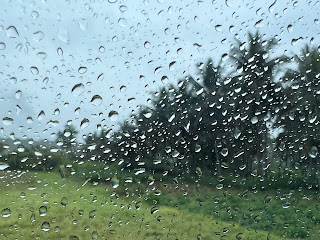
It was the day after the storm. The white and blue of the skies above belied the battering of the previous two days. The torrents of rain lashing down, and the dark clouds seemed like a dream.

As much as I love a rainy day adventure, the day after the rainy day has an appeal of its own. The world seems sparkling and clean, the air still has a lingering moisture in the air somehow making it smell fresher and sweeter. The glistening droplets on the flowers and treetops make for interesting interludes if they happen to drip on your upturned face, and the birds, oh the birds! They make up for everything. Their trilling is fuller, and richer – maybe they are relishing the sweet fresh Earth too.

This particular morning, I looked up at the blue skies with perfectly designed and placed fluffy clouds. There was even a Mickey Mouse shaped one to remind me to smile and think of the happiest place on earth (right then, it was there watching that cloud and taking in all the world around me).

My heart skipped along joyously when I was stopped my tracks by a California blue jay chipping away at the last remaining fruit in a fruit tree. 

I know this statement seems unremarkable. But when philosophers tell you savor every moment, I think they mean moments like this one. There was nothing special or remarkable about it. But it had that ethereal ability to capture the past, present and the future in one shining bubble.

All the leaves had fallen with the last storm, the bird was dry and trying to get at its food. This one poignant image sticks with me – of all the hundreds of photographs taken, this moment was one I did not capture. Yet, it seemed to hold the storm, life after the storm and hints of life during the storm in it.

As it was, so it shall be.

What does one say for moments such as this one? I don’t know. Maybe the reason I enjoyed the moment so much was because I had that childlike wonder of shoshin in me when I stepped out that morning, or maybe it was because the warmth of the sun after a cold, wet few days was striking. Regardless, there we are sloshing through life, and when we stop to admire a blue jay on a bright morning, it seems like all will be well.

The Wonder of Sonder

“Travel is fatal to prejudice, bigotry, and narrow-mindedness, and many of our people need it sorely on these accounts. Broad, wholesome, charitable views of men and things cannot be acquired by vegetating in one little corner of the earth all one’s lifetime.”

 Mark Twain, The Innocents Abroad / Roughing It

I found myself reveling in this quote as I traveled recently to the opposite side of the globe.  I had been to Jaipur, India. It was a part of India that we normally do not visit on our little family trips, and was thus a novel, beautiful experience for me. Truly, Incredible India has many surprises up its sleeve. UNESCO sites dotted the place, the vibrant active city co-mingling easily amidst centuries of history was more heartwarming than ever. 

We had visited the Amer Fort near Jaipur and our guide’s narrative views on the socio-economic views of those who had lived in the fort were well worth mulling over.

It was while we were discussing the flow of information that I got to musing on the nature of truth. There was a version of events presented to us over time. There was a version of these events that people lived through. The victors and the vanquished of all those battles, I am sure there were spies, untruths, noise, and chatter back in the days of royalty as well. Human beings have always been a complicated species, and the abilities to sort through what is right, what is factual and what needs benefit-of-doubt and so on have been questions that have wracked generations. More so, in ours, thanks to the speed and efficiency of information spread. 

To have a conversation about Twitter in the palace of the Maharaja of Jaipur, Sawai Jai Singh, was both amusing and exotic.

While, ancient ruins do have an appeal of its own, a thriving populace right alongside all of these historical sights makes for an even more interesting narrative in our heads. Just imagine the number of people who’d walked past this very strip of land: kings, queens, princesses, princes, soldiers, charioteers, jutka-pullers, robe-makers, royal jewelers, sculptors, artists, musicians, dancers, ministers, priests, philosophers, poets, maids, chefs, dhobis, plumbers, architects, animal trainers, army generals, court jesters, astrologers, astronomers, physicians, scientists, software engineers, surgeons, guides, shopkeepers, memorabilia makers and sellers, mobile phone operators, tuk-tuk drivers, bus drivers, journalists, advertisers, local influencers, and social media influencers.

How many more new professions would get to traipse along these very sands as they try to take in the long and incredibly short history of homosapiens? It is all highly fascinating when we stop to think of these things amidst all the noise and chaos that surrounds us. That is what I did that day:  imagined one of those fast-forward sequences with all the different folks who make up our society as they navigated life in this city over the past 295 years. 

Not unlike one of those sudden disorienting sensations that the persons we see going past us are just the same as we are: All people with bursts and spurts of emotions surging, thoughts swirling, ambitions burning, life calling, livelihood beckoning, creativity surging, peace loving, adventure liking, love yearning souls straddling the demands of life on the sands of time. 

There is a word for that.

Sonder — noun. the realization that each random passerby is living a life as vivid and complex as your own.”

So, there you have it. I had a moment of sonder on the other side of the globe that really we are one, and the wonder of that unifying feeling was one of the many many revelations of travel.

The Gingko’s Wisdom

The gingko trees have all spoken to each other, and the lovely trees have shaken off their golden robes all at once. I passed the stark trees on my daily walk and stopped suddenly. I remember stopping to admire the fresh green gingko leaves as the year started out. 

One year. 

One paradoxical year.

One tumultuous year.

One <Please-fill-in-the-blanks> year.

Yet, the gingko trees went on as before. They grew leaves, they displayed them in their glorious green, and their resplendent golden yellows, till they went back to being stark stumps again. 

Another year. 

Another year of the unexpected?

Another year of surprises?

Another <Please-fill-in-the-blanks> year.

As I pulled the husband along on a cold, rainy walk, I told him that the same time last year when we stopped to consider the bare branches of the gingko tree, we had no idea what the year would bring. The same way that we don’t know what the year ahead would bring. I shuddered a little (I’d like to think it was the freezing winds of the storm). The young gingko nearby withstood the winds without a tremor.

“Well…”, I said, donning my philosophical face. “Whatever the new year brings, there is comfort in the fact that there is a constancy in nature. The gingko tree’s seasons.”

“Pesu (talk!)!” Said the husband and laughed looking at my sincere face. I joined him. It is so easy to say these things.  Why is it then so hard to practice?

Maybe we need the tree’s lessons to be more than philosophical. A little more neurological: Belonging with Trees.

Read also: The night of the Gingko : By Oliver Sacks in the New Yorker magazine.