Hum of Chitter-Chatter

I’d had a trying sort of morning – my attempts at speaking had come to nought. I was speaking English, folks around me were not. I asked for chips, they told me it was several hours for nightfall. I asked for honey, I was given a shrug and a look reserved for the village fool. I left the chips and honey – life is great without chips and honey, thank you.

So, I veered off civilization and went off to moon in the woods.

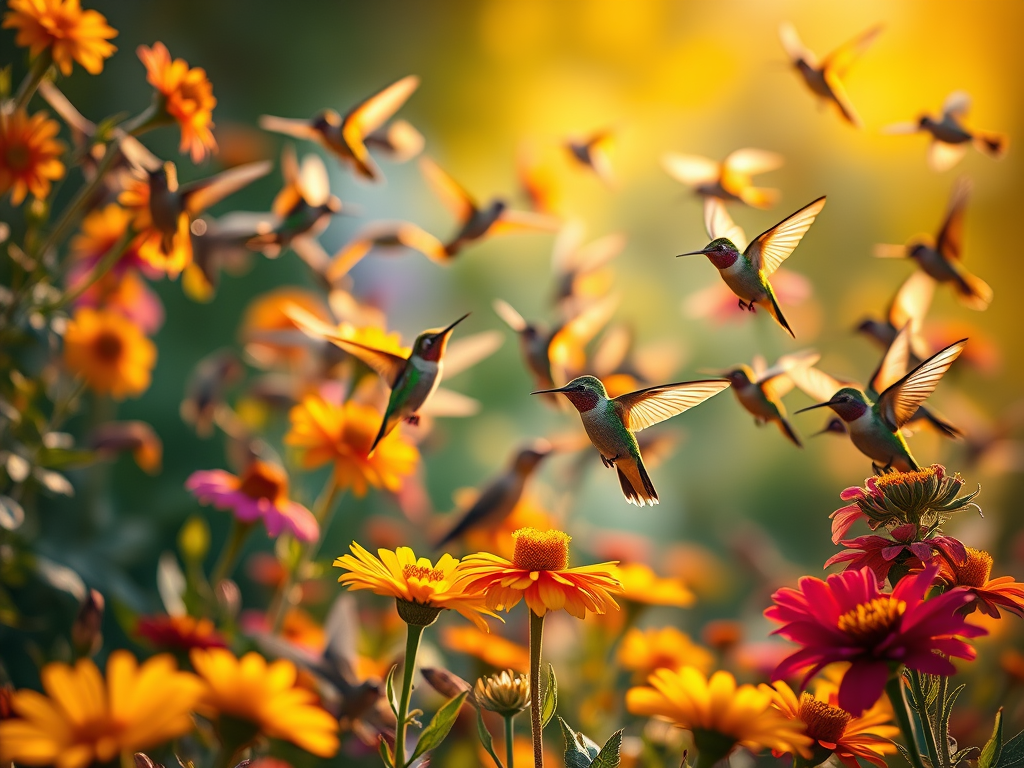
It isn’t often that we stop to revel in the orchestras of everyday life. That morning I did. When I did, I found myself transported. I had rarely seen this many hummingbirds together in one place and the noises they were making chittering together was music. What were they saying to one another? Were they discussing plans for the day? 

I smiled and reluctantly moved on – human beings had meetings of their own didn’t they? 

A few days later, I stopped listening to the chatter of the crickets starting up in the evening, even as the sun dipped into the horizon bathing the skies in robes of pink and orange. The deer grazing glowed, the blackbirds fluttered while singing, but the crickets were the loudest of them all. Enough to make you stop and wonder what they must all be saying to one another.

I exchanged glances with the son who’s come on a stroll with me, and we headed back musing.

Later we had a frenzy of celebrations planned – gatherings and people. I stopped to listen to the chatter around me. It was a feeling – not voices that I heard. It was a festive occasion, so all I heard was a pleasant hum – interest, friendship, camaraderie, laughter. 

What is it about communication that enthralls us so much? I remember reading a short story by Louisa May Alcott a while  ago in which a young girl acquired the ability to understand animals and birds for a short period of time. She is baffled to realize that they can actually communicate amongst themselves as well as amongst other species. A woodpecker could talk to a squirrel and understand each other perfectly. So, they could unite and we wouldn’t have a clue.

It was a beautiful touching story, for it helped me laugh once again at our own follies. It would serve us right if that was truly the case – too smart for our own good, but all the time being pitied by the wiser creatures of the Earth. Between all the languages we’ve managed to create as humans, it is truly humbling if that were the case. (No mishaps with honey and chips I assume.) 

It also made me stop and wonder what animals hear when they us jabbering. Many times on my walks, I come across people talking shop – serious talks on finance, technology trends (I live in the Bay Area – it is a way of life – you can’t throw a stone in any which direction without someone yelping ‘AI’ – whether as an expletive or not), movies, music, other people, offices, sports, etc.

What must they make of it? I wonder.

Navigating Life With the Power of Stories

Ooh! That’s a good one!

Read it!

Hmm..must check that one out.

Whadiddesey?

Predictable! 

I was enjoying the narrative voice in my brain as I jotted down the titles almost as much as the commentary given by the folks themselves. It had been so long since we sat in a room where everyone introduced themselves with their names and their childhood favorite book. 

image

As I went over the list I was writing, I wondered what those authors would feel when they heard about the kind of influence they had on children, now adults, decades later. Many of the authors we mentioned in our room were no more. Yet. Their words lived on, the worlds they created lived on, and the memories associated with these words and worlds lived on. One person said of their book that it saved them. The escape into the book saved them as a child. 

Isn’t that marvelous?

Our Fascination with Stories

I understood again our fascination with words, stories, images – in a confusing world, they provide guidance. In a fast evolving world with its revolving door of trends and gadgets, books provide continuum. 

To make sense of the world around us using stories is in itself an evolutionary gift. One that whales possess and possibly elephants too. Many creatures pass down knowledge needed to survive – are they in the form of stories? We do not know. We might soon enough. I read this article in which AI was able to decode sperm whale language. 

NPR: AI to decode Sperm Whale Language

Quote from Cosmos by Carl Sagan:

Some whale sounds are called songs, but we are still ignorant of their true nature and meaning. They range over a broad band of frequencies, down to well below the lowest sound the human ear can detect. A typical whale song lasts for perhaps 15 minutes; the longest about an hour. Often it is repeated, identically beat for beat, measure for measure, note for note. 

Very often, the members of the group will sing the same song together. By some mutual consensus, some collaborative song-writing, the piece changes month by month, slowly and predictably. These vocalizations are complex. If the songs of the humpback whale are enunciated as a tonal language, the total information content, the number of bits of information in such songs, is some 10 to the power of 6 bits, about the same as the information content of the Iliad or the Odyssey.

I would love to hear and understand the generational wisdom that these large benevolent creatures have for living in the oceans. The ever changing oceans must be a rich source of material. 

Through our words, and the stories of our lives, we help make sense of the world around us. We figure out what our heart desires, what our morals are, the choices we must make, the work we must do, the characters we want to become. 

Becoming is a Messy Business

So what are the stories we tell ourselves, and those close to us? How do those reminiscences help? I remember laughing at a statement I heard once – “avan oru padiccha muttaal  -அவன் ஒரு படிச்ச முட்டாள் ” which loosely translates to: “He is an educated fool.”, and it stuck with me. How often the growth that has to happen at critical moments in our life does not happen, and we are left dealing with the repercussions of this missed growth? The right book, the right story at the right time.

Becoming is a messy business, and yet as long as we have a sense of working towards who we are becoming, we can continue growing. 

In all these millennia, there does not seem to be a better teacher than stories. Small everyday stories of normal people navigating life in this balancing act of the universe.

Your Favorite Stories

“What about you? What was your favorite book as a child?”

I was somewhat surprised my turn had come this quickly, but I rallied, “The Magic Faraway Tree by Enid Blyton. We had this 90 foot eucalyptus tree near our home. It was so tall, more than half of it was obscured in the clouds, and it was very easy to imagine that high up in the clouds were revolving worlds – a new one every few days.” I said to a titter of polite murmurs. 

The remaining folks went on with their favorite books. In describing the old tree near our childhood home and all those rainy days spent reading my favorite books, I found myself smiling a small smile. 

This would be a nice thing to share with the children and ask after their favorite books. 

image

What was your favorite book as a child?

Each Day An Adventure

I can’t help but think of one of my favorite authors, Gerald Durrell and how he describes the greek island, Corfu and its environs. The colors of the island, the vibrance of everything around them.

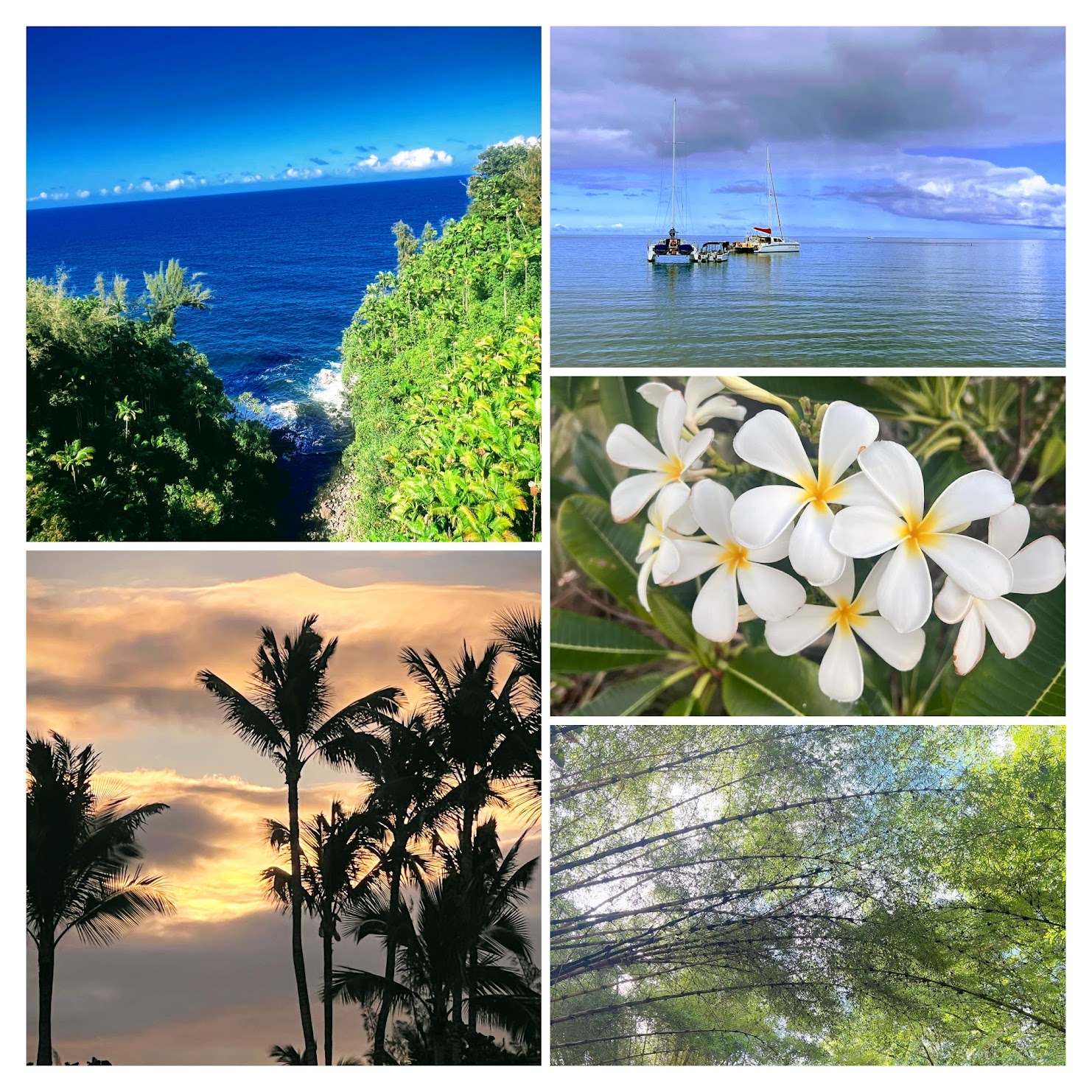
Hawaii is similar. It isn’t lost on me how very lucky we are to be able to visit the islands

I was trying to write about our recent vacation at Big Island, Hawaii. But I found myself strangely tied up for words. I could babble, I could close my eyes and let the images of the island rise up and shine out of every cell in the body. But I was having difficulty writing posts for them.

Hawaii is a sensation. A feeling that seeps into every pore, a light that illuminates every cell. It was the only possible explanation. How else could one feel surrounded by tropical flora, the full Milky Way galaxy overnight every night, the ocean and its abundance weighing down on you from every side?

Hawaii-COLLAGE

The colors, scents, warmth, waters, stars – many island destinations provide this feeling I am sure. But there was something special about the Hawaiian islands this time. It was an impromptu trip planned on the spur of the moment, each day unfolding as it came with not much thought or action plotted. Yet, every day seemed like a perfectly planned eternity that heavens boast of. We swam in the beaches, occasionally catching glimpses of colorful fish, or be gazing out at the changing landscapes on a drive and wonder how in one moment you felt like you were in the moors of Scotland with its brambles and heathen covered vegetation and the next in the misty mountains of Nilgiris with rain spattering your windshields; and the moment after gazing upon an ocean so blue and in so many blues that it surely could not be real, could it?

Every morning, I set off on my sunrise walk – quietly taking in the changing skies, soak in the light illuminating the island, and wonder about the stark difference to our work-a-day life and mornings.

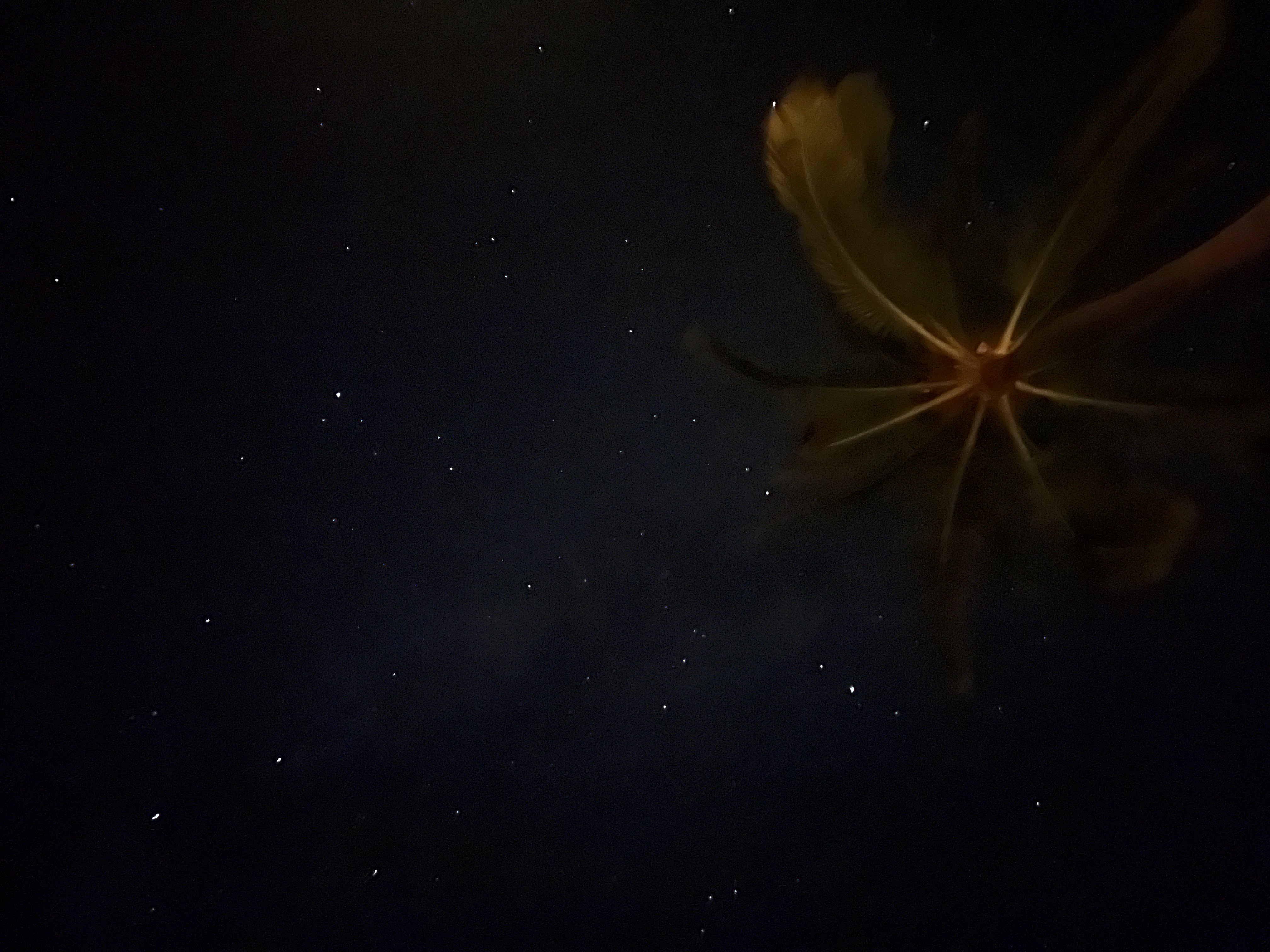
Every night, I would set off on my good night walk gazing up at the skies illuminated beyond anything I remember – maybe it was the fact that we were on an island far away in the Pacific Ocean with nothing for miles around, or something else, but the skies felt fuller – darker. Nothing but the piercing light of the stars to behold.

img_2425

“Gradually the magic of the island settled over us as gently and clingingly as pollen. Each day had a tranquillity, a timelessness, about it, so that you wished it would never end. But then the dark skin of night would peel off and there would be a fresh day waiting for us, glossy and colourful as a child’s transfer and with the same tinge of unreality.”

― Gerald Durrell, The Corfu Trilogy

Existential Angst & The Creation of Meaning

The son and I were listening to a podcast called Philosophize This on the Creation of Meaning series. Stephen West’s voice filled the kitchen while the week-end cooking was being done by Yours Truly, and a history project was being colored in by the son.

Many of us are familiar with the Existential Quest of mankind. In the absence of knowing exactly what animals think, we assume that as a species, we are uniquely gifted with existential angst. Does a whale worry about it? Do octopuses? Sheep?

Existential Angst

We all feel it at some point in time – some more keenly than others. Some for more prolonged periods in time.

https://www.philosophizethis.org/search?q=creation%20of%20meaning

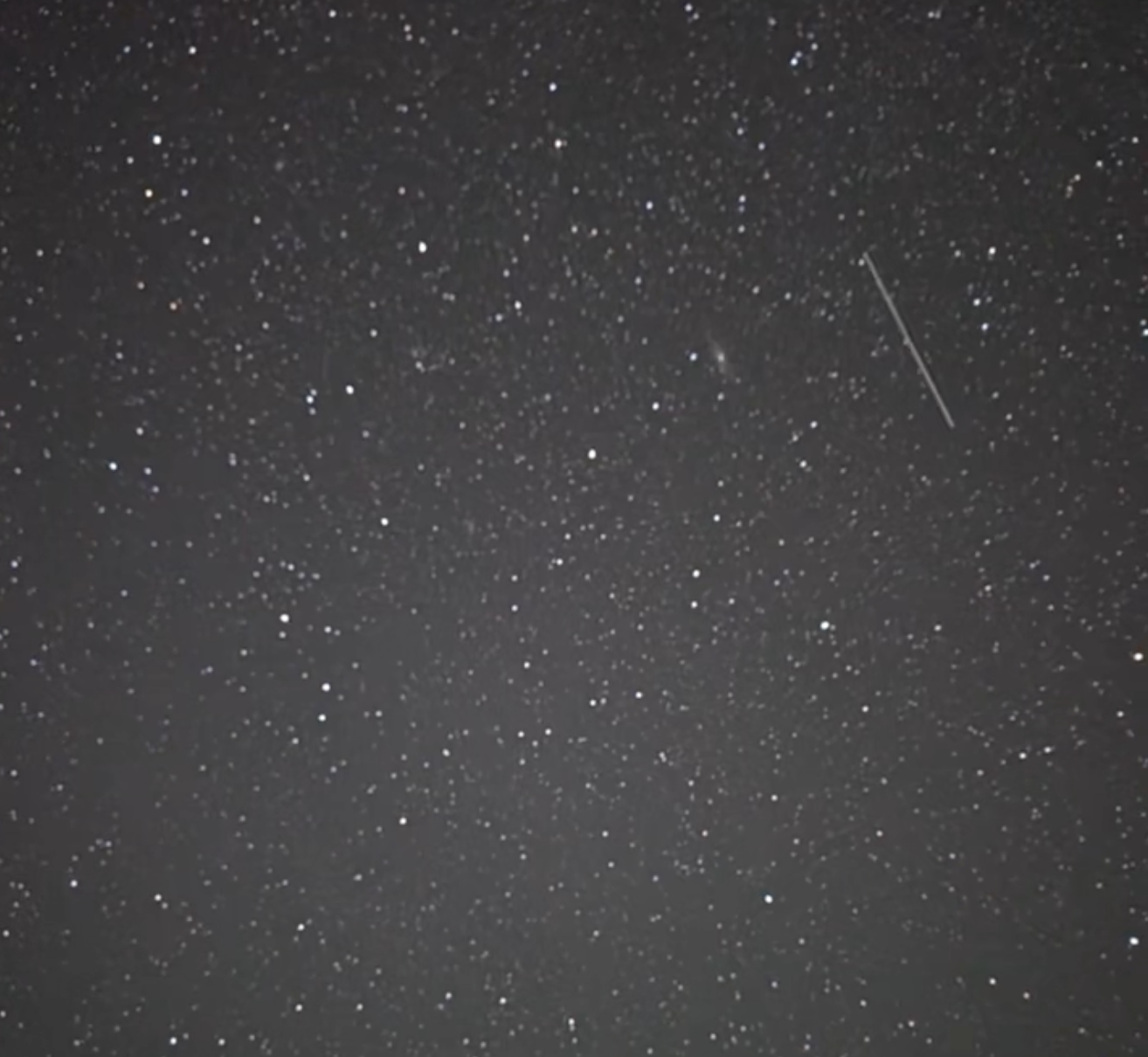
“Hmm…” we said almost together, and laughed. We were both thinking of that beautiful night a week ago. We were driving towards the middle of nowhere, in search of a parking lot, wide enough to allow us to glimpse the marvels above us, and far away enough from urban settlements to truly allow the darkness of the night to creep in and enclose us. It was during the preceding waxing moon phase, which meant that the skies were moonlit past midnight. So, we started driving past midnight and reached a suitably dark spot at about 3 a.m.

As we gazed up at the stars that summer night leading up to the August full moon, we were filled with this sense of awe. A sense of gratitude for being a part of this incredible universe, and for being able to play a small part in it.

Screenshot 2024-08-26 at 11.54.57 AM

One of my favorite quotes from Ursula K Le Guin from the Lathe of Heaven is:

“Things don’t have purposes, as if the universe were a machine, where every part has a useful function. What’s the function of a galaxy? I don’t know if our life has a purpose and I don’t see that it matters. What does matter is that we’re a part. Like a thread in a cloth or a grass-blade in a field. It is and we are. What we do is like wind blowing on the grass.”

― Ursula K. Le Guin, The Lathe of Heaven

The Perseid meteor showers were supposed to peak around dawn and we yawned our way through a steaming cup of tea to keep us company during the wait. In time, one or the other of us would yell, “There!”, and the others would moan. Till then, we gazed upwards, our eyes acclimatizing to the dark.

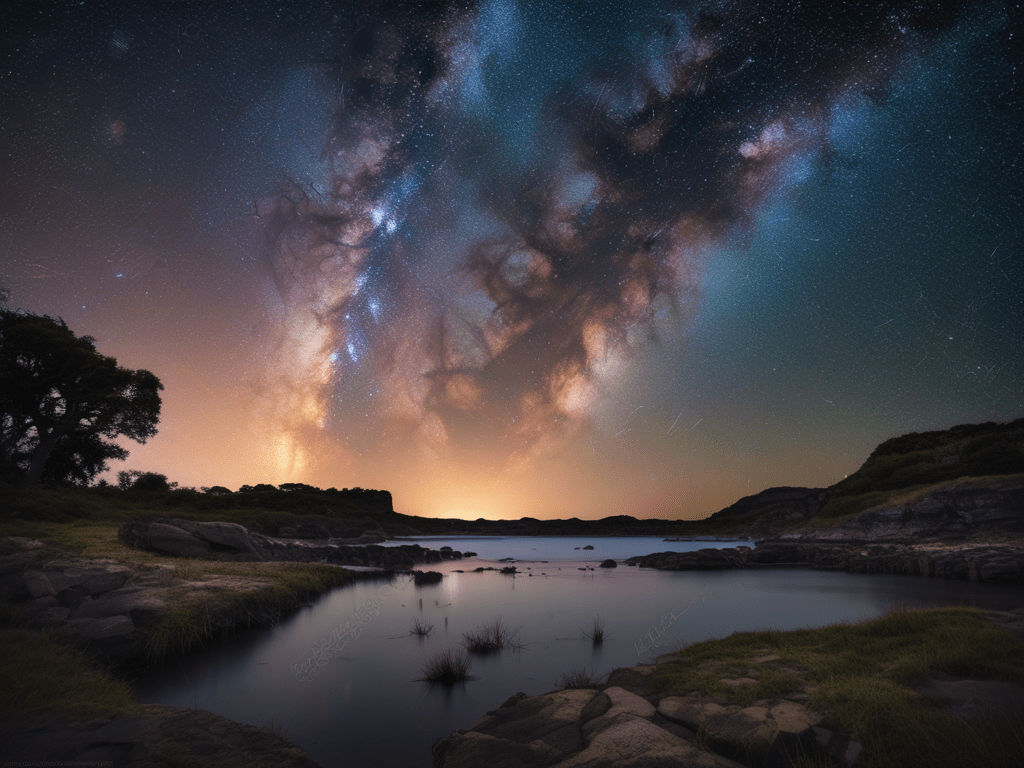
Whether we saw the meteors brightly enough or not, we did land up seeing the Milky Way -cloud-like stretch out and yawn in the canopy above. Lazily strewn – intensely bright in spots, and each star shining to its own capacity.

The Creation of Meaning

Huddled up watching the stars like that lulls the brain into the universe. With a slow sense of serenity and awe pervading your being, I found myself wondering about meaning.

Without meaning to, we attach an awful lot of meaning to many things.

Back in the kitchen, the son & I snapped back, and agreed that as far as meaningful experiences go, stargazing was at the top of the list.

“At what point do we decide that being us is all that is expected of us? Be a planet, be a star, be a galaxy, be an elephant or a human-being. There is nothing else. Why do we keep wanting to do meaningful things?” I asked.

The husband gave me an amused look, and said, “Huh Hmm! Pesu!” (You can Talk!)

I had the grace to laugh.

“But really – why not move to an obscure part of the planet, watch the stars at night and just live a happy life?”

“Why not indeed?“ He said, barely hiding the laughter in his voice.

“If more of us could do that, then existential angst would not be a thing, and without that, are we human-beings? That is how we come full circle or spiral into non-being! Get it? Get it?” I said chuckling. “Even the galaxy’s shape looked like we needed an artist’s rendition to show us the rest of the picture of the spiral. “

Screenshot 2024-06-29 at 3.32.19 PM

The daughter, who’d come yawning downstairs, said, “Thank goodness I wasn’t here for that meaningless lark. You’d have woken me up, and Euuuhh”, she shuddered and peered into the simmering contents of the stove. “Ahh – all my favorite things today! Thanks Ma!”

“The Creation of Meaning! Ladies & Gentlemen! “ I said with a flourish, and she laughed.

Question for you:

Life’s meaning to each of us is different and it is different at different stages in life. What are some of the things that you think give meaning to life?

Rediscovering the Art of Play: Exploring the Wonders of the Solar System

I vividly remember one Science class in which my teacher explained the solar system, our place in it, and how fast we were traveling through Space. It is an incredible concept, and when explained well, can spark interest and curiosity in a young child. I remember being flushed after that Science class, maybe because I was chosen to be the Earth. I had to rotate and spin around one of my best friends who was the Sun. What greater joy could there be?

man_in_stars

 As interesting as the lesson was, what sealed the memory in my mind is the fact that the chosen sun that day was exuberant, the chosen earth was joyous, and the rest of the class giggly and slightly jealous that they weren’t the ones to be given the chance to get up from their seats. The latter point gave way to some accusations about being picked by the teacher  “How come you both were picked? Sitting right next to each other too?”

I saw their point. Usually, teachers are careful about picking volunteers or nominees from opposite ends of the classroom. These little dramas are part of what makes our time together memorable.

The little upset may have dampened our spirits somewhat, but we were quick to regain lost ground. To children who generally liked the joy of spinning, the morning lesson was a gift indeed. To those of you who have not experienced the heady giddy sensation of going round-and-round  recently, please try it again. It is marvelous. If you can find a giggly companion, young at heart, please do so, and it enhances the experience in no small manner. 

Hypothesis, Conclusions, Fact-Checking & Collaborations

I remember it was during our little spin-ney-spin-ney sessions that one of us had a question as to why we feel giddy when we spin. Science is full of people who came up with their hypotheses and then set out to prove it. Our little band of scientists was no less committed. I came up with a perfectly wrong explanation for the phenomenon and it shows the sturdy nature of my friends that no one laughed at me that day. Instead, they indulged me in an experiment. 

“Maybe the Earth is already spinning and when we spin in the opposite direction, it makes us feel dizzy.”  

There were some thoughtful nods at this – “Then we should be able to spin even faster if we were to go the same direction right? “ said one. There was only one way to check – spin in both directions and find out for ourselves if this was the right theory.

 “Which direction does the Earth spin – do you know?” A collective wave of shoulders shrugged at the same time, but little things like this do not deter the determined. Someone said we will just time each other for 10 spins in each direction, adjust for right-handed, left-handed, ambidextrous, null-i-dexterous (the opposite word for being equally clumsy with both hands is called ambisinister, but I think null-i-dexterous sounds kinder) and we would be set.

That’s what we did. The exercise resulted in loud laughter, and the sound waves brought the earlier complainants to the fold wanting to join in the game too. All recent rancors forgotten, the experiments were done with rigor, encouragement and accuracy.
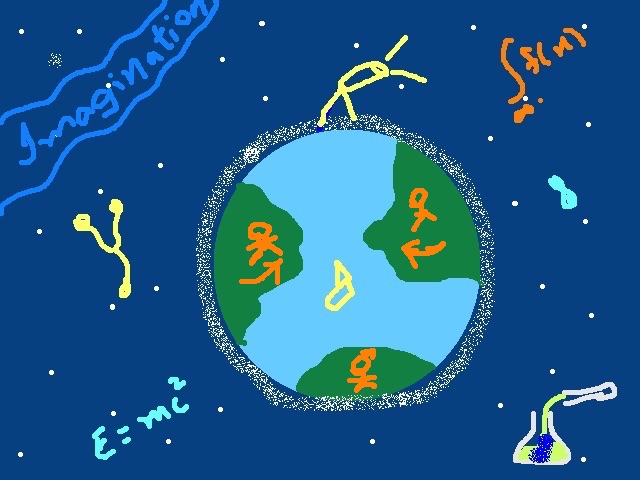
the_world_playground

While we are always in awe of the creative thinkers who take us a leap forward with their works, I have always wondered how each moment came to be: how Thinking Man figured so much out. This is one of the best ways in which I have seen the sentiment expressed.

 Excerpt from The Book That Nobody Read – Chasing the Revolutions of Nicholas Copernicus by Owen Gingrich

“The greatest of scientists have been unifiers, men who found connections that had never before been perceived. Isaac Newton destroyed the dichotomy between celestial and terrestrial motions, forging a common set of laws that applied to the Earth and sky alike. James Clerk Maxwell connected electricity and magnetism, and showed that light was electromagnetic radiation. Charles Darwin envisioned how all-living organisms were related through common descent. Albert Einstein tore asunder the separation between matter and energy, linking them through his famous E=mc^2 equation.”


Scientists do not always know what to expect and can sometimes be surprised at the results. That is what happened to us. The results were inconclusive and resulted in:

* One of us falling to the ground laughing heartily

* Another banging their head against a conveniently placed pole nearby 

* Another giving off an inaccurate imitation of a drunkard, which was impressive given that this was happening prior to the Internet or Cable Television, and the child’s parents were teetotallers

* Two subjects crashing into each other mid-orbital, resulting in tummy aches and headaches together 

 Our motley band of scientists had by this time dissolved into a fit of giggles. Good naturedly, we shrugged off the theory, accepting with grace that it may be an erroneous hypotheses and moved on to the next thing to play together. Consensus, criticism, fact checking, and collaborations had been achieved with the greatest of unity and hilarity. 

The Art of Play

In every problem, creativity and imagination are our solid allies. The simple act of playing together and collaborating to solve problems, keeping each other true is now more valued than ever. Today to see that school recess times have come down; children do not play out on the streets in free play mode anymore, but are rather being ferried up and down to supervised, classes with rigid rules of social conduct usually in the presence of adults; and the playgrounds in our neighborhood have become safe havens for spiders to spin their webs. 

Could we add in structured unstructured time – so we can all benefit from free spirited Play once again?

Those who were never exposed to Play may not miss it, but those who know the beauty of it, will always feel the richer for it. Much like Art, Play is Art, and I pray we do not lose the Art of Play.

Mine Eyes Have Seen The Glory

I have always been fascinated to see the world through another’s eyes. Maybe one of the reasons I am drawn to Fiction. It does seem to be an innate trait too. Obviously when I read the book, Eye By Eye – Comparing How Animals See – By Sara Levine, illustrated by T S SpookyTooth, it brought the eye fascination back in full force.

img_2088

I closed my eyes after reading – it was well past midnight – I had probably read 3 or 4 different books and I really needed to sleep if I had to be a functioning adult the next day. So I did. I closed my eyes – wondering about eyes.

If there is one overused trope in fiction, it is the eyes being the mirror of the soul. It is . Please don’t get me wrong. Expressive eyes are amazing. But I do find it over-used. How the eyes turned flat and gray, how the eyes were blue with excitement (Can eye color really change like that?) Also can the eyes show everything happening in another’s soul? The pupils dilated, the eyes red. 

In reality, how often do we sit and observe another’s eyes? I am reminded of this experiment by Sheldon & Penny of Big Bang Theory fame

The Big Bang Theory – Penny and Sheldons love experiment S08E16 [1080p]

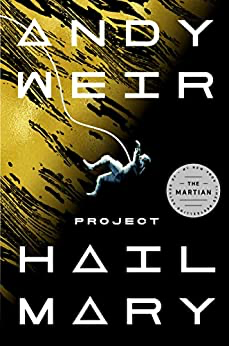
However, it is beautiful that we have an organ that allows us to experience our world in such a wonderful manner. In Andy Weir’s book, Project Hail Mary – he meets an alien species, from Erid in the Tau Ceti star system 12 light years from Earth, who do not perceive light. That made for an interesting premise – for they were an advanced civilization able to design space travel etc without sight.

image-3

https://en.wikipedia.org/wiki/Project_Hail_Mary

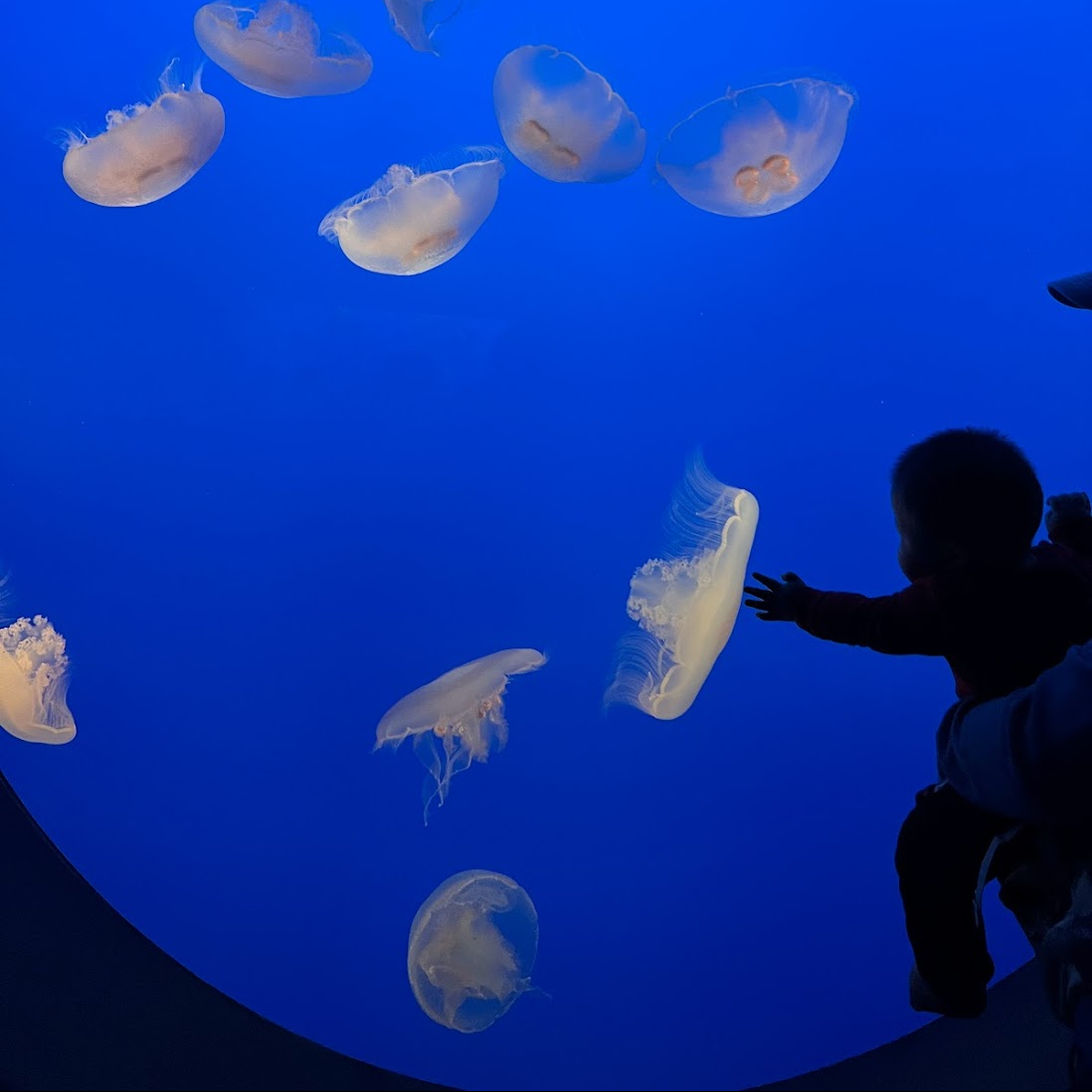
Anyway, where I’m going with all this meandering about light and sight is that, I was shocked to read that some underwater creatures do not perceive the color blue, and navigate a gray world instead. It made me sad for some reason – the blues are all we think of when we think of oceans and the lives it nurtures. How many shades do we have to describe the blues? Cerulean, Turquoise, Teal, Cyan, Aqua, Sky Blue, Royal Blue, Light Blue, Navy Blue and all the shades in between, and yet some creatures of the deep sea see none of that. Starfish, for instance, only perceive light as a vague form of light – they do not perceive differences in wavelength. 

cropped-img_5618

Cuttlefish, with their pupils W-shaped – what do they perceive? 

Seeing the world through another creature’s eyes can be rewarding, interesting and will make us more empathetic and passionate towards caring for our environment and preserving all the different kinds of life, would it not?

I might have made the goat whose eyes I stared into on my walk very nervous. You see? Ever since I read that goats have rectangular pupils, I am drawn to them. They allow me a moment to observe their pupils, then turn away bored. Interested in getting to that low-lying branch to eat. 

One goat even gave me an amused look – I did not detect amusement in the eyes if that is your question, I saw the face quirking up differently and moving away as though shaking its head.

Books:

The Magic of Waves, Birds and Beach Theories

August rolled around, (and well, a week into August, ) I realized that I had not written a single post. As I racked my mind to see what I’d like to write about, I found my brain in a blissful state of blank.

You see, as August rolled in, we found ourselves welcoming the month lolling on beaches, in art fairs, and in friends’ backyards playing games, chatting and soaking in the summer sunshine. All perfectly pleasant, remarkably blaze, and highly recommended activities. 

Wave Theories

One day at the beach, we walked – a jagged path dodging waves, chatting of wave dynamics and such. The predictions on the reach of small waves, vs the bigger ones proved to be a particularly engaging activity. It was curious to see how many times the smaller waves reached the farthest as though they didn’t believe in bravado and overt shows of strength, but simply did what needed to be done. The big waves made huge splashes, but fizzled out quicker. Very few were impressive in both size and reach. 

It also led to some hilarious moments remembering old professors drone on about Wave Theory.

Bird Theories

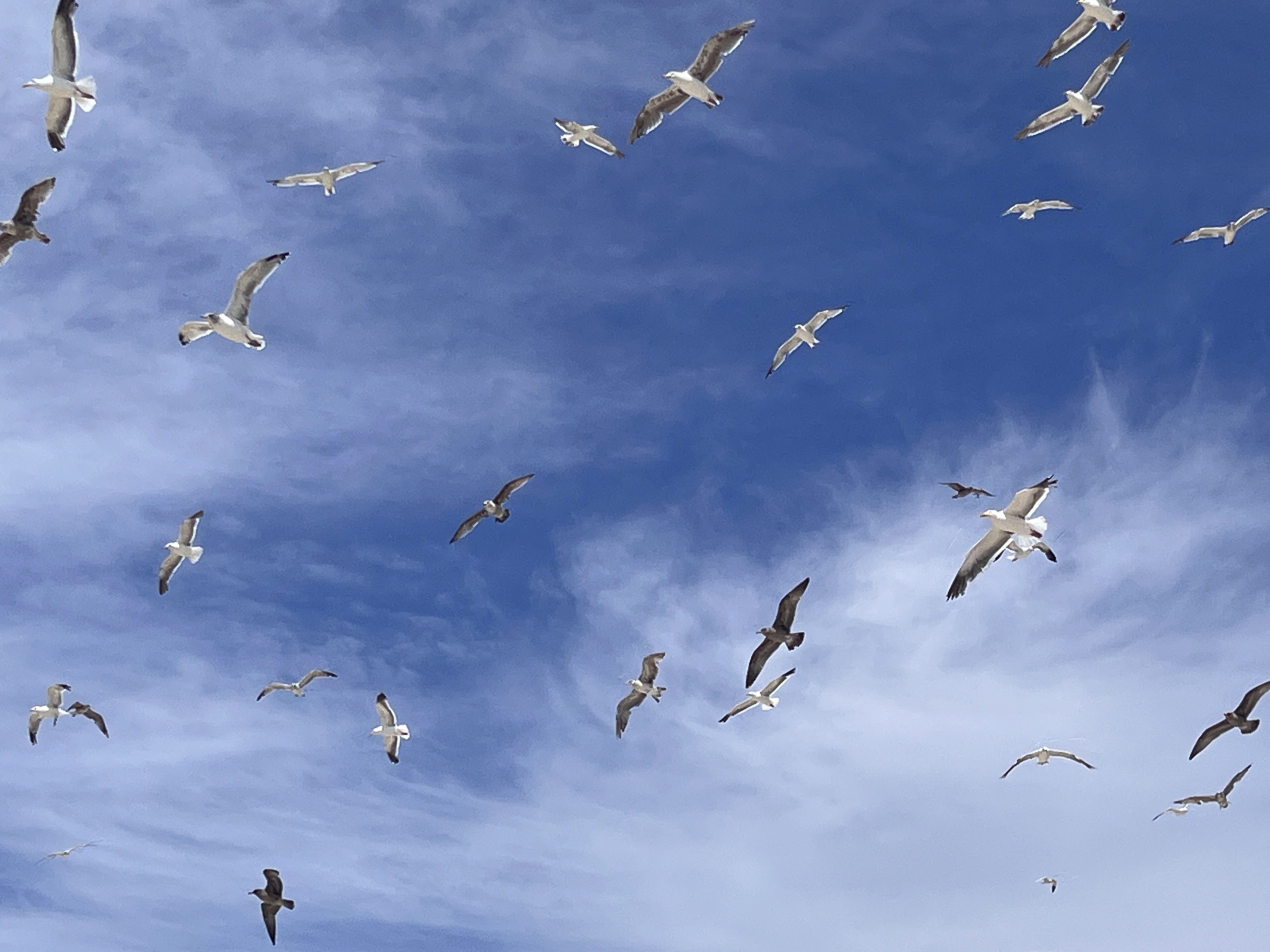
We watched hundreds of seagulls take to the skies for no apparent reason, and come back together for the same reason.

  • Could there have been a call to duty that was rendered unnecessary?
  • Were there portals for the gullible opening? (Get it? Get it?)
  • How much we creatures need to communicate with one another.

img_2164img_2166

Books at the Beach

I also found myself reading my first book by Salman Rushdie:Two Years, Eight Months, & Twenty Eight Nights

I found the book a good one to read at the beach: It feels possible to imagine jinns who made love with humans 800 years ago, and magic portals opening up to let the worlds in, while there. After all, there is an infinite sense of possibilities while lying calmly on a beach and reading. 

Sand Castle Theories

After all, it is where we build sand castles, and let our imaginations run wild:

  • Could it be as a volcano erupting 300 years ago?
  • The moats around the castle could have been the battlefield of a thousand troops. 
  • The secret passageways within the sand castles could be the architects way to ensure people could flee.

Oceansides and beaches may just be the magic we all need in our lives every now and then.

“The sea can do craziness, it can do smooth, it can lie down like silk breathing or toss havoc shoreward; it can give gifts or withhold all; it can rise, ebb, froth like an incoming frenzy of fountains, or it can sweet-talk entirely. As I can too, and so, no doubt, can you, and you.”

― Mary Oliver, A Thousand Mornings: Poems

Embracing the Tranquility of a Summer Evening

The day could have been better. My to-do list gave me reproachful looks all day long as I took care of many different things and accomplished nothing. It was time for this and time for that, not yet time for this-and-that, and oh-so-past-the-time for this-or-that. Finally, I wrapped up for the moment and headed out. It was a beautiful summer evening after all, and moping about not doing the work was not going to get it done. 

That’s how I found myself that beautiful summer evening, doing yoga in a friend’s garden that she had kindly invited us to. The sun’s rays danced through the maple leaves in the west, the mild breeze provided much required respite and made the italian cypress trees in the east look like they were dancing and swaying to the breeze too. 

The pink bougainvillea in the south leapt from fence to tree with such freedom of spirit, that I couldn’t help feeling a bit wistful at not being able to boldly leap and catch hold the way those plants did. How did creepers know whether they’d make it to the next branch? There must be a bold vision and a willingness to let go of safe harnesses that we never really stop to think about. I wonder how that feels – it certainly seems to be something we struggle with as adults more than as children. 

To complete the bucolic yogic scene, was the neighborhood black cat. Well-fed, preening its coat, gleaming in the evening sun and stretching every now and then to show us what a good stretch looks like, she lay there looking perfectly happy with the way her evening was going (or her days were going) by the looks of it. 

I told my friends about the state of to-do-ness that had ailed me that evening, and how the evening completely transformed it. My friends seem to have been in similar states of mind – and it all came spilling out the moment I said so. 

We smiled and drank in the scene: The cat did not care, the trees continued to sway, the leaves shone and the parched earth settled down to a cooler evening, the birds above made their way home. The purpose of life was right there, for those willing to take it.

The best part of the evening was the various angles from which we took in the garden – upside down, sideways. While breathing hard, while taking deep breaths. I tried taking the picture of the garden upside down, but of course all our tools seem to want to correct all our ‘mistakes’ and would not allow me to. So, I rotated the pic manually to retain the beauty of the world seen upside down.

upside_down_garden

Dancing in the wind, with the sun on my face.

Playing hide-and-seek and eating a treat.

It reminded me of Dr Seuss’s quote on looking at life

Fantasy is a necessary ingredient in living, it’s a way of looking at life through the wrong end of a telescope, and that enables you to laugh at life’s realities.

Dr. Seuss

Gazanias in the Garden

Time Paradox

There is a continuous time paradox that we run into in our lives.

My generous friends offered to help me plant my newly acquired gazanias in a small garden patch. You see, several times in the pasts, they’ve tried helping me with different plants with the cheery confidence that gardeners have:

“You cannot go wrong with these – they will definitely grow.”

“You don’t have to do anything, they will grow by themselves.”

“See those – they just spread without doing anything!”

To these optimistic statements, I say, “Challenge accepted!” and go ahead to botch the poor plants with the bumbling blistering competence of a dancing octopus with a shovel. (generated by Gemini AI)

octopus_shovel

So, they took pity on me, and came by with their shovels, hats, and laughter. The patch itself was a tiny one, but as we tried to turn the earth over, it was apparent to them why nothing grows there, and how I was making such a killing with their plants and bulbs. The patch was full of pebbles. So, instead of doing a half-baked job, they all pitched in till we were all shoveling, digging and plodding the earth along. We removed pebbles by the dozen, and by the time the patch was turned over, and the new gazanias were in place, we felt like proper earth movers, ready for some tea and biscuits.

Things take the time they take

As I sipped the tea though, I realized how much work goes into gardens that beam at us everywhere in suburban areas. If this small patch of land took us around 2 hours to do, how do people manage large yards, and sprawling garden spaces?

These things made me think of time itself. We did not realize that it took us 2 hours to plant the gazanias.  That night when I went to bed, I had a wholesome ache in my arms, and dreams filled with fresh soil and flowers. 

All this pondering on gardens made me realize how impatient I am with myself for things to develop into fruition: that garden patch, that novel, that myth, those short stories, those children’s books. Things take the time they take. Sometimes more than one thinks is necessary, but if we keep at it, removing one pebble at a time, moving one ounce of earth at a time, that is all that should matter.

I used my best philosophical insight voice and said so to the husband who chuckled and said “Pesu!” (Talk!) .

Ursula K. LeGuin’s Influence: Embracing the Passage of Time

This impatience towards results: Could it have something to do with the pace of modern life? After all, we spend a monumental amount of time flipping through videos on fast-forward mode showing us how cakes are baked, iced and decorated in less than 15 seconds. In reality, the whole process could easily take 2-3 hours. Do we really feel a sense of participation in the cake-making process by scrolling and consuming it? I think not. 

It reminded me of the interview by Ursula Le Guin in which she talks about time. 

“I lived when simply waiting was a large part of ordinary life: when we waited, gathered around a crackling radio, to hear the infinitely far-away voice of the king of England… I live now when we fuss if our computer can’t bring us everything we want instantly. We deny time. 

We don’t want to do anything with it, we want to erase it, deny that it passes. What is time in cyberspace? And if you deny time you deny space. After all, it’s a continuum—which separates us. 

So we talk on a cell phone to people in Indiana while jogging on the beach without seeing the beach, and gather on social media into huge separation-denying disembodied groups while ignoring the people around us.

​I find this virtual existence weird, and as a way of life, absurd. This could be because I am eighty-four years old. It could also be because it is weird, an absurd way to live.”

~ Ursula K. LeGuin, Interview by Heather Davis

I remembered one remark made by a mother of an elementary school going child who had helped her child out with an art project, and put it up as a reel on her feed: “That reel took more than 4 hours!” she said wistfully. 

I grinned, swiped, and sent a quick ‘like’ before parting ways. That was that. 

I have often wanted to see a flower bloom, or a berry ripen – but the real magic happens so slowly, you barely realize it is magic at all. Maybe, that is the real magic – work with a good intention, do your best, let things take the time they take, and develop into what they need to. In the meantime, I head out everyday to gaze at my gazanias – so lovingly planted. Surely, they heard the chatter and the laughs as they took root. In time, I hope they laugh too.

img_1524-effects

The Crafting of Characters

Development of our Characters

Book: Normal Rules Don’t Apply – By Kate Atkinson

I was reading a book (predictably), the son and husband fiddling about with their laptops. The short stories in the book,  Normal Rules Don’t Apply – By Kate Atkinson, were good. Really – we need more short stories than large novels of our lives, and this particular story was proving it so.

kate_atkinson

Quote:

“Good looks didn’t count for much with Franklin, he was the handsome child of handsome parents and had witnessed at firsthand the havoc that could be wrought by the pursuit of beauty without truth.”

A simple sentence – borne out generation after generation, and still as relevant in its truth.

In fact as I am writing this post, I thought of the variation of the quote in Jane Austen’s Emma:

“Vanity working on a weak head produces every sort of mischief.”

Jane Austen, Emma

Many of us remember the struggle (or continue to struggle depending on age, sex, race, nationality etc) of perception against self-esteem – I suppose it is hard to escape that. Society has improved by spades, but yet I do still see the expectations of eternal youth and raving beauty all around us. It is there in the filters that apps like instagram offer, it is there in the AI generated models’ and their definitions of beauty. It is there in the cosmetics, the advertisements, and even if most folks aren’t consumed by it, they are at the very least affected by it.  

Character Building

The building of character, the shaping and becoming of our authentic selves, however is a harder journey, and therefore, that much more satisfying, was it not? Luckily that is where the short story was heading towards. I read on, and stopped to read this piece twice. 

“Franklin spent his life under the impression that one day he would be tested, that a challenge would appear out of the blue- a war, a quest, a disaster-and that he would rise to this challenge, and not be found wanting. It would be the making of him, he would come into his own. But what if this never happened, what if nothing was asked of him? Would he have to ask it of himself? And how do you do that?” 

I remember writing a short story as a child. It was of a young girl, influenced by adventure books of Enid Blyton, looking for an adventure to prove their worth – their bravery, loyalty, their ‘goodness’ in the world. It was, in hindsight, partially autobiographical. For adventures seemed to come to these protagonists in stories, but seldom on such grand scales to ordinary beings such as us. I asked the middle schooler in our midst about the adventures they had, and he sighed somewhat wistfully, and said, ‘Ugh! Most days, The biggest stuff is whether to run via the library to PE, or return the book after PE, but risk getting to the next class late, amma! There aren’t any adventures! That’s Harry Potter stuff, not for us!”

We laughed and I told him about the story of the girl I wrote as a girl. But I continued musing that night. 

Everyday Choices & Grand Tests

Was a Grand Test better than the somewhat lackluster set of everyday choices and conundrums that shaped our characters?  

🪅Do you let your friend copy your homework? 

🎋Do you give in to the temptation of an extra toffee knowing your sibling will lose their share? 

🎏Do you sheepishly confess to being the person responsible for not finishing that group project on time?

Would we welcome the dramatic or realize that solid, everyday security was more difficult to achieve?

‘Dramatic things always have a bitterness for someone.” – L M Montgomery, Rilla of Ingleside, Anne of Green Gables series

Whether by dramatic events or small everyday events, we are constantly becoming – as long as we look into the mirror and like the character reflected to us, does it matter?

What do you think? Do you feel our small everyday choices help us take on the dramatic when they do happen, or do we find something within us that we didn’t know existed when the dramatic happens?