The Joys of Walking

There are places where walking is no longer allowed. Especially in densely populated areas where the coronavirus is raging and ravaging the population. Talking to my parents the other day, the father sounded strangely dull. A little prodding revealed that the evening walk was cut from his list of allowed activities for a few days, and I felt keenly for him. I, like him, enjoy nothing more than tying my hands behind my back (unladylike as my mother often said when I was growing up), and taking in the sights, smells and sounds of the air around me. Often, I don’t remember where all my mind has wandered during these walks, but I always come back strangely uplifted, the day’s conundrums a little clearer, and life’s perspectives a wee bit sharper.

I sympathized with the father and told him that all we could do was to make the best of the situation. For instance, I told him,  I had not enjoyed tea in my backyard for all this time. My work spot is a good 50 miles away from where I live, and I spent many an hour getting to and from work. Silently sipping my tea in the backyard before the day at work began the other day, I felt strangely grateful for this time – the time that I would ordinarily have been rattling to work on a crowded train. But that morning as I sat under the cypress trees, watching the sycamore sway in the breeze outside, I slowly raised my head upwards and was dazzled at the most beautiful blue that greeted the eyes.

The father lightened up at this little piece of my day that I shared with him, for he enjoys our backyard too when he visits, and spoke fondly of the squirrels. The squirrels really are admirable as a means of entertainment. They titter, run and make merry all day long in the fruit trees, and before you know it, a pleasurable time has been had by the entertainers and entertained alike. 

Walking makes philosophers of us. How many times have I admired the mallard ducks and the geese for their spirit? All these little creatures that we share the Earth with have to be the most engaging lesson-givers in the world. Squirrels, cats, butterflies, dogs, geese, ducks, and blackbirds – they are all marvelous teachers to the philosopher willing to take in lessons.

We fell into discussing the joys of walking, and he spoke of Thoreau and a number of writers who were known for their musing during their daily walks. We laughed at how some of our best ideas after hours of walking were nothing short of ordinary, while these authors of whom he spoke so highly had truly world-changing ideas at the end of theirs. One day at the end of a long walk, I came back with an epiphany about ducks, I said, and I wasn’t joking. 
ducks

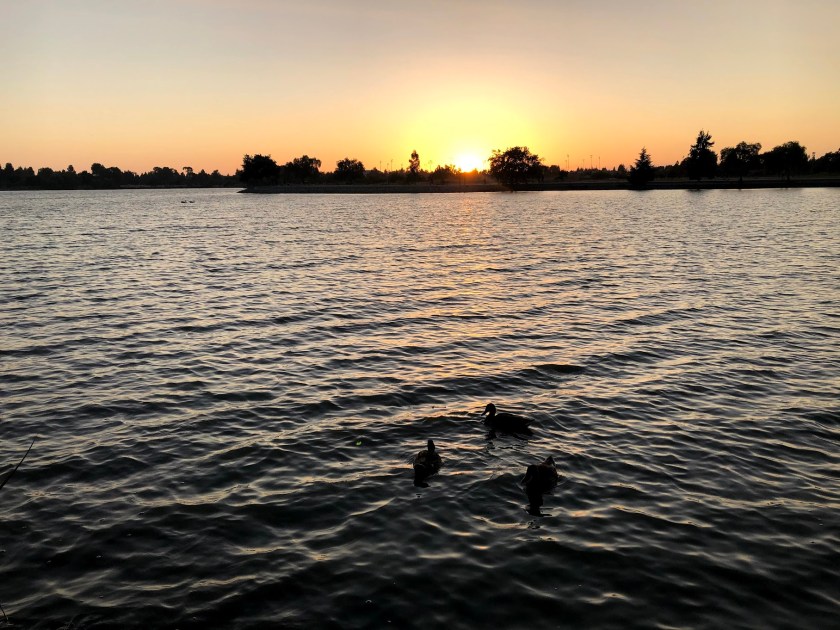
T’was one evening after a nice long walk, I sat by a lake. The waters were clearly more than 20-30 feet in depth, and I remember wondering whether ducks felt any qualms about plunging into waters that deep. Do they examine their toes studying the webbing and decide to swim? Do they stretch their legs knowing it is waddle-worthy? I have watched the ducks hatch their little ducklings countless times in the spring, and watched them teach their young to take to the waters. But how do they know their capabilities? Do they stretch their wings knowing it is intended for flight?  Ducks have to be the most admirable creatures for they adapt to any medium with ease, and seem to enjoy  it. They waddle, swim and fly with ease. 

How about that? 

“Anyway, why don’t you watch what you eat since your daily walks are also cut?” I said taking a large dollop of ice-water and pouring it over his igloo.

The mother came hissing into the phone like a queen bee in-charge of delivering the daily news updates to the BBC at this, and said, “As if! Now, because he is bored, he eats almost continuously from 4-8 p.m!” . We all landed up laughing at this. 

“Must see how these ducks control their diet Appa. But now that I got the chance to observe squirrels, I don’t think they control their diets very much. Munching on fruits all day long, and talking bites out of them and flinging them to the ground without even properly polishing them off!” I said.

And on this note, we said toodle-oo to each other. I continued on a walk grateful that I could indulge in this activity though my mask made me feel sweaty and hot. He went to make himself some coffee to go with his mid-morning snack. We both pondered on life.

A Philosophy of Walking

Qi to the Yin & Yang

Fact and Fiction were swirling and creating waves and patterns inside the old eggshell. Harry Potter – A History of Magic was entertaining in ways I did not quite expect. Regular readers and friends know how much I love the Harry Potter series. The sheer brilliance and richness of the world, and the marvelous ways in which J K Rowling examines our world has been written about in far greater depth and width and by far greater minds than my own. (Leaky Cauldron site for instance)

I know I enjoyed reading  this in The Prisoner of Azkaban

“Witch Burning in the Fourteenth Century Was Completely Pointless — discuss” – Holiday homework set to Harry Potter and his classmates in the Prisoner of Azkaban.

“Non-magic people (more commonly known as Muggles) were particularly afraid of magic in medieval times, but not very good at recognizing it. On the rare occasion that they did catch a real witch or wizard, burning had no effect whatsoever. The witch or wizard would perform a basic Flame Freezing Charm and then pretend to shriek with pain while enjoying a gentle, tickling sensation. Indeed, Wendelin the Weird enjoyed being burned so much that she allowed herself to be caught no less than forty-seven times in various disguises.”
—Bathilda Bagshot, A History of Magic

Harry Potter – A History of Magic book was amazing – Firstly, it contained little tidbits of deleted sections, some planning sketches etc. Secondly, it was organized by subject area: Herbology, Charms, Astronomy, Divination, Care of Magical Creatures, & Transfiguration. In each section were glimpses into humankind’s long fascination with magic. It is astounding to see the vast repertoire of knowledge that the author herself had to be able to synthesize all this and to create another world based on anthropological details, myths from various cultures and her own dose of fantastic imagination.

history_magic

The mind was reveling in the fact and admiring the fiction therein. Our cosmic dance of fact and fiction as a species is almost necessary to examine and understand the world around us. We are story tellers, and we are curious to understand and infer. The Qi to the Yin and Yang of understanding the world around us.

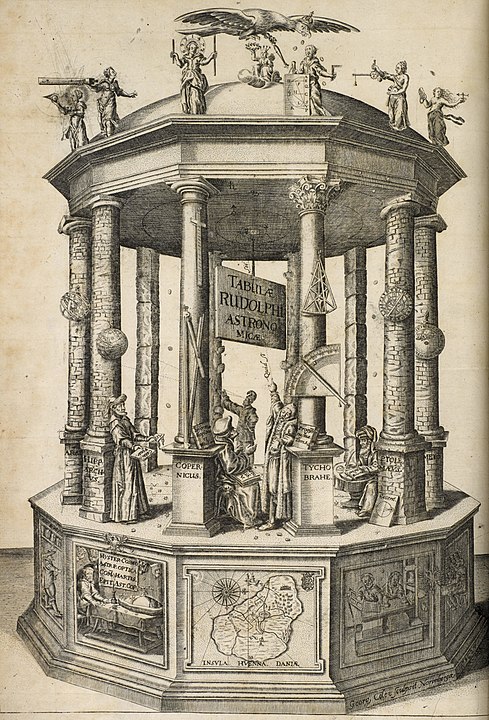
The Astronomy section of the book contained a drawing of the Rudolphine Tables, which helped the reader locate the planets amidst the stars. Containing the locations of 1000+ stars, this was probably the most comprehensive study at the time.

Beside the picture of the Rudophine Tables was a note by Alexander Lock, the Curator
“In 1617, Kepler’s mother was suspected of witchcraft, a crime punishable by death. The accused spent over a year in prison but was eventually released when her son intervened. Kepler was an official astronomer to the Holy Roman Emperor – this family intrigue must have been very difficult for him.”

489px-Johannes-kepler-tabulae-rudolphinae-google-arts-culture

I could not help linking this with some of the things I read in Carl Sagan’s Science as a Candle in the Dark, especially a chapter titled the Demon Haunted World, in which he talks about the grotesque practice of witch hunts and how it became an increasingly profit driven model as well.

Pope Innocent VIII (if ever there was a name that was totally out of sorts with the meaning, this must be it). Pope Innocent was singularly responsible for starting and popularizing the witch hunts in the 15th and 16th centuries leading to millions of people losing their lives and millions more living in a state of constant fear.

There are demon-haunted worlds, regions of utter darkness. – The Isa Upanishad (India ca 600 BC).

With a single proclamation in 1484, Pope Innocent VIII “initiated the systematic accusation, torture and execution of countless “witches” all over Europe.

While we know of the barbaric practices, little did I realize how pervasive the evil was – The Demon Haunted World -By  Carl Sagan:
It quickly became an expense account scam. All costs of investigation, trial, and execution were borne by the accused or her relatives down to per diems for the private detectives hired to spy on her, wine for her guards, banquets for her judges the travel expenses of a messenger set to fetch a more experienced torturer from another city, and faggots, tar and hangman’s rope. Then there was a bonus to the members of the tribunal for each witch burned. The convicted witch ‘s remaining property, if any, was divided between Church and State.

While I am enormously glad to see that we have evolved past this especially cruel phase of mankind’s history it does make me feel terrible about the state of things in the world today. Conspiracy theories, choosing which version of the truth to believe in etc have been problems for a long time, but now it seems these problems have occupied center stage because the leader of the free world seems to spend enormous amounts of time ingesting and spewing conspiracy theories himself.

Maybe it is time for all of us to equip ourselves with Carl Sagan’s famous Baloney Detection Kits.

But there is hope, we have moved past the atrocities of witch-burning to the point that we are now not only able to have witches and wizards in our stories, but also have a clear distinction between fact and fiction.

The yin and yang are sturdily holding their own, and I hope our qi (understanding) will remain unclouded and clear.


💦 🌳 Earth 🌏 Magicians 💥❄️

Magic was in the air. The afternoon sun was shining with an intensity that surprises us every summer. The high temperatures should really not surprise us anymore, but we still scuttle inside in the afternoon sun and wonder how it got to be so hot so soon. Inside the home, we were grateful for the cool atmosphere – the suns rays were filtering in through the large sycamore tree in the backyard, bathing us in Komorebi.

Komorebi (木漏れ日): Sunshine filtering through the trees.

trees_komerabi

Komerabi is beautiful and especially marvelous to experience on a week-end afternoon after a hearty lunch.

I was sprawled out on the sofa beside the son with a heavy book, a light heart, an empty page, and a full stomach. I was reading Harry Potter, A History of Magic. It is an impressive book that has on the cover apart from a magnificent rendition of a Phoenix, the words- The Official Companion to the British Library Exhibition at the New-York Historical Society Museum & Library.

Leaving the title aside, it is a comprehensive compilation of some of the magic and folklore in the Harry Potter world. I was happily frisking through the magical journey of our species through the ages stopping to savor the beautiful images in the book, and marveling for the n-th time about the brilliant mind of J K Rowling and her rich repertoire of knowledge that led to the marvelous wizarding world.

Some of the tidbits in the book were truly mind-boggling. Like the plethora of plants the myths have grown from and some superb paintings of the flora through the ages.Reading about the book, A Curious Herbal, for instance, made me realize how lucky we are to be living in this era of human history where high quality renditions of art, photography etc are available for reading and sharing digitally.

A Curious Herbal seems to have been a labor of love by Elizabeth Blackwell. Written between 1737 and 1739, the book had pictures of over 500 plants used “in the practice of physick”. Written, illustrated, hand-graved and hand colored by Elizabeth Blackwell, it was used to free her husband from debtor’s prison. He repaid her by leaving the country and being executed for treason in Sweden.

history_magic

The son was sitting next to me and making cards for the game he was designing. The looks of intense concentration were matched only by the splash of colors – clashing, brilliantly hued, and sparkling. The sound effects were not captured on the document itself, but if it could, it promised to be quite the party.

We sat each wrapped in our own imaginary worlds of thought in companionable silence for a space, when I asked him how his game was coming along. A sneak peak into the document revealed a marvelous world. There were a lot of pictures, points for this and that, and what-not. It looked like the end game would be a fascinating one, if somewhat high on the dishoom-flashoom-bazinga factor. Muons, quarks and photons made their brave show alongside tornado-crushers, wave-ripplers and what-nots in the game cards (a reflection to all that he enjoys reading and watching really.)

“Okay – I’ll tell you!” , he said the magic of Creating bubbling over as he explained his cards to me. After some time, his exuberant tones came to a hush and he said with flair. “This is for Earth Magicians! You have to get 15000 healing points to become an Earth Magician.”

“And how do you get 15000 points”, I asked, for who doesn’t want to be an Earth Magician? What a lovely title to be bestowed with?

As he explained, I scratched the old chin, and stumped him by asking what special powers Earth Magicians have.

The little fellow hemm-ed and umm-ed a fair bit as he thought through his answer. When finally he gave his answer, it went on for about two minutes, and I gathered that he had envisioned earth magicians as having the powers to create something amazing from the ordinary.

“You know? I like it – I should fight trolls and dragons and what-not to become an earth magicians. This time I will choose gardening as a earth magician superpower!”” I said.

He looked puzzled and I said with a serious expression on my face “Well…Gardeners, singers, dancers, writers, artists, aren’t they all Earth Magicians?”

I pointed to our little patch in the garden outside, where I have tried to grow many plants and flowers. Elizabeth Blackwell would have a bit of a challenge drawing a plant of rare repute from my backyard, much as I love it. I’ve even had instances of ordinary flowers which seem to thrive in the wild simply limp along and give it up as a bad job when I set to it.

“See? I try with all the best intentions and little business results. Yet, there are so many talented gardeners among us who use the same potting soil and are able to raise not just trees, but get the flowers to bloom – a new set for every season, in them! If that isn’t magic, I don’t know what is!” I said, and he guffawed.

“Well…I suppose that is true!” he said

“Want some more magic powers from Earth magicians? ” I said.

He rolled his eyes, a habit he has picked up from his teenaged sister. I told him I am going for some ice-cream, and he eagerly joined in – if Earth Magicians can make ice-cream, is there a bigger super-power?


Rainbow 🌈 Conscience

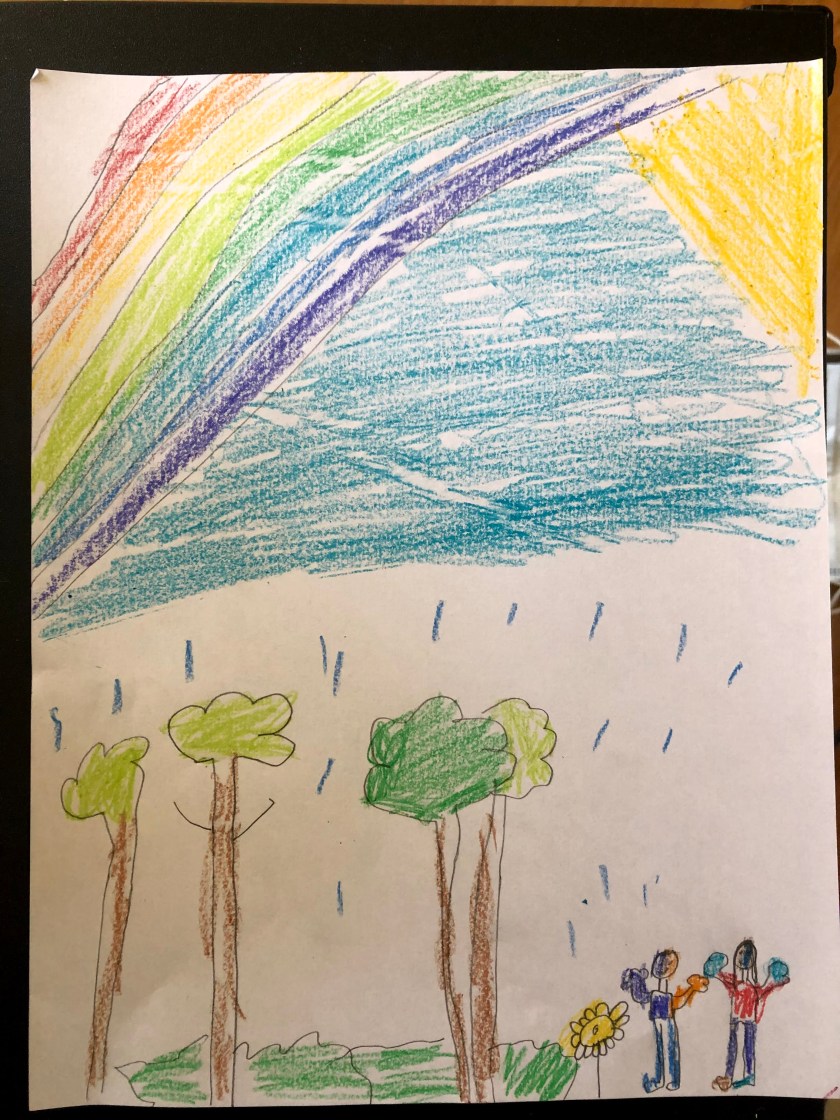
A few years ago when the son was in kindergarten, I attended a class room show-and-tell in which their works of art were displayed. Endearing pictures of zebras, horses and assorted flora and fauna painstakingly done, were being showed off brilliantly by the children. When I drew up close to the son’s painting, I paused. There in the corner of his painting were several people with rainbow colored faces. I loved the idea, and asked him why they had rainbow colored faces, to which he said, “Our teacher said to put colored people in our drawings.”

I turned to his teacher, and she nodded smiling, “Yes, I did for diversity, but I didn’t expect this!” My heart warmed at his interpretation.

I loved it! How beautiful and void of prejudice we are as children.

“No one is born hating another person because of the color of his skin, or his background, or his religion. People must learn to hate, and if they can learn to hate, they can be taught to love, for love comes more naturally to the human heart than its opposite.”

― Nelson Mandela, Long Walk to Freedom

I started reading Henry Thoreau’s book, Civil Disobedience, last week, and I must say the first chapter itself has me drawn in.  “The mass of men live lives of quiet desperation. What is called resignation is confirmed desperation.

A few sentences later he says again, “It is never too late to give up our prejudices. No way of thinking or doing however ancient can be trusted without proof.”

Savoring the sentences and thinking of the rainbow colored faces in the son’s drawing made me think. What would it take for us to learn what it is to be human? It seems to me like to understand deeper, we need to rely on Science: Science as a Candle in the Dark. Any phenomenon not readily understood suffers from the same problems. Could there be a better way to gauge our human-ness?

Structurally, we are containers for cells, possess neurons for consciousness, and use language for communication between one another. But this puts us in no different a category than octopus, dogs, elephants, whales or dolphins. Most marvelous creatures on Earth have evolved from the same set of conditions the planet has been subjected to, and are hence remarkably similar in these aspects. In fact, we are limited in so many abilities than our far-more abled canine friends or bird friends when it comes to smell, colors and noise frequencies.

Here is a fun game to be played by all age groups:
The High Frequency Hearing Game

Quoted from The Soul of an Octopus by Sy Montgomery:

Cambridge Declaration on Consciousness asserts that “humans are not unique in possessing the neurological substrates that generate consciousness”, and that “nonhuman animals, including all birds and mammals and many other creatures, including octopuses also possess these neurological substrates.”

Chemically speaking, I suppose we can attribute Oxygen, Nitrogen, Carbon etc as major components of the human body. But this too, is not unique to us on Earth. Many lifeforms use the same structural elements for life.
Composition of the Human Body

600px-201_Elements_of_the_Human_Body.02.svg
Image from WikiLink: OpenStax College / CC BY (https://creativecommons.org/licenses/by/3.0)

Culturally, we have ideologies so different, yet so similar. Most religions have stories of a big flood (starting from the epic of Gilgamesh, to the Matsya avatar in Hinduism, to Noah’s Ark), our mythologies have similar creatures (how then could we have dragons in Chinese mythology and Norse mythology?) The fossils found in each region seem to have contributed to the myths (Sankhu / Chakra myths originate from nautilus fossils found in the Himalayas). Is myth-making then the only human identifying factor (I don’t think so, for whales songs have tonal informational bits having the same length of an Iliad or Odyssey – some whale songs have been known to be taught from generation to generation and last over an hour long).

wind-in-the-reef

The differences in skin colors too, are no more than an evolutionary necessity – the UV light in different areas of the earth, and ability of the skin to absorb Vitamin D in areas of high or low sunlight is primarily the factors that determine these.

The Biology of Skin Color (The link between human evolution over time; the ability to adapt to different levels of UV  radiation in the tropics vs the poles; and its correlation with absorption of Vitamin D is explained in this video)

I come back to the question of what does it mean to be human? What is our unifying factor? On this globally unified Earth, can we all just find a way to get rainbow colored skin?

How Kindness Became Our Pleasure – By Maria Popova on Brain Pickings

P.S: The son touchingly drew this drawing again when he saw me writing this post:

img_8613

How do we exist?

It had been another long day, and as the clock ticked towards midnight, the body yearned for sleep, but the mind looked longingly at the tsundoku pile, and craved for some quiet moments of solitude. I peeked out of the window, and the moon sailing high through the skies tugged at my heart. There is something so intensely beautiful about catching sight of our  lovely cosmic neighbor sending its mellow moonbeams through the leaves at night.

I looked for a word that captures the phenomenon, but there isn’t one.

There are two words in Japanese that come close (the Japanese language has such amazing words for admiring wondrous nature around us.)

Kawaakari ( 川明かり – a word depicting the evening reflection of light on water, or in some cases can refer to the reflection of the moonlight off flowing water.

img_20200407_195324-effects

Komorebi (木漏れ日): Sunshine filtering through the trees.

trees_komerabi

I had just started reading The Sea Around Us by Rachel Carson. In the first chapter, Rachel Carson takes us with her steady voice into a time on Earth before the seas were created. When the planet was still heaving and churning its metallic ores, hot searing waves of liquid settling into a semi-liquid state in its outer cores. She wonders then about the question, how were the oceans formed?
“So if I tell here the story of how the young planet Earth acquired an ocean, it must be a story pieced together from many sources and containing whole chapters the details of which we can only imagine.
For although no man was there to witness this cosmic birth, the stars and moon and the rocks were there, and indeed, had much to do with the fact that there is an ocean.”

Then, she leads us from this fiery place in the cosmos with the sun heaving its solar flares, the earth itself arranging itself into concentric spheres with hot, molten iron at its core, and an intermediate sphere of semiplastic basalt , the outer layers of granite and basalt. And then gently she lures us into the possibility of the moon and the ocean being related to each other.

The next time you stand on a beach at night, watching the moon’s bright path across the water, and conscious of the moon drawn tides, remember that the moon itself may have been born of a great tidal wave of earthly substance, torn off into space.

How can one not be mesmerized by the creation of the moon? Was it truly hewn from the surface of the earth (The moon’s density does match the density of the outer crust). The hypothesis that the moon was hewn away after massive solar tides exerting a pull on semi-molten Earth is based on the theory that the large portion thus hewn away left such a large scar on the surface of the Earth. A scar that would continue to shape Earth and its lifeforms for millions of years afterward: The Pacific Ocean.

Later, as the Earth cooled and clouds formed from the steam rising, the rains started. Pouring onto the hot earth for years – initially almost immediately evaporating into steam, but eventually collecting as water – forming the first oceans.

It is, of course, fascinating that we still do not know for sure how the moon was created. There are several theories – theories of violent impacts, random objects being attracted by gravity, and young earth managing to keep one satellite, while heftier ones like Jupiter acquiring 67 etc. This is a topic still under discussion.

https://www.space.com/19275-moon-formation.html

Nevertheless, the very first chapter had me wowed. I would never be able to look at our closest cosmic neighbor with the same eyes ever again. How often I have stood marveling at the moon? Out on walks, my heart always skips a beat when I catch sight of the beautiful, faithful satellite accompanying Earth as she tears through space. To think that there is a possibility that the very creation of our cosmic neighbor was crucial to our oceans is awe inspiring. I live on the Pacific Coast, and never can I see the bays, the ocean or the moon without reminding me of this book.

The Sea Around Us by Rachel Carson

sea_around_us

The skies hold the answers to our most philosophical stirrings. Why do we exist?

The seas, it seems, holds the answers to our most existential stirrings. How do we exist?

Bee Blossoms

Out on a evening walk one day, my heart rose. The corona virus may be taking the world for a spin of its own. Days seem to be blending into weeks, and weeks into months. There are times, I sit up and notice the weekend is here. Some other times, I sit up and wonder where the week-end went. All of life seems to be one long news cycles of confusion & anxiety. What is a good time to reopen, should we reopen?

Human-beings may be in a state of confusion and anxiety.  But Nature around us has no such doubts. She brought on Spring just in time. The leaves sprouted in one marvelous unified stage opening. I stood mesmerized under the fresh, new leaves, sometimes glinting with dewdrops, and other times, filtering the rays of the sun beautifully around. Early tulips bloomed, spring snowflakes made their hearty show.

Then slowly, and just as surely, the temperatures rose, and the hills near where we live browned in the suns. But that meant, it was time for the summer flowers to take the stage. The jacaranda trees took their cues from the receding spring snowflakes, and assured them that the show must go on. On the evening walk, I noticed the beautiful purple flowers blooming against the green leaves, the early oleander flowers are revealing their pinks and whites, and roses everywhere are out on their annual romps warming hearts and lifting spirits with greater sincerity this year.

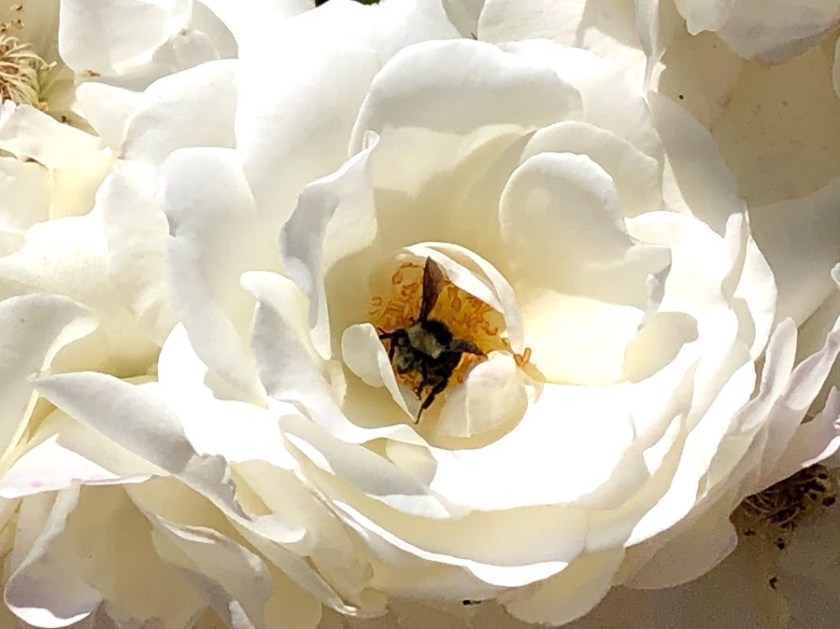
The son and I stood watching bees buzz from one flower to another taking with them the memories of a thousand blossoms with them, slowly but surely nurturing the circle of life. I was reminded of Ray Bradbury’s saying:

“Bees do have a smell, you know, and if they don’t they should, for their feet are dusted with spices from a million flowers.”
― Ray Bradbury, Dandelion Wine

rose-bee

When I watch the dew drops glisten on the spring snowflakes,
When I watch the rainbow makes up its mind and throw itself like a garland across the skies
When I watch the eight-legged marvels creations catch in the sunset
When I watch the waves lap and play with the sandpipers

I feel hope stir in the spirits
I feel decisive and conviction in Being
I feel solitude’s gift can be tangible and needs to be nurtured for its fragile state
I feel engaged with the planet and all its gifts

There is beauty in knowledge of the changing seasons, and wonder in anticipation.

Mother Earth is preparing for the Summer!

The Art of Hair

Haircuts, when we were children, were a treat in themselves. As a girl, I watched my father’s hair being snipped and pipped many times. Over time, his bald pate emerged more and more, but our barber never seem to think any less of his job just because he had a balding pate to work with. We lived in a small schooling community, and sometimes the school barber, Velusamy, a sweet, gentle mannered man, stopped by when he was free.

Velusamy set himself up in the garden, fussing over his instruments which he lovingly stowed away in his steel case. He set the chair facing away from the direct rays of the sun, so his subjects need not squint into the sun as he worked his magic on them. He filled a bucket of water, and set his mug near it. He wiped his scissors and blew on his clippers. The wind rustled the trees around us, the bees buzzed, birds chirped, and the good barber trimmed. There was a ritualistic feel to the whole thing: clearly, Velusamy was a man who enjoyed his work. 

Once the setup was done to his satisfaction, he wrapped a cloth around his subjects and set about the task of shearing the sheep clean. The sheep sometimes snoozed in their chairs, and it was imperative to tell the man before hand how much to cut. For the gentle mannered man acquired a gleam when he picked up his tools. He ran his lawn mower over the heads at his mercy without any mercy. 

barber

When he was happy with his task, he held up a rickety mirror, polished clean, at various angles for the subjects to inspect. Rarely were there any adjustments to be made. Sometimes, an involuntary yelp would be emitted seeing the amount of hair gone, but Velusamy would give one of his flattering smiles, and assure them that the hair would grow back. What was there to worry about? There wasn’t much to be said against such sterling good sense. He then cleaned up behind him. His rituals complete, he would accept the flowing gratitude from all in the family for coming all the way for a personalized haircut experience, and after a gentle chit-chat over a cup of tea, he left with a good-ish tip. The men of the house looked spruce and trimmed for days afterward. 

But there were times, when Velusamy’s services were scarce – especially during the school holidays. People attempt all sort of things after watching you-tube videos these days – we did the same after watching Velusamy a few times. You see over the years, my sister and I have rather prided ourselves on the haircuts we have given the little brother when Velusamy could not make it. We were happy for days afterward whenever we saw the little fellow, even though in some places, it looked like a rat had gnawed at his hair. 

Covid-19 has certainly given a lot of people renewed respect for a lot of professions. When barbers open up shop again, I am sure their clientele will flock back to them with gratitude in their eyes. Over video conference calls, there has been a steady rise in the length and density of hair. Seeing people over the past few weeks over Video cam, there came a time when most folks on the video calls seemed to encounter  an obstacle like poor Earl Emsworth did in Blandings Castle:

“Lord Emsworth passed a hand over his chin, to assist thought, and was vaguely annoyed by some obstacle that intruded itself in the path of his fingers. Concentrating his faculties, such as they were, on this obstacle, he discovered it to be his beard. It irritated him. Hitherto, in moments of stress, he had always derived comfort  from the feel of a clean shaven chin. He felt now, as if he were rubbing his hand over seaweed.”

When I read this a few days ago after a day spent trying to discern faces from the ‘seaweed’, I burst out laughing, and could not stop. The men in the family looked at me like I needed to have my head examined. I brushed the mane of my flowing hair, and said while my tresses never looked better, theirs needed some work. The husband leapt backwards clutching his mane, and I gave him a pitying look. Really! One would have thought we were unskilled at hair styling the way they shied away. 

So, I decided to play the trump card. “Oh please! We used to cut my brother’s hair sometimes when he was a kid, and he looked marvelous!” There was some mumbling at this, but I let it slide. 

On a video call with the brother a few  days later, I peered through the foliage and said to my son, “See this guy? Your maama – he was given a perfectly good haircut by me when he was your age. Look at him now.”  The brother mumbled that some scars ran deep, and hence his reluctance to have his haircut even now. I ignored this and said, “Some modest successes under my belt you know?” 

The brother beamed as he said, “I knew she would try to flaunt her success”. I  did not care much for how he unflatteringly put the word success in quotes thrown up in the air,  “But don’t let that sway you. You are better off having your head shaved off little fellow. She is lousy at it!”

I what-what-ed at this treachery. Really  – this brother of mine has a most inconvenient sense of  integrity. “Those haircuts were pure of heart and generous!” I cried stung.

The brother said “Oh! No one doubts your heart or your intentions  – both were as you so rightly say, pure. We are only  discussing results here.” he said and gave into a full throated chuckle that his nephew joined in with heartily. I huffed and I puffed, but the call seemed to have an impact  on the son. He seemed to think that his maama was a nice enough man even though he had endured haircuts from his mother in his youth, so how lasting could the damage be? Maybe it was okay to attempt after all. 

Quiet courage shows up in multiple ways – The men, to our pride, acquiesced to having their hair cut by the daughter and myself.

That is how you saw the men of the nourish-n-cherish household looking slightly uncomfortable as we spread garbage bags on the floor, and clucked away with our scissors. 


Teacher Appreciation Week

I hovered near the bookshelf – like a child hovering around the glass-pane of the candy store, Looking for that perfect piece of sweet : something familiar, good and a slight twist to wake up your cells every time.

It has been a long and stern day filled with purposeful adults, all filled to the brim with the cares of living, earning a living, and forgetting to live. My brain looked for a release, and a mode to thrive.

I picked up a book of short stories by one of my favorite authors: P.G.Wodehouse.

18-carat-kid

Eighteen Carat Kid and Other Stories: I opened the first page and was pulled in like an elephant to the early morning waters in the forest.

Paragraph 1:
There is something always going on in a private school.
Beyond breaking up fights, stopping big boys bullying small boys, preventing small boys bullying smaller boys, inducing boys of all sizes not to throw stones, go on the wet grass, worry the cook, tease the cat, make too much noise, climb trees, scale waterspouts, lean too far out of windows, slide down the banisters, swallow pencils, and drink ink because somebody bet them they wouldn’t, I had very little to do except teach mathematics, carve the joint, help the pudding, play football, read prayers, herd stragglers into meals, and go round the dormitories at night to see that the lights were out. ”

Both my parents were teachers (my father was a teacher in a residential school – public schools as they are called in India, private school in the US & UK) I sent the snippet to him, and he heartily took a trip down the memory lane and agreed in his booming, hearty voice that addressed assemblies without mikes, that there never was a dull day in his teaching career. Being a vegetarian, he did not often have to ‘carve the joint’ , but that apart, pretty much everything else was true, he said. It is always to good to hear the joy of being a teacher coming through.

This week is Teacher Appreciation Week, and I thought of sharing this essay the son had written for his 3rd Grade essay:

Topic: Imagine you are a teacher taking your class on a field trip to Baltimore National Aquarium

The Baltimore National Aquarium

At the Baltimore National Aquarium there is lots of life. This is one of the places where humans and marine life see each other as fun things.Anyway I brought my class with me because the principal wants the kids to experience new things, which I can understand. When we got to the nearest exhibit, I did a headcount of all the students. We were missing 6 of them.Thankfully, I found them near the water (where the animals are) and I gave them a good talk about not leaving the group. Then when I turned around all the other children were scattered. I thought to myself, “This is gonna be a long day.” After that, we went from exhibit to exhibit in the huge aquarium. As we were about to go to the display of skeleton from a dinosaur, we found another class. The kids merged together and the other teacher and I had the same expression: “Kids!” We sorted everything out and went to the dinosaur. I read from the brochure “This is the Shaustasourus, the largest marine dinosaur ever.” After many more mishaps we got back on the bus. For the first time, we had a full class. When we got back none of the kids thanked me for not losing them. Sometimes the world really isn’t fair, but that’s okay. I guess I had lots of fun too.

I guffawed at this piece of writing.

People who imagined the teacher’s job to be putty, are having to re-evaluate their assessments – their puddings of pie children weren’t such darlings when the Mathematics had to be taught by their parents anymore.

This is Teacher Appreciation Week in the US – really what would we do without the steady, positive influence of teachers?

Moon Magic

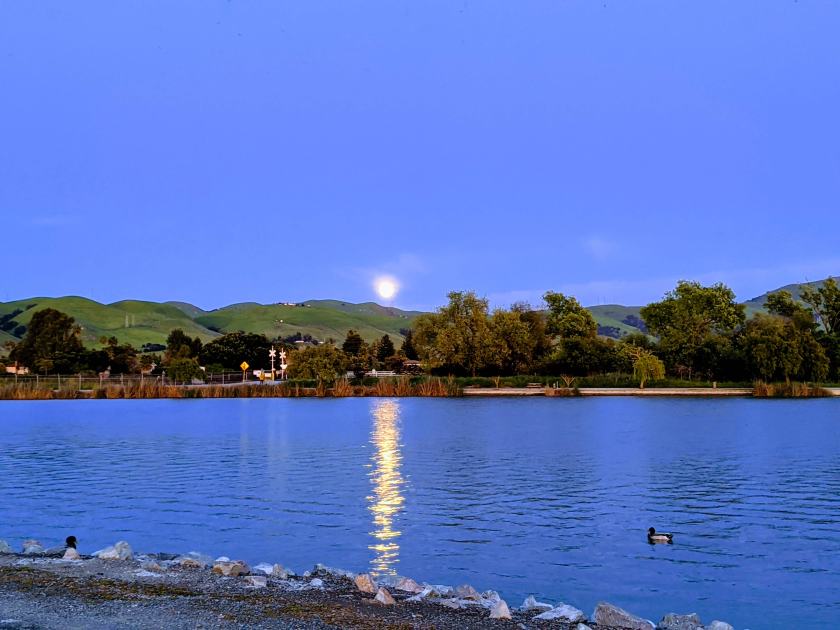
A few weeks ago, I got the incredible chance to see the full moon rise along with the sunset. One of those serendipitous things that the Covid-19 shelter-in-place has given me. I did not realize that it was the golden moon – the day the 🌝 moon comes closest to the Earth, and maybe  it was better that I hadn’t prepared for it. For, out on the walk, I stood mesmerized as  I saw the moon rise slowly in the East, as the sun set slowly in the West.

A better time or combination of light I could not imagine. A golden orb that rose from behind the green hills, and bathed the beautiful Earth with its benevolent beams, while the glittering sun bowed out graciously throwing pinks, oranges and purples with abandon against the blue skies. I watched the geese fly on over, ducks swim against the moonbeams on the lake, squirrels stopping to take in the surrounding beauty, and blackbirds swarming low over the lake waters. 

img_7899

I turned around to share  the beautiful marvel of the time with my  fellow beings when I realized I was quite physically distant from my fellow beings – human or otherwise. Do other sentient beings feel the same overwhelming sense of being at moments like these? Do dolphins take the time to gaze at the full moon like we do, do polar bears and penguins do the same from their respective poles? What a great unifying experience we all have with the celestial shows the universe throws at us?! 

Oh! To quiver with excitement with the Earth’s beauty has become my wont. 

The blue skies turned inky, and the golden moon turned silver, and  yet I could not pluck myself from the beauty of the evening. 

The giant glittering orb slowly peeked out from behind the green hills, and then rose steadily in a few minutes. We stood a few feet from a lake, socially distancing ourselves. How many times I have felt my heart flutter by catching a glimpse of the moon unexpectedly in the skies? How many lovers have gazed at the moon wistfully, dreamily, lovingly or yearningly through the ages? What a great unifying experience we all have across the pages of time?! 

I am so glad for our  nearest cosmic neighbor – I remember a few years ago when  we were moon-gazing awestruck at the beauty of the reflected sunlight, the son said, “Can you imagine how beautiful nights  on Jupiter must be? Imagine looking up and seeing 64  moons in the sky!

I was taken aback at the statement, but also thankful for the one moon we do have. 

A known Selenophile if there was one, I picked up the book Music for Mister Moon by Philip Stead with a song in my heart that evening.  The beaming moon has always attracted me, whether it is catching a fleeting glimpse of it as it appears and reappears amidst scudding clouds, or the waxing and waning of it during its reliable moon cycles or even when I catch an unexpected glimpse of it when the sun is bright and high above in the sky. 

mistermoon

The story of  a shy young girl who plays her instrument for no one but herself gently tugs us along for a ride as she accidentally pulls the moon right out of the sky. The moon’s revelation to know what it must be  like to float on the waters it is always reflected upon brings a little smile to your own lips, and slowly, but surely  you cheer for the little shy girl who opens her talent up to share with the moon.

The book does its  best to capture the magic of the moon, but probably the best gift of all is the dream I had after writing this post: I woke up thinking I was on a boat mesmerized by the floating moon near me.

🌙 🌝 Moon Magic. ✨ ✨

The Other Side of the Glass

There is a girlish delight in tucking oneself in the mode of Being, away from the duties of a Doing life on a Saturday morning. As I watch the minutes blend into hours, I sense my senses relax and delve deeply, calmly and yet completely enthralled at the prospect of indulging in my favorite pastimes of reading and writing. I feel the privilege in that sentence as I write it, for I recognize it for what it is: a luxury.

I hear the bees buzzing in the beautiful Spring day outside, a pair of blue jays have chosen a tree nearby to make their nest, and I watch the pair of them flit about busily during their days. Every now and then, one of them would come and peck on the window pane as if to check on me, though I know that comes from the human longing for self importance. The blue jays may just like the sound of the glass against their beaks, or probably; the reflection of themselves as they fly past. Whatever their motive, it is one of their many acts that I relish from the other side of the glass.

The other side of the glass.

What a wonderful way to observe the world? The internet is rife with jokes on humans sheltering in place with animals peeking at us, with their clever commentaries of us, and I must say I relish it. For once, we are all unanimously united in that state of achieving inner peace against the steady dripping of the news around us.

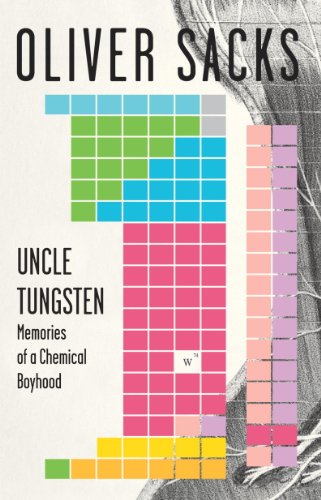
So, here I am sitting comfortably and reading the book, Uncle Tungsten – Memories of a Chemical Boyhood by Oliver Sacks.

The world as seen by the prolific writer and physician – his boyhood escapades with Chemistry and the influences of his life, are fascinating, full of learning and wonder, and makes one acutely alive to the fact that each life is a magnificent journey on its own. To those of us who are lucky to see life as an act of not just being, but becoming, it is a subtle reminder of the love of living.

uncle_tungsten

Every now and then, a passage takes you by surprise, such as this one. Oliver Sacks was born into a family of 4 siblings to physician parents, Dr Samuel Sacks and Dr Muriel Elsie Landau (one of the first female surgeons in England).

Reading has a way of taking us into worlds other than our own. I was delving into London of a century ago in his memoirs. The act of taking our consciousness with it to a different place and the ability to anchor us to the here and now, is a unique gift of reading. I found that strange juxtaposition in this passage:

“When it was time for my father to open his own practice, he decided, despite this early training in neurology, that general practice would be more real, more “alive”. Perhaps he got more than he bargained for, for when he opened his practice in the East End in September 1918, the great influenza epidemic was just getting started. He had seen wounded soldiers when he was a houseman at the London, but this was nothing to the horror of seeing people in paroxysm of coughing and gasping, suffocating from the fluid in their lungs, turning blue and dropping dead in the streets. A strong, healthy young man or woman, it was said, could die from the flu within three hours of getting it. In those three desperate months, at the end of 1918, the flu killed more people than the Great War itself had, and my father, like every doctor at the time, found himself overwhelmed, sometimes working forty-eight hours at a stretch.”

Just like that, I had moved to the other side of the glass. 100 years on, here we are, sheltering-in-place with the Coronavirus pandemic, and watching a similar situation of our good doctors being overwhelmed, and resources being stretched to their limits, as the virus sweeps through the world.

The other side of the glass.