The Domestic Explorer

There are things every explorer wants to do. Whether it is as drastic as Thoreau spending 2 years, 2 months and 2 days in a cabin in the woods, or Kate Harris finding herself in the process of exploring the Silk Road, there are aspirations for us to reach that state of mind where we can look past the hustle and the bustle of our daily lives. A form of reflection that one gets to experience once in a while, but has no idea how to sustain. (At least I have had no luck at it.)

Quote from Lands of Lost Borders:

“I’m not sure where I go when I spin wheels for hours on end like that, except into the rapture of doing nothing deeply.”

I think Kate Harris’s moving, poignant, lyrical, poetic, beautiful meditations on being, belonging, and living is well on it’s way to becoming one of my favorites. I have re-read sections of it soon after finishing it. Hers is a marvelous mind (I am grateful she penned her thoughts and found a publisher for us to enjoy). It does make me wonder sometimes how many others there are out there, who have similarly exalted thought processes, a Being larger than being squashed into narrow compartments that we seem to slot ourselves into: A Higher Order Thinker.

Kate Harris’s work is one for every traveler’s soul. Every body who has ever dreamed of adventures, ever dreamt of being bigger than your circumstances, hers is an invitation to sample what is possible. For everyone who is unable to sample the world with all its worries and problems, Lands of Lost Borders is there.

lands_of_lost_borders

The author writes of her journey across the oldest and possibly most famous road in the World, The Silk Route. Wanting to lose herself in the other worldly, she lands up finding herself on the oldest roads known to civilization.

Along with her friend Mel, the two women cycle through Turkey, the Stan-countries after Russia’s disintegration (Turkemistan, Kyrgystan, Uzbekistan), China, Tibet, Nepal and finally India – camping along the way, accepting the kind hospitality of friends and strangers along the way, navigating authorities, paper work and visa restrictions that make us want to throw our hands up in despair. A true voice of an explorer.

Her voracious reading sparkles in the form of quotations and anecdotes – Carl Sagan, Marco Polo, Charles Darwin, Russell Harris, Wright brothers are all in attendance adding their rich experience to the journey. Her clear heart blurs borders while sizing up people. Sitting up in bed with the wind roaring outside, the rains lashing, it is bliss indeed to pedal relentlessly through the high mountains, past lakes, punishing deserts and sketchy neighborhoods. Two women alone in an alien world.

As she quotes every so often,

“Every explorer dies of heartbreak.”

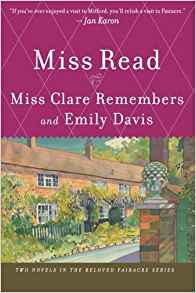
This is one of those books that will stay with me for a long time. I had the privilege of reading this book alongside another of Miss Read’s comfortable, cozy book. This book of travel and adventure was the perfect pairing to the domestic pleasures that a Miss Read book conjures up.

In Miss Clare Remembers, Miss Read writes about a young child of 8 or 9, who was excited and flushed after seeing the snowdrops when they went out on a school nature walk. Afterwards inside the home of the local farmer, where the farmer’s wife had kindly laid out biscuits, milk and cut fruit for the hungry children, she realizes how much she requires both pleasures in order to thrive. With a clairvoyance that children sometimes possess, she appreciates the vast spaces that nature provided for her soul to soar; and the cozy domestic pleasures where she can feel nurtured and at home. A safe haven from her flights of adventure.

Quote from Emily Davis – By Miss Read:

“One was her nest. The other was the place in which she stretched her wings, and soared, as effortlessly as the lark outside, into a different dimension.”

miss_clare_remembers


I felt that way while reading the Lands of Lost Borders together with a Miss Read book. I savored the stars kindly drawing the constellations out for the explorers to reach out to every night; as much as I enjoyed the domestic problems of a normal life. Ensconced in the modern comforts of living, reading both the books in parallel left me with a deeply delighted sense of having both adventure and comfort, and feeling grateful for it.

I am not sure my blogs can do justice to the books, but it seems a perfect way to begin winding down the year.

The Book of Kells

I was intrigued to see the book that Dublin is so proud of, and I wasn’t disappointed. Walking through the rain-washed squares of Trinity College, past all the students and tourists milling about the campus, I walked into the Trinity College Old Library to see the much talked about Book of Kells. Written about 800 years ago by at least 6 different scribes, it is reputedly the oldest book in existence in its original format. It was probably written at a monastery similar to the one below by monks.

IMG_0086

I was all agog to see the Book of Kells, rose early and off I went with nothing but 3 eggs, 2 pieces of toast with butter and blackberry currants jam, 3 cups of tea, some fruit, a spot of yogurt and some freshly squeezed fruit smoothie in me. (European hotels really do have the best continental breakfasts in the world. Try as I might, I could not get them to feed me less. Please can I have just 1 egg, nothing else, I’d say. “Just a leetel beet of vegetables on the side.” they’d say, and soon a tray bearing a couple of fried eggs, mushrooms, spinach, baked beans and toasts accompanying the eggs appeared behind a tottering waiter with a benevolent smile.)

breakfast

Anyway, the Book of Kells has scholars poring over its pages, art historians and critics study the dyes used for the illustrations in the book, and the book does look elegant. The letters were different, probably Celtic letters at the time, and the lettering had a calligraphic touch to it that we seem to have lost in the world of keyboards. What the book is about is, I guessed, derived more from the artful illustrations rather than the prose.

While it was inspiring to see writing as early as all that, I was not wholly prepared for how it made me feel later on.

Days later while walking down the streets, I’d recognize some rune from the Book of Kells or something similar looking displayed on the shop fronts, and feel a little strange. How ephemeral are our lives and its influences? Even the greatest works of the times, mean so little now. And only one book survived the times. What about the rest of the books written at that time?

So many languages fade away taking with it, another chunk of literary history forever with it. The thirukkurals in Tamil have had a good run so far.

IMG_0113

What writing will stand the tests of time, and which ones would not? What does it say about the writer who started with the intention of writing about the lofty Books of Kells and wrote instead of the fantastic breakfast she tucked into her stomach? Given how ephemeral even our inscribed works are, shouldn’t we have a little less ego, a little less lust for power, and little more acceptance of our state of being?

I mused on our social media presences. The place most avid users go to share our thoughts and feelings. Maybe we are subconsciously evaluating every thought that flits in like fluffy clouds on a bright day, taking a pulse of our feelings.  What of thoughts not shared, and if thoughts trigger feelings, will the absence of thought then remove suffering, but then what is the state of being?

Maybe that is why the old Eastern philosophers taught us to calm our minds. Ursula Le Guin’s quote comes to mind:

“Things don’t have purposes, as if the universe were a machine, where every part has a useful function. What’s the function of a galaxy? I don’t know if our life has a purpose and I don’t see that it matters. What does matter is that we’re a part. Like a thread in a cloth or a grass-blade in a field. It is and we are. What we do is like wind blowing on the grass.”

I like my spot of writing even if sometimes I have muddled things up a little more by the end of it all.

The Elephant Keeper 

I had been on a short trip to a Green island staying at a Purple hotel with White Christmas decorations in a city center. While there, I decided to make the most of it, and hopped on a tour bus to take in the sights of Ireland. It had been a dry few months in … Continue reading “The Elephant Keeper “

I had been on a short trip to a Green island staying at a Purple hotel with White Christmas decorations in a city center. While there, I decided to make the most of it, and hopped on a tour bus to take in the sights of Ireland.

It has been a while since I went meandering off on my own. As I boarded the day trip for Wicklow mountains and Glendalough lakes, that wily Master of Doubt was trying to work his way into the old brain stand, and I was becoming a little unsure. Most people had come with at least 1 travel companion. I saw the knots of people comfortable in their own little groups as we waited for the bus to come and pick us up.  I wondered whether I shall be alone. Not that it mattered much since I had a book about a jolly esoteric family to keep me company on the trip.

Sitting tentatively in the van, I was reading The Garden of the Gods by Gerald Durrell on the kindle. I giggled before I could help it. I was peeking out at the passing scenery every now and then, and imagining the little household at Corfu. The author, Gerald Durrell, then a boy, lived with his ‘Family and Other Animals’ in the island of Corfu. A budding naturalist, his boyhood is a most interesting one in which no living creature escapes his admiration. His bedroom plays hosts to barn owls, field rats, bats, along with the more traditional form of pets such as cats and dogs. He also has a donkey named Sally, and I could not help laughing at the resulting antics this menagerie produced with his esoteric family.

corfu_3

The Corfu Trilogy is set in the island of Corfu, and since I read each book in the series a few months apart, it was most satisfying.

I could barely believe that it was possible for somebody to live the way he described it. The Universe is not always kind to doubting dunlins, but this time it was.  Within the hour, I was to meet someone whose life was remarkably like the one I had just read about.

The tour bus dropped the folks who had opted to spend time at a Garden. Only two of us had opted for a hike instead of an amble around the Gardens to the dismay of the tour guide. The look we exchanged affirmed that we would be far happier being buffeted by the roaring winds, and gazing longingly at the rolling hills around us. I recognized a kindred nature loving spirit in her, and soon we got walking and talking.

As we loped up the trail with an enthusiastic whoop, she told me a little bit about herself, and I was so glad she did. She loved animals, she said, and lived in a home teeming with pets. I truly did not believe that Gerald Durrell’s family was possible, much as I loved reading his books. But her answer astounded me. She said they had a donkey, 2 geese, 2 cats, 2 dogs and 12 hens. Her business trip was the most interesting one I have heard to date. She worked as an Elephant Keeper in a Zoo in Holland. She was here, she said, on an week-long program to work at the Dublin zoo’s Elephant department, but would be going back to her own zoo at the end of the week.

elephant_keeper

I told her that the children would love to meet her, and she nodded understandingly. Looking at the excitement of their mother, she very kindly sent me some pictures and videos of the animals she worked with in her work spot.  She too had come alone, and the pair of us spent the whole day together – on windy hillsides, amidst towers and remnants of castles looking like giant rooks and bishops on a chess board.

img_0044

I was so glad that my earlier doubts had not stopped me from having a wonderful day: the serendipity of finding companionship, the beauty of learning of another way of life, and above all, the opportunity of shaking oneself out of the familiar and the tried and tested.

The universe finds a way of showing us the rainbow if only we stick with the rain.

Boarding the Flight of Fancy

A version of this post was published in The India Currents Magazine: On a Flight to a Land Without Borders

I boarded the flight at the end of a long week. I was going to be away for a week, and I had spent weeks trying to get things in order for the week I was gone. It felt good to finally stretch one’s legs (as much as an economy seat would allow anyway), relax one’s senses, and stretch one’s mind.

The flight was strangely beautiful. It left in the evening, and as it took off, I left behind a sparkling firework of lights. The vast, urban sprawling city and surrounding areas looked kindlier from above. The freeways glowed like veins throbbing with cars as they crammed their way home for the week-end along the packed highways. I have watched ants with interest as they scurry about their daily duties and I felt we must look the same if someone were to be observing us. Maybe those monitoring satellites do have the feeling every now and then.

Bay area at night is beautiful from an airplane, however else it feels when one is on the road.

img_08171

I fell into an uneasy slumber once we passed the populated sections and darkness fell. I looked out the window hours later, to be pleasantly surprised by the beauty that greeted me. The plane was gently reverberating with the satisfied sighs of sleep from most passengers. A few were watching the brightly glowing screens. I peered out of the window, at first unable to see anything since my eyes took some time adjusting to the sudden lack of light. Once I did though, it was marvelous.

I have always loved gazing at the moon while traveling. The feeling of us moving, and our beautiful cosmic neighbor giving us company even though we are moving so fast is surreal.

I could not see the moon just yet, but I recognized the belt of Orion. We were flying along side the big hunter as he made his way in his pursuit of the seven sisters across the skies. It is a strange feeling to watch the stars and a familiar constellation accompany us on the trip while we journey through the stars.

cd

The Pale Blue Dot, as Carl Sagan so beautifully christened our lovely, if sometimes crazy planet, seems wonderful from high above. It helps us forget how judgmental, critical, harsh and war-mongering a species we are. While up there, borders and countries seem like a strange concept, like a tiger marking its territory. Can the tiger determine where life can flourish, where the weeds grow, or how many gusts of wind may swish through the bamboo groves? Our borders mean much the same especially when surveyed from the stratosphere: Meaningless asks from an arbitrary marking.

Musings from the wonderful book, Lands of Lost Borders by Kate Harris, took me to an uneasy land of half slumber in which strange dreams accompanied unknown stars through a flight that even a 150 years ago was nothing but a flight of fancy. Kate Harris’s work is one for every traveler’s soul.

lands_of_lost_borders

I got up to see the moon looking slightly alarmed at still being up and about when the sun was rising. The pink, and orange skies twinkled benignly upon the clouds below, and all the world was still full of promise and expectant. The blush of joys unknown.

flight_clouds.jpg


To All Astrophiles

“Did you know, the Voyager Insight is going to land on Mars tomorrow?” said an excited son. T’was the night before school reopened after a joyous 10 day Thanksgiving break, and the night before the much anticipated Insight landing on Mars. I looked at his shining face when it should have been a sleepy one.  The sparkle in his eyes did not smack of eyes wanting to make the journey into the Land of Nod any time soon. So, I sat down next to him and said, “Really? How do you know?”

That’s better, his posture seemed to indicate, and said, “Yes…Appa told me. It has to land at an 12 degrees angle it seems.”

“Why 12 degrees?” I asked intrigued. 

Space.com article : Mars Insight Landing

Quote from article:

“InSight hit the thin Martian atmosphere at about 12,300 mph (19,800 km/h), nailing its entry angle of exactly 12 degrees. If the lander had come in any steeper than that, it would have burned up; any shallower, and it would have skipped off the atmosphere like a flat stone across a pond.”

After chatting a little more on the impressive Mars voyage, I asked the little fellow if we should read a book on Space exploration. He nodded. Anything to keep from falling asleep.

So, we picked up the sweet little children’s book, “Also an Octopus” or “A Little Bit of Nothing” 

also_an_octopus
Also an octopus : or, A little bit of nothing / Maggie Tokuda-Hall ; illustrated by Benji Davies

Also an octopus : or, A little bit of nothing / Maggie Tokuda-Hall ; illustrated by Benji Davies

The book is about an octopus who plays the ukulele, and wants to get on a purple spaceship. Who can help it build one though? Why a rabbit scientist of course!


We laughed as we read the book. As different as it was from Counting on Katherine by Helaine Becker, Illustrated by Dow Phumiruk, it stretched one’s imagination in a thoroughly whimsical manner that made us giggle at the very thought of the Octopus on the spaceship. If ever we need to convince ourselves of the diversity of life that we seem to be threatening, we need look no further than the impressive marine life we host on Earth. 

counting_on_katherine
Counting on Katherine – by Helaine Becker, Illustrated by Dow Phumiruk

All space lovers should definitely read the beautifully illustrated children’s book, Counting on Katherine. Based on the scientists featured in Hidden Figures, Counting on Katherine illustrates the love for Mathematics and its application to space travels in the most endearing fashion. A child who has the inclination towards numbers cannot help deepen their fascination with them, and hopefully, those who do not share that fascination, will develop a curiosity towards them. I have always loved the look of a blackboard with neatly written mathematical formulae and calculations: this book captures the aesthetic beauty of the blackboard beautifully.

img_0287
Counting on Katherine – by Helaine Becker, Illustrated by Dow Phumiruk

Anyway back to Voyager Insight I said, “Do you think we can watch it land?” 

“Yes….it will be on You-tube.”, said the little fellow, positive that the image transmission from the Insight landing on another planet can make it to the nebulous internet without any trouble at all.

Here is a video link prepared by LockHeed Martin in collaboration with NASA’s JPL:

Automatically, my mind harked back to the old times when an image was work, precious work, with days in between clicking the pictures and getting them developed. When they came out, you saw the lighting could have been better the framing better, the shake a little less, and solemnly swore that you were up to no good, and waited it out till the next film roll proved it. 

I still marvel at any photographs we receive from Space. 

Human minds can adjust to improvements so easily – if only, we had the sagacity to adjust just as quickly to hardship.

The Time For Scrunch Parties

I wonder when we stop skipping on our way, when we stop reading children’s books: tales of magic and myth and splendor, when we start looking weird for having crunch parties in the scrunchy leaves of fall, but it is a time we must take a knuckle and give ourselves a good knock on the head, and cut it out!

“Please! Just come with me for a walk! “ I said to the children.  November is the month of Scrunch Parties, and the month I can be seen begging the children to come on walks with me, even if they look and act like Hawks and Pandas. I still remember the day I came tottering into the home, my confidence in the true tra-la-la  of the world shaken. 

I had stepped out without the children after they had both called me ‘Nuts’ for wanting to go for a walk when the time could be spent inside the house on the couch instead. I gave them a withering look, and told them that I shall ascend to higher levels with my stint in the fresh air, where nature shall nurture my spirit and enhance my being, and they were going to miss all that. I threw in a quotation or two, gave them a sprinkling of philosophy, and a hint of lavender from my coat pocket to entice them into coming. I straightened my shoulders, and delivered the pep talk that Generals could take notes from. 

general_pep_talk

I don’t know how these Generals must have felt when they spread themselves liberally on the pep-talk, so they can leave pronto to acquire the next kingdom, only to have the troops say, “Nay, it is better if we camp here for a month. The Biriyani is particularly aromatic and spicy here!” But that is how my pep-t was received. They lolled on the couch, gamboled lazily in the warm, fuzzy throws like lambs in springtime, and continued watching whatever-it-is that amuses them so much. 

I told them they shall soon see a reformed person and made my way out, my back registering disapproval at this lack of enthusiasm for nature-walks, but my front eagerly galloping towards the joys awaiting me outside.  

A few minutes later as I stood looking up at the sunlight filter through the trees, a stiffish breeze started up. The mesmerizing sound of the the wind rustling through the trees caught my attention (There is a fascinating word for this – Psithurism). The wind rustled a special tune sending beautiful waves of ripples through the leaves. Standing there with the sunlight illuminating the waves was magical, the wind was also sending hundreds of leaves dancing their way down to the Earth. My face lit up with happiness, and I charged left and then right trying to catch one of these beautiful leaves on their way down.

My arms felt like the wings of a butterfly spread wide, my leaping from one side to another left me feeling catlike. I clasped at thin air as the leaves fluttered past me. I don’t think my performance would have landed me a spot on the International Cricket team for fielding, but no one could fault my enthusiasm. My face was happy, and it was then that I caught the eye of a gentleman out on a walk too. 

scrunch_party

He looked at me like I needed to have my head examined. A small twitch of his bulbous nose indicated disapproval of this entirely whimsical and childish act of catching falling leaves, his round head shook like he could not believe I was let loose on the streets and he made his way again with an exaggerated dignity. His figure exuded the unmistakable message: I was an adult in a world where we do not show happiness by ourselves, was I not? We do not skip, we certainly do not run like lumbering sea-whales going after fish, we are prim, and we must be proper, and we must never forget that we live in a world where there are many problems waiting to be solved.

I tried to shake the wet geezer off, but the scrunch had gone out of the scrunch party. I went back home, an altered soul. Seeing my less-than-exuberant spirits slink back into the house, the children wanted the low-down. I usually come back from my November walks bearing gifts of colorful leaves, or tales of butterflies and chirps of birds; not the slumping shoulder and the lack-luster shrug. I poured my heart out, and revived under the sympathetic brow swiftly giving way to gushing laughter. 

“You must’ve looked such a goofus Amma, running after leaves and scrunching leaves by yourself.” They cackled, and I smiled. 

Some inelegant demonstrations of my chasing the leaves were given to much mirth, and I felt happy at being able to spread joy in this stern world, even if it was at my expense. I mean I did not really think this little wet sop episode deserved rolling on the floor and laughing so hard, it was hard to stop.

I wonder when we stop skipping on our way, when we stop laughing out loud at Dr Seuss books, when we stop reading children’s books: tales of magic and myth and splendor, when we start looking weird for having crunch parties in the scrunchy leaves of fall, but it is a time we must take a knuckle and give ourselves a good knock on the head. 

When Seuss-isms Save Your Spirit

“Oh my gosh! You have to write about this!”, said the daughter laughing, and the son looked pleased with himself. He had uttered a Seuss-ism that just made the whole lot of us laugh out loud. I dilly-dally-ed on writing up the little anecdote and the incident has now slipped my mind. It had something to do with a packet of chips, some fellows playing on the street, some elephants and a circus. Something that reminded me of these two books by Dr Seuss:

If I Ran The Circus &

And To Think That I Saw It On Mulberry Street


I tell you a writer in the nourishncherish household has a full plate, and as a chronicler of sorts in the household, I tend to miss out on a lot of things, such as the tale of the water hose and the tulip bulbs, or the cartwheel aspirer whose tales of the leaping t-shirt kept us all enthralled, or the time the husband walked in to find a boy and his tiger entertaining the rest of us in the bedroom to chuckles and guffaws.

So, I hurried and wrote this down now before it too joins the nebulous places where thoughts and memories go: the duper pin lot of thunderbolt crate.

UUUUGGGGHHHH! This day sucks! GAAAAAHHHHHH!” I said exasperated. My family’s dinner, carelessly prepared, but tastefully done with the freshest of vegetables and the spiciest of spices lay in an orange goo splattered all over the kitchen. Like someone exploded a sunset on the ocean reef floor, only not as pretty.

It had been one of those days when I had dropped the daughter at Drombasollu, and picked the son at Pickabolou, then shopped for groceries at the Packed Aisles of Drabaloo, only to run an errand to the wasted lands of Grimes via the packed streets of Trafficity, before heading back to Drombasollu – all of this after a long working day on the grimiest streets of the city of the Somaridden, and back after a ride on the silver caterpillars of Mushart, not to mention 10 phone calls to co-ordinate who did what-s, where-s and when-s – with curt replies when the conversations veered to the how-s and why-s. I had run low on energy, even lower on patience and the ability to see the fun side of things was off hiding till I ventured to find it again.

The son came over, gingerly stepped around the splattered muck that I had intended to call dinner, and said, “Oh thank goodness you are not one of the engineers who work on the bridge of Bunglebung Bridge across Boober Bay – they have things falling from everywhere!”

This was from the book, Did I Ever Tell You How Lucky You Are – By Dr Seuss

lucky

He then gave me a hug from the back, and in a minute my tensions splattered too. I laughed at the genius of it, and hugged the little fellow. “Always read Dr Seuss my dear. Always! When you are ten, don’t forget them, when you are twenty, remind yourself to read them, and then go on reading them when you are thirty, forty and with tea, it will always be …. gah I can’t rhyme this anymore now!” I said, but the smile was back on my face.

“But it was pretty good!” said the little fellow encouragingly.

Within minutes, we had laughed and cleaned up the kitchen floor and were rummaging the shelves for another slap-a-dash dinner. When the husband and daughter came back from wherever their drombasolu, pickabolou route had taken them, we had a semblance of dinner ready again. Our spirits much revived by a Seuss-ism were smiling and happy again.

I doubly appreciate Dr Seuss, because I had never read his books as a child. But I get to enjoy them now, as I read them with the children – one of the many joys of immigration. It makes me a whimsical child again, and grateful for reading them at time when it is lovely to remind ourselves of the sunny days of youth again.

Like Graham Greene said of his famous work, The Wind in the Willows, which I thoroughly enjoyed reading every now and then:

“A book of youth, and so perhaps chiefly for youth and those who still keep the spirit of youth alive in them; of life, sunshine, running water, woodlands, dusty roads, winter firesides, free of problems, clear of the clash of the sex, of life as it might fairly be supposed to be regarded by some of the wise, small things that ‘glide in grasses and rubble of woody wreck’.”


The Cranes of Hope

Late one night, I read Sadako’s Thousand Paper Cranes by Eleanor Coerr. The book is based on the true story of a little girl called Sadako who contracts Leukemia ten years after the bombs were dropped on Hiroshima and Nagasaki. My heart attached itself to the lively, petite, friendly, active Sadako. Her energy is infectious and it leaps out of the pages and wants to make you skip too as you navigate the stairs and walk to school.

Sadako was two years old when the atom bomb was dropped in Hiroshima and Nagasaki. Ten years later, her body is wracked with the unmistakable signs of Leukemia, a disease her family knows as the ‘Atom-Bomb’ disease. Her friend gives her hope and says when she makes a thousand paper cranes, she will become better. Sadako’s older brother offers to hand the paper cranes for her and pretty soon, the soaring cranes of every hue and size adorn her hospital room.

Wiki Link: Sadako and the Thousand Paper Cranes

According to the book, she is on her 644th crane when she dies, but her brother says she really made 1400 paper cranes and some of her paper cranes are still available for viewing as a message for Peace. It is a poignant story, and just writing the summary brought back the details of a lively spirit forever taken from the world, and I was shaken.

sadako

The nuclear threat is ever there. Read: Butter Battle Book by Dr Seuss. Mindless tweets on the subject by dictators leave me in an uneasy state of mind: We have on Earth right now the power to annihilate all lifeforms and spread widespread suffering. How many Sadako’s does humanity have to lose before we embrace all encompassing peace? Isn’t One Sadako too many?

Compellingly told, it is a light book with a heavy message. Oh! How heartless is warfare and why oh why did humanity have to develop nuclear weapons? I said aloud – a loud lament with silence as an answer.

In a mutinous mood, I stormed into the concluding essay on the Value of Science in Richard Feynman’s What Do You Care What Others Think? book. What possible excuse had he for his work on the Nuclear bomb. (The essay doesn’t directly allude to his work on the atom bomb, but on the general value of Science.)

Much as I wanted to storm and rage, I found myself reading the whole essay. He started the essay with something he had heard from a monk in a Buddhist monastery once:

To every man is given the key to the gates of heaven; the same key opens the gates of hell.

It is a valuable essay and well worth reading. It reminded me of the beautiful saying by Ursula Le Guin in the Earthsea books,

“To light a candle is to cast a shadow…”


https://www.youtube.com/watch?v=kbh_6tQ6nm8

The value of science is similar – while it is hugely important for understanding our universe, solving medical problems etc, there is also the troubling underbelly of Science using the same understanding with mal-intent or certainly unintended intent. (Problem with the Like button?)

Troubling? Yes.

But did you know, said a small voice in my brain, paper cranes are a symbol of hope and peace in Japan? We can hope and have faith in our uncommon knack to find solutions even as we create more problems. (The Wizard & The Prophet)

Mermish Dreamish

“Ohhhwwwnn! What do you want us to get you from the labally?”, the son’s voice wafts upstairs to his teenage sister. She cannot make it to the library and her little brother feels bad for her, like she has been denied candy on Halloween. 

“Anything on Mermaids dobucles! From the Teen section.” 

The son and I exchange knowing smiles. 

“Okay!” 

I watch amusedly as the half teen swells with self importance: Oh! The glory of being given the esteemed task of picking out books for his teenaged sister from the teen section. 

“Mermaids! Really? Again? Still?” I ask, and I get a “Yessss!” accompanied by an eye roll, that I cannot see but can imagine, in response as we head off. 

keena_mermaid_doodle
A random doodle by the daughter when she was knee-high

The oceans and seas enthrall her, they exert an influence on her like no other. And it started young. Thousands of viewings of Finding Nemo, hundreds of The Little Mermaid later, her first choice for drawing anything is still marine. 

Keena_drawing

I can hardly blame her, I find the oceans fascinating myself.
Gerald Durrell’s Enchanted World Essay
Carl Sagan’s Essay on his interactions with Elvar The Dolphin
Epic of Whalayana – Carl Sagan

I have been seeped in books on Whales of late. Ever since I read Carl Sagan’s beautiful notes on these gigantic, intelligent and curious creatures, I have become half mermaid myself. I see the allure that sets the daughter’s heart beating. Regular readers know that I have often described that child as one who should have been born a mermaid.

Nick Pyenson : Spying on Whales:

Astronomy and Paleontology are sibling fields really: they take human imagination to places where no person has ever been.

Some writers have the knack of saying the most profound things in passing. 

It is true isn’t it? The reason we gaze longingly at the night skies, charting out the constellations, having myths that surround them is the same reason we have stories of oceanic splendor. The reason we listen in awe about Noah’s Ark, Mastya avatar, Kurma avatar and myths of a milk churning ocean coughing up ambrosia for things that seemed nigh impossible like immortality is the same reason we imagine The Great Big Hunter going after the seven sisters. It is magnificent and unimaginable.  

“This must be something to do with the Sea. It has the word Tempest on it and there is a mermaid like thingy on the front. “, said the little fellow handing me the book he had picked out for his sister. 

“Should we get one or two more just in case?” 

We agreed and off we went looking for mermaid like ones, oceanic tales. I fell back upon Twenty Thousand Leagues Under The Sea by Jules Verne in case all else failed. That was the choice that earned me a loving “MOM!” look.

We needn’t have worried, the little fellow was given glowing tributes for selecting the best mermaid book, and we all settled down to read that evening. 

Taking a deep breath we dived deep into the rich oceans. 

I was trying my best to keep up with Nick Pyenson and his colleagues as they tried to find and relocate some of the largest whale fossils on record. More than 2 million whales had been lost to Whaling in the beginning of the 20th century, and only about 200,000 remained. What have we done? Another silent lament in my mind that will not have an answer. 

The son had a thoughtful crease after reading his book, A Symphony of Whales by Steve Schuch. I could well imagine his feeling. It is one of those books that in ten flips of the page leaves you wondering and marveling at so many things – the climatic conditions because of the geography of the story, the sounds of nature surrounding the little village, and the sounds of the living in the churning waters calling out to little Glashka who is a little girl blessed with the ability of hearing different frequency voices like the song of the whales stranded in the bay and iced in. Accompanied by illustrations that take you to the little Arctic village, this book was the perfect marine choice for the little fellow.


Little yawns appeared on our faces and we smiled sleepily. When we resurfaced from the waters, feeling refreshed after a cool dip in the oceans, we slept dreaming the dreams of the unimaginable. It was marvelous.

The sea is as near as we come to another world. – Ann Stevenson


The Secret To Blooming Like a Flower

I gabbled on about the beautiful Kurinji flower over a distinctly sub-par dinner one night. Sometimes the rhythms of cooking are too frequent. “Do we really need to eat every few hours?!” I said drowning out the sound of “You haven’t cooked in 3 days!”

The children listened – one with ardent curiosity bursting with questions and the other cloaked in teenage blasé that belies the true interest behind the flowers. ( “Cool!” – only a little wag of the ear indicating possible interest).

“Can you believe the Kurinji blooms without alarms and clocks to set store by? Every 12 years like clockwork!”

The questions that followed were better than the answers:

  • Do all of them bloom at the exact same time?
  • What about plants that grew later, won’t they all flower at different times?

My answers are not answers that would have pleased Charles Darwin perhaps, but if he wanted to answer right, he should’ve been there, not let me field them is my stout reply to this.

Interesting aside:
The River of Consciousness by Oliver Sacks starts off with an essay on Darwin and the Meaning of Flowers.

river_sacks

I could see why Darwin liked his flowers so much. This was long after his magnum opus, The Origin of Species, was completed. He actually spent the last decades of his life pottering about his green house, setting the children in his life to chart the course of the bees, studying orchids and their flowering patterns etc, and was therefore immensely better prepared than yours truly.

His joy was evident in his letters:

“You cannot conceive how the Orchids have delighted me .. What wonderful structures! … Happy man, he [who] has actually see rows of bees flying around Catasetum, with the pollinia sticking to their backs! .. I never was more interested in any subject in all my life than in this of Orchids.”

He went on to write the book with the fascinating title: On the Various Contrivances by Which British and Foreign Orchids Are Fertilized by Insects

Meanwhile, the kurinji flower was still blooming in the home: the river of questions on What Is Time flowed on:
What is Time when you are a flower?
What is Time when you are a squirrel?

The husband had a bemused and half-exasperated expression on his face, as he heard me talk about alarms, time and biological clocks. He watched me squirm and the urge to tut came to me. I knew what was going on in that optimistic mind of his. He hopes I will have the sense of a Kurinji flower someday.

I feel bad for the old boy.

The thing is, I set beautiful poetic alarms, replete with soothing ringtones to go with it, place them on his side of the bed, and then proceed to sleep like a blessed bear in the winter.

If we need to get up at 6 a.m., I set the alarm for 5:30 a.m. thereby allowing me to snooze a few times, and then go back to dozing the doze of the blessed. It is marvelous to get that snooze time, and some of my best snoozes are at this time. This vague time of day between wakeful consciousness and blissful unconsciousness.

If everything in the universe follows a pattern, how do we determine what ours is, without the aid of all our poetic alarms? There is a beauty to seeing the natural things around us, for they soothe us in ways quite unknown to our hectic way of life.

I was reading Village Diary by Miss Read for the n-th time (like a flower knows when to bloom, I know when it is time for a Miss Read re-read), and I admired yet again the simple way in which she had set a truth about humanity in her beautiful language.

village_diary

Quote:

As I ironed, I amused myself by watching a starling at the edge of the garden bed. He was busy detaching the petals from an anemone…

This short scene, I thought as I pressed handkerchiefs, is typical of the richness that surrounds the country dweller and which contributes to his well-being. As he works, he sees about him other ways of life being pursued at their tempo – not only animal life, but that of crops and trees, of flowers and insects – all set within the greater cycle of the four seasons. It has a therapeutic value, this awareness of myriad forms and varied pace of other lives.

So, maybe that is the secret to blooming like a flower. Set our patterns to the natural rhythms of the world around us rather than to the dictates of productive days.

“Hmm … when would you naturally feel like doing stuff? Like cooking! Just asking!” said the teen rolling those eyes of hers. The loud guffaws that accompanied this were appreciation enough for a chef.

I think I will take after that Kurinji flower after all.

Books:

  • River of Consciousness – by Oliver Sacks
  • Village Diary – by Miss Read
  • Origin of Species – Darwin
  • On the Various Contrivances by Which British and Foreign Orchids Are Fertilized by Insects – Charles Darwin