The Art of Hair

Haircuts, when we were children, were a treat in themselves. As a girl, I watched my father’s hair being snipped and pipped many times. Over time, his bald pate emerged more and more, but our barber never seem to think any less of his job just because he had a balding pate to work with. We lived in a small schooling community, and sometimes the school barber, Velusamy, a sweet, gentle mannered man, stopped by when he was free.

Velusamy set himself up in the garden, fussing over his instruments which he lovingly stowed away in his steel case. He set the chair facing away from the direct rays of the sun, so his subjects need not squint into the sun as he worked his magic on them. He filled a bucket of water, and set his mug near it. He wiped his scissors and blew on his clippers. The wind rustled the trees around us, the bees buzzed, birds chirped, and the good barber trimmed. There was a ritualistic feel to the whole thing: clearly, Velusamy was a man who enjoyed his work. 

Once the setup was done to his satisfaction, he wrapped a cloth around his subjects and set about the task of shearing the sheep clean. The sheep sometimes snoozed in their chairs, and it was imperative to tell the man before hand how much to cut. For the gentle mannered man acquired a gleam when he picked up his tools. He ran his lawn mower over the heads at his mercy without any mercy. 

barber

When he was happy with his task, he held up a rickety mirror, polished clean, at various angles for the subjects to inspect. Rarely were there any adjustments to be made. Sometimes, an involuntary yelp would be emitted seeing the amount of hair gone, but Velusamy would give one of his flattering smiles, and assure them that the hair would grow back. What was there to worry about? There wasn’t much to be said against such sterling good sense. He then cleaned up behind him. His rituals complete, he would accept the flowing gratitude from all in the family for coming all the way for a personalized haircut experience, and after a gentle chit-chat over a cup of tea, he left with a good-ish tip. The men of the house looked spruce and trimmed for days afterward. 

But there were times, when Velusamy’s services were scarce – especially during the school holidays. People attempt all sort of things after watching you-tube videos these days – we did the same after watching Velusamy a few times. You see over the years, my sister and I have rather prided ourselves on the haircuts we have given the little brother when Velusamy could not make it. We were happy for days afterward whenever we saw the little fellow, even though in some places, it looked like a rat had gnawed at his hair. 

Covid-19 has certainly given a lot of people renewed respect for a lot of professions. When barbers open up shop again, I am sure their clientele will flock back to them with gratitude in their eyes. Over video conference calls, there has been a steady rise in the length and density of hair. Seeing people over the past few weeks over Video cam, there came a time when most folks on the video calls seemed to encounter  an obstacle like poor Earl Emsworth did in Blandings Castle:

“Lord Emsworth passed a hand over his chin, to assist thought, and was vaguely annoyed by some obstacle that intruded itself in the path of his fingers. Concentrating his faculties, such as they were, on this obstacle, he discovered it to be his beard. It irritated him. Hitherto, in moments of stress, he had always derived comfort  from the feel of a clean shaven chin. He felt now, as if he were rubbing his hand over seaweed.”

When I read this a few days ago after a day spent trying to discern faces from the ‘seaweed’, I burst out laughing, and could not stop. The men in the family looked at me like I needed to have my head examined. I brushed the mane of my flowing hair, and said while my tresses never looked better, theirs needed some work. The husband leapt backwards clutching his mane, and I gave him a pitying look. Really! One would have thought we were unskilled at hair styling the way they shied away. 

So, I decided to play the trump card. “Oh please! We used to cut my brother’s hair sometimes when he was a kid, and he looked marvelous!” There was some mumbling at this, but I let it slide. 

On a video call with the brother a few  days later, I peered through the foliage and said to my son, “See this guy? Your maama – he was given a perfectly good haircut by me when he was your age. Look at him now.”  The brother mumbled that some scars ran deep, and hence his reluctance to have his haircut even now. I ignored this and said, “Some modest successes under my belt you know?” 

The brother beamed as he said, “I knew she would try to flaunt her success”. I  did not care much for how he unflatteringly put the word success in quotes thrown up in the air,  “But don’t let that sway you. You are better off having your head shaved off little fellow. She is lousy at it!”

I what-what-ed at this treachery. Really  – this brother of mine has a most inconvenient sense of  integrity. “Those haircuts were pure of heart and generous!” I cried stung.

The brother said “Oh! No one doubts your heart or your intentions  – both were as you so rightly say, pure. We are only  discussing results here.” he said and gave into a full throated chuckle that his nephew joined in with heartily. I huffed and I puffed, but the call seemed to have an impact  on the son. He seemed to think that his maama was a nice enough man even though he had endured haircuts from his mother in his youth, so how lasting could the damage be? Maybe it was okay to attempt after all. 

Quiet courage shows up in multiple ways – The men, to our pride, acquiesced to having their hair cut by the daughter and myself.

That is how you saw the men of the nourish-n-cherish household looking slightly uncomfortable as we spread garbage bags on the floor, and clucked away with our scissors. 


Teacher Appreciation Week

I hovered near the bookshelf – like a child hovering around the glass-pane of the candy store, Looking for that perfect piece of sweet : something familiar, good and a slight twist to wake up your cells every time.

It has been a long and stern day filled with purposeful adults, all filled to the brim with the cares of living, earning a living, and forgetting to live. My brain looked for a release, and a mode to thrive.

I picked up a book of short stories by one of my favorite authors: P.G.Wodehouse.

18-carat-kid

Eighteen Carat Kid and Other Stories: I opened the first page and was pulled in like an elephant to the early morning waters in the forest.

Paragraph 1:
There is something always going on in a private school.
Beyond breaking up fights, stopping big boys bullying small boys, preventing small boys bullying smaller boys, inducing boys of all sizes not to throw stones, go on the wet grass, worry the cook, tease the cat, make too much noise, climb trees, scale waterspouts, lean too far out of windows, slide down the banisters, swallow pencils, and drink ink because somebody bet them they wouldn’t, I had very little to do except teach mathematics, carve the joint, help the pudding, play football, read prayers, herd stragglers into meals, and go round the dormitories at night to see that the lights were out. ”

Both my parents were teachers (my father was a teacher in a residential school – public schools as they are called in India, private school in the US & UK) I sent the snippet to him, and he heartily took a trip down the memory lane and agreed in his booming, hearty voice that addressed assemblies without mikes, that there never was a dull day in his teaching career. Being a vegetarian, he did not often have to ‘carve the joint’ , but that apart, pretty much everything else was true, he said. It is always to good to hear the joy of being a teacher coming through.

This week is Teacher Appreciation Week, and I thought of sharing this essay the son had written for his 3rd Grade essay:

Topic: Imagine you are a teacher taking your class on a field trip to Baltimore National Aquarium

The Baltimore National Aquarium

At the Baltimore National Aquarium there is lots of life. This is one of the places where humans and marine life see each other as fun things.Anyway I brought my class with me because the principal wants the kids to experience new things, which I can understand. When we got to the nearest exhibit, I did a headcount of all the students. We were missing 6 of them.Thankfully, I found them near the water (where the animals are) and I gave them a good talk about not leaving the group. Then when I turned around all the other children were scattered. I thought to myself, “This is gonna be a long day.” After that, we went from exhibit to exhibit in the huge aquarium. As we were about to go to the display of skeleton from a dinosaur, we found another class. The kids merged together and the other teacher and I had the same expression: “Kids!” We sorted everything out and went to the dinosaur. I read from the brochure “This is the Shaustasourus, the largest marine dinosaur ever.” After many more mishaps we got back on the bus. For the first time, we had a full class. When we got back none of the kids thanked me for not losing them. Sometimes the world really isn’t fair, but that’s okay. I guess I had lots of fun too.

I guffawed at this piece of writing.

People who imagined the teacher’s job to be putty, are having to re-evaluate their assessments – their puddings of pie children weren’t such darlings when the Mathematics had to be taught by their parents anymore.

This is Teacher Appreciation Week in the US – really what would we do without the steady, positive influence of teachers?

May the Fourth …

“I AM YOUR FATHER!” the son comes yelling into the room. His excitement has woken up the megaphone in his vocal chords and he startles his father as he professes this sudden revelation of Darth Vader and Luke Skywalker and all the rest of it. I turned around startled, as the pair of them babbled on about Star Wars – Return of the Jedi, Force Awakens. 

I knew my time was up.

I have hitherto flitted about the world confusing Star Wars and Star Trek – they looked like the same thing. There are spaceships, battleships, people wearing masks, everyone looking and sounding important, as they take their noble part in inter-galactic warfare. Every  time the husband tried to explain, I happily let my brain flit to more important things, like rose gardens, ducklings, sore thumbs, or dumplings.

Comparison of Star Wars & Star Trek

I could totally identify with Penny in Big Bang Theory as she said:

“There is absolutely no difference! But they get cranky when you mix the two up.”

My days of star-innocence however are coming to an end. The son has taken to watching Star Wars. He now painstakingly explains Jedi warriors, storm-troopers, and with a shining face awaits us as he says, “Oh my goodness! Revenge of the Sith blew my mind away! Everything suddenly made sense, right?!” 

As a treat to me, he sat next to me and made me watch Revenge of the Sith (the prequel that was taken after a considerable number of sequels were taken) in which it is revealed who Darth  Vader is. He sat like a little shining moon-let watching my face to see if it had the appropriate reaction as Anakin Skywalker is christened Darth Vader.

Sigh.

He uses his magic wand that is doubling up as a light saber these  days as he fights his imaginary battles. I tell him he needs nothing of the sort to fight inter-galactic battles – all he needs to do is fake-sneeze. He snorts with derision and guffaws with laughter at this Covid-humor, but good naturedly battles on armed with a wand or a rolling pin as the case may be. This Jedi shall stand by Obi-wan Kenobi!

To raise a geek, one must not be weak, or meek. I pick up my rolling pin, that I am making pooris with, and join in the fight. Your wand against my rolling pin – our light sabers emit energy, noises and most importantly memories.

Amy Farrah Fowler: “If you are going to compare hammers and wands, I can’t even take you seriously!”

May the Fourth be with you! The spaceship galactica takes off to a galaxy far far away…

img_8276

Moon Magic

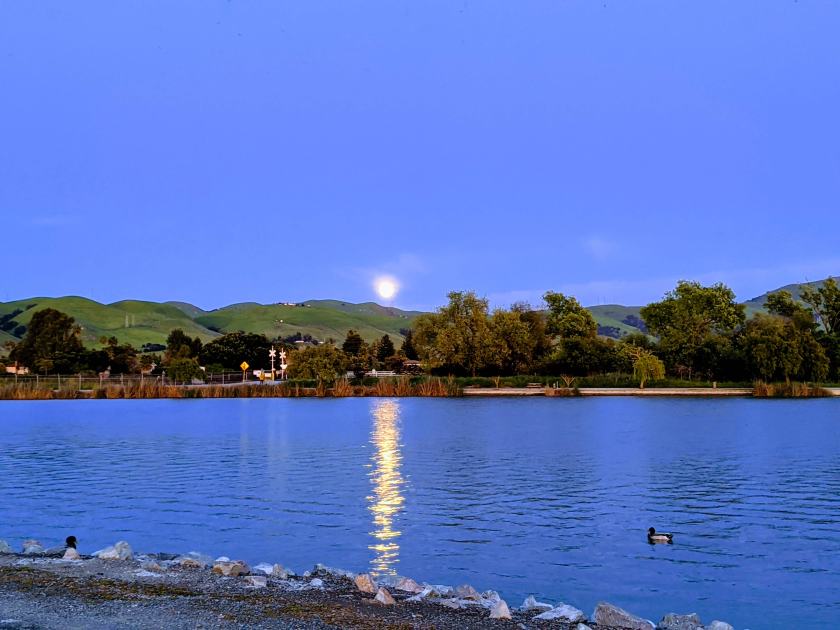
A few weeks ago, I got the incredible chance to see the full moon rise along with the sunset. One of those serendipitous things that the Covid-19 shelter-in-place has given me. I did not realize that it was the golden moon – the day the 🌝 moon comes closest to the Earth, and maybe  it was better that I hadn’t prepared for it. For, out on the walk, I stood mesmerized as  I saw the moon rise slowly in the East, as the sun set slowly in the West.

A better time or combination of light I could not imagine. A golden orb that rose from behind the green hills, and bathed the beautiful Earth with its benevolent beams, while the glittering sun bowed out graciously throwing pinks, oranges and purples with abandon against the blue skies. I watched the geese fly on over, ducks swim against the moonbeams on the lake, squirrels stopping to take in the surrounding beauty, and blackbirds swarming low over the lake waters. 

img_7899

I turned around to share  the beautiful marvel of the time with my  fellow beings when I realized I was quite physically distant from my fellow beings – human or otherwise. Do other sentient beings feel the same overwhelming sense of being at moments like these? Do dolphins take the time to gaze at the full moon like we do, do polar bears and penguins do the same from their respective poles? What a great unifying experience we all have with the celestial shows the universe throws at us?! 

Oh! To quiver with excitement with the Earth’s beauty has become my wont. 

The blue skies turned inky, and the golden moon turned silver, and  yet I could not pluck myself from the beauty of the evening. 

The giant glittering orb slowly peeked out from behind the green hills, and then rose steadily in a few minutes. We stood a few feet from a lake, socially distancing ourselves. How many times I have felt my heart flutter by catching a glimpse of the moon unexpectedly in the skies? How many lovers have gazed at the moon wistfully, dreamily, lovingly or yearningly through the ages? What a great unifying experience we all have across the pages of time?! 

I am so glad for our  nearest cosmic neighbor – I remember a few years ago when  we were moon-gazing awestruck at the beauty of the reflected sunlight, the son said, “Can you imagine how beautiful nights  on Jupiter must be? Imagine looking up and seeing 64  moons in the sky!

I was taken aback at the statement, but also thankful for the one moon we do have. 

A known Selenophile if there was one, I picked up the book Music for Mister Moon by Philip Stead with a song in my heart that evening.  The beaming moon has always attracted me, whether it is catching a fleeting glimpse of it as it appears and reappears amidst scudding clouds, or the waxing and waning of it during its reliable moon cycles or even when I catch an unexpected glimpse of it when the sun is bright and high above in the sky. 

mistermoon

The story of  a shy young girl who plays her instrument for no one but herself gently tugs us along for a ride as she accidentally pulls the moon right out of the sky. The moon’s revelation to know what it must be  like to float on the waters it is always reflected upon brings a little smile to your own lips, and slowly, but surely  you cheer for the little shy girl who opens her talent up to share with the moon.

The book does its  best to capture the magic of the moon, but probably the best gift of all is the dream I had after writing this post: I woke up thinking I was on a boat mesmerized by the floating moon near me.

🌙 🌝 Moon Magic. ✨ ✨

The Other Side of the Glass

There is a girlish delight in tucking oneself in the mode of Being, away from the duties of a Doing life on a Saturday morning. As I watch the minutes blend into hours, I sense my senses relax and delve deeply, calmly and yet completely enthralled at the prospect of indulging in my favorite pastimes of reading and writing. I feel the privilege in that sentence as I write it, for I recognize it for what it is: a luxury.

I hear the bees buzzing in the beautiful Spring day outside, a pair of blue jays have chosen a tree nearby to make their nest, and I watch the pair of them flit about busily during their days. Every now and then, one of them would come and peck on the window pane as if to check on me, though I know that comes from the human longing for self importance. The blue jays may just like the sound of the glass against their beaks, or probably; the reflection of themselves as they fly past. Whatever their motive, it is one of their many acts that I relish from the other side of the glass.

The other side of the glass.

What a wonderful way to observe the world? The internet is rife with jokes on humans sheltering in place with animals peeking at us, with their clever commentaries of us, and I must say I relish it. For once, we are all unanimously united in that state of achieving inner peace against the steady dripping of the news around us.

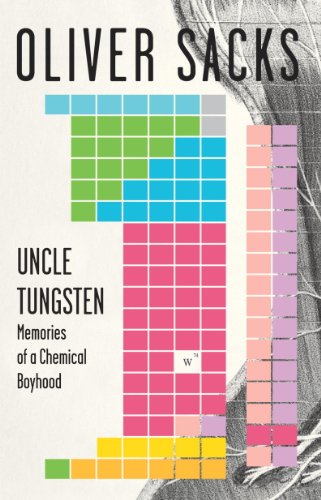
So, here I am sitting comfortably and reading the book, Uncle Tungsten – Memories of a Chemical Boyhood by Oliver Sacks.

The world as seen by the prolific writer and physician – his boyhood escapades with Chemistry and the influences of his life, are fascinating, full of learning and wonder, and makes one acutely alive to the fact that each life is a magnificent journey on its own. To those of us who are lucky to see life as an act of not just being, but becoming, it is a subtle reminder of the love of living.

uncle_tungsten

Every now and then, a passage takes you by surprise, such as this one. Oliver Sacks was born into a family of 4 siblings to physician parents, Dr Samuel Sacks and Dr Muriel Elsie Landau (one of the first female surgeons in England).

Reading has a way of taking us into worlds other than our own. I was delving into London of a century ago in his memoirs. The act of taking our consciousness with it to a different place and the ability to anchor us to the here and now, is a unique gift of reading. I found that strange juxtaposition in this passage:

“When it was time for my father to open his own practice, he decided, despite this early training in neurology, that general practice would be more real, more “alive”. Perhaps he got more than he bargained for, for when he opened his practice in the East End in September 1918, the great influenza epidemic was just getting started. He had seen wounded soldiers when he was a houseman at the London, but this was nothing to the horror of seeing people in paroxysm of coughing and gasping, suffocating from the fluid in their lungs, turning blue and dropping dead in the streets. A strong, healthy young man or woman, it was said, could die from the flu within three hours of getting it. In those three desperate months, at the end of 1918, the flu killed more people than the Great War itself had, and my father, like every doctor at the time, found himself overwhelmed, sometimes working forty-eight hours at a stretch.”

Just like that, I had moved to the other side of the glass. 100 years on, here we are, sheltering-in-place with the Coronavirus pandemic, and watching a similar situation of our good doctors being overwhelmed, and resources being stretched to their limits, as the virus sweeps through the world.

The other side of the glass.

That is the Earth!

“Do you know what this is?”

“That is the Earth! From the moon.” said the son matter of factly. “I saw it before!” he said in response to my awed expression.

We were looking at the back jacket of a book, that I flipped to the last page first.

this_is_earth

This is the Earth, by Diane Z Shore & Jessica Alexander with paintings by Wendell Minor.

It was a picture of the Earth rising on the Moon’s horizon.

A picture that generations of humans for millennia could only have imagined, and never really gotten close to the sheer beauty of it. Our myths are at once rich and limiting in its reach. They have imagined Earth as being elephants on elephants, turtles on turtles all the way down, flat discs, imagining heavens above and hells below.  

earth_myth


The picture was taken by an astronaut, Bill Anders, aboard the Apollo 8 spacecraft in 1968. I looked on mesmerized at the picture.

1200px-NASA-Apollo8-Dec24-Earthrise

Bill Anders / Public domain

But this picture is truly astounding. The pale blue dot when seen from the Moon is a brilliant, blue orb, suspended in space, intriguingly spattered with clouds, oceans, landmasses, not really depicting the billions of lives it fosters, or the number of ecosystems it has in its fragile balance. 

Bill Anders said: “We came all this way to explore the moon, and the most important thing is that we discovered the Earth.”

What a lovely statement that is, and together with his Earth Rising image, contributed to the concerns around Planet Earth that led to founding of Earth Day in 1970.

50 years later, we have made rocky starts and gains towards conservation. But this April 2020, 50 years later, purely coincidentally, Covid-19 has the world on lockdown, not just imagining a life of bare necessities but embracing it for the social good. We, the people, now have the time to observe our fellow inhabitants.

Heart warming tales of peacocks making its foray into the deserted cityscapes of Mumbai; turtles coming ashore to hatch in the beaches along the Bay of Bengal; seeing the Himalayas from a 100 miles away once the smog fog lifted; deeming the waters of the Ganges near Rishikesh fit for human consumption again without all the factories along the way dumping its wastes into the flowing water;or bears enjoying their natural habitats unhindered by human presence in Yosemite National Park, are surfacing, and it has my heart lifting again. I have often enough lamented on this blog about the poor attention we pay to the Planet that nurtures our fragile selves and egos. 

Watching the even more fragile ego of the stock market indices, it seems to me that we can very well have the world function this way, by having a month off every year in which everything stops but essential services. An Earth Month every year to reflect, slow down, plan and recoup our staggering impact to the environment. After all, the stock market seems to have a life of its own and seems only to want some stolidity in its expectations. So, we anticipate a month with no major events, no excessive or unnecessary travel, and only essential services operating. The notion isn’t that far-out either. 100 years ago, no one thought we could have 5 day work-weeks. Yet, here we are, in state where it is the norm now. 

Maybe this could be the measure we take for Earth Day to slow the rise of Carbon Dioxide levels in the atmosphere.

Screen Shot 2020-04-16 at 6.33.29 PM

Please go this site to see the curve over 2 years and over 200  years Keeling Curve – Scripps UCSD

If you look at the extrapolated curve from the 1700’s, it has risen exponentially. It is probably too soon to see the effect of Covid-19 on CO2 levels in the atmosphere.

Could, Earth Month become the new normal for us. So children matter of factly accept that Earth Month as essentials month in the coming generations?

Let’s care a whole lot!

T’was family movie night. An evening fraught with decisions, and everyone’s voice and opinion clanged over the dishes and sizzled over the noise from the stove.
Suggestions rose, opinions swelled and movies quelled.

“Uggghhh! No way!”
“That again?”
“What are you? A kid? Oh wait! Yes you are a kid! Okay never mind!”
“Nope! Too much for Amma! “
“What do you mean? It isn’t too much for me?!”
“You bawled last time for a movie that wasn’t even a tear-jerker, nope! How about this?”
“Star Wars!”

A collective moan went up. Finally, it was revealed that the youngest member of the family had no recollection of the Dr Seuss movie Lorax. He has read the book multiple times, and so we all settled in to watch Lorax.

The_Lorax

Dr Seuss is an inspiration, of course; but just how insightful his take on humanity is uncanny. From fresh air as a commodity, to a land without trees, to surveillance at every pore, his far sighted vision has so much to nod your heads at.

The Thneeds, created by the Once-ler, in his story are made from Truffle trees. Thneeds were fashion statements – doubling up from head scarves to sweater vests and shawls. (“But even he, it seems, could not envision a future where ripped jeans were fashion trends!”,  I said and drew a grudging chuckle from the teen with the ripped jeans. ) Eventually, of course, the Once-ler’s greed led to decimation of trees, habitat loss and a devastated landscape is all that is left.

“Wow – that was such a good movie Amma – though the movie had scenes that the book didn’t have.” was the verdict of the youngest.

“Really! Humans are impossible!” said the teenager, and discussion turned to conservation, Greta Thunberg and some you-tuber who talks about going green.

“Did you know the Lorax was banned in some schools in California because loggers felt it was not friendly to the ‘foresting industry’. ” I said.

I looked at their agonized faces with awe – how is it children get these things, and adults don’t; and I felt a surge of hope.

lorax

We were walking a familiar route through our neighborhood a few days later, stopping to see some of the felled trees as we do every so often. The rings in the pine trees show they must have been at least 80 years old, and to see the forlorn stumps reminded of the beautiful book, The Giving Tree.

img_7820

The book starts with friendships between a young boy and an apple tree. The boy plays and swings on the tree’s branches, but as he grows older demands more and more from the tree. He needs her apples to make money, cuts her down to build himself a house and a boat, and finally comes back tired and spent with life, when all the poor tree can offer is the stump to rest.

The Giving Tree, can be interpreted and discussed in many different ways. Givers & Takers, Need & Greed, Selfish & Selfless, but the most beautiful one is the simple one, the one where your children make a sad face at the end, and say, “Why doesn’t this boy/man/grandpa ever feel sorry for what he’s done?”

giving_tree

The boy reminds us of human’s relationship with nature. The human species can be broadly classified as takers: from the planet, & from our co-habitants on this planet. You might have seen this video clip of Man’s greed By Steve Cutts:

The Giving Tree too was banned interestingly for sending sexist messages – the tree was female and the little boy continued to take from her without ever giving back.

I just finished a book called Losing Earth – by Nathaniel Rich. The book, deals with the science, politics and action of climate change.

losing_earth

Despite humanity having the science locked down more than 50 years ago, little action has resulted. The closest we came to getting everyone to agree on unified action was the Paris Agreement where all countries agreed to work towards keeping emissions such that we not go above the 2 degree increase of temperatures world-wide. The largest emission offender for decades, United States, pulled out of the agreement when Donald Trump became President.

I was shocked to find that Climate Change as a topic has been banned in certain schools, skirted around in others and given a miss altogether elsewhere. The science behind Climate Change and the effect of our industries were long proved – as far back as 1970.

This April 22nd is the 50th anniversary of Earth Day with a special onus on Climate Action. Maybe this Earth Day, we can renew our commitment to the only pale blue dot that will harbor us. Let’s care a whole lot about our planet before all we are left with is the word ‘Unless‘ like in the Lorax story, or the tree stump in The Giving Tree.


no_garagepale_blue_dot

Read also: Are we to become Lab Rats?


The Rings of Life

We were walking a familiar route through our neighborhood, stopping to see some of the felled trees as we do every so often. The rings in the pine trees show they must have been at least 80 years old.

img_7820
For an impatient flitter such as myself, trees are truly sentient beings. Beings that teach me about holding still, of being sentient beings for the small time we spend on this beautiful planet. Like a butterfly flitting through the Earth for a day. You can replace tree for a star in the quote below and it would still hold when one sees redwood trees, sequoia trees and old banyan trees.

“From the point of view of a mayfly, human beings are stolid, boring, almost entirely immovable, offering hardly a hint that they ever do anything. From the point of view of a star, a human being is a tiny flash, one of billions of brief lives flickering tenuously on the surface of a strangely cold, anomalously solid, exotically remote sphere of silicate and iron.”

― Carl Sagan

As I was reading Life in the Garden by Penelope Lively, I stopped to relish the section on trees. Though the book is largely about gardens, she does make a foray into trees briefly:
“Tree rings are wonderfully eloquent; here is time stated, time recorded, time made manifest. Dendrochronology- the scientific method of dating based on the analysis of tree rings-can determine past climates, or the age of a building, it can be used to calibrate radiocarbon dating, or by art historians to determine the date of a panel painting. And all because a tree grows slowly, systematically, but laying down each year a memory of what that year was likes – usually wet, dry cold, hot-whether the tree flourished and grew, or held back, and how many years have passed. And the more I think about it, the more I have come to the conclusion that this is why trees invite anthropomorphism. They are sentient in a way that a building cannot be.”

octopus_tree

When I read this piece in Life in the Garden by Penelope Lively, I thought to myself, that Covid-19 would not register in the life of trees, would it? Droughts, wildfires, these may, but Covid-19 would not. The human suffering is acute – there is no doubt about it. The true heroes are the front-line workers, such as doctors, nurses, water and essential service providers, cleaners, mailmen, supply chain workers for groceries and medication who are braving the outbreak to keep society functioning as best as it can, while the virus takes it toll. The human toll is one thing, Covid-19’s economic ramifications is quite another, reminding us of the tottering pile we have built our societies upon: Stock markets indices, economies, international boundaries, – everything that a virus can thwart on a whim.

3D_medical_animation_coronavirus_structure

What would Covid-19 imprint in our psyches? It can be a time of transformation. A time of reflection. A time to prune the unnecessary, a time to nurture the necessary, a time to get to know ourselves and our loved ones better. A time to think of needs vs wants.  A time of quiet.

We may never have taken pandemic preparedness seriously. Covid-19 is teaching us about the importance of these things. What would we need to do for far more severe outbreaks, with water-borne or air-borne diseases in the future? I am sure these will never be treated with the same levity ever again.

“Nature is always more subtle, more intricate, more elegant than what we are able to imagine.”
― Carl Sagan, The Demon-Haunted World: Science as a Candle in the Dark

The more I think about it, the more I want to believe that we shall embrace Science as a Candle in the Dark. Many children will take up research in microbes. I hope we shall, from now on, invest in our infrastructure, in our research, in our general preparedness, and appreciate the fragility of life and our social ecosystems itself. Our rings in time will bear out the wisdom in the coming years if only we learn from it. One dark circle reverberating it’s learnings outward, and spreading light in the subsequent rings afterward.

“In its encounter with Nature, science invariably elicits a sense of reverence and awe. The very act of understanding is a celebration of joining, merging, even if on a very modest scale, with the magnificence of the Cosmos. And the cumulative worldwide build-up of knowledge over time converts science into something only a little short of a trans-national, trans-generational meta-mind.”
― Carl Sagan, The Demon-Haunted World: Science as a Candle in the Dark

References:

  • Life in the Garden – By Penelope Lively
  • The Demon-Haunted World: Science as a Candle in the Dark – Carl Sagan

Time in the Garden

Regular readers know how much I enjoy nature and gardens. It is one of life’s ironies that my plants only thrive despite my loving care, and  many is the time I have made bloomers in the little patch I tend to. However, never one to shy away from blooming from the bloomers, I picked up this book, Life in the Garden, By Penelope Lively. 

life_garden

Lively begins by examining the gardens in Literature starting with the Garden of Eden, and working  her way through other fantastical gardens in the books, The Secret Garden, Alice in Wonderland and the beloved gardens of dear, absent-minded Lord Emsworth’s at Blandings castle. 

She examines the writing and finds out which of the writers are gardeners themselves and which of them have merely picked up the scenery from a gardening catalog. She teases the co-ordination of colors, the seasonality of the plants themselves in the landscapes and has given me an entirely different appreciation of gardens. 

Some passages are especially endearing and made me want to read them again. Especially her meditations on time, the gardener and the garden itself. 

I quote from her book: 

“To garden is to elide past, present and future; it is a defiance of time. You garden today for tomorrow; the garden mutates from season to season, always the same, but always different. … In autumn, I plant up a pot of “Tete-a-Tete” daffodils, seeing in the minds eye what they will look like in February. We are always gardening for a future we are supposing, assuming, a future. I am doing that at eighty-three; the hydrangea paniculata “Limelight” I have just put in will outlast me, in all probability, but I am requiring it to perform while I can still enjoy it.”

“The great defiance of time is our capacity to remember – the power of memory. Time streams away behind us, and beyond, but individual memory shapes for each of us, a known place. We own a particular piece of time; I was there then, I did this, saw tear, felt thus.”

She goes on to say, 

“A garden is never just now; it suggests yesterday, and tomorrow; it does not allow time its steady progress. “

Certainly, for me, part of the appeal of gardening is this ambivalent relationship with time; the garden performs in cycles, it reflects the seasons, but it also remembers and anticipates, and in so doing takes the gardener with it.”

As I look out the window at my clover-filled backyard with some foxgloves looking happy amidst the narcissi blossoms and the newly sprouted cherry leaves after their spectacular show of cherry blossoms, and the rose buds ready to burst forth in a few weeks,I cannot help feel the lessons nature is teaching us. Be forward looking – always, nurture what is important, and enjoy the passage of time. One moment at a time. Every flower has its chance to bloom and fade.

do-nothing-garden_1

Gardens are enduring lessons in hope. I cannot tell you the number of times, I have planted something in October and been surprised when they bloom in April, or the number of times, I have been pleasantly surprised that something  thrived  at all. 

“Hope” is the thing with feathers –

That perches in the soul –

And sings the tune without the words –

And never stops – at all – 

Emily Dickinson – Hope

I am lackadaisical at best with my gardening and it shows. I have a minuscule patch that seriously  has more air-time on the blog than the square feet it occupies. Yet, it gives me immense pleasure, peace and calm. Spurred on by the book, I went outside to take a more active role in the tending of my plants. I have been admiring the sweet peas plants that have sprouted in the garden. Some time ago, I got a packet of sweet  pea seeds from our local library. Thrilled at finding them, I scattered them by the apricot tree and forgot about them. The plants are thriving now, quite tall, and seem to be sagging. So, I went – “Coming dears! Here I am to take care  of you!”, I said, in my best nurturing voice and tried to prop up the plants as best as I could, in the process, breaking off one of the plants’ main stems.

If the plants in my patch could talk, they would’ve chorused – “Go inside – we know you  love us, just let us thrive! Breaking off our stems indeed!”

A Rose is a Rose

We were out hiking one day in mid February. The son and I eagerly packed our snacks, water bottles and headed off as the sun rose. It was a golden day in which we stood under trees listening to the blackbirds trilling overhead. Squirrels scuttled past with their duties, while woodpeckers drilled in the trees above. New born calves stood demurely by their mothers. We stopped to sniff at the flowers every now and then, looking indulgently at the buds waiting for the spring bloom. A thousand smells rent the air, and I said “How marvelous it must be to be a flower in spring time?”

He laughed – the sort of tumbling laughter that children have, and we adults can do with from time to time. His words tumbled out between his giggles, and he said, “Did you know? That a flower 🌹 comes up when its ovaries burst open?” 

I gasped dramatically and the little botanist went on to explain what his teachers must have told him in school. I listened enamored, wondering not for the first time why we ever grow out of schooling, and the shoshin of childhood.

Anyway, there we stood with the beauty of spring all around us. The rains had made the hills green, and in this verdure, it was hard to imagine anything but positivity and beauty. It was hard to imagine that in less than 2 weeks, the world would be reeling under the influence of a virus.

Talking to my colleagues & friends over virtual calls, and phone, reading what people have to say over Social Media, I feel a general sense of overwhelm, gloom and what-next overpowering some. Some seem to have taken to the new normal, doing the best they can with the new set of circumstances, others not so much. The relentless news cycles have been pounding us with streams of news that reminds me of Oogway. 

Oogway, the wise turtle: “There is no good news or bad news, there is only news!”

Master Shifu: “But Tai Lung has escaped” (But Corona has escaped!)

Oogway, the w turtle: “Oh, That is Bad News!”

Oogway & Shifu

As human-beings, we are always forward looking. We want to set forecasts for corporations, we want to predict & measure, and when all of these things are fluid, it is understandable to feel unmoored. 

We want to know we are in control of things, only rarely do we realize that Control is an Illusion. 

Walking past rose bushes one evening during this time, we stopped to admire the buds ready to bloom. I thought about the beautiful poem by Mary Oliver. A poem I often think of when the human calls of productivity and being busy beckon. 

Roses, 🌹🥀  Late Summer – Blue Iris 

 – By Mary Oliver

I would be a fox, or a tree

full of wing branches

I wouldn’t mind being a rose

in a field full of roses.


Fear has not yet occurred to them, nor ambition.

Reasons they have not yet thought of.

Neither do they ask  how long they must be roses, and then what?

Or any other foolish question

rose