The Oldest Trick in the Book

Flittable Flipperbits

It was one of those days when I felt speed and productivity were playing a cruel joke on me. It bonked me from chore to meeting to event to missed messages, and by the end of it all, I had a vague sense of all the things that didn’t feel quite right because the important had been muddled in with the unending stream of the banal.

In all the melee of rushing about the day, I realized that I had missed an important piece of communication, which, had I picked up at the right time might have saved me about two hours of turmoil, but there you are. 

Later that night, I felt foggy. Nebulous clouds, misty and mysterious as they seemed, I knew I needed to sit and stew for a bit for them to take shape. But then, of course I was too stimulated to do that – flittable flipperbits!  I marveled yet again at the highly energetic, always-on-top-of-things folks we meet in our daily lives. They sparkle with busyness, and seem to be happy about it too. I felt that strange longing to be like them just for a day perhaps! 

By the end of the day, the world seemed to laugh at me, and I had no choice but to join in. So, I did. 

The husband gave me a curious look and said, “Well – you just did get a day like that, and you seemed to have managed pretty well – you were busier than you wanted to be – a day filled with things to do, and jobs to get done, buzzing about. You seem to have missed out on some important things, but you took care of them. And you seem to be laughing at the end of it, so what’s wrong?”

I gave the poor fellow a look that I usually reserved for poorly cooked cabbages, said he wouldn’t understand, and swished off to bed. I felt like a cooked cabbage myself, how was that any good? 

Dreamy Strawberries

It was all made clear to me the next morning when I awoke from what seemed to be one of the strangest dreams that even I have had in a while. It involved marriage halls with catchy music, social situations that I fervently hope and pray I shall never find myself in, and feeling like I was run over by a truck that had strawberries in them with flowing taps of chocolate (but not dark chocolate – for some reason, this seemed like an important thing for the brain to remember the next day) 

So I decided to meditate today – the diagnosis was clear: this was an over-wrought brain. Nothing else. I shall meditate and all shall be well. By the time things pick up in a few hours, I shall have the world in control again, I said, and sat down to it. The oldest trick in the book really, but the most effective.

How did we muddle it all up?

I thought of all my wonderful yoga and meditation teachers, and invoked their calming voices. They floated up, and did their job, and I spent the next few minutes thinking about a conversation I had with my friend – who is a poetic soul brimming with love, and we had chuckled about it. How the world of remuneration is all inverted. The ones who really should be the best compensated are the ones who teach us to spend time with ourselves, taking what is available and trying to help us shape ourselves into something far more beautiful – our teachers, coaches, mentors, yoga, art and meditation teachers – and yet, the world has somehow played a cruel joke by compensating those who make the very algorithms and enable the lifestyles requiring these things to dance to the bank, and not the other way around.

I thought, I’d share this video though – for it says a lot of what I’d like to say – only a lot more cogently:

Rory Sutherland – Are We Now Too Impatient to Be Intelligent? | Nudgestock 2024

“Let’s let go of all stray thoughts – acknowledge them, but tell them, you’ll come to it.” said my meditation teacher’s voice in my brain – forgiving yet insistent, and I chuckled. How did she know where I had gone off to – even when I was only bringing her up as a figment of my imagination?

Meditation done, I felt like I could begin the dance of a new day with fresh energy, and rather looked forward to seeing how I would muddle it all up again. Somehow, that felt right.

Embracing the Tranquility of a Summer Evening

The day could have been better. My to-do list gave me reproachful looks all day long as I took care of many different things and accomplished nothing. It was time for this and time for that, not yet time for this-and-that, and oh-so-past-the-time for this-or-that. Finally, I wrapped up for the moment and headed out. It was a beautiful summer evening after all, and moping about not doing the work was not going to get it done. 

That’s how I found myself that beautiful summer evening, doing yoga in a friend’s garden that she had kindly invited us to. The sun’s rays danced through the maple leaves in the west, the mild breeze provided much required respite and made the italian cypress trees in the east look like they were dancing and swaying to the breeze too. 

The pink bougainvillea in the south leapt from fence to tree with such freedom of spirit, that I couldn’t help feeling a bit wistful at not being able to boldly leap and catch hold the way those plants did. How did creepers know whether they’d make it to the next branch? There must be a bold vision and a willingness to let go of safe harnesses that we never really stop to think about. I wonder how that feels – it certainly seems to be something we struggle with as adults more than as children. 

To complete the bucolic yogic scene, was the neighborhood black cat. Well-fed, preening its coat, gleaming in the evening sun and stretching every now and then to show us what a good stretch looks like, she lay there looking perfectly happy with the way her evening was going (or her days were going) by the looks of it. 

I told my friends about the state of to-do-ness that had ailed me that evening, and how the evening completely transformed it. My friends seem to have been in similar states of mind – and it all came spilling out the moment I said so. 

We smiled and drank in the scene: The cat did not care, the trees continued to sway, the leaves shone and the parched earth settled down to a cooler evening, the birds above made their way home. The purpose of life was right there, for those willing to take it.

The best part of the evening was the various angles from which we took in the garden – upside down, sideways. While breathing hard, while taking deep breaths. I tried taking the picture of the garden upside down, but of course all our tools seem to want to correct all our ‘mistakes’ and would not allow me to. So, I rotated the pic manually to retain the beauty of the world seen upside down.

upside_down_garden

Dancing in the wind, with the sun on my face.

Playing hide-and-seek and eating a treat.

It reminded me of Dr Seuss’s quote on looking at life

Fantasy is a necessary ingredient in living, it’s a way of looking at life through the wrong end of a telescope, and that enables you to laugh at life’s realities.

Dr. Seuss

Stimulus🧘🏼‍♀️ 🪷 Pause 🧘🏼‍♀️ 🪷Response

“Life in India is so fast and hectic, isn’t it? “ . We were discussing the fast and furious pace of India with friends. We were each reminiscing our respective trips to India – both made under difficult circumstances, and we were both glad to be back home in the United States.

I nodded fervently, and said wistfully, “Yes – at least during the time I was there, the concept of solitude was rarely acknowledged.”

“Solitude?” And we all laughed. It was true – the populace, and the ways of life make slowing down much harder than usual. It isn’t made any easier with the speed of communications and transportation in cities. The very essence of vibrance that is a huge advantage and a beauty to the civilization was also a disadvantage.

There are times when I have marveled at how the Indian way of life came up with practices such as meditation and yoga, but then I also realize that it was there that it could have developed, for it was required to build still pockets of serene moments into one’s life. in fact, the concepts are nothing short of brilliant. The pause between breaths is essential to be mindful of, when it may be all you can get in terms of mindfulness. The breath becomes the prana in very significant ways. The pause, when rarely taken, becomes harder to practice, and yet the pause becomes that tiny moment of choice in our agency of life.

There are so many aspects to the Philosophy of Being (I am amused it has such a strictly medical sounding name: Ontology)

Keeping ontological explanations aside, if The Nature of Being comes down to simple techniques of breath, fluidity and movement, it makes the simplicity behind it all brilliant.

Buddha in Lotus?
Buddha in Lotus?

For many years I had thought of this quote, attributed to Victor Frankl in Man’s Search for Meaning:

“Between stimulus and response, there is a space. In that space lies our freedom and our power to choose our response. In our response lies our growth and our happiness.”

-Quote widely attributed to Viktor Frankl, Author of Man’s Search for Meaning, but not sure: Between Stimulus & Response

Back home, I savored the morning air, as I stepped out for a brisk walk embracing the nippy air. I felt like I could finally hear myself think, and I had a beautiful walk weighing and thinking of such topics as courage, resilience, choices, decision-making etc in the context of our work and personal lives. How one helps us evolve in another sphere, and how we are as human-beings are nothing more than the function of life’s ebbs and flows.

img_8958

The Art of Breathing

A colleague caught me mid breath one day. It was one of those days that butterflies would have looked on me with mixed emotions.

On the one hand with pride: When did this caterpillar learn to flit like this?

On the other hand with amused tolerance: The half-wit seems to be forgetting the sweet joy of collecting nectar amidst pretty bright flowers, with all the fast paced flitting. Forfeiting the sweet thing about flitting – tut tut!  Flutter tutter utter nutter! (I am not high up on the poems caterpillars learn to sing about when still creepy crawlies; and the butterfly metaphor only goes so far!)

Anyway, it was one of the many days in which I flitted about the old work spot tasking, multi-tasking, sub-tasking, reminding others about their tasking, setting reminders for my own tasks and so on. Thoroughly immersed in my second self that Mary Oliver so succinctly calls the Social Self…yes, it was one of those days.

Mary Oliver’s, Upstream, is a book of many marvelous essays.  The essay, Of Power and Time, talks about the three selves in many of us:

•The Child Self

•The Social Self &

•The Eternal Self.


upstream

Though in the essay, Mary Oliver, refers to the Eternal Self as the artistic self, I like to interpret it as the Creative self.

• The Child Self is in us always, it never really leaves us.

• The second self is the social self. This is the do-er, the list maker, the planner, the executer.

• Then, there is the third self: the creative self, the dreamer, the wanderer.

T’was during one of these trying days that I remembered the deep breath technique my Yoga teachers had tried to teach me about. Take deep breaths, and concentrate on it filling your stomach, feel it coming in and out of your nostrils and so on. So, I started my deep breaths as I was walking from one meeting to another. Deep breath, exhale, deep breath, exhale and so on. I had thought no one watched, but one colleague caught me, and grinned. “That should be your GIF you know?” he said.

I nodded sheepishly, and went back to my brand of breath-less flitting within minutes.

Later that week-end I ran into this beautiful children’s book in the library. A book that was just waiting to be written. A beautiful capture of all the different types of breath, Alphabreaths 

Written by : Christopher Willard (a clinical psychologist) & Rechtschaffen MA, Daniel (a counselor)

Illustrated by:  Clifton-Brown


The book is a lovely read urging us to Breathe like a Dolphin taking a dive, or our favorite one, The Ninja Breath – silently and slowly. The illustrations too make for a marvelously relaxing read. Please check out their Youtube clip : here


Mindful breathing and Yoga are excellent concepts to teach the children, and I am always in awe of those who can take complex concepts and make them palatable for the consumption of young and old alike.

If you happen to come home and find the son and I swimming like dolphins or getting ready for a Star Trek mission on the floor while Yoga-ing along with the Cosmic Kids Yoga series by Jaime Amor , do not be alarmed. Her yoga videos are appealing and fun. If, along the way, we do something to calm ourselves down – then great, else, we have had a great time.

There are so many aspects to the Philosophy of Being (I am amused it has such a strictly medical sounding name: Ontology)

Ontology is the branch of metaphysics dealing with the nature of being, and reading the Wikipedia page itself boggles my simple mind (A post on the Study of Philosophy is sitting up on its hind legs and begging to be written). Maybe, what is required is a Ninja Training on Ontology. Excerpt from the wiki page:

Such an understanding of ontological categories, however, is merely taxonomic, classificatory. Aristotle’s categories are the ways in which a being may be addressed simply as a being, such as:[9]

  • what it is (its ‘whatness’, quiddity, haecceity or essence)
  • how it is (its ‘howness’ or qualitativeness)
  • how much it is (quantitativeness)
  • where it is (its relatedness to other beings)

*** Taking a Y for Yawning Breath before a Z for zzzz breath about now ****

img_4049

Keeping ontological explanations aside, if The Nature of Being comes down to simple techniques of breath, fluidity and movement, it makes the simplicity behind it all brilliant.

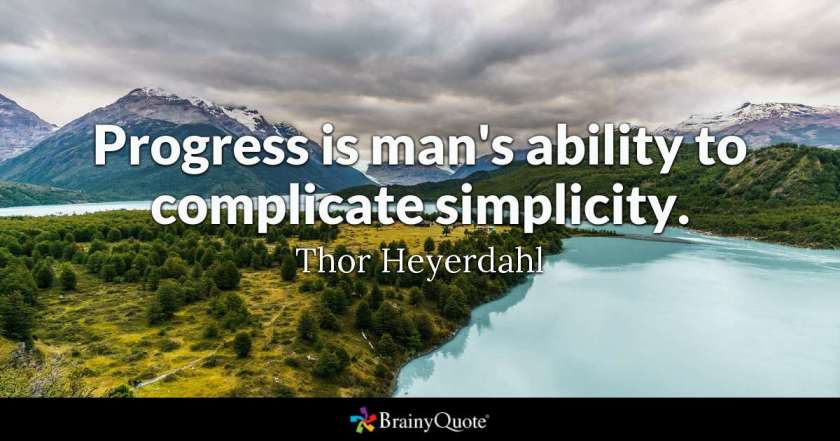
It was one of those ‘Simple is brilliant’ types of  quotes that I went looking for. I know many brilliant blokes and blokees have said marvelous things about simplicity -I know old Leonardo Da Vinci said something about it, so did old man, Einstein. In any case, looking for one of those made me fumble on this one by Norwegian explorer, Thor Heyerdahl

From Wikipedia: Thor Heyerdahl became notable for his Kon-Tiki expedition in 1947, in which he sailed 8,000 km (5,000 mi) across the Pacific Ocean in a hand-built raft from South America to the Tuamotu Islands. The expedition was designed to demonstrate that ancient people could have made long sea voyages, creating contacts between separate cultures.

thorheyerdahl1-2x


Continue reading “The Art of Breathing”

Buddha in a Lotus

International Yoga Day is approaching and consequently there was an intense discussion amongst our diverse group, that involved yours truly foraging in the murky forests of my Indian-not-at-all-devout-Hindu upbringing and serving up dubious explanations. As we leaped and scoured the real and mythical worlds alike, the venerated Vanars would have been proud to see us. We started with lofty enough topics, but ended up – well, see for yourself where we ended up.

International Yoga Day

The discussion started with Yoga-in-the-park for International Yoga Day. Why must it be so early? said a colleague and I sympathized. Regular readers of this blog know that I am not at my brightest in the mornings. I am best left alone to peek out from behind my coffee and quickly pull myself back into the cup, peek from the c., pull back in, and then slowly, like a snail, venture out into the world.

I deplored the state of affairs in India and how we deify the early-riser and leave the poor late-risers feeling somewhat inferior and catching up with the early-risers for the rest of the day. We traipsed around early morning rituals and temples and why meditation in the first place.

Just as I was patting my back on the spiritual plane the discussion could reach from the lofty stepping stone of Yoga,  it slid straight down the slide to idlis, dosas & sambhar. It was like playing Snakes & Ladders in the thick Madhuban forests, I tell you. From the spices of the foods, it was but a natural stop at yogurt.

After moving to the USA, I like flavored yogurts such as strawberry or apricot yogurt, but I also told them about the slurpilicious plain-yogurt and rice. There was a sticky moment when folks could not see the appeal of plain yogurt against the Apricot yogurt, but I scored a goal by bringing up mango pickles.

When you bring yogurt and rice up to a South Indian at lunch-time, she can’t but help talking of mango pickles. Other colleagues of Asian origin chimed in with durian and jackfruits, and we all sighed collectively at the exotic fruits and tropical vegetables of the East. Some bright person then said something about lotus roots and another said that Buddha sits in a lotus.

Spiritual-plane-wise, we were getting back up from the hard fall into dosa, sambhar and curd rice territory, so I felt I had to wade in.

“For some reason, the lotus holds a special place in Indian Mythology”, I said.

I turned and looked at the awed expressions on my co-conversationalists, and this gave me the confidence to plunge on. It is a knack. When people expect something profound from me, as if they are making up their mind to see whether or not I am intelligent, I say something like this and dash all hopes.

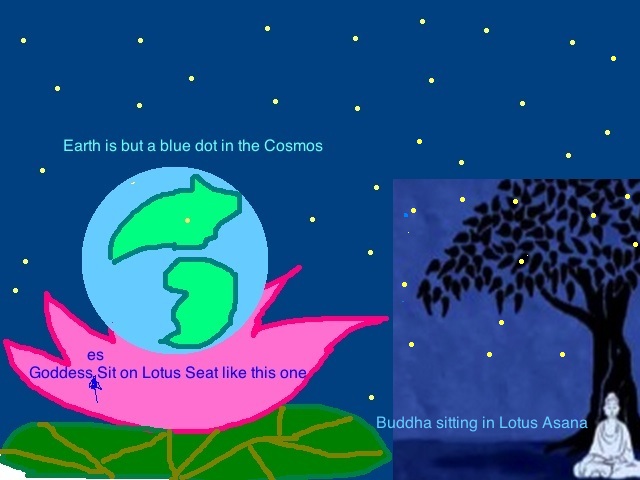
“Most goddesses I know like to sit in one. Although the lotuses I have seen are pretty small – I don’t know how goddesses sit comfortably in them. “

“Really? Goddesses sit in lotus too? I don’t know much – I have seen some pictures of Indian Goddesses, but never saw that – maybe hard to make out from the saree and all, but Buddha I know.” said a colleague who has taken the Myth of the Mystical East to heart.

I summoned up the picture of Saraswathi and Lakshmi in my visual eye. I don’t remember seeing their saree flowing over their lotus seat. I mean, they were caparisoned in beautiful garments and jewelry, but the lotus was apparent too. I have never seen the saree flowing all over the lotus hiding it from view. Have you?

Somewhat befuddled, I prodded on. “No, I am pretty sure the Goddesses sit in lotuses. I do remember seeing some stylistics paintings of Buddha in a lotus, but mostly he is under a Bodhi tree, looking happy, right?”

This must have been interesting to watch, if it wasn’t me, sinking deeper and deeper into the mire. Anyway, neither of us backed down, and both of us were equally sure of our lotus occupants. The birds stopped twittering to watch the great philosophical debate. Apricot yogurt or plain yogurt with rice: Which one would emerge the victor?

Buddha in Lotus?
Buddha in Lotus?

“Really? I don’t know. I have always seen Buddha in Lotus Asana – except for some statues in Pier 1 Imports, of him lying down.” said she.

Wait a minute. I knew what was going on. I observed, deduced and felt that faint feeling of relief and comprehension dawn on me and the birds twittered again. I asked, “You mean the yoga posture Buddha sits in? Lotus Asana?”

“Yes! Isn’t that what you have been talking about? “

“Oh when you said you couldn’t make out the lotus in the Goddesses, you meant, you couldn’t make out whether their legs were truly crossed in Lotus Asana with the saree and all that?”

“Yeah.”

And then, I laughed as I told her that I was talking about the seat in which the goddesses sat, although, I conceded they may have been sitting in lotus asana too.

So, both of us were right. You can have apricot yogurt or plain-old-curd-rice-with-mango-pickle. Yes, in the Lotus Asana, if you like.

Maybe that will remind us to be truly humble while talking of Lotuses or anything else. We are, after all, a fraction of the small blue dot in the Cosmos, like Carl Sagan said.

http://www.brainpickings.org/2012/12/10/pale-blue-dot-motion-graphics/

Now, if you will excuse me,I need to practice my half-lotus position for International Yoga Day.