Weaving The Sequins Of Time

This article was published in The India Currents magazine dated 17th Feb 2018: The Magic We Miss Every Night

Taking a drive up the mountains is always a nostalgic experience for me. Regular readers know I grew up in a small village nestled in the mountainside and every time I spot a pine cone or take in a whiff of Eucalyptus scented air, I get a gleamy look in my eyes that prompts the daughter to ask me for a story about my childhood. I comply almost gleefully and she sits back and imagines her mother as a little girl, a person who is vastly more interesting than the adult version. One loopy enough to jump across streams, build mud tree houses and make a wish against a shooting star.

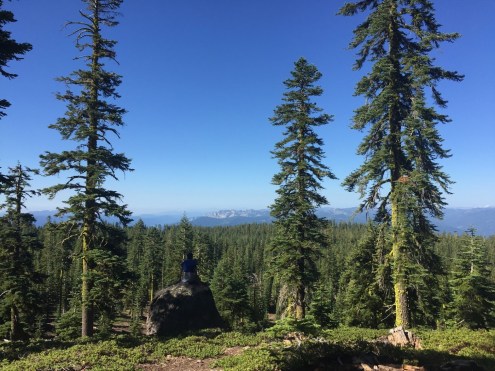
I was thoroughly pleased to do that again during our recent visit to the Inyo Canyons. Not build a mud tree house, but to make a wish against a shooting star. One of the best things about going out to the vast expanses of nature that we urban dwellers completely forget is how the dark the sky is at night (duh!) and how many stars we can see against this backdrop.

We were blessed with remarkably clear skies during our time there, and we headed out bundled up like Eskimoes in Winter to see the night skies. We made our way up a winding mountain road that overlooked a vast plain thereby giving us a wonderful vantage point for seeing the skies. Maybe it was the enormity of what was in front of us, but it subdued our normally stentorian voices temporarily. We stood there in companionable silence for a while just gazing at the outer arms of the Milky Way (at this time of year, apparently, we do not get to see the whole Milky Way).

My, it is so dark – it can be lonely here, we whispered to each other after some time.

The stars tousled our hair gently teasing us : of course it is dark, what did you expect, and look up at us. You are not lonely unless you wish to be. You have a universe unto yourself. ( I have an idea brewing here: it may be laughably inadequate, but that has not stopped me from publishing before)

The sun groaned from the other side : Duh, everyday I give you the gift of night, you know?

For the first time, I saw Ursa Major or Big Dipper drawn large against the night sky, with nothing to impede its view. It is amazing how many different civilizations managed to study the skies in varying yet similar ways.

There is the North Star, that was known as the Dhruva Nakshatram  in the early days when the Indian civilization named it (Story here: https://en.wikipedia.org/wiki/Dhruva).

Can you see Arundathi? Did you know the story about Arundathi being a twin star to Vashishta and rotating around each other? That is why it is a wedding ritual.  Alcor & Mizar known as Vashishta and Arundhati. Really?

So it went.

The daughter rattled stories from Greek Mythology that we tried to find Indian equivalents for. The magic of story-telling under the stars came alive for us that night. Sirius barked and Taurus ran. The hunters belt was bright and gleaming, the Plaeidis cluster was there, the Seven sisters were being relentlessly chased by the Big Hunter, while the same Krittikai sisters raised Karthikeya in the plains of Indus Valley millenia ago.

sequins_of_time

Lest you run off thinking that the daughter has sat down with the classics and pondered the deep recesses of ancient cosmology, let me assure you that Rick Riordan and his Percy Jackson books formed the basis for the bulk of her knowledge.

The white cloud that we never really see in urban areas was visible – consisting of millions of stars, the cosmos probably is home to millions of Earths fostering life and intelligent lifeforms. I was reminded yet again of Carl Sagan’s words  about the pale blue dot.

pale_blue_dot.png

It is true, every tyrant, every usurper of power, every chaser of money, every person with cares in this world, should stand beneath the blanket of stars everyday, and look at our souls in a detached manner. See ourselves as specks in a dark world where the only place for us to find light is by looking inwards and capture the feeling of light in our hearts like Earth captures sunlight and warmth in its atmosphere.

As we stood there with the children bundled up in the cold on a mountainside overlooking a vast plain with the stars shining down, we saw in the distant horizon seven or eight shooting stars.

Magical moments come in various ways, sometimes it comes in the form of shooting stars, sometimes it comes in the form of a fluttering leaf falling upon you and other times it comes in the warmth of a lazy winter morning when all the world outside seems bleak, but you feel warm inside. Even these cold winters can be translated to a warm feeling that the Danish have a wonderful word for: Hygge. ( pronounced – Hoo-ghey)

Embracing Hygge – The Danish Secret to staying happy in the winter

It is the feeling of warmth and coziness even when the world outside is harsh and cold.

As Louisa Thomsen Brits, author of The Book of Hygge: The Danish Art of Living Well says, “It leads to a sense of a rich inner life that radiates out through bleak days.”

What better way to weave the little sequins of magical moments into the fabric of life?

If

We had been to the East coast to gulp in the beauty of the fall colors before the trees were stripped bare for the Winter. I marveled at the beautiful tapestry that nature had laid out for us. The greens, golds, yellows, rusts, oranges, reds and browns blended together beautifully to please the eye. The same patch of forest looked beautiful in the different lights of day. The color of the skies above, the intensity of the sunlight, the shadows of the scudding clouds above, all painted marvelous pictures and nature soothed in a way that it has always done.

A forest is beautiful to look at. A forest in fall colors is brilliant to look at. The diversity in colors is mind boggling, and it all pieces together beautifully in a marvelous tapestry. It is the differences in color that make it glorious.

An artist’s palette is made more vibrant with different shades.

As much as we all like everyone to be like us, it is the fact that we are different that makes the world a beautiful place. It is the disappointments that should propel us forward.

I am distraught at the person America has chosen as its President elect. I am trying to find solace in the words of Carl Sagan on Earth:

Look again at that dot. That’s here. That’s home. That’s us. On it everyone you love, everyone you know, everyone you ever heard of, every human being who ever was, lived out their lives. The aggregate of our joy and suffering, thousands of confident religions, ideologies, and economic doctrines, every hunter and forager, every hero and coward, every creator and destroyer of civilization, every king and peasant, every young couple in love, every mother and father, hopeful child, inventor and explorer, every teacher of morals, every corrupt politician, every “superstar,” every “supreme leader,” every saint and sinner in the history of our species lived there-on a mote of dust suspended in a sunbeam.

screen-shot-2016-11-14-at-1-56-32-pm

Now, more than ever before, is the time for all of us to come together and become heroes in our own ways. I felt this was the right time to read Rudyard Kipling’s poem ‘If’ to the children.

If you can keep your head when all about you   
    Are losing theirs and blaming it on you,   
If you can trust yourself when all men doubt you,
    But make allowance for their doubting too;   
If you can wait and not be tired by waiting,
    Or being lied about, don’t deal in lies,
Or being hated, don’t give way to hating,
    And yet don’t look too good, nor talk too wise:
If you can dream—and not make dreams your master;   
    If you can think—and not make thoughts your aim;   
If you can meet with Triumph and Disaster
    And treat those two impostors just the same;   
If you can bear to hear the truth you’ve spoken
    Twisted by knaves to make a trap for fools,
Or watch the things you gave your life to, broken,
    And stoop and build ’em up with worn-out tools:
If you can make one heap of all your winnings
    And risk it on one turn of pitch-and-toss,
And lose, and start again at your beginnings
    And never breathe a word about your loss;
If you can force your heart and nerve and sinew
    To serve your turn long after they are gone,   
And so hold on when there is nothing in you
    Except the Will which says to them: ‘Hold on!’
If you can talk with crowds and keep your virtue,   
    Or walk with Kings—nor lose the common touch,
If neither foes nor loving friends can hurt you,
    If all men count with you, but none too much;
If you can fill the unforgiving minute
    With sixty seconds’ worth of distance run,   
Yours is the Earth and everything that’s in it,   
    And—which is more—you’ll be a Man, my son!


When the materialistic society around us automatically glorifies money, we can use the moment to say that money does not equal dignity, money does not beget culture, money may earn you servitude, but not loyalty.

And point to the example in The White House.

Who Am I Revisited

I have been featured in The Times of Amma.
The editor , Shweta Ganesh Kumar, an author and a former CNN correspondent, sent me a questionnaire in interview format to fill out – all very official and intimidating it was, till I applied my usual tactics.
Parts of this ‘Who Am I’ answer is also there in my Who Am I ? post which was easily accessible before I changed the blog format in a stroke of brilliance.
The Times of Amma says: Today we feature Saumya Balasubramanian who blogs on Life, Humour, Books, Nature, Children, Adventures and Travel.
She also sent me one of the most interesting bios, I have read when I asked her for one. I usually edit bios when they come in the first person, but this was written so engagingly that I am publishing it here, as is.

Isn’t life a quest in finding who you really are?
Sometimes, I am a nefelibata and a pluviophile and a bibliophile and a logophile. There are dreams, passions and words floating up there in my mushroom shaped head. I love my family and friends, so when someone asks me who I am, I can barely stop myself from having this conversation:So what do you do?

Self: I think, I write, I play, I dance in the kitchen/fields/lawns/woods, I enjoy nature, I exercise, I plan, I am not scared of using my imagination, I analyze data, I code and design in the ever-changing software world, I teach, I experiment, I cook, I enjoy the company of family and friends, I sometimes talk to myself, I laugh and smile a lot.

I mean what do you do for living?

Self: I breathe. Try it. It is very good. One deep breath, fill your lungs and exhale and empty your stomach. Now try again.

I mean what do you do for A living? One thing please.
Me beaten: Fine. I am a Software Engineer and a Writer and a * Person loses interest and walks away *

I smile again.

There is always a state of flux and a number of articles, novellas, novels, children’s books in progress. It is what keeps me going, and if you are interested in reading anything of more length, please get in touch with me.I hope my readers enjoy my writing as much as I enjoy the process of writing them.

Please visit http://www.timesofamma.com/single-post/2016/10/14/Moms-Who-Blog-Featuring-Saumya-Balasubramanian for the complete interview.

Interview with Times of Amma posted here: 

1. What was it that prompted you to become a blogger?
Ans: I have always liked writing. I loved writing letters, essays, and when blogging came along, it gave me a platform and I joyfully went along. 
 
2. Which has been your most memorable post to date and why?
Ans: That is a very difficult question as I genuinely enjoy writing my posts. Some I could think of:
 
3. What has the most memorable comment on your blog been so far?
Ans: It was one of the emails one of the readers sent me after reading The Little Blue Train. The post was about the Nilgiri Mountain Railways and how we sometimes yearn for a tranquil life. In it, I mention that the train driver used to wave to my mother as she rushed down the slope to catch her train. This reader actually helped me track down the kind train driver who might have been the person who waved to my mother all those years ago. That truly touched my heart. 
 
4. Have you ever been trolled? How did you handle it?
Ans: I have been lucky enough to have a very supportive set of people and e-people around me. I will want to follow Michelle Obama’s advice though if I happen to be trolled “When they go low, you go high!”
 
5. Have you ever started to write a post and then abandoned it? Why?
Ans: More than half the time. I have a bulky document with half written posts, posts with potential and sometimes just links that I think can be used in a post.
 
6. Do you stick to a regular posting schedule or do you post whenever inspiration strikes? Do you have a writing routine?
Ans: I try to post approximately once a week, though there are some productive weeks in which the posts tumble out more often. 
 
7. Do you find it hard to get your voice heard in the crowded blogosphere? 
Ans: Yes I do. But to be honest, I have not really tried very much to have my blog publicized. I write for the joy of writing and writing has become the mode of Art I turn to to make sense of the world around me. 
 
8. Many say that blogging is dead thanks to other micro-blogging avenues like Twitter, Snapchat and others. As the owner of a traditional blog, how would you respond to that?
Ans: I would like to say that though there are more demands on people’s attention, long form reading is still relished and will continue to have its place. The human brain is remarkable and can adapt to multiple ways in which to keep it challenged and occupied. As long as the world has voracious readers, and diligent writers, the blogosphere will thrive is my hope.
 
9. Do you see your blog as a stepping stone to something else? Do you see yourself wearing the tag of ‘blogger’ five years down the line?
Ans: There are moments when I wish that the gems from my keyboard will find a magical outlet – who doesn’t? But I also know that it is a small, crazy thought. 
 
The true magical moments happen when I am swirling an idea in my head, reading about different things, connecting the dots and drawing up my little illustrations to go with the narrative. Those are the special moments that make me come back to this art form over and over again. Since I write a lot of humor based blogs, I find myself developing a muscle for it – when things are less than ideal, I think: I am going to get a funny story out of it. I find myself laughing wholeheartedly at my own foibles and troubles and if that isn’t a gift, I don’t know what is. 
 
So, to answer your question, I sincerely hope to continue writing for as long as I can.
 
10. What tips do you have for other Indian Mom bloggers? 
Ans: I hardly feel the sort of person to be doling out advice to others, let alone competent mothers. Well, if I absolutely must, then: Enjoy the journey, stay interested in life, and things will fall in place.
 
I also need a 200 word bio about you. An individual picture of you, a picture of you with your kid(s) and a screenshot of the blog. 
 
Isn’t life a quest in finding who you really are?
 
Sometimes, I am a nefelibata and a pluviophile and a bibliophile and a logophile. There are dreams, passions and words floating up there in my mushroom shaped head. I love my family and friends, so when someone asks me who I am, I can barely stop myself from having this conversation:
 
So what do you do?
 
Self: I think, I write, I play, I dance in the kitchen/fields/lawns/woods, I enjoy nature, I exercise, I plan, I am not scared of using my imagination, I analyze data, I code and design in the ever-changing software world, I teach, I experiment, I cook, I enjoy the company of family and friends, I sometimes talk to myself, I laugh and smile a lot.
 
I mean what do you do for living?
 
Self: I breathe. Try it. It is very good. One deep breath, fill your lungs and exhale and empty your stomach. Now try again.
 
I mean what do you do for A living? One thing please.
 
Me beaten: Fine. I am a Software Engineer and a Writer and a * Person loses interest and walks away *
 
I smile again🙂
 
Some of my writings have become children’s books:
 
 
Some have made their way to leading publications as articles:
 
 
There is always a state of flux and a number of articles, novellas, novels, children’s books in progress. It is what keeps me going, and if you are interested in reading anything of more length, please get in touch with me.
 
I hope my readers enjoy my writing as much as I enjoy the process of writing them.

What The Mango Seller Can Teach Us About Voting

This US election season has been a wearying one. I don’t think any other election has been discussed this feverishly and with this much passion for so long by so many people. I have watched as the media fanned people’s guilty pleasures by trumping up Trump – he has given them lots of material and far from ignoring him, the media and the audience have helped boost his megalomania.

Now this is when people look to me like I am going to let drip my own electoral analysis and stump you all with my keen insights and well reasoned theories. The Economist, The Political Strategist, The Clairvoyant you think and look at me with your ears hanging onto my every word. I feel like I am back as a girl in history class in sixth grade again when I could not for the life of me answer why the Mughals had an interest in India, though the teacher held me with an expectant eye. My elder sister had blazed on ahead of me, and consequently many teachers spent their time giving me expectant looks to see if their polite gleam would nudge my hereditary brilliance, but every time I gave them an answer like the blog post below, and had them head to a corner cradling their head in their arms and moaning gently that my poor sister could have been blessed with someone brighter for a sibling.

Anyway, here goes:

The journeys across Tamil Nadu in South India to visit my grandmother in Trichy were affairs filled with anticipation and joy. There were a number of different routes one could take, and a number of different methods in which to travel. Some routes passed through the poorest sections of Tamil Nadu, where female infanticide was rife, education was trying to make its dent, but making no headway etc. Daily life in these belts was and is a struggle.

Frequently, we were on local buses with folks piling in from the local villages and getting off at the nearest town to sell their wares. One journey stands out in my mind in the light of this long drawn election drama between Hillary Clinton and Donald Trump.

The bus stopped at a local stop and several folks clambered on. One was selling fish and the other mangoes. The one selling jasmine was sitting two seats ahead of us and the smell of fresh jasmines was wafting welcomingly with the breeze that a moving bus with open windows entails. The fish and the mangoes would soon be added to this and one wondered what the experience would be like.

My father and I were sitting stretching somewhat luxuriously on a three seater, when the mango-lady eyed us. She had on her broad forehead a large bindi, her ear lobes sagged with the weight of her earrings and her hands were liberally tattooed. She gingerly balanced on her head a large wicker basket of mangoes. She was accompanied by her ten year old grand daughter and the pair of them squeezed themselves, the wicker basket and a bag on a three seater where two of us were already sitting. One she had squashed everyone and everything but the mangoes, she turned and gave us a radiant smile. We smiled back, knowing that mangoes were better than dead fish as neighbors. Life teaches you to look for the silver lining in many ways.

As the bus bumped its ways along the tree lined roads, the mango seller started talking. She was not one to hold back her opinions, a trait that must have stood her well in the realm of mango sales no doubt, but one somewhat constricting on a three seater with 3 adults, 2 children, a bag and a comfortably seated basket of mangoes. She roundly abused the Chief Minister of the day, Jayalalitha, and had several things to say about the policy regarding Farmers Markets, raise in bus fares etc.

mango_seller

My father was listening to her rant on how politicians were out to drown the daily lives of honest hardworking folks like her. He then asked her if she voted. “Of course!” she said.

Would you vote for Jayalalitha? he asked.

She looked shocked. I would not sully my lips with that, she sputtered ominously stewing her betel leaves juice. She then leaned her bulk over us and crushed several co-passengers bones before she spat the betel juice out of the bus window. She settled back in and went on about the various ways in which she thought Jayalalitha was a bad choice for her.

So which symbol will you vote for then? asked the father.

“Why the errata elai (இரட்டை எலை – two leaves) of course!” she said. I gasped. My father then said to her as gently as he could, that by voting erattai elai (the symbol for two leaves), she was in fact voting for Jayalalitha. She looked confused.

I don’t know how much she got of the explanations the father was giving her about symbols, party nominations and such, for as the bus stopped at the town and she heaved herself out, she said doubtfully, “But we have always voted for erattai elai”.

Once the mangoes, fish and jasmine ladies left the bus, we fell to discussing the recent bizarre turn of events. It is the lack of education in these belts that is the problem, said the father sadly. They realize that electing Jayalalitha is bad for them, but they will go on voting for her symbol. Unless education spreads, there is no hope. That ten year old grand daughter of hers stands a chance, if she is sent to school, but look at what she is doing? She is helping her grandmother sell mangoes and listens to her say that erattai elai is the way to go. I wish formal schooling can be extended to everyone, he said and I agreed sadly.

Watching the long drawn election drama between Hillary Clinton and Donald Trump makes me realize that formal schooling may not be the solution after all. I watch people head into rallies saying things like ‘Even if we don’t like Trump very much, we will still vote Republican.’

If we continue to vote based on what we have always done, we are no better than that poor, uneducated, old lady selling mangoes and hoping her lot will improve, are we? In the words of Maria Popova: Allow yourselves the uncomfortable luxury of changing your mind.

https://www.brainpickings.org/2016/10/23/10-years-of-brain-pickings/

P.S: Given that the Tamil Nadu electorate has flip-flopped between electing the rising-sun or the two-leaves many times since that conversation, I am sure a good many mango sellers did change their mind over the course of time.

brain_pickings_change_your_mind

The Cry of Natural Symphonies

Regular readers of this blog know what a pesky cricket I can be when it comes to babbling about nature. If I see one of those news articles about hippos dwindling in number, I grieve.  The day I saw a ninety foot tree logged in our neighborhood, I grieved. I had seen the number of birds that roosted in the tree every evening as dusk fell, and I felt that we lost out on all that natural chitter for no good reason.

I moon about hills and flop around pictures of beautiful Mother Earth and all that in spite of negligible botanical and zoological knowledge. Ducks and Canadian Geese I will bucket as one, hippos and rhinos I draw about the same (one with a horn and one without).

I am also one for natural sounds – I like to listen to the cascading brook or the patter of the rain. I like to be able to say, “Coo! Did you hear that blue kingfisher? Easily distinguishable by that rich guttural sonic burst.” So, one can readily imagine why I picked up a book called ‘The Animal Orchestra’ by Bernie Krause. I must say the book was a revelation of sorts.

screen-shot-2016-10-06-at-8-48-46-am

Most of us have an idea about the damage we are wreaking on Earth. We are aware of over population, we are aware of shocking deforestation and we are aware of global warming. What this book gives us is another perspective to the problems that face Earth.

Bernie Krause is a musician who has since turned to recording the natural sounds around him. He has recorded the forest areas before and after selective logging operations, he has dipped his receivers into a coral reef to hear the natural sounds, he has recorded in the depths of the rain forest, and the great barren deserts and the frozen tundra.

I have written about Biophony before with a link to Bernie Krause’s recording on NPR before: https://nourishncherish.wordpress.com/2015/01/14/cacophony-for-biophony-socialization-for/

Recording:listen-as-a-california-forest-grows-quiet-over-time/

Birds
Birds

What Bernie Krause finds with his recordings is that the human touch affects biophony in unimaginable ways. You can hear some of his recordings at thegreatanimalorchestra.com. Even if unable to read the book, please try to listen to some of the sound tracks on the site. It makes for an enriching experience.

There are a number of passages in the book that I can go back to re-read any number of times. One such passage is the one where he refers to a beaver recording. In a remote lake in Minnesota, some wardens of the preserve, blew up a beaver dam killing most of the beaver young and females. The recording was taken later that evening, and describes the sounds of the grieving beaver male. He says that to date it is the most heart-rending sound he has ever heard made. A poignant sadness to it that the most heart-rending human music cannot even come close to.

Or of the time he describes the sonic variances between the sounds of orcas in captivity and the sounds of the pod from which the orcas were captured in the wild. The ones in the wild were always “filled with energy and vitality”. While the captive vocalizations were “palpably lethargic and slow”.

He talks off a recording he took where a logging company resorted to selective logging i.e. deliberately taking a few trees here and there so as to not disturb the ecosystem much. However, the sounds recorded before the logging operation and after have perceptibly changed. The pictures taken later show a fairly decent rebound of the wilderness, but the biophonic recordings  give us a different perspective – the more disturbing and truthful perspective. Though the area looked wild enough, the great natural symphony never bounced back.

From a BBC program titled ‘A Small Slice of Tranquillity‘: There were certain sounds such as breathing, footsteps, a heartbeat, birdsong, crickets, lapping waves, and flowing streams that people described as tranquil. Researchers demonstrated that such sounds stimulate the limbic system in the brain, resulting in the release of endorphins and a feeling of serenity. The program says that tranquillity is an elemental acoustic foundation upon which we can rest our mental processes.

By definition a tranquil area is one that is this many miles from the nearest road, away from the sonic boom of aircraft etc. In the 1960s UK had more than 40 tranquil areas, now there are less than 5.

Bernie Krause concluded that  the book on a note that I cannot help agreeing with. He says that he is asked almost at the end of every lecture what we can do to help preserve our remaining natural environments. He says: “It’s easy: leave them alone and stop the inveterate consumption of useless products that none of us need.”

Nature’s Adventures

The son and I read a chapter book together. Hitherto, we watered gardens with Liam in The Curious Garden, or ate cookies out of a tin with Frog and Toad. This time we decided to spend several days with Edward and Avon in ‘The End of the Beginning‘. Avon, the snail wants an adventure and he seeks it with the help of his friend, the ant Edward. Over the next twenty odd chapters, the pair of them meet salamanders and have perilous snail crossings on narrow bridges. The beauty of the whole thing is that they had never really left their tree branch. At the end of their long and arduous journey, the pair of them find themselves facing the end of the branch and turn back. The Beginning of the End. Or does the end signal a new beginning?

The book had many philosophical sayings, and the next time the son and I observe a snail, we shall wonder what goes on in that animal’s brain.  Adventures do not need exotic settings or the need to traverse large oceans. It is all right there on the tree branch.

a447d33d-4ce1-48e8-b5f9-e437cc08e6de

It also brought back some of the best adventures I had had as a child in the Nilgiri Hills growing up in those wonderful surroundings cradled by Mother Nature. Everyday from our Elementary school a few kilometers away, we took a different route walking home. One day we stuck to the narrow roads laid out by the municipality as an occasional vehicle passed us. Another day, we slid down the hills, picked some berries at the bottom of the hill and found another narrow footpath leading home. There were days when the walk took us twenty minutes, and days when it took us an hour. The whole place was tiny enough to not merit a marking on the map of the state, but it held adventures enough for a lifetime for us.

sultan's life

The toddler son and I enjoy taking a walk in our neighborhood and finding little by lanes within our neighborhood. For us, it is a revelation of sorts. One path leads you to the shaded path with oleander trees sagging with the weight of the summer flowers.

img_3410

Another path in the neighborhood has an plum tree that shows you how squirrels thrive near that tree. We see clusters of plums flung to the ground with nothing but a bite taken off of them. Every time I see those little eaten plums, I think back to one glorious summer afternoon spent in a friend’s garden. We had a blue quilted comforter laid out on the lawn and were watching the breeze gently ruffle the grass and skim the trees  as the children played. The son was then a baby and sat up in that adorable fashion that made him look and sway like a bowling pin used to prop open a door. Pretty soon, the topic turned to squirrels and fruit trees. Our host then set about plucking plums from his tree before the squirrels got them. We sauntered over to inspect, suggest and generally hinder the fruit picking process when I heard a slurp. Turning around we saw we’d saved the plums from the squirrels, but the baby human squirrel in our midst was looking triumphant: red-lipped, red-cheeked and red-chinned having bitten into the plums himself. Talk about being caught red-handed .

Night Life

There are wonders galore in our own little branch, if only we set out to find them.

An Asian Reading Fest

Regular readers of the blog know that we recently returned from an Asian vacation. Every time I take a vacation with the sister in the Middle East, she has a set of books ready for me to read. The books she had laid out for me this time included books written by Jean Sasson, who happens to be one of her favorite authors. Jean Sasson  was a nurse by profession and spent a little more than a decade working and living in Saudi Arabia. One of the princesses of the Al Saud family solicited Jean’s help in telling the inside story of a Saudi princess’s life. She has since written eleven books dealing with various problems faced by middle eastern women.

This time, the book I chose from her pile was ‘Growing Up Bin Laden’. It is a book about Osama Bin Laden as told to Jean Sasson by Osama Bin Laden’s fourth son, Omar Bin Laden and his first wife, Najwa Bin Laden. She uses their alternating voices in the book to tell the story of his life. It is the first book of the kind and is an interesting read.

I am following up this book with two books that I hope to write about soon in conjunction with Growing Up Bin Laden:
Al Qaeda, The Islamist State And The Jihadist War by Daniel Beaman &
The Audacity of Hope by Barack Obama

I suppose I expect to get a glimpse of the view from within Bin Laden’s family, from a professor on Middle Eastern Affairs and a President who finally caught Bin Laden, but is abetted by a world that is still host to a variety of terrorist organizations.

Serious fare thus far you will agree, so I followed it up with delightful fare.

What better mode to release those endorphins than by paying a visit to Malgudi?

IMG_3150

I fell in love again with R.K.Narayan and his writings. Every time I read one of his books, I am amazed at how simply, how nonchalantly he takes you on a stroll along the Sarayu river after passing through the tantalizing wares on Market Street or on quieter days muse and saunter along Vinayak Mudali Street, passing Albert Mission College on the way. The charm of Malgudi never stales. I have come back and scoured the local library for books on R.K.Narayan and find very few.

Note to self: Buy some books by this great writer and donate to the library the next time I visit.

IMG_3304

While I visited the hills of Dehradun with Ruskin Bond, or Malgudi with R.K.Narayan, the husband took off on his own into the Tamil world of Sujata.

Blissful are the days when one is visiting another world while sipping tea in a cool room.

Braving The Himalayan Cold

Uncles-in-law, aunts-in-law and friends-in-law headed over to take in a spot of the Californian sun from the hot plains of Chennai, India. During the rare glimpses of television time that we get when the house is full of visitors, the husband picked out a 5 minute segment of folks climbing Mt Everest, and wanted me to watch it. That poor optimist.

I don’t know whether the husband has thought about a role of a shepherd actively before this, but I think he now appreciates their task. Fluffy lambs, obstinate rams and flighty sheep are all fine by themselves. Put them together and try giving directions, and that is when things fall apart.

It is somewhat a situation like this that faced the husband.

After a half a dozen explanations and as many jump starts, he got the program going.

“Everest Base Camp: The weather on the mountain can take a life of its own”, says the sharp voice in the commentary, when Maama #2 asks, “What is this?”

Pause Program.

Explanation: Showing a documentary on climbing the Everest and it will only take 5 minutes. You can also watch.

Play

Maama#2 feels that his friend, Maama#1, would like the program since he once went to the Himalayas. The husband nods politely, intensely aware that Maama#1’s Himalayan visit, starting from Chennai Central Railway Station with puliodare & curd rice (with lime pickle) packets in tow, is not in the same league as the poor mountaineers trying to summit the Everest, but he gallantly refrains from saying anything.

Himalayas

Maama#1 saunters to the TV, and the Play button is pressed, when Maama#1 feels that Maami#2 would like the program since she has heard so much about Maama#1’s trip to the Himalayas.

Maama#1 hollers to Maami #1, “Are you coming? Himalaya on TV.”

Protocol demands that Maama#1 does not holler for Maami#2.

Pause Program while Maami#1 finishes her task with the laundry (drying her sarees outside because the washer and dryer do not do a good job with sarees) and comes to watch.

Explanation: Showing a documentary on climbing the Everest – these people have to take their own supplies and go up the steep inclines. You can also watch.

Play

Maami #1 hollers to Maami#2, “Everest-aan! Come and watch – your Maama will like it.” i.e, Maami #2’s husband will like it, so the protocol demands that Maama#1 calls out dearly to his wife, Maami#1. Maami#1 hollers to Maami#2, who then bellows the message to her husband, Maama#2. But Maama#2 is already there watching the program, so there is a side-show wherein communication channels are halted all around to ensure everybody understands everybody else and whoever is interested in watching the segment gathers.

This goes on for about 10 minutes, before the husband shows signs of impatience. He nudges me to watch intently, only to find that I have fluttered away to the sink to do a spot of washing while the tedious interruptions and explanations were being done with. For some reason, the husband is upset by this and just to mollify the shepherd in him, I head back filled with docility and plant myself on the sofa to watch.

Thirty seconds into the clip, two of the team slip on a crevice and go crashing down, trying to jam their pickaxes into the snow to break their descent. It is a tense moment, and the cameras do a good job of capturing the bitterly cold winds on the unforgiving mountain. I have always looked at the mountains with awe, respect and fear. At 28000 ft, how quickly a good expedition can turn into a scary and savage one?

Maami#2 interrupts : “Weren’t you saying that when you went also, the Himalayas were extremely cold, and that you could not sleep at night even with 20 blankets, and the room heater switched on?”

Maami#1 glories in her adventure and launches on an explanation of the wicked Himalayan cold, and the effect on her arthritic limbs at 5000 ft.

I don’t know whether the poor sods in the documentary made it up to the Summit, they didn’t on our Television.

P.S: Artistic licenses invoked.

How The Train Chugged Memories

It has been a great pleasure to see that my article on the little blue train made it to The Hindu (a leading publication in India) The article also mentioned my email address as a contact and I received many messages from readers. I cannot make a sweeping statement for humanity based on the emails sent to me, since most of them were sent to me by retired and/or educated folk, but I have to admit the comments were overwhelmingly warm, sincere and helped me reaffirm my faith in the basic goodness of mankind.

Of course, there were a few meant to make me skip a heartbeat. Some insurance salesmen sent me devastating statistics on disease and dying and how it is imperative for all to buy a policy (from him) in order to survive.  Then, there was this furniture salesmen who extorted his wares and offered me free shipping from some place in Hyderabad, India to anywhere. I wonder whether I should have ordered some furniture and had them shipped to California.

But such emails were few. Very few. Or my spam filter was very good. Many readers mentioned their own train-related experiences, and I enjoyed reading most of the emails.

train_tracks
Train Tracks Through a Forest

One person wrote to me about the heart warming story of his train journey in the Gir forests of Gujarat. He himself was traveling there from an urban area. Apparently, the train made many unscheduled stops along the way – there was no station, no station master and no ticketing machine, but people clambered on in these unscheduled stops. This traveller thought something fishy was going on and asked folks what the deal was. It turns out that many rural stations were closed along the way due to lack of funds, but the people in these villages still needed to use the train for various activities, so a truce with the engine drivers was reached, and the train stopped at the erstwhile stations.

“What about the tickets?” asked the fiscally conscious urban dweller, and the train clamberers shook their heads at his ignorance and said they usually purchased their tickets with the engine driver up front before climbing on.

“But what if you don’t? People can cheat this way!” said the shocked traveler.

The train clamberers were indignant. The urban dweller was told that cheating their way out of a ticket is not something that appeals to the simple and honest rural folk in that area. Every one of them held up the ticket they bought. With dignity.

Many letters came from people who had lived in the Nilgiris, or do so now,  and they wrote of their own experiences with the train. One reader even helped me track down the engine drivers who served in the approximate timeframe of my writing and narrowed it down to one or two people. They may have actually been the ones who waved to my mother.

One thing is clear, I enjoyed the ride with the little blue train all over again simply by reading the reminiscences of these readers.  I am immensely grateful for that.

Happy Earth Day Mr.Peck

The first few minutes of my train ride are always on the dramatic side. I am charging to get on the train, no matter at what time I catch the train, I charge to get on it. My feet pump like a fast flowing river and my heart resembles a mambo drum echoing in the Kenyan national forest.  Obviously,  it takes a bit of soothing to calm down the nerves after that.

The scenery outside does just that. You see the first few minutes afford a view of a smallish lake and the hills nearby. Come Springtime, the water bodies are full of ducks with their ducklings in tow and the heart slows down. It has to. It is a marvelous sight and I must say it is with reluctance that I pass up that view as the train heads out into the bustling city.

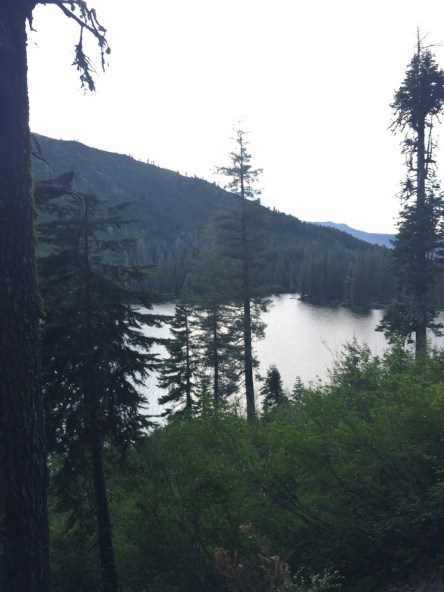
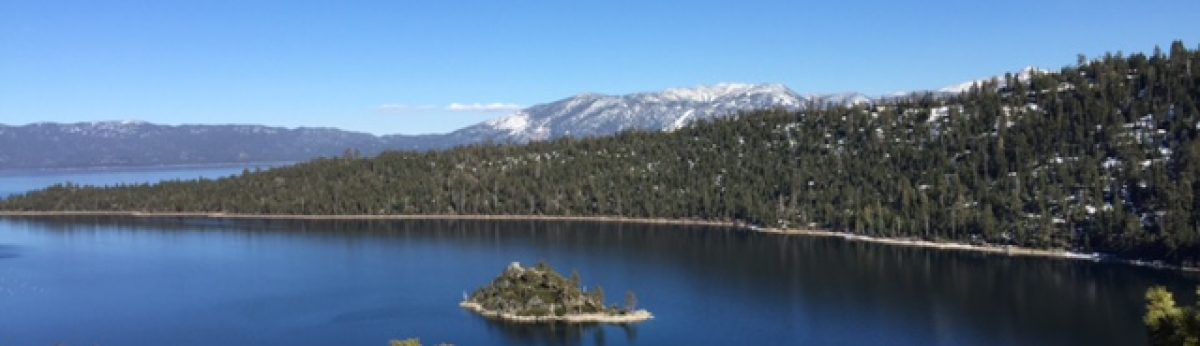
How lucky those ducks are, I tell myself. If these ducks knew of the life Mr Peck leads, there would probably be a pang there. No trains rumbling nearby to disturb Mr.Peck’s peace. No Sir. Mr Peck was a magnificent duck the son and I befriended on one of our hikes down  at Lake Tahoe. As we set off down the steep slopes towards the lake, there was an ominous looking sign that wanted hikers to know that it was a steep hike back. While cylinders roll down easily enough, they find it hard to roll back upwards seemed to be the gist of it.

IMG_2215

So, off we went, gibbering and jabbering all the way. The snow had started to melt in places and we heard little gushes of streams all the way down. We stopped to play with some of that water and even gulped a little.

The son and I were the ones who reached the lake shores first. There was nobody down there. There was a thicket of trees behind us, a sandy beach on which there was one picnic table and the water gently lapped the shores by the picnic table. We sat together in companionable silence, and watched the distant island in the lake.  One duck, paddled away serenely at a respectable distance.

After a few minutes of this silence, the duck came to join us, probably to satisfy a noetic urge about humans. We sat quietly and he came and looked at us in turn. He then pecked at something on the lake shore and circled us taking us in. The son was beside himself with excitement, but for a toddler with a loud voice, he kept silent and the duck and son had a silent rhythm of reciprocated curiosity going. If I had not been right there, I wouldn’t have believed how long this state of affairs went on.

The duck gazed, we gazed. The duck lost interest and pecked and we looked at the lake. Then the duck gazed and we gazed back. The duck did not seem to think of us as pestilential creatures out to ruin his habitat, or if he did, masked it politely. It is one of those moments of time when a fast spinning top slows down just enough to take in the world before spinning at top speed again. It was only after the duck swam away that he was christened Mr Peck.

IMG_2223

The daughter came charging with her father and grandfather from the thicket of trees a few minutes after that. The sun was starting to set, and the pinkish hues were already coloring the peaks as if the mountains were blushing. All the contained excitement about Mr Peck came bursting forth from the son when he saw his sister. Excited gabbles were heard for miles in the surrounding Sierra Nevada mountains as Mr.Peck assumed a small role in our family story, and nestled in next to Patchy (that sweet lamb who taught us a thing or two on patience and perseverance).

I think of Mr.Peck everyday when I cross the lakes with the ducks and wonder if he knew what a lovely life he led.

Happy Earth Day to all our fellow beings. Mr.Peck, I hope you are having a nice day down by the lake.

P.S: Mr Peck has since been identified as a Canadian Goose. (The local ornithology club probably has a picture of us barring entry, but we have a history: https://nourishncherish.wordpress.com/2005/08/25/ducks-fishes/)