🐙The 🐙🐙Kraken 🐙🐙Sleepeth🐙

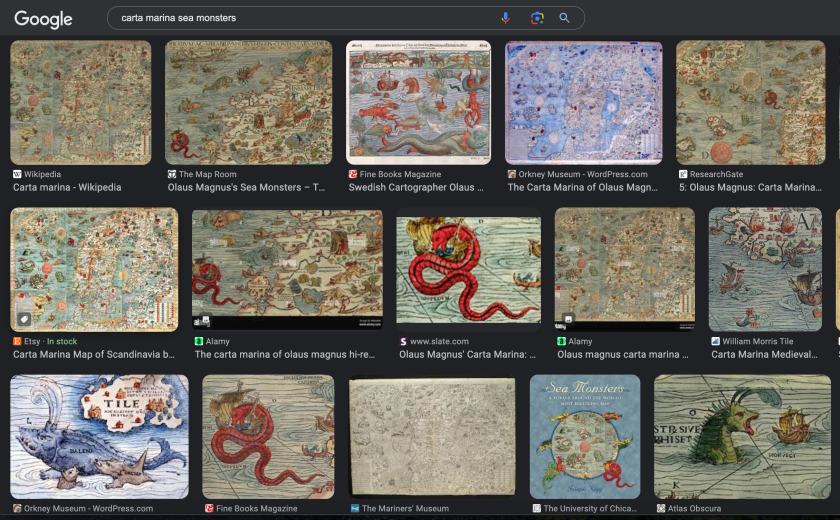
I don’t know how many of you have heard of the Carta Marina: I hadn’t and was agog after reading about it. It is a fascinating geological map showing the mythical monsters in the oceans and where they are to be found. 

Completed by Olaus Magnus in Italy in the mid sixteenth century, it attempts to outline all the monsters known at the time in the Nordic regions from various accounts. 

In the book, The Underworld – Journeys to the Depths of the Ocean – By Susan Casey, she writes about the Carta Marina:

“On land the action is orderly: tiny figures are farming, hunting, skiing, playing the violin, By contrast, the ocean is in chaos, awash in dangers and tragedies, livid with waves and currents flowing, swirling, pooling, seething. Aid the tumult, twenty-five monsters make their appearance.”

  • Susan Casey – The Underworld – Journeys to the Depths f the Ocean

I may have mentioned several times in these archives that the daughter is a mermaid born to human parents. Which is to say the endless fascination with the oceans, and natant joys of reveling in the waters are things we all enjoy. 

After reading about the Carta Marina, I went looking for the Kraken picture. When you browse through the daughter’s artwork, there are quite a few aquatic themed paintings. This one – it is Kraken – the mythical creature that is spoken of with awe among the nautical elite. I must admit I am endlessly fascinated with octopii, squid and I suppose the kraken  as well.
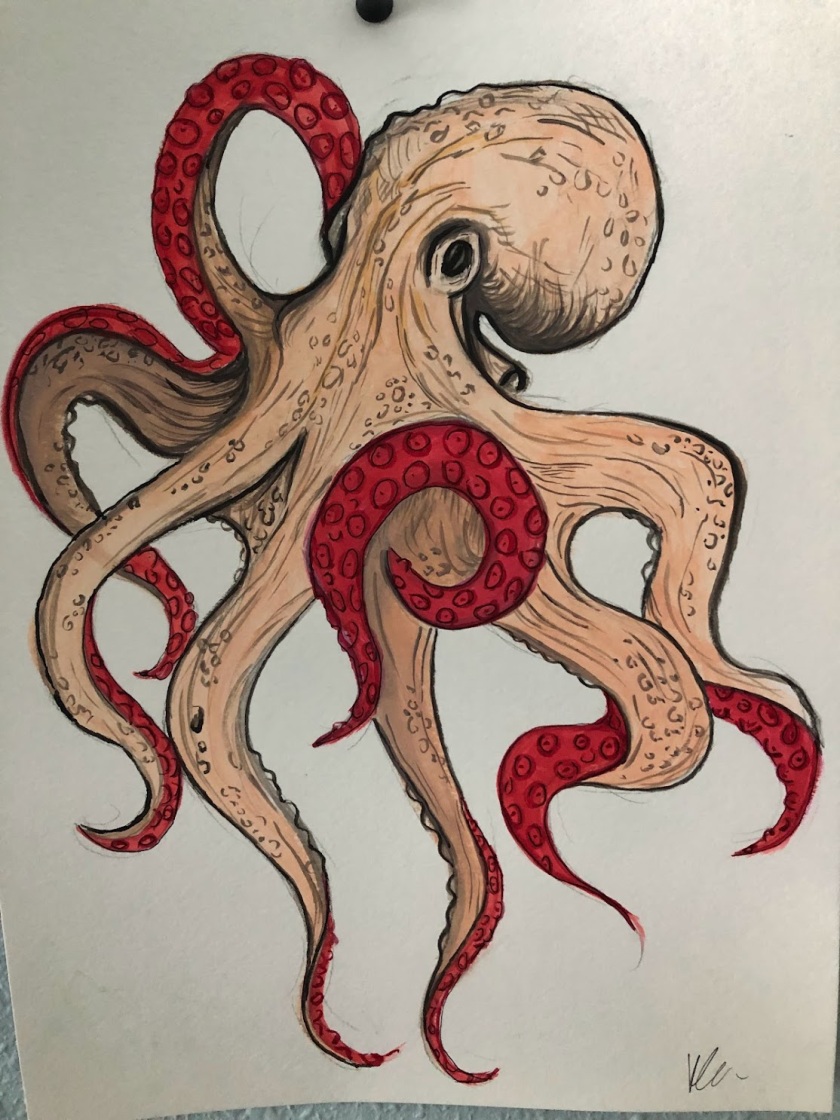
octopus

Dictionary.com summarizes this perfectly: https://www.dictionary.com/e/squid-vs-octopus/

In summary, if you see a sea creature with eight sucker-covered arms and a round shape, that’s an octopus. But if it’s got a long, thin, triangular shape and 10 limbs—eight arms and two tentacles—it’s a squid. If you see it swallowing a ship, it’s a kraken.

Sea-faring must have been a difficult vocation as most vocations in humankinds’ past seems to have been, but it also provided the richest tales of adventure and mystique to those whose fortunes or destinies never allowed them to leave the small square footage they’d been born and raised in. 
Screenshot 2023-11-13 at 6.48.32 PM

Even now, as we set out sights on interplanetary travels, I find the deep allure of the deeps as fascinating as ever.  Would we see into the eyes of a greenland shark that is rumoured to live on for 350 years or be pulled into the clutches of the mythical Kraken? Or be dumbfounded in the noises of the monster that rises out of the depths of the ocean in the FogHorn – By Ray BradBury (I believe the book is out of print – but I can never truly forget that feeling of deep awe and fear as the monster rears towards the lighthouse thinking it’s being called by a mate. I felt a strange sense of loneliness for the last monster standing the night I read it as a teenager)

As Sylvia Earle says, “Looking into the eyes of a wild dolphin – who is looking into mine-inspires me to learn everything I can about them and do everything I can to take care of them…You can’t care if you don’t know.”

I looked at the picture, and remembered the poem by Lord Tennyson

Below the thunders of the upper deep

Far, far beneath in the abysmal sea,

His ancient, dreamless, invaded sleep

The Kraken sleepeth

– Alfred, Lord Tennyson

References:

  • Life in the Ocean – the Story of Oceanographer Sylvia Earle – by Claira A Nivola
  • The Underworld – Journeys to the Depths of the Ocean – By Susan Casey
  • The Carta Marina – The map of monsters 16th Century – By Magnus
  • The FogHorn – by Ray Bradbury

Navigating by the Starlight

Navigating by the Starlight – Listen on Spotify

Rest, nature , books, music, such is my idea of happiness.

– Leo Tolstoy

I sat looking out at the lake, with a book on life in the Oceans by Sylvia Earle in my hand. I was not exactly reading. That in itself was worth musing about: with a book in a quiet spot, but not reading. Usually I can zone into a book within seconds. It is a source of being teased in the home. But that day, I found thoughts fleeting, the mind elsewhere: it’s this pace of life, I told myself sagely. Not much time for nourish-ing and cherish-ing. I chuckled at that (I know! )

I had been on a brisk walk at the campsite a few hours from where we lived. The drive up there was relaxing in itself.  The long, solitary drive gave me the space to make a few phone calls, listen to some music and an audiobook. It was perfect. This kind of solitude is rarely available and I was determined to enjoy it.  

Where was I? Yes – sitting and doing nothing but taking deep breaths and looking lazily out at the lake in front of me. 

img_7039

The Eye of the Earth quote playing on my mind. Looking across the lake, I saw a bush of greenery that reflected so beautifully in the lake as so resemble a human eye. Some boys were skipping stones lazily across the lake, and faint music was heard elsewhere. 

Later that night, the skies opened up. At first the faint light did not reveal the nightly glory – the cosmic dance that plays out every night. But by 11 p.m., there was no escaping the stage of the heavens. In our heavily populated urban areas we rarely see this skies like that:  The Milky Way in all its glory. There was the international space station circling the Earth, and thousands and thousands of stars, with familiar shapes of the constellations that our ancestors mapped over the ages.

At one point, I had to walk from point A to point B, and found that I had lost my way amidst a thicket of trees. I felt a strange sense of unease – How did birds migrate by the starlight? I looked up, enthralled, my breath stolen from me in a gasp of wonder, but also acutely aware navigating by the stars is tougher than it looks.

I read a while ago, that birds align with the electromagnetic patterns of Earth and then use that to orient and navigate against the stars. From the magical birds who sense the Earth’s magnetic field for their migration journeys to the fish who are able to navigate by the position of the stars from deep under the ocean, we each have our own unique way of living. Of Life.

In Dr Oliver Sack’s book, Musicophilia, he says:

“Every act of perception, is to some degree an act of creation, and every act of memory is to some degree an act of imagination.”

― Oliver Sacks, Musicophilia: La musique, le cerveau et nous

https://www.nytimes.com/1958/10/17/archives/study-finds-birds-guided-by-stars-migrating-flocks-are-led-by.html 

All this may be fine. But how was I to get back? My electromagnetism wasn’t helping, and the stars seemed to be twinkling and having their little joke up high in the skies. It is then I caught glimmer of the starlight reflected in the lake down below, and like a thirsty wildebeest pushes towards the water, did the same, urging the body to orient itself with the lake and the paths around it like I had done earlier during the day.

One day, I shall have to take lessons from the birds and learn to navigate by the stars instead. “Stop using the GPS while driving first!” said a little voice of truth, and I chuckled. Yes – baby steps. Driving first, and then flying. 

How Daughters Protect Planets

The daughter is home, brimming with chatter and tales from college. I cannot deny that we have been counting down days to have her come home. The house feels different, quieter somehow without her, and I listened happily as she jabbered on a few miles a minute, and gushed and laughed with her little brother. I sat there letting all the flurry blanket me, and smiled. 

“What are you smiling about?”, she said.

I said ‘something soppy’ about being happy that she is home again. She looked at me appraisingly and said, “Oh Amma! Look at you. You’ve mellowed into this sad thing who is ‘just happy to have her her daughter home’! What happened to you? What happened to the fierce woman who flew about the place?” 

“I am still fierce!” I said. 

“Nah! These days – I think she is going to just say something sharp, and she takes a deep breath and shrugs! She really does miss you!”, said her little brother, and I gave him a reproachful look. 

A few hours later, she had convinced us to settle down to a week-end movie night of Our Planet II – a Netflix documentary on the state of the planet, narrated by David Attenborough. It is an excellent program of course, and this particular episode veered from the whale sharks in the Persian Gulf to the wildebeest and zebras in the Savannah to the bees in search of their home with equal ease. We sat there mesmerized by the images, occasionally commenting on how hard it must’ve been to capture some of these shots. It had apparently taken 4 years to film and we could well understand why. 

“But think about it! Most species are absorbed with staying alive – finding food, reproducing and life resets, for the next generation, right?” I yawned sleepily.

“Yes – Amma & I were talking about that. I mean, if you are a duck: have ducklings, feed yourselves and them, and make sure they are safe. That’s it. That’s their whole life.”

“Yeah!”, the daughter said, laughter ringing in her voice, “Low-key simple, but also every day is just survival! Dog-eats-dog-world. I mean look at us. Tucked into our blankets on reclining couches, watching this on TV, and popping chips into our mouths.”

“We are a spoilt species.  “ I agreed. “But I am also glad that we have sentience and energy enough to ponder on more than survival, don’t you think?” I yawned again, ready to head up to a comfortable bed, and thought about that. This extra brain power is probably a double-edged tool. If we hadn’t this extra bandwidth, would we have been happy with survival, and learned to shake down down with our cohabitants better, or can we use this extra bandwidth in ways other than what we have done thus far? Maybe there has to be another leap in our understanding and way of life to truly protect our home and those we share it with. 

IMG_5618

Documentaries, and books certainly help us along that path, I mused, but a true awakening and action? I yawned another jaw splitting yawn, and decided that my brain power just then had about enough to contemplate sleep and relish in the thought of getting up to no alarms the next day (a rare gift in our busy lives). 

As I drifted off to sleep, I thought of the likes of Jane Goodall, Sylvia Earle, Rachel Carson, Gerald Durrell et al, who are voices that help us see the importance of ecosystems. I thought of the question that Sylvia Earle brings up in her book on Oceans: She was asked by a journalist as she stood staring into the vast ocean on the Australian shores, “What would happen if the oceans were to just dry up?”

Flabbergasted, she attempts an answer of the all-encompassing need for the oceans for our survival. Wouldn’t we go the way of lifeless and barren Venus and Mars without the waters of our beloved oceans and its ability to nurture life?

But all of us cocooned in our daily lives of earning our living, and living our lives, and raising our children do not stop to wonder why the jellyfish, and whale sharks are important to us do we? 

That is why we need daughters to come home from college. To ponder on the beauty of life, and what we must do to sustain and protect our lovely home: Earth. 

In the oceans of wonder

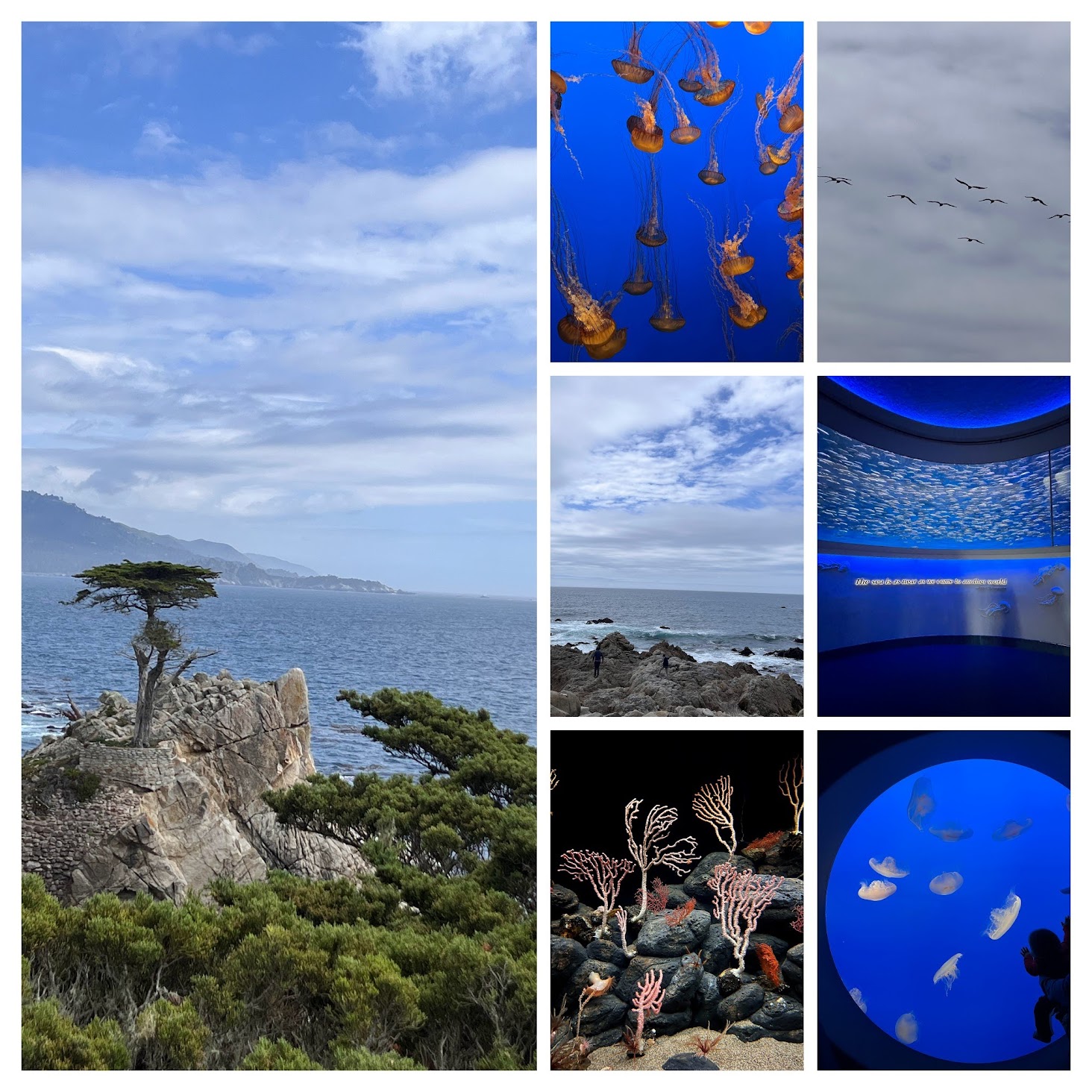
T’was the time to plan one of our trips to another dimension, and we were excited. For this time, we also had the company of our family friends who came in from India, which meant that we had planned both a trip to the Monterey Bay Aquarium and the beach nearby afterward for a sumptuous picnic. 

At Monterey Bay Aquarium, we can be assured of being grateful to our marvel-filled planet for all its resplendent forms of life: the staggering variety of it, and the true meaning of diversity. For all our time in our daily lives, we seem to devote little of it to ponder the wonders of the world. So, taking a day in which we see nothing but life other than our own, so often so different than our own – with exactly the same conditions to develop is not just wondrous, but necessary.

IMG_5616-COLLAGE 

There were a few moments in that day that stood out:

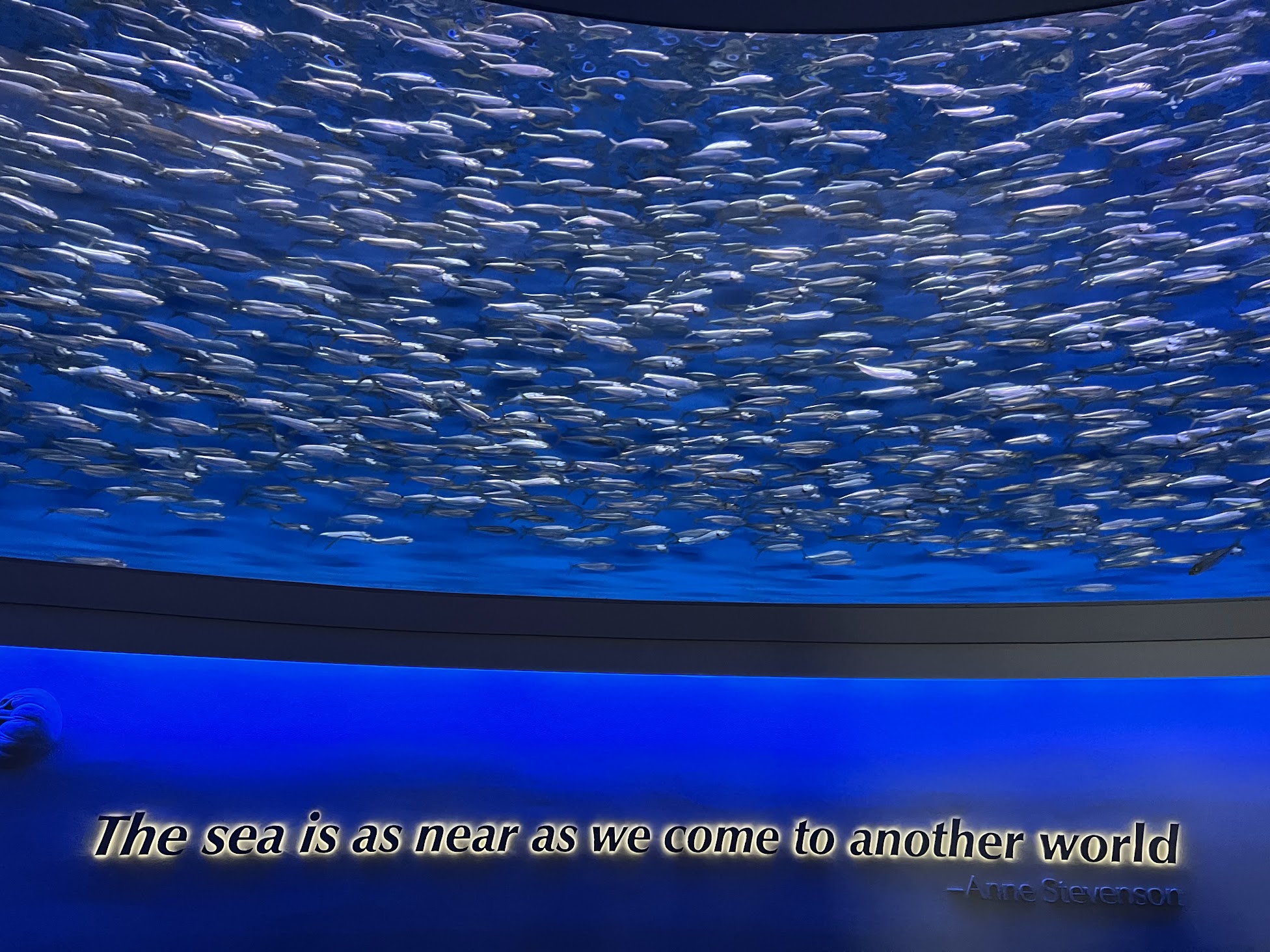
🐟 Standing in an entryway where thousands of sardines swam overhead, the son and I noticed that there were a few – very few maybe 5 in all, who were determined to swim in the opposite direction. It seemed to be by choice, since they were edged multiple times in the opposite direction by the other fish. They were packed like sardines after all.

IMG_5615

Maybe, every society does need those few who swim against the tide and make their own way – hard as it seems, I thought philosophically. Though, I am the first to admit that I have never studied sardine behavior to corroborate this. It simply seemed like a comforting anthropomorphizing thought at the time. I was feeling contrarian at the moment and these little fishes making their way against the rest of their crowd made it seem like those feelings were valid. 

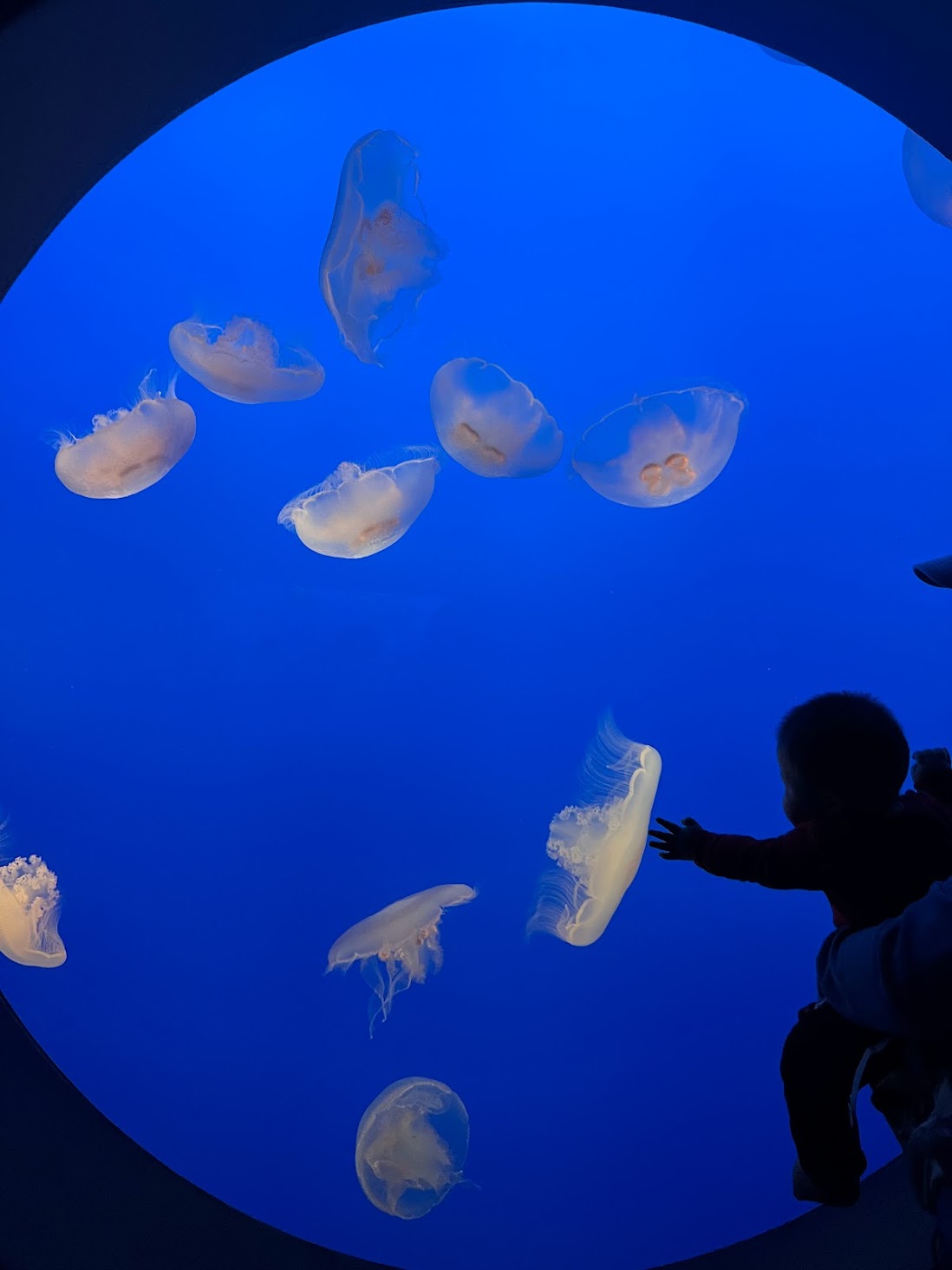
🐟 I have almost identical pictures of the jellyfish exhibit from my multiple visits to the aquarium, but this one was different. The picture of a baby silhouetted against the glass and longingly touching the glass housing the jellyfish caught my attention. Had my more photographically inclined friends been there, I am sure they would have captured an award worthy photograph. What I got was this. I love this picture because it seems to capture that essence of wonder innate in all of us, that we forget to cultivate and nurture.

IMG_5618

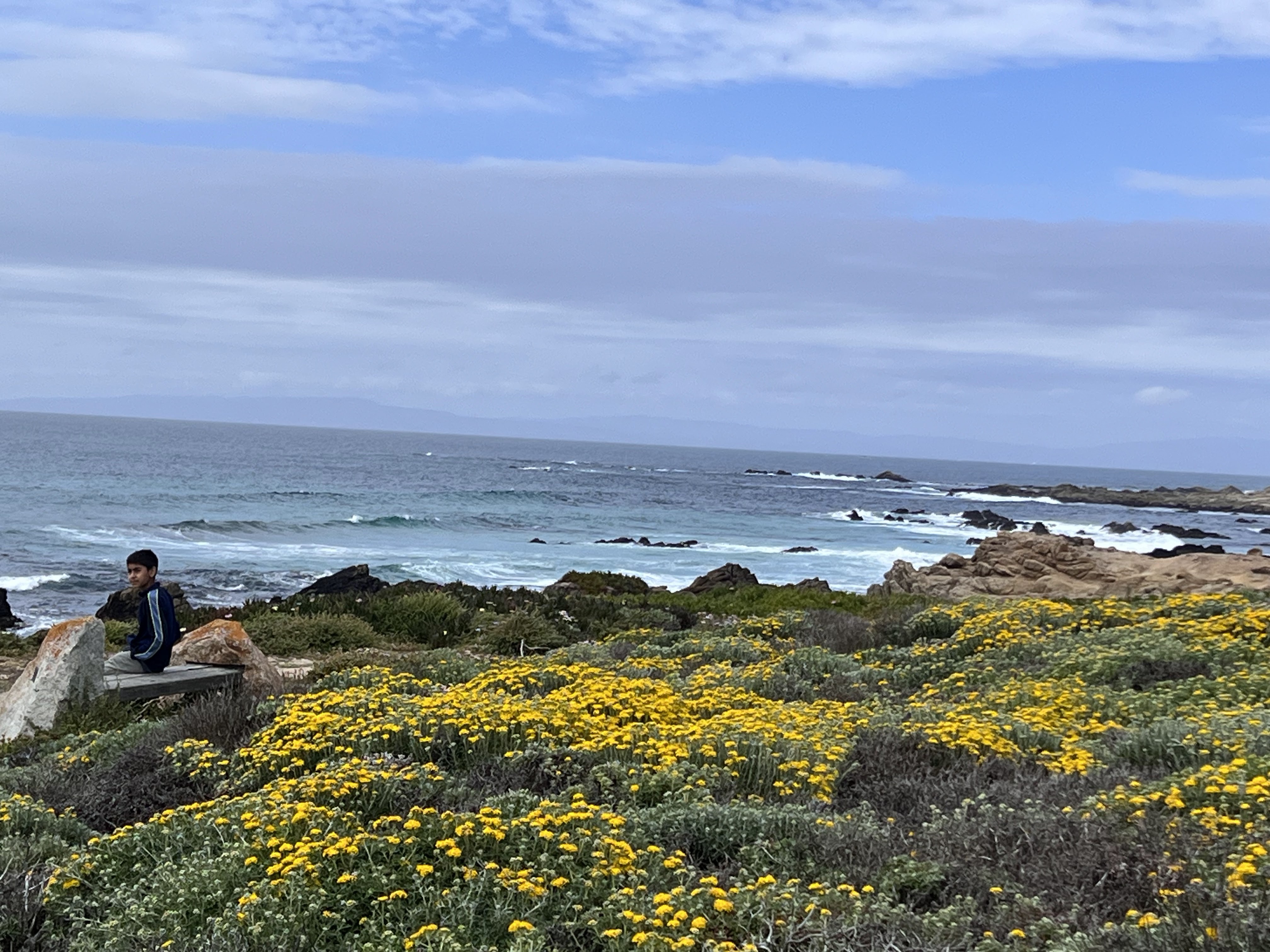
🐟 Later that day at the picnic at the beach and on a walk by the waters looking at the profusion of wildflowers I could not help staring into the ocean waters. The home to all these grand creatures we had just seen. Their habitats and life in the waters had been beautiful, but so was ours. The tiny wildflowers on either side of the trail were reminders of that. Even if a tiny part of me resented the fact that my attempts at growing these wildflowers had come to naught for so many years and yet here there, able to thrive with no help from mankind. 

img_5716

There is something marvelous about being in the beach on a warm day at the end of May. It isn’t as crowded with the summer sunbathers yet, and the waters are neither warm nor cold: perfect for a game of guess-the-wave -lines (this game is a complicated game where we point to a wave and try to stand as close to the wave on the shore without it actually touching your feet. So the person closest to the wave before it starts receding wins) 

I have with me a book on the oceans titled: Sea Change: A Message of  the Oceans by Sylvia Earle and plan to wrap myself in the wonders of that world over the week-end.Â