Fiction Inspire Non-Fiction?

While reading a good piece of fiction, I often wonder about the inspiration behind the writing.  Dune, for example, is a book that immediately lets you know the author must be a personality of prodigious learning. The ecological angle, I was delighted to read in the note by his son, had its origins in Frank Herbert’s work for an an Op-Ed on the Shifting Sands in Oregon. The government was toying with the idea of planting grasses that could help with stopping the sands from shifting and collapsing onto roads and rivers. 

Dune-Frank_Herbert_(1965)_First_edition

Quote: 

In 1957, Dad flew to the Oregon coast to write a magazine article about a US department and Agriculture project there, in which the government had successfully planted poverty grasses on the crests of sand dunes, to keep them from inundating highways. He intended to call the article “They stopped the Moving Sands” but soon realized that he had much bigger story on his hands

Dune is a modern-day conglomeration of familiar myths, a tale in which great sandworts guard a precious treasure of melange, the geriatric spice that represent, among other things, the finite resource of oil. The planet Arrakis features immense, ferocious worms that are like dragons of lore, with “great teeth” and a “bellows breath of cinnamon”.

Planetology is a marvelous word for taking in the intricacies of a life sustaining planet (Dune makes reference to planetologists for figuring out survival strategies),  and the effects of our consumption of finite resources. 

I would love to study Planetology.We know that we are stretching the Earth’s resources – National Geographic came up with a simple number: we are currently using 1.71 times Earth’s resources every year and it is increasing. The effects are everywhere.

A friend and I were discussing the lack of tree cover in a country like Iceland for instance. Blessed with enormous natural beauty, the lack of tree cover is quite unnerving. Everywhere you turn is green because it rains a lot, but there are no trees. Apparently, excessive logging first got rid of them, and replanting did not take root as intended for sheep grazing ate away the saplings and the seedlings before they had a chance to sprout. 

horse

This too is not a new phenomenon. World over there are examples of over-grazing that edged out forest cover( Ireland, England, Mauritius are all examples of how our lifestyles has altered the ecosystem drastically). In the book Golden Bats & Pink Pigeons by Gerald Durrell, the author is on a mission to collect endangered species from Mauritius so he can bring them back to the Conservation Center for breeding and releasing into the wild. He writes about Round Island and how the simple act of introducing goats, sheep and rabbits into the ecosystem by humans has eroded the tree cover irreparably. 

IMG_0210
From Golden Bats & Pink Pigeons by Gerald Durrell – Round Island

While reading this book, I realized the inspiration behind his fiction book, Mockery Bird. This hilarious fiction book, Mockery Bird – was based on a story doing the rounds in Mauritius surrounding the Dodo bird and the loss of certain trees. The knowledge gave me immense pleasure. How lovely to see the inspirations behind good fiction.


Just as fiction draws its inspiration from reality, reality too can draw its inspiration from fiction.

In the Dune universe, the planetologist, Kynes, shares the visionary dreams for the planet Arrakis – a vision outlining a glorious self sustaining future for the planet that will take three or maybe four generations to come to fruition. We can derive our inspiration from fiction and set ourselves on a similar path working towards setting aside half the planet for forest cover to reverse global warming, sustenance etc. (News item : here)


A Planet of Wizards & Prophets

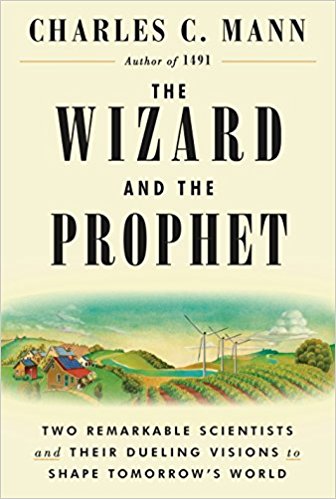
I was reading The Wizard & The Prophet by Charles E Mann on a crowded train one evening, and a pair of young girls shared the seat with me. The name of the book is a highly appealing one especially to little girls, and it piqued their interest too.

One of them was probably in the 1st or 2nd grade, and showed a precocious interest in my reading material. Her curly hair was made into numerous tiny plaits, and her eyes shone with a curiosity that would make her teacher’s heart sing. Her mother’s heart though, quailed. She said, “Now…now don’t bother the nice lady there, let her get on with it. “ I looked up at the mother, and told her that I love reading to children, and though this particular book sounds pedantic when read to children, I did it anyway. It taught me never to under-estimate children – the child soaked in everything, and asked the most engaging questions.

wiz_prop

I saw a certain amount of editing would need to be done if I were to sustain the interest of a 6 year old. The book is a non-fiction tome going strong at 678 pages – pages richly adorned with facts and figures, and life histories of all the people involved. I had already been through about 300 pages, so I knew the interesting bits, I knew the bits where a child’s wonder can be kindled. For the rest of the hour, I told her about wheat strains, water tables, and climate change.

The Wizard & The Prophet is a marvelous title because it encapsulates the polarity of our thinking so beautifully, and in this sense, they are both required for us to thrive. The Wizard in the book is Norman Borlaug, who is credited with leading the way for GMO strains of wheat production that along with stalwarts in the field such as Dr M.S. Swaminathan saved billions of people from hunger and starvation. 

William Vogt is the Prophet, who during his study in the Mexican coastal areas observed how we are stretching our natural resources and the effects it has on things as far-flung as bird migratory patterns and climate. In many ways, he is the one who set up the first bells of Global warming and Climate Change. He is the Prophet.

Do you believe in Climate Change? asked the girl wide-eyed.

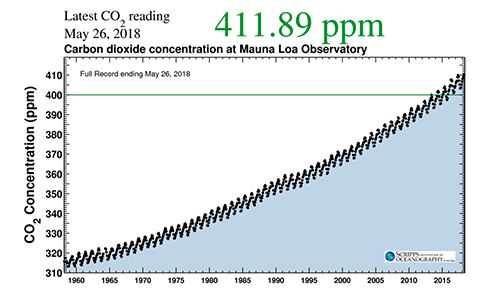
I told her I did not need to believe Climate Change at all, and the experiments were here to show me how we are changing the air around us, and I showed her the pages outlining the experiment where humanity managed to pin down Carbon Dioxide as the problem-maker in the first place. 

I cannot deny that global warming and climate change has always intrigued me. Carbon Dioxide only accounts for 0.03 % of the atmospheric gases, a remarkably small proportion for it to be causing global warming on such a scale as to change weather patters and cause severe climatic catastrophes, is it not? 

In The Wizard & The Prophet, the author outlines the experiments used in determining that it is indeed carbon dioxide that is the culprit and how our industries are directly contributing to its increase. The correlation between carbon-dioxide levels increasing and global warming followed. I found it a fascinating experiment and one that school laboratories can demonstrate I hope. 

Keeling_Curve
By Scrippsnews [CC BY-SA 4.0  (https://creativecommons.org/licenses/by-sa/4.0)%5D, from Wikimedia Commons
https://en.wikipedia.org/wiki/Keeling_Curve

(During the spring, there are dips because the Arctic tundra sprouts plant life and plants absorb Carbon Dioxide from the atmosphere. )

Looking at the worried expression in the child’s face, I asked her, Did she know what we can do to reduce the carbon dioxide?

Trees? she said, and I nodded yes.

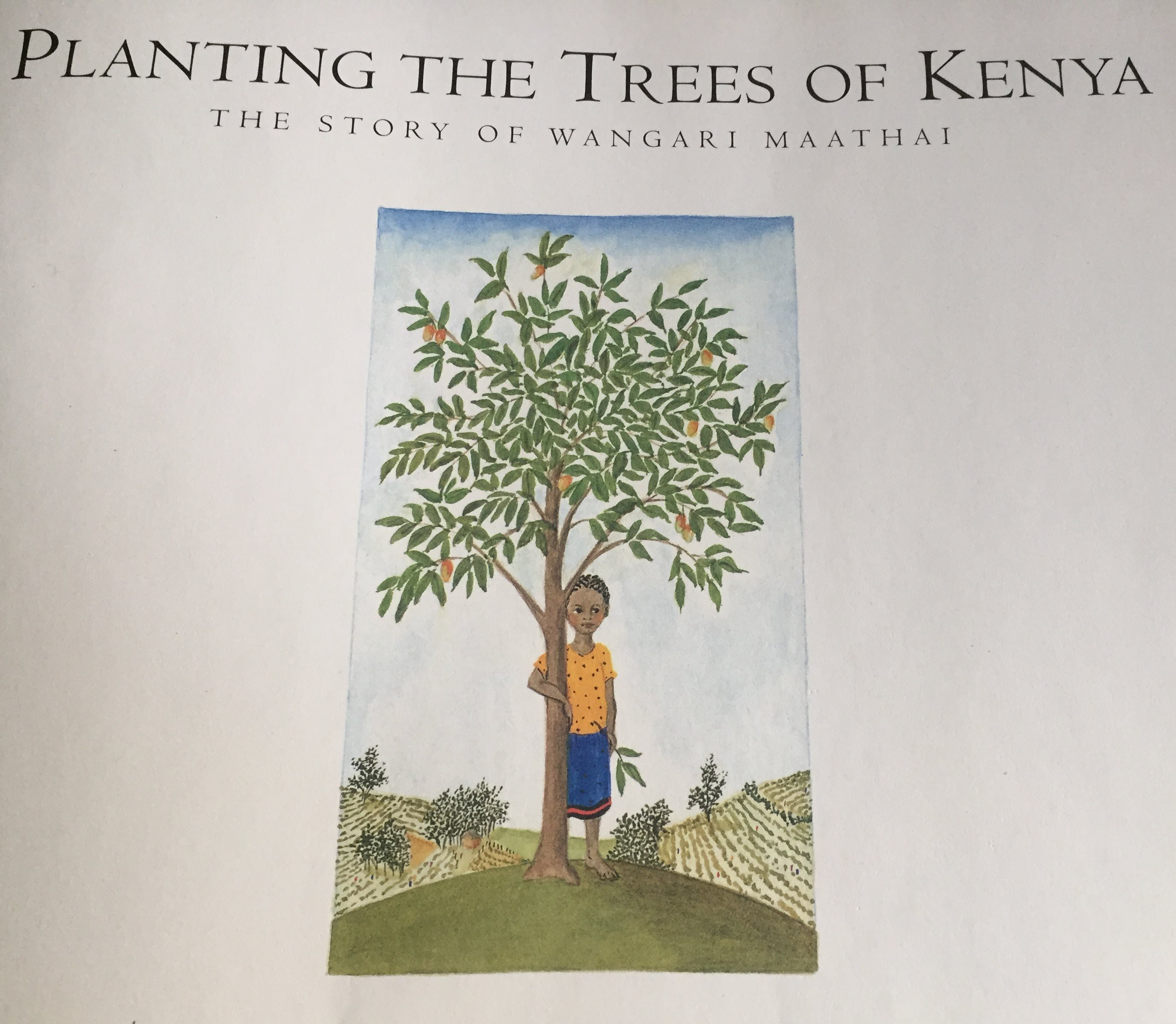
I went on to tell her about the excellent example set forth for us by the Kenyans in The Green Belt movement, and how a person called Dr Wangari Maathai helped the Kenyans plant millions of trees over the past 30 years.

Planting the Trees of Kenya, by Claire A Nivola, The Story of Wangari Maathai

Planting the trees of Kenya - Wangari Maathai
Planting the trees of Kenya – Wangari Maathai

She glowed at the simple solution thought of by Dr Wangari Maathai, but her stop had come, and she stepped off the train with her mother who was now listening to her daughter talk to her about The Wizard & The Prophet.

As I reflected on the chat with her, I realized that the narrative around Climate change and Global warming is quite confusing.  It is no wonder that the child framed her question as – “Do you believe in Climate Change?” The prophets in this case are doing their job, but the question of : “How does one realize when an extreme storm or flood is part of a natural occurrence and when it is a direct result of our tampering with the delicate balance of the climate?” is a vexing one.  

The Prophets have sounded the alarm bell often enough, and the Wizards have yet to think of a sustainable solution to it. But there is hope: I am glad to read that China proposes to plant and nurture a forest the size of Ireland to reduce carbon emissions and improve air quality. 

China to create new forests covering area size of Ireland

cropped-shasta_forest.jpg

Hero-Worship, Nicomacean Ethics & Baloney Detection Kits

I have heard friends rave about Dune by Frank Herbert many times over the past few years. I finally got to read the book, and I feel richer in mind and thought for it. The book was long and at times hard to keep track of (especially in the beginning). This is one of those times when I realize how my mind flutters with attention spans that drive calm butterflies to frenzy. But slowly, steadily, I settled into the book, and there were multiple moments when I felt like I must grab a pen and start writing (but that stern butterfly gave me a look, and kept me at my the task of reading). This, is probably the reason I have forgotten half the things I wanted to write about (This is where I glare back at the butterfly guardian who kept me reading)

Dune-Frank_Herbert_(1965)_First_edition
First Edition Cover – Image from Wikipedia

One of the many things that appealed to me in the Dune was the fact though there were vague references made to technology and the number of technological devices used by those living at the time, it is not a mainstay.

The book is a multi-layered piece of literature with over-arching themes of ecology, the art of war, religion, philosophy and politics. There is a particular quote that stuck with me in the Prologue written by Brian Herbert, Frank Herbert’s son, about the dangers of hero worship.

Quote:

As Liet Kynes lay dying in the desert, he remembered the long ago words of his own father: “No more terrible disaster could befall your people than for them to fall into the hands of a Hero.”

Having studied politics carefully, my father believed that heroes made mistakes…mistakes that were simplified by the number of people who followed such leaders slavishly.

In many ways, hero worship is what leads people to choose leaders who then turn into despots and dictators. Adulation affects everyone, and those with fragile egos are the most prone to its lure.

Towards the end of the book, Paul Atreides recognizes that he is being hailed as the Messiah and regardless of his acceptance of the title, there is a holy jihad in his future. He can either lead to the best of his abilities like his able and excellent father, Duke Leto or simply be the mascot of a movement that has already gathered momentum – a force that is much larger than him. This sort of trusting faith in one human being is never a good sign, and is a malady that has affected us for centuries. 

I quite agree with how Aristotle describes the nobility required of politicians: he opines that politicians should take an oath, almost as sacred as a Hippocratic oath, to remain fair and mete out justice. From the Nicomachean Ethics – By Aristotle. 

The lecture on Aristotle and Socrates on How Does One Live The Good Life? From 36 Books That Changed The World (Chapter 8) is an excellent listen.


There are no initiation courses for politicians. No training. Though, I have a suggestion to have every politician complete the Butter Battle Course, it is unheeded. (The Butter Battle Course is an excellent course consisting of childrens’ books not more than a few pages each, and should only take a few moments of every leader’s time):

butter_battle

However, till politicians start taking their careers to truly be in service of humanity, we need to equip ourselves with Carl Sagan’s excellent Baloney Detection Kit from the book: The varieties of scientific experience : a personal view of the search for God / Carl Sagan ; edited by Ann Druyan. This book contains the Gifford lectures given by Carl Sagan in 1985.

The_Varieties_of_Scientific_Experience
By Source, Fair use, https://en.wikipedia.org/w/index.php?curid=28513011

When someone asked Carl Sagan after his lecture what we can do when the governments do not act in our best interests, he advised us to have Baloney Detection Kits handy.

Quote:

“I would say that the first thing to do is realize that governments, all governments, at least on occasion, lie. And some of them do it all the time – some of them do it only every second statement-but, by and large, governments distort the facts in order to remain in office.

And if we are ignorant of what the issues are and can’t even ask the critical questions, then we’re not going to make much of a difference. If we can understand the issues, if we can pose the right questions, if we can point out the contradictions, then we can make some progress. There are many other things that can done, but it seems to me that those two, the baloney detection kit and use of the democratic process where available are at least two things to consider.”

This seems to be age old wisdom: our oldest myths write about flaws in heroes, what brings about the downfall of the most powerful tyrants  etc; and yet, the reminder for our own Baloney Detection Kits is a timely one.

Books:

  • Dune – Frank Herbert
  • Varieties of Scientific Evidence  – Carl Sagan 
  • Nicomachean Ethics – Aristotle
  • 36 Books That Changed The World – Lectures on Great Courses
  • Butter Battle Book – Dr Seuss

The Lentil Chips Shine Down

The excitement in the bunch of children gathered was palpable. They were united by a sense of wonder and pleasant anticipation. Were they really going to be able to touch the telescope, and see something remarkable? A bar stool had been borrowed from a kindly neighbor and the little telescope was perched on it. An earthworm like line was formed with the children waiting to get a turn at the telescope. It was as wiggly and restless as an earthworm, and just as fascinating to watch from a safe distance.

mars_watching

Mars in the distance shone with the iridescence of a star. Mars has been exceptionally bright in the evening skies, and the Mars viewing party was happening on the week it was closest to the Earth.

Mars has fascinated mankind for centuries. It started with hoaxes of finding extra terrestrial life on Mars: maybe those rigged lines on the planet were canals? said a 19th century astronomer, and from that hypothesis, sprang a vibrant story of alien life. In our enthusiasm to find extra terrestrial neighbors, the populace went along. That kind of hope is refreshing even if misguided. 

https://en.wikipedia.org/wiki/Life_on_Mars

Tonight the telescope we had with us was only as big as a professional camera, and I hoped it would not disappoint the children gathered.

While the telescope was being deftly handled by the husband, I diverted the attention of the children skyward. Their questions about progress were distracting the misguided astronomer who was pointing the lens towards the stile on our neighbor’s roof, and wondering how he could see things fluttering there (I pointed to the sycamore tree nearby that had shed a few of its leaves on the stile, and crushed the poor fish’s soul about finding extra terrestrial life on Mars. Andy Weir might have imagined potato cultivation on Mars, but even by his standards, a sycamore tree was a leap, I told him kindly. He guffawed loudly at this and fiddled on.)

https://en.wikipedia.org/wiki/The_Martian_(Weir_novel)

In the meanwhile, I pointed out the familiar constellations to the hopeful looking children. The budding astronomers were skeptical. 

‘How do you know it is Big Dipper?’ 

‘It could be anything or nothing’, said another, and quickly the pendulum swung from hope to disillusionment. I managed a quick save by not letting it swing too far, and told them about the excellent app, Skyview, using which they could confirm the stars for themselves. The older teenagers who had smartphones for themselves were suddenly beset upon to share the marvels of the night sky. 


Cecilia Payne would have been proud indeed of the motley group of astronomers gathered in our driveway. It is marvelous to see how the work of early astronomers & physicists set the base for us to be able to map the skies and predict the movements of stars and planets.

glass_universe

The Glass Universe

Book recommendation: The Glass Universe by Dava Sobel

“Oh look!”, said the Big-Dipper-doubter, pointing the phone wildly at the sky, “the moon, the moon!”. 

An experienced hand said he had seen the moon before and there was nothing remarkable about it.

“But it is so beautiful!” said another sounding reproachful at the dismissal of the beautiful moon, and I agreed. The moon has exerted her pull over mankind almost since the beginning of time. Even if we do see it everyday, the moon has a poetic beauty all of its own. That night it was looking achingly beautiful. 

Maybe it was the effect of the scintillating talk I had the privilege of attending earlier that week.

I have never had the opportunity to listen live to a TED Talk. But that week, I had listened to a very TED-esque talk by Jon Carmichael the cosmic photographer. He shared the beautiful story of how he photographed the full lunar eclipse a year ago with the help of a Southwest crew. 

jon_carmichael_speech

Please listen to the talk on the site if you can.

I was telling the children about the talk, when the husband let out an involuntary yelp and said this time he was fairly sure it was Mars. 

One child gazed into the telescope and said, “It looks like a Papad in the sky.”, and we all laughed. (Papad  – is a sort of flat, round lentil chip!)

The cosmos has a way of uniting us in the darkest of times. Even during the most inane days, there is always a cosmic show that is ready to enthrall us and fill our souls with enchantment. It is why I was so happy to be standing among the children gazing up at the stars, and soaking in the wonders of the cosmic show above me that day. Even if the children did see a lentil chip in the sky, I hope for some of them at least the magic seed was sown. A seed nurtured by the hopeful innocence of youth, tempered by the wisdom of years, with the potential to mature into a star of their own.

Radiance of a Thousand Suns

The children and I were reading the Butter Battle Book, by Dr Seuss again: A marvelous book that never fails to enlighten : the bigociously atrocious weapons we are capable of creating, how littlyfully small-minded we are when we come to self righteousness,  and the idiotic ends to our means. It makes me want to take our brains apart to see where bravado and ego reside and short circuit them, to see if it results in a fuzzy ice-cream show in the pupils. 

butter_battle


Written in 1984 this book is a simple parody of the nuclear arms race, and is chillingly relevant today.

The book is about Yooks and Zooks: The Yooks eat their bread with the butter side up, while the Zooks eat their bread with the butter side down. This leads to escalating differences and a long curvy wall is built between the two lands.

butter_battle_2

Soon, both sides start fighting by using weapons of increasing grandeur and magnitude starting from the Tough Tufted Prickly Snickle Berry Snitch to the Eight Nozzled Elephant Toted Boom Blitz. The book finishes with the Yooks and Zooks sitting on either side of a wall threatening to drop the Bitsy Big-Boy Boomeroo, signifying the nuclear threat.

Around the same time that Dr Seuss came out with this brilliant book for children, another one of my favorite writers delivered  a series of Gifford Lectures. Titled ‘The Varieties of Scientific Experience : A Personal View of the Search for God’ , Carl Sagan goes on to explain in one lecture how we fail to comprehend the true magnitude of the nuclear problem ahead of us. 

The_Varieties_of_Scientific_Experience
By Source, Fair use, https://en.wikipedia.org/w/index.php?curid=28513011

Quote:

The bombs that destroyed Hiroshima and Nagasaki – everybody’s read about them, we know something about what they did-killed some 1/4 million people … The planet Earth today has 55000 nuclear weapons, almost all of which are more powerful than the bombs that destroyed Hiroshima and Nagasaki and some of which are, each of them, a thousand times more powerful.* Some twenty to twenty-two thousand of these weapons are called strategic weapons, and they are poised for as rapid delivery as possible, essentially halfway across the world to someone else’s homeland.

*By 2006, the world nuclear arsenals had been reduced to about 20,000 weapons-still roughly ten times what would be necessary to destroy our global civilization. the principal reductions since 1985 were due to the 1993 Start II Treaty between the United States and Soviet Union.

“Twenty thousand strategic weapons in the world is a very large number. For example: lets ask how many cities there are on the planet Earth. If you define a city as having more than 100,000 people in it, there are 2,300 cities on the Earth. So the US and  Soviet Union could, if they wished, destroy every city on the Earth and have eighteen thousand strategic weapons left over to do something else with.

These lectures were delivered in 1985, the numbers have definitely been revised from thereon. A number of countries have also harnessed the power of nuclear weapons, even though there have been treaties and agreements to restrict its use. 

Robert Oppenheimer, credited as being the ‘father of the atomic bomb’, when he witnessed the test of the nuclear bomb over the desert in New Mexico was supposedly reminded of a text in the Bhagawad Gita.

If the radiance of a thousand suns
Were to burst at once into the sky
That would be like the splendour of the Mighty One…
I am become Death,
The shatterer of worlds.

With the rise of autocracy the world over, what would it take for us to save ourselves this time around? For all our brilliance in developing the bomb, we have yet to develop sound defenses against it.


Dragons of Fire & Ice

“What is your favorite dragon amma?” asked the son as we made our way to see an active volcano. Dragons follow a long line of illustrious characters such as Lightning McQueen, Ninjago – Masters of Spinjitzu. They come and claim his interest and imagination in ways that make me envious at times. How do children play so wholeheartedly?

I mock-sighed and said, “Aaah! Not dragons again! Fine! Nature Dragon is my favorite.”
“Which dragon are you scared of?”
“Volcano Dragon!”, I said. Given that we were going to see an active volcanic region, it seemed like an apt choice. (There is no Snarling Traffic Dragon, I checked.)
He then went on chattering about the shattering power of volcano dragons, and I went back to nodding absently while taking in the physical aspects of the changing landscape around me. (The fellow talks incessantly of dragons and gets cranky if I get the dragons in Dragon Land mixed up with those in Dragon City. I, as you can guess, see no difference between the two.)

volcano

By now, we were ambling along up the mountainside looking at the damage wrought by the volcanic activity. Thick crusts of lava had solidified along the trail helpfully laid out for tourists. It was a stark image, an image in which it was possible to imagine ourselves stepping gingerly on the back of a troll or a dragon with a particularly hideous hide, that at any moment could roar and spurt fire at the indignity of seeing mere morsels tread on his or her back. The very thought sent an electric shiver down the spine.

Looking at the barren/dry landscape made me think of an episode I had seen on Cosmos on Venus. In his deep rumbling voice, Neil Grasse Tyson explains how Venus was once a planet with a wonderful landscape like Earth, but intense volcanic activity seems to have made it a desolate angry planet trapped in its own greenhouse effect.

The World Set Free (Cosmos: A Spacetime Odyssey)

http://channel.nationalgeographic.com/cosmos-a-spacetime-odyssey/episodes/the-world-set-free/

But hope always finds a way of creeping in, in the most unlikely ways and means. A few feet from a still smoking volcano, in which the lava rocks were red hot, around the dense rocks that bore the marks of hardened lava, in that otherwise barren and desolate looking mountainside, grew pink flowers. Tiny pink flowers bravely, cheerfully doing their part in reminding me of the resilience of life and beauty.

volcano_wildlfower.jpg

“So you like Flora then?” chirped the son.
How did he know? I looked surprised, and then realized that the Nature Dragon in his game was called Flora. Everything felt surreal in this place. Were there really dragons?

We had reached the smoking crater by now, and I gingerly picked up a red hot piece of rock in my hands. Was I in a dream or was I really touching hot lava rocks, and watching icebergs cleave?

Just a couple of days earlier, we felt a similar sense of awe while watching the glaciers float like icy dragons. One huge ice dragon stirred and with a thunderous roar, cleaved in half from underneath. There is something awe-inspiring in the forces of nature, and it behooves us to remember that our biggest and strongest weapons are no use against the vagaries of nature.

ice

I sometimes visualize ourselves looking like idiots standing bewildered in front of the storms that batter us every now and trying to tell the storms, “Ehh….I don’t know whether you realize this or not, but we have nuclear weapons you know? “

Dashed silly it makes us look, when a little extra rain sends us scrambling.

To me, both surreal experiences had only 1 way of bringing me to reality: An urgent need to find a restroom. The elements of our being are all very well if you aren’t sprinting across lava beds and glaciers looking for a restroom with a desperate child clasped to your hand.

I wonder whether Dragon Land has a shortcut to restrooms.

Read also:

Baða – A Vatn post 
Foss, Ain, Ja, Vatn, Jökull, Sjó
Jörð, Gaia, Bhoomi
The Earth Laughs in Flowers

The Epic of Whalayana

The mother has been reading The Ramayana. She is especially fond of the Sundarakandam. For a few months, any good is attributed to the Sundarakandam readings. Anything bad is soothed away with the assurance that her Sundarakandam chantings will make it better. It takes her several weeks to make it through a complete reading. The Ramayana is a long epic, and lilts rhythmically. Reading this epic soothes her, and every now and then with touching belief, she has a go at it.

I like the Ramayana too for its main storyline, and its myriad side stories. I do think Sita could have been a pluckier heroine, but then I remember that these tales were passed down from one generation to the next, each one, quite probably, embellishing the epics a little to make sure their ideal version of the woman is subtly inserted in there. (Another post for another day)

It is interesting to think of how our epics and ballads have helped shape human history. Artifacts and natural phenomena shaped our myths, and particularly gifted story-tellers were always a treasured people. We truly believed that story-telling was the single distinguishing feature of our species. After all, imagination is a task much higher on the cognitive scale than living & feeling. 

‘Did you know? We used to have a Professor who could chant every verse and explain it so beautifully? From memory! In those days, our professors used to remember Shakespeare, entire Sanskrit texts, and eloquently recite from memory. ‘ said the father, and waxed as eloquently about the good old days; his fervor growing as he spoke of the stellar nature of his professors, about how they learnt and memorized Shakespeare and the Sanskrit texts from their forefathers. 

I smiled at the pride in his voice when he thought of his long-dead professors. For millennia we thought we were the only ones capable of passing on this kind of generational wisdom and knowledge. But that is not the case. Take the enormously intelligent whales and dolphins for instance. Carl Sagan, the physicist, writes about these intelligent creatures often. In his essay on dolphin sounds, he writes of Elvar the Dolphin who knows up to 50 English sounds and can use them in context. 

IMG_7634.jpg

Quote from Cosmos by Carl Sagan:

Some whale sounds are called songs, but we are still ignorant of their true nature and meaning. They range over a broad band of frequencies, down to well below the lowest sound the human ear can detect. A typical whale song lasts for perhaps 15 minutes; the longest about an hour. Often it is repeated, identically beat for beat, measure for measure, note for note. 

Very often, the members of the group will sing the same song together. By some mutual consensus, some collaborative song-writing, the piece changes month by month, slowly and predictably. These vocalizations are complex. If the songs of the humpback whale are enunciated as a tonal language, the total information content, the number of bits of information in such songs, is some 10 to the power of 6 bits, about the same as the information content of the Iliad or the Odyssey.

I would love to hear and understand the generational wisdom that these large benevolent creatures have for living in the oceans. The ever changing oceans must be a rich source of material. Do they have heroes vs villains, good vs evil, or things much more complex and intriguing than simple story lines like that? 

wind-in-the-reef

Quote:

They have no manipulative organs, they make no engineering constructs, but they are social creatures. They hunt, swim, fish, browse, frolic, mate, play, run from predators. There may be a great deal to talk about.

If human beings have a fault, it is assuming our anthropomorphic abilities are the pinnacle of what is possible. I must remember that until recently, we did not know whale songs existed. 

The sea is as near as we come to another world. – Ann Stevenson

Coming up next: The Inner Life of Animals

The Dance of the Butterflies

Magical March gave us the immense satisfaction of walking to school under magical rainbows,  leprechauns had wreaked havoc and left treasures, my mother got to see her father for the first time at the age of 73, we had a beautiful trip playing in the snow, the doting grandparents arrived and the children have been reveling in the social rainbow that enveloped them.

Out in the natural world, the hills are alive with the sound of moo-sic (cows grazing – get it, get it?), the cherry blossoms send sparks of joy piercing through the soul every time I look at them, and the butterflies have been dancing the dance of joy. Rain showers cleansed the Earth, and all nature around us seems to be smiling benevolently.


One beautiful evening, I stepped out on a walk with my little son. Elementary school children derive a certain pleasure in crouching and looking at ants, snails or ladybugs. This time, however, we crouched down to look at a furry, black caterpillar. After reading Eric Carle’s book, The Very Hungry Caterpillar, everyday for months at a time with each of the children, I did not think that I would be enamored sitting and observing caterpillars, but such is the infectious enthusiasm of youth. (The Wind in the Reefs – Working title of The Wind In The Willows)

I found myself excited and thrilled to crouch and watch the caterpillar make its short journey across the concrete path back into the sidewalk where the bushes grew. I still find it amazing that these creatures metamorphose into butterflies. Eggs->Caterpillar(larvae)->Chrysalis(Pupa)->Butterfly has to be the most magical thing in our daily existence next to rainbows.

Later that week, the crouch with the caterpillar made me reach longingly for the book, The Girl Who Drew Butterflies: How Maria Merian’s Art Changed Science – Joyce Sidman

IMG_8198.jpg

Maria Merian was a naturalist and illustrator in the seventeenth century.  Written by the children’s author and poet, Joyce Sidman, she says:

In many ways, Maria was an enigma. She rarely wrote about anything other than caterpillars…What we do know is that she had boundless energy, insatiable curiosity, and superhuman focus – traits that would have been difficult to live with, but ones that marked her as a true scientist at a time when the odds were stacked against her.

How does one find the passion and perseverance to stick to a field of study in spite of societal disapproval, familial duties and demanding businesses?  The book gives us a glimpse into seventeenth century life: The impossible clamps on Women, the dangerous possibility of any curiosity being mistaken for witchcraft, the difficult life of artists in general and so much more.

I have always admired those who have high energy levels and put it to good use. Maria Merian was one of those people. She was a brilliant artist, had business acumen and her curiosity about insects made her a pioneer in the field of etymology (A field that did not even have a name until several decades after her death). Her contributions to etymology were remarkable because she also managed to travel to Surinam near Barbados in those days with the sole purpose of studying animal life. Her paintings on Surinam and her books on caterpillars had great appeal in Europe, and Maria Merian went on to transform Art and Science forever.

Screen Shot 2018-03-29 at 5.12.14 PM.png

The book is full of beautiful diagrams, paintings, flowers and plants with little insects on them. It is a joy to thumb through even if it is just to look at the pictures.


Here is to more butterflies, rainbows and magic.

How Squids Shaped Our Myths

We are familiar with the Pangea theory (large hulk of a landmass floating together, and breaking apart into the continents of today, current day India going and joining up with the Eurasian chunk and creating the Himalayas in the process etc). Supporting evidence for this theory has been largely in the form of marine fossils found in the Himalayas, a region that is landlocked today.

Pangea_animation_03
Pangea animation from Wikipedia

It was while reading Squid Empire by Danna Staaf that I realized how intertwined the evolution of the world, our myths, theories and culture are.

SquidEmpireCover

Culture is a funny word. It is supposed to capture the intellectual and sociological elements of a group of people living at a certain point in time in a certain place. The clothes, the food, the music and drama, the myths, the beliefs, the societal graces etc are what loosely constitute culture. It always amazes me how a word that is essentially an observation of life can be taken by the self righteous and used to noisily monger about the manger (but that is another post for another day.)

It is not surprising that our myths reflect our surroundings. Some cultures where myths have intertwined with religion are also reflective of the evolution of mankind over time in these places.

Indian myths, for instance, say that the Himalayas are home to the Gods. At the time when the myths originated, the Himalayas were probably looked on with awe (they still are, but probably more so 5000 years ago), and the only beings capable of living and scaling the mountains were attributed to having god-like capabilities. (Lord Shiva, the destroyer of the universe, apparently could be reached at Mt Kailas, Himadri Range, Himalayas. )

Lord Vishnu (The preserver), was always depicted with a conch and a shell. I have often wondered why Vishnu had a conch and a shell. Why not a sword and scythe?

Vishnu_shiva
Shiva-Vishnu: Image from Google Search

But like a minute puzzle piece waiting to chink into place, I realize that these were the fossils found in the Himalayas at the time. Nautilus shells, and ammonoid shells. They are shaped like conches and shells. Of course, they became the accessories for the popular gods. <Pictures of ammonoid shell fossils below>

Screen Shot 2018-03-22 at 9.10.28 AM

Quote from The Squid Empire by Danna Staaf:
Just on the other side of the Himalayas in India, certain coiled ammonoids fossils are named saligrams, symbols of the god Vishnu, and are believed to offer spiritual rather than physical healing.

Quote from: Adrienne Mayor’s paper on  (Fossil Appropriations Past and Present), (Classics and History of Science, Stanford University)

A current popular exhibit called “Mythic Creatures” at the American Museum of Natural History (May – Dec 2007) demonstrates how some stories of fantastic creatures, such as griffins, unicorns, and water monsters, arose from observations of extinct animal fossils around the world.

There is always a beauty to observing the natural phenomena around us. We are minute in a large throbbing cosmos, occupying a still thriving ecosystem on Earth for minuscule specks in time.

When you think about life that way, it seems beautiful:  a gift meant to be nourished and cherished. Did the squid think they would influence homo-sapiens millennia later, and help shape their culture? Probably not. But they did, just by existing.


Cephalopods

The husband had an amused expression on his face as he walked into the kitchen and saw me reading while making dinner. His eyes were set to roll, and his lips had already started on the journey to upward curvature that results in an indulgent smile. I told him so.

“Your neurons, it seems, are all controlled by one brain – tut tut! Not the case with Cephalopods. Take octopi or octopuses for example. They have neurons tingling all over their many arms, and each arm can function almost independently of another. Severed arms have been known to collect food on their own you know?”

“What are you reading now?”, asked the husband.

“Squid Empire by Danna Staaf. It is a book about squids, octopuses, and some other creatures called nautiluses and ammonoids, coleoids and cuttlefish and god-knows-what-else. Apparently, they are all called Cephalopods.” I said beaming happily, while slowly roasting the dinner. It made me feel like an eight armed goddess myself just reading about these fascinating creatures, and cooking at the same time. Never mind that I was making the most gawd-awful hash at both these tasks.

SquidEmpireCover

“Did you know? The humble garden snail is descended from the ammonoids and squids?” I said.

“Well….I will leave you to it then.” said he squiggling out of the kitchen like an octopus out of a tank.

I went back to the book and though I was at times confused by the various scientific terms, I enjoyed the read. It yanked me through the ages, and took me to a time in Earth’s history well before dinosaurs or life on land had started. It was intriguing to see how they formed shells, and how those very shells helped them move from the ocean floor to the central zones of the ocean where they could swim and live with no apparent threat till the whales and larger fish evolved to eat them. The shells secreted a liquid less salty than the surrounding sea water, and this helped them float and remain buoyant instead of being brought down by the heavy shells.

IMG_8046.jpg
The Evolutionary History of Cephalopods from the book, Squid Empire

Why did I pick up a book on Squids?

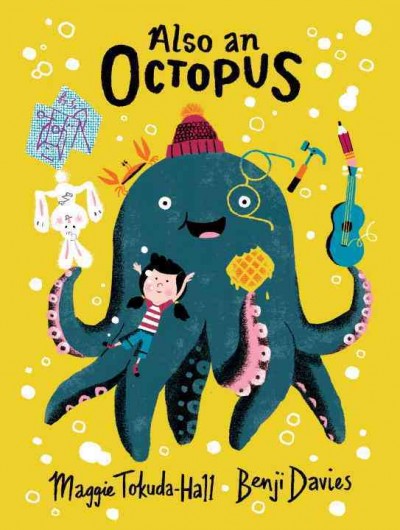
I don’t really know, except that I loved the children’s book, Octopus and Squid by Tao Nyeu. A book that the son and I read every now and then for its beautiful friendship between two seemingly different creatures.

Imagining
Squid and Octopus by Tao Nyeu

Then, a few months ago, I read The Soul of an Octopus by Sy Montgomery

Cosmic Nature of Living:

Quoted from The Soul of an Octopus by Sy Montgomery:

Cambridge Declaration on Consciousness asserts that “humans are not unique in possessing the neurological substrates that generate consciousness”, and that “nonhuman animals, including all birds and mammals and many other creatures, including octopuses also possess these neurological substrates.”

Now, I felt it was time to get acquainted with Squids. I don’t distinctly remember a squid – I must have seen them at the Monterey Bay Aquarium.  Their evolution is fascinating. The book is written by a genuine marine lover (Danna Staaf’s site is here: cephalopodiatrist), and her love for these creatures shines through in the book. I only wish the book had more pictures. I had to keep looking up pictures on the internet. Pictures of nautilus, cuttlefish, squid and octopus obtained from Google search below:

I had never used the word, Cephalopod, before, and I was glad to learn so much about another way of life, even if I may never fully comprehend what it means to have consciousness so permeable, so distributed, and yet co-ordinated.

If there is magic on this planet, it is contained in water. Loren Eiseley

jelly