Exploring Gardening Philosophy: The Joys of Deadheading

“Huh?! Who knew deadheading flowers was a thing?” I said.  I was reading a Miss Read book for the n-th time, and came across the phrase as she took charge of her new garden in the fictional village of Beech Green. I had read the book enough times, but somehow, this time, her thoughts on the flowers in the garden drew my attention. Maybe because I was enjoying the flowers in the gardens myself.

“Do you think I should try that? To get some better blooms in our garden?” I said to the husband. He muttered something which I took to mean yes, and started snoring to avoid further plant-based rants or ramblings. If I didn’t know better, I’d have prodded the man, but I know he literally can sleep, and snore, midway through a sentence that he was speaking.

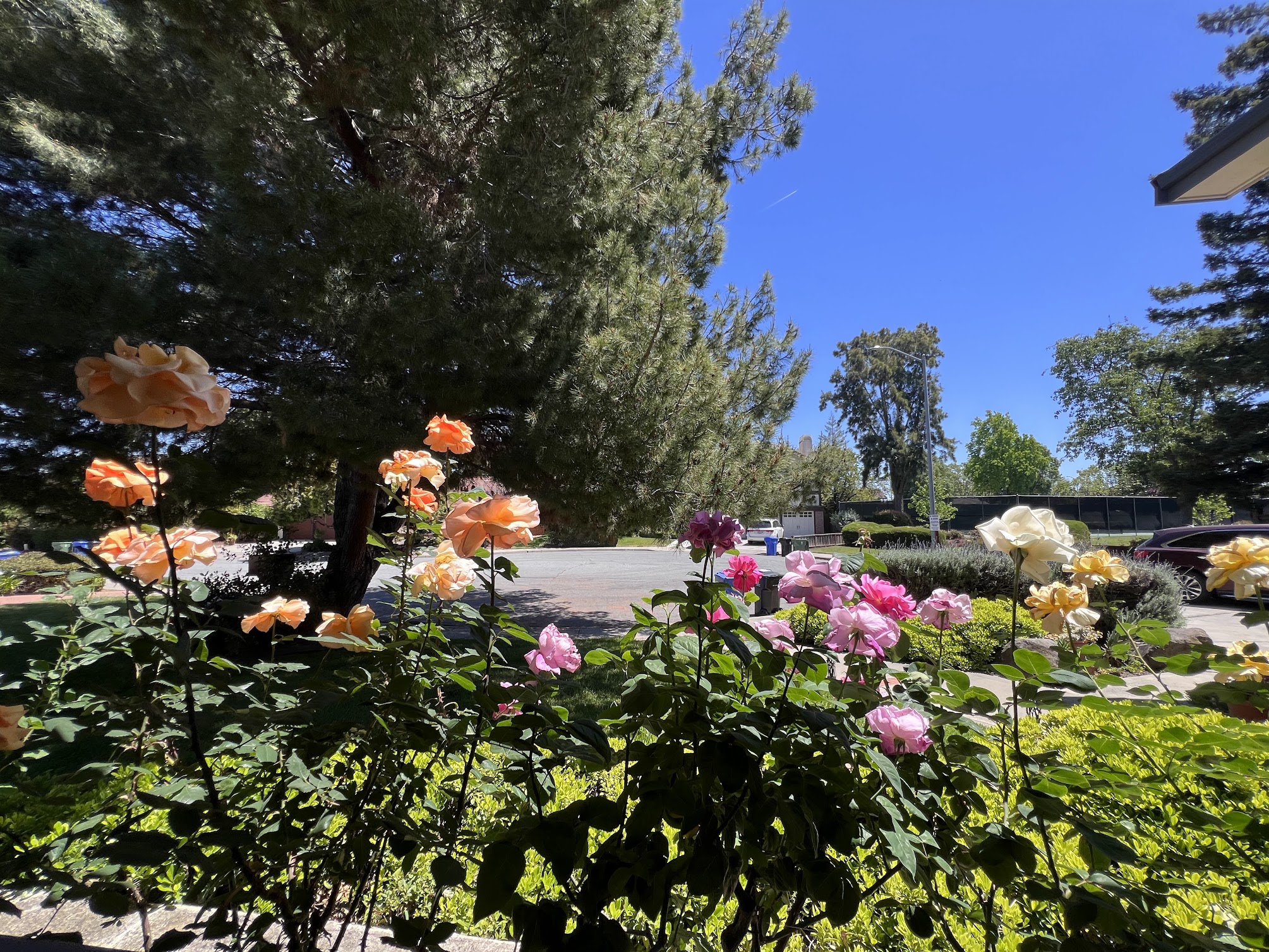
So, I set about deadheading the little yellow roses off my little shrub that refuses to grow beyond a certain point. After that, I walked around with a pair of scissors and shears, properly and improperly deadheading flowers in and around the garden. Some variety of aster or phlox or daisies did not take kindly to this, and remain sticks pointing out. I think they sometimes give me severe looks when I step out. Roses are more forgiving for all their thorns. The chamomiles are conferring amongst themselves and deciding to see how much of a menace I can be with my garden shears. 
I muse about Ray Bradbury’s quote on gardening in the book, Dandelion Wine, as I flit about on my own in the evenings. The long days give me ample time before sunset. 

Gardening is the best excuse for being a philosopher. Nobody guesses, nobody accuses, nobody knows, but there you are. Plato in the peonies, Socrates force-growing his own hemlock. A man toting a sack of blood manure across his lawn is akin to Atlas letting the world spin easy on his shoulder.

-Ray Bradbury

These are summertime joys. California is full of flowers in the summer. Even as the sun beats down on your head, you can’t help enjoying the blooms. The huge angel’s trumpet flowers, the large hibiscus and magnolias, or the smaller chamomiles, and aster, they all attract your attention. There is one garden that boasts of all colors and varieties of hydrangeas. I love them. 
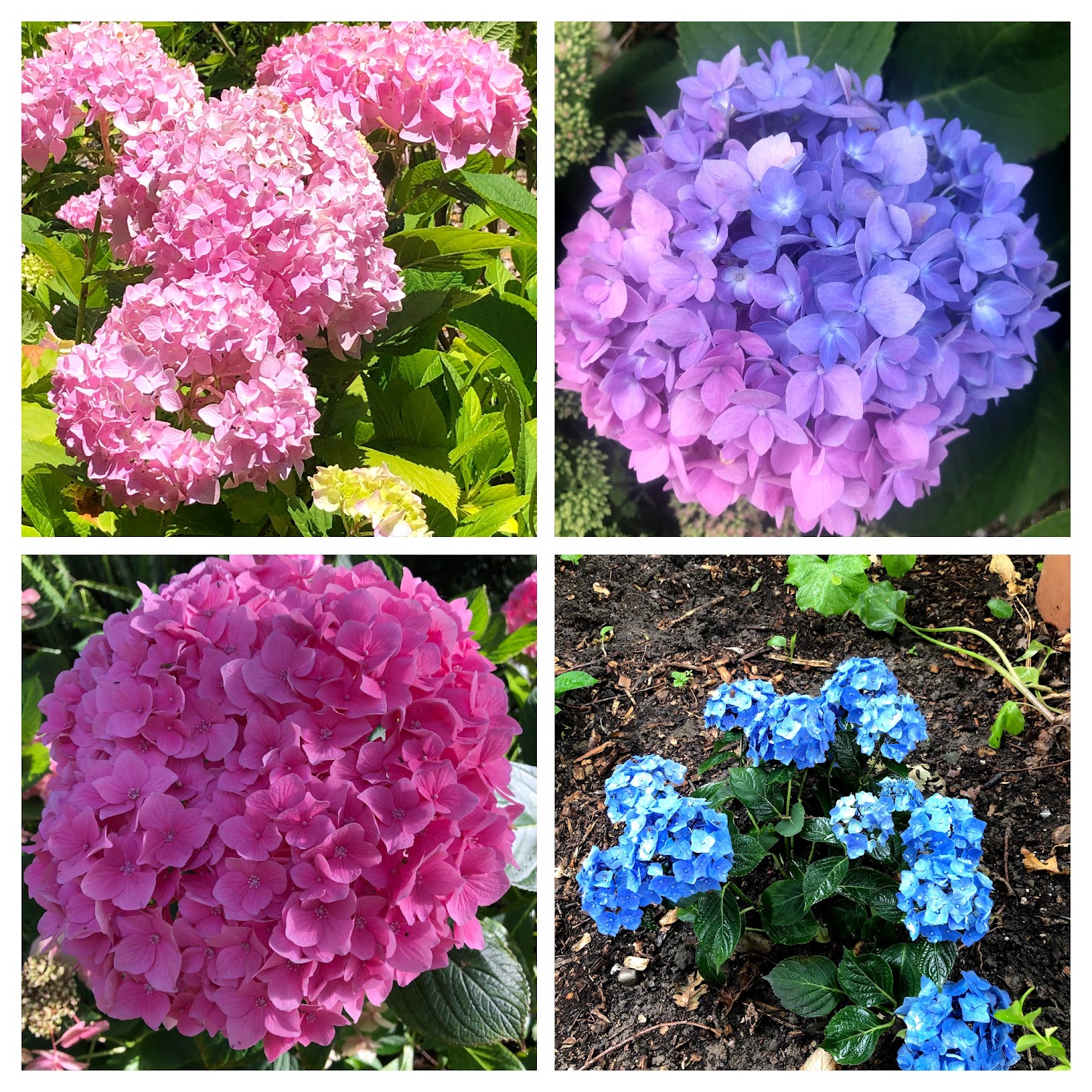
So, I bought a beautiful light pink hydrangea after a friend told me they need shade and grow very well. I spent the last few weeks deadheading the hydrangea, and resuscitating the poor plant after it almost died. I did everything the friendly fellow at the store told me to do. Sigh.

It makes me wonder every time I pass by a good garden. Because while I enjoy a good garden, I had thus far strayed from gardening shears and gardening experiments. Now, I have a new respect for Earth magicians. How do they coax the beautiful bounty from the Earth?

 If we could see the miracle of a single flower clearly, our whole life would change.”

– Buddha (apparently!)

If anyone has bright ideas on easy flowers that grow in pots or in tough soil, please let me know in the comments section. I saw a cheeky post on the internet the other day and drew solace from it. “You are enough!” it said, “That plant should have tried harder!”

Also, does anyone if the philosophers mentioned in the post were also good gardeners? I hope not!

Gazanias in the Garden

Time Paradox

There is a continuous time paradox that we run into in our lives.

My generous friends offered to help me plant my newly acquired gazanias in a small garden patch. You see, several times in the pasts, they’ve tried helping me with different plants with the cheery confidence that gardeners have:

“You cannot go wrong with these – they will definitely grow.”

“You don’t have to do anything, they will grow by themselves.”

“See those – they just spread without doing anything!”

To these optimistic statements, I say, “Challenge accepted!” and go ahead to botch the poor plants with the bumbling blistering competence of a dancing octopus with a shovel. (generated by Gemini AI)

octopus_shovel

So, they took pity on me, and came by with their shovels, hats, and laughter. The patch itself was a tiny one, but as we tried to turn the earth over, it was apparent to them why nothing grows there, and how I was making such a killing with their plants and bulbs. The patch was full of pebbles. So, instead of doing a half-baked job, they all pitched in till we were all shoveling, digging and plodding the earth along. We removed pebbles by the dozen, and by the time the patch was turned over, and the new gazanias were in place, we felt like proper earth movers, ready for some tea and biscuits.

Things take the time they take

As I sipped the tea though, I realized how much work goes into gardens that beam at us everywhere in suburban areas. If this small patch of land took us around 2 hours to do, how do people manage large yards, and sprawling garden spaces?

These things made me think of time itself. We did not realize that it took us 2 hours to plant the gazanias.  That night when I went to bed, I had a wholesome ache in my arms, and dreams filled with fresh soil and flowers. 

All this pondering on gardens made me realize how impatient I am with myself for things to develop into fruition: that garden patch, that novel, that myth, those short stories, those children’s books. Things take the time they take. Sometimes more than one thinks is necessary, but if we keep at it, removing one pebble at a time, moving one ounce of earth at a time, that is all that should matter.

I used my best philosophical insight voice and said so to the husband who chuckled and said “Pesu!” (Talk!) .

Ursula K. LeGuin’s Influence: Embracing the Passage of Time

This impatience towards results: Could it have something to do with the pace of modern life? After all, we spend a monumental amount of time flipping through videos on fast-forward mode showing us how cakes are baked, iced and decorated in less than 15 seconds. In reality, the whole process could easily take 2-3 hours. Do we really feel a sense of participation in the cake-making process by scrolling and consuming it? I think not. 

It reminded me of the interview by Ursula Le Guin in which she talks about time. 

“I lived when simply waiting was a large part of ordinary life: when we waited, gathered around a crackling radio, to hear the infinitely far-away voice of the king of England… I live now when we fuss if our computer can’t bring us everything we want instantly. We deny time. 

We don’t want to do anything with it, we want to erase it, deny that it passes. What is time in cyberspace? And if you deny time you deny space. After all, it’s a continuum—which separates us. 

So we talk on a cell phone to people in Indiana while jogging on the beach without seeing the beach, and gather on social media into huge separation-denying disembodied groups while ignoring the people around us.

​I find this virtual existence weird, and as a way of life, absurd. This could be because I am eighty-four years old. It could also be because it is weird, an absurd way to live.”

~ Ursula K. LeGuin, Interview by Heather Davis

I remembered one remark made by a mother of an elementary school going child who had helped her child out with an art project, and put it up as a reel on her feed: “That reel took more than 4 hours!” she said wistfully. 

I grinned, swiped, and sent a quick ‘like’ before parting ways. That was that. 

I have often wanted to see a flower bloom, or a berry ripen – but the real magic happens so slowly, you barely realize it is magic at all. Maybe, that is the real magic – work with a good intention, do your best, let things take the time they take, and develop into what they need to. In the meantime, I head out everyday to gaze at my gazanias – so lovingly planted. Surely, they heard the chatter and the laughs as they took root. In time, I hope they laugh too.

img_1524-effects

🪷🍁🍀🍇🌴The Power of Plants🪷🍁🍀🍇🌴

Around the World in 80 Plants – Jonathan Drori Illustrated by Lucille Clere

80_plants

Reading about plants and how they shaped our lives is a fascinating endeavor. How little we stop to think when we sprinkle turmeric, or asafoetida in our foods? Turmeric and Asafoetida by themselves are used so ubiquitously in Indian cooking that we quite forget the journeys from farm to consumption.

Starting off with plants that I have heard of in the magical context such as Myrtle, Wormwood, Clovers, Mandrakes, the book makes its way through plants that influenced our  civilizations in different parts of the world. 

The amount of information packed into a 200-page book is amazing and warrants a place in the reference section. 

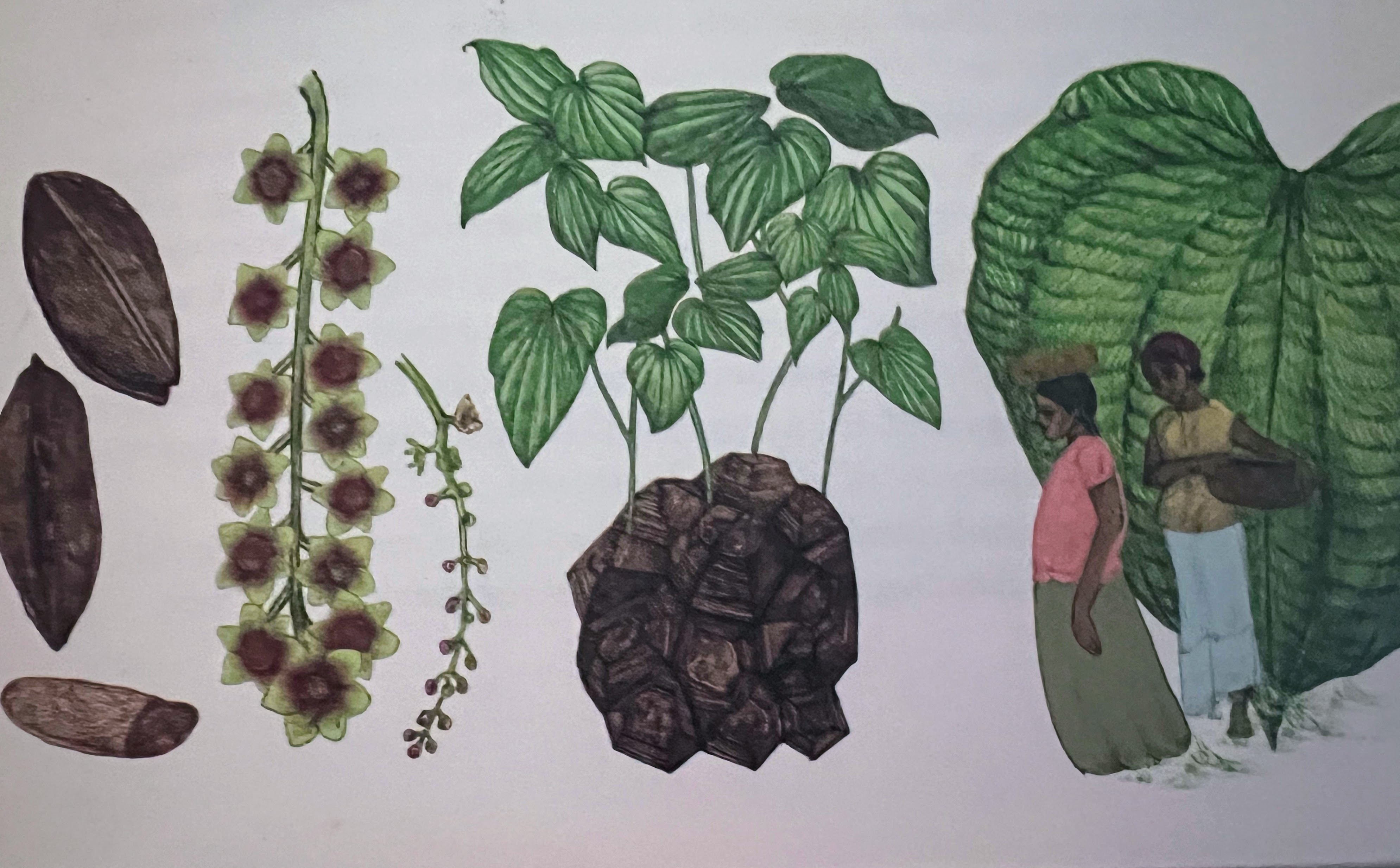
We are mostly aware of the fact that we have not even scratched the surface when it comes to the potential of plants and their medicinal uses. There are around 380,000 plant species in the world, and we do not know how many are not catalogued yet. Even the ones in popular use, we do not yet know their potential. Take the Mexican Yam for the instance. It grows like a vine and produces its tubers.  

Yet, when I read about the Mexican Yams (Dioscorea Mexicana), I was blown away. The humble vegetable has a substance called diosgenin. Diosgenin, it turns out, is a vital starting ingredient for the manufacturing of steroids. Steroids are used to treat asthma, rheumatoid arthritis and autoimmune diseases. 

“The use of steroids expanded in the 1940s, but the drugs, derived from animals and even humans, were hideously expensive. At one time, it took forty oxen to provide the cortisone to treat one arthritic patient for a day. “

– Around the World in 80 Plants – Jonathan Drori

How many times have I applied the cortisone ointments to relieve eczema for the children, without considering how we came by it?

As if this weren’t enough, they are also used in the production of sex hormones progesterone and testosterone. 

“The biggest boom of all came from the use of yam-derived progesterone and other hormones to trick a woman’s body into acting as if it was pregnant thereby inhibiting ovulation. The contraceptive pill was born.”

– Around the World in 80 Plants – Jonathan Drori

Our lives as we know it today, have been forever changed thanks to this humble vegetable. 

“It is fitting that a plant with splendidly heart-shaped leaves should have had such a profound effect on the well-being and love lives of millions of people.”

– Around the World in 80 Plants – Jonathan Drori

img_4603

Science as an Art

I caught sight of an artist one day, sitting in the garden and painting the profusion of life around her.  I stood there drinking the contentment of the scene in. Here was beauty, poetry, art and the science behind it all in one grand stroke. How marvelous it is to stop and observe someone paying attention to the world around them?

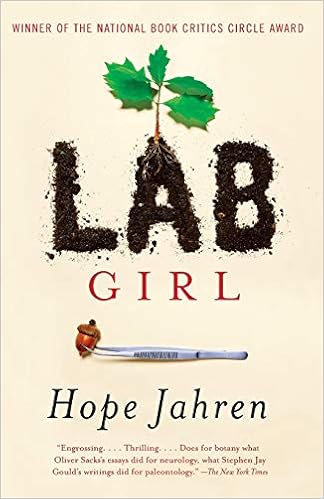
I remembered the piece in a book recommended to me by a writer friend, Lab Girl, by Hope Jahren. The book is an example to show how each one of our stories is different in its own way. This memoir is written by a dedicated scientist, and covers among other things a rare friendship, her bipolar disorder, and her journey of a life with trees. 

In the book, Dr Jahren writes about the science and its demands on its lovers. Her writing is lyrical, and when she writes of her research and her little moments of leap, it is nothing short of poetic. For instance, she writes of studying the structure of the seeds of  hackberry trees. It is the kind of research that is, as she says, ‘curiosity-driven research’.  Dr Hope Jahren is a paleobotanist, and she goes on to say that her research is the kind of work that “will never result in a marketable product, a useful machine, a prescribable pill, a formidable weapon, or any direct material gain – or if it does indirectly lead to one of those things, this would be figured out at some much later date by someone who is not me. “ 

I have always admired the tenacity and perseverance of endeavors such as these. In the world of instant gratification, working on fields where the gratification may not arrive in your lifetime is nothing short of phenomenal. It is the work of an artist: working on something solely for their interest, because they have the aptitude to understand life around them, and to persevere in the face of odds.

In the book, she captures some moments along the path of a scientist’s life that are magical. For instance, she writes of the time she was studying the structural makeup of the seeds of hackberry trees, and she unmistakably finds traces of Opal in the seeds:

“It was opal and this was something I could draw a circle around and testify to as being true. While looking at the graph, I thought about how I now knew something for certain that only an hour ago had been an absolute unknown, and I slowly began to appreciate how my life had just changed.

I was the only person in an infinite exploding universe who knew that this powder was made of opal. In a wide, wide world full of unimaginable numbers of people, I was – in addition to being small and insufficient—special. I was not only a quirky bundle of genes, but I was also unique existentially because of the tiny detail that I knew about Creation,…Until I phoned someone, the concrete knowledge that opal was the mineral that fortified each seed on each hackberry tree was mine alone.”

How could one not smile at this? How beautifully she marvels at understanding the ecstasy of life. Walking along a forest path, I’ve often wondered how, that of the millions of seeds dropped in there, a few decide to take the leap and sprout into sapling, clawing their way up towards the light, while digging deep and finding their roots. It turns out there may be no definitive answer to that. If you were a seed, what are the parameters you would use to sprout your wings and decide where to put down your roots, knowing fully well that from then on, movement is out of the question?

There is more to the miracle of our ecosystems than we can imagine. The ones who study this profundity – astrophysicists, anthropologists, scientists, ecologists, geologists – and then, go on to share their journey with us is marvelous. #Shoshin.

Who was it who said that – when you read a book you live a thousand lives, but if you don’t read, you only live once, yours?! 

“A reader lives a thousand lives before he dies. The man who never reads lives only one.” – George R R Martin in A Dance with Dragons

What would we do without the internet to give the answer right away?!

Complement with:

How to Master the Ancient Art of Walking Meditation in Modern Life: A Field Guide from the Pioneering Buddhist Teacher Sylvia Boorstein