Emotion in Art: Unveiling the Power of Creativity

Art is about capturing a feeling 

T’was a few days before the Inside Out 2 movie was released. The husband was making me watch a thought-provoking interview. (He knew the distractions at hand on a beautiful summer evening. I needed to watch bees flit, deer graze, geese squawk, herons fish, dogs bark. As I cradled my evening cup of tea wondering when to get out on my evening walk, he swooped in. “Won’t take longer than the time it takes to gulp your tea” he said cheerfully and I gave him a skeptical look. I do not take ½ an hour to drink tea.)  

image-2

Anyway, in the interview, they spoke of suffering and how one needed that pain in order to emote well as an artist. It is not a new sentiment. I remember listening to an interview by J K Rowling or Stephen King (I don’t remember which) that one needs to have had a sufficiently terrible time as a teenager if they were to write anything worth writing at all. 

Problems Are Steady

I am not sure I agree with that. Suffering can be acute, agonizing and astonishing in its effects even as adults. In fact, much like our boggarts tend to change through life, so too does our ability to imagine and empathize, don’t they? Also, for many of us, problems tend to be a steady stream in life – we get jittery and nervous if there aren’t any. Can it really be that we are having a perfectly peaceful time – do you think something awful is going to happen? This can’t be true. Maybe I should call the children, see if they are okay.  Oh – what about the old parents, the siblings, the nieces, the nephews, our friends, colleagues, neighbors? Work? No? All well – is this really so?

Then, you tend to the heart like an overwrought bee in summer and soothe it down. “Yes my dear – there really are flowers everywhere! Believe it or not, managing plenty is as much work as managing long distances for some nectar. Just relax, will you?!” Problems like to steadily hum along like background music. We all need problems at some level, do we not? At least that’s what I tell myself when things get a bit clammy. 

Does Art Capture Emotion?

So, does art need to be about capturing emotion – whether through direct suffering or empathetic suffering? I thought Starry Night by Vincent Van Gogh was brilliant because it captured the frenzied anxiety of the artist’s mind. But, was that what everyone thought? How about those moments of bliss, joy, anger, disgust, repulsion, serenity, contentment, love, and all the ones that Pandora so generously released from her little box of troubles. Hope?

Screenshot 2024-06-29 at 3.32.19 PM

A couple of days later when we went to watch Inside Out 2, we sat spellbound as the movie captured Anxiety’s frenzy so perfectly in this animated movie. How Riley’s imagination spewed up every little thing that could go wrong and let her sense of self develop into a skewed sense echoing, “I am not good enough!” was tragic and Oh! So Well Done!

Screenshot 2024-06-29 at 3.28.31 PM

When you observe a piece of art, do you concentrate on how it makes you feel? Or do you appreciate it for the skill of the artist? 

P G Wodehouse on Art

What’s a post on Art without one of my favorite quotes by P G Wodehouse – only I feel a little like Bertie Wooster himself writing this – it has something to do with a painting looking like ‘summer blew up in your face’ – but I cannot remember it. Gemini threw up its hands and said: P G Wodehouse is not an art critic, but an humorous writer, without a trace of irony. I did spend an enjoyable few hours since then

(a) looking for the quote and reading several good ones on the internet,

(b) perusing my own PG Wodehouse collection opening books at random looking for the quote

Which is to say that I had a marvelous time, but still not find the quote. If anyone remembers it, please let me know. But the art of remembering the quote and imagining the painting itself made me laugh, made me feel joyous, so by that standard, it is already a piece of art. What do you think?

I would love to hear all the different ways in which you appreciate Art.

The Ease & Malaise of Literature

The Literature Malaise

There was a strange sense of malaise and I could not put my finger on it. It had nothing to do with the body – a blood test could’ve told you that. It had something to do with the literature I was reading.

I have felt like this many times in the past – especially when reading some writer who has the gift of ripping our hearts out, crushing it, and then putting the raw, bleeding thing in gingerly again. You gasp to regain control over the poor organ again, and soothe it back into action: “Never mind – that was just a book!” and the heart contracts, beats, pumps and does its thing again. How the writers themselves write it, I do not know.

Then, there are books that take one particular theme: shame, guilt, horror, anxiety, or grander themes like social injustice, and play on the heart-strings. J M Coetze’s Disgrace comes to mind.

That was how this particular book was. The narrative tone is never upbeat. It is  wrought with anxiety.  The reader is quite caught up in the frenzy of the social media world, its harsh realities of unraveling reputations, and the fate of the protagonist in YellowFace – by R F Kuang. ‘The mechanics behind the popularization’, as she puts it in her novel. The world of popularity has always been a high-stakes game (Or at least as far as I’ve read about. I wouldn’t know.) It is interesting to see the publicity stakes in the publishing industry . The book says something to the effect of : Best sellers are chosen long before they make it to the stores.

The illusion of an image built up through social media engagement can be a frightening monster indeed. For how do you find the imaginary?

I had decided to dedicate the week-end to catch up on some reading, and was I reading?!

After a few hours, I stepped outside. The world outside was basking in the summer sunshine. The bees were buzzing around my shaggy lavender patch. The patch needs trimming, but right then, the faint smell of lavender was soothing, and oddly endearing. It was a tug to reality, a reality in which not everything felt so grim as in the book. That was grounding – I took charge.

bee_in_roseroses

I made a cup of tea, and shook myself like a dog after a swim. Literally – I went for a swim and shook myself as I got out of the water. I had been drowning in the book all morning, and the cool swim in the hot sunshine worked wonders.

The Joy in Literature

I mused to the husband. “It is like Nobel Prize winning literature. You have to be serious-minded, have plenty of  suffering and drama. You cannot bung in humor and hope and write about light and all that and expect to find literary acclaim, can you? “

Why can’t people write like P G Wodehouse? I said forlorn. What was it that P G Wodehouse said on Writing?

https://claremontreviewofbooks.com/frivolous-empty-and-perfectly-delightful/

“I go in for what is known in the trade as ‘light writing’ and those who do that – humorists they are sometimes called – are looked down upon by the intelligentsia and sneered at.” – P G Wodehouse

So what is it about taking ourselves so seriously that appeals to humankind so much? I’d like a serious response please.

The book was critically acclaimed -a lot of serious books are, you’ll notice. It is like the world is looking to see – “Ahh – this particular kind of anxiety and loneliness, let’s see which writer can crush the essence of that most succinctly.”

So, I did what I do best:  I bull-dozed through the book, sitting up till 4 in the morning, finishing the book, before soothing the heart to sleep. I refused to put myself through another day with that feeling.

Something Fresh – By P G Wodehouse

The next evening, I resolved to do the opposite. I picked up books where the overpowering mirth or joy of the writer exudes from the pages and envelopes the reader in a warm, cocoon. A trip to Blandings Castle seemed nice

“This is peculiarly an age in which each of us may, if he does but search diligently, find the literature suited to his mental powers.”

P.G. Wodehouse, Something Fresh

 I laughed, and I grinned at the turn of phrase. I anticipated the next laugh – because I had read the book several times of course, and I still hung on. Laughing – matching the glorious summer outside. Later that night, the son & I thumbed through an illustrated copy of a favorite book as the silvery light of the full-moon filtered in through the night. 

All was well. Knowing all will be well in a book is a wonderful feeling. It is why I turn to authors like Miss Read, P G Wodehouse, R K Narayan, Alexander McCall Smith, Jacqueline Winspear etc like plants turn towards the sunlight.

Recommendations Please

Please recommend some authors you turn to for light, joy, hope, optimism and magic.

How the Library (Not the Prince) Saved Rapunzel

When the Covid lockdowns started, many folks went on a buying spree (we all know the toilet paper jokes). Ever the dutiful one, off I went too. I was feeling rather pleased with myself when I got an extra bag of rice, and headed onto the library (to get books to tide us over during the lockdown).  When the husband called to ask where I’d gone, I sheepishly said that I was at the library just in case we were unable to get books during lockdown. I could hear a sound like a paper bag bursting – his version of a cross between a snort, and the urge to laugh. I bragged about the extra bag of rice, and I could see his face wondering why he had to be landed with someone, who in P G Wodehouse’s language, ‘must’ve been bumped on the head as a baby’. 

Well, I must say that when we staggered home with books for the children and self, I felt better. The local library has been one of my favorite spots to visit of course, but over the Covid period, I felt like Rapunzel in the book: How the Library Saved Rapunzel (Not the Prince). The library allowed us to schedule an appointment and arrange to pickup books on hold. What was more, they were kind enough to include a few picture books of their choice if you requested them to do so. I am eternally grateful to have access to libraries.

I felt almost an irresistible urge to increase my Science based reading this year (maybe this is a tiny rebellion for the disturbing anti-Science strain emerging with the 45th POTUS office). Starting the year off by re-reading Carl Sagan’s Cosmos set the stage for the year ahead. The following books gave me no end of pleasure and learning over the year. (My Science writing class for children)

trees_komerabi

2020 was the 50th anniversary of Earth Day

  • Unbowed – Wangari Maathai (in progress)
  • On Looking  – Alexandra  Horowitz
  • Losing  Earth  A Recent History – Nathaniel Rich
  • This is the Earth – Diane Z Shore & Jessica Alexander, Paintings by Wendell Minor

Bill Anders said: “We came all this way to explore the moon, and the most important thing is that we discovered the Earth.”

What a lovely statement that is, and together with his Earth Rising image, contributed to the concerns around Planet Earth that led to founding of Earth Day in 1970.

1200px-NASA-Apollo8-Dec24-Earthrise

It was also a wonderful year to take in poetry. Mary Oliver & Margarita Engle were always welcome in a year when poets alone seemed to know the right turn of phrase for the bizarre. Dr Seuss & Jackl Prelutsky always know to turn one’s frown into a smile. 

  • Blue Iris – Mary Oliver
  • Enchanted Air – By Margarita Engle
  • Dog Songs – Mary Oliver
  • Owls and other fantasies – Mary Oliver (Yes! no!)
  • Be Glad your nose is in your face – Jack Prelutsky
  • Dr Seuss books (always worth reads and re-reads). I found a few gems that truly tickled the mind and got out some belly laughs.
    • Horton hears a Who
    • Horton Hatches an Egg
    • Sleep book
    • Oh the Thinks you can Think
    • How Lucky You Are
    • Thidwick the Big Hearted Moose

summer-collage

With the Black Lives Matter movement, the year was ripe for educating oneself on the inequities of society and civil disobedience. The local library, news media, and friends all helped with an excellent array of reading material. Notable among the works read then were:

  • Becoming – By Michelle Obama
  • Black Panther – by Ta Nehisi Coates
  • Sneetches and other stories – Dr Seuss
  • A Long Walk to Freedom – Nelson Mandela‘s children’s book version
  • My Many Colored Days – Dr Seuss

img_8883

With uplifting books and humour, life can be truly marvelous. My all-time favorites kept me company, and I am eternally grateful to their influence of course but a few others were added to the list this year.

The world isn’t such a good place either, and reading books such as these helps to remind us about the many problems that still beset society

The lure of power, and how we are seeing it all play out in real life

  • The Fate of Fausto – Oliver Jeffers
  • Louis I – The King of Sheep – Oliver Tallec
  • Yertle the Turtle and other Stories – Dr Seuss
  • Harry Potter and the Order of the Phoenix (pieces relating to the Minister of Magic refusing to acknowledge Voldemort’s return so he could stay in power)

Of course the true magic of life is never complete without children’s books. There are so many of them in this genre, that I did not even note half of them. But a few of them lit up my life

  • My Grandma is a Ninja – By Todd Tarpley, Illustrated by Danny Chatzikonstantinou (When I become a grandma – though it is a few decades off, that is how I wish to be 🙂 )
  • Gondra’s Treasure – By Linda Sue Park
  • Enchanted Wood – by Enid Blyton (old Saucepan Man, Silky and Moonface with the lands above the enchanted tree – though it doesn’t hold the same level of magic it did as a child, it still has its charm)
  • The Red Pyramid – By Rick Riordan (this was the son’s recommendation, and thoroughly enjoyable it turned out to be romping down the Egyptian myths!)
  • The Quiet Book – by Deborah Underwood
  • A Fun Day with Lewis Carroll – Kathleen Krull & Julia Sarda
  • Peter Rabbit’s Tales – Beatrix Potter
  • Why is my Hair Curly – By Lakshmi Iyer
  • A History of Magic – Based on Harry Potter Universe
  • Tintin Comics (a fair few)
  • Calvin & Hobbes
  • The Velocity of Being – Maria Popova & Claudia Bedrick

velocity_being

On that magical high note, here is wishing everyone a healthy, happy new year in 2021. Things are already turning around, and looking hopeful. Keep reading, and sharing 🙂

img_0851

Teacher Appreciation Week

I hovered near the bookshelf – like a child hovering around the glass-pane of the candy store, Looking for that perfect piece of sweet : something familiar, good and a slight twist to wake up your cells every time.

It has been a long and stern day filled with purposeful adults, all filled to the brim with the cares of living, earning a living, and forgetting to live. My brain looked for a release, and a mode to thrive.

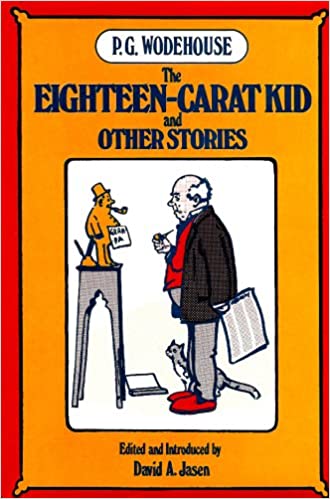
I picked up a book of short stories by one of my favorite authors: P.G.Wodehouse.

18-carat-kid

Eighteen Carat Kid and Other Stories: I opened the first page and was pulled in like an elephant to the early morning waters in the forest.

Paragraph 1:
There is something always going on in a private school.
Beyond breaking up fights, stopping big boys bullying small boys, preventing small boys bullying smaller boys, inducing boys of all sizes not to throw stones, go on the wet grass, worry the cook, tease the cat, make too much noise, climb trees, scale waterspouts, lean too far out of windows, slide down the banisters, swallow pencils, and drink ink because somebody bet them they wouldn’t, I had very little to do except teach mathematics, carve the joint, help the pudding, play football, read prayers, herd stragglers into meals, and go round the dormitories at night to see that the lights were out. ”

Both my parents were teachers (my father was a teacher in a residential school – public schools as they are called in India, private school in the US & UK) I sent the snippet to him, and he heartily took a trip down the memory lane and agreed in his booming, hearty voice that addressed assemblies without mikes, that there never was a dull day in his teaching career. Being a vegetarian, he did not often have to ‘carve the joint’ , but that apart, pretty much everything else was true, he said. It is always to good to hear the joy of being a teacher coming through.

This week is Teacher Appreciation Week, and I thought of sharing this essay the son had written for his 3rd Grade essay:

Topic: Imagine you are a teacher taking your class on a field trip to Baltimore National Aquarium

The Baltimore National Aquarium

At the Baltimore National Aquarium there is lots of life. This is one of the places where humans and marine life see each other as fun things.Anyway I brought my class with me because the principal wants the kids to experience new things, which I can understand. When we got to the nearest exhibit, I did a headcount of all the students. We were missing 6 of them.Thankfully, I found them near the water (where the animals are) and I gave them a good talk about not leaving the group. Then when I turned around all the other children were scattered. I thought to myself, “This is gonna be a long day.” After that, we went from exhibit to exhibit in the huge aquarium. As we were about to go to the display of skeleton from a dinosaur, we found another class. The kids merged together and the other teacher and I had the same expression: “Kids!” We sorted everything out and went to the dinosaur. I read from the brochure “This is the Shaustasourus, the largest marine dinosaur ever.” After many more mishaps we got back on the bus. For the first time, we had a full class. When we got back none of the kids thanked me for not losing them. Sometimes the world really isn’t fair, but that’s okay. I guess I had lots of fun too.

I guffawed at this piece of writing.

People who imagined the teacher’s job to be putty, are having to re-evaluate their assessments – their puddings of pie children weren’t such darlings when the Mathematics had to be taught by their parents anymore.

This is Teacher Appreciation Week in the US – really what would we do without the steady, positive influence of teachers?

Time in the Garden

Regular readers know how much I enjoy nature and gardens. It is one of life’s ironies that my plants only thrive despite my loving care, and  many is the time I have made bloomers in the little patch I tend to. However, never one to shy away from blooming from the bloomers, I picked up this book, Life in the Garden, By Penelope Lively. 

life_garden

Lively begins by examining the gardens in Literature starting with the Garden of Eden, and working  her way through other fantastical gardens in the books, The Secret Garden, Alice in Wonderland and the beloved gardens of dear, absent-minded Lord Emsworth’s at Blandings castle. 

She examines the writing and finds out which of the writers are gardeners themselves and which of them have merely picked up the scenery from a gardening catalog. She teases the co-ordination of colors, the seasonality of the plants themselves in the landscapes and has given me an entirely different appreciation of gardens. 

Some passages are especially endearing and made me want to read them again. Especially her meditations on time, the gardener and the garden itself. 

I quote from her book: 

“To garden is to elide past, present and future; it is a defiance of time. You garden today for tomorrow; the garden mutates from season to season, always the same, but always different. … In autumn, I plant up a pot of “Tete-a-Tete” daffodils, seeing in the minds eye what they will look like in February. We are always gardening for a future we are supposing, assuming, a future. I am doing that at eighty-three; the hydrangea paniculata “Limelight” I have just put in will outlast me, in all probability, but I am requiring it to perform while I can still enjoy it.”

“The great defiance of time is our capacity to remember – the power of memory. Time streams away behind us, and beyond, but individual memory shapes for each of us, a known place. We own a particular piece of time; I was there then, I did this, saw tear, felt thus.”

She goes on to say, 

“A garden is never just now; it suggests yesterday, and tomorrow; it does not allow time its steady progress. “

Certainly, for me, part of the appeal of gardening is this ambivalent relationship with time; the garden performs in cycles, it reflects the seasons, but it also remembers and anticipates, and in so doing takes the gardener with it.”

As I look out the window at my clover-filled backyard with some foxgloves looking happy amidst the narcissi blossoms and the newly sprouted cherry leaves after their spectacular show of cherry blossoms, and the rose buds ready to burst forth in a few weeks,I cannot help feel the lessons nature is teaching us. Be forward looking – always, nurture what is important, and enjoy the passage of time. One moment at a time. Every flower has its chance to bloom and fade.

do-nothing-garden_1

Gardens are enduring lessons in hope. I cannot tell you the number of times, I have planted something in October and been surprised when they bloom in April, or the number of times, I have been pleasantly surprised that something  thrived  at all. 

“Hope” is the thing with feathers –

That perches in the soul –

And sings the tune without the words –

And never stops – at all – 

Emily Dickinson – Hope

I am lackadaisical at best with my gardening and it shows. I have a minuscule patch that seriously  has more air-time on the blog than the square feet it occupies. Yet, it gives me immense pleasure, peace and calm. Spurred on by the book, I went outside to take a more active role in the tending of my plants. I have been admiring the sweet peas plants that have sprouted in the garden. Some time ago, I got a packet of sweet  pea seeds from our local library. Thrilled at finding them, I scattered them by the apricot tree and forgot about them. The plants are thriving now, quite tall, and seem to be sagging. So, I went – “Coming dears! Here I am to take care  of you!”, I said, in my best nurturing voice and tried to prop up the plants as best as I could, in the process, breaking off one of the plants’ main stems.

If the plants in my patch could talk, they would’ve chorused – “Go inside – we know you  love us, just let us thrive! Breaking off our stems indeed!”

Teachable Moments

I was telling the husband casually about a friend of mine. “She is thinking of taking up primary school teaching.”

“Huh?! Really?” said the son, his ears twiddling, for the news interested him. He loved this particular aunt.

“Well – maybe I should tell her the best grades to teach then!” said he.

“What do you mean the best grades to teach? ” I said cautiously for I felt a moment to savor coming on in my bones, but acted as nonchalant as possible. “Elementary school teaching – doesn’t that mean kids in your school?”

“Well, you know how it is? We aren’t all just cute kids like you think Amma! There are some grades you want to be careful with.” he said with a meaningful look in his eyes.

“What do you mean? I’ve seen you children in Elementary School – so sweet you all are!” I said – knowing fully well the reaction this would elicit.

“Ha! Okay, okay – I’ll tell you. Kindergarteners are naughty, 1st graders are okay, 2nd graders are rowdy, 3rd graders are sassy, 4th graders think everything is lame, and 5th graders are okay.”

I stifled a hearty laugh for the moment, and asked him, “So only 1st and 5th grades are okay to teach huh?!”

“Yep! Pretty much! ” he said.

I gave into a full throated laugh, not for the first time admiring and thanking all the stellar teachers of the Naughty, Sassy, Rowdy, and Think-Everything-Is-Lame children. Somehow, these magicians strive to make students of them all.

teachers

Later that evening, the daughter came moaning into the kitchen – “Gosh! There is just so much homework! I mean – these teachers think we are awesome, but we really aren’t!”

Coming hot on the wheels of the Elementary School analysis, this seemed to be something to be milked for its true worth. So I tried.

“Are you saying your teachers are poor things for trying to uplift you and so on?”

“Of course they are!” said she.

“Remember they were teenagers too once, and probably realize that teen potential is high. They do want to give you the best opportunity to attain your true potential!” I said, thinking of the stalwart teachers of the folks who make the 30-under-30 and 20-under-20 lists.

Yeeaaarrcccchhh!” she said. I am quite sure Yeeaaarrcccchhh isn’t a real word, but a guttural sound open to interpretation. After a moment she said, “I sometimes think to myself what my teachers must be like if they were teenagers today. ”

There was silence for a moment. A silence I did not break while she gathered her thoughts. This was going to be something, I knew. When the daughter thinks of smart-aleck moments, it is best for the waiting populace to take cover.
“My Chem teacher would probably be obnoxious, but not a super smart version of Sheldon. My Math teacher would be a shy but sweet kid. My history teacher would have been the low key popular kid who is friends with everybody.”

I laughed enjoying this analysis as she went down the list of teachers. And then, I asked looking as innocent as it was possible to be. “What would you think of me as a teenager?”

“HA! Not falling for that one – better luck next time Mother! Mother, who is long past her teenage years!” she said, ruffling my head like I was a cute dog, and made off for her room to tackle the oodles of homework her stellar teachers had set out for her.

As a child I was keenly aware of both sides of the coin. Both my parents were teachers, but that did not stop me from becoming a dab hand at imitating my teachers, and giving them fond pet-names when required. The father and I enjoyed the creativity there.

All in all, I know in the name of professionalism and growing up, we lose this marvelous trait of making light of things, but I wish we didn’t.

For those who enjoy light tales of children in their schools, these are all good reads and worth chuckling anytime one feels the weight of the years settling in on them.

Some whimsical poems here:

We-Are-Teachers.Com

Refection on Reflection

I often feel this way after some heavy reading, or hard periods of news activity. Frazzled, taut if you know what I mean. On edge. One fine day, a voice in the upturned cauldron piped up and said, “Look, I know you mean well, and all that, but the old brain is not quite suited for deep learning, heavy news and all that lark. We’d better leave all that to the algorithms, while we potter around in the sunny recesses of the spring garden. What? What do you think of that?” I took a serious look at the proposition, and nodded along enthusiastically. Everyone should do what’s best suited to them, right? So, I should .. eh..potter and totter, nourish and cherish, or perhaps enjoy refection on reflection.  

So, it was with a wholly energetic outlook that I went on to read several books to air the musty brain a bit.  P.G. Wodehouse – that unwavering rallier of spirits rallied like nobody’s business, and started off by soothing the sore spot at once:

The Pride of the Woosters is Wounded, By P.G.Wodehouse:

If there’s one thing I like, it’s a quiet life. I’m not one of those fellows who get all restless and depressed if things aren’t happening to them all the time. You can’t make it too placid for me. Give me regular meals, a good show with decent music every now and then, and one or two pals to totter round with, and I ask no more.

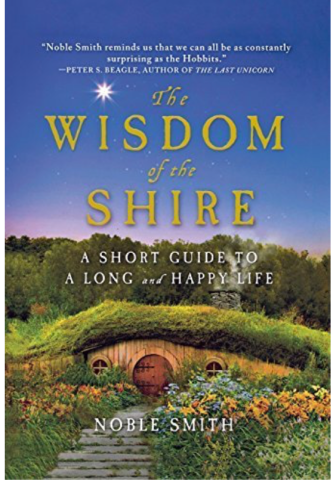
It was after I had revived after a spot of humor that I went in for a bit of magic. The Wisdom of the Shire by Noble Smith. It is a lovely little collection of essays on Middle Earth. The courage of Hobbits, the lore of the Ents. As I started reading the little book on Magic, it made me realize why we love Lord of the Rings so much that it endures on a century later. The hobbits are lovable in a way that is easy to relate to. They lead us to the joys in a simple way of life.

Screen Shot 2018-03-01 at 4.06.36 PM
The Wisdom of the Shire

Hobbits like a good meal, think nothing of throwing in an energetic walk in the Shire, enjoy the companionship of fellow hobbits and are generous enough in their outlook. Some of the essays on the Hobbits were:

Eat like a Brandybuck, drink like a Took

Sleep like a Hobbit

It seems they know how to enjoy a magical do-nothing day as often as possible.

Incidentally, A Magical Do Nothing Day is a wonderful children’s book written and illustrated by Beatrice Alemagna. The book practically tugged at me in the library. Some titles speak to your heart, and this was one of them.

A Magical Do Nothing Day. Swirl it around, and feel that sense of peace descend upon you. The book gently takes you on a slide down the mountains, a whirl among the leaves, a dip in the pond and the exquisite pleasure of touching a snail.

Screen Shot 2018-03-01 at 4.14.21 PM.png

For each of us, a Do-Nothing Day would be different. I am curious to hear what a Magical Do Nothing Day signifies for you. Please share your ideal version of a Do-Nothing day with me.

I had several Magical do-nothing moments recently. Moments  in which the children and I learnt to skip stones in a pond, or I stood mesmerized by a cherry blossom tree that looked like garlands on every branch. The beauty around us is ethereal, and that makes it all the more inviting to go and enjoy nature.

To see a World in a Grain of Sand
And a Heaven in a Wild Flower – William Blake 


The Artistic Touch

I waltzed in to the San Francisco Museum of Modern Art thinking my usual self should do. It didn’t do. It pursed already thin lips and drew in breaths that should have been released.

So, here is a tip: Before you head into a museum, prepare to put on a face that reminds you of a serious matter: something like a puppy being pulled back home from a glorious spring saunter that yielded an unexpected bone, a couple of birds to chase and beautiful water hydrants to raise their hind legs against. An occasional smile commiserating with the owner (or the puppy) is okay, but grim seriousness is admired.

Remember: Life is Stern, Art is Earnest & Its Depiction Torturous. Good.

pets

What tripped me up was this: I walked into a largish room and found a men’s piddle seat in the middle. You know one of those umbrella-handle shaped urinals? In the middle. I know I have expressed the opinion that I wished the blasted things in bathrooms were less in the corner when you were trying to tighten a screw, but by gosh, I had not quite meant this! I am afraid I did the wrong thing here – I pointed and let loose a guffawing squeal and giggled at the exhibit. Modern Art patrons are a tolerant lot. Tolerant towards Art I mean – they scowled at my flippant attitude, while the urinal drew admiring noises.

urinal
Random pic of some urinal from the internet – I did not take a picture of the thing!

When I finally tottered away from this marvel, there was a painting around the corner, that reminded me of one of P.G.Wodehouse’s short stories. Reggie Pepper (who gave PGW the idea for Jeeves) says of his Artist friend’s work:

I’ve seen his pictures, and they are like nothing on earth. So far as I can make out what he says, they aren’t supposed to be. There’s one in particular, called “The Coming of Summer,” which I sometimes dream about when I’ve been hitting it up a shade too vigorously. It’s all dots and splashes, with a great eye staring out of the middle of the mess. It looks as if summer, just as it was on the way, had stubbed its toe on a bomb. He tells me it’s his masterpiece, and that he will never do anything like it again. I should like to have that in writing.

Art certainly conflicts: I stood astonished I suppose that one would take up a whole wall for a work like that when I looked around, and was told by a Patron, “Don’t you just admire how a true artist comes out?”
I eh-ah-ed weakly. When he says, artist comes out: Did artists lay their intestines out on canvas? It certainly did look like it. I recoiled a bit, but luckily the fellow was well launched on his story to notice. He then proceeded to tell me the most extraordinary thing.
Apparently, this artist was hailed as a genius after his death. His paintings regularly sold for $150 million dollars. I gasped at this. I should like to see these patrons! Apparently, one of his works made it to the local Goodwill shop where a lady paid 3 bucks for it. I suppose it must have shocked the $150 million dollar fellows, but life is tough. Anyway, a friend of the $3 buyer said there were enough squiggles to make the fellow a big artist, and had her check it out. Apparently, she got $25 million bucks for it but was not happy, since the other paintings of the fellow sold for over 100 million bucks. People I tell you. Never really happy! Tush.

There were beautiful paintings that managed to depict the 4 seasons, something that looked like a desert sunset, geometric shapes and so much more.


All of these marvels jostled with what I thought were the trial canvasses of the artist – you know those sheets against which you imagine them testing their strokes, and shaking out the extra spots on the brush and so on. (They weren’t – they were the real pieces of Art. I checked.)

IMG_7520.jpg

What really got me thinking about this whole Art business is the Sensuous blue painting.

There was one painting that looked like this.

IMG_7602.jpg

Oh, sorry, that is a picture of my daughter’s wall.

This is the painting.


Next to this was written a most poignant note. If I had not read the notice, I could not have imagined such a beautiful set of phrases can be applied for the color blue.

The final straw was the one where the artist forgot to paint and occupied a wall.


“Does this white square hold a mystery?”

I shoo-hoo-ey-ed my way up the floors, all the while admiring the many works, stopping to muse at a fair few, and thoroughly enjoying myself. When they say Art is mind-blowing, I could agree. I may not be able to appreciate the finer details of each piece the way the sturdier patrons do, but I was quite sure, it awakened some dormant senses.


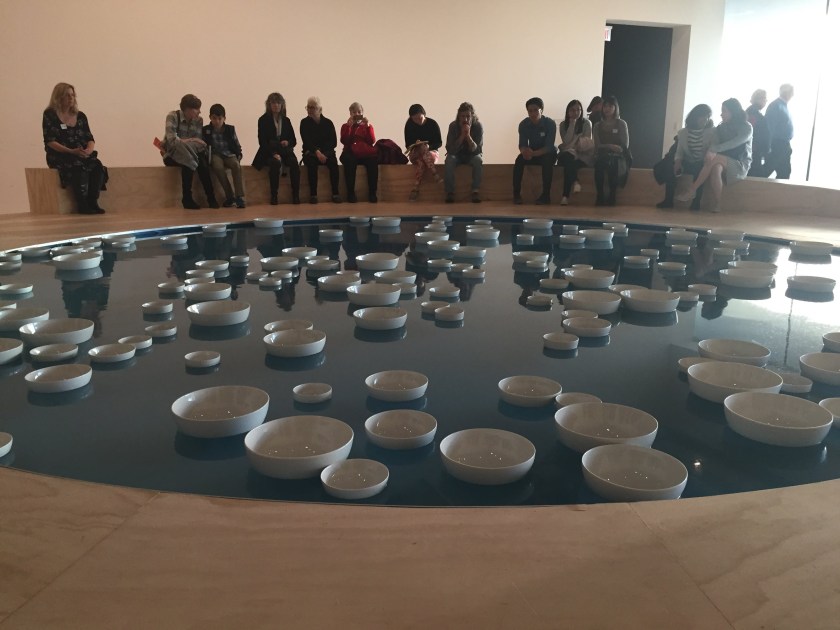
Finally, I washed up in front a pool of floating dishes. Not a dishwasher, more like an indoor pool with clean china chinking and tinkling against each other producing a haunting musical memory to go with the visual. It seemed like a marvelous touch depicting the day at the museum.

IMG_7515.jpg

All in all, the museum should have made me feel like this character from one of P.G.Wodehouse’s story on being in the presence of an Artist:

She was perfectly pleasant, and drew me out about golf and all that sort of thing; but all the time I felt that she considered me an earthy worm whose loftier soul-essence had been carelessly left out of his composition at birth.

But it didn’t. There was matter enough to engage simple minds like mine, and I thoroughly enjoyed it.

When Humor Jumped In Neptune’s Pool

California has many things to offer: it is home to sprawling deserts, cold beaches, misty forests, rainy fogs, snowy stretches, marvelous lakes, fast flowing rivers, and so much more. It is one of the reasons why we had neglected the Hearst Castle in San Simeon California for this long. Every time some one asked us about Hearst Castle, we’d say, “Oh – yes! Must go” without conviction and move on. This time, however, we took the plunge and buoyed up in Paso Robles, California.

hearst_2

Once in there, it is imperative that you follow your hosts’ instructions scrupulously, for the tour guides there do not put it past themselves to take a ruler and rap it across your knuckles if you don’t. One time, we found ourselves standing in the game room and the guide went on and on about the parties the rich man used to give there (Their guests used to play scrabble here, and then they would move across the hall, and play the uno cards there. Sometimes, they would think that chess might be a good idea, but thinking was hard….). Then, she stopped mid sentence, found my pinkie toe not on the carpet, and pulled me up in front of the whole tour. “Ma’am. Ma’am. I ask that you stand on the carpet.
To which I looked around to see who the rule-breaker was, and found there was no Ma’am in the general direction she was shouting at except me. I asked her, “Who? Me?”
Yes Ma’am. Please stay on the carpeted area.
“I am on the carpeted area.”
No ma’am. Your pinkie toe is out.
Sticklers for perfection the Hearst Castle folks.

When you go up to the Hearst Castle, you cannot but help noticing that the man, William Hearst, had nothing to do, had wealth with which he knew not what to do, and therefore he thought it a perfectly reasonable thing to build a castle that made Napolean Bonaparte, Julius Caeser and King Henry the VIII all squirm together in a co-ordinated pirouette in the nether world. As though the human built edifice wasn’t enough, he decided to introduce some zebras, llamas and mountain goats into a habitat that boasts natively of some squirrels and lizards.

If the tour guide is any reflection on the hospitality offered up at the home of old William Hearst, I should like to pass on the invite. We were all now made to stand in attention in the dining room where folks, I was enlightened by the tour guide, ate. I did not know this. So, I looked up.
Sometimes, they had potatoes for dinner, sometimes they had eggs, oatmeal…

hearst_1.JPG

I must mention that this punishing tour was happening at an hour where breakfast is a memory and lunch a yearning.

The guide’s voice was one of those voices these sharp nurses who brook no nonsense have. To top that, she seemed to belong to the category of folks who swallow their sense of humor mistaking them for calcium tablets in their youth. Her jaw set, her face impassive, she went on and on like a steady drip into your veins.

I have always felt for these tour guides. I am not sure what draws them to the career in the first place. It must be a beautiful thing to proudly show the legacy of the place the first three hundred and two times. But the three-hundred and third time, must get somewhat repetitive what? And then, you have people who refuse to keep their pinkie toes on the carpet. Hard.

If you were a guest here at the castle, you would be given the place of honor the first night and sit right next to Marion Davies (his mistress), and then as more and more guests joined, you will be moved along the table. When you find yourself at the end, it is time for you to go.”, she went on in that flat dictaphone commanding her troops sort of voice.

I am sure that was a line inserted for humor. I could almost see Humor springing gay and carefree in that line, and then tripping on the carpet that all toes were supposed to be on, and falling nose first and splattering on the floor.

People shuddered at the implication, thankful that their pal William Hearst did not send them a personal invitation.

A giggler throughout, I was quite sure I would have myself thrown out of the hilltop if I did not behave, but I could not help thinking of P.G.Wodehouse’s quote:

“It was one of the dullest speeches I ever heard. The Agee woman told us for three quarters of an hour how she came to write her beastly book, when a simple apology was all that was required.”

P.G. Wodehouse, The Girl in Blue

I laughed and the husband yanked me to the back of the troupe, to save me from myself.

It was in fact, P.G.Wodehouse, who had put up that gag about being shoved off the table if you stayed too long.
Meals are in an enormous room, and are served at a long table, with [William Randolph] Hearst sitting in the middle on one side and [actress-mistress] Marion Davies in the middle on the other. The longer you are there, the further you get from the middle. I sat on Marion’s right the first night, then found myself being edged further and further away till I got to the extreme end, when I thought it time to leave. Another day, and I should have been feeding on the floor.”—Humorist P.G. Wodehouse, in a letter to a friend describing his visit to William Randolph Hearst’s San Simeon, Feb. 25, 1931, quoted in The Oxford Book of Literary Anecdotes.

If only PGW knew how his good pal, Humor, jumped into Neptune’s pool to avoid further torture, he would have had a gag or two about it for sure. (Neptune pool is a monstrosity with *gulp* Roman columns surrounding a humongous pool, that was dry and was up for renovation because it drained some 5000 gallons of water, when the rest of the state was smacking their lips in thirst).

Do Not Hate In The Plural

This post of mine was published in The Hindu dated 15th June, titled Undistilled Wodehouse

I was reading a short story by P.G.Wodehouse on the train. These are the times when I most mistaken for a lunatic. My seat shudders with unconcealed mirth. I giggle, laugh and sometimes wipe away tears of laughter, while the world is going about the stern business of earning a living. He is one of my favorite authors, and after every few books that makes me mope around the world pondering on the wretchedness and seriousness of life, I turn to a P.G.W book to remind myself that tomfoolery is a virtue to be exalted and celebrated. His turn of phrase, his romping joy, is enough to set me straight.

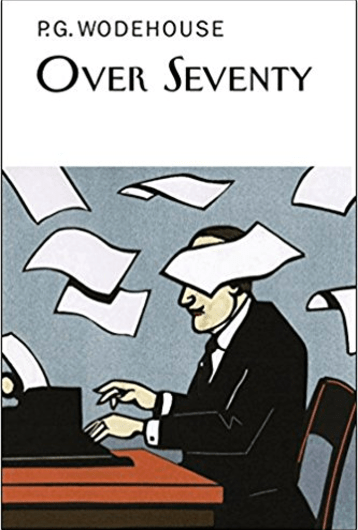
When I read his autobiography ‘Over Seventy’ a few years ago, I could see that the septuagenarian viewed his own life pretty much the same way he came across in his writing: Sunny and delightful. In his own words, he simply lacked the life required for a gripping autobiography because one needs some level of suffering to bung into the thing. “My father was plain as rice pudding and everyone in school understood me perfectly.” he wrote.

Screen Shot 2017-06-12 at 2.28.35 PM

So, it must have been particularly jarring to the man when he was treated as badly in his own country.

P.G.Wodehouse had his head in books and led a sheltered life. Whether it was Blandings Castle, or Jeeves rescuing his young master, his thoughts were almost always occupied with love and the stirrings of the idiotic. P.G.Wodehouse, known as ‘Plum’ to his friends, had a villa in Le Touquet, France where he and his wife Ethel often stayed. Plum and his wife were unfortunately there, when German troops stormed France, and he was taken prisoner at the beginning of the Second World War.

The Germans released him after 42 weeks, when he was nearing 60 as they seldom kept foreign internees beyond the age of 60. Through an old Hollywood friend of his, they sought to use him to make humorous broadcasts about his internment, and he naively did so. His was a trusting nature completely devoid of malice of any kind, and incapable of seeing political propaganda. Though he suffered immensely during his internment – he lost around 60 pounds, and ‘looked like something the carrion crow had brought in’, he did not quite realize the extent of evil and genocide that was happening inside War-time Germany. He simply intended to let his readers know that he was alive and well.

That back-fired, however, and the author went from beloved to detested in his native United Kingdom. People were looking for a scape-goat and he fitted the bill perfectly. He sadly became his own Bertie Wooster with no Jeeves to help.

Sometime after the Second World War ended, P.G.W was goaded by a journalist asking him whether he hated the Germans for what they put him through. To which the author supposedly replied, elegantly smoking his pipe, ‘I do not hate in the plural’.

A truly astounding statement. It was this statement of ‘not hating in the plural‘ that I sought out to find when I read the books below, but I could find no reference to the actual statement.


What I found instead was a man who was not only the world’s funniest author, but also the most hard-working, shy, kind and gentle person, who so magnanimously shared the gift of his sunny mind with the world.

I read all five of his broadcasts in entirety and to my equally naive mind, there is nothing in there that can be seen as treason. It shows how war, and malice can take any inane thing and wring it out of shape and proportion. What is real and what is fake when power is involved?

The piece written by George Orwell defending P.G.W’s innocence is well worth reading:
Quote :
The article and the broadcasts dealt mainly with Wodehouse’s experiences in internment, but they did include a very few comments on the war. The following are fair samples:
“I never was interested in politics. I’m quite unable to work up any kind of belligerent feeling. Just as I’m about to feel belligerent about some country I meet a decent sort of chap. We go out together and lose any fighting thoughts or feelings.”

P.G.Wodehouse was finally knighted by the British Government in January 1975. He died the following month on 14th February 1975, aged 93.

I am immensely grateful to the dear author, even if that means the Prims & Propers of the world lift their eyebrows and look away uncomfortably when I laugh. I cannot say it better than Stephen Fry does on the personal influence of P.G.Wodehouse:
He taught me something about good nature. It is enough to be benign, to be gentle, to be funny, to be kind.