
Ostrich Philosophy: News to Peace

“I would like to be an ostrich, and just bury my head somewhere deep in the sand! “, I said reacting to another piece of breaking news. 

“What happened now?” said the husband. 

I mumbled and rambled, “Nothing new. Just expected but also so outrageous! Makes my blood boil. But like most of the folks at this point, I just feel resigned. Like I said want to be an ostrich – preferably in its natural habitat – halfway across the world from here!”

The husband laughed, and said, “Change of topic! What are you reading now?” 

Ah…he was going for safe bets, but no sir! This time, I was ready with a book that plunged right on. I was re-reading Persepolis – By Marjane Satrapi. It was our bookclub pick, and I realized why it remains one of my favorite books of all time. Marjane Satrapi’s sense of story-telling has a childlike sense of wonder. It is a coming-of-age story after all. But it is set against the backdrop of the increasingly regressive Islamic Revolution, the Iran-Iraq war, and the numerous humanitarian excesses that go with these situations.  Marjane Satrapi’s sense of humor, even in the telling of the most horrific scenes of 1970’s Iran is what makes the book a marvel.

I held the book up, and opened up to read : as luck would have it, my eyes landed on the announcement by the authorities that they would be shutting down Universities and higher learning was banned. 

FromthebookPersepolis:ByMarjaneSatrapi
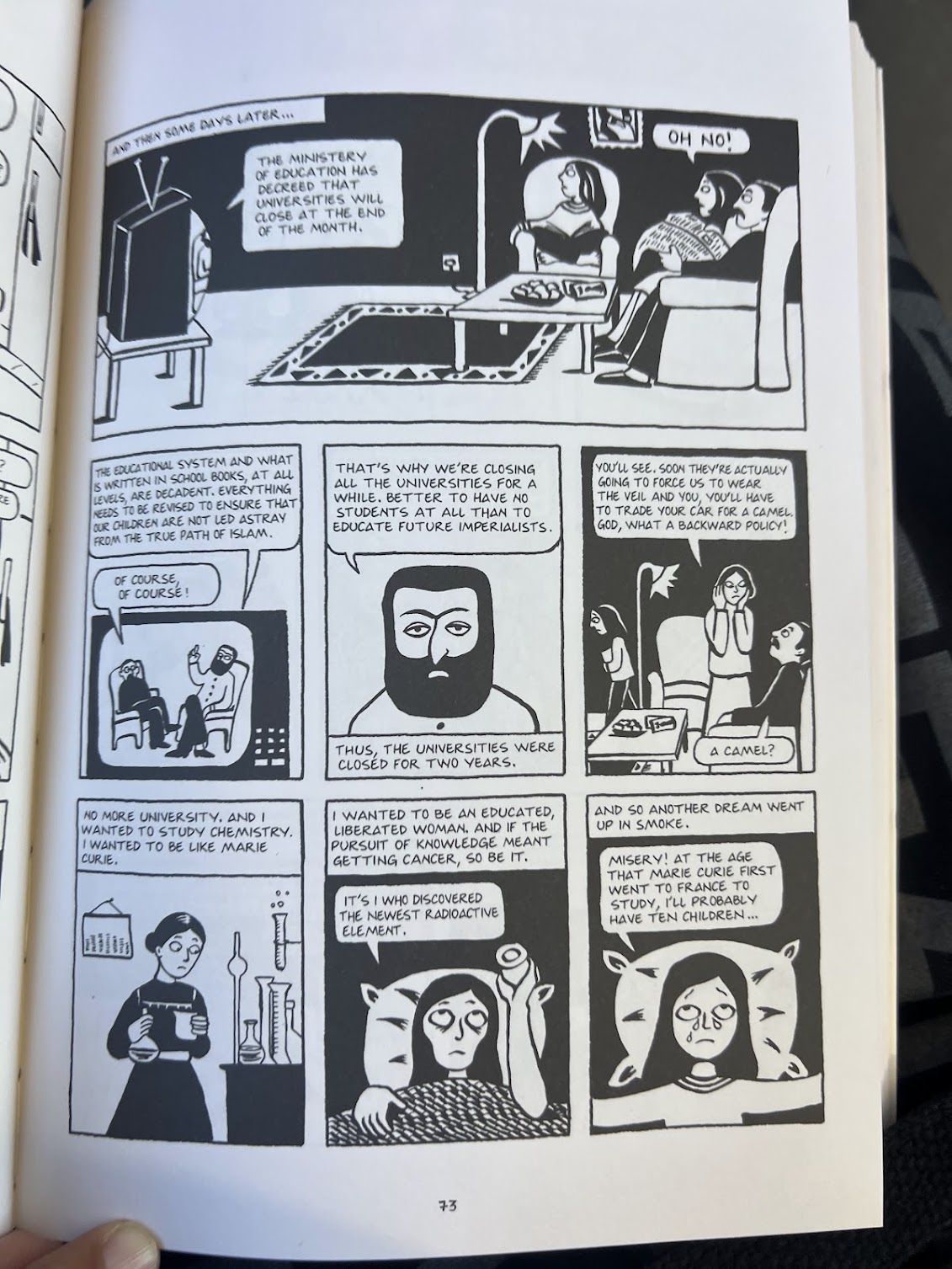
The next day’s breaking news made me want to be an ostrich again. The Education Department’s funding was being revoked. “Did he read the book and decide what to do next?” I said, clanging the dishes with extra vigor while unloading the dishwasher. 

“Really! There must be some sort of book of ideas – some template to go by, no?” I said. I admit I was flummoxed by the uncanny Tyranny 101. On Tyranny – By Timothy Snyder’s book also got it right. 

Why isn’t there an equivalent for Peace 101? I suppose all the hard things in life have to be worked for and attained in the hard way, but for everything else there are rulebooks.

On Tyranny: Power and Compliance

On Tyranny

This book is a required reading for what’s coming.

on_tyranny

The book restricts itself to Twenty Lessons from the Twentieth Century, which is even better. For power hungry dictators have been there throughout human history, and the book may well turn out to be a treatise of its own, if not time-capped. Recent events are usefully analyzed from a technological and sociological view. After all, many of the fascists of the past century found themselves propped up through a democratic process, even if they refused to give up power democratically later on. 

One of the first topics in the book, On Tyranny – By Timothy Snyder Illustrated by Nora Krug caught my attention.

It talks about compliance without being asked to. 

“Do not obey in advance”

“A citizen who adapts in this way  is teaching power what it can do.”

  • On Tyranny – By Timothy Snyder

I found myself nodding along several times during the examples given from the Hitler regime, or sociological experiments conducted since, and was quite shocked to see it all play out again in recent times. 

For instance, the past week itself gave us examples of ‘Do not obey in advance’. It was in the flurry of news items about Meta – the mega social network bending over and showing what it is capable of doing for Donald Trump’s regime. The company removed the fact checking team, and essentially stopped DEI efforts.

Quote from article on removing the fact-checking intiative:

“Everyone is entitled to his own opinion, but not his own facts,” the late New York Sen. Daniel Patrick Moynihan memorably wrote four decades ago.

As far as DEI efforts go, to get to a point where a DEI team was necessary took many decades of work, mindset changes and progressive ideas. To remove it all in one stroke sets us back by at least two decades, does it not?

Now slowly think of all the programs and places in which progress has been painstakingly achieved through education, forward thinking initiatives etc, and the mind boggles on what lies ahead of us.

In the past few weeks, there were several discussions in which we wondered:

  • How do we know when a leader is likely to become a fascist ruler?
  • How do we know whether our systems designed to survive democracy will do so?
  • Which of the very institutions that help towards justice will be disbanded or at least thwarted in their efforts to do so?
  • And many more. 

The questions will answer themselves soon, shall they not?