Frog & Toad’s Wisdom

Dinner was done, the kitchen was clean enough, and the children were smelling delightful after a hot bath (They looked and smelled like mops after playing all evening just an hour ago). The kindergartner and I had read a children’s book. After a few minutes, I thought I heard the rhythmic breathing that meant he fell asleep and, I started fiddling about with the phone. I had started with the intention of checking my email, and had gone all over the place, finally grazing my Facebook feed.

Every now and then, an article pops up in my feed exhorting me to rise to greater heights and tell me in 10 easy ways how to become a Better Person. Over the past decade, the nature of these articles has changed. At first, it said great things like Manage Priorities in your list and how best to Stick to Plan and all that.

Now, things have been taken down a couple of notches. We will get you effective to the point of Making Lists. Then, you are on your own. Go back to your phone if you like. If you want to stick to the lists, you must already be efficient enough, the articles say and throw up their hands.

This one told me how to Be Productive in the age of notifications.

‘It has been a long time since we read Frog & Toad’, said a sleepy child’s voice by my side. I looked up and the pair of us started laughing.
‘You didn’t sleep yet!’
‘No!’ he chuckled.
I gladly set aside my phone – pesky little thing telling me how to be Effective and Efficient. Like I wanted that. Pssk Tssk and Zsssk.

’Let’s read it then!’, I said. ‘Yeah!’, he said, and we settled down together. I love those books. I am drawn to the simple problems, the bonds of friendship that endures between them and the humor in them.

frog_toad

Frog & Toad Eat Cookies

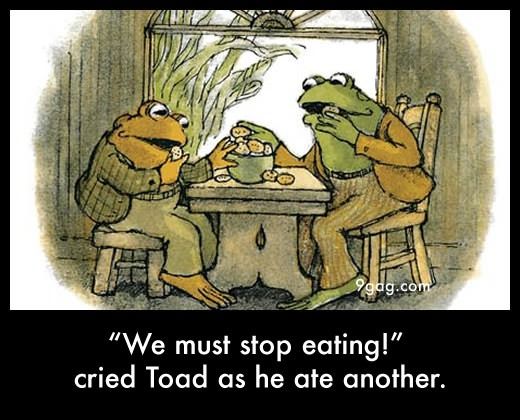
Frog & Toad sat at the tables eating cookies out of a jar. Frog had made the cookies and the friends could not stop eating them.

Hmmm….the brain said, and I glanced at the phone buzzing and blinking with a notification.
frog_toad1.jpg

Frog and Toad ate many cookies, one after another. “You know, Toad,” said Frog, with his mouth full, “I think we should stop eating. We will soon be sick.”

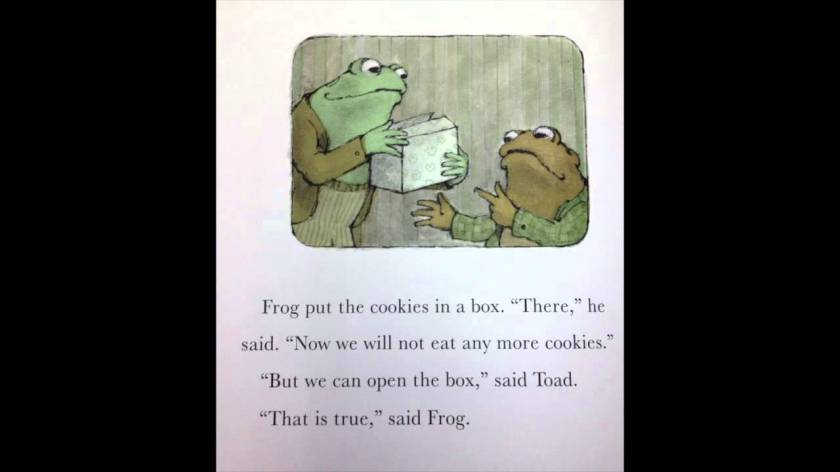
The friends try closing the jar each time after taking a cookie.
But they find they can open the jar every time.
frog_toad2

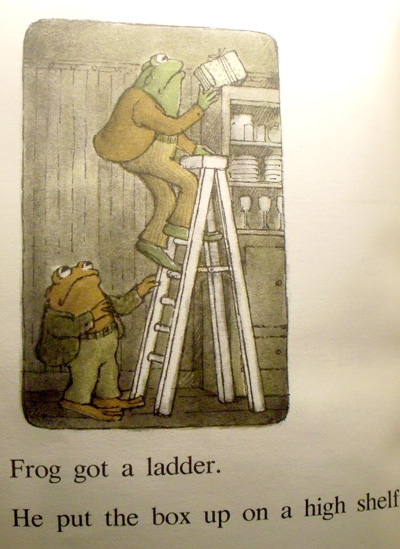
They then try closing the jar, and putting it on a high shelf where you have to mount a ladder.
They find that they can climb a ladder, open the jar, and eat the cookies.
FrogAndToad-ladder

My mind could not help drawing parallels to the article I had just been reading. The article told me that the way to stop the habit of grazing your favorite apps was to move the oft-used icons to a different, hard to find area in the phone. I had done that, but found myself, swiping a few screens, opening a folder with the apps, and going after them anyway.

I was Frog getting on a ladder and opening the jar of cookies.

Frog & Toad now figure they are going to get a stomach ache soon, and are desperate to stop eating the cookies. So, they decide that as long as they know the cookies are there, they cannot stop. The best path forward would be to share the cookies with the birds and the cookies are done, they agree, and take the cookie tin out into the Spring evening to share with the birds.

Like the wise friends above, it might be a better thing to do, to just ‘share the cookies with the birds’ and be done with it. I pushed the phone away from me resolutely, and we took to discussing cookies. ‘Yummy- I love cookies. Let’s bake them one day.’, said the little fellow. I agreed, and content with that promise, he settled down and fell asleep almost instantaneously.

I lay musing. It is a good reminder for us to read how our brains respond to the demands of technology (we know the effects of Dopamine, we know how companies gain by making us spend more time, but yet…)

Tristan Harris is a Design Ethicist who has taken it upon himself to make us aware of the challenges we face:

Quote from article

“Never before in history have a handful of technology designers working at three tech companies … influenced how a billion people spend their attention.”

https://ww2.kqed.org/futureofyou/2017/05/25/tristan-harris-brain-hacking/

Well….

Not all wisdom is new, nor is all folly out of date. – Bertrand Russell

 

From Dostoevsky to Dr Seuss

uOne evening, I arrived a tad grumpier than I’d like on a spring evening. That day on the train, there was some commotion ahead of me, and I heard a person rudely shout and say, ‘What are you all doing here? Go back.’ His pugnacious intent scared people. He stared at me and shouted. I was unnerved, Then he looked at another one and shouted at her too. In the peak hour rush, he lay there sprawled across two seats and shouted down at everybody. Another one of those people who was spewing hatred post-election. It was a sad sight, and my senses were more alert than usual.

Hate is a virulent organism that thrives on people’s inclination to adopt it. In fact, if you do not put up an active resistance towards it, it will consume you.

A few weeks ago I read, Dr Seuss and Mr Geisel, the biography of the beloved author, Theodore Seuss Geisel or more famously Dr Seuss.

IMG_5232

In the early chapters, one realizes how bigotry and hatred are vicious poisons that can affect people more deeply than we realize. Ted was a school going child in Springtown, Massachusetts, when the first world war started. The Geisel’s were first generation German Americans and though they were citizens at the time of war, it turns out the world around them did not treat them kindly. It is disheartening to read that young Ted Geisel was persecuted for his lineage. He never really got over the nickname he was given as a child, The Hun.

Outings grew rare as Germany became the common enemy and nativist prejudices arose; German Americans sought whatever anonymity they could. Ted and his sister, Marnie, grew even closer, sharing advice on how to cope with taunts on playgrounds and sidewalks.

This boy went on to write books that are loved and adored by children of all races, religions, nationalities and backgrounds. His books only asked for an open mind whether it was imagining an elephant gingerly climbing up a tree to hatch an egg, or a rajah taking a walk down Mulberry Street.

To think that a century later, we are still labeling entire swaths of humanity with these broad labels is deeply concerning. To parrot a divisive slogan is easy, but true growth comes when we question what is being parroted to us.

Our narratives matter, for they become history, and history then forms the basis of our myths. In this beautiful essay by Fyodor Dostoevsky (Dostoyevsky on Good Fellows – Brain Pickings), he says :
It is our responsibility as human beings, to peer past the surface insecurities that drive people to lash out and look for the deeper longings, holding up a mirror to one another’s highest ideals rather than pointing the self-righteous finger at each other’s lowest faults.

Why was that poor man shouting at people on the train? And how can we resist succumbing to this fate?

Dostoevsky:

Judge [the people] not by those villainies which they frequently perpetrate, but by those great and holy things for which they long amidst the very villainy.

Coming up next: We cannot and must not hate in the plural. A lesson taught by one of my favorite authors, P.G.Wodehouse.

P.S: Also listen to this commentary on German-Americans on the centenary of American entering the First World War: http://www.npr.org/templates/transcript/transcript.php?storyId=523044253

Drones on Kaapi Conspiracy?

The news, is and has been somewhat of a Debbie-Downer and I have kept clear of it. We have instead been listening to heartening material such as Horton Hatches The Egg. This morning, I switched to NPR, and as usual, the news was ready with a bucket of cold water to pour on my head.

The correspondent droned on about how companies in the USA are rethinking employees’ travel plans given that people are made to give up their phones, laptops and even social media usernames and passwords. This was an idea that was floating around in late January:

http://www.nydailynews.com/news/national/white-house-foreign-visitors-social-media-accounts-article-1.2958851

This idea of asking for social media profiles is abhorrent to me, given that we are further enabling algorithms to slice and dice the populace based on one’s likes and dislikes. But I burst out laughing while listening to it, and probably had folks wonder why.

Lexicon: Maama: Uncle; Maami: Aunty; Kaapi: Coffee

Let us assume Kittu Maama is planning to visit his daughter in the Golden Land of the USA to celebrate his 70th birthday with his grandchildren. Kittu Maama has been flagged as having strong opinions on Sasikala, Filter Coffee pronounced Kaapi and Dasavatharam (still baffled whether his views are on the movie or mythology).

In any case, they being the Esteemed and Respected Parents of Silicon Valley Engineers of Indian origin, the administration rubs their hands in glee to data science the heck out of this one.

That’s when the Mannar & Mannar Coffee Conspiracy comes to light.

Kittu Maama and Maami’s social media posts are intriguing.

Day 1: Shared: Good morning – filter coffee is good.

Day 2: Shared: Good morning – filter coffee is the best.

Day 3: Shared: Good morning – filter coffee.

Day 4: Shared: Good morning – filter coffee is very good.

Filter_coffee_South_Indian_style

Riveting as these posts were, investigators are unable to fathom the train of thought here.

(a) The posts are being shared from someone’s feed, and this person does not seem to rank high on Kittu Maama’s or his wife’s list of adored folks. Baffling. Why would they go and share it everyday?

(b) The original photograph on closer examination (after using sufficient zooming techniques), had inscriptions on the coffee cup that translated to, ‘This cup was stolen from Muruga Vilas.

Could Kittu Maama be tipping off gangs on stolen silverware?

A few days later, Kittu Maama’s daughter calls from the USA, and asks how they are doing. “What is with your coffee posts everyday?, “ she asks.

The investigators on the nose of this Mannar & Mannar Coffee conspiracy case pick up the dials on the board: Phone calls being made and substance being discussed. Tap and apply algorithm. Quick.

“You only said that we should share if we like something? I don’t know why he puts coffee out everyday, I know Ambujam Maami does not make filter kaapi like that.”, said Mrs Kittu Maama alias Kittu Maami.

To which Kittu Maama chimed in, “Yes, in fact when I go there, I hastily say no to coffee. I stop at Saravana Bhavan on the way back and have good filter coffee there before heading back. “

The FBI is stumped. There must be something here. Could there really be no conspiracy here? Just daughter-discussing-ditchwater-kaapi? But everyday on Facebook, and on International Phone Calls?

A dial spins in the other room. WhatsApp shared: Helpfully labelled ‘Coffee joke’

Is it worth putting a drone on them?

Not just yet.

Note: While the scenario above was light-hearted and frivolous, it is useful for us to know exactly how our social media profiles have been used, and can be used in the future.

Excerpt from Nextdraft (http://nextdraft.com/archives/n20161123/turkey-shoot/)

Cambridge Analytica worked on the Trump campaign. They also worked for those in favor or Brexit. Now they’re in talks to score a couple new big contracts.

https://en.wikipedia.org/wiki/Cambridge_Analytica

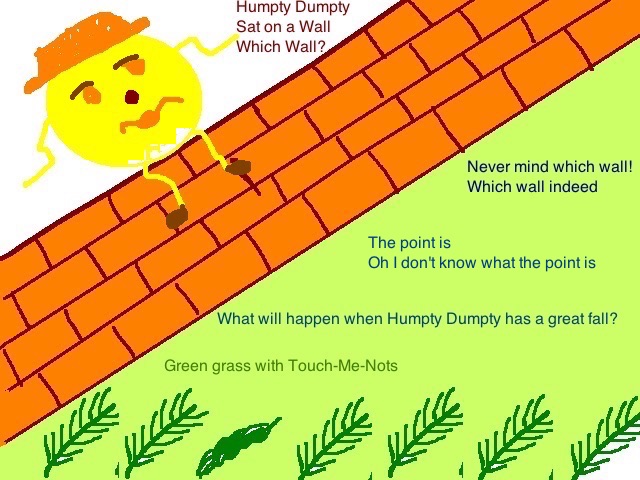
If Mimosa Pudica Met Humpty Dumpty

The children ask me interesting stories about my childhood every now and then. They seem to think I lived in a fairy tale and maybe I did. I find my reminiscences are often seen through the endearing lens of time ignoring the trials and strife of living in a wet, rainy, cold place. My stories often feature panthers, wild boars, and tigers. Occasionally, just to spice things up, I tell them about the different berries, clovers and exotic plants that were native to the Nilgiri Hills and they marvel at the wonders in this world and how on earth I am alive and kicking today when I seem to have used such loose food control mechanisms as picking berries to plop into my mouth. Today, when I attempt to pluck a wild berry and put it in my mouth, I am met with aghast looks and stopped with pleas appealing to my remaining sanity.

I remember being enamored over touch-me-nots too. Have you played with touch-me-not plants? If not, I suggest taking the term and tucking it firmly in the back of your brain and keep looking out for the curious species. The scientific name is Mimosa Pudica.

https://en.wikipedia.org/wiki/Mimosa_pudica

The fascinating little plants react to external threats by closing up their leaves as if in tune to a rhythmic heartbeat. There is something deeply soothing about watching them close their leaves to one’s touch and then open them again. To the immense delight of the children, we found clusters of touch-me-nots on our last trip to the Nilgiris and they spent an entire morning playing with them.

In the Hidden Life of Trees, Peter Wohlleben cites a piece of research showing that plants learn and indeed have memories. What the researchers did was take the shy mimosa plant into the laboratory. The mimosa plant closes itself up on external stimuli. So, to see whether the plant can learn, researchers set up the plant under a steady trickle of water.

Quote:

Dr Monica Gagliano designed an experiment where individual drops of water fell on the plants’ foliage at regular intervals. At first, the anxious leaves closed immediately but after a while, the little plants learned there was no danger of damage from the water droplets. After that, the leaves remained open despite the drops. Even more surprising was the fact that the mimosas could remember and apply their lesson weeks later.

Screen Shot 2017-03-14 at 8.59.19 AM

It is a good lesson for us to learn in these times of constant interruptions, distractions, news and fake news. These are steady drips and we the mimosas can learn and adapt.

Like the mimosa plant, it may be a worthwhile skill to find methods to rise and react when required rather than when Mr Donald Trump wants to divert attention onto something other than what he wants us looking at.

http://nextdraft.com/archives/n20170320/tweet-grinder/

The last time President Trump faced an uncomfortable moment, he tweeted the Obama-phone-hack claim, and all the kings horses and all kings men went chasing after the latest tweet leaving the egg he wanted to crash to do so unattended.

mimosa_humpty

If Mimosa plants met Humpty Dumpty regularly, what would they do? It is a great philosophical question to ask oneself.

Oh Snap!

I attended a conference last week, a vast sprawling area brimming with people having an analytical bent of mind, or at least that is what they do for a living.

It was wonderful, for many reasons: It not only provided a good change of pace for me, but it also helped me cope with the post election disbelief by observing vast numbers of people from different parts of the country.

Before one of our trainings, our instructor put up a hashtag on the screen and requested everybody to tweet with that hash tag, so we could analyze the data coming in for that hashtag for the exercise.

For our convenience, he was also streaming the tweets as his code picked them up. For a hall containing at least 200 people, the tweets were trickling in. 5 and then 10 and then a plateau. After some time, another few.

The instructor then showed us how he was going to analyze this data and when he tried to pull up the dashboard he had created for the purpose of the training, the server went down. As it turns out, the instructor was embarrassed, obviously, that his carefully prepared presentation ran into a glitch in this uncharacteristic manner, but he had a Plan B, and going by the way he conducted his training, probably had Plan C, and D. Competence and Determination. He took a derogatory stab at himself, got a laugh, and moved on. He chose instead to recreate the dashboard from scratch, so we all get to see how it is done, instead of showing us the finished product.

The person right next to me, pulled out his phone though, and tweeted the hashtag almost instantly saying “#Hashtag Demo not working. Not Cool.” I was sitting right next to him , so I could see his tweet. I also remembered that he had not tweeted when the instructor asked us all to tweet so that he could get a dataset, but when it came to calling someone’s failures out, he was more than willing to do so.

That is human nature. We all suffer from it. So, I am not blaming this person by any chance, but rather hoping to use this as a call to introspection. Are we so quick to judge that we are losing our ability to empathize just because we now have the power to quickly voice our opinions? That could have been us fumbling when the server went down unexpectedly, couldn’t it?

I was reading an article in which President Obama warned us in a similar manner about snap judgments that social media enables us to make:

Obama, without directly naming Trump, appeared critical of the political discourse in the United States, saying social media has made it easier “to make negative attacks and simplistic slogans than it is to communicate complex policies.”

Obama-Merkel issue joint rebuttal to the coming era of Donald Trump

Every tool has its place, but if we attempt to mow the lawn with a kitchen knife, it will not work. I cannot help thinking of our gardeners, who in my mind have magical abilities, get things done quickly and efficiently, while I blubber and fly rudderless because I do not use the right tools for the job. (Divine Intervention of the Gardening Gods)

mow_the_lawn

Now is the time for all of us to tap the critical thinkers in us, to read extensively, to seek the truth and take up the job of providing a voice of reason. All of us know how distorted our consumption of information can be. Sites like Snopes.com have their work cut out for them in the age of social media.

Snopes.com Check Facts!

P.S: I loved Angela Merkel’s measured response to Trump’s victory:

Angela Merkel in her note to Trump offered cooperation reiterating that cooperation should be based on “a common platform of democracy, freedom, advocacy for human rights all over the world and championing the open and liberal world order.”

After all, we all may have to pack up and go to different planet soon (in which case we are all in the same boat regardless of race, creed or gender.)
Stephen Hawking’s prediction that humans have at best 1000 years in which to find another planet to inhibit

The Sun Shall Rise Again

I wish I could have captured the toddler son’s reaction to the election results. He burst out crying and sobbed that he did not want President Obama to go. “He has been the President my whole life!” he sobbed. That is true. The little fellow has since picked up a book on Barack Obama from the library and has had it read to him every night.

“Amma – stop over-reacting. Why are you so sad? It is fine.”, said the daughter, seeing me mope around with drooping shoulders. I was reading a Children’s book called ‘Night World’ by Mordicai Geistein, and my mood matched the illustrations in the book.

I am not able to shrug it off in my usual manner, because this time it feels personal.

What I am about to tell you happened all of 20 years ago. I was selected to become the first female General Secretary of the Department in my college in my final year. It was not exactly an earth shattering position, but enough to cause a stir in the conservative community.

I took my responsibilities seriously and went out of my way to find someone note worthy in the industry to come and give us a talk for kicking off the year. I myself prepared a speech simply dripping with quotations and positivity, exhorting us all to Dream Big, Achieve High, Reach For Stars and so on. Einstein jostled with Jawaharlal Nehru, Ramanujan and C V Raman.

Some stalwart friends (both boys and girls) helped me with the various tasks associated with this event. A large auditorium was booked, flowers procured for chief guests and professors, some of the folks with the best singing voices were to ring in the August Assembly and wrap up with a hearty chorus of the National Anthem. It seemed to me that it was going to be a function fit enough to ring in a new year of hard work, and success.

What I neglected to do was order sufficient food for the gathering, and here I accept full responsibility. The truth is that I had simply under-estimated teenage appetites. I assumed everyone will be content with half a biscuit and a whiff of tea. But that apart, time and venue were printed out and sufficiently publicized in the college, professors reminded their students in the classes and smiled at me when they told me that they had told their respective classes to attend, and how they themselves will be there with their bells and whistles on. The Principal himself came out for the event. All very noteworthy.

I must say everything went well except for one glitch: Not a single boy turned up for the event. Minutes before the Chief Guest was to arrive, a boy in the first year came and told me that he had been told to inform me that all boys were boycotting the event because they were biffed that the ‘prestigious’ position of General Secretary of the Association had gone to me, a girl.

My crest fallen face evoked sympathy from the poor fellow and he left looking miserable and determined. That boy went on to become a friend in time, but then I could not bear his looks of sympathy. Tears stung my eyes. I turned away from him. I told myself that I must brace myself and got on stage. Great leaders instead of romping on stage with their inspirational quotes simply waddled up there like dispirited ducks on sewage water.

When the Chief Guest was speech-ing away about Networks and Protocols, a few of the more decent fellows made an appearance and lurked at the back entrance so it would look like they came but also would not look like they had overtly supported me. Obviously, that boy must have told the other boys how crushed I looked.

Twenty years on, the humiliation still rankles. What I wanted to do most was to take off the next day, week or month, and possibly burrow myself in a hole. But of course, I knew I had to face this problem head on. So, I made my way to college the next day determined to find out what the problem was. Had I done something to upset all the boys? Were all the boys upset with all the girls? Or just me?

The previous year, I had been the first Associate Secretary, and that time there did not seem to be dissent of any kind. So, this was truly baffling. Had I done something wrong? When I holed some fellows in my class, who were decent enough to look abashed the next day for staying away, and then making a half hearted appearance, they told me, that the Boys did not really mind me being the Associate Secretary because that involves a lot of work, and not much recognition. But the General Secretary was quite something else, I was told. There was recognition here, and that was what they could not bear. They felt recognition should not go to a girl.

Who could not bear? I asked. But all I got out of them was that ‘They’ felt that way.

I pushed on. Can you not bear?

‘No no’, – they quickly assured me. ‘We like you, but we were told by Them not to go. You understand? ‘

I told them I didn’t.

Twenty years later, America has done the same thing to Hillary Clinton, and I still do not understand it. The pain is raw. The wound still stings. I am sure there are plenty of women out there who have things in their past that hurts the same way, and for those people I offer solidarity.

I sighed a bit and continued reading. I turned the book over to the last page, and like President Obama said, The Sun Did Rise Again. In the book at least.

IMG_3697.JPG

If

We had been to the East coast to gulp in the beauty of the fall colors before the trees were stripped bare for the Winter. I marveled at the beautiful tapestry that nature had laid out for us. The greens, golds, yellows, rusts, oranges, reds and browns blended together beautifully to please the eye. The same patch of forest looked beautiful in the different lights of day. The color of the skies above, the intensity of the sunlight, the shadows of the scudding clouds above, all painted marvelous pictures and nature soothed in a way that it has always done.

A forest is beautiful to look at. A forest in fall colors is brilliant to look at. The diversity in colors is mind boggling, and it all pieces together beautifully in a marvelous tapestry. It is the differences in color that make it glorious.

An artist’s palette is made more vibrant with different shades.

As much as we all like everyone to be like us, it is the fact that we are different that makes the world a beautiful place. It is the disappointments that should propel us forward.

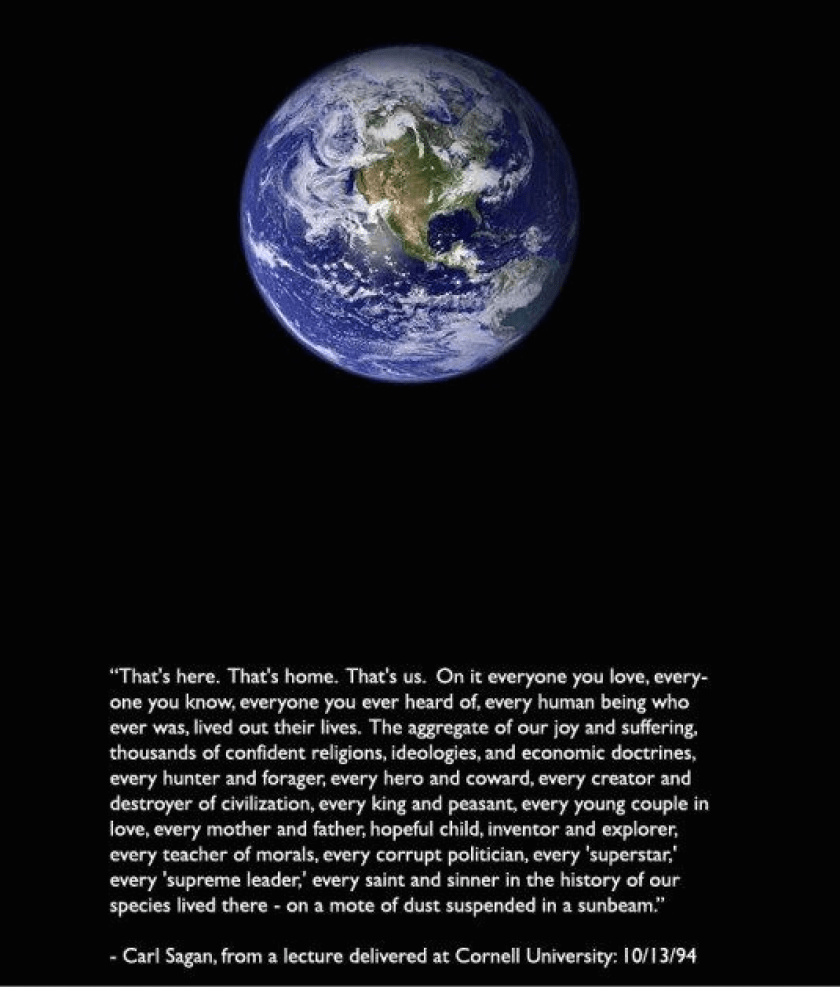
I am distraught at the person America has chosen as its President elect. I am trying to find solace in the words of Carl Sagan on Earth:

Look again at that dot. That’s here. That’s home. That’s us. On it everyone you love, everyone you know, everyone you ever heard of, every human being who ever was, lived out their lives. The aggregate of our joy and suffering, thousands of confident religions, ideologies, and economic doctrines, every hunter and forager, every hero and coward, every creator and destroyer of civilization, every king and peasant, every young couple in love, every mother and father, hopeful child, inventor and explorer, every teacher of morals, every corrupt politician, every “superstar,” every “supreme leader,” every saint and sinner in the history of our species lived there-on a mote of dust suspended in a sunbeam.

screen-shot-2016-11-14-at-1-56-32-pm

Now, more than ever before, is the time for all of us to come together and become heroes in our own ways. I felt this was the right time to read Rudyard Kipling’s poem ‘If’ to the children.

If you can keep your head when all about you   
    Are losing theirs and blaming it on you,   
If you can trust yourself when all men doubt you,
    But make allowance for their doubting too;   
If you can wait and not be tired by waiting,
    Or being lied about, don’t deal in lies,
Or being hated, don’t give way to hating,
    And yet don’t look too good, nor talk too wise:
If you can dream—and not make dreams your master;   
    If you can think—and not make thoughts your aim;   
If you can meet with Triumph and Disaster
    And treat those two impostors just the same;   
If you can bear to hear the truth you’ve spoken
    Twisted by knaves to make a trap for fools,
Or watch the things you gave your life to, broken,
    And stoop and build ’em up with worn-out tools:
If you can make one heap of all your winnings
    And risk it on one turn of pitch-and-toss,
And lose, and start again at your beginnings
    And never breathe a word about your loss;
If you can force your heart and nerve and sinew
    To serve your turn long after they are gone,   
And so hold on when there is nothing in you
    Except the Will which says to them: ‘Hold on!’
If you can talk with crowds and keep your virtue,   
    Or walk with Kings—nor lose the common touch,
If neither foes nor loving friends can hurt you,
    If all men count with you, but none too much;
If you can fill the unforgiving minute
    With sixty seconds’ worth of distance run,   
Yours is the Earth and everything that’s in it,   
    And—which is more—you’ll be a Man, my son!


When the materialistic society around us automatically glorifies money, we can use the moment to say that money does not equal dignity, money does not beget culture, money may earn you servitude, but not loyalty.

And point to the example in The White House.

More (मोर) on Sherbat Gula

This post was also published on May 30th 2017 in India Currents Magazine.

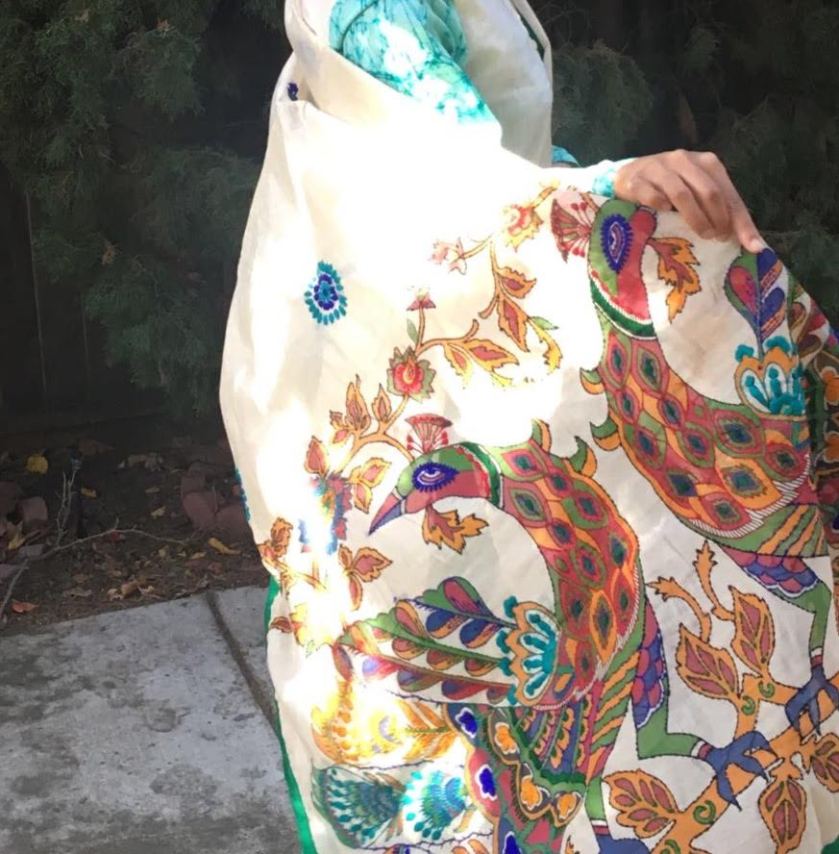
Let’s take it easy and go eat at some place nice for a change, I said one lazy Saturday morning. You know, just spend a relaxed, agenda-less morning. Some place I can wear this to. I was fondly looking at my new dupatta, carefully embroidered with dancing peacocks.

The kerfuffle just to spending a relaxed morning doing nothing I tell you! There was hectic activity everywhere: feverishly looking for things, toddler shoes worn on wrong feet, missing cell phones, cell phones without charge all needing urgent handling in a 10 minute interval.

I ignored the daughter as she took charge while throwing me a disdainful look . The little fellow was bossed around, the big fellow was bossed around, the bosser and bossees felt the charges of love and tension squirt back and forth.

Appa! What are you doing? That’s it!

Time for me to take charge around here, she said. Amma, stop dancing! Why are you wearing this fancy dupatta-thing-y now anyway?

Because I can! Dance! Dance! More! I said in a smart repartee and chuckled. Completely lost on them of course. (For the Hindi challenged ones: ‘More’ (मोर )means Peacock in Hindi)

peacock_dupatta

The husband meekly looked up from his game of chess and sighed yet again.  I heard him murmur something about Men’s Freedom as we headed out.

Pretty soon, we found ourselves in an Afghani restaurant sitting quietly. I turned the menu card over and the back of the menu had a picture of the girl taken by National Geographic magazine and became famously one of the pictures that defined the turmoil of war world over. It was the cover picture of National Geographic magazine in 1985

http://www.nationalgeographic.com/magazine/2002/04/afghan-girl-revealed/

the-afghan-girl-730x410

Sharbat Gula (meaning sweetwater flower girl in Pashtun)

That was enough. The husband and I got a professorial gleam in our eyes and we tripped over ourselves trying to open the daughter’s eyes to the plight of women the world over.

Not everywhere can women boss men around like it happens in our home, said the husband. The daughter and I chuckled.

We had not even started on the political turmoil with the Russian occupation of Afghanistan when the pesky waiter came and took the menu cards away. I tchaa-ed with feeling at this tendency of waiters to hoard the menus. The restaurant is empty – what do they want to do with the menus? I am sure they don’t have to read it!

’You finished ordering and what are you doing reading the mutton and chicken section anyway? You are a vegetarian!’, the daughter said in what she thought was a scorching debate point. She thought I would fumble and drop my eyes in repentance, like a puppy told to snuff it while trying to oil the moth eaten rag doll through the door. But she under-estimated my power of repartee: She was talking to the author of the (why-are-you-dancing-now? Because I can! ) response (scroll up).

I caught her eye and took her on a wild ride through the streets of Kabul selling spices and the perils of grocery shopping in times of turmoil, past the beautiful poppy fields and the orchards of apricot, gasping through the crevices of  the Tora Bora mountains and finished with a comparison of Indian, Pakistani and Afghani cuisines.

I got to admit, I like to traipse through the menu even after I’ve ordered. Especially after I’ve ordered. I enjoy reading all the entrees and getting a feel of the cuisine, the culture, the spices and a dip into life in the normal households in the area. I like to imagine their grocery lists, their dinner tables, their lunch boxes and so much more.

The daughter rolled her eyes. I rolled mine.

By the time the food had arrived, we had sent a prayer for World Peace and a goodwill message to Sherbat Gula and hoped her daughters would have a chance at peace and happiness in a strife ridden world.

I read yesterday that Sherbat Gula is now married with three living daughters and is facing deportation from Pakistan back to Afghanistan:

https://www.hrw.org/news/2016/10/26/national-geographics-afghan-girl-faces-deportation-pakistan

That evening, I casually left a copy of the book : Because I Am a Girl: I can change the world, in her room. A book that tells the story of girls from different parts of the world, and how we as women can and should play a part in changing lives for the better.

screen-shot-2016-10-27-at-10-32-30-am

Subtle as a peacock.

What The Mango Seller Can Teach Us About Voting

This US election season has been a wearying one. I don’t think any other election has been discussed this feverishly and with this much passion for so long by so many people. I have watched as the media fanned people’s guilty pleasures by trumping up Trump – he has given them lots of material and far from ignoring him, the media and the audience have helped boost his megalomania.

Now this is when people look to me like I am going to let drip my own electoral analysis and stump you all with my keen insights and well reasoned theories. The Economist, The Political Strategist, The Clairvoyant you think and look at me with your ears hanging onto my every word. I feel like I am back as a girl in history class in sixth grade again when I could not for the life of me answer why the Mughals had an interest in India, though the teacher held me with an expectant eye. My elder sister had blazed on ahead of me, and consequently many teachers spent their time giving me expectant looks to see if their polite gleam would nudge my hereditary brilliance, but every time I gave them an answer like the blog post below, and had them head to a corner cradling their head in their arms and moaning gently that my poor sister could have been blessed with someone brighter for a sibling.

Anyway, here goes:

The journeys across Tamil Nadu in South India to visit my grandmother in Trichy were affairs filled with anticipation and joy. There were a number of different routes one could take, and a number of different methods in which to travel. Some routes passed through the poorest sections of Tamil Nadu, where female infanticide was rife, education was trying to make its dent, but making no headway etc. Daily life in these belts was and is a struggle.

Frequently, we were on local buses with folks piling in from the local villages and getting off at the nearest town to sell their wares. One journey stands out in my mind in the light of this long drawn election drama between Hillary Clinton and Donald Trump.

The bus stopped at a local stop and several folks clambered on. One was selling fish and the other mangoes. The one selling jasmine was sitting two seats ahead of us and the smell of fresh jasmines was wafting welcomingly with the breeze that a moving bus with open windows entails. The fish and the mangoes would soon be added to this and one wondered what the experience would be like.

My father and I were sitting stretching somewhat luxuriously on a three seater, when the mango-lady eyed us. She had on her broad forehead a large bindi, her ear lobes sagged with the weight of her earrings and her hands were liberally tattooed. She gingerly balanced on her head a large wicker basket of mangoes. She was accompanied by her ten year old grand daughter and the pair of them squeezed themselves, the wicker basket and a bag on a three seater where two of us were already sitting. One she had squashed everyone and everything but the mangoes, she turned and gave us a radiant smile. We smiled back, knowing that mangoes were better than dead fish as neighbors. Life teaches you to look for the silver lining in many ways.

As the bus bumped its ways along the tree lined roads, the mango seller started talking. She was not one to hold back her opinions, a trait that must have stood her well in the realm of mango sales no doubt, but one somewhat constricting on a three seater with 3 adults, 2 children, a bag and a comfortably seated basket of mangoes. She roundly abused the Chief Minister of the day, Jayalalitha, and had several things to say about the policy regarding Farmers Markets, raise in bus fares etc.

mango_seller

My father was listening to her rant on how politicians were out to drown the daily lives of honest hardworking folks like her. He then asked her if she voted. “Of course!” she said.

Would you vote for Jayalalitha? he asked.

She looked shocked. I would not sully my lips with that, she sputtered ominously stewing her betel leaves juice. She then leaned her bulk over us and crushed several co-passengers bones before she spat the betel juice out of the bus window. She settled back in and went on about the various ways in which she thought Jayalalitha was a bad choice for her.

So which symbol will you vote for then? asked the father.

“Why the errata elai (இரட்டை எலை – two leaves) of course!” she said. I gasped. My father then said to her as gently as he could, that by voting erattai elai (the symbol for two leaves), she was in fact voting for Jayalalitha. She looked confused.

I don’t know how much she got of the explanations the father was giving her about symbols, party nominations and such, for as the bus stopped at the town and she heaved herself out, she said doubtfully, “But we have always voted for erattai elai”.

Once the mangoes, fish and jasmine ladies left the bus, we fell to discussing the recent bizarre turn of events. It is the lack of education in these belts that is the problem, said the father sadly. They realize that electing Jayalalitha is bad for them, but they will go on voting for her symbol. Unless education spreads, there is no hope. That ten year old grand daughter of hers stands a chance, if she is sent to school, but look at what she is doing? She is helping her grandmother sell mangoes and listens to her say that erattai elai is the way to go. I wish formal schooling can be extended to everyone, he said and I agreed sadly.

Watching the long drawn election drama between Hillary Clinton and Donald Trump makes me realize that formal schooling may not be the solution after all. I watch people head into rallies saying things like ‘Even if we don’t like Trump very much, we will still vote Republican.’

If we continue to vote based on what we have always done, we are no better than that poor, uneducated, old lady selling mangoes and hoping her lot will improve, are we? In the words of Maria Popova: Allow yourselves the uncomfortable luxury of changing your mind.

https://www.brainpickings.org/2016/10/23/10-years-of-brain-pickings/

P.S: Given that the Tamil Nadu electorate has flip-flopped between electing the rising-sun or the two-leaves many times since that conversation, I am sure a good many mango sellers did change their mind over the course of time.

brain_pickings_change_your_mind

9/11 Fifteen Years Hence

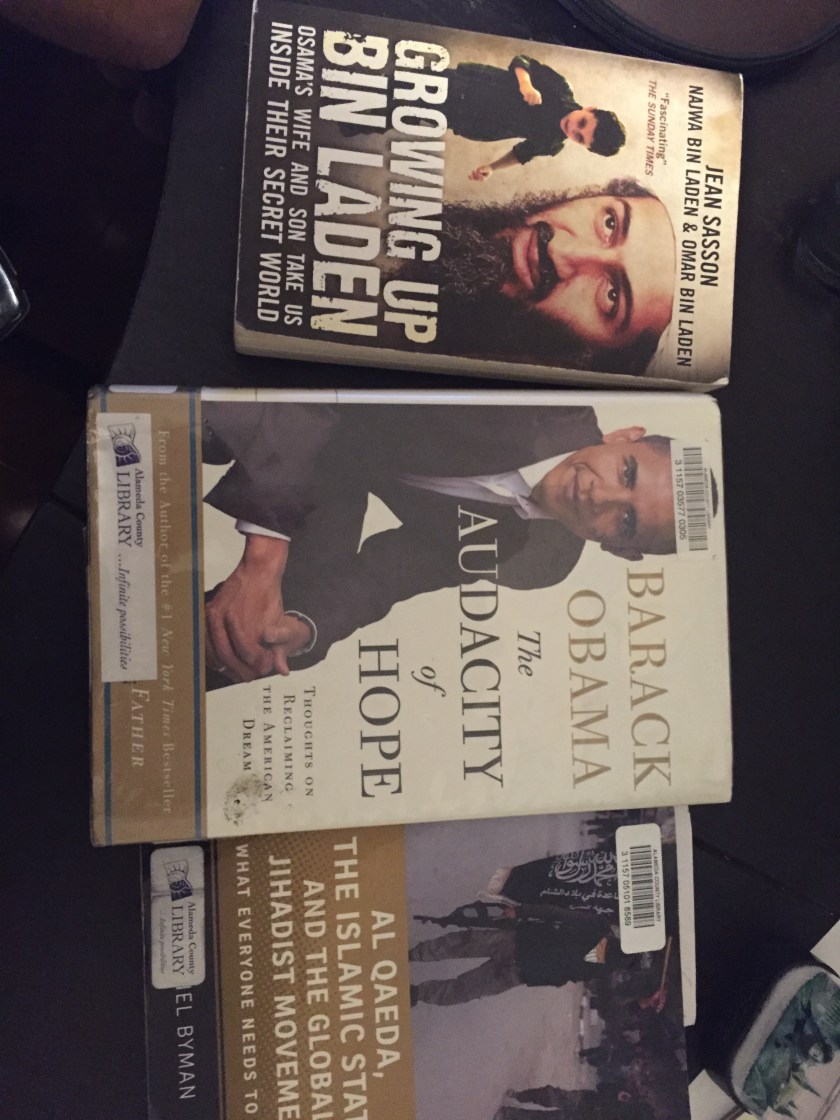
On a recent vacation to the Middle East, I chose from my sister’s pile of books, an intriguing book titled, ‘Growing Up Bin Laden’. It is a book about Osama Bin Laden as told to the author, Jean Sasson, by Osama Bin Laden’s fourth son, Omar Bin Laden, and his first wife, Najwa Bin Laden. From accounts of his first wife and fourth son, Osama seems to have been a kind husband to Najwa, and a strict, tyrant of a father to his children.

I have always felt sympathetic towards children of tyrants. Given that tyrants aren’t particularly loved by their subjects, this opens the children to endless persecution not to mention the harrowing experience of living with the tyrant themselves. If one does not agree with any part of their philosophy, how can a young child carve out an ideology for themselves? When it isn’t easy to fall out with a parent as an adult, it must be phenomenal to do so as a teenager, especially in the Arab world where obedience and respect are weaved into the culture for good or for bad.

The Bin Ladens lived a sheltered, rich, privileged existence with little knowledge of Osama bin Laden’s activities in Saudi Arabia. When they moved to Sudan, it was evident his fortunes were waning. By the time they were in Sudan, Osama Bin Laden was banished from Saudi Arabia, and his anger at the West was already seething. It is interesting to see the genesis of Osama Bin Laden’s hatred towards the West. Ironically, it was Saudi’s reluctance to continue to parade him as a war hero (after his efforts against USSR in Afghanistan), and take US help with the Iraq-Kuwait issue that seemed to have finally caused the rift. It was during the period that the family lived in Sudan that Omar bin Laden as a growing teenager first got whiffs of his father’s nefarious activities. The hectic activity, feverish planning and the subsequent euphoria in his father’s camps after the US embassy bombings in 1998 were his first clues.

As for Najwa Bin Laden, I must say that she sounds like a phenomenal lady. Her calm and un-quavering mind seems to have been the one place of security for the children. Probably the reason that none of them as adults sought to follow their infamous father in his footsteps. Hers is a sheltered and domestic life that few can imagine. A mother to 11 children of Osama, she was also his first cousin and first wife. Osama went on to marry 5 times in his lifetime, one ended in divorce. As the eldest wife, it was Najwa’s lot to maintain harmony: between wives, between her children and between the children of the various wives. She seems to have done so with her characteristic grace and charm. Osama went on to have 23 children, and towards the end of the book the author tries to figure out the fate of each of them. It was thanks to the persistent Omar bin Laden who had broken away from his father at 19, that Najwa left him mere weeks before the 9/11 attacks with her last three. Neither of them had any idea as to what was planned, just that something bad was going to happen.

The book does not condone any act nor do I. The truth is extremism has no rationale. Why do certain buy into extremism? No one knows.

It is a common malady of the West to try to bring everyone to their view of thinking. Often times, it is done with little understanding of the cultural forces in these places and that results in enmity and animosity that is quite baffling to the West. It is why I find it fascinating to read about other cultures. Diversity in reading. The conviction that different people bring to their way of life, the belief that works for them.

img_3444

I am now following up with two books that offer food for thought:

  • Al Qaeda, The Jihadist State and the Islamist State by Daniel Byman &
  • The Audacity of Hope by Barack Obama.

The Audacity of Hope was written by Barack Obama when he was a Senator in 2006. While some of the chapters are pedagogical, one chapter that is worth reading is the one titled ‘The World Beyond Our Borders’.

There are some questions that are worth pondering about through they are not the mainstay of the chapter. Why did US invade Iraq and not North Korea? Why intervene in Bosnia but not in Darfur? What about countries that are liberalizing economically but not politically like China?

Daniel Byman is an academic with a focus on Middle Eastern policies and his book analyzes the organization Al Qaeda to see how the organization profiles its recruits. But it is baffling to the point of no coherence. Students in western universities who feel alienated are just as good candidates as a rich businessman’s son in Europe. How this ideology appeals to people no one knows. How they drift towards extremism, no one knows.

The truth is that our actions are too complex. The ripples of our action interweave too intricately with other ripples to determine one cause and one action. Having the humility to know that we know not what the consequences are is worth cultivating.

The Dalai Lama’s world view in this article could possibly help us.
https://www.brainpickings.org/2015/06/09/pico-iyer-the-open-road-dalai-lama/

Quoted from the article: Book by Pico Iyer on The Dalai Lama and how he erupts so often into his famous giggles:
Seen from the vantage point of one who meditates several hours a day, traveling to the place where everything is connected, much of our fascination with surface or with division seems truly hilarious.