The Lentil Chips Shine Down

The excitement in the bunch of children gathered was palpable. They were united by a sense of wonder and pleasant anticipation. Were they really going to be able to touch the telescope, and see something remarkable? A bar stool had been borrowed from a kindly neighbor and the little telescope was perched on it. An earthworm like line was formed with the children waiting to get a turn at the telescope. It was as wiggly and restless as an earthworm, and just as fascinating to watch from a safe distance.

mars_watching

Mars in the distance shone with the iridescence of a star. Mars has been exceptionally bright in the evening skies, and the Mars viewing party was happening on the week it was closest to the Earth.

Mars has fascinated mankind for centuries. It started with hoaxes of finding extra terrestrial life on Mars: maybe those rigged lines on the planet were canals? said a 19th century astronomer, and from that hypothesis, sprang a vibrant story of alien life. In our enthusiasm to find extra terrestrial neighbors, the populace went along. That kind of hope is refreshing even if misguided. 

https://en.wikipedia.org/wiki/Life_on_Mars

Tonight the telescope we had with us was only as big as a professional camera, and I hoped it would not disappoint the children gathered.

While the telescope was being deftly handled by the husband, I diverted the attention of the children skyward. Their questions about progress were distracting the misguided astronomer who was pointing the lens towards the stile on our neighbor’s roof, and wondering how he could see things fluttering there (I pointed to the sycamore tree nearby that had shed a few of its leaves on the stile, and crushed the poor fish’s soul about finding extra terrestrial life on Mars. Andy Weir might have imagined potato cultivation on Mars, but even by his standards, a sycamore tree was a leap, I told him kindly. He guffawed loudly at this and fiddled on.)

https://en.wikipedia.org/wiki/The_Martian_(Weir_novel)

In the meanwhile, I pointed out the familiar constellations to the hopeful looking children. The budding astronomers were skeptical. 

‘How do you know it is Big Dipper?’ 

‘It could be anything or nothing’, said another, and quickly the pendulum swung from hope to disillusionment. I managed a quick save by not letting it swing too far, and told them about the excellent app, Skyview, using which they could confirm the stars for themselves. The older teenagers who had smartphones for themselves were suddenly beset upon to share the marvels of the night sky. 


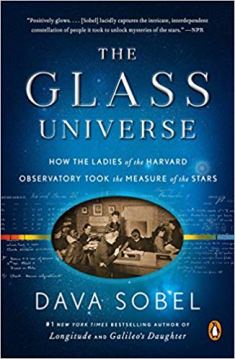
Cecilia Payne would have been proud indeed of the motley group of astronomers gathered in our driveway. It is marvelous to see how the work of early astronomers & physicists set the base for us to be able to map the skies and predict the movements of stars and planets.
glass_universe

The Glass Universe

Book recommendation: The Glass Universe by Dava Sobel

“Oh look!”, said the Big-Dipper-doubter, pointing the phone wildly at the sky, “the moon, the moon!”. 

An experienced hand said he had seen the moon before and there was nothing remarkable about it.

“But it is so beautiful!” said another sounding reproachful at the dismissal of the beautiful moon, and I agreed. The moon has exerted her pull over mankind almost since the beginning of time. Even if we do see it everyday, the moon has a poetic beauty all of its own. That night it was looking achingly beautiful. 

Maybe it was the effect of the scintillating talk I had the privilege of attending earlier that week.

I have never had the opportunity to listen live to a TED Talk. But that week, I had listened to a very TED-esque talk by Jon Carmichael the cosmic photographer. He shared the beautiful story of how he photographed the full lunar eclipse a year ago with the help of a Southwest crew. 

jon_carmichael_speech

Please listen to the talk on the site if you can.

I was telling the children about the talk, when the husband let out an involuntary yelp and said this time he was fairly sure it was Mars. 

One child gazed into the telescope and said, “It looks like a Papad in the sky.”, and we all laughed. (Papad  – is a sort of flat, round lentil chip!)

The cosmos has a way of uniting us in the darkest of times. Even during the most inane days, there is always a cosmic show that is ready to enthrall us and fill our souls with enchantment. It is why I was so happy to be standing among the children gazing up at the stars, and soaking in the wonders of the cosmic show above me that day. Even if the children did see a lentil chip in the sky, I hope for some of them at least the magic seed was sown. A seed nurtured by the hopeful innocence of youth, tempered by the wisdom of years, with the potential to mature into a star of their own.

Lord Float A Duck!

I remember the first time I heard the Duck-with-an-F word in public. I was horrified. It was in a meadow where we had convinced a gullible teacher to take us out on a nature amble instead of listening to the stern and necessary work that goes into maintaining a civic society. The middle school children far from being lambs and observing nature were trying to play a game of Kabbadi instead. Kabbadi for those who don’t know, is a game where one runs saying the word Kabbadi Kabbadi Kabbadi Kabbadi Kabbadi Kabbadi Kabbadi Kabbadi over and over again till you want to shriek in agony.

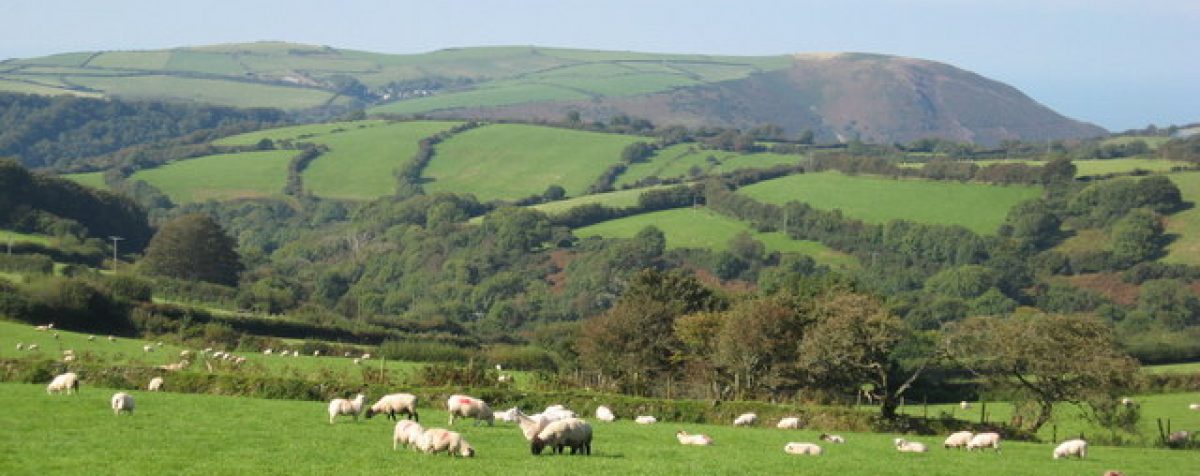
sheep_dog

What horrified me was the fact that far from shouting Kabbadi Kabbadi Kabbadi, the boys were insisting on shouting Mucking-an-F or Duck-with-a-letter-that-comes-after-E and this seemed to incense the whole lot of them unduly.

As they looked around in that male-hen-y fashion, I was appalled that something this crude was expected to draw admiration from the girls. I cannot say the girls admired the swearing nitwits very much. We felt a little sorry for the new teacher who was flailing his arms like a shepherd who had just let a puppy loose in the herd by mistake.

sheep_dog_1

The Fabbading went on and on till another resourceful teacher hovered in sight, saw the plight of the poor new recruit who had completely lost control of his class, and showed the fellow how to regain control. Under this stern shepherd, suddenly the fowls spitting F’s became lambs again, bleated a little pathetically, and quietly headed back to the classroom. But I had altered that day.

Then, I remember reading the first “adult” book, and gasping for air every few minutes. For something strange happened: contrary to the adults I knew, the folks in the book hissed and puffed and cussed all over the place. I was wondering whether being adult meant puffing like a penguin in a desert.

I can’t say things have changed much since then.

Society far from growing out of this trend seems to have taken this to alarming extremes. Presidents freely use S-*-*-* words, and worse the news agencies gleefully repeat them.

I wonder how many of you remember cackling at the Tintin comics by Herge: Tintin comics are great fun. I read a few last week, and found myself giggling like a preschooler being tickled by the carpet on which they are rolling. Captain Haddock was my favorite. When he lost his temper, which he seemed to do on every alternate page, he swore in the most imaginative manner possible. The bumbling-bashibazouk made me smile every time he swore. He made one think. He made one use one’s fumbling brain and every swear was one in which you smiled at the brilliance of it.

IMG_7849

Would he call you a jelly-fish or a marinated eel? One never knew.

Imagine yourself facing off a street punk who looks ready and willing to punch your nose. If you call him a Mucking-Duck with a double F, he has to stop mid punch with his hand drawn back and ask himself, “Whaddideesay?” and it gives you valuable time in which run away like krill fleeing the direction of the whale’s rumble. Fumble, tumble, rough and scramble.

So, here is a plea – make people work out their insults. Give them work. Mucking a Duck is far too easy. Call a fellow who does not like his vegetables a squash-nibbling centipede. Tell a fellow who is proud of his batting that he is a bat-bungling bamboozle. Think nonsense and regain the pleasant sensibilities of being in one’s senses.

As Theodore Geisel, or Dr Seuss says, “I like nonsense, it wakes up the brain cells. Fantasy is a necessary ingredient in living; it’s a way of looking at life through the wrong end of a telescope. Which is what I do, and that enables you to laugh at life’s realities.

How My Mother Saw Her Father

My mother saw her father for the first time last week. She is 73 years old.

Her older siblings are in their eighties and nineties. Yet, their reactions on unexpectedly seeing their father made one think the last seven decades never happened. Will miracles never cease? Geriatric Joy is a lovely thing to behold.

My mother was the last born in a family of seven. When she was 3 years old, her father passed away. A shock that left the family bereft, and sent their mother into a decline from which she never recovered. Kind relatives helped, but there was no denying that the household was headed for turbulent times. Her older brothers, then teenagers, made for the nearby towns in search of work. They were hard-working boys, and slowly, the boys managed to bring the rest of the family to the town. Despite all the hardships and the lack of money and resources, they sent my mother and her sister (still young children) to school.

The girls did not disappoint them. Their intelligence, hard work and perseverance was easily recognized by their schools, and soon, they were encouraged to get a college degree. When all the world around them judged the brothers for spending their hard earned money on educating the girls (That too sisters, not even daughters wagged the tongues in the village), they did it anyway. The sisters became the first graduates from their village and went on to become Physics and Chemistry teachers.

Life’s tempests may have denied my uncles the opportunity to study, but they did not hesitate when it came to educating their little sisters. They, in my mind, are the true heroes of the #HeForShe movement.

“O, brave new world

that has such people in’t!” 

William Shakespeare, The Tempest

I remember reading the children’s book, Are You My Mother, By P.D.Eastman . In the book, an egg hatches when the mother bird is out. The chick goes out into the world searching for its mother. The little chick asks all types of creatures: dogs, cows, and even cars and planes, “Are You My Mother?”. 


I remember thinking that my mother must have felt the same way about her father. She had no recollection of how he looked, and this was something that always wrung my heart given how much I adore my own father. She, however, was stoic and practical about it, just as she is about life. She always considered herself lucky to have been a sibling to such a loving set of brothers and sisters, all of whom dote on her to this day.

Her brothers, our dear maamas, told us that they looked and searched for any photographs of their dear father, the good-looking, duty bound man.  They had combed through the scant wedding albums, peered into old archives since he had worked as a chef in the Kanchipuram Sankaracharya’s Mutt,  but they were disappointed. Though many people had good things to say about him, and even went on to say my mother looked a lot like him, there were no photographs anywhere. He lived on in the memories people had of him, but my mother did not even have any of those to hang on to.

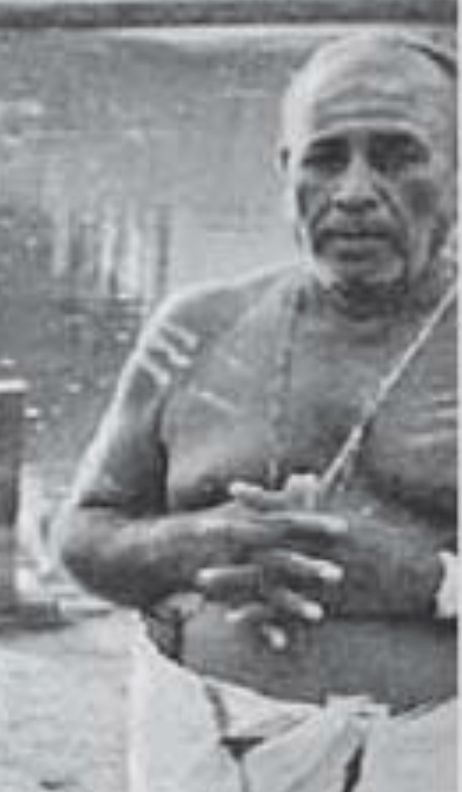
Then, one spring morning in 2018, on a new moon day,  her 90 year old brother sat down with his morning coffee in hand and opened Dinamalar, the Tamil newspaper. That day the newspaper had printed some pictures from the Kanchipuram mutt’s archives. And there he was. In the frame beside Sankaracharya stood their father. Maama recognized him, and immediately hollered to his son, to send the picture to my mother. “She is the only one who has no memory of how he looked.”, he said smiling like a child again.


So, at 73, my mother finally saw her father. R Iyer had 7 children, two of whom have already passed away. The youngest is a septuagenarian. What were the chances of a 90 year old man still retaining the habit of reading the newspaper every morning? Why he had been reading that particular newspaper that day? The fact that he retained the mental acuity to recognize his father who passed away 70 years ago is nothing short of a miracle.

I sat with my mother while she massaged her arthritic knees, and asked her how she felt at seeing her father’s face finally. Her face broke into a slow, wide smile, and she said, “I felt very happy to see him of course! You should have heard anna and akka (elder brother and sister) though. They were so excited and happy to finally show me my father!”

amma_thaatha.jpg

I love the word, Serendipity.  If this isn’t Serendipity, what is? Though a tiny analytical piece of me nudges me about probability and coincidence, I think R Iyer wanted his youngest daughter to have a glimpse of him in her lifetime, and he revealed himself to her.


The Lure of NorEaWesSou

I picked up a light hearted book that outlined how journalism was done 100 years ago: Scoop By Evelyn Waugh. Written in the 1930’s, the book deals with how newspapers made do with telegrams from remote locations to fill newspaper columns: How they decided ahead of time on the stance to take, the line to pitch. Journalism was and is a series of Scoops. Which nugget gets scooped by whom?

Screen Shot 2018-03-08 at 9.20.36 AM.png

The book is based on William Boot, a thoroughly good-natured hedgehog type of fellow, who writes the nature column about life in the English countryside. One week his column writes of the country mouse, and the next week about thriving lobelias. Up in high brow London, he is mistaken for a dashing up-and-coming novelist, also Boot, and asked to go to Ishmaelia, a fictional country in Africa to cover the news. Given no choice, he embarks on the journey, and learns a thing or two about journalism from his journalist pals.

Corker looked at him sadly. “You know, you’ve got a lot to learn about journalism. Look at it this way. News is what a chap who doesn’t care much about anything wants to read, and its only news until he’s read it. After that, its dead. We’re afraid to supply news. If someone else  has sent a story before us, our story isn’t news.”

William Boot is not only ignorant of the scoop business, but distinctly inept at keeping his bosses in the know. His telegrams read like stories; and lack buzz and content. When asked by his head office to send regular updates, Boot replies, that nothing much is going on, and that the weather continues to be fine.

The sort of missive that drives his editor mad. “How am I to fill a column based on the weather being fine?

The dilemma is real. Nobody wants to know when things are going well, and the weather is fine. The populace wants sensational news, and if there isn’t any, they have no qualms about creating some.

Purely by accident, William Boot uncovers a plot to overthrow the powers in the country. When he is composing the telegram with his first real piece of news, he receives the sack from the head office.

Telegram by William Boot:

Nothing much has happened except to the president who has been imprisoned in his own palace by revolutionary junta …. but governess says most unusual lovely spring weather …. bubonic plague raging.

He got so far when he was interrupted. Frau Dressler brought him a cable: your contract terminated stop accept this stipulated months notice and acknowledge stop beast.

William added to this message, Sack received safely thought I might as well send this all the same.

The book is not as engaging and funny as its critics claim, but the premise of the book makes for a charming plot. It is amusing to see how little things have changed since the days of the Telegram: our telegrams arrive almost instantly via tweets, but the essence is the same.

In the current era of news, and fake news, how does one discern truth, and in which cases does one have to bother to do so?

bus_stand

I remember being about a decade old, traveling in South India, when I saw the headlines from a local daily: “Prime Minister resigns”. I gasped, and tugged at my father’s arm, and showed him the headline. Apparently, he had resigned from the milking committee of a farm or some such thing.

That is my earliest recollection of questioning the sanctity of print. Up until then, I read anything printed with a wholesome innocence assuming purity of thought and intent. The father noticed my shocked expression, and we went on discuss the nature of the Scoop, and the thrill of Sensationalism. Television had not yet entered into every home, and one waited every morning for the newspaper to bring us news of the wide world. A whole day in which to ruminate on what one read.

Aristotle apparently wrote, It is the mark of an educated mind to be able to entertain a thought without accepting it. 

Did he really say that? We don’t know.

Sensationalism and Scoop-ism have steadily chipped away at the hallmark of ruminating and discerning narratives having a semblance of truth.

The Green Belt Movement

It was a beautiful day, and the children had been very good on a hike together. We had chuckled our way through the muddy paths still damp with the recent rains, attempted to climb a tree, looked out for robins, thrushes and hawks.  Cows on these hillsides were minding their own business and grazing. Calves of all sizes made a welcome sight. A couple of pups were frolicking on the trail, and made for great hilarity. There is something alluring about the fresh outlook of the young and we enjoyed the hike taking in these heartening glimpses of life thriving around us.  The children, puppies and calves on the trail that day were bursting with the fount of youth.

IMG_7682.jpg

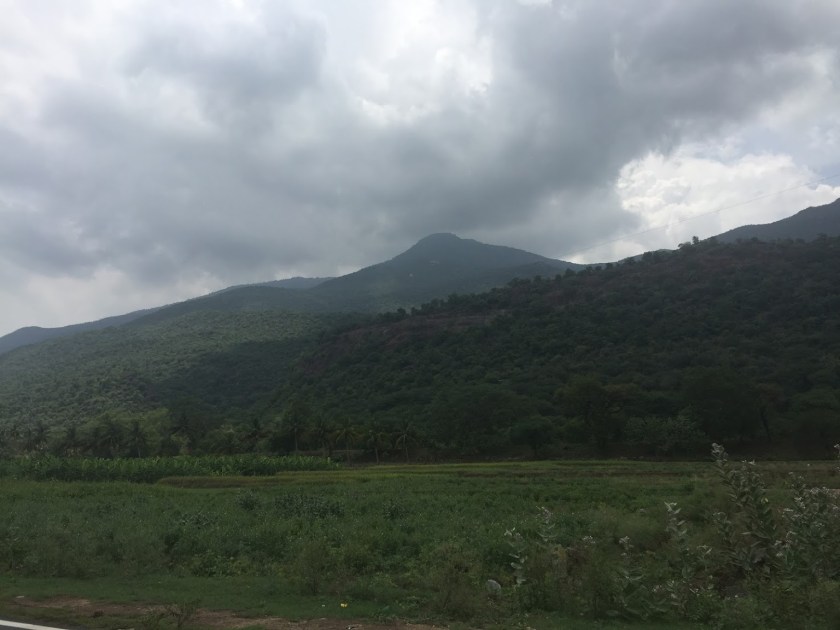
From up above, we could see the tiny houses lined up like toys on glimmering silver ribbons. The Earth around us was clothed in marvelous hues of Green, and peace seemed to hail. ‘Did you know? All those areas down there were fruit orchards with thousands of trees.  Apparently, these hills too were more like forests about 50-60 years ago. Then they cut down the trees so the cattle could graze, but now the ranchers have gone, and we don’t really need all these hills for pasture, but the trees are gone too.’, I said sadly.

The children looked appalled at this, and we set about discussing how important and beautiful trees are. “I wish we could replant all those trees!” said my little environmentalists wistfully, and I heartily agreed.

The Green Belt Movement

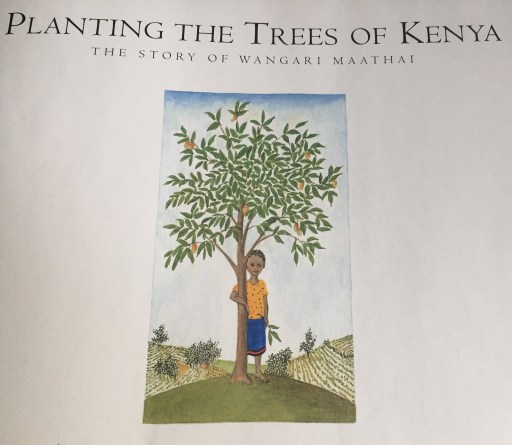
A few days later, I was grazing in the library, when my eyes fell upon the beautiful book,  Planting the Trees of Kenya, by Claire A Nivola, The Story of Wangari Maathai. I picked it up intrigued, for I love to read about that beautiful continent.

Planting the trees of Kenya - Wangari Maathai
Planting the trees of Kenya – Wangari Maathai

Wangari Maathai was the first woman to win the Nobel prize from the continent of Africa. She was awarded the Nobel Peace Prize in 2004 for making the connection between natural environments and the well-being of the people.

Wangari Maathai – Nobel Peace Prize winner in 2004. First woman from Africa.

The book started off with the beautiful page depicting the Kenyan countryside when Maathai was a little girl. Kenya was clothed in its ‘dress of green’ when she was a little girl.  Fig trees, olive trees, cornets and flame trees covered the land, and fish filled the pure waters of the streams.

The Fig tree was considered sacred, and it was one of her favorite trees.

Planting the trees of Kenya - Wangari Maathai
Planting the trees of Kenya – Wangari Maathai

Maathai then went to the US to study with the Benedictine nuns where she imbibed the lessons of doing more than you receive and to make a larger impact on Earth.

Planting the trees of Kenya - Wangari Maathai
Planting the trees of Kenya – Wangari Maathai

She returned to Kenya, full of hope, only to see the landscape completely transformed. Even the fig tree was gone, the streams had run dry and large-scale farming had take over the individual farmers needs. Food was more expensive and she was shocked to see that ‘economic progress’ had left behind a sickly, weak, and much poorer populace.

She was the first person to make the link between people and nature living together in harmony. 

Why not plant trees?

As can be expected, she was faced with opposition and setbacks at every turn. Her nursery did not thrive, the governments did not embrace the program, but none of that deterred her. She encouraged the women to take up tree planting. She visited schools and gave the children saplings to plant and nurture trees and even taught them how to make their own nurseries.


She, and this is my favorite, appealed to the gun-bearing soldiers with the slogan : Gun in your righthand and a tree seedling in your left. She said to them that if their goal was to save Kenya, both aspects are equally important.

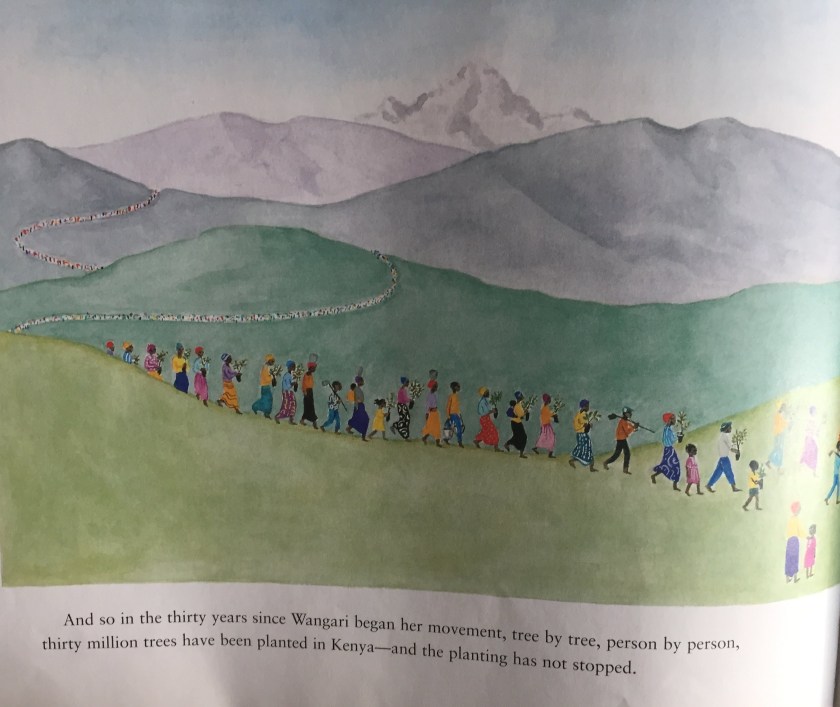
Ever since Wangari began her Green Belt Movement in 1977, tree by tree, person by person, 30 million trees have been planted in Kenya, and the planting has not stopped.

Planting the trees of Kenya - Wangari Maathai
Planting the trees of Kenya – Wangari Maathai

http://www.greenbeltmovement.org/wangari-maathai

What can we do?

When I look at the hills near where I live clothed in its rich shade of green in the rainy season, my heart sings. But I know this is a short-lived season before we have signs saying ‘Brown is the new green’, and the summers dry out the landscape bringing with it the threat of wildfires.

Last year, the very places that were most damaged by the wildfires were also affected by devastating flooding in California. These are nature’s wake-up calls.

SoCal – same areas affected by fires now devastated by storms

Every year roughly the size of the country of Costa Rica is being lost to deforestation.

UN Deforestation Statistics

Wangari Maathai died in 2011, but her lessons for us need not.  What will it take for a similar program to take root all over the world, so we can save ourselves and our beautiful planet?

Can Mammoths Stop Thawing Arctic Permafrost?

“Let’s not watch this – it is depressing, and some of that stuff makes my blood curl.”, I said as the daughter suggested some gothic fiction. It was the week-end before Halloween, and we were picking our Friday evening entertainment. Never an easy task.

“Fine! What do you want to watch?”

Cosmos” I said without flipping a heart beat. (Watch the you-tube video introducing Cosmos here)

To her eye-roll, I said “No really! You see, there are so many things in there that I wanted to understand as a student.  I plodded along to the library and I got to admit, the Physics books in there. “ I gave a shudder here, and I fully meant it. “I suggest you curl up with one of those tomes in our library looking jaundiced, pale, and excellent cures to Insomnia. I thought some of them needed vitamins, sunshine and exercise to regain what Doctors call a healthy glow. “

geek_world

So, we sat together and watched a Cosmos episode by Neil deGrasse Tyson on global warming. In his slow, sure voice, he rumbled like the volcanoes on Venus that set the poor planet into an irreversible green house cycle.

The World Set Free (Cosmos: A Spacetime Odyssey)

http://channel.nationalgeographic.com/cosmos-a-spacetime-odyssey/episodes/the-world-set-free/

We have twenty years at the current rate to stop us from going into an irreversible state like Venus.

The daughter gave me a significant look .I gave her a more sig. look, and we sat there looking like stuffed frogs with s. looks etched on our faces digesting the info. “How could you think this was okay to watch, but that movie was too scary. This is the scariest thing I have ever seen. How do you think it will all end?” said the daughter sounding worried, and deeply stirred.


A few days later, I read out a passage from the book I was reading. Woolly: The True Story of the Quest to Revive One of History’s Most Iconic Extinct Creatures. (Related post: Mankind trying to resurrect the woolly mammoth by impregnating Asian elephants with mammoth genes.)

Screen Shot 2017-10-27 at 4.37.00 PM

Pleistocene park  – Using 160 square kilometers of Siberian Tundra given to him by the Russian government, Zimov’s goal was repopulating the area with modern equivalents of prehistoric animals that had adapted to Arctic conditions (moose, Yakutian horses, Finnish reindeer and even North American bison.) … To re-create the effects of the Woolly Mammoths on the land, he’d bought in a World War II tank …. Punching holes in the snow, … , using the tank treads to mimic the continual stomps of Mammoth feet, he’d worked the land, year after year. And along the way, he’d accumulated data that were staggering in their implications.

Within his 16- square kilometers refuge, he had lowered the permafrost temperature by an average of fifteen degrees. 

We change the world just be being. I remember watching a video by National Geographic in which they chronicle how 41 wolves introduced in the Yellowstone park, changed the ecology and even the physical structure of the park.

Introducing Wolves in YellowStone National Park – National Geographic Video

If that was the case with 41 wolves, what would introducing Mammoths do? Would it save us from the brink of extinction or introduce problems of the kind we hardly envisioned?

We never know the ramifications of our creations. I mean we are a species who has unintended consequences from a ‘Like’ button on Social Media.

Hola Amigos! Tres Bien Nachos

This article appeared in The Hindu’s Open Page Section dated 15th October 2017

“Hi Amma. Konichiwa!”, said the little fellow as he pranced home from school.

Konichiwa?”

“It means Hola! Hello in Japanese.” said the fellow beaming.

“Oh that’s nice. Konichiwa. It sounds like a tinkling windchime. Koni-chiwa. “

Ni Hao is Hello in Chinese.” said the Hello expert.

“How did you know these things? Did they teach you in school?” I asked.

He pulled out a beautiful children’s book called ‘Say Hello’ by Rachel Isadora, and said he picked that from the library that day. That night we snuggled into bed with the Say Hello book. I must say that it is a most beautiful inclusive book and includes illustrations as a little girl walks through town saying Hello to the various people she meets.

The Shalom Aleikkum, Ni Hao and Konichiwa-s roll out with ease, before she finally finds her Abuela and says ‘Hola!’

The daughter sometimes joins us for story-time, and this time the two minute read turned into a twelve minute reminiscence into what is lovingly known as the Hola Snafu At Cancun.

The fellow at the gates to the resort in Cancun was looking morose, and wondering whether there was any purpose in going on sitting at the resort gates like this. There were folks inside going about their duties sipping a whisk of margarita as they were preparing some for the guests at the bar inside, while he had an iced water bottle that had long since melted the ice and left a puddle around it. Our van pulled up after a day’s trip to Chichen-Itza, and I poked my head out.

Hola! Uno nuevo nuevo deux.” I said and smiled. I gave him the room number allocated to us at the resort, so he could let us pass. It had been a long day with dinosaurs, asteroids, nuclear warfare by aliens from another galaxy, hobnobbing with the spirits of those who built the pyramids centuries ago.

The fellow chuckled to himself and looked uplifted in spirits. Just for this performance of Spanish, it was well worth giving up the spot to work at the bartenders backyard. He waved us in cheerfully, and I said in perfect Spanish. “Thank you Amigos. Have a tres bien day!

I turned around to see the daughter who incidentally learns Spanish up at the school rolling in the aisles and laughing with her little brother. “Did you just think you spoke Spanish?” she gurgled when I asked her what the matter was.

Our van was trundling in toward the resort, so I must have said all the right things, I said Oui with confidence.

“Have a tres bien day! Tres Bien is French Amma, not Spanish!”

It sure was. I had not considered the possibility that French and Spanish occupied the same area in the old brain. Amazing what all happens inside the walnut isn’t it?

“Well Spain is near France, so I am sure they will understand. “, I said miffed that my marvelous attempt at Spanish was being given the rip down by the children.

Screen Shot 2017-10-05 at 10.44.52 AM.png

“Yes! But Mexico isn’t near France. If I were him I would have asked for the room number again, and keep you there till you got it right.”

I was on solid ground there. Our room number was 1-9-9-2. Uno Nuevo Nuevo Deux.

Nuevo means ‘New’ ; Nueve means 9”, said the Stickler for Spanish Perfection.

“Why didn’t you say anything then, eh? Hola?”

I hola-ed and tres bien-ed and buenos nachos and muchos gracias-ed my way through the Mexican resort much to the delight of the staff there. Some of them taught me that Buenos Nachos means ‘Good Nachos’, not Good Night but smiled along indulging me in my Spanish dreams of fluency.

We all laughed, but the husband said that the important thing is that I made the effort to communicate with them all, and they understood that. Even when I said Muchos Nachos Tres Bien, and Google translator had no clue what that meant, the server who had laid out dinner for us with amazing vegetarian fare knew I meant well, and bestowed an avuncular smile on me.

The recent mass shooting at Las Vegas has horrified America yet again, and the press has said the latest terrorist attack was because the terrorist was a lone wolf. (Yes, when an act is calculated and carried out to spread terror, it is a terrorist attack, ask any fellow who works up these places that curates dictionaries and so on. The press seems to have this curious idea that the word can only be applied to certain sub sects of people, though the feeling of terror is universal.)

Anyway, as I was saying the Lone Wolf – I read a book by Daniel Byman a professor on Middle Eastern studies who tried to see the correlation between how terrorist organizations recruit and train towards extremism and any other factor (economic, academic, geographic), but came up with no correlation whatsoever. It was baffling. There was only one unifying factor among each of the recruits: They were all Lone Wolves. 

That got me thinking that every time we spot someone feeling lonely in our community, why not send a Hello or Hola or an Konichiwa or Ni Hao or Namaste or Salaam Alaikkum their way? We never know when a simple smile and word can change the course of one’s day. A smile is as universal as loneliness after all.


Freedom Is Sweet

Driving through lush green hills, past wide rivers and huge boulders, the route was marvelous. We had been a-visiting India for a short trip. The roads were smooth, and the rain clouds brought on a blast of monsoon rains. The little car burst forth joyfully on the empty roads swerving like a little child to splash puddles along the way.

The driver may be a grown man who sports whiskers on his face, but the heart the body houses is a child’s when it rains.
“You know? Two years ago, I took this road and it was agonizing to drive. The road was full of potholes, and our backs were sore for days.” he said smiling before splashing a big puddle again. The brother was driving and we were on the way to the city where my parents lived.
“What changed then?” I asked puzzled, for the gray ribbon in front of us was smooth and clean.
“Politics happened. The interim chief minister’s constituency is somewhere on this road, so we got our lovely scenic route done up – no charge.”

mettur_route.JPG

We reached home and affectionate greetings exchanged between parents, grandparents and children alike. A little while later, I was sprawled on the couch listening to the pater rile himself up with the news. Blithering-idiots-the-lot-of-them-are, seemed to about the gist of it, and I watched him amused.

The next day was Indian Independence Day, and the politicians were scrambling to see whose speeches would get maximum coverage on television, while ensuring that important topics of daily living were tabled for later. One incensed statement from the host of the News network forced the father to mute the television, and launch into a full scale explanation of politics that is best explained with a bedtime story. If you would snuggle in and close your eyes. Good then..:

There was a diamond ring, and everyone wanted it. But one strong, majestic troll had it, and did not let anybody else touch it. One day, the troll died, and all the remaining trolls fought each other for the ring. The troll children were hungry and thirsty, but that bothered no one. They are still fighting for the ring.

The End.

I know what you are thinking. As far as bedtime stories go, that was pretty rotten! I agree, but the state in which the parents live had recently lost their chief minister, and the squabble around the position was enough to make reality show hosts blanch. The populace has learned to look at the ensuing drama as such, and take a philosophical view of enjoying the good roads while they lasted.

We chewed the fat about the latest situ. in the United States, and how divisive strains were making themselves heard, and how we must do all we can to fight it.

Like Mark Twain said, The truth is stranger than fiction, but that is because Fiction is obliged to stick to possibilities whereas the Truth isn’t.

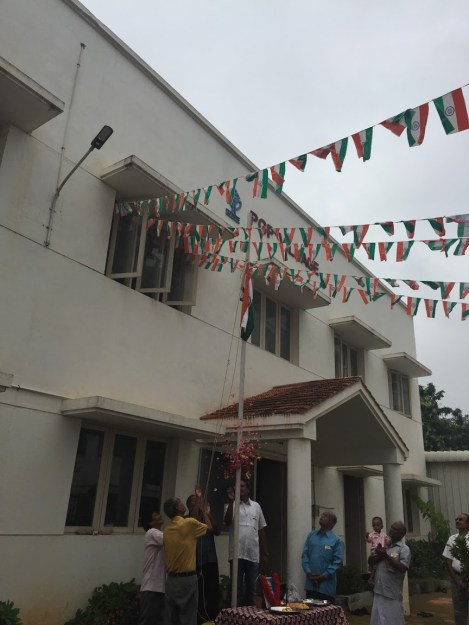
The next day was August 15th – Indian Independence Day, and we chirped with the birds, looked smart and went down for the flag hoisting in the community. I had with me my son and nephew – both five year olds who were eager for any activity involving the outdoors. As they stepped out, the boys were warned that they were not to take more than 1 sweet when offered the plate after the flag hoisting. If they were pups, I could have seen their ears drooping, but they bore the blow stoically enough and charged downstairs.

I stood there marveling at the fact that a month earlier we had celebrated Independence Day in the US. I looked around at the knot of people with whom I was celebrating Indian Independence Day. The stupendous privilege of celebrating Independence Day in the world’s largest democracies was not lost on me. To every one of us who looked at the flower petals fluttering down from the flag, freedom meant a different thing. To some of us, it meant living peaceful lives, to some, it meant having the right to dream, to some others, the ability to dissent. But we all agreed that it deserves celebration.

independence_day

Reading Lolita in Tehran, a book about the oppressive regime in Iran, was still in my mind, and as I was in the habit of reading particularly affecting passages to those near me ( a malady I inherited from the pater), I was doubly grateful to Democracy in spite of all its pitfalls. Fighting for diamond rings or no, taking a stand against divisive policies or not, we have something worth fighting for.

Afterward, we walked towards a small store. The path was an exciting one – past barking dogs, and motorcycles weaving their way through the streets. I smiled and asked for some chocolates for the lads. Their faces lit up with joy: Freedom is sweet.


Do Not Hate In The Plural

This post of mine was published in The Hindu dated 15th June, titled Undistilled Wodehouse

I was reading a short story by P.G.Wodehouse on the train. These are the times when I most mistaken for a lunatic. My seat shudders with unconcealed mirth. I giggle, laugh and sometimes wipe away tears of laughter, while the world is going about the stern business of earning a living. He is one of my favorite authors, and after every few books that makes me mope around the world pondering on the wretchedness and seriousness of life, I turn to a P.G.W book to remind myself that tomfoolery is a virtue to be exalted and celebrated. His turn of phrase, his romping joy, is enough to set me straight.

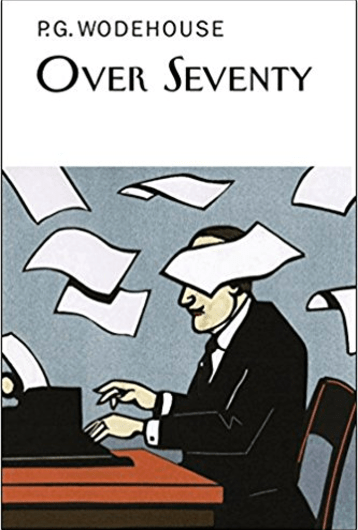
When I read his autobiography ‘Over Seventy’ a few years ago, I could see that the septuagenarian viewed his own life pretty much the same way he came across in his writing: Sunny and delightful. In his own words, he simply lacked the life required for a gripping autobiography because one needs some level of suffering to bung into the thing. “My father was plain as rice pudding and everyone in school understood me perfectly.” he wrote.

Screen Shot 2017-06-12 at 2.28.35 PM

So, it must have been particularly jarring to the man when he was treated as badly in his own country.

P.G.Wodehouse had his head in books and led a sheltered life. Whether it was Blandings Castle, or Jeeves rescuing his young master, his thoughts were almost always occupied with love and the stirrings of the idiotic. P.G.Wodehouse, known as ‘Plum’ to his friends, had a villa in Le Touquet, France where he and his wife Ethel often stayed. Plum and his wife were unfortunately there, when German troops stormed France, and he was taken prisoner at the beginning of the Second World War.

The Germans released him after 42 weeks, when he was nearing 60 as they seldom kept foreign internees beyond the age of 60. Through an old Hollywood friend of his, they sought to use him to make humorous broadcasts about his internment, and he naively did so. His was a trusting nature completely devoid of malice of any kind, and incapable of seeing political propaganda. Though he suffered immensely during his internment – he lost around 60 pounds, and ‘looked like something the carrion crow had brought in’, he did not quite realize the extent of evil and genocide that was happening inside War-time Germany. He simply intended to let his readers know that he was alive and well.

That back-fired, however, and the author went from beloved to detested in his native United Kingdom. People were looking for a scape-goat and he fitted the bill perfectly. He sadly became his own Bertie Wooster with no Jeeves to help.

Sometime after the Second World War ended, P.G.W was goaded by a journalist asking him whether he hated the Germans for what they put him through. To which the author supposedly replied, elegantly smoking his pipe, ‘I do not hate in the plural’.

A truly astounding statement. It was this statement of ‘not hating in the plural‘ that I sought out to find when I read the books below, but I could find no reference to the actual statement.


What I found instead was a man who was not only the world’s funniest author, but also the most hard-working, shy, kind and gentle person, who so magnanimously shared the gift of his sunny mind with the world.

I read all five of his broadcasts in entirety and to my equally naive mind, there is nothing in there that can be seen as treason. It shows how war, and malice can take any inane thing and wring it out of shape and proportion. What is real and what is fake when power is involved?

The piece written by George Orwell defending P.G.W’s innocence is well worth reading:
Quote :
The article and the broadcasts dealt mainly with Wodehouse’s experiences in internment, but they did include a very few comments on the war. The following are fair samples:
“I never was interested in politics. I’m quite unable to work up any kind of belligerent feeling. Just as I’m about to feel belligerent about some country I meet a decent sort of chap. We go out together and lose any fighting thoughts or feelings.”

P.G.Wodehouse was finally knighted by the British Government in January 1975. He died the following month on 14th February 1975, aged 93.

I am immensely grateful to the dear author, even if that means the Prims & Propers of the world lift their eyebrows and look away uncomfortably when I laugh. I cannot say it better than Stephen Fry does on the personal influence of P.G.Wodehouse:
He taught me something about good nature. It is enough to be benign, to be gentle, to be funny, to be kind.


The Mountain of Greed

Hiking through the rolling hills one day, I noticed one hill that had the touch of our greed all over it. It was probably a quarry. Set against a state park, this stark mountain made me wince. It was visible from many points in the park, and I moved my eyes away from it as though it was a raw, open, visceral wound. I noticed later in the dozens of pictures I had taken that day, I had deliberately cut this mountain out from my lens. Like my cutting out a mountain from the frame will remove it from my conscience. But it didn’t. I can still see its jagged unnatural edges in my mind’s eye – edges that have been scraped by metal against rock abruptly, not shaped by wind and water over time.

A sight like that got me started on the book called Biomimicry by Janine Benyus, for we have devised a way of life that is not sustainable.


Our corporations, keen on profitability, raced each other to figure out the best ways in which to make us consume more and more. But we have taken the race too far. It is time we stepped away from the treadmill.

As I gurgled on in this vein, I could not help noticing that there was a spring gurgling nearby. I stopped chattering like a monkey and quietened down, and as I did so, I felt a queer feeling seep into me and fill my being. Could it be happiness or gratitude? Whatever it was, I liked it. When birds, butterflies, rabbits, pinecones, free flowing water, trees and mountains jostle in friendly ambience in the early morning sunshine the way that Gaia intended it to be, it is refreshing.

brook.jpg

Please read this marvelous article on The Sound of Silence – Brain Pickings

I looked at the vegetation around me, and I found I did not quite know the type of trees or the plants around me. Gone were the days when I could tell you which berries were good, which ones made you itchy, and which flowers you could sip to get a wisp of nectar. How do animals know instinctively what works and what doesn’t, while we do not? I thought of the chimps in Gombe Stream National Park, the most studied species in the planet thanks to Jane Goodall’s work.

Quote From Biomimicry by Janine Benyus: Observing a chimp in Gombe Stream National Park, anthropologist Richard Wrangham, says: A chimp I was observing had woken up sick and instead of rolling over for more sleep, she got up and made a beeline. Twenty minutes later she stopped at an Aspilia plant [a cousin of the sunflower that grows as high as 6 feet] She suckered up her face and swallowed a dozen leaves before she moved back to her troop. It was obvious from her grimace that this was not a taste treat. Though chemical analysis of the ingested leaves showed no conclusive proof of medicine, he saw that a spike in leaf swallowing behavior coincided with the months of host tapeworm infection.

We too had this kind of instinctive knowledge with us, and instead of adding to its repertoire, we have accidentally followed another path.

Most frightening of all reports is that one in four wild species(including all taxonomic categories) will be facing extinction by the year 2025.

All this huffing up hills takes a toll on amateur knoll-climbers, and on the pretext of admiring a giant pine cone, I stopped to regain my breath. The pine cone was beautiful: It’s tough exterior, perfect symmetry and overall shape made me look at it and wonder why we cannot build jam jars like that pine cone.

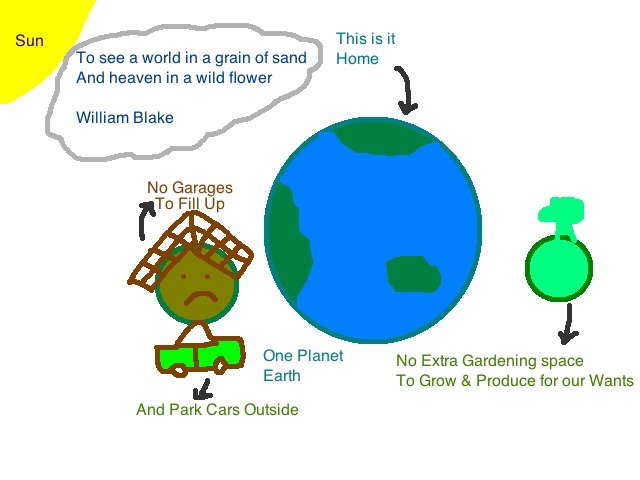
It is hardly the first nor the last time I will come across a Mountain of Greed. We have made extraordinary progress in areas pertaining to the skies, the seas, connectivity etc, but seem to grapple with the simple fact that we have one finite resource on which to live. There are no garages to be built for Earth. No extra closets. This is it.

no_garage

I sound extraordinarily sententious in this post, so maybe what we need is a reward system for eco-sustenance, so each of us can tap into the Naturalist nestled in us.

To see a world in a grain of sand
To see a heaven in a wild flower
– William Blake