The Great Quivering of Autumn

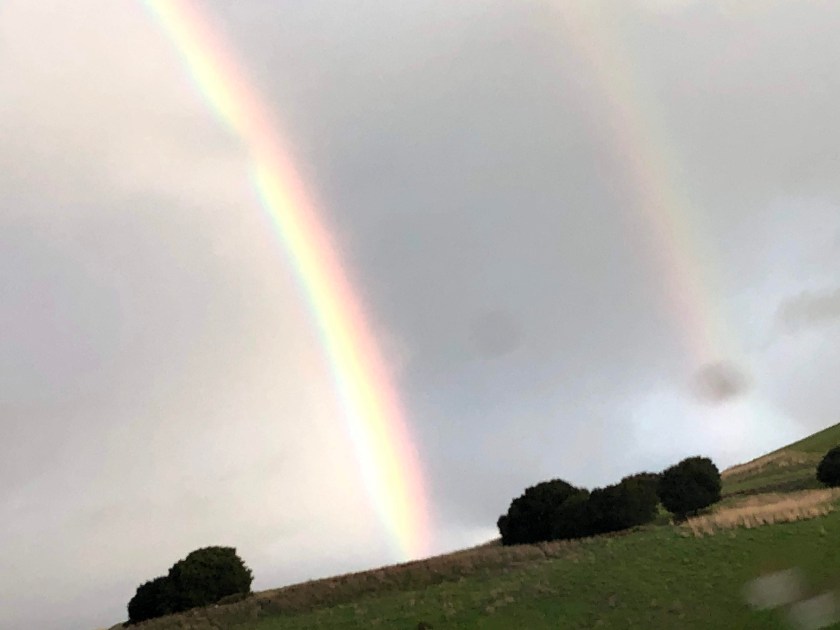
“I just witnessed the Great Quivering of 🍂🍁🍃 Autumn!” I said as I stepped into the house flushed with the exercise and thrilled with the beauty of a blustery day. “Luckily, I checked the weather before heading out.” I said taking off my light jacket.

“What’s she saying?” said the daughter, raising her sleepy head from the couch, and pulling her teeth out of a bagel.

“Its windy outside!” said her little brother, already practicing that teenage eye roll, and the art of turning poetry into the prosaic.

I rolled him up and said, “You too buddy?! Come here – you would have loved it. you know that? I saw so many hawks – I have never seen so many of them soar up together in great big circles like this. All of nature quivered. Trees shook, branches swayed, waves lapped at the shores of the lake, and leaves, oh my goodness – so many leaves went quaking to the floor. I stood with my arms apart like this and just stood there!”

“In the middle of the road?! Appa, I told you not to let her out alone!” moaned the teenager, and we all laughed.

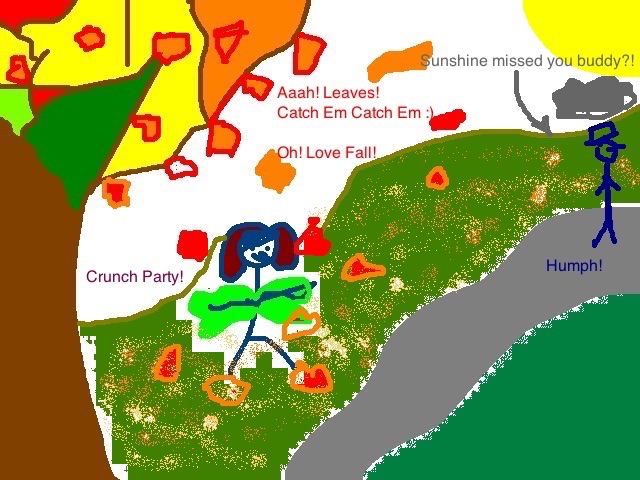
scrunch_party

No amount of pictures and videos will do the least bit of good when you catch glimpses of the rays filtering through the quivering leaves, or feel the light caress of falling leaves against your skin or catch the beautiful leaves of all colors against the blue skies. How does one capture the beauty of seeing a dozen hawks soar overhead, or the awe of seeing the pelicans do their little ballet dance of fishing, or the susurration of the leaves murmuring in the wind. There is a word for this: Psithurism.

As I gathered my little brood around me for a hot cup of tea after that invigorating walk, I shushed them to peek outside to see what I meant. The leaves were fluttering down in our garden, but there was another creature up and about at work regardless of the winds. 

“Bulby!” said the son excited.

“You named the squirrel? He can give you rabies you know that?”

“He can, but he won’t, and certainly not for naming him! You talk as though he is yearning for our company. I assure you, he isn’t. Just watch what he does. Bulby never fails to entertain.” I said, and the son nodded fervently. 

After sometime, we all burst out laughing at the squirrel’s antics. We have seen him hide great nuts in the soil every now and then, he nibbles and gnaws at the fruit on our trees, I have seen him scamper on seeing us sometimes, other times he watches us as though he doesn’t mind allowing us to enjoy a spot of nature with him. Today, he dug up my recently planted flower shoots, and dug something out, looked at us and furtively patched the garden up as though nothing had happened, and scurried. He had something on his mind, maybe a gut feeling of what was to come.

The morning out amidst nature, and finishing up with Bulby’s antics made me think of one of Mary Oliver’s poem:

From the Book of Time – By Mary Oliver

I rose this morning early as usual, and went to my desk.
But its spring,

and the thrush is in the the woods,
somewhere in the twirled branches, and he is singing.

And so, now, I am standing by the open door.
And now I am stepping down onto the grass,

I am touching a few leaves.
I am noticing the way the yellow butterflies
move together, in a twinkling cloud, over the field.

And I am thinking: maybe just looking and listening
is the real work.

Maybe the world, without us,
is the real poem.

The wind whipped and whooshed around all day. By evening, the winds had gathered speed alarmingly, trees that had swayed earlier in the day were lying broken, roads closed, emergency responders were keeping the populace further up North informed about the situation, power was down. It astounds me every time how forceful nature can be. But it also made me stop and think – the hawks had been more fitful than usual that morning, the squirrel was bustling more too. The animals knew we were in for a rough time, and responded, while we waited by our gadgets to give us the news.

img_4362

It is marvelous how Mary Oliver puts her finger on the pulse of the Earth :
Maybe just looking and listening is the real work,
Maybe the world without us is the real poem.

The Art of Breathing

A colleague caught me mid breath one day. It was one of those days that butterflies would have looked on me with mixed emotions.

On the one hand with pride: When did this caterpillar learn to flit like this?

On the other hand with amused tolerance: The half-wit seems to be forgetting the sweet joy of collecting nectar amidst pretty bright flowers, with all the fast paced flitting. Forfeiting the sweet thing about flitting – tut tut!  Flutter tutter utter nutter! (I am not high up on the poems caterpillars learn to sing about when still creepy crawlies; and the butterfly metaphor only goes so far!)

Anyway, it was one of the many days in which I flitted about the old work spot tasking, multi-tasking, sub-tasking, reminding others about their tasking, setting reminders for my own tasks and so on. Thoroughly immersed in my second self that Mary Oliver so succinctly calls the Social Self…yes, it was one of those days.

Mary Oliver’s, Upstream, is a book of many marvelous essays.  The essay, Of Power and Time, talks about the three selves in many of us:

•The Child Self

•The Social Self &

•The Eternal Self.


upstream

Though in the essay, Mary Oliver, refers to the Eternal Self as the artistic self, I like to interpret it as the Creative self.

• The Child Self is in us always, it never really leaves us.

• The second self is the social self. This is the do-er, the list maker, the planner, the executer.

• Then, there is the third self: the creative self, the dreamer, the wanderer.

T’was during one of these trying days that I remembered the deep breath technique my Yoga teachers had tried to teach me about. Take deep breaths, and concentrate on it filling your stomach, feel it coming in and out of your nostrils and so on. So, I started my deep breaths as I was walking from one meeting to another. Deep breath, exhale, deep breath, exhale and so on. I had thought no one watched, but one colleague caught me, and grinned. “That should be your GIF you know?” he said.

I nodded sheepishly, and went back to my brand of breath-less flitting within minutes.

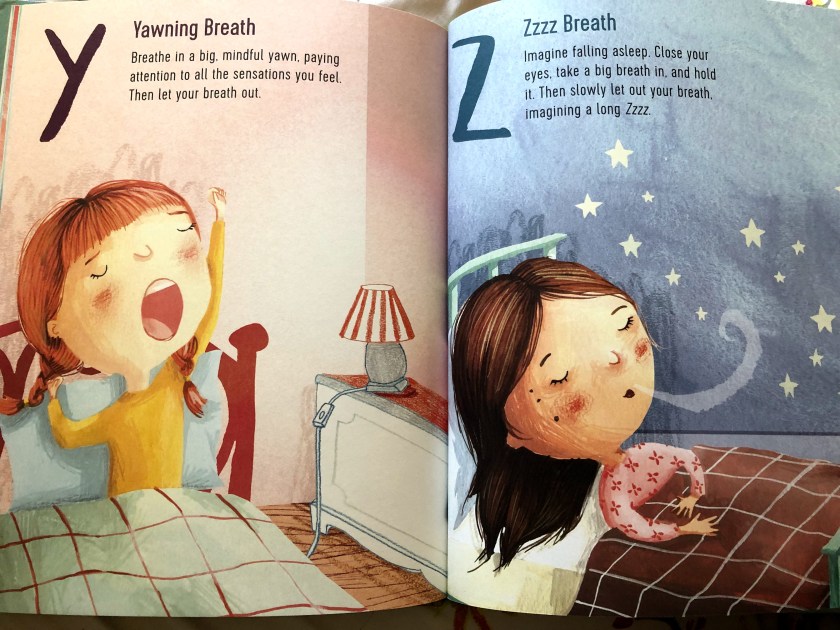
Later that week-end I ran into this beautiful children’s book in the library. A book that was just waiting to be written. A beautiful capture of all the different types of breath, Alphabreaths 

Written by : Christopher Willard (a clinical psychologist) & Rechtschaffen MA, Daniel (a counselor)

Illustrated by:  Clifton-Brown


The book is a lovely read urging us to Breathe like a Dolphin taking a dive, or our favorite one, The Ninja Breath – silently and slowly. The illustrations too make for a marvelously relaxing read. Please check out their Youtube clip : here


Mindful breathing and Yoga are excellent concepts to teach the children, and I am always in awe of those who can take complex concepts and make them palatable for the consumption of young and old alike.

If you happen to come home and find the son and I swimming like dolphins or getting ready for a Star Trek mission on the floor while Yoga-ing along with the Cosmic Kids Yoga series by Jaime Amor , do not be alarmed. Her yoga videos are appealing and fun. If, along the way, we do something to calm ourselves down – then great, else, we have had a great time.

There are so many aspects to the Philosophy of Being (I am amused it has such a strictly medical sounding name: Ontology)

Ontology is the branch of metaphysics dealing with the nature of being, and reading the Wikipedia page itself boggles my simple mind (A post on the Study of Philosophy is sitting up on its hind legs and begging to be written). Maybe, what is required is a Ninja Training on Ontology. Excerpt from the wiki page:

Such an understanding of ontological categories, however, is merely taxonomic, classificatory. Aristotle’s categories are the ways in which a being may be addressed simply as a being, such as:[9]

  • what it is (its ‘whatness’, quiddity, haecceity or essence)
  • how it is (its ‘howness’ or qualitativeness)
  • how much it is (quantitativeness)
  • where it is (its relatedness to other beings)

*** Taking a Y for Yawning Breath before a Z for zzzz breath about now ****

img_4049

Keeping ontological explanations aside, if The Nature of Being comes down to simple techniques of breath, fluidity and movement, it makes the simplicity behind it all brilliant.

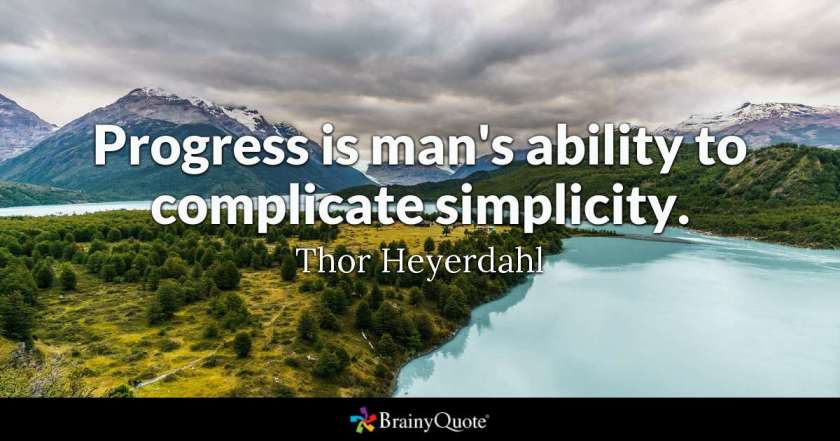
It was one of those ‘Simple is brilliant’ types of  quotes that I went looking for. I know many brilliant blokes and blokees have said marvelous things about simplicity -I know old Leonardo Da Vinci said something about it, so did old man, Einstein. In any case, looking for one of those made me fumble on this one by Norwegian explorer, Thor Heyerdahl

From Wikipedia: Thor Heyerdahl became notable for his Kon-Tiki expedition in 1947, in which he sailed 8,000 km (5,000 mi) across the Pacific Ocean in a hand-built raft from South America to the Tuamotu Islands. The expedition was designed to demonstrate that ancient people could have made long sea voyages, creating contacts between separate cultures.

thorheyerdahl1-2x


Continue reading “The Art of Breathing”

To Fall In Love With Earth

 “Good going amma! You are doing well. Just try riding a little faster, okay?”, said the daughter, and then the children gave me a thumbs up, and smiled encouragingly. We were out cycling on a relatively flat trail in the mountains nearby.  I was amused at the encouragement. It was true that I was in worse shape than I expected. 

lunch_box

It had been decades since the days of pointless cycling up and down the hills, and the old spirit was reviving with every pedal stroke. I looked up yearningly at the tree-tops, and the pinecones hanging from them. All Earth looked and smelled inviting, reminding me of the gratitude for having such a beautiful planet on which to live. Today was not the day to rue the state of our laws, or how fast climate change is creeping up on us. Today was a day to feel grateful for what we have, so we may learn better to conserve what we have for future generations better. It was in this moment of great gratitude that I was admiring the tree-tops against the clear blue skies when I promptly veered off the bicycle path and crashed into some brambles nearby. 

img_2846

I tottered back to the path to chuckles from the daughter.  The husband in the meanwhile, was acting as though as he was in his teens again and cycling with both hands off the handle bar. The elementary school going son, gave me a shrug and said, “Show off!”. But I caught him trying to take his hands off the bar one at a time, and smiled to myself. 

The son had graduated to a bigger cycle for the first time and his face registered joy, and a little trepidation, as he stopped pedaling and went whizzing downhill. The adrenaline was pumping, and his cautious nature was kicking in at the same time. When we stopped for a break a few minutes later, he looked happy, and ready to start pedaling again. 

Out amidst nature that day was a wonderful balm for the soul. The air still felt nippy – there had been a light snow and rain at night, but the clouds had scattered nicely and the trail had some wet patches through which we went zipping with joy. The skies were blue, and the glistening snow and raindrops on the trees in the path brought about a pristine joy. 

The fresh, moist, clear air reminded me of Kate Harris when she wrote in the book, Lands of Lost Borders:

lands_of_lost_borders

“I’m not sure where I go when I spin wheels for hours on end like that, except into the rapture of doing nothing deeply—although ‘nothing,’ in this case, involves a tantrum of pedal strokes on a burdened bicycle along a euphemism for a highway through the Himalaya.” 

― Kate Harris, Lands of Lost Borders: Out of Bounds on the Silk Road

We were not in the Himalayas. We were on safe biking paths with brilliant nature folding us lovingly in its embrace on all sides, and yet the feeling was the same. There was harmony there between human souls and the Earth, and I could only hope that we never truly lose touch with that feeling. This is our only home after all.

We stopped for a while to take in a small hike around a place that has the wonderful combination of meadows, marshes, forests and river. A more Wind in the Willows kind of setting I could not have imagined, but there it was, and like the rest of the surreal day, I found myself feeling increasingly happy at being there. As we walked listening to the surging snow melt in the fast flowing stream nearby, I felt a sense of clarity, and I thought of Mary Oliver’s words:

I walk in this Earth to fall in love with it. – Mary Oliver

What is your Friend?

The din from the kitchen area was appalling. One of our favorite aunts was a-visiting and the nieces had gathered around for a day of fun, and laughter which she invariably ensured was there around her. 

“What is your day like Athai (Aunt) ? How do you pass time?” we asked.

This is one of the questions that I pose to those of the older generation often. I know boredom and loneliness can be a big problem for some people. However, there are a few in the older generation who somehow manage to retain their vibrant joie-de-vivre as they age, so that they are not just occupied but keep themselves happily occupied and stimulated. 

“I am occupied enough, “ she began. After she told us in loving detail of time spent with her family, particularly grandsons, she said with a smile. “I practice what I want to teach later in the day to my students, and I find the time flies past. Music is really a friend.“

It was true. I remember visiting this Aunt a few months ago, and heard her humming and practicing a particularly tricky song that she wanted to teach her student later that day. She was trying it as she cooked & cleaned and it made for a comforting background while we went about our day. 

Many I know find it heavy-going after retiring from their busy lives. Some find solace in the demands of religion, others find themselves watching a lot of television. A few, though, find ways in which to keep themselves intellectually stimulated and happy.  These people seem to me the kind of people who are not only in touch with their Eternal Selves, but also nourished and sustained it. They are the ones who quite unwittingly spread joy and happiness around them by virtue of being happy with their own state of being.

Mary Oliver’s, Upstream, is a book of many marvelous essays.  The essay, Of Power and Time, talks about the three selves in many of us:

  • The Child Self
  • The Social Self &
  • The Eternal Self.

Though in the essay, Mary Oliver, refers to the Eternal Self as the artistic self, I like to interpret it as the Creative self. 

  • The Child Self is in us always, it never really leaves us. 
  • The second self is the social self. This is the do-er, the list maker, the planner, the executer. 
  • Then, there is the third self: the creative self, the dreamer, the wanderer. 

upstream

Talking to people around me, I hear many who say that they would do this or that after retirement: I would take up gardening after retiring, I will take up reading after retiring. I am guilty of postponing  some of my desires to a golden time in my mind that is post-retirement ( I will learn to play an instrument after I retire).

But how would you know whether you like one activity over the other? The problem is finding that ‘something’ becomes more elusive the longer you deny it. 

Finding something that makes us want to do something without rewards is at once the least monetarily tangible and the most gratifying thing in the world. Not all of us can lead the life of an artist, but we each can devote small amounts of time consistently to find an artistic pursuit that sustains us. It may be in the creative process in things as varied as tinkering with wood, or analyzing the ebb and flow of economic market conditions. 

The essay ended on this note:

“The most regretful people on Earth are those who felt their own creative power restive and uprising, and gave to it neither time nor power.” – Mary Oliver

The Aunt who said “Music is a friend!” gave to her creative spirit time and power.

What is your friend?

Note: A version of the essay by Mary Oliver is found here: 

Mary Oliver: The Artist’s Task 

Brain Pickings – The Third Self

The Three Selves

Mary Oliver’s, Upstream, is a book of many marvelous essays. One in particular stood out: Of Power and Time. This one is about the three selves in many of us:

  • The Child Self
  • The Social Self &
  • The Eternal Self.

upstream

Reflecting upon the piece, I realized we should know this by now, and we probably do at some level, but it takes a clairvoyant writer to set it out so neatly.

The Child Self is in us always, it never really leaves us. I completely identify with that. I am decades away from my childhood, but I can dip into it like I only just grew up.  Everything felt keener and sharper as children, and that is part of the reason why The Child Self never really leaves us, I suppose. (Probably the reason why I forget the name of the person I met yesterday, but remember the names of my friends from when I was 5 years old : What is Time?)

While young, I yearned to grow up, and in the words of L M Montgomery realize that growing up is not half as fun as it is purported to be.

“That’s the worst of growing up, and I’m beginning to realize it. The things you wanted so much when you were a child don’t seem half so wonderful to you when you get them.”
― L.M. Montgomery, Anne of Green Gables

The second self is the Social Self. This is the do-er, the list maker, the planner, the executer. The one, in short, that most of us find ourselves trapped in for the most part of our lives. This is “the smiler and the doorkeeper” as Mary Oliver so elegantly puts it. This self I am familiar with: metaphorically the whirlpool, the swift horses of time, the minute  keeper.

“This is the portion that winds the clock, that steers through the dailiness of life, that keeps in mind appointments that must be made. Whether it gathers as it goes some branch of wisdom or delight, or nothing at all, is a matter with which it is hardly concerned. What this self hears night and day, what it loves beyond all other songs, is the endless springing forward of the clock, those measures strict and vivacious, and full of certainty.”

The social, attentive self’s surety is what makes the world go around as she says.

Then, there is the third self: The Creative Self, the dreamer, the wanderer.
“Certainly there is within each of us a self that is neither a child, nor a servant of the hours. It is a third self, occasional in some of us, tyrant in others. This self is out of love with the ordinary, it is out of love with time. It has a hunger for eternity.”

The essay goes on explain the regular, ordinary self in contrast to the creative self. The Creative Self – the one that is out of love with the ordinary, out of love with the demands of time or the regular routines of life, is concerned with something else, the extraordinary. This is the self, she says, that makes the world move forward.

“The extraordinary is what Art is about. No one yet has made a list of places where the extraordinary may happen and where it may not. Among crowds, in drawing rooms, among easements and comforts and pleasures it is seldom seen, It likes the out-of-doors. It likes the concentrating mind. It likes its solitude.”

img_1781-effects

The essay was eye-opening in many ways. For I know many, including myself, have to fill our days with the demands of the clock. It is also easier to be the do-er, so that we may not have to enter that difficult place of teasing, figuring and wrestling the extraordinary out; to give shape to the nebulous clouds skirting in the recesses of the brain.

There is nothing wrong with succumbing to the demands of the clock, but it is a valuable lesson to teach ourselves to take our brains for a tease and see what results, isn’t it? We may land up surprising ourselves if only we give it the chance.

The essay ended on this note:

“The most regretful people on Earth are those who felt their own creative power restive and uprising, and gave to it neither time nor power.”

What do we do to ensure that there is enough time in our lives to ensure the nurturing of the Eternal Self? (Read: The Art & Charm of Shoshin) I don’t know the answer yet, but when I do, I shall hop on social media and share it right away.

Note:

A version of the essay is found here: 

Mary Oliver: The Artist’s Task 

Brain Pickings – The Third Self

The Touch of the Eternal

The daughter came hurtling into the room bursting with something to share, her brother in quick pursuit. I was sprawled on my stomach across the bed surrounded by a bunch of books.  She looked surprised at finding me indoors instead of hustling people to come and enjoy the outdoors, and said “How come you aren’t flitting with the butterflies?” 

The skies were blue, the air pure, the trees outside looked splendid and inviting, the first shy cherry blossoms were peeping out, the first of my tulip shoots were making their way out of the ground much to my delight.

I snorted and said, that just because the day looks awesome outside does not mean that I have to ‘flit like a butterfly’. Besides, it was perfect Gluggavedur weather. (Gluggavedur is a delightful Icelandic word that signifies, ‘Window weather’ – beautiful from the inside, but too cold to go outside.)

I know I have yearned for the right word many times. (A word for the cool breeze that hits your face when you run down a mountain for instance: Zephyr Tales) This book, What a Wonderful Word, taps into that feeling with words from many cultures across the world.

Book: What a Wonderful Word – By Nicola Edwards & Luisa Uribe

Anyway, where was I? Oh yes: I looked dignified and mature. It is done by setting the chin at an awkward angle, and giving the impression of one finding a skunk when one lifted the bushes to find a squirrel.

“A mature adult can do many things!” I said.

“Like reading children’s books?” said she.

I laughed hard and she joined in. Mature indeed! 

One time she found me doing Yoga with a beautiful Children’s book open, and checking out the illustrations from various angles. This act of whimsy earned me the loving and coveted label that teenagers award rarely, “You are SO weird! That is such a you-thing, why am I not even surprised?”

Much later when I read Upstream by Mary Oliver, I was glad to see that I was doing something right – the whimsical part at least.

“You must not ever stop being whimsical. And you must not, ever, give anyone else the responsibility for your life.” 

― Mary Oliver, Wild Geese

Some of my favorite things to do is flip through children’s books. The illustrations on some of them made me admire the books on wholly different levels.

How an artist comes up with conceptualization, the drawings themselves, and the whole process that goes into making children’s books is amazing. Every book is a testament to creativity, teamwork, solidarity, the calling of the eternal, and so much more. When asked to critique a piece of Art, I would trip up on a few things like techniques, styles, brush strokes, paint colors, paint directions, canvas quality etc. But I can appreciate good Art when I see it, and describe it with the word, Beautiful.

I was book-flitting like butterflies, very happy with the set of books I was flitting through.

“See! See this book – how can people even conceptualize a piece like this? Hmm…what would we do without Children’s books?”

I was surprised she had no snarky comeback – it is seldom so. Blessed as she is with sharp wit, it is usually me that has Espirit D’Escalier episodes. I looked up, and saw her immersed in the beautiful drawing in the children’s book I showed her. She spends a good amount of her time doodling and definitely with more success than Yours Truly. 

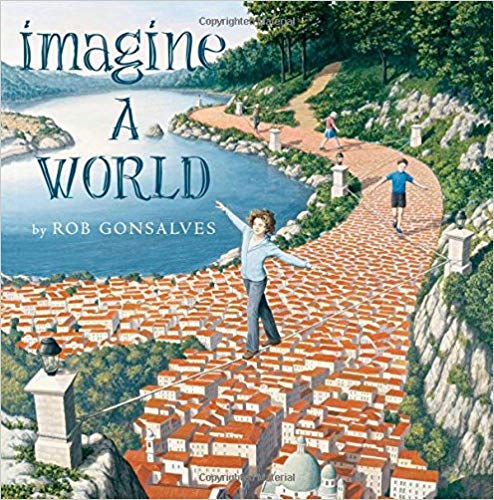
Rob Gonsalves book, Imagine A World, was definitely mesmerizing. The almost seamless transitions within the Art that hid multiple layers and concepts was work of genius. A sample piece shown below  – you can also head on over to his site that has more Art work. 

img_1863
Rob Gonsalves work Book: Imagine a World

The book reminded me of Mary Oliver’s Quote:

“Keep some room in your heart for the unimaginable.” 

― Mary Oliver

Magical Realism is Gonsalves’ speciality, and I am so glad to have picked up the book. It is easy to see the pictures over and over again – being immersed in them over again.

imagine_a_world

I am the first to admit that I am no Art Critic, just a child admiring the work of artists whose touch of the eternal we are blessed to see. 

Also read: Dr Seuss’s Art