

During the holiday season I read two epics from different perspectives: The Mahabharata & The Ramayana.
The Mahabharata from the River Ganga & Bhishma’s perspective:
The Goddess of the River – By Vaishnavi Patel
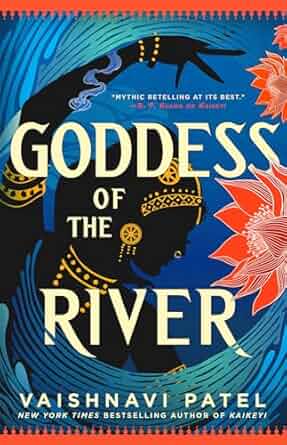
The book started off beautifully for I have always loved myths of rivers and streams and oceans, and the gods that embody them. How they interact with the human world is a leap of imagination and faith, and when told beautifully, never ceases to make me admire the human capacity for creativity and the beautiful gifts of our imagination.
How River Ganga fell to the Earth from the cosmic skies, unbridled, full of energy and the strength of the universe behind her is a beautiful chapter, and even if told separately without the context of the Mahabharatha makes for a marvelous read bursting with magical realism. The river’s long continuing peeve against the Lord Shiva who broke her fall to the Earth, and contained her wild spirits to be nothing more than a river able to provide sustenance for humanity is well told.
The story of her curse, and how she comes to bear a mortal form, and how she comes to marry King Shantanu, and sire him eight offspring ,killing them all – save one, Bhishma, is enthralling.
Points to Ponder:
🦌Fascinating as this all was, the birth of Bhishma Pitamaha, the grand uncle of the Kauravas and the Pandavas may have set the stage for the Mahabharatha. But, once the river returns to her goddess form, her perspective and narrative is not enough for an epic such as the Mahabharatha.
Bhishma is the grand uncle, yes, but he is still forced to take sides, and the sides of the Kauravas, if it needs empathy, needs more work. Grand villainy is not an easy side to tell.
🦅The river is a river and even with divine powers is only able to be in the same plane so many times, unless she was worshipped and kept in little containers by all concerned. If everyone carried a bit of the waters of the River Ganges from whence she was able to observe, it might have worked. But as it was, from a narrative point, it might’ve worked if she stopped the story after Bhishma’s birth. The author was trying to tell the Mahabharatha from a female centric perspective, but truth be told, the best female perspective for the Mahabharatha is from the point of view of Draupadi – the princess who marries all five of the Pandava princes (Yudhisthira, Bhima, Arjuna, Nakula & Sahadeva).
🦢She might have better selected the alternating perspectives of Gandhari & Kunti (the mothers of the Kaurava and Pandava princes’ respectively) That would have been a perspective I would have liked to read, for I have always wondered how the mothers felt about their sons and nephews initiating wars, and how their hearts must remain conflicted – for love can be confusing in its loyalties and moralities especially within families. They would also have been present at all the crucial points in the story – when Draupadi was gambled away, when the kingdoms were split unfairly, when they were exiled, and when they came to the inevitable war.
The Ramayana from Kaikeyi’s perspective:

I had qualms picking this up because the previous one The Goddess of the River by the same author did not hold the same kind of sway for the epic it was trying to tell. You see, the Goddess of the River was an attempt at Mahabharata from the Goddess of the river Ganga’s perspective, which was a severely limiting perspective. If you needed a female centric perspective on the Mahabharatha, the best one still seems to be Draupadi, which is already well-written and well-received in The Palace of Illusions by Chitra Banerjee Divakaruni.
But Kaikeyi was beautifully woven. The story of the warrior princess who saved her husband’s life on the battlefield and got herself two boons to use at any time. How did this particular queen manage to get on the battlefield and save her husband at a time and age when women were kept safe in their palaces at the time of war?
I always found a pang of sympathy for Kaikeyi – for I felt her life, who she was, where she came from, were all colored with the lens of her choices that set the Ramayana in motion. (Asking for the boons: Rama to be exiled and her blood-son, Bharatha, to be coronated as King instead of Rama) Could she really have festered ambitions for her birth son all that long, even as the epic says Rama & Kaikeyi considered themselves as mother-and-son throughout?
Points to Ponder:
🦌The author wisely stopped the narrative after Rama, Sita & Lakshmana went on exile. This worked very well, for attempting to provide a peek into the Ramayana from Kaikeyi’s perspective would have very limited narrative points of view.
🦅As it was a story from Kaikeyi’s perspective, it also provided a peek into her life. In this book, Kaikeyi’s maid and nurse, Manthara, is not filled with malice as many versions of the epic seem to indicate. In this retelling, Kaikeyi bears full responsibility for what she does and manages to convince the reader of her thoughts and motivations for essentially what set the Ramayana into motion (the exile of Rama for 14 years, and placing Bharatha on the throne instead.)
🦢The relationships between the people in Kaikeyi’s life were well done. Her relationship with her husband, Dasaratha, her fellow queens, Kausalya and Sumitra, and her maids, Manthara and Asha, her sons, Bharatha, Rama, Lakshmana and Shatrughna, her younger brothers – in particular, her twin brother, Yudhajit.
All in all, these two made for good reads over the holiday season, with a trip to India in the mix.
 Nourish-n-Cherish