Magic of Zen

“Chitthi, you should read this book for sure. I am sure you will like it.”, said the niece, holding up some teen fiction. She has been reading what she calls Dystopian Fiction and some of her stories tend to mistake my blood for milk set out to curdle. I looked skeptical.
The daughter joined in the conversation with another book suggestion. “Adults won’t enjoy it, but I am sure you will Amma.” she said.
I donned an amused expression. That I should be pegged for having a child’s capacity made me feel truly honored.

Like Ursula K Le Guin, the famous fantasy author said, ‘The creative adult is the child who survived.’

“I mean of course you are an adult and stuff, but … well you know what we mean.” The girls rushed on almost immediately, “This is the good stuff – you will love it.”

The book recommendations discussion was happening before our trip to Mt Shasta, and I was deciding what should be taken along for reading.

After a little deliberation, I picked out Tales from Earthsea by Ursula K Le Guin. A better book for the wilderness could not have been chosen if I had researched the thing for weeks. Earthsea is a mythical archipelago where wizardry is not uncommon. This book contained tales from Earthsea set in various points in time. The stories are set in beautiful islands amidst forests and meadows and was the perfect read at Shasta.

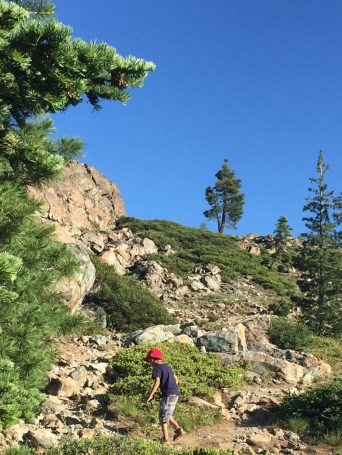
One fine early morning, on a hike in the forests of Shasta, I chose a spot in which to slowdown and take in the surroundings just like the characters do in the Grove. I sat myself on a rock, and looked out upon miles of trees and forest cover. Sitting there, I noticed how the leaves were shaped against the blue skies, the clear, sharp shapes rising up against the sky, looking majestic and beautiful. Why is it, that nothing man made can even hope to compete with the magnificence of a leaf, tree, forest or mountain? It was a biomimicry moment.

shasta1

With the forest around me and Mt Shasta in the background, Nature helped still and quiet my senses so much that I felt strange. The incessant chatter of inner turmoil quiet, the constant rippling of life’s waves smoothened, the distant and affectionate view of my own foibles on Earth. In only a few moments of this relative calming of the senses I could feel every observation keenly as though the distant telescopes were adjusted better to give a clairvoyant view into life.

To hear, one must be silent.
Ursula K. Le Guin

I resolved to take the children on a hike that very evening. The evening hike was just as splendid. It hugged a coastline on a lake, and the evening sun transformed a normal forest setting into a magical one. We trudged up the mountain path chattering happily and gaining altitude. A number of meandering trails and paths criss-crossed the ones we were taking as we hiked on.

shasta-lake.JPG

As we were hiking, I told my daughter about the moment of Zen that I felt during the morning hike, and she said she would try it too. I looked up surprised, but noticed that a while later, she sought out a rock and sat there just drinking in the scenery. I hope she felt the same sense of quiet.

keena_zen.JPG

As we made our way back, the sun had started to set and colored the sky with patches of radiant pink, purple and orange. It was then that we realized that we may have lost our way. I remember going left from this mountain peak, but that trail up there also goes there, how about this one? Every one was sure we had come up by a completely different path. The daughter was unusually quiet and then she exclaimed thoroughly proud of herself, “This is it! I know now. This is it. This is the way to go!” and she was perfectly right.

Days later, when we were discussing the concept of magic, I went all Ursula Le Guin on her and said, “You know? That day, on the hike, you were so much in tune with nature that you were the one who found the way back. You know how appalling you are usually when it comes to directions, but that day because you loved the hike so much, the forest revealed its magic to you.” She rolled her eyes, but the joy in her eyes was unmistakable.

Le Guin writes of magic in a way that is manifest in our daily lives without us ever stopping thinking of them as magic. It is neither wand waving nor dramatic, but it is spectacular. It is in the unique talents we each have, and just like any other talent needs nurturing and nourishing to develop to its full potential.

The Author’s work has the influence of Tao-ist philosophies, that help us tap into the ageless wisdom of generations. The books talk of listening to the Earth as a means to understanding the greater forces at play, the ability to gauge what is to happen, but have the sagacity to neither judge nor criticize its actors unduly. In short, it is life cloaked in the glamorous garbs of magic.

Lao Tzu Tao – Ursula Le Guin

Hill Billy Tales

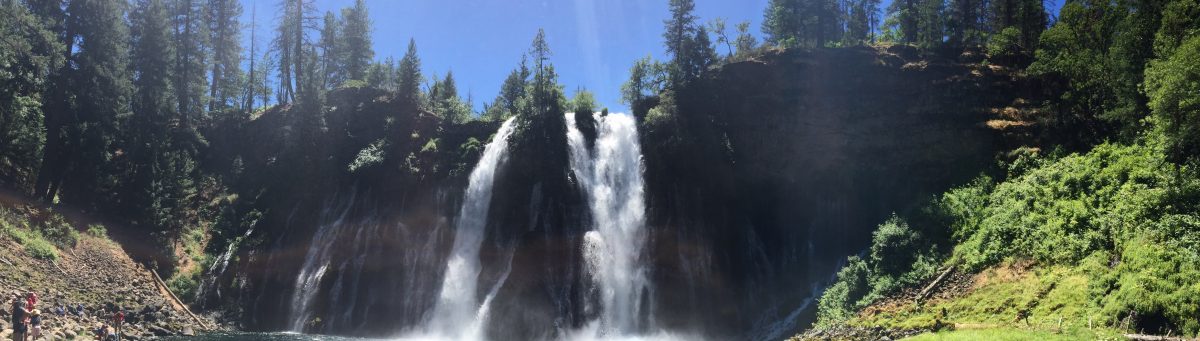
We took a short trip to the beautiful place in the mountains where the Sierra Nevada mountains meet the Cascade range of mountains. It is also where the grasslands sport a sign that says ‘Welcome to Oregon’ as you keep driving north in California. Studded with lakes, rivers and waterfalls, amidst the towering glory of the tall trees, the place really welcomed us with marvelous, serendipitous finds, wholesome joys and gave us moments of Zen that I know we will look back on with contentment for years.

shasta1.JPG

We drove smartly past grasslands and hills rolling by and sailed into Oregon in style. Within a few miles, we saw the quintessential American landmark: Signs indicating how many miles to the nearest Visitor Center.

15 miles to the Visitor center.
10 miles to the Visitor center.
The count down was on. The highway signs were creaking with the beckoning of the visitor center. This is one of those times where you can see Marketing mess with your minds: What if we missed the sight of a lifetime because we ignored the signs to the V Center? We succumbed and went in to find a sleepy town that had two main streets and two cross streets connecting the main ones (Lest the folks of the town come at me: I exaggerate, but you get the pic).

Once in there, we tootled along for a walk by the river admiring the swallows and giving them the names in the fancy pamphlet. We spotted a narrow sign that stated ‘River access’, and off we went through the thickening vegetation. Brambles scratched, the sound of the fresh flowing water was soothing to the ear, and the teenage girls (daughter and niece) looked distinctly uncomfortable with the mosquitoes but gallantly kept from complaining. In a titter and a tat, we found ourselves amidst lingerie on a rock, a dog that was wondering whether to rouse itself and check out the strangers, and two people camping by the riverside.

“Oh…sorry to bother you. We did not know this comes to the campground – just admiring the river.”, we said largely for the benefit of the dog, who felt that he must earn his keep and came along to check us out.

An old man clumped out of the trees, and said in his gruff voice that it was alright, and that the river and the river bed did not belong to him, and anyone was welcome. His unshaven face gave him a mane-like countenance, his voice reeked of not being used often, and he looked like he had been living on the rough for sometime. I felt the children draw closer to me and gave him a nervous smile.
He went on to tell us about how he has been camping by the riverside for a while now. “ I am down from the South,” he said.
“Oh really! We are here from California too.”
He threw his mane back and laughed.
No Ma’am. Am from down south!” he said puffing his chest out with pride.
“Oh you mean southern states like Louisiana?”
Yes Ma’am – a true hill-billy I am. You meet a hill-billy before?

riverside

This is where the conv. got a little strained. I mean, I had not met a true hill-billy before, or atleast I did not know the conditions for classifying someone as a hill-billy. I spent my childhood in the remote hills, and still startle at loud motor noises like metal being grated for a salad, does that make me a hill-billy? I gave him a silly, strained, forced laugh to which he looked at me keenly, and said “Why? What is wrong with me being a hill-billy.
“Uh..Nothing. Nothing at all. Do you like being a hill-billy?”
I do! Course I do! There are sum who can’n live off earth-like. Me? I can live off the earth – I can find meself some berries an’ hunt an’ fish like.
“That is very good.” I said.
I have to admit my admiration for the man rose. I have often wondered whether we have the ability to survive anymore. The more I think about it, the more I am convinced that we are slowly devolving to a point of not knowing how to survive by our wits. We seem to rely on GPS for going to the corner grocery store, the corner grocery store seeing the trend, is telling us, “Please please don’t bother. Just press a button and we’ll send a drone along with milk and such. You just keep pressing ‘Yes’ on that remote when it asks you whether you want to continue watching.”

Conversation languished for sometime after this, and the daughter came to my rescue, by shoving the creature catalogue in his hands, and asked whether he had seen river otters before. He gave her a pleased smile and told her about all the different bird and animal-likes he had seen in the river, and said he had never seen an otter before. His classifications and naming differed somewhat from the pamphlet, and his ‘white birds’ and ‘grey lil ones’ and ‘those brown ones up top’ were definitely easier to look out for.

We were well on our way after bidding him and his dog good-bye. Living on the wits may have suited him, but for us, we needed a good sandwich before we could go on, seemed to be consensus of the group. The husband reached for the phone, and I smartly took it from him saying, ‘It is such a small town, I am sure we can just drive down and find a Subway sandwich place. If he can live without technology, why can’t we?”.
‘It will be much quicker with a phone!’, he groaned, but I heard none of that nonsense: it was drowned in that growl that emanated from the stomach.

Life’s greatest lessons are learned when tempers are short. Everyone argued that the sandwich place was the other way, and after 3 u-turns, 4 no-no-not-that-one false starts, a hungry gloom settled upon the car.

Sniffing out a sandwich place in a car with its A/C on in full blast and closed windows is an art you got to learn. The hill-billy might have done it with the dog’s help, but we had to admit defeat.

I confess that we finally pulled out the phone to locate the place in a 3 mile strip. But after that: Boy! We were bulldogs and nosed on straight for Crater Lake with the GPS on. After all, evolution also means knowing how and when to use the right tools, what?!

crater_lake

When Humor Jumped In Neptune’s Pool

California has many things to offer: it is home to sprawling deserts, cold beaches, misty forests, rainy fogs, snowy stretches, marvelous lakes, fast flowing rivers, and so much more. It is one of the reasons why we had neglected the Hearst Castle in San Simeon California for this long. Every time some one asked us about Hearst Castle, we’d say, “Oh – yes! Must go” without conviction and move on. This time, however, we took the plunge and buoyed up in Paso Robles, California.

hearst_2

Once in there, it is imperative that you follow your hosts’ instructions scrupulously, for the tour guides there do not put it past themselves to take a ruler and rap it across your knuckles if you don’t. One time, we found ourselves standing in the game room and the guide went on and on about the parties the rich man used to give there (Their guests used to play scrabble here, and then they would move across the hall, and play the uno cards there. Sometimes, they would think that chess might be a good idea, but thinking was hard….). Then, she stopped mid sentence, found my pinkie toe not on the carpet, and pulled me up in front of the whole tour. “Ma’am. Ma’am. I ask that you stand on the carpet.
To which I looked around to see who the rule-breaker was, and found there was no Ma’am in the general direction she was shouting at except me. I asked her, “Who? Me?”
Yes Ma’am. Please stay on the carpeted area.
“I am on the carpeted area.”
No ma’am. Your pinkie toe is out.
Sticklers for perfection the Hearst Castle folks.

When you go up to the Hearst Castle, you cannot but help noticing that the man, William Hearst, had nothing to do, had wealth with which he knew not what to do, and therefore he thought it a perfectly reasonable thing to build a castle that made Napolean Bonaparte, Julius Caeser and King Henry the VIII all squirm together in a co-ordinated pirouette in the nether world. As though the human built edifice wasn’t enough, he decided to introduce some zebras, llamas and mountain goats into a habitat that boasts natively of some squirrels and lizards.

If the tour guide is any reflection on the hospitality offered up at the home of old William Hearst, I should like to pass on the invite. We were all now made to stand in attention in the dining room where folks, I was enlightened by the tour guide, ate. I did not know this. So, I looked up.
Sometimes, they had potatoes for dinner, sometimes they had eggs, oatmeal…

hearst_1.JPG

I must mention that this punishing tour was happening at an hour where breakfast is a memory and lunch a yearning.

The guide’s voice was one of those voices these sharp nurses who brook no nonsense have. To top that, she seemed to belong to the category of folks who swallow their sense of humor mistaking them for calcium tablets in their youth. Her jaw set, her face impassive, she went on and on like a steady drip into your veins.

I have always felt for these tour guides. I am not sure what draws them to the career in the first place. It must be a beautiful thing to proudly show the legacy of the place the first three hundred and two times. But the three-hundred and third time, must get somewhat repetitive what? And then, you have people who refuse to keep their pinkie toes on the carpet. Hard.

If you were a guest here at the castle, you would be given the place of honor the first night and sit right next to Marion Davies (his mistress), and then as more and more guests joined, you will be moved along the table. When you find yourself at the end, it is time for you to go.”, she went on in that flat dictaphone commanding her troops sort of voice.

I am sure that was a line inserted for humor. I could almost see Humor springing gay and carefree in that line, and then tripping on the carpet that all toes were supposed to be on, and falling nose first and splattering on the floor.

People shuddered at the implication, thankful that their pal William Hearst did not send them a personal invitation.

A giggler throughout, I was quite sure I would have myself thrown out of the hilltop if I did not behave, but I could not help thinking of P.G.Wodehouse’s quote:

“It was one of the dullest speeches I ever heard. The Agee woman told us for three quarters of an hour how she came to write her beastly book, when a simple apology was all that was required.”

P.G. Wodehouse, The Girl in Blue

I laughed and the husband yanked me to the back of the troupe, to save me from myself.

It was in fact, P.G.Wodehouse, who had put up that gag about being shoved off the table if you stayed too long.
Meals are in an enormous room, and are served at a long table, with [William Randolph] Hearst sitting in the middle on one side and [actress-mistress] Marion Davies in the middle on the other. The longer you are there, the further you get from the middle. I sat on Marion’s right the first night, then found myself being edged further and further away till I got to the extreme end, when I thought it time to leave. Another day, and I should have been feeding on the floor.”—Humorist P.G. Wodehouse, in a letter to a friend describing his visit to William Randolph Hearst’s San Simeon, Feb. 25, 1931, quoted in The Oxford Book of Literary Anecdotes.

If only PGW knew how his good pal, Humor, jumped into Neptune’s pool to avoid further torture, he would have had a gag or two about it for sure. (Neptune pool is a monstrosity with *gulp* Roman columns surrounding a humongous pool, that was dry and was up for renovation because it drained some 5000 gallons of water, when the rest of the state was smacking their lips in thirst).

The Butter Battle Course

When you look up the definition for religion, it states among other things that it is “a pursuit or interest to which someone ascribes supreme importance”

How many conflicts has the world endured, is enduring, and will continue to endure because of this belief to which one ascribes supreme importance? I had written about it here (religion).

Who was it who said that every good kind of learning  can be obtained from Childrens’ books?  I whole heartedly agree.

The latest book that I am babbling about is the Butter Battle book, by Dr Seuss.

The Yooks and the Zooks live on either side of a long, meandering wall. The Yooks wear blue, the Zooks wear orange.
butter_battle

The Yooks think the Zooks silly for buttering their bread with the butter side down, while the Zooks think the Yooks are somewhat dim-witted for buttering their bread with the butter side facing up. The flags of the Yooks and Zooks represent the belief in buttering bread, and the animosity builds from this bread-butter-theory to which they attach supreme importance.

IMG_6227 (1).JPG

One day, the Yook patrolman is prowling the place with his Tough-Tufted Prickly Snick-Berry Switch, when a Zook pelts him with a slingshot. This sets in motion an escalating conflict, with both sides coming up with more and more exotic and dangerous arms with which to fight each other.

The Triple Sling Jigger, the Jigger Rock Snatchem, the Blue Goo-er, the Kick-a-poo kid operated by a cocker spaniel – Daniel, the Eight-Nozzled Elephant-Toted Boom Blitz.

butter_battle_2.jpg

The last page has the Yook patrolman sitting atop the wall with a Zook warrior. Both of them have in their hands a Bitsy Big-Boy Boomeroo – a small bomb that can annihilate life as we know it, signifying the nuclear threat.

I know we ask of no formal training as a politician: there are no politician licenses, no courses one has to complete to take up public office, but I really think there should be a set of children’s books that they all have to read and re-read as refreshers every year in order to stay in office. We could call it the Butter Battle Course.

The Butter Battle Book has of course given rise to great hilarity in the house. “Do you want to be a Yook or a Zook?”, we ask taking out the butter and the bread. We now butter our bread on both sides so we can be Yooky-Zooks, and sometimes Zooky-Yooks.

The next time any two nations start warring, I suggest thrusting bread buttered on both sides to both parties.

Complement with:
Kahlil Gibran on the Absurdity of Self righteousness
The Colander Religion
Bertrand Russell’s Teapot Religion

Historically Speaking …

I looked at the delectable pile of books by my side waiting to be read. The top of the pile was the beautifully annotated ‘Jane Austen’s History of England. –

Just the sort of history book that appeals to me. Written by Jane Austen when she was 16 years old, the book bears the hallmark of her humor.

Screen Shot 2017-07-06 at 1.26.31 PM

I sat smiling at some of the things written about Henry the 8th & Anne Boleyn.

The book certainly sounded like some of the answer papers of my youth.

I have always felt that History was one of those subjects that was calculated to freeze my brain. Good though my teachers in the subject were, bless them, they could not but help say that the Second Battle of Panipat was fought in 1556. Inside my brain, this simple fact would start a whistling train of thought:

1556. Hmm … funny number.

How to remember that number?

55 in the middle and 6-1 = 5. 

Why not 6551? Because that is in the future.

Very clever. But what about the number 6? Why 6 and not 7?

Maybe, History is the sixth period(?)

But only on Wednesdays.

If only it were 1596, 15*6=90  and then add 6

“Can anybody tell me what happened to Akbar after that battle?” These teachers have voices that have a way of cutting through the most interesting meanderings of the mind.

“What battle?”, I’d write on the side margin, and slip it across to my friend. There she would be, sitting by my side at the wooden desk with a vacant expression on her face biting her pencil. But at this urgent message, she’d stoutly pull herself together and write back, “The Battle of Panipuri, I think.”

Then the exams would roll along, and after days spent cramming the dates and emperors, I would come to the conclusion that all emperors who sought to reign should be made to stand in line in shorts and recite the dates of all those who aspired to power before them.  If they still want to reign, may their shorts fall while they lead the charge – that should teach them not to add to that horribly long list.

To make matters worse, the rumor mills during examination time worked overtime:

(a) The teachers likes diagrams, one person would say, stating emphatically that whatever you do, make sure you draw a diagram for it.

Feverishly, we would start drawing Africa maps, and label the Gold Coast, and the Sahara desert, throwing in the Kilimanjaro for luck. Never mind that the question was about Egypt.

(b) The more you write, the better will be your marks.

So, we would write double-spaced and add spice to the Spice Wars.

history

One time I remember writing about Alexander’s Horse. Our History teacher had on one occasion told us about the fine breeds of horses that emperors prided themselves on. My brain tick-tocked away with Alexander’s Horse, and I found to my amazement that the brave stallion was heroic beyond what History books knew. I imagined the horse pulling his great emperor across the blizzards of the mountains one day just by trusting its instinct. The marvelous animal found a stream of fresh flowing water for its emperor. I wrote about 16 sentences on the virtues of the horse, borrowing heavily from my recent reading of Black Beauty (also a black horse with a star on its forehead, duh!) I wrote of its aching muscles, its loyalty that was much admired, and how stable managers had a job that was olfactorily unsatisfactory maybe, but really quite a prestigious one, if it meant looking after the emperor’s horse. I also gave him a name, Macedonia, if I remember right – sealing my understanding of the reign once and for all. (Alexander’s Horse, Bucephalus, would have turned in his grave and asked ‘Is she talking about me? Neigh! ‘ )

He_ran_toward_the_horse_and_seized_the_bridle
By Walter Crane – The story of Greece : told to boys and girls

“15 more minutes.” the examiner said, and I looked to see that while the paper had a brilliant character sketch of the horse, it had very little about Alexander the Great.

I hastily started another paragraph on the the horse’s rider and finished up the paper. I came out into the brilliant sunshine from the exam hall when my friend said looking at me in admiration, “How much you wrote! I saw you taking two extra sheets! I am sure you are going to ace it!”

I shrugged off this undue praise guiltily, feeling a little sorry for the teacher who had to read such drivel.

It was years later that I read “I, Claudius”, the historical fiction book written by Robert Graves,  and came upon Incitatus, Caligula’s horse. Whether it was fiction or not I cannot say, but this was the horse that the Roman ruler, Caligula, sought to make a senator, and invited to State dinners.

http://www.history.com/news/ask-history/did-caligula-really-make-his-horse-a-consul

The truth is stranger than fiction, but it is because Fiction is obliged to stick to possibilities; Truth isn’t. Mark Twain

I smiled at these pleasant memories, and opened the book in my hand.


Jane Austen said,

Edward the 4th

This monarch was famous only for his Beauty & his Courage of which the Picture we have here given of him, & his undaunted behavior in marrying one Woman while he was engaged to another are sufficient proofs. His Wife was Elizabeth Woodville, a Widow who, poor Woman! was afterwards confined in a Convent by that Monster of Iniquity & Avarice Henry the 7th. One of Edward’s Mistresses was Jane Shore, who has had a play written about her, but it is a tragedy & therefore not worth reading. Having performed all these noble actions, his Majesty died, & was succeeded by his son.

The Elusive Soother of Souls

We were at a party of sorts where good friends gathered for the evening with families. Adults, senior adults, teenagers, tweens, kids all jostled together happy to see one another.

The children got eating out of the way as soon as they could, and started playing in that vigorous fashion that makes me want to drop everything and join them. 

Mounds_of_food

People with food on their plates drifted like continents and grouped and regrouped for conversations. At one point, I found myself amidst septuagenarians talking about sleep, or lack thereof. “Go on and tell them how little I sleep!”, said the father-in-law to me.

 “He does have difficulty falling asleep…”, I said carefully, casting a longing look at the children playing outside.

He gave me a wilting look for this lame endorsement, and decided to stick it out on his own.

“I was never like this. I cannot sleep these days. I used to sleep the moment my head touched the pillow.” he said

“Me too” agreed an uncle.

“It would take sometime to fall asleep, but once I did, I could sleep well without interruptions.” said an aunt.

“How many times can one turn this way and that? How many times to say our prayers?”

“It is such a big problem. What do you think we should do?” they asked, looking at me earnestly.

Sometimes, I get when it is a rhetorical question, and nod. Other times, I behave like a particularly dimwitted penguin, and start telling an ostrich how to bury its head in the sand. I go on to make comparisons between the similarities in nature between sand and snow and how it is all a matter of technique.

penguin_ostrich

“Well, sometimes when I am excessively tired,  I find a hot bath before bed helps.” I said.

“I take a hot bath every night. Nothing helps.” my father-in-law said looking miserable. All the senior adults agreed: Baths were elementary stuff.

The squeals from the garden indicated an energetic game of hide-n-seek in progress. I glanced to see a squealing army run towards the washing machine – apparently somebody saw one of them go there to hide, and everybody was running to investigate.

By now, more folks had joined in the conv. Herbal teas were discussed next as aides to that Elusive Soother of Souls, Sleep. Chamomiles, lavenders and orange blossoms wafted their scents in.  In time, the topic had slid down the tea slopes and gone on to meditation as a technique.

“I find I worry if I have nothing to worry about”, said an aunt, and smiled wanly. “One day, I saw 2 o’clock and was so disgusted”, said she.

“But it cannot be as bad as mine. The other day, I saw 3 o’clock on the clock. 3 o’clock can you believe it?.”

My father in law said he saw 3:10, while another uncle said 3:30.

They all looked at me to declare the winner. Braver generals could have taken on the task, maybe, but I confess I shrank from the task. These individuals who would happily set themselves to lose in a game against their grandchildren were now competing for The Most Ardent Sufferer Award, and I wasn’t going to be the one to decide. Nu-Uh.

I quietly slipped into the garden, to see the children were all running strictly following the principles of Brownian motion. They ran onto the lawn and tumbled over, and ran again. The setting sun washed them all aglow. The grass on their beautiful clothes, the dirt on their cheeks, the sweat pouring down their faces, and their squeals of laughter made a marvelous sight.

The evening slowly wound down, and we gathered all the folks up and started back on the ride home. The children were giggling still, while the senior citizens in the car were discussing the food in detail.

The Payasam was very good. 

The bondas could have been hotter

The rice was good, and the curd-vadaSome of them were soaked nicely, others needed some more time to soak.

One thing, everybody seems to not be able to sleep, they said with satisfaction.

I glanced at the children. One had already fallen asleep, and the other was nodding off.

Wynken Blynken & Nod one night

Sailed off in a wooden shoe

Sailed in river of crystal light

Into a sea of dew…..

“Did you make sure the children ate well?”, their solicitous grandmother asked me.

Dear Athai

When I look back upon my childhood, I see that it sparkled with a fine collection of aunts and uncles (most not related by ties of blood) My father was a teacher in a residential school (Lawrence, Lovedale), and all teachers lived on the campus along with their broods like one large, extended family. It is only natural that we adopted some of his close friends for our very own aunts and uncles as well.

“Isn’t she such an inspiration?” said my friend, as we waved to Athai (meaning Father’s sister) one night about thirty years ago. “Poor thing has had such a tough life.” Athai seemed happy enough to me, I thought to myself, why was her life tough? Seeing my puzzled expression, my friend, who was older, taller and wiser (she still is), took it upon herself to enlighten me.

That evening, she told me how Athai was a very well off young lady when she lost her husband unexpectedly. She realized later that she not only lost her husband, but her fortunes as well. Suddenly, she found herself rudderless. She told me how Athai took up the job as matron in her children’s school, and how she had rebuilt her life with dignity and perseverance. She had gone on to raise her three children as a single mother through those hard times.

I never looked at Athai the same way again.

They say children have an innocence that is hard to define, and I understand now what that means. I had known Mrs Ramachandran my whole life spanning less than a decade without stopping to think about her past life: her life beyond being matron to hundreds of children, the person who managed the kitchens and Athai to all of us. In all of these roles, she was gracious, loving and giving. It was as if she had simply sprung into being the same beautiful way in which I interacted with her everyday. Her grey hair framing her round face with a ready smile that dimpled her cheeks.

When I stopped to think of it, I realized that she must have been a stunning beauty in her youth.

It was then that I started asking Athai about her life. She would share bits and pieces of some incidents here and there and I was happy to listen whenever she did. She came home in the evenings some days with her friends and we always looked forward to seeing her if only for a few minutes.

One day, I opened the door looking despondent. She asked me what the matter was, ever ready to deal with the intensity of teenage turmoil.

“This is one of the reasons I don’t like jewelry!” I said as I finished telling her about how I lost one of my gold earrings on the playground. I was feeling miserable.

With her characteristic humor, and knowing how much I balked at wearing jewelry, she teased me that I might find myself married to a husband in a remote village, where every woman wore six chains, twelve bangles, sagging earrings, a nose-ring, and that I would have to get into a bullock cart decked up in my finery, in order to take a phone call from my sister on market day. I laughed, feeling better already.

maatu_vandi

Then, she said, “You should be careful with your belongings, but you must not become attached to them.”

Every bit that Athai shared of her life was beyond inspirational, it was motivating. I sat mesmerized by how without her ever realizing, she weaved her grief, misfortunes, perseverance and joy together as one beautiful tapestry through which her personality shone through. I loved every interaction with her, the attentive companionship she gave, and her unfailing good humor.

Last week, Athai passed away at the age of 88. I wished I lived in a remote village and had to wait till market day to receive the sad news of her passing. But WhatsApp is relentless and swift. The network packets encrypted and decrypted the message the same way it packaged every inane joke and forwarded message: “Athai passed away. “ it said blankly.

I am enormously grateful that my life was influenced by people like Athai, Raghavan uncle, Mr Bharathan and so many more.

Don’t cry that it is over, smile because it happened. – Dr Seuss.

Seuss_dont-cry-because-its-over

I dragged my children along for a walk that evening. Fresh air always makes it easier for me to think happy thoughts, and I knew the walk would help me celebrate Athai’s life. I do not know whether my children will remember the evening, but for me, it was important. It is a tiny piece of Athai that I wish to share with my dear ones.

I know Athai would have liked to know my little ones. In her heart, there was always place for love.

Dear Athai – may you rest in peace and thank you for everything.

athai_3

Do-Nothing Cooking

It was a mild and breezy week-end morning. “Yeah! We are going to work in the garden today! In the garden! In the garden!” I heard the song gain in strength as the gardeners thumped upstairs. “Get up amma!”, they called. I was lingering on in bed, savoring the warmth of the summer quilt.

“What is this?” I asked a little later. The husband was back from somewhere brandishing several sinusoidal wave-like sticks of blue. Could they be fancy walking sticks?

“No – silly. These are for the tomatoes.”

“Yes – don’t you want large tomatoes from the plants? Look, they are already sagging outside.”, said the father-in-law pointing to his pride and joy in the garden. “The rasam can be even tastier with these tomatoes.”, he said with a sly grin on his face.

“Can you make rasam without tomatoes? I just don’t like tomatoes but I like the rasam otherwise.” said the daughter.

This I-Don’t-Like-Tomatoes theme was getting a bit tiring. I rolled my eyes, and stamped my foot in exasperation. “I do not know how to make tomato rasam without tomatoes! Let me know when you make it. ”

“Okay okay! Sheesh kababs! No need to get all cranky if you don’t know how to cook something.” she said and made off to the garden dragging her little brother with her to help her grandfather.

“Make rasam without tomatoes indeed!” I muttered to myself as I gathered the garlic, cumin, pepper, tamarind and tomatoes for rasam. Once the rasam was comfortably simmering, I went back and forth from the kitchen to the garden. Every now and then I was beset upon to give directions and suggestions for the garden. I asked for an old rose plant and the star jasmine creeper to be pruned.

do-nothing-garden

“But they are poonchedis ” said the father-in-law reluctant to cut flowering plants. South Indians have this strange, but endearing affection with flowering plants. I assured him pruning was good.

The children were busy discussing how to plant the other little flowers and herbs in the garden. The son was looking mighty impressed with himself for he was patted with admiration by his elder sister on the gardening tip he had provided.

“If you put a garlic in the herb garden, then nothing will happen – you know? Nothing. Yes. Ms Lara told us that. No insects will come.”

“Really? We can do that.”

“What?! Do we have garlic in the house? I didn’t know that!”

“Of course we have garlic in the house! How else do you think we can do any Indian cooking you little diddle gump?”, said the chef, who wanted to make tomato rasam without tomatoes.

The little brother was suitably impressed and a few frozen cloves of garlic made its way to the patch containing the Thai basil leaves.

do-nothing-garden_1

I looked at the father-in-law. He was tackling the unruly star jasmine creeper with energy. The jasmine had crept up the adjoining fir and cherry trees and was busy making its way past the garden fence. I saw the intense concentration on his face, and surveyed the garden. He must have taken lessons from the barber in the best army in a past life, for the trees had an efficient crewcut demeanor when he was done with them.

The whole scene reminded me of a short story, Annamalai, by R.K.Narayan in The Grandmother’s Tales. The story is about a gardener who had stopped on with him. The gardeners horticultural knowledge and classifications are simple. All flowering plants were ‘poonchedis’ while non-flowering plants were ‘not poonchedis’. The story writes of his taking charge of the garden and how sometimes he would go on a rampage and prune everything in sight, and the garden wore a threadbare, forlorn look for a few days afterward. At other times, he let things be, and the garden flourished anyway. It is a beautiful story that transports you to a little garden in South India almost instantly.

Screen Shot 2017-06-15 at 11.47.51 AM.png

I smiled thinking of the story. My horticultural knowledge is as woeful as that gardener’s, and my father-in-law’s botanical classification was equally simple. However, I hope our garden too thrives. Maybe we will become the best advocates of the Do-Nothing farming that Farmer Fukuoka speaks so highly of in the Biomimicry book by Janine Benyus.

Screen Shot 2017-06-02 at 9.37.17 AM

Quote from Biomimicry book:

A young man named Masonobu Fukuouka took a walk that would change his life. As he strolled along a rural road, he spotted a rice plant in a ditch, a volunteer growing not from a clean slate of soil but from a tangle of fallen rice stalks.

This proved an inspiration for the young boy : how a grain thrived without the need for coddling and soaking in water canals and so on.

Over the years Fukuoka would turn this secret into a system called Do-Nothing farming because it requires almost no labor on his part and yet his yields are among the highest in Japan. His recipe, fine tuned through trial and error, mimics nature’s trick of succession and soil covering . “It took me 30 years to develop such simplicity” says Fukuoka.

Instead of working harder, he whittled away unnecessary agricultural practices one by one, asking what he could stop doing rather than what he could do.

A sizzling sound alerted me to the rasam simmering over its sides. I charged into the kitchen wondering how to better the Do-Nothing cooking technique.

AF1QipPRTkiTkyjfsh8vHWiHJZkN-rBHzBnw9wR_wMua=I-U.jpg


Do Not Hate In The Plural

This post of mine was published in The Hindu dated 15th June, titled Undistilled Wodehouse

I was reading a short story by P.G.Wodehouse on the train. These are the times when I most mistaken for a lunatic. My seat shudders with unconcealed mirth. I giggle, laugh and sometimes wipe away tears of laughter, while the world is going about the stern business of earning a living. He is one of my favorite authors, and after every few books that makes me mope around the world pondering on the wretchedness and seriousness of life, I turn to a P.G.W book to remind myself that tomfoolery is a virtue to be exalted and celebrated. His turn of phrase, his romping joy, is enough to set me straight.

When I read his autobiography ‘Over Seventy’ a few years ago, I could see that the septuagenarian viewed his own life pretty much the same way he came across in his writing: Sunny and delightful. In his own words, he simply lacked the life required for a gripping autobiography because one needs some level of suffering to bung into the thing. “My father was plain as rice pudding and everyone in school understood me perfectly.” he wrote.

Screen Shot 2017-06-12 at 2.28.35 PM

So, it must have been particularly jarring to the man when he was treated as badly in his own country.

P.G.Wodehouse had his head in books and led a sheltered life. Whether it was Blandings Castle, or Jeeves rescuing his young master, his thoughts were almost always occupied with love and the stirrings of the idiotic. P.G.Wodehouse, known as ‘Plum’ to his friends, had a villa in Le Touquet, France where he and his wife Ethel often stayed. Plum and his wife were unfortunately there, when German troops stormed France, and he was taken prisoner at the beginning of the Second World War.

The Germans released him after 42 weeks, when he was nearing 60 as they seldom kept foreign internees beyond the age of 60. Through an old Hollywood friend of his, they sought to use him to make humorous broadcasts about his internment, and he naively did so. His was a trusting nature completely devoid of malice of any kind, and incapable of seeing political propaganda. Though he suffered immensely during his internment – he lost around 60 pounds, and ‘looked like something the carrion crow had brought in’, he did not quite realize the extent of evil and genocide that was happening inside War-time Germany. He simply intended to let his readers know that he was alive and well.

That back-fired, however, and the author went from beloved to detested in his native United Kingdom. People were looking for a scape-goat and he fitted the bill perfectly. He sadly became his own Bertie Wooster with no Jeeves to help.

Sometime after the Second World War ended, P.G.W was goaded by a journalist asking him whether he hated the Germans for what they put him through. To which the author supposedly replied, elegantly smoking his pipe, ‘I do not hate in the plural’.

A truly astounding statement. It was this statement of ‘not hating in the plural‘ that I sought out to find when I read the books below, but I could find no reference to the actual statement.


What I found instead was a man who was not only the world’s funniest author, but also the most hard-working, shy, kind and gentle person, who so magnanimously shared the gift of his sunny mind with the world.

I read all five of his broadcasts in entirety and to my equally naive mind, there is nothing in there that can be seen as treason. It shows how war, and malice can take any inane thing and wring it out of shape and proportion. What is real and what is fake when power is involved?

The piece written by George Orwell defending P.G.W’s innocence is well worth reading:
Quote :
The article and the broadcasts dealt mainly with Wodehouse’s experiences in internment, but they did include a very few comments on the war. The following are fair samples:
“I never was interested in politics. I’m quite unable to work up any kind of belligerent feeling. Just as I’m about to feel belligerent about some country I meet a decent sort of chap. We go out together and lose any fighting thoughts or feelings.”

P.G.Wodehouse was finally knighted by the British Government in January 1975. He died the following month on 14th February 1975, aged 93.

I am immensely grateful to the dear author, even if that means the Prims & Propers of the world lift their eyebrows and look away uncomfortably when I laugh. I cannot say it better than Stephen Fry does on the personal influence of P.G.Wodehouse:
He taught me something about good nature. It is enough to be benign, to be gentle, to be funny, to be kind.


The Mountain of Greed

Hiking through the rolling hills one day, I noticed one hill that had the touch of our greed all over it. It was probably a quarry. Set against a state park, this stark mountain made me wince. It was visible from many points in the park, and I moved my eyes away from it as though it was a raw, open, visceral wound. I noticed later in the dozens of pictures I had taken that day, I had deliberately cut this mountain out from my lens. Like my cutting out a mountain from the frame will remove it from my conscience. But it didn’t. I can still see its jagged unnatural edges in my mind’s eye – edges that have been scraped by metal against rock abruptly, not shaped by wind and water over time.

A sight like that got me started on the book called Biomimicry by Janine Benyus, for we have devised a way of life that is not sustainable.


Our corporations, keen on profitability, raced each other to figure out the best ways in which to make us consume more and more. But we have taken the race too far. It is time we stepped away from the treadmill.

As I gurgled on in this vein, I could not help noticing that there was a spring gurgling nearby. I stopped chattering like a monkey and quietened down, and as I did so, I felt a queer feeling seep into me and fill my being. Could it be happiness or gratitude? Whatever it was, I liked it. When birds, butterflies, rabbits, pinecones, free flowing water, trees and mountains jostle in friendly ambience in the early morning sunshine the way that Gaia intended it to be, it is refreshing.

brook.jpg

Please read this marvelous article on The Sound of Silence – Brain Pickings

I looked at the vegetation around me, and I found I did not quite know the type of trees or the plants around me. Gone were the days when I could tell you which berries were good, which ones made you itchy, and which flowers you could sip to get a wisp of nectar. How do animals know instinctively what works and what doesn’t, while we do not? I thought of the chimps in Gombe Stream National Park, the most studied species in the planet thanks to Jane Goodall’s work.

Quote From Biomimicry by Janine Benyus: Observing a chimp in Gombe Stream National Park, anthropologist Richard Wrangham, says: A chimp I was observing had woken up sick and instead of rolling over for more sleep, she got up and made a beeline. Twenty minutes later she stopped at an Aspilia plant [a cousin of the sunflower that grows as high as 6 feet] She suckered up her face and swallowed a dozen leaves before she moved back to her troop. It was obvious from her grimace that this was not a taste treat. Though chemical analysis of the ingested leaves showed no conclusive proof of medicine, he saw that a spike in leaf swallowing behavior coincided with the months of host tapeworm infection.

We too had this kind of instinctive knowledge with us, and instead of adding to its repertoire, we have accidentally followed another path.

Most frightening of all reports is that one in four wild species(including all taxonomic categories) will be facing extinction by the year 2025.

All this huffing up hills takes a toll on amateur knoll-climbers, and on the pretext of admiring a giant pine cone, I stopped to regain my breath. The pine cone was beautiful: It’s tough exterior, perfect symmetry and overall shape made me look at it and wonder why we cannot build jam jars like that pine cone.

It is hardly the first nor the last time I will come across a Mountain of Greed. We have made extraordinary progress in areas pertaining to the skies, the seas, connectivity etc, but seem to grapple with the simple fact that we have one finite resource on which to live. There are no garages to be built for Earth. No extra closets. This is it.

no_garage

I sound extraordinarily sententious in this post, so maybe what we need is a reward system for eco-sustenance, so each of us can tap into the Naturalist nestled in us.

To see a world in a grain of sand
To see a heaven in a wild flower
– William Blake