A Planet of Wizards & Prophets

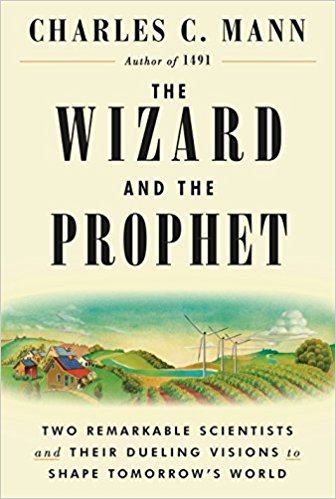
I was reading The Wizard & The Prophet by Charles E Mann on a crowded train one evening, and a pair of young girls shared the seat with me. The name of the book is a highly appealing one especially to little girls, and it piqued their interest too.

One of them was probably in the 1st or 2nd grade, and showed a precocious interest in my reading material. Her curly hair was made into numerous tiny plaits, and her eyes shone with a curiosity that would make her teacher’s heart sing. Her mother’s heart though, quailed. She said, “Now…now don’t bother the nice lady there, let her get on with it. “ I looked up at the mother, and told her that I love reading to children, and though this particular book sounds pedantic when read to children, I did it anyway. It taught me never to under-estimate children – the child soaked in everything, and asked the most engaging questions.
wiz_prop

I saw a certain amount of editing would need to be done if I were to sustain the interest of a 6 year old. The book is a non-fiction tome going strong at 678 pages – pages richly adorned with facts and figures, and life histories of all the people involved. I had already been through about 300 pages, so I knew the interesting bits, I knew the bits where a child’s wonder can be kindled. For the rest of the hour, I told her about wheat strains, water tables, and climate change.

The Wizard & The Prophet is a marvelous title because it encapsulates the polarity of our thinking so beautifully, and in this sense, they are both required for us to thrive. The Wizard in the book is Norman Borlaug, who is credited with leading the way for GMO strains of wheat production that along with stalwarts in the field such as Dr M.S. Swaminathan saved billions of people from hunger and starvation. 

William Vogt is the Prophet, who during his study in the Mexican coastal areas observed how we are stretching our natural resources and the effects it has on things as far-flung as bird migratory patterns and climate. In many ways, he is the one who set up the first bells of Global warming and Climate Change. He is the Prophet.

Do you believe in Climate Change? asked the girl wide-eyed.

I told her I did not need to believe Climate Change at all, and the experiments were here to show me how we are changing the air around us, and I showed her the pages outlining the experiment where humanity managed to pin down Carbon Dioxide as the problem-maker in the first place. 

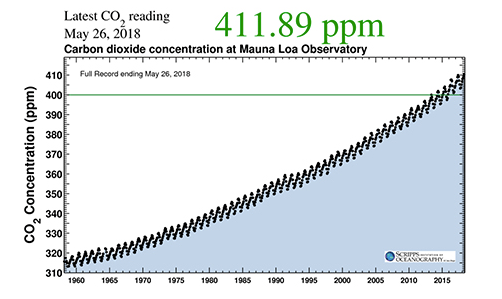
I cannot deny that global warming and climate change has always intrigued me. Carbon Dioxide only accounts for 0.03 % of the atmospheric gases, a remarkably small proportion for it to be causing global warming on such a scale as to change weather patters and cause severe climatic catastrophes, is it not? 

In The Wizard & The Prophet, the author outlines the experiments used in determining that it is indeed carbon dioxide that is the culprit and how our industries are directly contributing to its increase. The correlation between carbon-dioxide levels increasing and global warming followed. I found it a fascinating experiment and one that school laboratories can demonstrate I hope. 
Keeling_Curve
By Scrippsnews [CC BY-SA 4.0  (https://creativecommons.org/licenses/by-sa/4.0)%5D, from Wikimedia Commons
https://en.wikipedia.org/wiki/Keeling_Curve

(During the spring, there are dips because the Arctic tundra sprouts plant life and plants absorb Carbon Dioxide from the atmosphere. )

Looking at the worried expression in the child’s face, I asked her, Did she know what we can do to reduce the carbon dioxide?

Trees? she said, and I nodded yes.

I went on to tell her about the excellent example set forth for us by the Kenyans in The Green Belt movement, and how a person called Dr Wangari Maathai helped the Kenyans plant millions of trees over the past 30 years.

Planting the Trees of Kenya, by Claire A Nivola, The Story of Wangari Maathai

Planting the trees of Kenya - Wangari Maathai
Planting the trees of Kenya – Wangari Maathai

She glowed at the simple solution thought of by Dr Wangari Maathai, but her stop had come, and she stepped off the train with her mother who was now listening to her daughter talk to her about The Wizard & The Prophet.

As I reflected on the chat with her, I realized that the narrative around Climate change and Global warming is quite confusing.  It is no wonder that the child framed her question as – “Do you believe in Climate Change?” The prophets in this case are doing their job, but the question of : “How does one realize when an extreme storm or flood is part of a natural occurrence and when it is a direct result of our tampering with the delicate balance of the climate?” is a vexing one.  

The Prophets have sounded the alarm bell often enough, and the Wizards have yet to think of a sustainable solution to it. But there is hope: I am glad to read that China proposes to plant and nurture a forest the size of Ireland to reduce carbon emissions and improve air quality. 

China to create new forests covering area size of Ireland

cropped-shasta_forest.jpg

A Life Well Lived

One of my earliest memories were of sitting next to the grand old man and pressing the mole on his hand. It was a button, he said, that made him laugh. Every time I pressed it, he sent a shiver down his body and laughed. That is the kind of game that cannot ever tire a 4 or 5 year old child. I’d press the button at random times hoping to catch him off-guard. But the button always worked. It even worked last year when I showed the button to my little son as an adult. The great grand old man laughed.

He was known as Pattu-Mani, a loving nickname given to the bluish—gray-eyed handsome boy with a twinkling smile and pleasant personality.

He was the closest my mother had to a father. (How I Mother Saw Her Father)

Pattu-mani maama
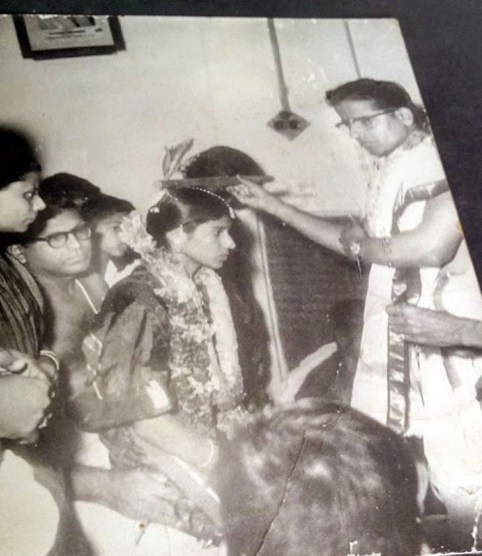
My Mother Being Given in Marriage By Pattu-Mani Maama(Kanya Daanam – usually given away by the girl’s father)

I remember listening wide-eyed to the stories of my maamas (Pattu-mani and Ambi as they were popularly known) and how they raised and educated my mother, their little sister. (My mother was the last born in a family of seven. When she was 3 years old, her father passed away. A shock that left the family bereft, and sent their mother into a decline from which she never recovered. )

The one who regaled the story was often my father. He was the story-teller in the household. In his stentorian voice, he would go on to narrate how they educated their sisters making them the first graduates in their village, in a time and age that girls were married off before completing high school.

These people were the true heroes of the #HeForShe movement.

The same loving, doting aunts and uncles who bathed us in the warm glow of their smiles were heroes?

As a young girl, I cannot quite describe the impression it made on me.

Clad modestly in cotton dhotis with no fancy degrees or awards, living lives of modest means in normal houses with dignity and self-uplifted from poverty; the ideas of personality, achievement and greatness conflicted with the world’s idea of greatness. Was it not always associated with wealth and fame?

Confusing as it all was as a child, it helped me understand that greatness comes in so many shapes and forms. It helped me understand that life is unfair, but we have to fight fairly anyway. That there is no correlation between (wealth, fame), and (wisdom, greatness). Sometimes, the wealthy and famous are also wise and great, but not all wise and great people are wealthy and famous.

So, what constitutes a worthy life?

pattumani_maama3

Is it in the fact that every one of us nieces, nephews, and grandchildren felt they were special to him?

Is it in the fact that the entire town showed up to say farewell to him when he died last week? The very town to which he came barefoot and penniless, looking for work as a teenager after his father’s sudden death.

Or is it in the sparkling affection behind the smiles he bestowed on those around him every time?

All the world’s a stage, and all the men and women merely players: they have their exits and their entrances; and one man in his time plays many parts. William Shakespeare

Here is to a man who played every role well, who made the show enjoyable for all those who had the privilege of sharing the stage with him.

My heart aches, my eyes tear up as I hear things like ‘end of an era’, ‘great soul’ etc. Maybe his parting gift is the meditation on what constitutes a good life, and working towards the very qualities he embodied.

TED Talk on a Worthy Life: here

The past few days have been a glorious recollection of a life well-lived.

A life that shouldered responsibility with élan
A life that never questioned sacrifice and duty
A life that gave and accepted love
A life whose inner light lit the world around him
A life that showed us how extraordinary an ordinary life can be
A Life Well Lived.

I have a small birth-mark where he had a mole, I propose to make that my laugh button. My way to remember Maama and to remind me to laugh when life gets me down.

pattumani_maama2

I love and miss you dear Maama. Thank you for your influence, your love and your beautiful presence in our lives.


Hero-Worship, Nicomacean Ethics & Baloney Detection Kits

I have heard friends rave about Dune by Frank Herbert many times over the past few years. I finally got to read the book, and I feel richer in mind and thought for it. The book was long and at times hard to keep track of (especially in the beginning). This is one of those times when I realize how my mind flutters with attention spans that drive calm butterflies to frenzy. But slowly, steadily, I settled into the book, and there were multiple moments when I felt like I must grab a pen and start writing (but that stern butterfly gave me a look, and kept me at my the task of reading). This, is probably the reason I have forgotten half the things I wanted to write about (This is where I glare back at the butterfly guardian who kept me reading)

Dune-Frank_Herbert_(1965)_First_edition
First Edition Cover – Image from Wikipedia

One of the many things that appealed to me in the Dune was the fact though there were vague references made to technology and the number of technological devices used by those living at the time, it is not a mainstay.

The book is a multi-layered piece of literature with over-arching themes of ecology, the art of war, religion, philosophy and politics. There is a particular quote that stuck with me in the Prologue written by Brian Herbert, Frank Herbert’s son, about the dangers of hero worship.

Quote:

As Liet Kynes lay dying in the desert, he remembered the long ago words of his own father: “No more terrible disaster could befall your people than for them to fall into the hands of a Hero.”

Having studied politics carefully, my father believed that heroes made mistakes…mistakes that were simplified by the number of people who followed such leaders slavishly.

In many ways, hero worship is what leads people to choose leaders who then turn into despots and dictators. Adulation affects everyone, and those with fragile egos are the most prone to its lure.

Towards the end of the book, Paul Atreides recognizes that he is being hailed as the Messiah and regardless of his acceptance of the title, there is a holy jihad in his future. He can either lead to the best of his abilities like his able and excellent father, Duke Leto or simply be the mascot of a movement that has already gathered momentum – a force that is much larger than him. This sort of trusting faith in one human being is never a good sign, and is a malady that has affected us for centuries. 

I quite agree with how Aristotle describes the nobility required of politicians: he opines that politicians should take an oath, almost as sacred as a Hippocratic oath, to remain fair and mete out justice. From the Nicomachean Ethics – By Aristotle. 

The lecture on Aristotle and Socrates on How Does One Live The Good Life? From 36 Books That Changed The World (Chapter 8) is an excellent listen.


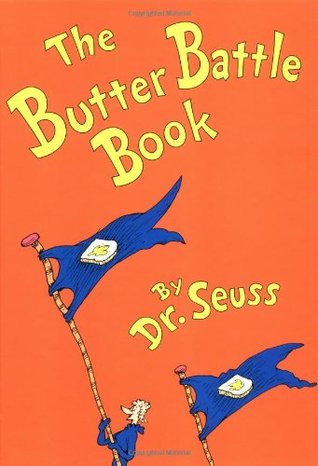
There are no initiation courses for politicians. No training. Though, I have a suggestion to have every politician complete the Butter Battle Course, it is unheeded. (The Butter Battle Course is an excellent course consisting of childrens’ books not more than a few pages each, and should only take a few moments of every leader’s time):

butter_battle

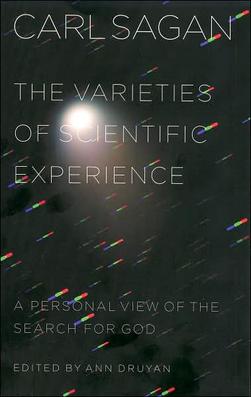
However, till politicians start taking their careers to truly be in service of humanity, we need to equip ourselves with Carl Sagan’s excellent Baloney Detection Kit from the book: The varieties of scientific experience : a personal view of the search for God / Carl Sagan ; edited by Ann Druyan. This book contains the Gifford lectures given by Carl Sagan in 1985.

The_Varieties_of_Scientific_Experience
By Source, Fair use, https://en.wikipedia.org/w/index.php?curid=28513011

When someone asked Carl Sagan after his lecture what we can do when the governments do not act in our best interests, he advised us to have Baloney Detection Kits handy.

Quote:

“I would say that the first thing to do is realize that governments, all governments, at least on occasion, lie. And some of them do it all the time – some of them do it only every second statement-but, by and large, governments distort the facts in order to remain in office.

And if we are ignorant of what the issues are and can’t even ask the critical questions, then we’re not going to make much of a difference. If we can understand the issues, if we can pose the right questions, if we can point out the contradictions, then we can make some progress. There are many other things that can done, but it seems to me that those two, the baloney detection kit and use of the democratic process where available are at least two things to consider.”

This seems to be age old wisdom: our oldest myths write about flaws in heroes, what brings about the downfall of the most powerful tyrants  etc; and yet, the reminder for our own Baloney Detection Kits is a timely one.

Books:

  • Dune – Frank Herbert
  • Varieties of Scientific Evidence  – Carl Sagan 
  • Nicomachean Ethics – Aristotle
  • 36 Books That Changed The World – Lectures on Great Courses
  • Butter Battle Book – Dr Seuss

The Chance To Catch A Deep Breath

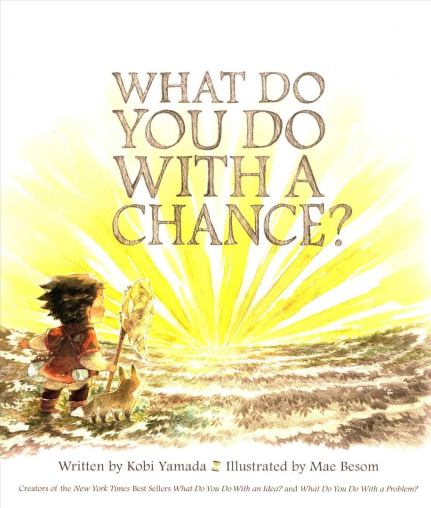
What Do You Do With A Chance? Written by Kobi Yamada and Illustrated by Mae Besom, is a insightful read on a young boy who sees a chance, and decides not to take it. The chance flutters by him, and he misses it. 

images

What Do You Do With A Chance – By Kobi Yamada, Illustrated by Mae Besom

The next time, he decides that he will not let a chance pass by him again, and he reaches for it as it flutters tantalizingly by him, but this time, he falls flat on his face, and is laughed at by the other children.

So, he refuses to entertain chances again. They flutter by him multiple times, but he turns his back on them. Slowly, they stop fluttering by.  Time goes on, and he starts to yearn for a chance, This time, he thinks, come what may, he will grab on and go wherever the chance takes him. 

The chance does arrive eventually, and it is a huge one. A bright shining illuminance that lights up everything nearby, and he jumps on, and soars watching the monochrome world around him explode in technicolor.  

Like all good children’s books, this one made me wonder too. 

How often have we missed chances? It is one thing for a book to beautifully illustrate a chance, but quite often the chances we miss are not always that beautifully illuminated in the landscape of our life, except perhaps in hindsight.  Sometimes chances come in the guise of problems, and they transform into opportunities. Sometimes chances are so common-place you barely recognize them at all. Sometimes, a chance comes in the form of slowing down, catching a deep breath and taking a glimpse of the world around us.

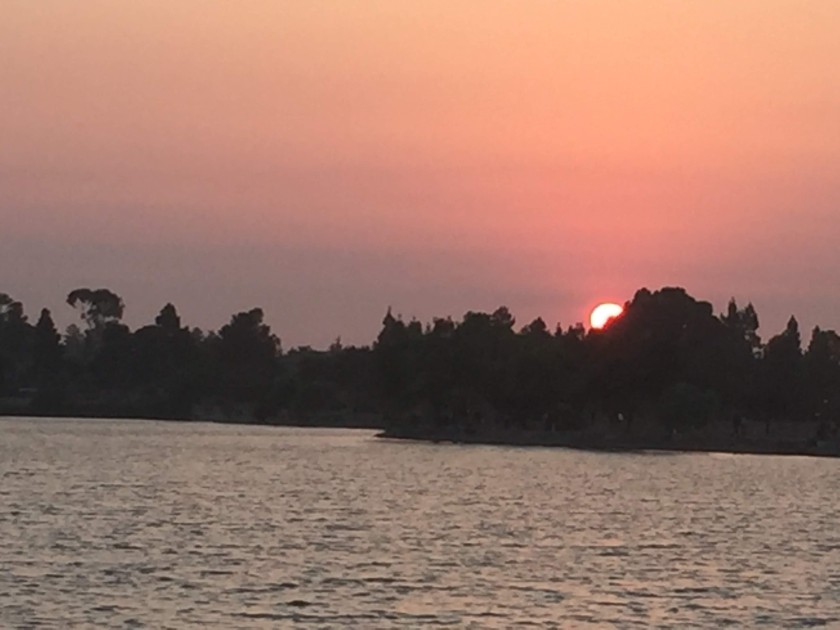
Take for instance the time I was running around a lake, watching the sunset throw its myriad patterns on the lake waters. It was beautiful and fleeting. My pounding heart was pouting at this sudden enthusiasm for fitness. I myself was quite miserable. Running can be quite the mental exercise: the mind jabbers on:

Why does it have to be so hard? Really, after all this time, has it only been a mile? So slow, I could have beat myself if I had been 5!

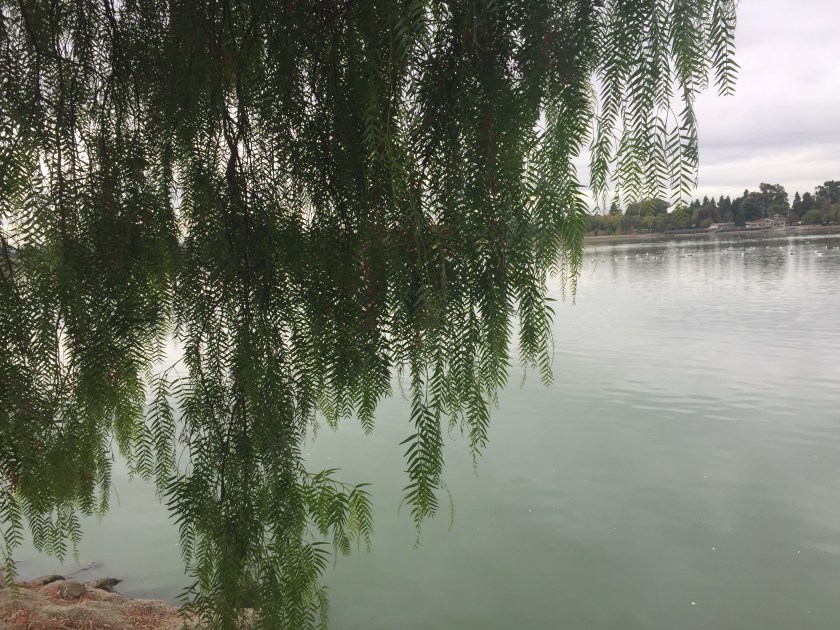
Then, I looked at the shining lake waters and chided my brain for being such a wet sod, took a deep gulp and pushed on. But after a few miles, I stopped by my favorite pepper willow trees. I had been running around the same spot, and yet, I had not noticed so many things. It was as though my senses suddenly woke up when I stood still. I could feel the evening breezes lift off the stray tendrils of my hair, the sun’s rays seemed magical: sunset orange is a lovely color, and the way it transformed the clouds in the sky was beautiful. Breath-taking as it was, its true beauty lay in its very essence of being ephemeral. 

img_0111

Dandelion Wine: A Sunset is only beautiful because it doesn’t last forever. – Ray Bradbury in his book, Dandelion Wine, when discussing the Happiness Machine.

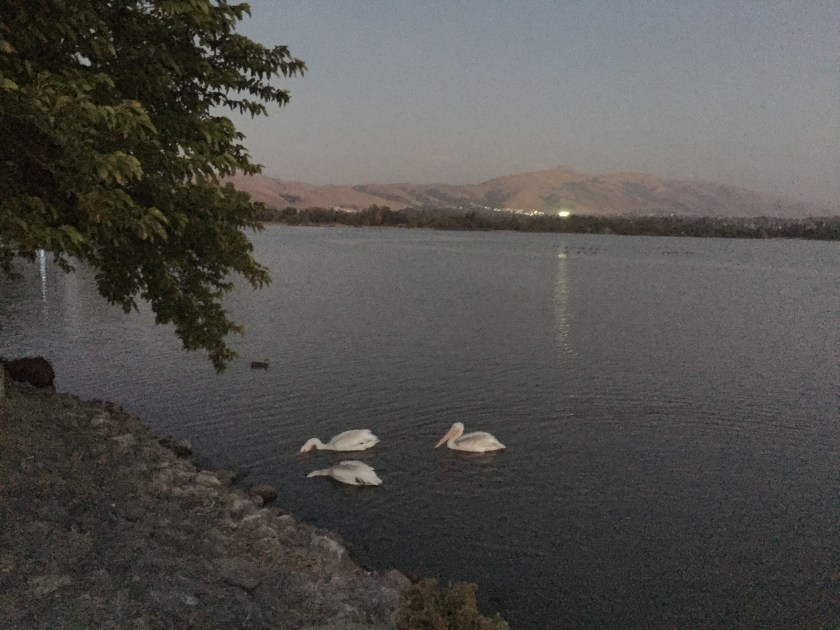
I watched the pelicans go about their evening business of co-ordinated fishing, small groups of geese were making their way back to the lake, landing together smoothly with the most melodious sounding splashes, and a fluidity of movement that would have made any pilot look on with awe.

We are lucky indeed to be able to stop and enjoy nature. As humanity huddles more and more closely in densely populated urban areas, we seem to have squeezed out these natural pleasures. For decades now, people have flocked to cities in search of livelihood. What option is there otherwise? Cities get larger, people cluster closer together physically and yet farther apart emotionally. How many city dwellers know all their neighbors?

img_0118

I looked at the pelicans and geese spotting the lake as they settled down to roost for the day. There was companionship there. The pelicans were steadily drifting towards me – together, gracefully, and I could not resist going to a vantage point by the willow tree. I have always loved how these trees look like princesses, letting their tresses down in the stream – looking joyful, and serene to let the flowing water tickle the hair-tips, even as the breeze caresses their locks. 

Nature, the soother, had worked her magic again, and my heart bloomed and expanded with joy. Sometimes a chance flutters by and you need to stop and take a breath to catch it.

IMG_7145.jpg


The Lentil Chips Shine Down

The excitement in the bunch of children gathered was palpable. They were united by a sense of wonder and pleasant anticipation. Were they really going to be able to touch the telescope, and see something remarkable? A bar stool had been borrowed from a kindly neighbor and the little telescope was perched on it. An earthworm like line was formed with the children waiting to get a turn at the telescope. It was as wiggly and restless as an earthworm, and just as fascinating to watch from a safe distance.

mars_watching

Mars in the distance shone with the iridescence of a star. Mars has been exceptionally bright in the evening skies, and the Mars viewing party was happening on the week it was closest to the Earth.

Mars has fascinated mankind for centuries. It started with hoaxes of finding extra terrestrial life on Mars: maybe those rigged lines on the planet were canals? said a 19th century astronomer, and from that hypothesis, sprang a vibrant story of alien life. In our enthusiasm to find extra terrestrial neighbors, the populace went along. That kind of hope is refreshing even if misguided. 

https://en.wikipedia.org/wiki/Life_on_Mars

Tonight the telescope we had with us was only as big as a professional camera, and I hoped it would not disappoint the children gathered.

While the telescope was being deftly handled by the husband, I diverted the attention of the children skyward. Their questions about progress were distracting the misguided astronomer who was pointing the lens towards the stile on our neighbor’s roof, and wondering how he could see things fluttering there (I pointed to the sycamore tree nearby that had shed a few of its leaves on the stile, and crushed the poor fish’s soul about finding extra terrestrial life on Mars. Andy Weir might have imagined potato cultivation on Mars, but even by his standards, a sycamore tree was a leap, I told him kindly. He guffawed loudly at this and fiddled on.)

https://en.wikipedia.org/wiki/The_Martian_(Weir_novel)

In the meanwhile, I pointed out the familiar constellations to the hopeful looking children. The budding astronomers were skeptical. 

‘How do you know it is Big Dipper?’ 

‘It could be anything or nothing’, said another, and quickly the pendulum swung from hope to disillusionment. I managed a quick save by not letting it swing too far, and told them about the excellent app, Skyview, using which they could confirm the stars for themselves. The older teenagers who had smartphones for themselves were suddenly beset upon to share the marvels of the night sky. 


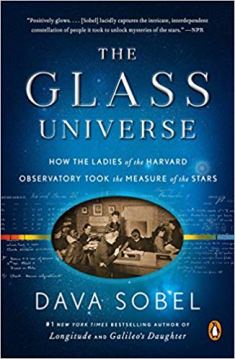
Cecilia Payne would have been proud indeed of the motley group of astronomers gathered in our driveway. It is marvelous to see how the work of early astronomers & physicists set the base for us to be able to map the skies and predict the movements of stars and planets.

glass_universe

The Glass Universe

Book recommendation: The Glass Universe by Dava Sobel

“Oh look!”, said the Big-Dipper-doubter, pointing the phone wildly at the sky, “the moon, the moon!”. 

An experienced hand said he had seen the moon before and there was nothing remarkable about it.

“But it is so beautiful!” said another sounding reproachful at the dismissal of the beautiful moon, and I agreed. The moon has exerted her pull over mankind almost since the beginning of time. Even if we do see it everyday, the moon has a poetic beauty all of its own. That night it was looking achingly beautiful. 

Maybe it was the effect of the scintillating talk I had the privilege of attending earlier that week.

I have never had the opportunity to listen live to a TED Talk. But that week, I had listened to a very TED-esque talk by Jon Carmichael the cosmic photographer. He shared the beautiful story of how he photographed the full lunar eclipse a year ago with the help of a Southwest crew. 

jon_carmichael_speech

Please listen to the talk on the site if you can.

I was telling the children about the talk, when the husband let out an involuntary yelp and said this time he was fairly sure it was Mars. 

One child gazed into the telescope and said, “It looks like a Papad in the sky.”, and we all laughed. (Papad  – is a sort of flat, round lentil chip!)

The cosmos has a way of uniting us in the darkest of times. Even during the most inane days, there is always a cosmic show that is ready to enthrall us and fill our souls with enchantment. It is why I was so happy to be standing among the children gazing up at the stars, and soaking in the wonders of the cosmic show above me that day. Even if the children did see a lentil chip in the sky, I hope for some of them at least the magic seed was sown. A seed nurtured by the hopeful innocence of youth, tempered by the wisdom of years, with the potential to mature into a star of their own.

When Love is Theratti Paal Sweet

This article was published in The India Currents Magazine for Krishna Jayanthi. Link here: When Love is Theratti Paal Sweet

“Do you remember?”, started an aunt, “how he stuck his hand in the theratti paal * container when the lights went out during Krishna Jayanthi?”

*Theratti paal refers to a heady Indian sweet made of condensed milk, ghee and cardamom

*Krishna Jayanthi – Lord Krishna’s birthday

The story was being related to peals of laughter. The hero of the tale beamed and laughed heartily at his boyhood escapades – it had all happened about 70 years ago after all. We knew the story, but it did nothing to diminish the retelling of it. I already knew my father was the naughtiest of the 9 children borne by Visalam Paati and Kalyanam Thaatha. (Paati – Grandma; Thaatha – Grandpa)

I sat watching the glow on the faces around the table, like an eternal torch lit by the essence of shared times and space of childhood. There was genuine affection, laughter and love there, and it enveloped all those around in its warm embrace. We had been to visit our aunts in Atlanta. The septuagenarian father has two septua sisters who live there, and I went with him to enjoy the siblings get together. I watched indulgently as their laugh lines etched over the years crinkled with every anecdote. 

His sisters and nieces had lovingly charted out the menus for a whole week. A week that included all of the father’s favorite dishes. Dishes remembered from childhood, dishes acquired in far off lands, and dishes that made my paternal grandmother, Visalam paati, come alive in the retelling of the process. The delectable snacks and the satisfying compliments such as, “You have your mother’s gift with the art of cooking.” flowed graciously.  The brood of Visalam and Kalyanam were known for their sweet tongues, and every meal had a different dessert to go with it. 

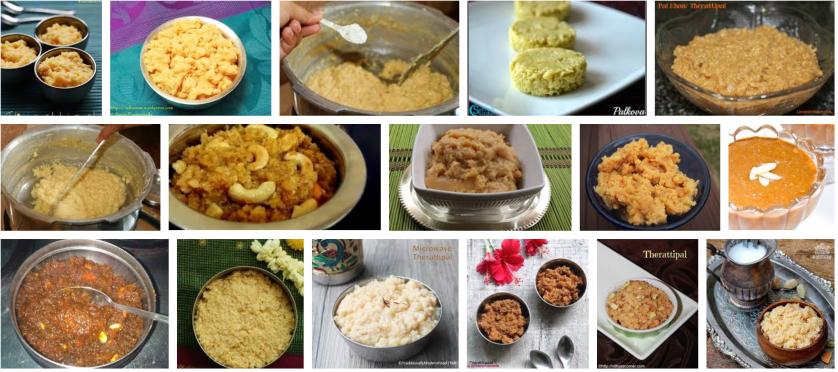
The sweet of this meal was theratti paal. It’s commercial cousins are called Milk Peda, but it is an unpoetic name and as a sweet is a poor substitute for the Theratti Paal. Theratti paal, when made on the stove with fresh milk takes hours to come to the right consistency. I can imagine how Hinduism came to have the myth of churning the milk ocean. There are so many milk based sweets in the land, and it is quite possible that that particular myth was the gift of the dreamy subconscious thoughts of some person making theratti paal hours at a time. One can go into a sort of meditative trance as the milk gathers its cream, and then folds and bubbles again, and then again and again, till the color changes, the consistency changes, and the sweet smell of condensed milk wafts through the air. In slow measures, one adds the sugar, butter or ghee and the cardamom to send those in the vicinity to realms of ecstatic waiting. 

Screen Shot 2018-08-17 at 10.32.21 AM

Today the same marvel can be obtained from a can of condensed milk, a stick of unsalted butter, and a microwave in under 10 minutes, and I felt the tongue dance and explode in joy as the microwave theratti paal melted on the tongue. The ghee, condensed milk, and cardamom all tickled the nostrils. 

I remember listening to stories about her children from my grandmother, Visalam Paati. (Visalam means vast, and the name suited her. She was generous with her time, attention and her servings, and when one wanted to play with the jiggling oodles of arm fat, there was plenty of that too and she never once got irritated when we teased her about her bulk. ) Feeding and taking care of a brood like that makes me shudder, but Visalam paati seemed to have done it with love, competence and skill. 

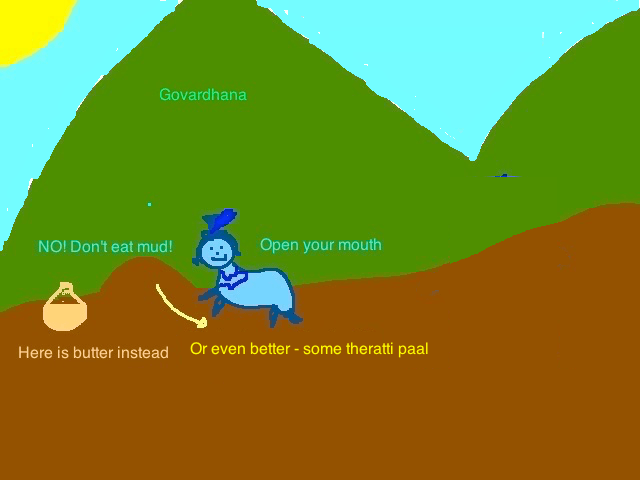
The tale being narrated was the one on Krishna Jayanthi. Krishna, Lord Vishnu’s avatar, is said to have loved theratti paal. 

krishna_therattipaal.jpeg

Apparently, the evening pooja was ready to start. Bowls of snacks: (mysore pak, payasam, thattai, seedai, murukku, theratti paal), butter and ghee were all placed in front of the Gods, and just before the offering to the God was complete, the electricity went out plunging the little village house in South India in the 1940’s, into a darkness lit just by the flame of the small wicker lamp near Lord Krishna’s deity. Visalam Paati having the kind of prescience that comes from raising nine children immediately placed her hand covering the theratti paal container. True enough, within seconds, a small hand struck at the theratti paal container – Visalam paati caught the hand, and waited for the lights to come on again. Just as she thought, the malefactor was none but the naughtiest of her brood, my father. 

“I knew you will reach for the theratti paal. Little rascal! “ she said. 

We all laughed heartily while spooning in some more excellent microwave theratti paal ourselves. 

The smells and scents of ghee, condensed milk and cardamom cut across decades and the siblings sat there giggling like school children again. 

Isn’t it marvelous how regaling our pleasant memories often transforms the bleak horizons of time to become as brilliant as the Milky Way studded with the shining moments of our memories?

Next week is Krishna Jayanthi, and I will go about the joyous task of drawing tiny Krishna feet from the doorstep to the kitchen. I shall make the microwave theratti paal, and think of the children in the 1940’s who shared the adventure of theratti paal, and waited the whole afternoon for the exotic taste of it in the evening. I shall regale the children in the twenty-first century with the story again, and smile indulgently at the fact that his sisters remember their naughty brother every time they eat theratti paal.

Love takes various shapes. Ours is sweet. Theratti paal sweet.

Life is a Circus

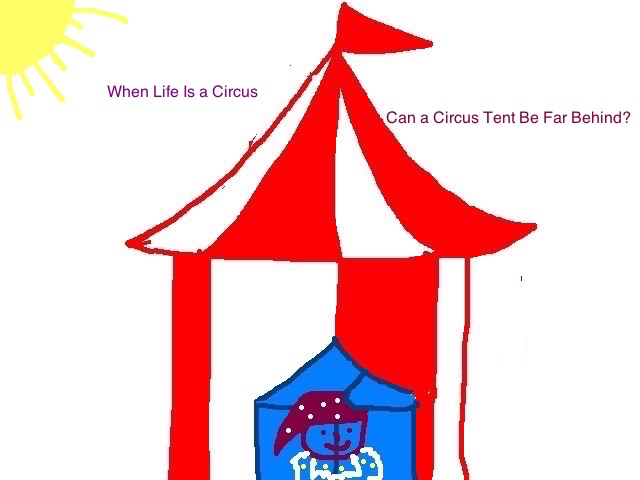
This article was published in The Hindu Open Page dated 19th August 2018, with an excellent cartoon by cartoonist Surendra  . I love the illustration of the mother (me) sitting like a circus elephant on a stool and looking fondly at the clown in the tent!

When life is a circus, can a circus tent, be far behind?

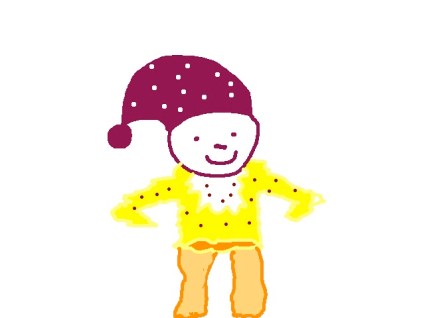
That’s what I tell myself everyday as I walk into the home. It helps me cope. You see as soon as I walk into our modest home, apart from a heavily used sofa set (on which I seldom find place to sit when I want to, because it is overrun with books, stationary, toys, papers and coats: relax! It is summer – Chill!), and a dining table (which has not an inch of real estate to spare, what with the pater claiming it as his office on which his laptop and assorted junk sits and the mater using it for her sewing machine and her sewing needs), one also finds a red circus tent with a clown inside.

clown

It was meant to be a fortress – a haven of peace and quiet in a noisy world.

It all started with a sales pitch one evening. The son was trying to sell me a fort. The little fellow was going the salesman on me. I suppose it is frustrating if a customer does not bite. The evening sun shone on his eager face and his voice chirruped louder than the birds. Folks stopped by to see what the furore was about, and wondered why I was being unreasonable about buying a fort. 

Before one runs off with the idea that I buy forts and palaces in my spare time, I must assure you that the fort was going to be engineered with paper, and tape borrowed from, that’s right, from me. I poked holes at the plan dubiously, and tried telling him the obvious answer, “I don’t need a fort!”

“You said you did not need that sheet set, but you bought it, and now you like it. Like that, once you buy the fort, you will like it.” he said.

Fair point, but I got to tell you, a sheet set and a fort are not quite the same things.

“But I am quite happy in our house, why would I need a fort?” I asked. 

“It is your own place to sit, and relax and do stuff Amma. “ Painted that way, the fort did seem appealing. I mean I do crave for a little quiet every now and then. A fort that is my own in the middle of all the everyday drama sounded marvelous.

Sweet are the thoughts that savour of content;
The quiet mind is richer than a crown. – Robert Greene

“But where will you build the fort?”

“Inside the house of course!” said the architect and I quailed. The house is barely big enough for our needs, and when folks come, I land up frantically shoving things into closets and hope no one opens them to have stuff tumble out on them. I certainly don’t have the kind of spare real estate required for building forts in them. 

But the little beaver would not back down. “It will upgrade our house. Remember you gave that man money for putting tiles in the bathroom? He upgraded the bathroom right? (Subject for another blog post) Like that, I will build you a fort and upgrade the house, and you pay me money.”  

This discussion went on for a bit, and things reached an impasse. I hoped the passage of time would make him forget and so on, but I should have known better. When fate socks me, it socks me with a big red flapping hand.

A couple of days later, the son and I were enjoying some down time together while the rest of the family went to Ikea for some shopping.

Imagine my chagrin when they trooped home with a surprise for the beaver. “Your very own tent – ta da da da! “ proclaimed his protective sister, and the fellow hugged her as hard as he could every chance he got for the rest of the day. He invited us into his tent, and it was soon forgotten that the tent was supposed to be made for me.  

circus_tent

So, now there he sits at every opportunity he gets. Last night, I found a pillow I’d been looking for in the tent: he took it in there to lie down and read a book. 

Interior designers may shudder at the aesthetics of it, but the clown inside is immensely happy.

Solitude by Lewis Carroll

I’d give all wealth that years have piled,
The slow result of Life’s decay,
To be once more a little child
For one bright summer-day.

IMG_8187

See also:

The Land of Crumpled Cardboards


Zephyr Tales

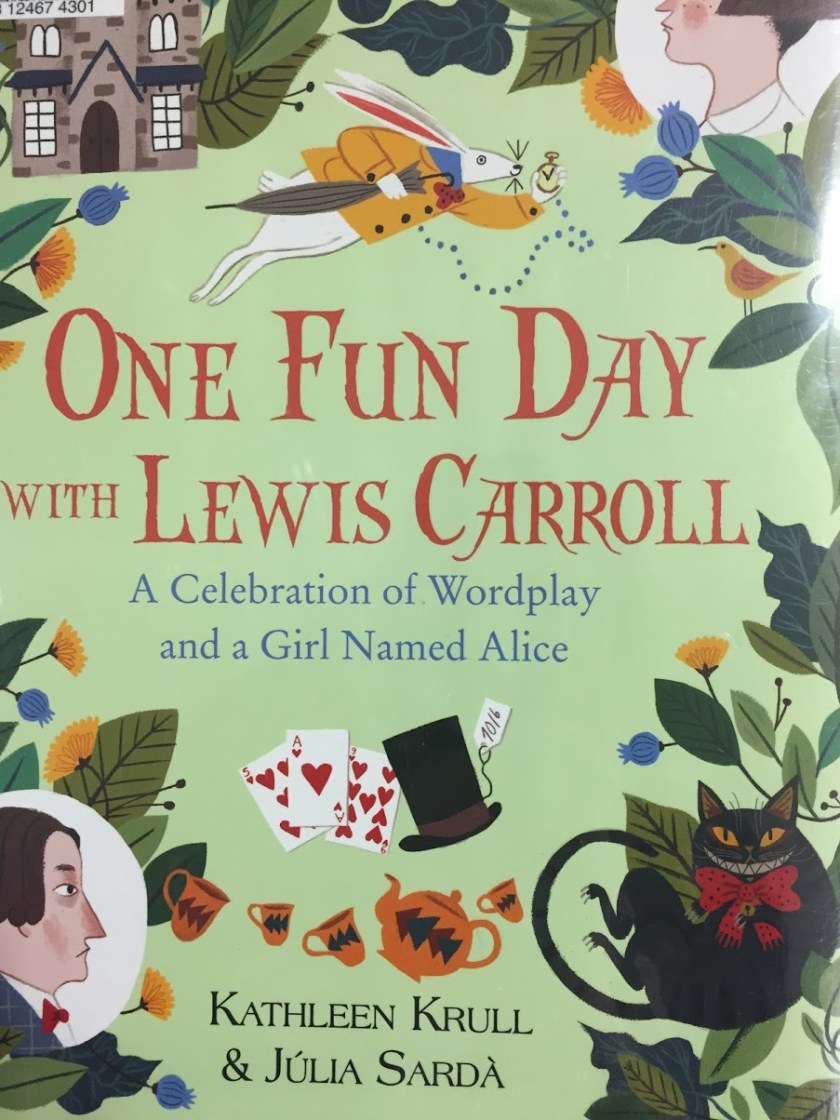
A few days before our trip to Iceland, I was reading a beautiful book on Lewis Carroll, One Fun Day with Lewis Carroll – A celebration of wordplay and a girl called Alice, and how the world was gifted with Alice’s Adventures in Wonderland. The book had exceptional illustrations and I found myself looking longingly at the pages multiple times over. Written and illustrated by Kathleen Krull & Julia Sarda, the book lets us peek into the journey of Lewis Caroll, and his particular penchant for finding words when the English language fell short.

IMG_8187

What was fabulous and joyous at the same time? Why ‘Frabjous’ of course.

I thought of this book while running down a mountain in Iceland. I was in a magical place and everything around me felt surreal. I was also reveling in the spurts of fresh air, reminding me every now and then that I was not in a dream. So, I suppose I could not really be Alice scuttling after a rabbit, though….I was running behind a friend whose physical fitness is legend in our little circle, and before I could say “Ho!”, he had loped easily ahead of me like a rabbit in a waistcoat. I was lost in the beauty and strangeness of the world around me, and kept on.

IMG_8730
Just as a sample of the brilliant art work in the book, please check it out.

Uphill, it was torture. I was wearing multiple layers of clothing, and huffing and puffing like puffins in a marathon. I plucked at my scarf, petulantly tugged at my jacket, and tied it around my stomach, and kept running. The marvelous scenery around me was ever so slightly befuddled by the mambo drums in the heart.

Downhill however, it was marvelous. I could feel the cool breeze on my face. Knowing that I had a gushing waterfall on the right, and a huge glacier to the left helped. The weather had become cooler, and the clouds that ordinarily I would have found beautiful were now stunningly beautiful.


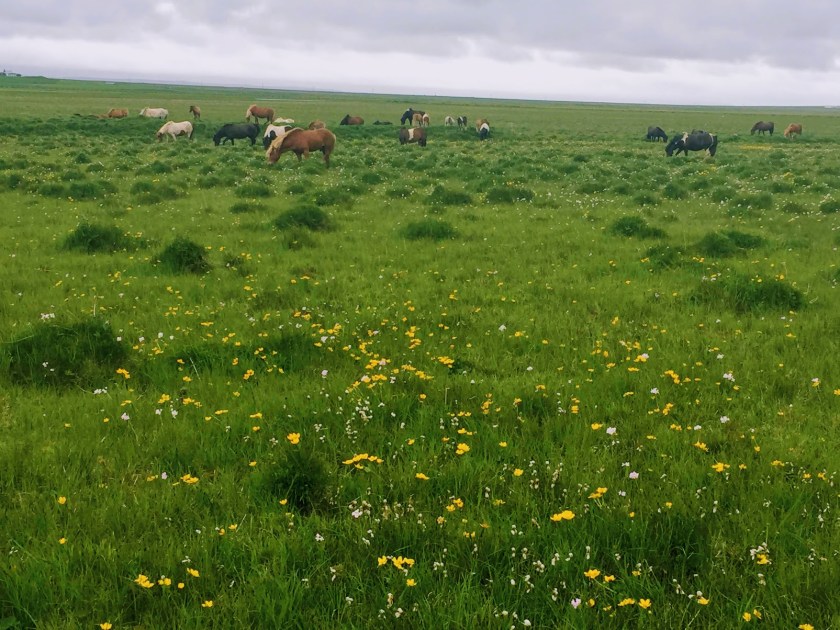
Isn’t there a beautiful word that describes the heady feeling of feeling the cool air against your face as you run downhill? Zephyr was the closest word I could think of.  Could horses have something that captures this particular joy? Maybe in the timber of their neighs.

horse

Exultant, I kept running. There is nothing in the world that can take that feeling from you, I thought, and smoothly tripped on a pebble, and did a routine that could be incorporated in to the next vaudeville act.

In a place where the winds are ubiquitous, there must be many words for describing the wind. I looked up words for wind in Icelandic and I was not disappointed to see 56 distinct words. (Counting Icelandic Words for Wind (JóB))

The search for this particular word led me to other beautiful ones though. Psithurism, for instance. Describing the sound of the wind rustling through the trees, I often stop and listen for this marvel during walks. Some others here:

A Nemophilist’s Orchestra

In the cathedral of the trees,
The bells of the wind
Like perfect music sounds
Accompany our montivagant joys.

Maybe we do need to follow Lewis Carroll’s wisdom and come up with a new word for the wind beneath your wings or the wind on your face.

P.S:
Nemophilist – a haunter of woods, one who loves the forest for its beauty and solitude
Psithurism – describing the sound of the wind rustling through the trees.
Montivagant – wandering over hills and mountains

Dragons of Fire & Ice

“What is your favorite dragon amma?” asked the son as we made our way to see an active volcano. Dragons follow a long line of illustrious characters such as Lightning McQueen, Ninjago – Masters of Spinjitzu. They come and claim his interest and imagination in ways that make me envious at times. How do children play so wholeheartedly?

I mock-sighed and said, “Aaah! Not dragons again! Fine! Nature Dragon is my favorite.”
“Which dragon are you scared of?”
“Volcano Dragon!”, I said. Given that we were going to see an active volcanic region, it seemed like an apt choice. (There is no Snarling Traffic Dragon, I checked.)
He then went on chattering about the shattering power of volcano dragons, and I went back to nodding absently while taking in the physical aspects of the changing landscape around me. (The fellow talks incessantly of dragons and gets cranky if I get the dragons in Dragon Land mixed up with those in Dragon City. I, as you can guess, see no difference between the two.)

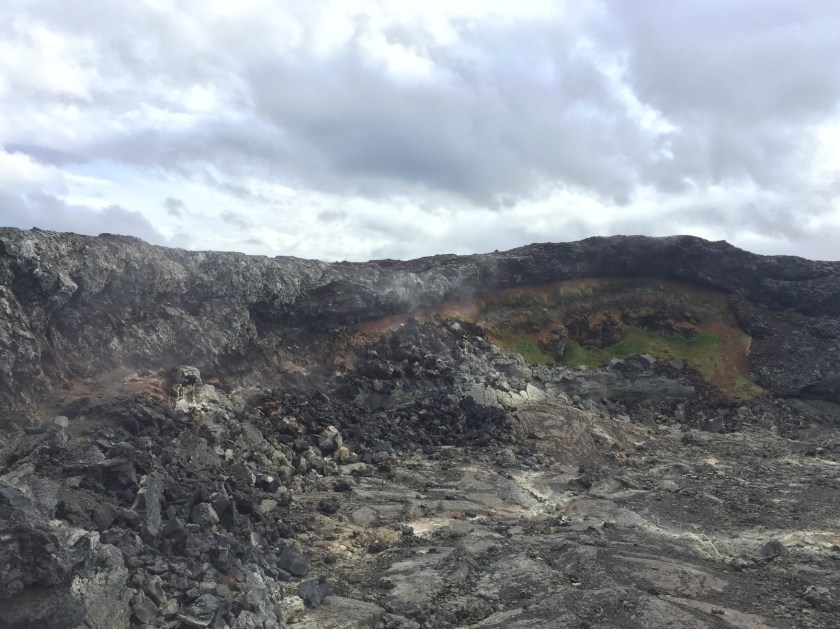
volcano

By now, we were ambling along up the mountainside looking at the damage wrought by the volcanic activity. Thick crusts of lava had solidified along the trail helpfully laid out for tourists. It was a stark image, an image in which it was possible to imagine ourselves stepping gingerly on the back of a troll or a dragon with a particularly hideous hide, that at any moment could roar and spurt fire at the indignity of seeing mere morsels tread on his or her back. The very thought sent an electric shiver down the spine.

Looking at the barren/dry landscape made me think of an episode I had seen on Cosmos on Venus. In his deep rumbling voice, Neil Grasse Tyson explains how Venus was once a planet with a wonderful landscape like Earth, but intense volcanic activity seems to have made it a desolate angry planet trapped in its own greenhouse effect.

The World Set Free (Cosmos: A Spacetime Odyssey)

http://channel.nationalgeographic.com/cosmos-a-spacetime-odyssey/episodes/the-world-set-free/

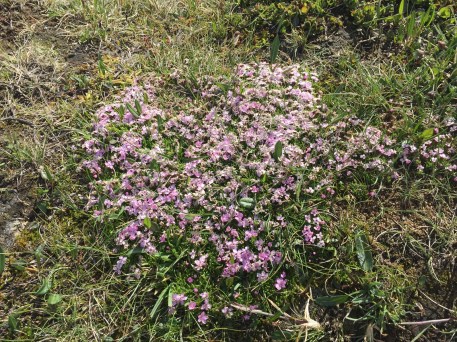
But hope always finds a way of creeping in, in the most unlikely ways and means. A few feet from a still smoking volcano, in which the lava rocks were red hot, around the dense rocks that bore the marks of hardened lava, in that otherwise barren and desolate looking mountainside, grew pink flowers. Tiny pink flowers bravely, cheerfully doing their part in reminding me of the resilience of life and beauty.

volcano_wildlfower.jpg

“So you like Flora then?” chirped the son.
How did he know? I looked surprised, and then realized that the Nature Dragon in his game was called Flora. Everything felt surreal in this place. Were there really dragons?

We had reached the smoking crater by now, and I gingerly picked up a red hot piece of rock in my hands. Was I in a dream or was I really touching hot lava rocks, and watching icebergs cleave?

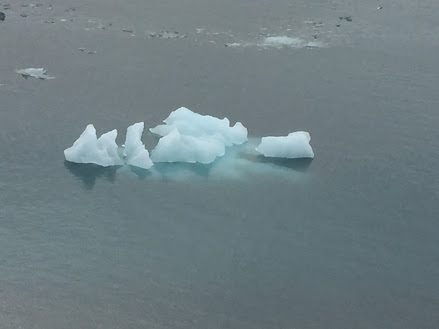
Just a couple of days earlier, we felt a similar sense of awe while watching the glaciers float like icy dragons. One huge ice dragon stirred and with a thunderous roar, cleaved in half from underneath. There is something awe-inspiring in the forces of nature, and it behooves us to remember that our biggest and strongest weapons are no use against the vagaries of nature.

ice

I sometimes visualize ourselves looking like idiots standing bewildered in front of the storms that batter us every now and trying to tell the storms, “Ehh….I don’t know whether you realize this or not, but we have nuclear weapons you know? “

Dashed silly it makes us look, when a little extra rain sends us scrambling.

To me, both surreal experiences had only 1 way of bringing me to reality: An urgent need to find a restroom. The elements of our being are all very well if you aren’t sprinting across lava beds and glaciers looking for a restroom with a desperate child clasped to your hand.

I wonder whether Dragon Land has a shortcut to restrooms.

Read also:

Baða – A Vatn post 
Foss, Ain, Ja, Vatn, Jökull, Sjó
Jörð, Gaia, Bhoomi
The Earth Laughs in Flowers

Foss, Ain, Ja, Vatn, Jökull, Sjó

In a moment of poetic rarity, I daftly said I would break my posts into the Elements of our being (Earth, fire, air, water and space), which means I am now stuck with the strange problem of writing my experiences around water in Iceland in one post.

Now do I tell you about how I bathed like a horse in Reykjavik, or how I much-muchly laid bare my ignorance of this beautiful Earth’s ecosystem as I lamented the cleaving of the iceberg, or how we were convinced an obstinate mermaid had come ashore the beach, and insisted on getting into people’s pictures the whole afternoon?

mermaid

I have to swim quickly past the Icelandic rivers and streams (Ain), gasp like a wasp at the thousands of waterfalls (Foss), warm myself in a sprint by geothermal spas, jump and shiver near glaciers (Jökull), watch a tidal wave sweep past me as I admire the seas (Sjó) and let my soaking in the rain (rigning) all just fleet past.

I can hear you mumble that now, no one feels refreshed by the post on the most sustaining of the poetic elements, and I agree.

I get a faint understanding of what these authors have to deal with when they go and promise a N- book series. Take the Harry Potter series for instance. J K Rowling must have had little choice but to get the books bigger and bigger because she had to fit everything in 7 books.

I now have to delegate all of the important things to be said about these things to the links below:
Did you know how 90% of Iceland’s energy needs are obtained from geothermal energy?

Did you know Icelandic glacial water is so fresh that you can drink it from source with little fear of contamination?

Well, you do now.

We were there in Iceland when Summer was beginning to show her beauty. Even so, more than half our days, there was rain. For a pluviophile, this was marvelous. Everywhere the eye could see, green carpets were rolled out for us to feast our eyes on.

The rain matched the tones of the children. Sometimes, the joyful pattering of the rain was like their perky tones of enthusiasm, the shuddering and heavy downpours were met with “Amma! Do you really want to hike like that? Get in now!”, and other times when the rain could not quite decide whether to pour or drizzle, the heart was torn whether to go out or stay in the car. These moments of cloudic indecision were the best and I danced and pranced in the rain, while the children adopted a distinct “I don’t know this crazy woman!” stance.

There were waterfalls of every kind and very soon, we stopped pointing them out to one another. We quietly enjoyed the weeping wails of the fjords, as much as the roaring riptides of the beach, and almost as much as the gleaming turquoise blue of the glacial ice pack. Water, in any form, is mesmerizing, tantalizing, energizing and therapeutic.

Well, I suppose I shall at least have to write about bathing in Iceland after all this larking about.