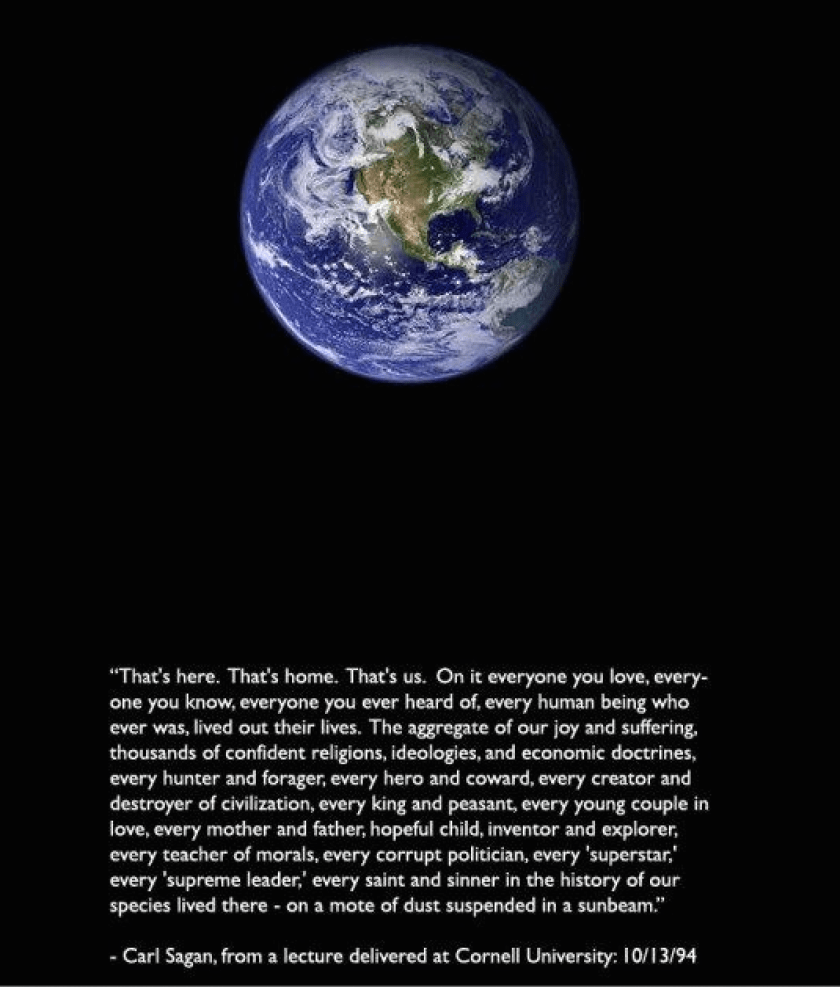
Rainbow 🌈 Conscience

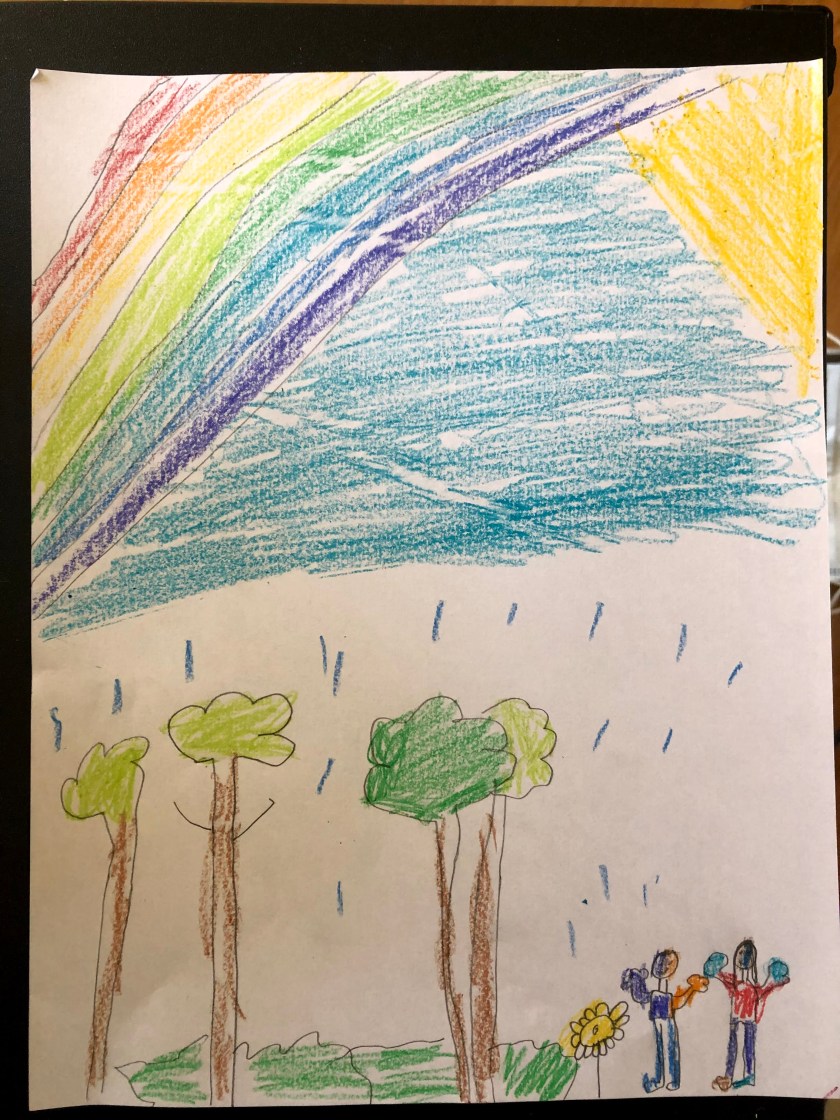
A few years ago when the son was in kindergarten, I attended a class room show-and-tell in which their works of art were displayed. Endearing pictures of zebras, horses and assorted flora and fauna painstakingly done, were being showed off brilliantly by the children. When I drew up close to the son’s painting, I paused. There in the corner of his painting were several people with rainbow colored faces. I loved the idea, and asked him why they had rainbow colored faces, to which he said, “Our teacher said to put colored people in our drawings.”

I turned to his teacher, and she nodded smiling, “Yes, I did for diversity, but I didn’t expect this!” My heart warmed at his interpretation.

I loved it! How beautiful and void of prejudice we are as children.

“No one is born hating another person because of the color of his skin, or his background, or his religion. People must learn to hate, and if they can learn to hate, they can be taught to love, for love comes more naturally to the human heart than its opposite.”

― Nelson Mandela, Long Walk to Freedom

I started reading Henry Thoreau’s book, Civil Disobedience, last week, and I must say the first chapter itself has me drawn in.  “The mass of men live lives of quiet desperation. What is called resignation is confirmed desperation.

A few sentences later he says again, “It is never too late to give up our prejudices. No way of thinking or doing however ancient can be trusted without proof.”

Savoring the sentences and thinking of the rainbow colored faces in the son’s drawing made me think. What would it take for us to learn what it is to be human? It seems to me like to understand deeper, we need to rely on Science: Science as a Candle in the Dark. Any phenomenon not readily understood suffers from the same problems. Could there be a better way to gauge our human-ness?

Structurally, we are containers for cells, possess neurons for consciousness, and use language for communication between one another. But this puts us in no different a category than octopus, dogs, elephants, whales or dolphins. Most marvelous creatures on Earth have evolved from the same set of conditions the planet has been subjected to, and are hence remarkably similar in these aspects. In fact, we are limited in so many abilities than our far-more abled canine friends or bird friends when it comes to smell, colors and noise frequencies.

Here is a fun game to be played by all age groups:
The High Frequency Hearing Game

Quoted from The Soul of an Octopus by Sy Montgomery:

Cambridge Declaration on Consciousness asserts that “humans are not unique in possessing the neurological substrates that generate consciousness”, and that “nonhuman animals, including all birds and mammals and many other creatures, including octopuses also possess these neurological substrates.”

Chemically speaking, I suppose we can attribute Oxygen, Nitrogen, Carbon etc as major components of the human body. But this too, is not unique to us on Earth. Many lifeforms use the same structural elements for life.
Composition of the Human Body

600px-201_Elements_of_the_Human_Body.02.svg
Image from WikiLink: OpenStax College / CC BY (https://creativecommons.org/licenses/by/3.0)

Culturally, we have ideologies so different, yet so similar. Most religions have stories of a big flood (starting from the epic of Gilgamesh, to the Matsya avatar in Hinduism, to Noah’s Ark), our mythologies have similar creatures (how then could we have dragons in Chinese mythology and Norse mythology?) The fossils found in each region seem to have contributed to the myths (Sankhu / Chakra myths originate from nautilus fossils found in the Himalayas). Is myth-making then the only human identifying factor (I don’t think so, for whales songs have tonal informational bits having the same length of an Iliad or Odyssey – some whale songs have been known to be taught from generation to generation and last over an hour long).

wind-in-the-reef

The differences in skin colors too, are no more than an evolutionary necessity – the UV light in different areas of the earth, and ability of the skin to absorb Vitamin D in areas of high or low sunlight is primarily the factors that determine these.

The Biology of Skin Color (The link between human evolution over time; the ability to adapt to different levels of UV  radiation in the tropics vs the poles; and its correlation with absorption of Vitamin D is explained in this video)

I come back to the question of what does it mean to be human? What is our unifying factor? On this globally unified Earth, can we all just find a way to get rainbow colored skin?

How Kindness Became Our Pleasure – By Maria Popova on Brain Pickings

P.S: The son touchingly drew this drawing again when he saw me writing this post:
img_8613

How do we exist?

It had been another long day, and as the clock ticked towards midnight, the body yearned for sleep, but the mind looked longingly at the tsundoku pile, and craved for some quiet moments of solitude. I peeked out of the window, and the moon sailing high through the skies tugged at my heart. There is something so intensely beautiful about catching sight of our  lovely cosmic neighbor sending its mellow moonbeams through the leaves at night.

I looked for a word that captures the phenomenon, but there isn’t one.

There are two words in Japanese that come close (the Japanese language has such amazing words for admiring wondrous nature around us.)

Kawaakari ( 川明かり – a word depicting the evening reflection of light on water, or in some cases can refer to the reflection of the moonlight off flowing water.

img_20200407_195324-effects

Komorebi (木漏れ日): Sunshine filtering through the trees.

trees_komerabi

I had just started reading The Sea Around Us by Rachel Carson. In the first chapter, Rachel Carson takes us with her steady voice into a time on Earth before the seas were created. When the planet was still heaving and churning its metallic ores, hot searing waves of liquid settling into a semi-liquid state in its outer cores. She wonders then about the question, how were the oceans formed?
“So if I tell here the story of how the young planet Earth acquired an ocean, it must be a story pieced together from many sources and containing whole chapters the details of which we can only imagine.
For although no man was there to witness this cosmic birth, the stars and moon and the rocks were there, and indeed, had much to do with the fact that there is an ocean.”

Then, she leads us from this fiery place in the cosmos with the sun heaving its solar flares, the earth itself arranging itself into concentric spheres with hot, molten iron at its core, and an intermediate sphere of semiplastic basalt , the outer layers of granite and basalt. And then gently she lures us into the possibility of the moon and the ocean being related to each other.

The next time you stand on a beach at night, watching the moon’s bright path across the water, and conscious of the moon drawn tides, remember that the moon itself may have been born of a great tidal wave of earthly substance, torn off into space.

How can one not be mesmerized by the creation of the moon? Was it truly hewn from the surface of the earth (The moon’s density does match the density of the outer crust). The hypothesis that the moon was hewn away after massive solar tides exerting a pull on semi-molten Earth is based on the theory that the large portion thus hewn away left such a large scar on the surface of the Earth. A scar that would continue to shape Earth and its lifeforms for millions of years afterward: The Pacific Ocean.

Later, as the Earth cooled and clouds formed from the steam rising, the rains started. Pouring onto the hot earth for years – initially almost immediately evaporating into steam, but eventually collecting as water – forming the first oceans.

It is, of course, fascinating that we still do not know for sure how the moon was created. There are several theories – theories of violent impacts, random objects being attracted by gravity, and young earth managing to keep one satellite, while heftier ones like Jupiter acquiring 67 etc. This is a topic still under discussion.

https://www.space.com/19275-moon-formation.html

Nevertheless, the very first chapter had me wowed. I would never be able to look at our closest cosmic neighbor with the same eyes ever again. How often I have stood marveling at the moon? Out on walks, my heart always skips a beat when I catch sight of the beautiful, faithful satellite accompanying Earth as she tears through space. To think that there is a possibility that the very creation of our cosmic neighbor was crucial to our oceans is awe inspiring. I live on the Pacific Coast, and never can I see the bays, the ocean or the moon without reminding me of this book.

The Sea Around Us by Rachel Carson

sea_around_us

The skies hold the answers to our most philosophical stirrings. Why do we exist?

The seas, it seems, holds the answers to our most existential stirrings. How do we exist?

Bee Blossoms

Out on a evening walk one day, my heart rose. The corona virus may be taking the world for a spin of its own. Days seem to be blending into weeks, and weeks into months. There are times, I sit up and notice the weekend is here. Some other times, I sit up and wonder where the week-end went. All of life seems to be one long news cycles of confusion & anxiety. What is a good time to reopen, should we reopen?

Human-beings may be in a state of confusion and anxiety.  But Nature around us has no such doubts. She brought on Spring just in time. The leaves sprouted in one marvelous unified stage opening. I stood mesmerized under the fresh, new leaves, sometimes glinting with dewdrops, and other times, filtering the rays of the sun beautifully around. Early tulips bloomed, spring snowflakes made their hearty show.

Then slowly, and just as surely, the temperatures rose, and the hills near where we live browned in the suns. But that meant, it was time for the summer flowers to take the stage. The jacaranda trees took their cues from the receding spring snowflakes, and assured them that the show must go on. On the evening walk, I noticed the beautiful purple flowers blooming against the green leaves, the early oleander flowers are revealing their pinks and whites, and roses everywhere are out on their annual romps warming hearts and lifting spirits with greater sincerity this year.

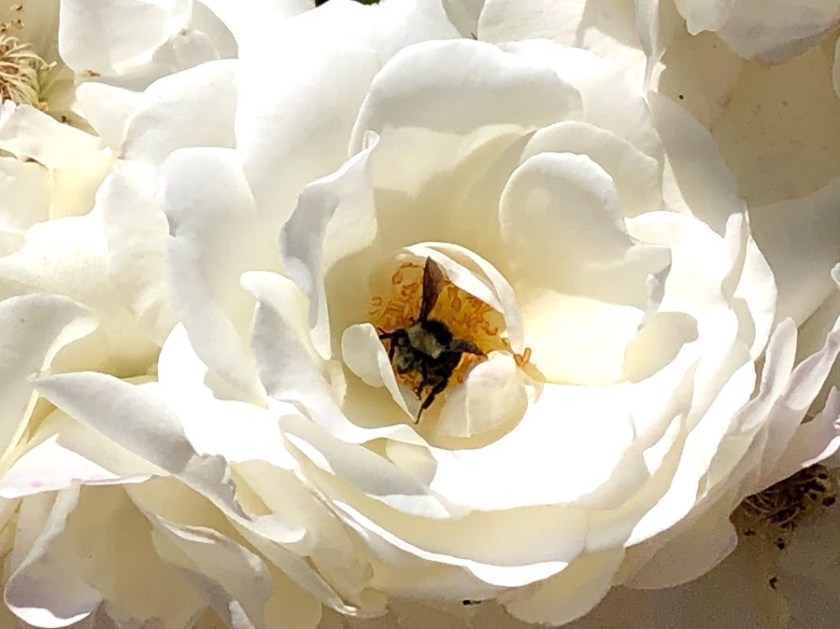
The son and I stood watching bees buzz from one flower to another taking with them the memories of a thousand blossoms with them, slowly but surely nurturing the circle of life. I was reminded of Ray Bradbury’s saying:

“Bees do have a smell, you know, and if they don’t they should, for their feet are dusted with spices from a million flowers.”
― Ray Bradbury, Dandelion Wine

rose-bee

When I watch the dew drops glisten on the spring snowflakes,
When I watch the rainbow makes up its mind and throw itself like a garland across the skies
When I watch the eight-legged marvels creations catch in the sunset
When I watch the waves lap and play with the sandpipers

I feel hope stir in the spirits
I feel decisive and conviction in Being
I feel solitude’s gift can be tangible and needs to be nurtured for its fragile state
I feel engaged with the planet and all its gifts

There is beauty in knowledge of the changing seasons, and wonder in anticipation.

Mother Earth is preparing for the Summer!

To Nourish & To Cherish

This May marks 15 years of nourish-ing &  cherish-ing. I started the blog out as a sort of a personal journal with embarrassingly personal posts. But over time, the journal took on a life of its own. It has helped me find my voice, helped me resoundingly answer the question, “What is your friend?“, and has definitely played an outsize role in the family joke circles.

My family and friends have been marvelously sportive about starring in the posts, reading them and encouraging me. Over time, the nourisher became the cherisher, and vice-versa. Fiascos were looked on with amusement knowing it will take on a life of its own and pave  the way for amusement. Travelogues are interwoven with family  drama, and it makes it all the more memorable.

When I am out in nature stopping to admire the butterflies flit between flowers, 🌺 🌸 , I think of how I would capture these beautiful images in the one place I nourish and cherish. I have a phone filled with images of family, friends, travel destinations jostling along side the everyday wonders of sunsets, lakes, rivers, butterflies, mountainsides, grasses, flowers and trees, and still the photographs seem to lack a narrative. A narrative that words round out.

“To walk on Earth and fall in love with it. “, as Mary Olivers would say.

When I am reading books, I stop and wonder about particularly  well written passages. Books take us on incredible journeys and some of them, I manage to write down to nourish later on. Some books open my mind in ways I did not imagine possible, some others reiterate what I had nebulously known, while some others do the most marvelous job of soothing and calming the mind. For every article I do write related to books, there are probably 15 others that I didn’t get to finish writing.

cropped-reading_wordpress

A friend of mine once asked me how I stumbled upon writing as a passion, and I found to my surprise that I had no clear answer. I remember a marvelous childhood filled to the brim with absolutely stunning and inspirational personalities, joyous friends, beautiful nature, dance, music, reading and writing complete with toppings of marvelous reveries and journeys into the make believe worlds. But somewhere in my early twenties I lost touch with it all. I meandered in the corporate world spending almost all my waking hours pursuing work and my part-time post graduate degree simultaneously. What time I had for reading was dedicated to academic work, and all other times were dedicated to learning and unlearning technologies to continue work.

Shoshin was in short supply.

Life in the meanwhile had brought me to the shores of the United States, opening a whole new world of possibilities. When I became a mother, something beautiful happened. I came in contact with the marvelous feeling of youth. Being an immigrant, the children’s books were all new to me, and with the children, I read and devoured books alongside them, reminding me of Kenneth Grahame’s note on the Wind in the Willows.

“A book of youth, and so perhaps chiefly for youth and those who still keep the spirit of youth alive in them; of life, sunshine, running water, woodlands, dusty roads, winter firesides, free of problems, clear of the clash of the sex, of life as it might fairly be supposed to be regarded by some of the wise, small things that ‘glide in grasses and rubble of woody wreck’.”

With all the supposed ‘achievement’ of being in the big world, there was a niggling dissatisfaction though. I didn’t realize it at the time, but I was missing my link to Art. When eventually, I stumbled back to Art forms, albeit in a much reduced fashion, I started feeling whole again.

“The most regretful people on Earth are those who felt their own creative power restive and uprising, and gave to it neither time nor power.” – Mary Oliver

My hope and wish is for everyone to nourish and cherish their own creative powers to the extent possible.


The Noble Accolades

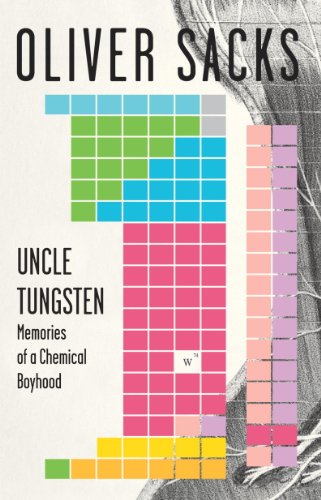
The sun was up briskly rousing all of nature’s non-nocturnal creatures to rise and shine. I opened my eyes – the sun had nudged me half heartedly wondering whether I was to be classified as nocturnal or non-nocturnal that beautiful Sunday morning. I had after all spent a good part of the night reading several books late into the night. Covid-19 has wrought a strange change in reading habits and I found myself yearning for some uninterrupted time in which to get my reading done. I devoured two short stories by P.G.Wodehouse, read some tidbits of 3 other books and finally settled in for a long-ish snuggle with Uncle Tungsten by Oliver Sacks.

Bookworm_ReadingCorner

I felt strangely alive – with that beautiful feeling of youth-ish rebellion stealing over me as I read on. How long had it been since I had defied reasonable bed-times and gone on reading late  into the night? Moreover, I was reveling in the boyhood of the great Oliver Sacks – a boyhood steeped in Chemistry and his experiments with them.

But, there is a reason for such pesky things as sleep times. As a teen, the body shrugged off a night like that with a spot of tea, but I found the intervening decades did not take so kindly to this sort of treatment, and I was being given by the stink eye by the neurons in the brain that refused to wake up.

I dragged myself from bed the next morning and set some dish-pots on the stove for the afternoon meal. I don’t know what I plopped in there it terms of ingredients. I moped and moaned, “Oh with Covid, all these folks are posting these amazing pictures of their culinary adventures in Facebook, and I don’t even know what I am making!”

“Aww! Don’t worry ma! You always manage to make it palatable except when you get creative and experiment and stuff!” said the daughter eyeing me drooping over the kitchen counter. She shuddered and said, “Remember that bread pudding?!”

I maintained a dignified silence for post-bread-pudding, most people had to do the same as the pudding seem to get their jaws stuck. While the pot bubbled, I flopped over to the Uncle Tungsten book again, and started  reading. The chapter was about Eve Curie’s biography of Madame Curie. The book was given to Oliver Sacks when he was a ten year old boy by his mother and he had savored the copy over the years. 

uncle_tungsten

 I seemed to finally awaken as I read the passage below aloud to the children:

Eve Curie’s biography  of her mother – which my own mother gave me when I was ten –   was the first portrait if a scientist I ever read, and one that deeply  impressed me. It was no dry recital of a life’s achievements, but full of evocative, poignant images- Marie Curie plunging her hands into the sacks of pitchblende residue, still mixed with pine needles from the Joachimsthal mine inhaling acid fumes as she stood amid vast steaming  vats and crucibles, stirring then with an iron rod almost as big  as herself; transforming the huge, tarry masses to tall vessels of colorless  solutions, more and  more radioactive, and steadily concentrating these, in turn, in her drafty shed, with dust and grid continually getting into the solutions and undoing  the endless work.”

The book is full of footnotes, and annoying as this can be sometimes, this particular footnote was fun. 

Footnote:

In 1998 I spoke at a meeting for the centennial of the discovery of polonium and radium. I said that I  had been given this book when I was ten, and that it was my favorite biography. As I  was talking I became conscious of a very  old lady in the audience, with high Slavic cheekbones and a smile  going from one ear to the other. I thought, “It can’t  be!” But it was – it was Eve Curie, and she signed her  book for me sixty years after it was published, fifty-five years after I got it. 

The pot I had set on the stove sizzled over, and I charged to take control. When the dish was salvaged, I said, “See what all can happen when Eve & Madame Curie worked together dear? Madame Curie won the Nobel prize, and her daughter chronicled her! Imagine all that is possible if we were work together more sweetly in the kitchen together? I plop, you stir, I salt, you pepper. Maybe we could have our picture posted on Facebook as two smiling chefs who were never happier than when cooking together, and you can post the dishes-finale in your Insta account!” I said. 

The child did not even have to think before she shook her head. “Mom and daughter working together with chemicals and stuff! Oh they must’ve fought plenty. Besides! Think Mother! Is a Facebook photo worth all that?”

“You think!” I retorted. I have always been quick with dumb repartees.

She laughed and tousled my hair – she is now fully a head taller than my head and these days when I need to give her ‘the look’, I get the feeling of a meerkat peering at a giraffe. I suppose my noble culinary marvels will just have to wait for the Facebook accolades.

Teacher Appreciation Week

I hovered near the bookshelf – like a child hovering around the glass-pane of the candy store, Looking for that perfect piece of sweet : something familiar, good and a slight twist to wake up your cells every time.

It has been a long and stern day filled with purposeful adults, all filled to the brim with the cares of living, earning a living, and forgetting to live. My brain looked for a release, and a mode to thrive.

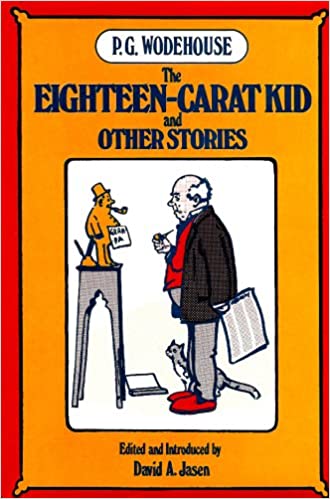
I picked up a book of short stories by one of my favorite authors: P.G.Wodehouse.

18-carat-kid

Eighteen Carat Kid and Other Stories: I opened the first page and was pulled in like an elephant to the early morning waters in the forest.

Paragraph 1:
There is something always going on in a private school.
Beyond breaking up fights, stopping big boys bullying small boys, preventing small boys bullying smaller boys, inducing boys of all sizes not to throw stones, go on the wet grass, worry the cook, tease the cat, make too much noise, climb trees, scale waterspouts, lean too far out of windows, slide down the banisters, swallow pencils, and drink ink because somebody bet them they wouldn’t, I had very little to do except teach mathematics, carve the joint, help the pudding, play football, read prayers, herd stragglers into meals, and go round the dormitories at night to see that the lights were out. ”

Both my parents were teachers (my father was a teacher in a residential school – public schools as they are called in India, private school in the US & UK) I sent the snippet to him, and he heartily took a trip down the memory lane and agreed in his booming, hearty voice that addressed assemblies without mikes, that there never was a dull day in his teaching career. Being a vegetarian, he did not often have to ‘carve the joint’ , but that apart, pretty much everything else was true, he said. It is always to good to hear the joy of being a teacher coming through.

This week is Teacher Appreciation Week, and I thought of sharing this essay the son had written for his 3rd Grade essay:

Topic: Imagine you are a teacher taking your class on a field trip to Baltimore National Aquarium

The Baltimore National Aquarium

At the Baltimore National Aquarium there is lots of life. This is one of the places where humans and marine life see each other as fun things.Anyway I brought my class with me because the principal wants the kids to experience new things, which I can understand. When we got to the nearest exhibit, I did a headcount of all the students. We were missing 6 of them.Thankfully, I found them near the water (where the animals are) and I gave them a good talk about not leaving the group. Then when I turned around all the other children were scattered. I thought to myself, “This is gonna be a long day.” After that, we went from exhibit to exhibit in the huge aquarium. As we were about to go to the display of skeleton from a dinosaur, we found another class. The kids merged together and the other teacher and I had the same expression: “Kids!” We sorted everything out and went to the dinosaur. I read from the brochure “This is the Shaustasourus, the largest marine dinosaur ever.” After many more mishaps we got back on the bus. For the first time, we had a full class. When we got back none of the kids thanked me for not losing them. Sometimes the world really isn’t fair, but that’s okay. I guess I had lots of fun too.

I guffawed at this piece of writing.

People who imagined the teacher’s job to be putty, are having to re-evaluate their assessments – their puddings of pie children weren’t such darlings when the Mathematics had to be taught by their parents anymore.

This is Teacher Appreciation Week in the US – really what would we do without the steady, positive influence of teachers?

May the Fourth …

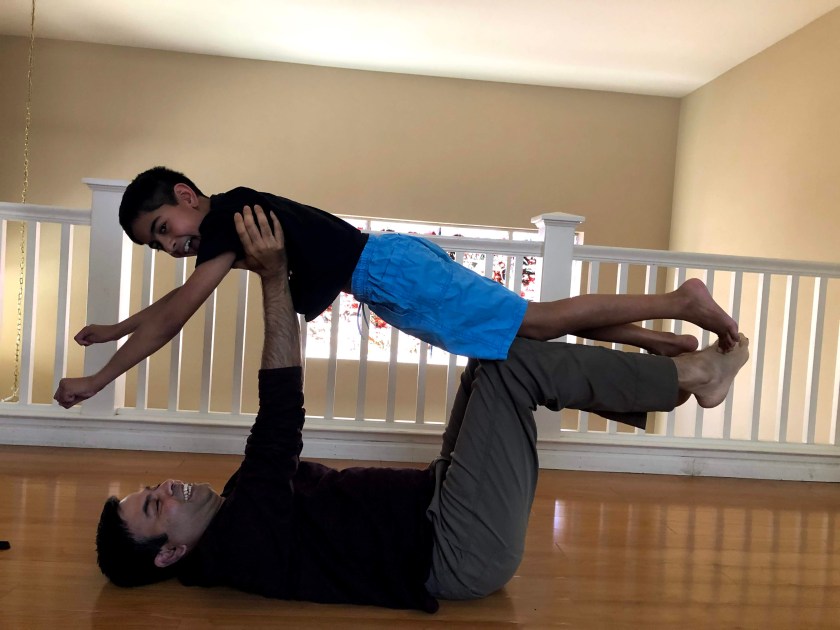
“I AM YOUR FATHER!” the son comes yelling into the room. His excitement has woken up the megaphone in his vocal chords and he startles his father as he professes this sudden revelation of Darth Vader and Luke Skywalker and all the rest of it. I turned around startled, as the pair of them babbled on about Star Wars – Return of the Jedi, Force Awakens. 

I knew my time was up.

I have hitherto flitted about the world confusing Star Wars and Star Trek – they looked like the same thing. There are spaceships, battleships, people wearing masks, everyone looking and sounding important, as they take their noble part in inter-galactic warfare. Every  time the husband tried to explain, I happily let my brain flit to more important things, like rose gardens, ducklings, sore thumbs, or dumplings.

Comparison of Star Wars & Star Trek

I could totally identify with Penny in Big Bang Theory as she said:

“There is absolutely no difference! But they get cranky when you mix the two up.”

My days of star-innocence however are coming to an end. The son has taken to watching Star Wars. He now painstakingly explains Jedi warriors, storm-troopers, and with a shining face awaits us as he says, “Oh my goodness! Revenge of the Sith blew my mind away! Everything suddenly made sense, right?!” 

As a treat to me, he sat next to me and made me watch Revenge of the Sith (the prequel that was taken after a considerable number of sequels were taken) in which it is revealed who Darth  Vader is. He sat like a little shining moon-let watching my face to see if it had the appropriate reaction as Anakin Skywalker is christened Darth Vader.

Sigh.

He uses his magic wand that is doubling up as a light saber these  days as he fights his imaginary battles. I tell him he needs nothing of the sort to fight inter-galactic battles – all he needs to do is fake-sneeze. He snorts with derision and guffaws with laughter at this Covid-humor, but good naturedly battles on armed with a wand or a rolling pin as the case may be. This Jedi shall stand by Obi-wan Kenobi!

To raise a geek, one must not be weak, or meek. I pick up my rolling pin, that I am making pooris with, and join in the fight. Your wand against my rolling pin – our light sabers emit energy, noises and most importantly memories.

Amy Farrah Fowler: “If you are going to compare hammers and wands, I can’t even take you seriously!”

May the Fourth be with you! The spaceship galactica takes off to a galaxy far far away…

img_8276

Moon Magic

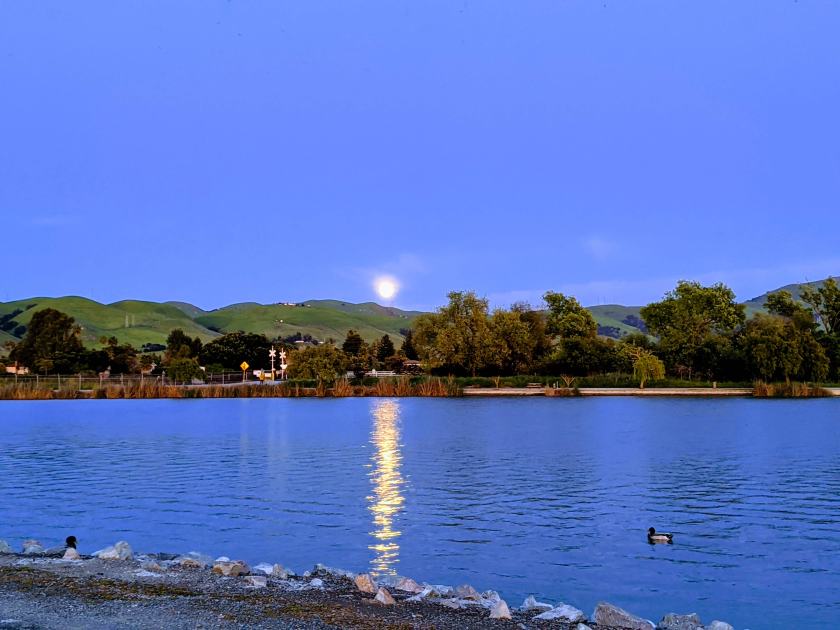
A few weeks ago, I got the incredible chance to see the full moon rise along with the sunset. One of those serendipitous things that the Covid-19 shelter-in-place has given me. I did not realize that it was the golden moon – the day the 🌝 moon comes closest to the Earth, and maybe  it was better that I hadn’t prepared for it. For, out on the walk, I stood mesmerized as  I saw the moon rise slowly in the East, as the sun set slowly in the West.

A better time or combination of light I could not imagine. A golden orb that rose from behind the green hills, and bathed the beautiful Earth with its benevolent beams, while the glittering sun bowed out graciously throwing pinks, oranges and purples with abandon against the blue skies. I watched the geese fly on over, ducks swim against the moonbeams on the lake, squirrels stopping to take in the surrounding beauty, and blackbirds swarming low over the lake waters. 

img_7899

I turned around to share  the beautiful marvel of the time with my  fellow beings when I realized I was quite physically distant from my fellow beings – human or otherwise. Do other sentient beings feel the same overwhelming sense of being at moments like these? Do dolphins take the time to gaze at the full moon like we do, do polar bears and penguins do the same from their respective poles? What a great unifying experience we all have with the celestial shows the universe throws at us?! 

Oh! To quiver with excitement with the Earth’s beauty has become my wont. 

The blue skies turned inky, and the golden moon turned silver, and  yet I could not pluck myself from the beauty of the evening. 

The giant glittering orb slowly peeked out from behind the green hills, and then rose steadily in a few minutes. We stood a few feet from a lake, socially distancing ourselves. How many times I have felt my heart flutter by catching a glimpse of the moon unexpectedly in the skies? How many lovers have gazed at the moon wistfully, dreamily, lovingly or yearningly through the ages? What a great unifying experience we all have across the pages of time?! 

I am so glad for our  nearest cosmic neighbor – I remember a few years ago when  we were moon-gazing awestruck at the beauty of the reflected sunlight, the son said, “Can you imagine how beautiful nights  on Jupiter must be? Imagine looking up and seeing 64  moons in the sky!

I was taken aback at the statement, but also thankful for the one moon we do have. 

A known Selenophile if there was one, I picked up the book Music for Mister Moon by Philip Stead with a song in my heart that evening.  The beaming moon has always attracted me, whether it is catching a fleeting glimpse of it as it appears and reappears amidst scudding clouds, or the waxing and waning of it during its reliable moon cycles or even when I catch an unexpected glimpse of it when the sun is bright and high above in the sky. 

mistermoon

The story of  a shy young girl who plays her instrument for no one but herself gently tugs us along for a ride as she accidentally pulls the moon right out of the sky. The moon’s revelation to know what it must be  like to float on the waters it is always reflected upon brings a little smile to your own lips, and slowly, but surely  you cheer for the little shy girl who opens her talent up to share with the moon.

The book does its  best to capture the magic of the moon, but probably the best gift of all is the dream I had after writing this post: I woke up thinking I was on a boat mesmerized by the floating moon near me.

🌙 🌝 Moon Magic. ✨ ✨

That is the Earth!

“Do you know what this is?”

“That is the Earth! From the moon.” said the son matter of factly. “I saw it before!” he said in response to my awed expression.

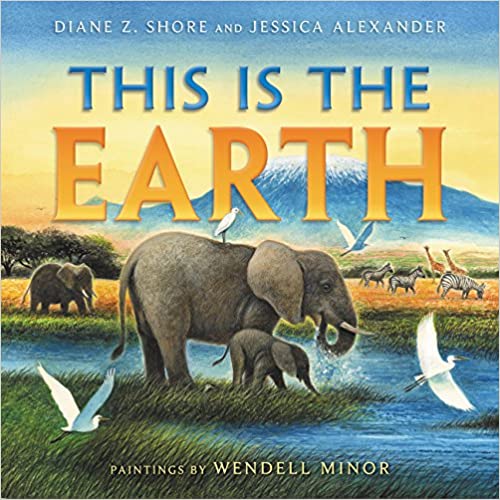
We were looking at the back jacket of a book, that I flipped to the last page first.

this_is_earth

This is the Earth, by Diane Z Shore & Jessica Alexander with paintings by Wendell Minor.

It was a picture of the Earth rising on the Moon’s horizon.

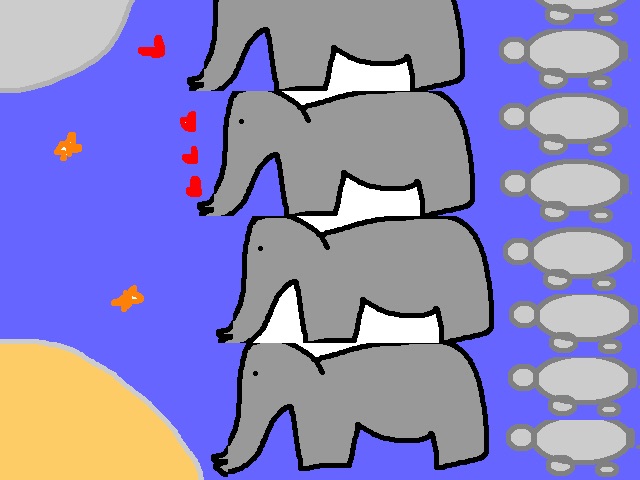
A picture that generations of humans for millennia could only have imagined, and never really gotten close to the sheer beauty of it. Our myths are at once rich and limiting in its reach. They have imagined Earth as being elephants on elephants, turtles on turtles all the way down, flat discs, imagining heavens above and hells below.  

earth_myth


The picture was taken by an astronaut, Bill Anders, aboard the Apollo 8 spacecraft in 1968. I looked on mesmerized at the picture.

1200px-NASA-Apollo8-Dec24-Earthrise

Bill Anders / Public domain

But this picture is truly astounding. The pale blue dot when seen from the Moon is a brilliant, blue orb, suspended in space, intriguingly spattered with clouds, oceans, landmasses, not really depicting the billions of lives it fosters, or the number of ecosystems it has in its fragile balance. 

Bill Anders said: “We came all this way to explore the moon, and the most important thing is that we discovered the Earth.”

What a lovely statement that is, and together with his Earth Rising image, contributed to the concerns around Planet Earth that led to founding of Earth Day in 1970.

50 years later, we have made rocky starts and gains towards conservation. But this April 2020, 50 years later, purely coincidentally, Covid-19 has the world on lockdown, not just imagining a life of bare necessities but embracing it for the social good. We, the people, now have the time to observe our fellow inhabitants.

Heart warming tales of peacocks making its foray into the deserted cityscapes of Mumbai; turtles coming ashore to hatch in the beaches along the Bay of Bengal; seeing the Himalayas from a 100 miles away once the smog fog lifted; deeming the waters of the Ganges near Rishikesh fit for human consumption again without all the factories along the way dumping its wastes into the flowing water;or bears enjoying their natural habitats unhindered by human presence in Yosemite National Park, are surfacing, and it has my heart lifting again. I have often enough lamented on this blog about the poor attention we pay to the Planet that nurtures our fragile selves and egos. 

Watching the even more fragile ego of the stock market indices, it seems to me that we can very well have the world function this way, by having a month off every year in which everything stops but essential services. An Earth Month every year to reflect, slow down, plan and recoup our staggering impact to the environment. After all, the stock market seems to have a life of its own and seems only to want some stolidity in its expectations. So, we anticipate a month with no major events, no excessive or unnecessary travel, and only essential services operating. The notion isn’t that far-out either. 100 years ago, no one thought we could have 5 day work-weeks. Yet, here we are, in state where it is the norm now. 

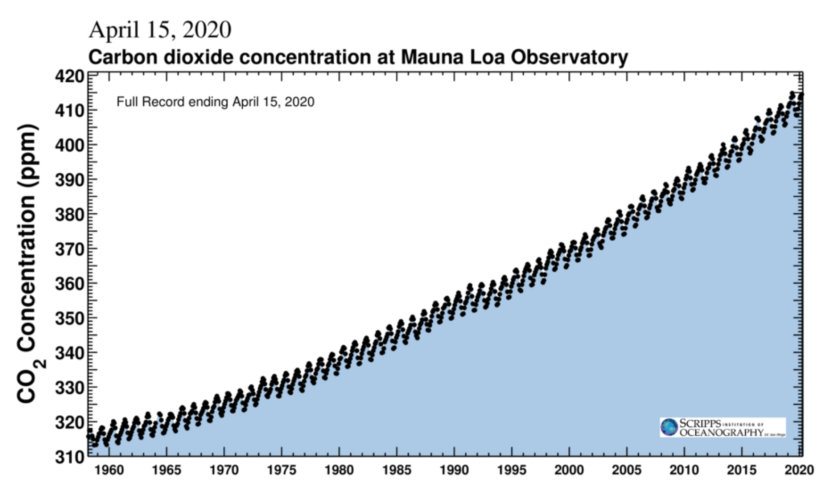
Maybe this could be the measure we take for Earth Day to slow the rise of Carbon Dioxide levels in the atmosphere.

Screen Shot 2020-04-16 at 6.33.29 PM

Please go this site to see the curve over 2 years and over 200  years Keeling Curve – Scripps UCSD

If you look at the extrapolated curve from the 1700’s, it has risen exponentially. It is probably too soon to see the effect of Covid-19 on CO2 levels in the atmosphere.

Could, Earth Month become the new normal for us. So children matter of factly accept that Earth Month as essentials month in the coming generations?

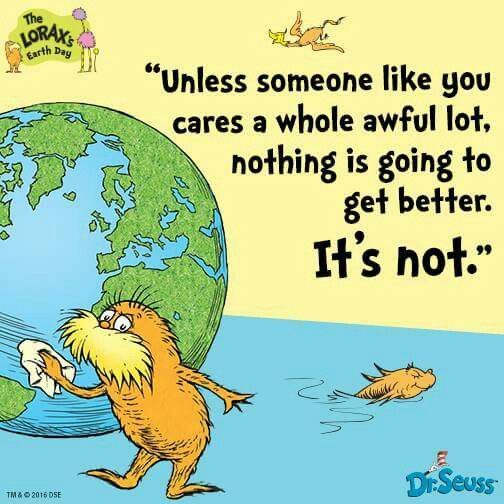
Let’s care a whole lot!

T’was family movie night. An evening fraught with decisions, and everyone’s voice and opinion clanged over the dishes and sizzled over the noise from the stove.
Suggestions rose, opinions swelled and movies quelled.

“Uggghhh! No way!”
“That again?”
“What are you? A kid? Oh wait! Yes you are a kid! Okay never mind!”
“Nope! Too much for Amma! “
“What do you mean? It isn’t too much for me?!”
“You bawled last time for a movie that wasn’t even a tear-jerker, nope! How about this?”
“Star Wars!”

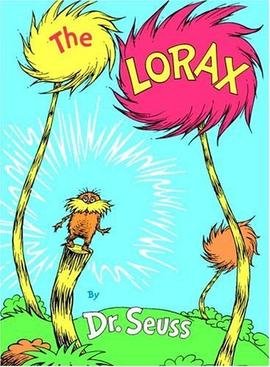
A collective moan went up. Finally, it was revealed that the youngest member of the family had no recollection of the Dr Seuss movie Lorax. He has read the book multiple times, and so we all settled in to watch Lorax.

The_Lorax

Dr Seuss is an inspiration, of course; but just how insightful his take on humanity is uncanny. From fresh air as a commodity, to a land without trees, to surveillance at every pore, his far sighted vision has so much to nod your heads at.

The Thneeds, created by the Once-ler, in his story are made from Truffle trees. Thneeds were fashion statements – doubling up from head scarves to sweater vests and shawls. (“But even he, it seems, could not envision a future where ripped jeans were fashion trends!”,  I said and drew a grudging chuckle from the teen with the ripped jeans. ) Eventually, of course, the Once-ler’s greed led to decimation of trees, habitat loss and a devastated landscape is all that is left.

“Wow – that was such a good movie Amma – though the movie had scenes that the book didn’t have.” was the verdict of the youngest.

“Really! Humans are impossible!” said the teenager, and discussion turned to conservation, Greta Thunberg and some you-tuber who talks about going green.

“Did you know the Lorax was banned in some schools in California because loggers felt it was not friendly to the ‘foresting industry’. ” I said.

I looked at their agonized faces with awe – how is it children get these things, and adults don’t; and I felt a surge of hope.

lorax

We were walking a familiar route through our neighborhood a few days later, stopping to see some of the felled trees as we do every so often. The rings in the pine trees show they must have been at least 80 years old, and to see the forlorn stumps reminded of the beautiful book, The Giving Tree.

img_7820

The book starts with friendships between a young boy and an apple tree. The boy plays and swings on the tree’s branches, but as he grows older demands more and more from the tree. He needs her apples to make money, cuts her down to build himself a house and a boat, and finally comes back tired and spent with life, when all the poor tree can offer is the stump to rest.

The Giving Tree, can be interpreted and discussed in many different ways. Givers & Takers, Need & Greed, Selfish & Selfless, but the most beautiful one is the simple one, the one where your children make a sad face at the end, and say, “Why doesn’t this boy/man/grandpa ever feel sorry for what he’s done?”

giving_tree

The boy reminds us of human’s relationship with nature. The human species can be broadly classified as takers: from the planet, & from our co-habitants on this planet. You might have seen this video clip of Man’s greed By Steve Cutts:

The Giving Tree too was banned interestingly for sending sexist messages – the tree was female and the little boy continued to take from her without ever giving back.

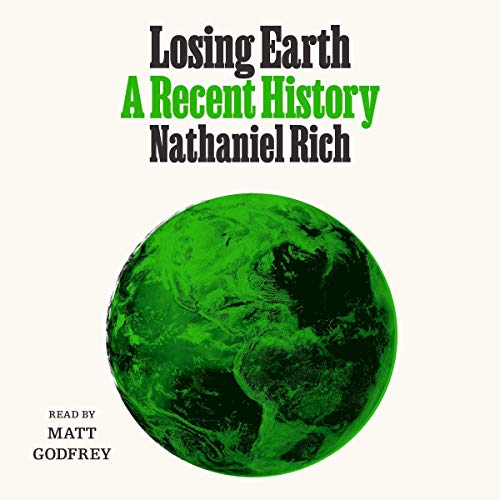
I just finished a book called Losing Earth – by Nathaniel Rich. The book, deals with the science, politics and action of climate change.

losing_earth

Despite humanity having the science locked down more than 50 years ago, little action has resulted. The closest we came to getting everyone to agree on unified action was the Paris Agreement where all countries agreed to work towards keeping emissions such that we not go above the 2 degree increase of temperatures world-wide. The largest emission offender for decades, United States, pulled out of the agreement when Donald Trump became President.

I was shocked to find that Climate Change as a topic has been banned in certain schools, skirted around in others and given a miss altogether elsewhere. The science behind Climate Change and the effect of our industries were long proved – as far back as 1970.

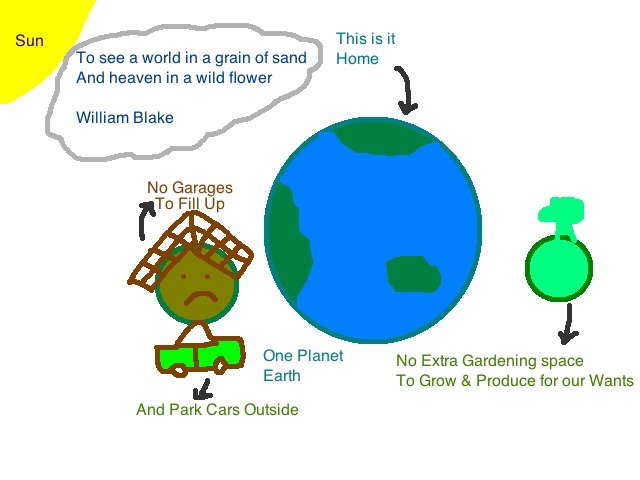
This April 22nd is the 50th anniversary of Earth Day with a special onus on Climate Action. Maybe this Earth Day, we can renew our commitment to the only pale blue dot that will harbor us. Let’s care a whole lot about our planet before all we are left with is the word ‘Unless‘ like in the Lorax story, or the tree stump in The Giving Tree.


no_garagepale_blue_dot

Read also: Are we to become Lab Rats?