The Leaping of Spring

We had been on a short trip up the mountains recently. On the way back, I realized yet again that I had taken far too many photographs that were of no use. So I sat sagely deleting them making space for more. In that moment of weakness, I told myself that I would not whip out my phone at the slightest thing, and take a photograph. That is how I landed up missing the picture of the blackbird racing a red hawk for a few meters. It is also why I have the image clearly etched in my head. 

I took a short morning walk to clear my head. It was cold, I had not slept well. As I trudged on, I was already listing the different things to get done during the workday, the things that needed tending in the home, and the things I wanted to do with the children and friends. All the mundane things that flit through a working woman’s mind on a weekday morning flitted, and I stopped to chastise myself. This was what Henry David Thoreau meant when he said he walked without leaving the village behind or something to that effect.  I was physically there, but not spiritually or mentally, and that would not do, I told myself sternly.

Taking a deep breath and feeling the cold rush of fresh air, I moved on. This time, I felt the difference. The clear, trilling sound of the swarms of blackbirds, that is missing in January or even February was clearly filling the air. I stopped to look around, and the soaring of the blackbirds with their little flashes of red beneath their wings, the tittering of the thrushes, and the quacking of the ducks in the distance were all enough to pin me to planet Earth even as my spirits soared from the ground. 

Live in each season as it passes; breathe the air, drink the drink, taste the fruit, and resign yourself to the influence of the earth.

Henry David Thoreau
The influence of the Earth

A little distance away, a red hawk took flight, and a little blackbird flitted up against it. Trying to keep up, basking behind the great birds wing span and sheltering against the air currents. It was a marvelous sight to catch. The little one’s sense of adventure elicited a smile. After a few minutes of this folly, the little one veered away. Happy to go back to flitting joyously. 

It is amazing what a little spring time air can do for the soul. One can come back energized in soul, and tired physically, and that is just as it should be. 

The 🌏 Laughs in 🌸 🌺

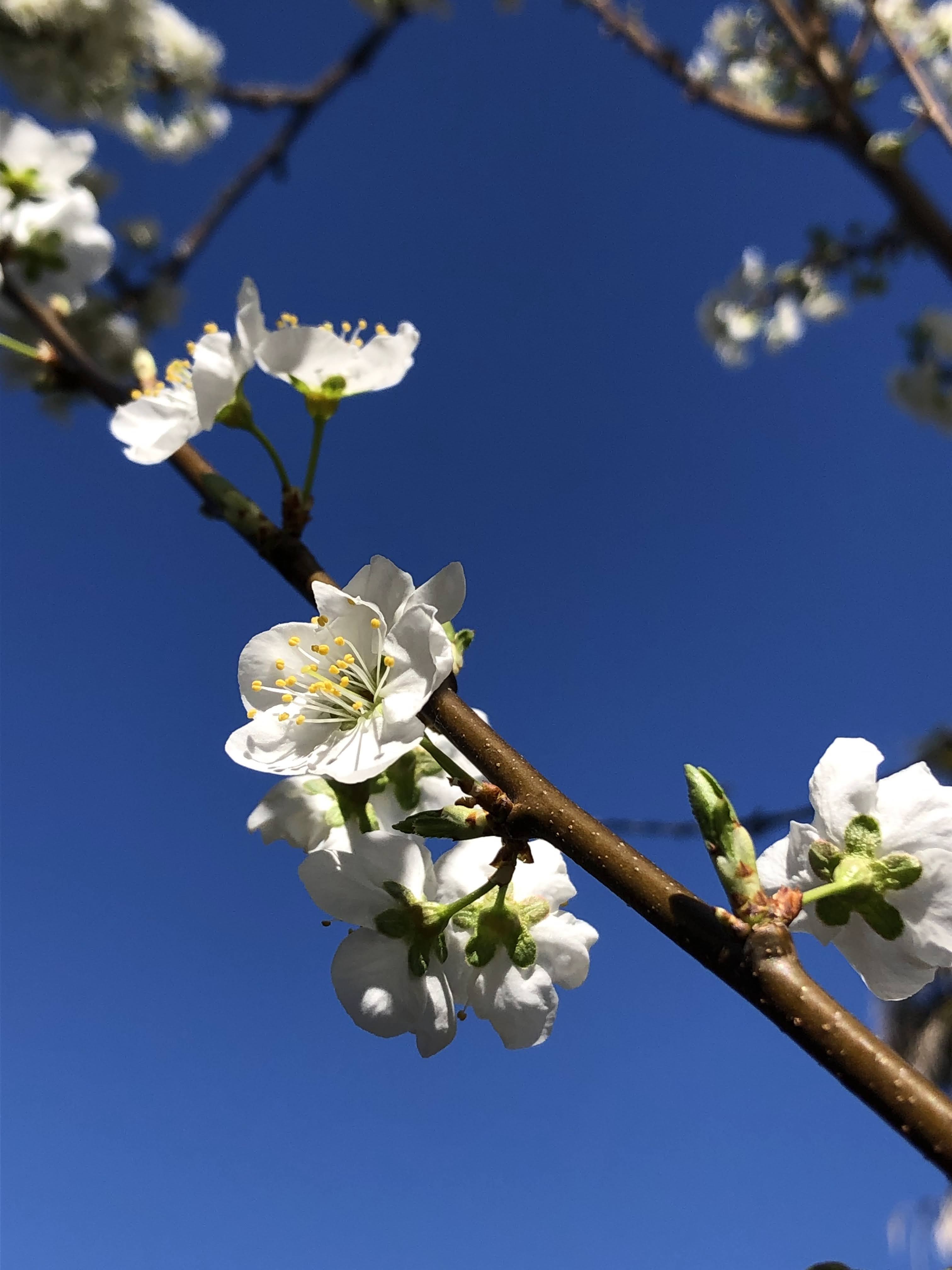
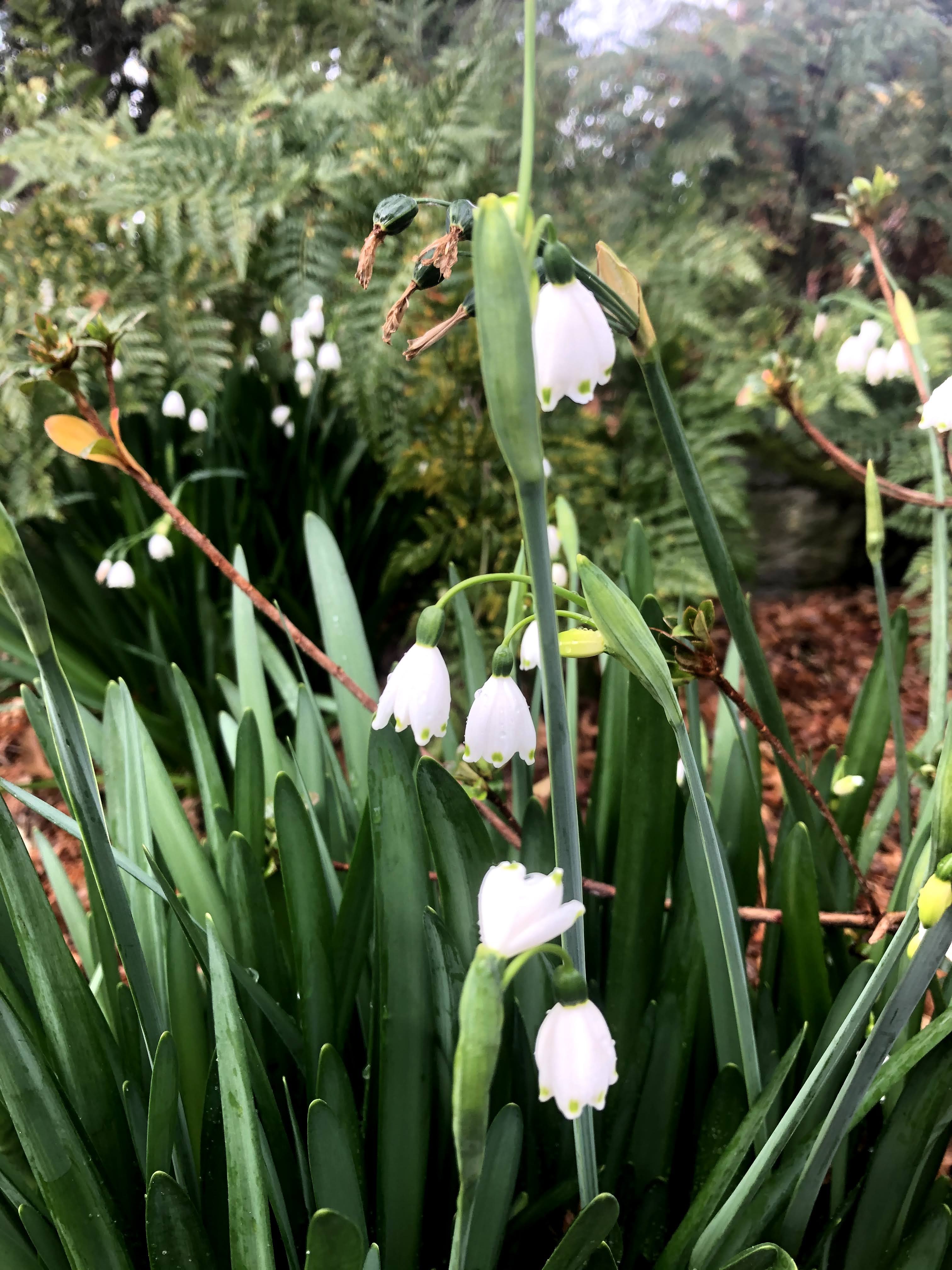
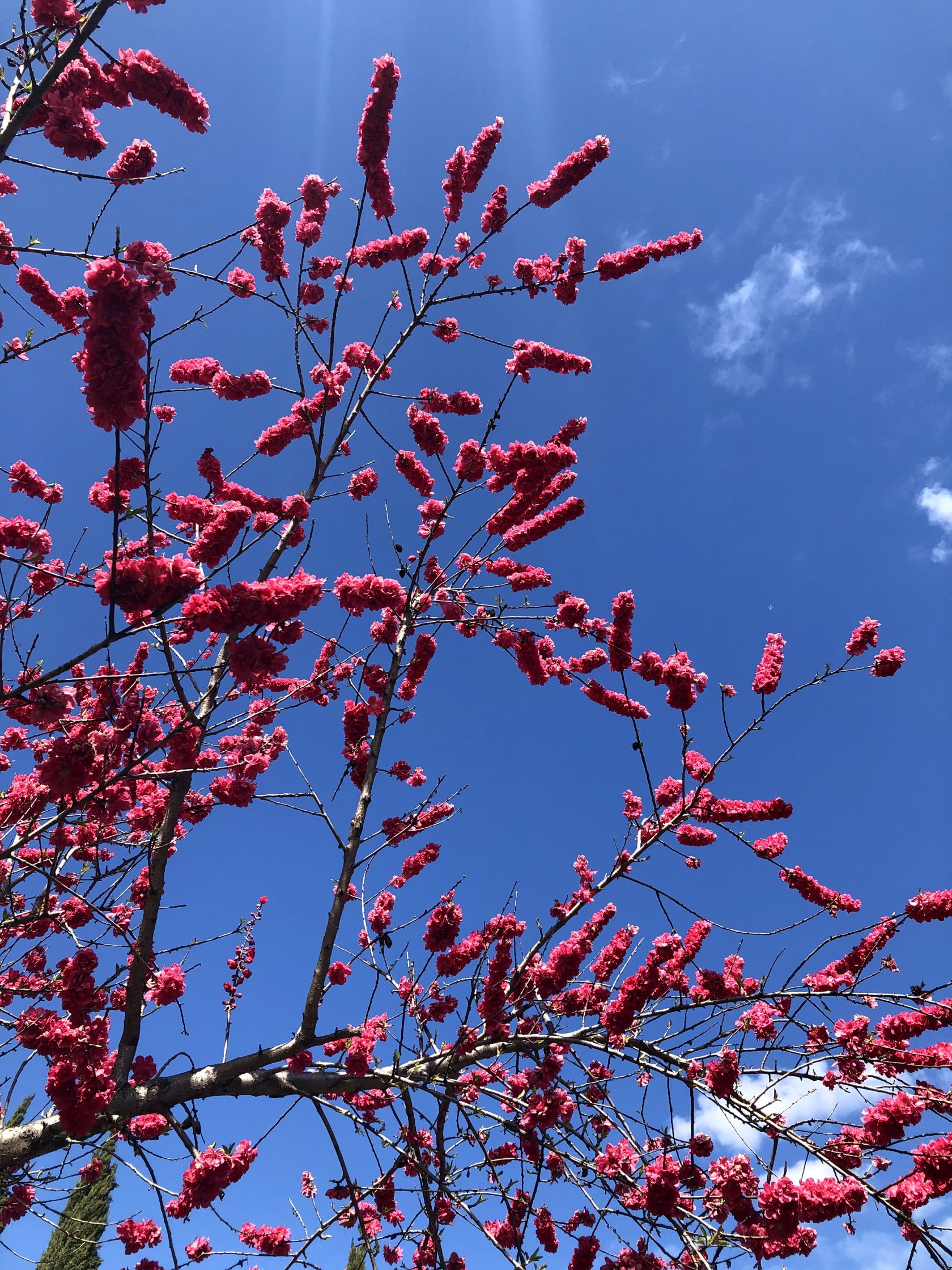
Most trees are still bare. Winters are milder in California than elsewhere. Even so, the bare branches of the brilliantly hued trees just a few months ago is stark against the skyline. But then, there are early spring heralders that enthrall and enchant. When I am out walking these days, they are often punctuated with rapture – little stops to admire a cherry blossom tree in full bloom, a tulip bulb poking its head out, or snowdrops working its way through the cold hard months and blooming just in time for the spring equinox.

Snowdrops

Spring is the best time for a saunter. Californian Springs have the best combination of rainy days, cloudy days, sunny days, warm days, cold days, and windy days. Through it all, there is the breathtaking beauty of the flowering trees. It is hard to imagine an Earth without flowers given how much they brighten our days on Earth. But it wasn’t that long ago that Earth was rampant with life and lifeforms without flowers. Makes us stop and think doesn’t it? What else evolution would have up its sleeve if allowed to go at its own pace. How many creations beautiful, mesmerizing, unknown and somewhat hampered by the limits of our own imagination?

Sitting inside on a cold March day and watching the wind whipping the trees outside, and looking at the petals of the cherry blossom flit towards the earth below is fascinating. On sunny days, the birds pecking at the cherry blossom flowers and sending showers of little petals earthwards is showtime. 

I cannot help thinking of the distant lineage of the little birds. Did their dinosaur ancestors see flowers and interact with them? I thought beaks were a particular evolutionary step for nectar. But maybe not. I remember reading that flowering plants only appeared towards the tail-end of the dinosaur’s time on Earth, or maybe even later. I also remember walking along the Natural History Museum time line and thinking that the dinosaurs really missed the marvelous great flowering of planet Earth.

https://earthhow.com/earth-timeline-geological-history-events/

But then again, this recent article seems to think the dinosaurs may have seen flowers after all.

https://www.livescience.com/40088-flowers-existed-with-dinosaurs.html

Quote:

Newfound fossils hint that flowering plants arose 100 million years earlier than scientists previously thought, suggesting flowers may have existed when the first known dinosaurs roamed Earth, researchers say.

LiveScience Journal – article linked

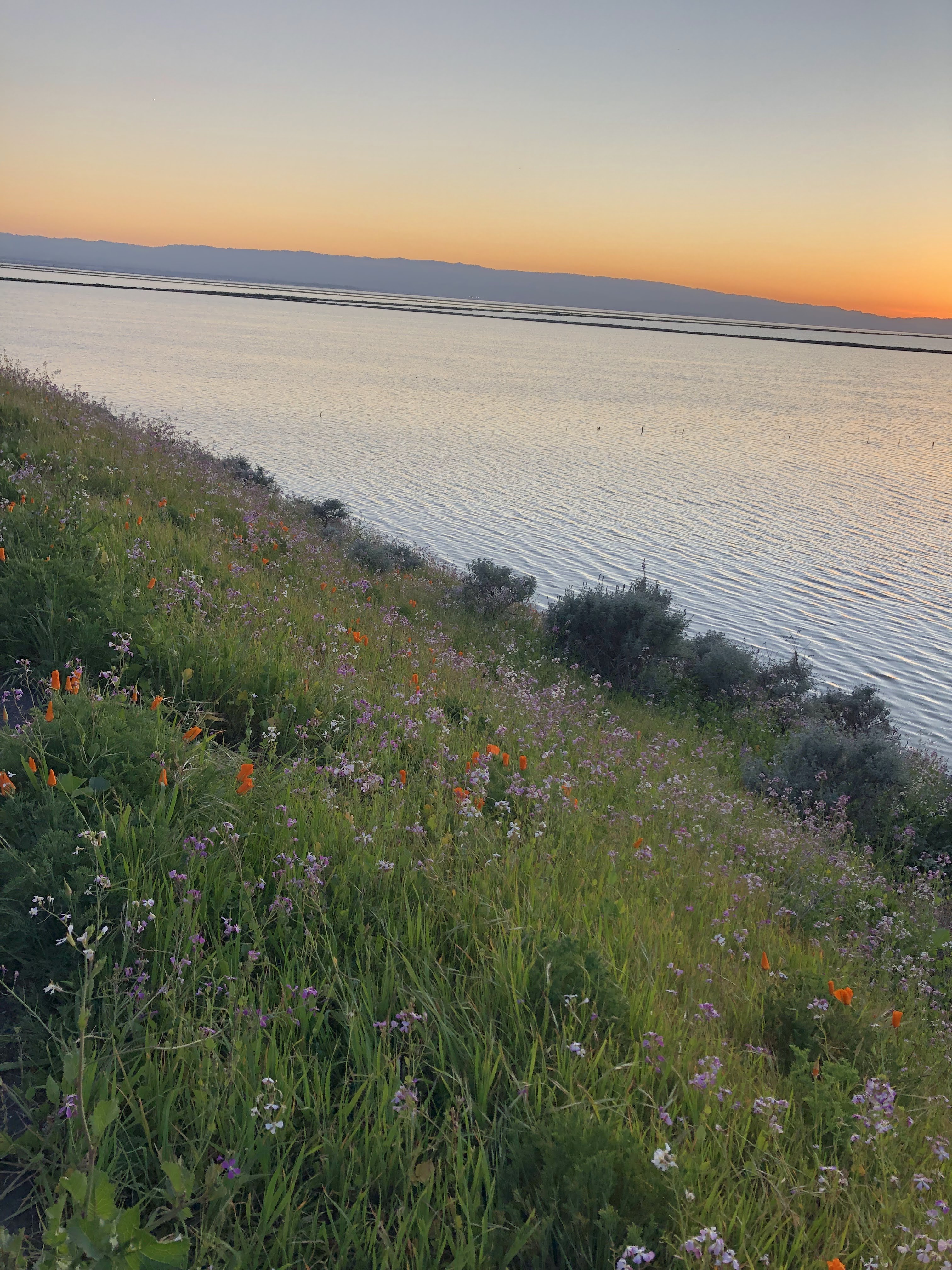
Whether or not the dinosaurs saw the flowers, I am grateful we live in an era when we can experience flowers. All the musings of the cosmic accident of life seems glorious in the flowering trees around us. Meadows are bursting with wildflowers. On a little hike near the coastline one day, we saw hillsides filled with golden orange poppies, lupines, and flowers of yellow, white and pink weaving and waving amidst the fresh green of Earth. Set against most trees that are still bare from the winter the flowers are a sharp reminder of all the stark contrasts of life.

We don’t know about all the forms of life possible in our universe, and probably never will find the enormity and possibilities. Yet in that very paradox lies the power of musing.

koi sonder

One day during a particularly windy bike ride, I stopped to catch my breath. Riding against the wind even if the terrain is flat can be hard. I watched the windy skies blowing the fluffy cirrus clouds away, and said aloud that it would be nice for some rain. The husband gave me that look he reserves for my references to eucalyptus, rain and all things Nilgiris. “You and your rain!”

But the universe has a strange way of granting wishes sometimes. A day or two later, the temperatures dipped, a cold spell gripped the area, and I sat up around midnight watching the rain pelt the windows. It was beautiful to watch in the warmth of our homes. I felt a blast of warm air from the air purifier in the room and sent a little note of gratitude for warmth and security when it must’ve been cold and wet outside. 

A few days ago, we had visited a quiet spot tucked away from the hustle and bustle of Bay Area freeways, and turned in past the almond farms into a quaint garden and farm. There, in the corner was a small koi pond with koi fish whose size looked magnified several times given the size of the pond itself. The fish swam towards where we were standing peering into the waters.

The curiosity of these creatures 🙂 If I knew Koi-polese, I could’ve translated. But I think they wanted to know more us: Who were these people who are peering at us? Would they be kind enough to feed us? 

I thought of Dr Dolittle:

These fish languages, they really only work underwater. It’s fascinating! The basic system is mouth movements and bubbles signals.

Dr Dolittle

For some reason, that night looking at the rain against our the windows, I thought of the koi fish peering out of the waters and contemplating the gathering clouds. How they would react to the gentle rains falling from the skies? Would their sea brethren feel the same way when they navigated the oceans? I remembered reading an article in the New York Times about how the fish used stars and starlight to navigate the oceans. Polar bears and many creatures do so too. How do they fare when the cloudy skies 🌌 obscure their vision?

“Did you know that an ant has more intelligence than a hippopotamus? And that a grasshopper, in relation to his size, has more power in his hind legs than a kangaroo. Absolutely, fascinating! There’s no doubt about it, animals are much more interesting than people.”

Dr Dolittle

There is a word that captured my fancy when I read it, for I have often felt that especially when traveling. (Grocery shopping in Afghanistan post) . 

sonder (the realization that each random passerby is living a life as vivid and complex as your own).

That night I felt that word with respect to all our fellow creatures. We have no Dr Dolittles among us to know the extent of our fellow creatures feelings. But we do know we have many creatures around us show feelings of warmth, love, clannishness and so forth. 

Almond Blossoms to Cake

“Hmm….is that badam cake?”. (Badam is the Tamil name for Almond) The son’s nose whiffed and sniffed rapturously as he came home from school. I laughed at his reaction. The heavenly scents of ghee, almonds, milk, cardamom, and sugar have felled many a strong heart. No wonder celestial offerings have this combination of aromas the world over. I nodded and the little fellow ran inside. His grandmother handed him a warm piece of badam cake, and his eyes shone. His mouth watering, he gave her a hug, and knowing how his grandfather must’ve been the one who stirred the mixture for hours to get it to this consistency gave him a hug too.

Then he bit into it slowly: relishing, licking, savoring the cake in his hands, he danced a little jig. 

Relishing badam cakes is a family tradition I think. Across the length and breadth of the family tree, you will find people who melt in anticipation of badam cake. The nephews, nieces, son, daughter, their parents and grandparents all smack their lips when the very name is mentioned. The grandmothers treasure the almonds more than diamonds.

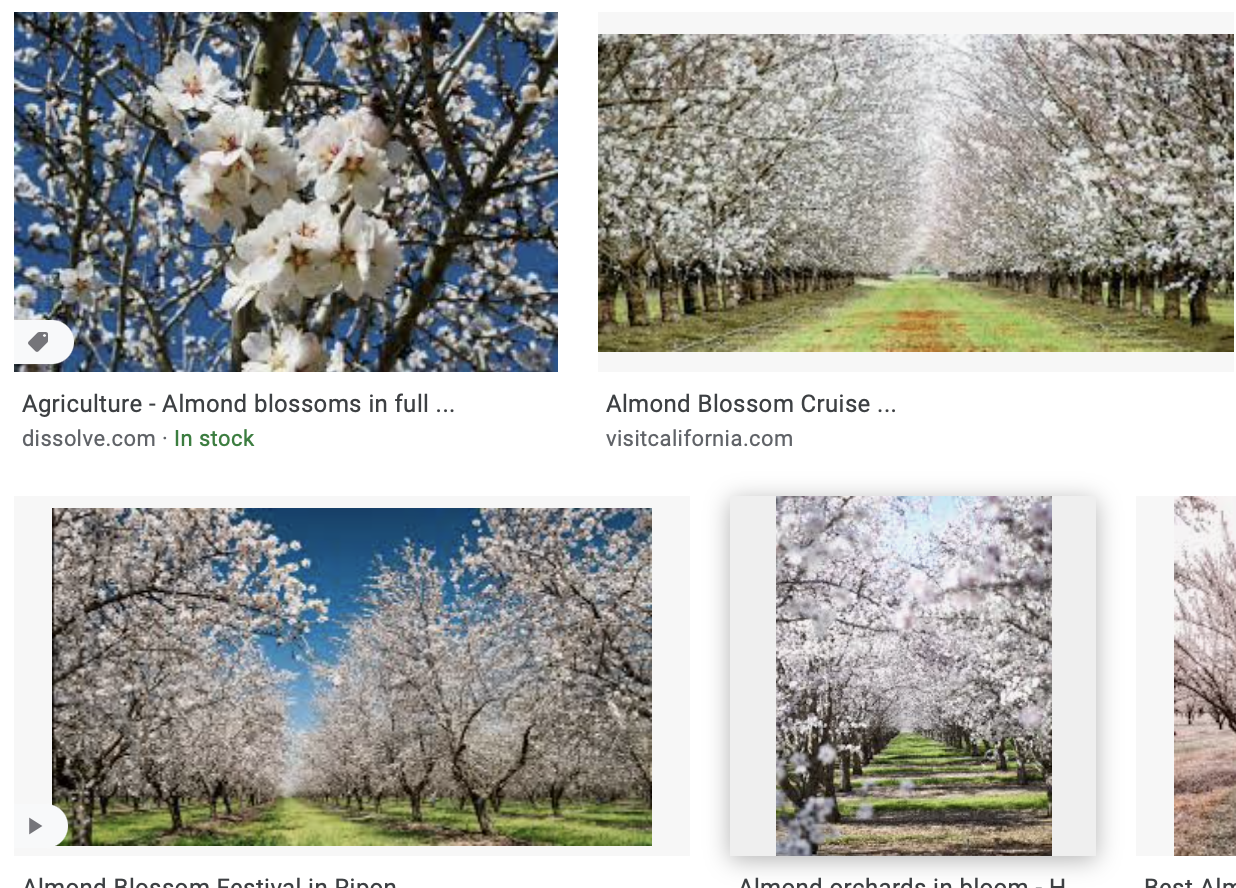
A couple of days later we went on a short drive. The drive through the green hills of California was enough to raise the spirits of everyone in the car. The view of the rolling hills of the Bay Area is best in late winter and early spring. All around us is resplendent green tugging at the heart strings of poets to take up that muse of the alluring verdure. But, there are bounties waiting the moment you reach the plains too: fields of almond trees in rows and rows spread over acres like one of those 3-d models that mesmerize you in their symmetry and movement. In early spring, the almond trees are in full bloom. Watching the brilliance of their white snowy blossoms even non-poets feel their heart strings tug.

It is no wonder that Van Gogh and thousands of artists on this beautiful planet looked to almond blossoms as inspirations in their work. It is stunning. Vincent Van Gogh wrote in a letter to his brother as he worked on his famous Almond Blossoms painting:

I am up to my ears in work for the trees are in blossom, and I want to paint a Provençal orchard of astonishing gaiety.

Van Gogh
Almond Blossoms by Vincent van Gogh – Image from Wikipedia – using Wikimedia Commons

Grown in France, Spain, Iran and California, almonds occupied prime real estate in the nourish-n-cherish childhood home. We had sturdy Godrej cupboards of yore for valuables. Other families stashed gold, silver, diamonds etc: ours had almonds and cashews.

Soaked, peeled with glee ( you could pop the almonds out of their skin after soaking, and several of them would escape and flee across the tables), ground, and then stirred with ghee, sugar and cardamom, this is a delicacy alright.

The son and I watched the trees in quiet symmetry zoom past our windows. Beautiful fields full of trees, quietly standing in the Californian soil doing all the hard work of blooming, sprouting and growing. How I wish we could learn from trees. How they go about the business of living and enabling living for creatures such as we: sans fanfare, yet with complete grace and majesty. A stoic patience underlying their vibrance; their steady creation the backbone of life on this planet. 

almond fields California

I thought of the happy faces of the nourish-n-cherish household when we see the badam cakes each time. That godly moment of sliding the cake into the mouth – all starting with the astounding wondrous work of the almond flowers in bloom outside the window. It makes us pause and appreciate all that is takes to satisfy the human palette, doesn’t it? 

The Journey Not The Destination

There is a saying in Tamil that the old pater evokes every time he hears me rave about my little brother. (Little meaning younger – he ceased to be a little fellow about quarter a century ago, though my friends still ask after ‘my little brother’ much to his amusement.) “Thambiyudaiyan padaikku anjaan” In short it means, one who is blessed with a brother, is blessed with the might of an army. I’ve always felt my brother was more like wings.

When he came, we were ready to take flight and soar. When he was home, home was a place one returned to from our little flights of adventure and fancy. His love of vehicles, not withstanding, he has always been the  one ready to take you out on a ride, whether on his bicycle as a boy, or on his scooter and bike as a young adult, or in his car as an adult. As I moved to the United States, I slowly lost touch with driving in India, and increasingly found myself restricted in movement on my trips to India. He truly became my wings. When he was there, I could take on anything / anywhere.

Road trips with the brother have acquired a legendary status over the years, because he, like the father, has acquired the knack of peppering the trip with snacks – the right delicacies at the right time.

This time, the trip was not a pleasure one. I had flown down to help the old parents. As my trip was nearing an end, the brother came home (having recovered from Covid himself in the past few weeks) as a surprise.

He said we’d go out one evening, and I felt the stirring of the spirits once again. The roaring of adventure in the ears. A few miles from our urban home, he spun his wheels in what he calls off-roading. I had only vaguely heard the term. His eyes rove for unbeaten paths, muddy side roads and often roads that no one prefers. The first time, he did this, I was not prepared, since he somewhat abruptly swung off the road and bumped off most unceremoniously into a muddy path by the roadside. I clutched whatever I could, and rattled off a prayer cum expletive that had the brother and nephew laughing. What was this? Before I knew it, he had the car in a ditch, and it did not look possible to get it out of there. As much confidence as I had in the spirit of adventure with the fellow, this time, it seemed, we were done for. 

The nephew, all of a decade old, said ‘Athai! ‘ using a tone meant to soothe and calm irrational patients. “Don’t worry – this car can do….” He went on to rattle some statistics on torques, elevation gains and things that sent my head reeling. I looked at the little fellow, and felt a gurgle of laughter slip through the panic: I heeded it and laughed.  This apple fell right next to the tree alright. This was exactly what his father as a little fellow did. I remember the old pater trooping home from bookstores in far flung corners of whichever city he had visited, and we all made a beeline to see what he picked up for us. The little brother’s eyes always lit up with the old Auto magazines he had picked up from used book stores for him. He would spend rainy afternoons reading about the cars, their makes, their engine powers, their capacity. The joke in the household was that we could set him up with a Cycle Mart or an Auto Mart, and his life would be fine.

The bucolic scenes that reveal themselves in these off-roading experiences are amazing. One time, we positioned our phones to click a number of goat kids bleating atop a knoll when this lady came out of  her hut. The smile she gave us afterwards was priceless. 

Clucking hens, and goat kids seem almost magical in the early evening.

Evening scenes of women making their way home with firewood on their heads, or goats and cows ambling back home against the rural landscape set the pace differently from the rushing automobiles, and folks honking homewards in urban scapes just a few miles away.

Off-roading in poramboke lands means you get to see arid stones and rocks, or patches thriving in vegetation, and not really knowing what you would see.

He stopped to watch the sunset, and there in the distance was a peacock.  

It was pure coincidence that we caught this peacock take flight into the sunset and that I managed to capture the picture. Mostly, by the time I fumble for the phone, and click, the birds have not only gone, in the art of fumbling, I miss both the photograph and the wonderful sight of the bird taking flight as well. This time, I caught both. Life shows you moments of joy and luck, every so often to remind us of the magic of serendipity.

“Serendipity will take you beyond the currents of what is familiar. Invite it. Watch for it. Allow it.” 

 Jeanne McElvaney

When we trooped back into the home, the parents asked us where we’d been, and we had no destination to name. Sometimes, it is just the journey.

World Peace

The first part of this article was published in The Hindu titled Collective Effort dated 10th April 2022

I am in India on a short trip. Most evenings, I take a short walk around the apartment complex the parents live in. The community is a middle class community with children playing outside every evening. Regular readers know how much I enjoy seeing children playing outside everyday. One day as I was walking past the play area, I stopped to see what the commotion was all about. Slippers were being thrown as high as little hands could reach, and all the little children were standing around giving instructions. It was then I noticed the two badminton rackets lodged up in the tree branches above (probably a dare since there were two rackets lodged firmly.)

The little band of racket-throwers were now trying to retrieve them from the trees, It is amusing to be a silent spectator to problem solving such as this. Several suggestions were being given by all gathered (Some enthusiastic, but clearly not grounded in laws of Physics. Others, theoretically brilliant but lacking the practical aspects such as the presence of a long 7 ft stick to dislodge the rackets). When it looked like there were close to dislodging the racket by themselves, I carried on, only to come back a few minutes later on my rounds to see that several attempts had yielded nothing. A general despondency had set in, and some gloomy faces stared at the unyielding tree with its branches so ridiculously high above. 

When it was obvious that the little folk could not dislodge the rackets, a small dip in their collective can-do attitude was apparent. Sensing this, the older children playing a little distance away, gathered to help. On my walk as a spectator, this was such a heart warming scene, for I could see the future of humanity secure in this simple act. When one of us suffers a setback, the others came to help willingly without even being asked. The older children had height on their side, and the tallest one lifted a younger child, who then dislodged the racket with a stick lying around. 

The cheers erupted all around. One might’ve assumed that a World Series match was just finished. But this jubilation was a different one altogether and play resumed.

Retrieving rackets from trees!

I wish children played outside on the streets more especially in the United States. I couldn’t help thinking that that motley bunch of children could have a future CEO reimagining the world, a diplomat helping out in times of humanitarian crises, scientists solving problems as deftly and quickly as humanity creates them, artists and writers who dare to dream and imagine a different world, etc. 

Which brings to this excellent book I was reading earlier, World Peace and Other 4th Grade Achievements. I always think highly of children’s perspectives and potential, so naturally I was attracted to this book. In the book, a fourth grade teacher, John Hunter designed a game to restore World Peace in a mythical world of his creation bearing enormous resemblance to our own. Climate change, wars, humanitarian crises, economic bankruptcies are all problems to be solved in this world.

World Peace and Other 4th-Grade Achievements by [John Hunter]

There are Prime Ministers of countries, nominated by the teacher. There is a World Bank, a weather goddess who controls things like freak climatic disasters, the stock market etc, a United Nations council all ably run by the children in the classroom. There is even a secret saboteur whose main job is to spread lies and sow discord between factions. So they learn to trust but verify, be wary but condone etc. 

He has a 3-D model depicting their world in which the oceans, the lands and the skies above us need governance and international cooperation to achieve World Peace. They are given 50 problems that must all be solved, and the net worth of the countries needs to be higher than when the game started for the game to be won.

He has perfected the game over several years in his classroom, and the results are indeed stunning in some cases as he writes in his book. In most years, the children did manage to solve World Peace in spite of the overwhelming odds stacked against them. Like in the little anecdote above, the children mostly hit upon a solution only after they are that close to giving up altogether. The failure, dejection all slowly yields to a new mode of thinking. One that is difficult to think of before, and this invariably leads the teams to collaborate and help each other better. (As J K Rowling says in her Harvard Commencement Speech – The Fringe Benefits of Failure and the Importance of Imagination)

TED Talk by John Hunter – 4th Grade Teacher

Truly, what we learn in Elementary School is priceless. The camaraderie accompanying solving problems truly makes the heart lighter. When in the right company, no problem is insurmountable. More importantly, there is hope for this world despite what we have done. 

Traveling with the Moon

I traveled with the moon on my trip to India. The full moon rose along side my flight taking off.  There was something poetic about traveling with the moon halfway around the Earth. 

The golden moon elegantly shone and sailed through the inky skies. Slowly, the golden orb turned silver, while the skies around it turned pitch black. Far above the Earth, the hues of the night sky seem richer somehow. Finally, during the last leg of my flight, it was a pale white against the rosy pinks of the early morning clouds and azure skies.

Amuse me while I chant like an enchanted kindergartener:

The Earth rotates on its axis every 24 hours.

The Earth revolves around the sun every year.

The Moon rotates on its axis every 27.322 days.

It also takes that amount of time for it to revolve around the Earth.

So, we only see the same face of the moon, yet the trick of light and its reflection gives us a different show every night.

I see you shaking your head and wondering whether all is well. It is. But, I felt the beauty of it all wash over me anew every time I peeked out at the moon from the aircraft window.

Moon high above the clouds

The only difference between the moon and self was that while my sights may have soared skyward at take-off, it was a pretty poor dance companion to the smooth gliding of the moon. The flight shuddered and blinked its way through the long night, while the moon gracefully accompanied – serene, shining, and sans fuss: Gravitational forces holding it in bay. Thousands of feet below, the ocean waves rose and fell, also dancing to the gravitational tugs and pulls of the beautiful mistress of the skies. Man made designs are cumbersome at best compared to those polished and tuned by eons of nature. Nevertheless, I was grateful for the marvel of flight – we took off in the darkness, and flew always across the world where it was dark when we reached it. I felt like the penguins in winter – huddling and peeping to the skies over a long, dark night. 

At my transit airport, I asked for a cup of coffee to keep awake through the night for my connection flight. The moon needed nothing. The cosmos, is, was, will be.  

Humankind’s movements seem jerky and and oddly designed in comparison. Interspersed with the human sounds and interruptions for food, restroom breaks, flights landing and taking off, the human trip around the earth, was lacking the moon’s elan. 

While thousands undertake journeys like this all the time, I felt a vastness and a soaring that felt un-earthly. In sharp contrast to just 24 hours later, when the world felt constricted, restricted and very much moored to Earth. With instructions to ‘Self Quarantine’, I stepped inside the home, and was not to see the moon make its journey around the planet for the next few days.

Human doings do not affect moons. At least not yet.

The Little Red Fox

I have written about the little red fox in the riverbed before. This little creature never ceases to fascinate me. Living amidst the geese, herons, grebes , ducks, deer and numerous cats, I am unable to determine where this creature came from. I have never seen another fox in the vicinity. His fox parents are missing, fox kin seem absent too. This fox is a mystery alright. Yet he is full of verve and sprightly leaps across the stream-like river, or takes a fast run without missing a step along its grassy banks. 

One day, when the rains had lashed down particularly hard, I stood there scouring the river to see where the little fox may have gone. I do not see him or her regularly, but when I do, it is always worth it. That day, as I walked up the levee to the raised river bank, I saw the little red fox sunning itself on a rock. Anthropomorphizing humans that we are, I craved to catch its mood as it lay there – was it satisfied, scheming, satiated? 

As if in answer, the fox raised its head, looked towards me and then nonchalantly curled up to sun bathe again. I am doing none of the things you think I am doing, I am thinking none of the thinks you think I am thinking. I am simply being.

Watching the fox

The little red fox is a crafty muse:

The little red fox is a crafty muse

She doesn’t appear when you need her

She grants a glimpse 

When she does, you better be prepared for poetry never announces its arrival:

It simply Is.

One day I saw the fox sprinting

Running faster than I had seen any living creature in recent times run

Not in fear, not in pursuit, 

For exercise maybe – it turned its head mid stride, and said with its eyes,

Just simply running.

Another day, I saw him lying on a rock

Sunning himself.

Was he brooding, contemplating or scheming?

As if in answer he raised his head and said

I am just being.

Foxes have fascinated mankind for ages. Fantastic Mr Fox – By Roald Dahl, 🦊 Fox and Eight – by George Saunders, so many animal tales on their ingenuity and resourcefulness, and yet they continue to enchant. The latest I read was a poem on a goodbye to a fox by Mary Oliver, that made me attempt this feeble one.

Solarium Magic

The son came and tugged me to the newly opened section in our local library. His eyes were shining as he said, “Come on! I found something that you’re going to love!” I cannot deny that I love it when something like this happens, and smiled. Off we went, climbing two stairs at a time. Christened ‘The Solarium’, it nestles in a sunlit section of the building – like a mini glass house, it basks there in the warmth of the Californian sun, and doing the good quiet work that is hardest of them all- converting sunlight to food. The area is dedicated to making gardeners of us all – there are seedling packets with instructions on how to sow and grow the seeds given to us. There are books on gardening nearby.  Feeble attempts to capture the glory and wonder of the real work.

I admit it, it has since become one of my favorite places in the library. I am in awe of gardeners – true magicians of the Earth I call them. My own feeble attempts at coaxing life to take root and thrive, only reiterate the power of the simple garden. I was talking to the son as to how we must all learn to grow our own food, make our own food, learn to sew and stitch out clothes etc. More and more, we live in a world where these simple things are becoming separated by layers of machinations and supply chain mechanics. 

When we were in Epcot (Disney World, Florida) a few years ago, I remember the children seeing the plants from which their beloved tomatoes and eggplants grew with awe. City children typically do not see these marvels of nature slowly doing their work, conscientiously and relentlessly.

Epcot green house

It was probably propitious that I should have found the book, The Blue Book of Nebo by Manon Steffan Ros, just then in the new fiction shelf. The book is set in a time after a nuclear war, and how very very few people have survived the disaster. The mother-son duo manage to grow food for themselves in a glass house, and learn to thrive on their own. It is a fascinating read. It is by no means unique, but the narrative style is appealing and slowly draws you in. It is also something that I am sure everyone thinks of occasionally – the sad aftermath of an apocalypse. What would we do? Who would survive and how will they live? So many of our solutions depend on power. 

Mulling over these things early one morning, is when I heard about the ProtoVillage from one of my friends. 

Protovillage.org

  • Grow your own food, 
  • Make your own food
  • Weave your own clothes
  • Build your own home 

Inspired, I emptied the seeds from the Solarium, into a moist patch of mud in the backyard and watched as slowly, a few weeks later, little shoots and leaves sprouted from the Earth. I may have danced a jig.

“Nature never hurries, yet accomplishes everything.”

Lao Tzu

The Art of Judging Art

The husband showed me an episode on White Collar – a drama series based on an FBI agent who takes the help of a conman he arrested to solve art crimes. A fascinating series, it soon caught the fancy of the household primarily because it is one of the few shows that we can watch with the young son in tow.  Of course, modern television has taken gripping drama to an art, and we found ourselves enjoying the show together. 

In one episode, the protagonist goes to great depths to explain how he found a particular piece of art was counterfeited. The light of the shadows in the painting, he says, were at an angle that could only have been possible if the museum lighting were shining at that angle, not something that Rembrandt or Van Gogh or Picasso (I forget which artist) would have had to contend with in his work of art. 

I remember being awestruck at this. Of course, art aficionados would not find it marvel-worthy, but I did. My simple mind appreciates the beauty of a good work of art, and it stops there. The critical eye, the keen observations, they all seem a work of wonder to me. 

It was, after we had watched this episode that we bundled up and drove through the lush hills shining in the sun-dappled valleys and plains of California for a short trip to the Getty Museum in Los Angeles. The Getty Museum turned out to be a wonderful outing for Covid times. It was not crowded, and the artwork was good without being overwhelming.

As I stood in the Van Gogh section, I could not help wondering how that many works of Van Gogh were in Getty’s Museum when we had seen numerous others in galleries across Italy. Apparently, in his last year of life, confined to an asylum for mental illness, Van Gogh created around 600 masterpieces.

I snapped a picture of the Irises, and made my way down to the gift shop afterwards. It was there that the awe of what we have done dawned on me, There were mass produced pieces of merchandise with the exact nuance of the irises on purses, scarves, tote bags, books and magnets.

What is the true worth of a masterpiece? I am sure there are hundreds of paintings, true masterpieces, that do not go on to have this enduring sense of appeal and capture the imagination of generations. 

I tried fumbling some of these sentiments to the children, and the children piped up in style, “If Neal Caffrey tries to steal it, it is worth it. If not, forget it!”

Regardless, the urge to paint is encouraged by Van Gogh himself (according to the Internet)

“If you hear a voice within you say ‘you cannot paint,’ then by all means paint, and that voice will be silenced.”

– Vincent Van Gogh