Our Rainbow Colored Hearts Can Sing

The elementary school going son and his friends were proudly showing off their art work at the open house. It always makes my heart sing when I see the beauty of effort. Tables that looked like flattened zebras, zebras that looked like striped platypuses, and platypuses that looked like duck bills were all being open to interpretation. I was admiring everything and the artists around me were very proud of themselves. They puffed their chests out and competed with each other to show off one another’s work. 

img_8684.jpg

The teenaged daughter tugged my hand to show me a particularly fetching piece of art done by her brother. “Oh beautiful!” I coo-ed, though I could not really make out what it was. But to paraphrase Ursula Le Guin, a potter’s job is not to explain a pot, but to make the pot. It is upto us to use that pot as we will. In her fascinating collection of essays or blog posts, No Time To Spare, she deplores this tendency in Modern Art museums for the artist to explain their work.

Screen Shot 2018-06-04 at 4.57.22 PM

An artists work, she says, is open to interpretation and mean different things to different people at different points in time. It is a sentiment that I agree with, and I relished her way of putting it into words. Something that I have always admired in Ursula Le Guin’s work. Of course, she put it far more elegantly than I have attempted to here. 

Please read this earlier post on the daughter’s drawings as a child.

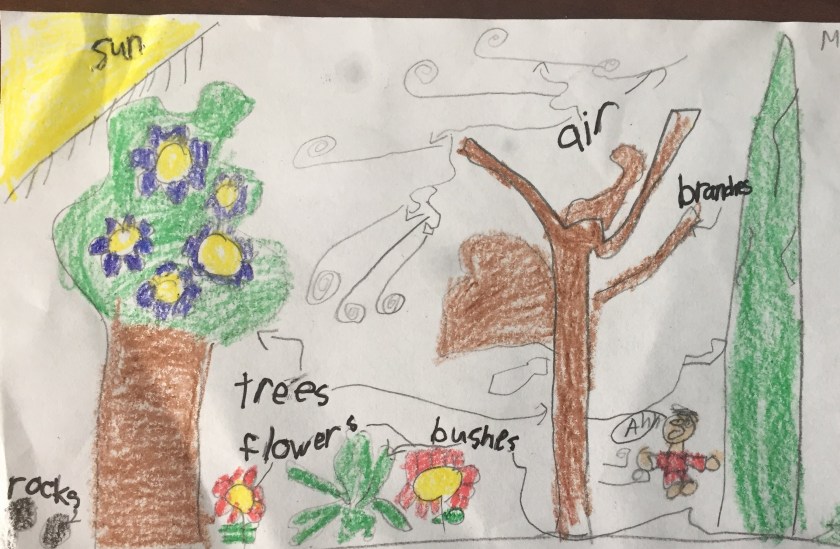
Anyway, I admired the son’s work, and then the daughter pointed to the bunch of people in the picture. Peering closely, I noticed they had rainbow colored faces. I asked the son why the folks in his drawing looked like rainbow trout in the sunshine.

He said, “Oh my teacher said to the class, to put in some colored people.”

I turned to the teacher, and she said she did say that for Diversity and Inclusion. I smiled at her, and thanked our stars for all the lovely things teachers teach the children.  Half the adults seem to have difficulty remembering these simple lessons in these sad times. All the more reason why we should all attend a year of Kindergarten every decade.

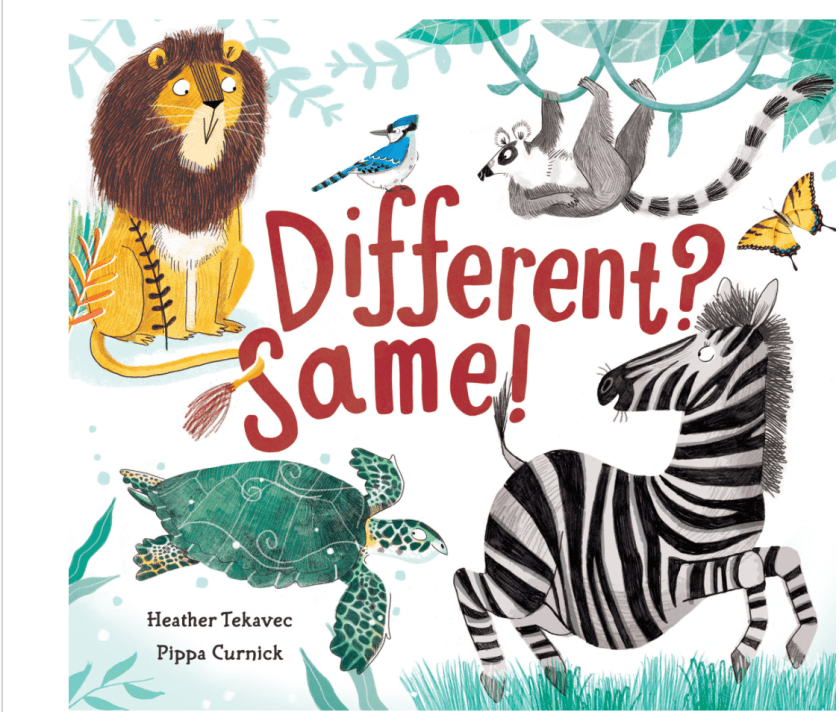
I looked again at the rainbow colored people and thought how beautifully untainted and open minded we are before we learn our little prejudices along the way. To think how much we obsess on skin color makes my rainbow colored heart very sad. It was, therefore, with utter joy that I picked up the book, “Different? Same!” Written By Heather Tekavec and Illustrated by Pippa Curnick.

Screen Shot 2018-06-04 at 5.22.25 PM
Different?Same! By Heather Tekavec, Illustrated by Pippa Curnick

In this beautiful book, we are reminded of how each of us are so different and yet similar. How is a Zebra similar to a bumblebee? Or an Elephant and a Narwhal? 

The book finishes on a beautiful note that can make our rainbow colored hearts sing: If you look closely enough, it soon becomes clear … we’re not as different as we first appear.

Swimming Across The Media River

One week-end evening, the devices in the house were barking mad. Twing, twang, tring. Video calls, phone calls, instant messaging systems were all driving themselves to a tizzy. Far away, far, far away, 5000 miles away a temple bell was clanging.

I yearned for some quiet and asked if anyone cared on joining me for a walk in the cool Spring evening. Everyone sprang out of my sight like a cat let loose in a party of rats. The husband was trying to yelp his way out of a walk when the first free WhatsApp call came. He ran to pick up the phone with a sense of urgency, and secret relief that he did not have to go a-walking with me, but narrowly missed the call. I made for the open skies while he dialed back. 

The walk was a beautiful one. I admired squirrels chittering, birds twittering, even the raucous cackle of the geese seemed musical. I have, in my chronicles expressed an interest in finding out about animal communication. Misguided. It is better if we don’t know. This way, I could let the noise wash over me, and assume best intentions on their part. The breeze gently tousled my hair, and the setting sun threw brilliant hues across the scattered clouds.

img_7558.jpg

I stepped in to the home after some time, and saw the husband looking drawn and crumpled, like wet cloth tumbled about in a dryer.

Is everything alright? I asked him a little worried.

Yes! Yes! he said, and proceeded to tell me the thrilling tale of the past 1/2 hour. The saga clanged its way across temple towers, cell phone towers, underground cable networks, and busy human ones. Leaping from a small rural temple town in South India, a couple of metropolitan cities, and continents, with data bits coursing through half the earth, it read like the glossy blurb of these bestselling novels steeped in drama and suspense. 

I was intrigued, and gave the sympathetic ear at once.

The first phone call had been from his mother in India. She lives in Madras. WhatsApp calls are free, and people are free, so I will just give the gist. 

Mother in Madras: Can you call your cousin in New Jersey, and ask him for his sister’s number in India?

Husband in California: Why? 

M in M: His sister is here in India visiting no? 

Wait! I see even gists could take a while, alright let’s try this then:

Premise: Husband’s cousin visiting India for a few weeks.

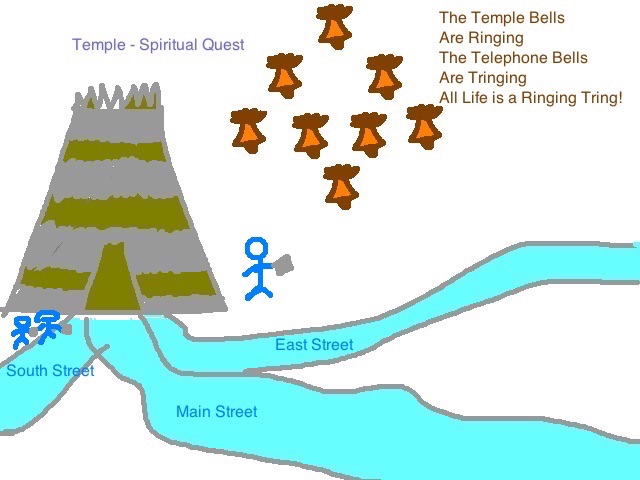
Plot: Said cousin and her mother, viz, husband’s aunt, went to a small temple town in South India.  There, they planned to meet up with husband’s uncle, and go into the temple together.  

Plot Twist: Uncle tried to call Aunt, but she had put the phone in her handbag and did not hear it ring because someone was twanging the infernal temple bell with great righteousness.

Cliff hanger: Will they ever meet? The temple town had all of 3 streets culminating at the temple after all.

That is it. The entire plot. 
temple.jpg

How does that leap across metrops, continents and coasts, you ask? Fair question. 

As I see it, the itch to go temples stems from mankind’s search for spirituality. Learn to calm the inner anxieties and voices and so on. On this spiritual quest, when one does not meet the intended person in the first 32.5 seconds, the mind flutters and they place an immediate call to their sister in Madras. She then calms her brother saying there is no need to worry, and immediately places a phone call to the husband in California. 

Why husband in California? 

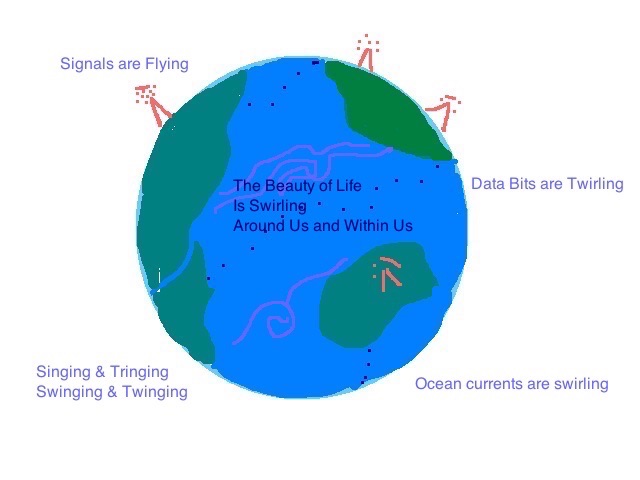
Repeat after me: Aunt visiting temple with d. Plot thickens when Aunt does not pick her phone. But the visiting cousin has a phone for use in India. Stroke of brilliance indicates that her brother preparing for bed in New Jersey will have his sister’s number. Call husband in CA *Tring* to call girl’s brother *Tring* to find out temp cell phone number in India. 

Husband misses call narrowly *Tring*. 

Husband calls mother again *Tring* as soon as possible, but mother’s phone is busy for she has called *Tring* her second son in New Delhi to call his cousin *Tring* in New Jersey and get the phone number. 

After several nerve wracking minutes, both folks call the poor fellow in New Jersey *Tring Tring*. The fellow moans sleepily that he has already fielded five free calls from various parts of the globe asking the same thing and there is no need for any of this, since they seem to have found each other. 
tring-tring

Then a next set of phone calls were completed for the express purpose of letting everyone know that the concerned parties had met each other, and all was well. In all, I guess about 23 different calls were made. If one party had stood still for 5 minutes, the other party would have simply fluttered into them in the breeze. 

Though tactless, I laughed heartily. The husband looked like a spent force after dealing with this hurricane of calls. He eyed me, and said somewhat icily, “Let’s talk about something else, shan’t we?”

“Do you know how trees, and wild boars communicate to each other?” I asked the husband grinning. 

“Tell me”, he said, and we spent the rest of the walk discussing acacia trees, giraffes, wild boars and hunting laws in Geneva. (Inner Life of Animals, The Hidden Life of Trees – Peter Wohlleben)

“Did you know the wild boars are so smart, they have figured out that the Geneva side of the river has a hunting ban, and the France side doesn’t? So when the first gunshot rings out in France, all the boars scramble, splash into the river and swim to the other side of the river. I suppose they poke their tongues out at the hunters on the other side!” I said.

“Is there someplace that has a free-calling ban, so we can swim across the media river when the first phone calls start?” moaned the fellow, and I patted his hand in commiseration, wisely refraining from telling him that all of this could have been avoided if he had just come out on the walk with me leaving all modes of communication behind. 
Should Okras Be Peeled?

The father waddled up to me in the library and spoke in his whispers. “Oh! Look what I have found? I am going to become a force, and talk to Aunty by myself.” 

It was a Tamil book: Learn Hindi Through Tamil. I looked amused. Hindi has always been the pain point in the household. I remember being a single digit age, lolling on the bed in our childhood home, a few weeks before our trip to New Delhi, and the mother was exhorting us to learn Hindi.

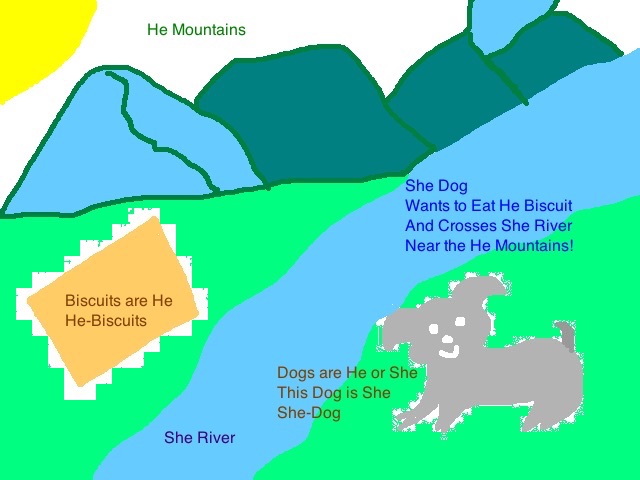
I was the only one who was technically qualified to say anything in Hindi because I was the only one who learnt the subject, but I use the term ‘learnt’ loosely. The teachers taught, I struggled.  I always struggle with languages that force you to determine before hand whether a biscuit is masculine or feminine. Fine! Male biscuit! I say, and then it asks me, what about a dog? How does it matter whether the dog is a she-dog or he-dog?  ( although I suppose it matters to the dog, I see that now. Hmm.) Okay, She – The dog is female. Then what about a dog-biscuit? Is that asexual. You see how confusing it all is? 

hindi_dog_biscuit

We made it to Delhi after a thrilling ride on the train that took us several days and various experiments with Telugu, Marathi, Bihari, Urdu, Rajasthani and Hindi. One day, we went shopping in Delhi. We were told by our kind advisors that the thing to do in Delhi markets was to issue a prompt, “Baap re baap Bhaiya. Itna?!  (Oh my goodness me! This much?!). Like a ‘Hello’, you first belt out the Baap-Re-Baap. After that you are on sound ground, and can proceed to ask for a price less than half the asking price. 

When we baap-re-baap-ed at this, our hosts told us that it is standard practice. Traders in that market priced goods at more than double for they knew it would come down to less than half, so it is a fair price game after all. I had no working knowledge of Economics then (or now), but this sounded wonkilicious.

So, we baap-re-baap-ed our way around the city.

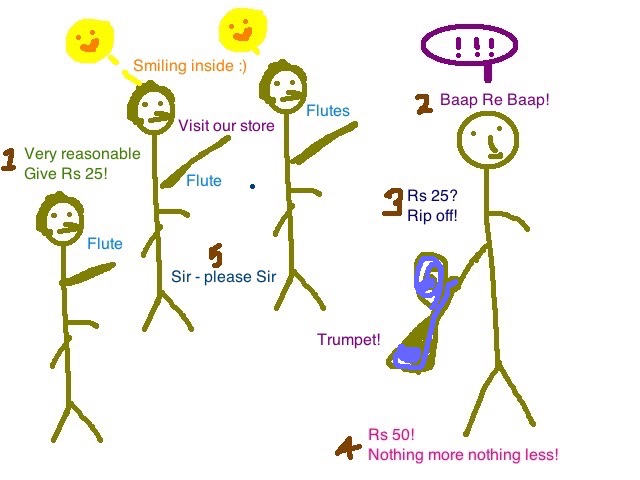
In the crowded market, I heard the Baap-Re-Baap in the Pater’s voice emanate to much commotion. A soft voice was never his identifying feature. If he were an instrument in the band, he would be a trumpet, not the flute or the bagpipe.

The pater was bargaining hard. “Nahin, nahin. Pachees too much hai. Myn pachaas-heee givoonga, errrmm, day-oonga.” (“No no. 25 rupees is too much. I will give you only 50 rupees.” )

hindi_bargain

I went over to investigate the fracas, since more and more people were joining in to get a good seat on the show. The pater was driving the hard bargain. 

I tried explaining in Tamil so folks watching the show would not understand: “Do you want to give Rs.15? He says the thing is Rs 25, and you are saying you will settle for Rs.50!”

The merchant was laughing to split, and several more were joining in by the minute. Finally, he said in perfect Tamil. “Saami – irupadhu kudu.” (Sir, just give Rs 20.)

After that, the association of market stall traders were most helpful – they pulled us into their stores and treated us to tea and more bargains. Who after all bargains to give more? Here was a soul of gold, they said to themselves, and went on to rip us off with perfect amiability.

I can’t say the decades in between taught very much more of the language.  One could get by quite well in South India without Hindi. 

Then, a few decades later, Aunty came to our household. She is a stellar help. She speaks Hindi and when excited switches to Urdu.

So, that day in the library, he was obviously thrilled that he found the book that promised to teach him Hindi through Tamil. That night, I heard the father proudly showing the ‘Learn Hindi through Tamil’ book to the mother, and telling her looking rather pleased with himself. “Look! The milk is here. Doodh yagaan hai! 

“Oh Look!” The father is a confirmed oh-look-er. “There is even a page for vegetables. Did you know aloo means potato? ”

The mother, always up to the challenge, told him that it was admirable, and said coolly. “Tomorrow, ask Aunty to cut the peerkangai (ridge gourd) into small squares, and keep the scrapped tholi (hide)”.

The father turned to the vegetable page, exclaiming loudly that it was a marvelous book, and asks like this are child’s play. Bacchaasplay. After a few minutes, he yipped loudly. “There is no translation for peerkangai in the book. I cannot ask her. Should I ask her to peel the bhindi instead? Vendakkai means Bhindi.” (Okra is vendakkai)

“Life is worth living as long as there’s a laugh in it.” – ― L.M. Montgomery, Anne of Green Gables

The Land of Crumpled Cardboards

I love to see the children play their games of make-believe. One night the son went on and on about which island I would save and why. I was doing three different things in the physical realm as he spoke, and mentally fifteen. So, by the time the question was posed to me, I was flummoxed.

“Umm the biggest island.”, I said.

“Ugh! You didn’t listen did you? That has the ferocious dragon, and not just that, it won’t even listen to you! Do you really want a dragon that doesn’t listen?” he asked. Distracted as I was, I was glad that the irony of the moment was not lost on me, and I chuckled.

Sometimes, I need to get something at night, and howl and yip after stepping on gallant heroes, tired cars, planes and figurines parked on the ‘arena’ in neat rows so they can sleep.

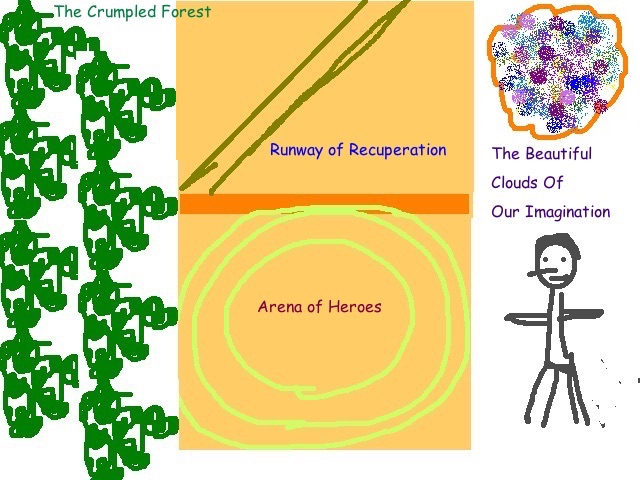
An old cardboard box has occupied prime real estate in my home landing for months. Several attempts to throw the thing out fizzled out when I heard the touching passion with which the son argued for it to be kept. It isn’t an ordinary one: It has hosted grand prix races, super hero battles and has even been used as an air strip for firefighting airplanes. 

cardboard_box


Inside, you will notice several faded crayon marks, the battle scars on a war-field.  The faded crayon lines are the tracks where the races take place. The green colored lines are the lanes within which the firefighter plane has to land, exhausted after fighting fires raging over the crumpled forests of paper nearby.

I was reminded of the poem, The Land of Counterpane, by Robert Louis Stevenson. A poem so endearing to me given the situation with the crumpled cardboard box.

The Land of Counterpane – By Robert Louis Stevenson, 1850 – 1894

When I was sick and lay a-bed,   
I had two pillows at my head,   
And all my toys beside me lay   
To keep me happy all the day.   

And sometimes for an hour or so     
I watched my leaden soldiers go,   
With different uniforms and drills,   
Among the bed-clothes, through the hills;   

And sometimes sent my ships in fleets   
All up and down among the sheets;  
Or brought my trees and houses out,   
And planted cities all about.   

I was the giant great and still   
That sits upon the pillow-hill,   
And sees before him, dale and plain, 
The pleasant land of counterpane. 

land_of_counterpane
Illustration from Book of Poems – R L Stevenson


One evening, all the adults and teenagers in the house were busy trying to figure out how to amuse themselves. Netflix was straining its algorithms, and saying, If you liked that, how about this? You-tube stars were creaking and moaning leading folks down rabbit holes of if-you-like how the soap bubbles popped in this purple bucket, then you will surely also like how the soap bubbles pop in this pink mug.

The elementary school going son, however, was playing vigorously. The Piston Cup was in progress, and he was charging round and round the stadium trying to see whether Lightning McQueen would win yet again. After an hour or two of this game, he became a firefighter, and flew off, his mouth-engine purring brrrr—prrr—vrooom—broom. 


Ask any adult about how they played as children, and you can be sure of being entertained.

“Because when you are imagining, you might as well imagine something worth while.”
― L.M. MontgomeryAnne of Green Gables 

I wonder when we lost this admirable skill. What would it take for us to regain the ability to amuse ourselves, and delve into the wonderful worlds of our imagination? 

I can understand now what Robert Frost meant when he said something to the effect of, the older one gets, the younger the teachers. 

When I was young my teachers were the old.

Now when I am old my teachers are the young.
Robert Frost

The World of Pure Imagination

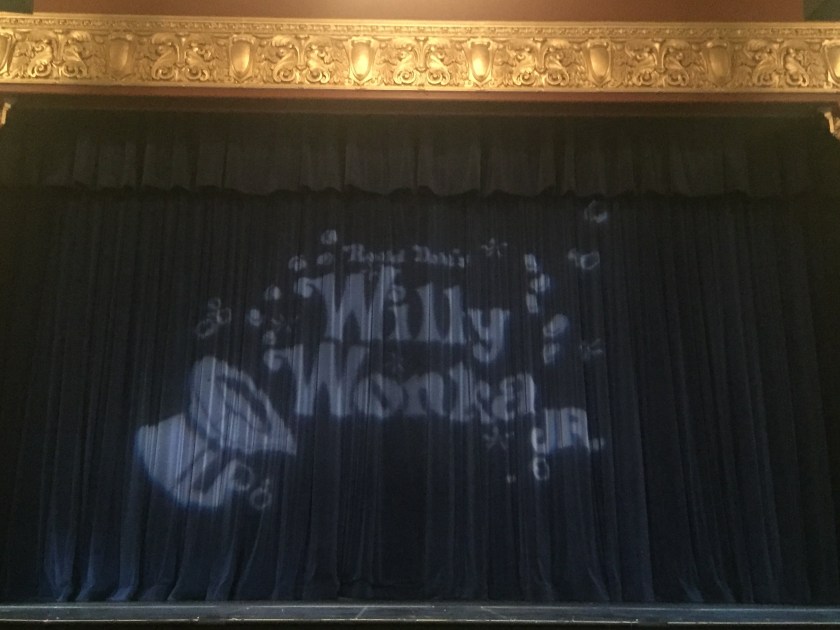
The daughter pranced into the home one evening a few months ago, her eyes agog with excitement. She had auditioned and been cast as Willy Wonka, the eccentric chocolate factory owner in Willy Wonka Jr (the musical based on Charlie and the Chocolate Factory). They say Art is Transformative, and it is true. Every time I see the children pull off something spectacular, my heart soars. 

Come with me and you’ll be 

In a world of pure imagination

We’ll begin with a spin 

Traveling the world of my creation

What you’ll see will defy explanation

IMG_8469.jpg

As she sang her songs from Willy Wonka around the house, there was a pleasant hum in my brain too. I remember reading the little book with her when she was in elementary school. The years in between have smudged into a blur in which I remember doing a lot of things, cherishing a few memories, and before I knew it, my little girl towered over me in height and ability. 

In a world of pure imagination: how would that world be? It must be a world in which all things vile are wished away, and only pleasant striving has a place. A canvas on which the best is to be painted and awaits the strokes of our creation. Maybe that is how we must view life. Every aspect of ours a stroke on our canvas – the true nature of the painting ever changing to be revealed to us as we go along, giving us a subtle choice here and there on whether to put in that jarring, wrong stroke or a mellow, right one.

There are many marvelous things that I can attribute to imagination (and immigration). One that ranks highest is the fact that I get to read American Children’s literature as an adult. As a child, in the lovely hills of South India, I loved curling up with Enid Blyton’s books, and often escaped into fairy lands on wishing chairs and ran into magical forests. It was easy imagining an adventure, while swinging on tree trunks that had fallen in the last storm. We had plenty of time, and had no one but ourselves to rely on for entertainment. State television made its entry a few years later, but it was agreed fact that our own flavor of entertainment was far superior to what we saw on Television. I sometimes played alone, but not once did I feel lonely. There were always imaginary friends who’d drop in for a cup of tea and we’d bake some scrunchy scones and whip up some tea cake, though I had never seen the inside of an oven. 

The Indian comic books, Amar Chitra Katha, Chandamama added flavor and beans to the curry pot of imagination. It was a wonderful time in the head. The pressures of wanting to make something of oneself had not yet begun to exert itself, the only lures were those of nature as it enclosed us. The trees were friends and frequently doubled up as props in our adventures. Many a scraped knee was soothed away with scratches from brambles. 

I entered my teenage years, and my imagination left some of its whimsy behind. The teen years and the early twenties were dedicated to much serious reading, and I spent a good portion of my time striving and wondering what to make of myself.

“That’s the worst of growing up, and I’m beginning to realize it. The things you wanted so much when you were a child don’t seem half so wonderful to you when you get them.”

L.M. Montgomery, Anne of Green Gables

Then, I realized that all those years that I had spent wondering what to make of myself had actually made me. Just like that, I could embrace all that happened to me. It was liberating, and then the more whimsical side of my imagination swooped in once more. I took tentative steps into Wonderland when I became a mother in the United States, and indulged the child in me with my growing children. 


Dr Seuss graced our tongues and teased the brain (What if I had duck feet? Did the elephant hatch the egg finally, will Zooks and Yooks ever become friends?), we sang poems by Robert Louis Stevenson set to the tunes of the old hymns in our school hymn book (To be written), we giggled with Bernstein Bears, hoo-hoo-haa-haa-ed with Curious George, and marveled at the friendship between Frog & Toad. The children and I read Charlotte’s Web when I was in my thirties, but I enjoyed it even more than I would have as a child.  

dr seuss

For a long time, I had meant to read Anne of Green Gables, but for some reason, did not. The daughter had not shown inclination towards this series, and there was no one to tell me how I absolutely must read it. Then, one day I read a quote from Anne of Windy Poplars, and I was intrigued. I have always loved that style of uplifting writing weaving the tendrils of imagination with subtle humor: the gentle breeze of the soothing powers of nature to nurture our soul wafting through every page. It is why I like Miss Read’s writing so much.

I identified keenly with how much Anne prized the gift of imagination. Somehow, we lose that streak of imagining as we grow older, much like we forget to skip while walking.  I now have that pleasurable thrill of reading all the remaining books by Lucy Maud Montgomery. It is a sustaining thought.  

Margarita Engle’s poem:

No giant or dragon

Is bigger or stronger

Than the human imagination

P.S: If you have not already listened to J K Rowling’s commencement speech, it is definitely worth listening to: The Importance of Failure and Imagination


How Windmills Became Giants

No giant or dragon

Is bigger or stronger

Than the human imagination

– Margarita Engle

That was the first poem in the children’s book, ‘Miguel’s Brave Knight – Young Cervantes and his Dream of Don Quixote‘. It acted like a magnet on me – not that iron had entered my soul, far from it, but you get the gist. Silly thing to say that magnets work on people, what I mean is that the book appealed to me. 

Screen Shot 2018-04-12 at 5.13.22 PM

The son and I read it together a few days later, and he cackled, “My goodness! This boy thinks of Knights on every page. “

“Yes. Doesn’t he?” I said, bemused that one who introduced car and ninja motives into everyday speech should find it amusing that another young boy was fixated with knights. I told him so, and he laugh good naturedly. “Yeah – but how come he sees knights everyday? I have never seen a knight.” said the little fellow.  We then had an illuminating discussion on the lure of the knight in the olden days. How ubiquitous he seemed, and what enamored thousands of boys to sign up as knights. Could it have only been a means of livelihood or a quixotic quest for glory? 

Back in the book, the story of Miguel Cervantes flowed along poetically.

The book is artfully written, and tastefully illustrated (Pen,ink and watercolor – sample below) . In short poems, titled Hunger, Imagination, Comfort, Daydreams; the story takes one through the life of Miguel Cervantes, the poor boy with an indifferent education, who made the world a richer place by imagining the modern day novel into existence. His flawed, grandiose, knight, Don Quixote lingers on in human imagination centuries later. 

IMG_8390

Miguel’s Brave Knight – Young Cervantes and his Dream of Don Quixote

The poems really talk of the life of Miguel Cervantes, but are lucid enough to be relished on their own. Miguel Cervantes lived during the sixteenth century, and had a far from easy life. Born to a barber cum surgeon, his early life was in constant turmoil as his father was frequently in debt, and was arrested for it several times. They had to move often, went to school if he could, but throughout all his travails, his imagination was his best friend. At a time when books were rare, and imagination frowned upon, the young Cervantes managed to learn to read and write, and carefully hone his imagination: a gallant knight on a magnificent horse was ever ready to rescue him and the world.

Daydreams  

My daydreamed knight

protects farmers and maidens

from ogres, goblins and trolls

The Ingenious Nobleman Sir Don Quixote of La Mancha was the original title of the book that was eventually published in Spanish. 

He sees windmills as giants 

with enormous, spinning arms

The first time I saw a windmill, I stood transfixed, even as an adult. It is no wonder that it appealed to the imagination of a young boy.

Beautiful poetry, mellow illustrations and the story behind Don Quixote is truly irresistible, and I have read the book several times already with joy.

Also read: The Boy Who Harnessed The Wind

Lord Float A Duck!

I remember the first time I heard the Duck-with-an-F word in public. I was horrified. It was in a meadow where we had convinced a gullible teacher to take us out on a nature amble instead of listening to the stern and necessary work that goes into maintaining a civic society. The middle school children far from being lambs and observing nature were trying to play a game of Kabbadi instead. Kabbadi for those who don’t know, is a game where one runs saying the word Kabbadi Kabbadi Kabbadi Kabbadi Kabbadi Kabbadi Kabbadi Kabbadi over and over again till you want to shriek in agony.

sheep_dog

What horrified me was the fact that far from shouting Kabbadi Kabbadi Kabbadi, the boys were insisting on shouting Mucking-an-F or Duck-with-a-letter-that-comes-after-E and this seemed to incense the whole lot of them unduly.

As they looked around in that male-hen-y fashion, I was appalled that something this crude was expected to draw admiration from the girls. I cannot say the girls admired the swearing nitwits very much. We felt a little sorry for the new teacher who was flailing his arms like a shepherd who had just let a puppy loose in the herd by mistake.

sheep_dog_1

The Fabbading went on and on till another resourceful teacher hovered in sight, saw the plight of the poor new recruit who had completely lost control of his class, and showed the fellow how to regain control. Under this stern shepherd, suddenly the fowls spitting F’s became lambs again, bleated a little pathetically, and quietly headed back to the classroom. But I had altered that day.

Then, I remember reading the first “adult” book, and gasping for air every few minutes. For something strange happened: contrary to the adults I knew, the folks in the book hissed and puffed and cussed all over the place. I was wondering whether being adult meant puffing like a penguin in a desert.

I can’t say things have changed much since then.

Society far from growing out of this trend seems to have taken this to alarming extremes. Presidents freely use S-*-*-* words, and worse the news agencies gleefully repeat them.

I wonder how many of you remember cackling at the Tintin comics by Herge: Tintin comics are great fun. I read a few last week, and found myself giggling like a preschooler being tickled by the carpet on which they are rolling. Captain Haddock was my favorite. When he lost his temper, which he seemed to do on every alternate page, he swore in the most imaginative manner possible. The bumbling-bashibazouk made me smile every time he swore. He made one think. He made one use one’s fumbling brain and every swear was one in which you smiled at the brilliance of it.

IMG_7849

Would he call you a jelly-fish or a marinated eel? One never knew.

Imagine yourself facing off a street punk who looks ready and willing to punch your nose. If you call him a Mucking-Duck with a double F, he has to stop mid punch with his hand drawn back and ask himself, “Whaddideesay?” and it gives you valuable time in which run away like krill fleeing the direction of the whale’s rumble. Fumble, tumble, rough and scramble.

So, here is a plea – make people work out their insults. Give them work. Mucking a Duck is far too easy. Call a fellow who does not like his vegetables a squash-nibbling centipede. Tell a fellow who is proud of his batting that he is a bat-bungling bamboozle. Think nonsense and regain the pleasant sensibilities of being in one’s senses.

As Theodore Geisel, or Dr Seuss says, “I like nonsense, it wakes up the brain cells. Fantasy is a necessary ingredient in living; it’s a way of looking at life through the wrong end of a telescope. Which is what I do, and that enables you to laugh at life’s realities.

Cephalopods

The husband had an amused expression on his face as he walked into the kitchen and saw me reading while making dinner. His eyes were set to roll, and his lips had already started on the journey to upward curvature that results in an indulgent smile. I told him so.

“Your neurons, it seems, are all controlled by one brain – tut tut! Not the case with Cephalopods. Take octopi or octopuses for example. They have neurons tingling all over their many arms, and each arm can function almost independently of another. Severed arms have been known to collect food on their own you know?”

“What are you reading now?”, asked the husband.

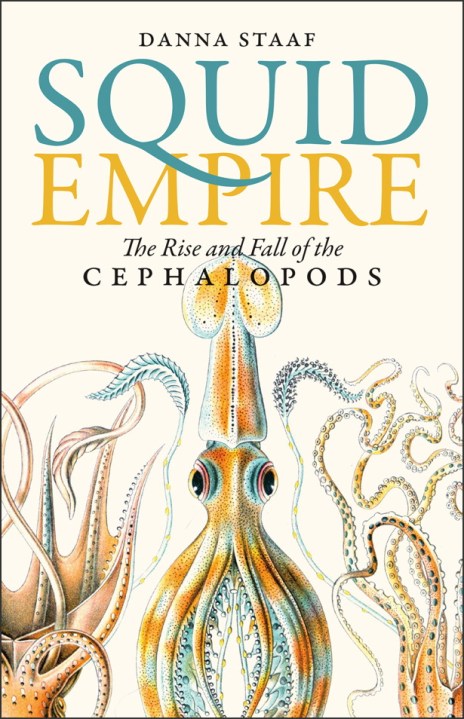
“Squid Empire by Danna Staaf. It is a book about squids, octopuses, and some other creatures called nautiluses and ammonoids, coleoids and cuttlefish and god-knows-what-else. Apparently, they are all called Cephalopods.” I said beaming happily, while slowly roasting the dinner. It made me feel like an eight armed goddess myself just reading about these fascinating creatures, and cooking at the same time. Never mind that I was making the most gawd-awful hash at both these tasks.

SquidEmpireCover

“Did you know? The humble garden snail is descended from the ammonoids and squids?” I said.

“Well….I will leave you to it then.” said he squiggling out of the kitchen like an octopus out of a tank.

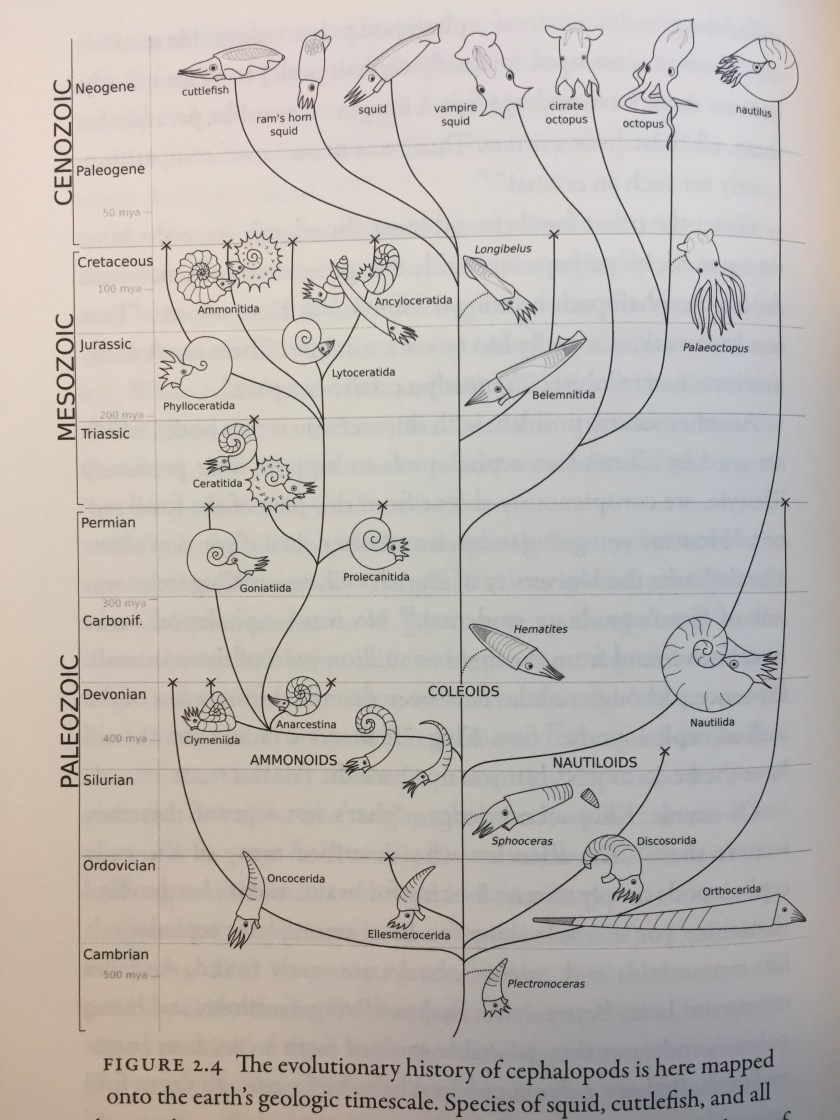
I went back to the book and though I was at times confused by the various scientific terms, I enjoyed the read. It yanked me through the ages, and took me to a time in Earth’s history well before dinosaurs or life on land had started. It was intriguing to see how they formed shells, and how those very shells helped them move from the ocean floor to the central zones of the ocean where they could swim and live with no apparent threat till the whales and larger fish evolved to eat them. The shells secreted a liquid less salty than the surrounding sea water, and this helped them float and remain buoyant instead of being brought down by the heavy shells.

IMG_8046.jpg
The Evolutionary History of Cephalopods from the book, Squid Empire

Why did I pick up a book on Squids?

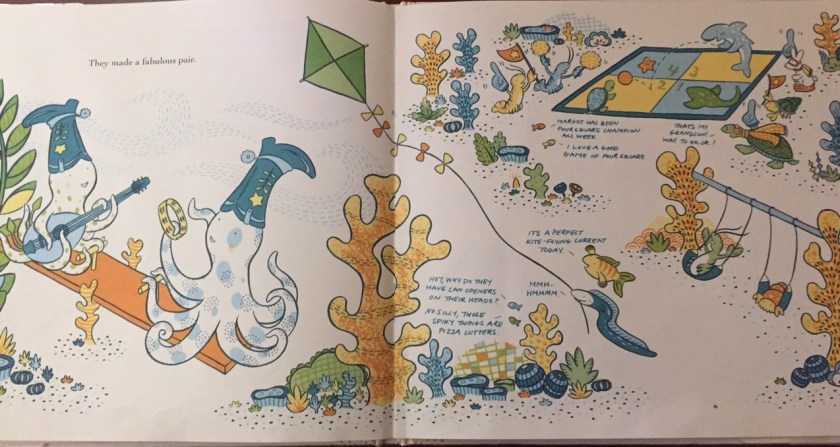
I don’t really know, except that I loved the children’s book, Octopus and Squid by Tao Nyeu. A book that the son and I read every now and then for its beautiful friendship between two seemingly different creatures.

Imagining
Squid and Octopus by Tao Nyeu

Then, a few months ago, I read The Soul of an Octopus by Sy Montgomery

Cosmic Nature of Living:

Quoted from The Soul of an Octopus by Sy Montgomery:

Cambridge Declaration on Consciousness asserts that “humans are not unique in possessing the neurological substrates that generate consciousness”, and that “nonhuman animals, including all birds and mammals and many other creatures, including octopuses also possess these neurological substrates.”

Now, I felt it was time to get acquainted with Squids. I don’t distinctly remember a squid – I must have seen them at the Monterey Bay Aquarium.  Their evolution is fascinating. The book is written by a genuine marine lover (Danna Staaf’s site is here: cephalopodiatrist), and her love for these creatures shines through in the book. I only wish the book had more pictures. I had to keep looking up pictures on the internet. Pictures of nautilus, cuttlefish, squid and octopus obtained from Google search below:

I had never used the word, Cephalopod, before, and I was glad to learn so much about another way of life, even if I may never fully comprehend what it means to have consciousness so permeable, so distributed, and yet co-ordinated.

If there is magic on this planet, it is contained in water. Loren Eiseley

jelly

Refection on Reflection

I often feel this way after some heavy reading, or hard periods of news activity. Frazzled, taut if you know what I mean. On edge. One fine day, a voice in the upturned cauldron piped up and said, “Look, I know you mean well, and all that, but the old brain is not quite suited for deep learning, heavy news and all that lark. We’d better leave all that to the algorithms, while we potter around in the sunny recesses of the spring garden. What? What do you think of that?” I took a serious look at the proposition, and nodded along enthusiastically. Everyone should do what’s best suited to them, right? So, I should .. eh..potter and totter, nourish and cherish, or perhaps enjoy refection on reflection.  

So, it was with a wholly energetic outlook that I went on to read several books to air the musty brain a bit.  P.G. Wodehouse – that unwavering rallier of spirits rallied like nobody’s business, and started off by soothing the sore spot at once:

The Pride of the Woosters is Wounded, By P.G.Wodehouse:

If there’s one thing I like, it’s a quiet life. I’m not one of those fellows who get all restless and depressed if things aren’t happening to them all the time. You can’t make it too placid for me. Give me regular meals, a good show with decent music every now and then, and one or two pals to totter round with, and I ask no more.

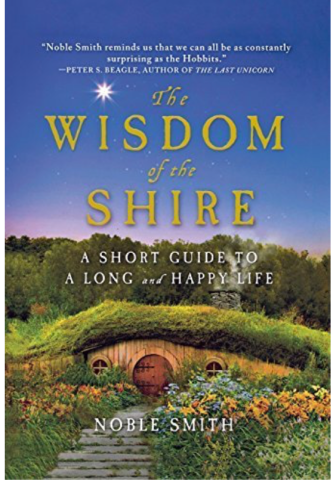
It was after I had revived after a spot of humor that I went in for a bit of magic. The Wisdom of the Shire by Noble Smith. It is a lovely little collection of essays on Middle Earth. The courage of Hobbits, the lore of the Ents. As I started reading the little book on Magic, it made me realize why we love Lord of the Rings so much that it endures on a century later. The hobbits are lovable in a way that is easy to relate to. They lead us to the joys in a simple way of life.

Screen Shot 2018-03-01 at 4.06.36 PM
The Wisdom of the Shire

Hobbits like a good meal, think nothing of throwing in an energetic walk in the Shire, enjoy the companionship of fellow hobbits and are generous enough in their outlook. Some of the essays on the Hobbits were:

Eat like a Brandybuck, drink like a Took

Sleep like a Hobbit

It seems they know how to enjoy a magical do-nothing day as often as possible.

Incidentally, A Magical Do Nothing Day is a wonderful children’s book written and illustrated by Beatrice Alemagna. The book practically tugged at me in the library. Some titles speak to your heart, and this was one of them.

A Magical Do Nothing Day. Swirl it around, and feel that sense of peace descend upon you. The book gently takes you on a slide down the mountains, a whirl among the leaves, a dip in the pond and the exquisite pleasure of touching a snail.

Screen Shot 2018-03-01 at 4.14.21 PM.png

For each of us, a Do-Nothing Day would be different. I am curious to hear what a Magical Do Nothing Day signifies for you. Please share your ideal version of a Do-Nothing day with me.

I had several Magical do-nothing moments recently. Moments  in which the children and I learnt to skip stones in a pond, or I stood mesmerized by a cherry blossom tree that looked like garlands on every branch. The beauty around us is ethereal, and that makes it all the more inviting to go and enjoy nature.

To see a World in a Grain of Sand
And a Heaven in a Wild Flower – William Blake 


President Squid

I get the feeling that the Universe potters around jotting down whether things are going the way they are supposed to and so on, and then stops and sees me having a good time, and says to itself. ‘That half-wit there seems to be enjoying herself. Catch her, and put her up for a Leadership course or something. Do something with her! Something!” So, in my unguarded moments, I have been bunged into courses on Leadership.  Barely do I totter out of one, when another beams at me touting the title, ‘Effective Leadership’, and the moment I finish that up, ‘Most Effective & Beneficial Leadership’ (Beneficial to whom?)

I have no problem with these blokes whose job it is to tell you to polish your pencils and sharpen your brain and what-not, but I find the whole thing irksome and tedious. So much better to take my Leadership course. My course is fun. Titled, Butter Battle Course, it is being substantially boosted up with these gems.

Skip several tomes on Leadership, and read up: Hope this helps the squids, squirrels and sheep too.

President Squid – a witty book that enthralls and amuses.

Screen Shot 2018-02-12 at 12.14.54 PM.png

Giant Squid has a very important realization. No giant squid has ever been a president before. He looks for qualities to be a President and surprise of surprise – he already has them all.

Qualities of a President:

  • He wears Ties
  • He has a large house (The Titanic!)
  • He is famous
  • He does ALL the talking
  • Big & bossy


IMG_7854

President Squid is as loud and rambunctious as ever. He is convinced that he the Best President Ever!

One day as a President, he unwittingly does some work, and then being a President doesn’t seem like fun anymore.

IMG_7856
President Squid: Book by Aaron Reynolds

The book also provides a solution for those unfortunate Presidents who became Presidents and then realized it is not all as gassy as a cup of beans.

IMG_7857
President Squid: By Aaron Reynolds

Complement this with the equally endearing and hilarious books on leadership:

King Hugo’s Huge Ego : By Chris Van Dusen

Loius I, King of the Sheep – By Oliver Tallec

Who was it who said that there is nothing that cannot be learnt from good children’s books? I heartily agree.

Children are actually the best (and worst) audience for literature because they have no patience with pretence.Orson Scott Card