Upanayanam: Insights into a Traditional Ceremony

Upanayanam – Thread Ceremony

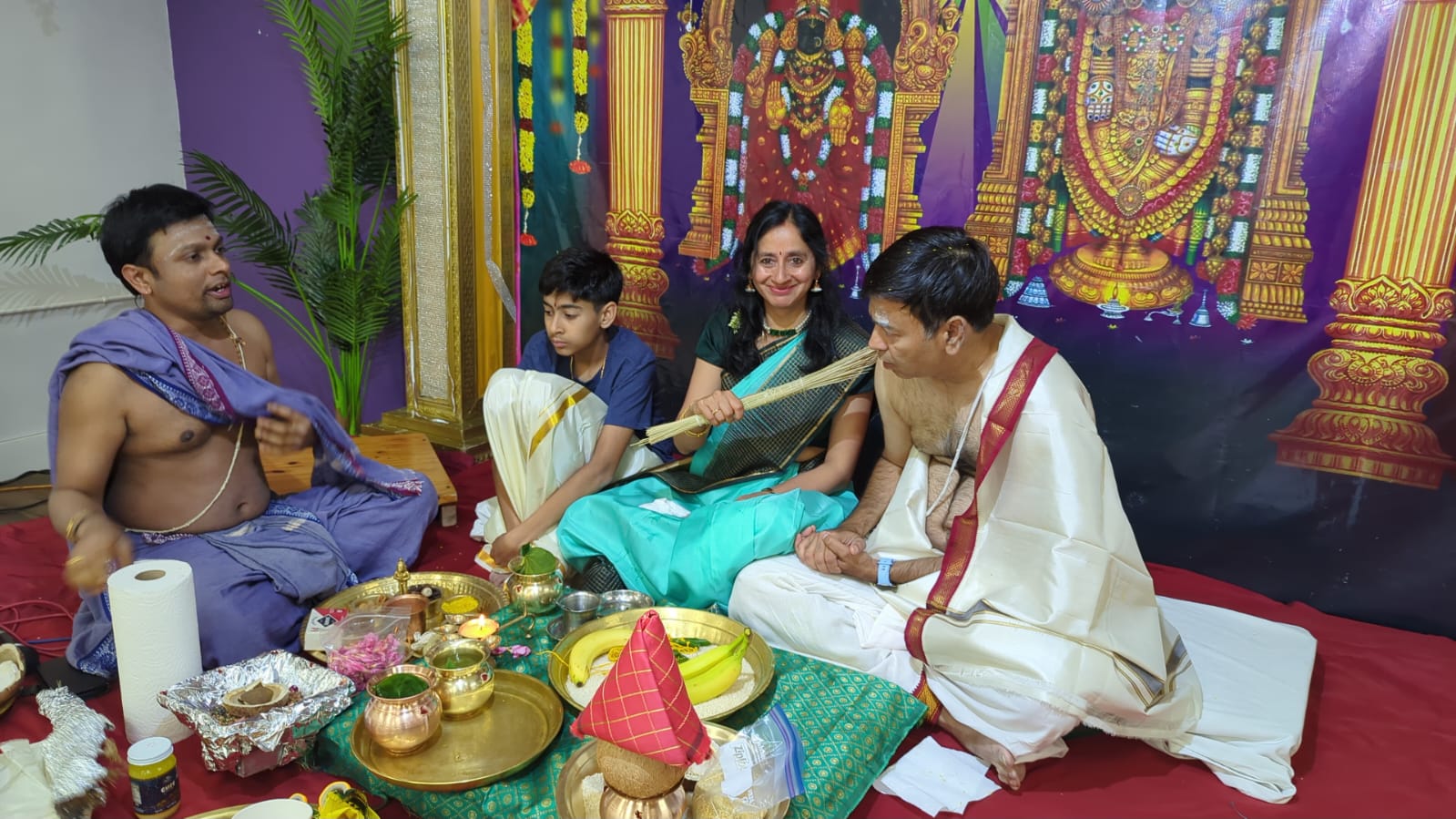
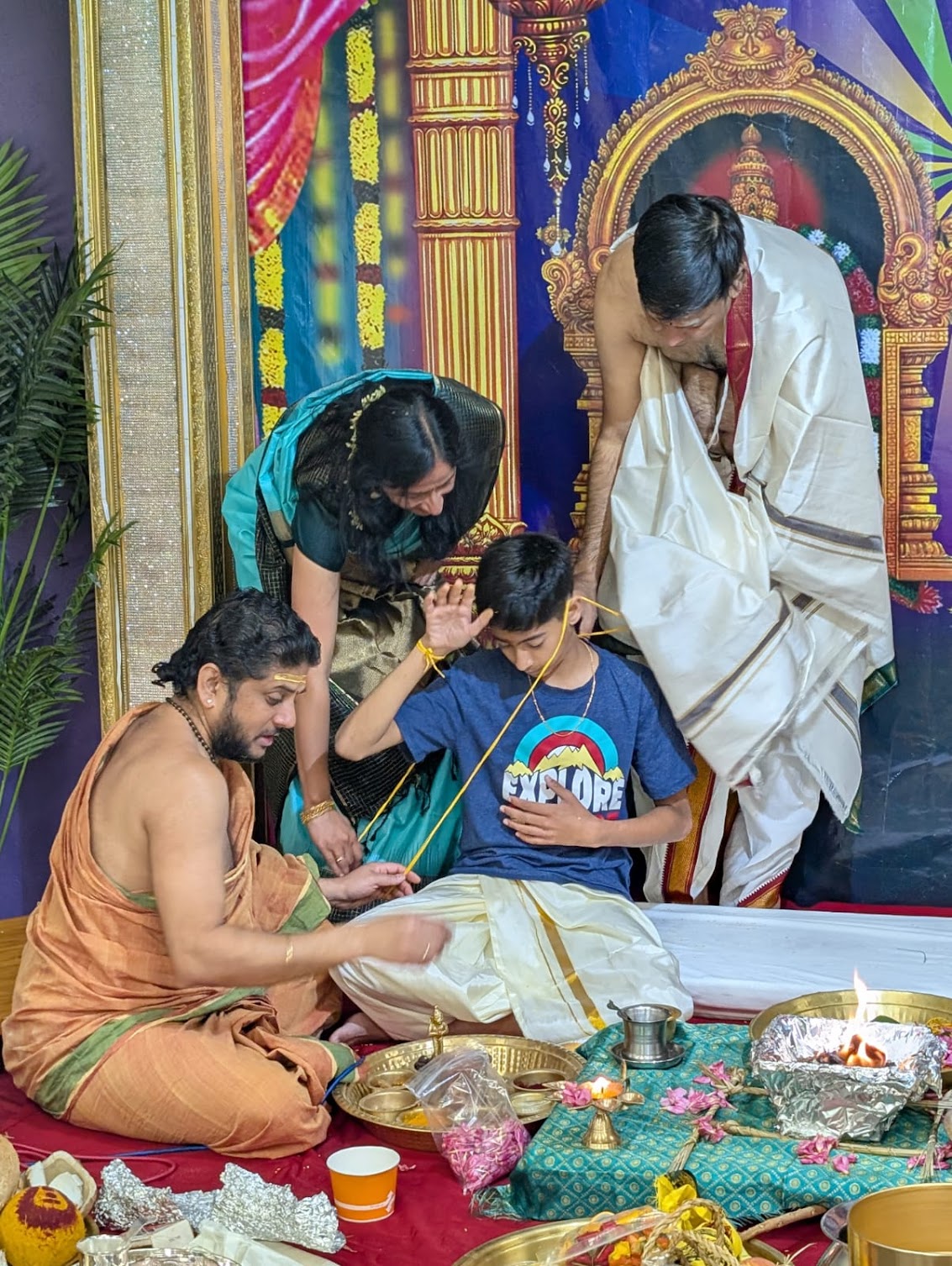
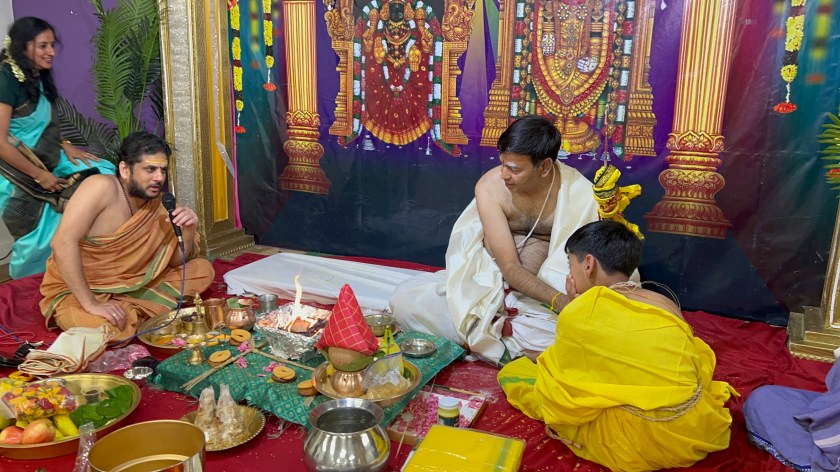
The husband and I found ourselves stupendously stumped. You see? We celebrated the son’s thread ceremony. We had managed to get in the middle of organizing and executing a function that smacked of our curious mixture of naïveté and fun. 

So much so that a lot of people were very happy, a few people held their tongues with pursed lips and stiff jaws (some even graciously told us that it is indeed what they were doing), and a precious few reveled in their self-glorified role of saying things-as-it-is (any politically savvy person knows what this means. But seeing as Yours Truly is particularly poorly suited to this, took some getting used to).

Summoned like a Woman!

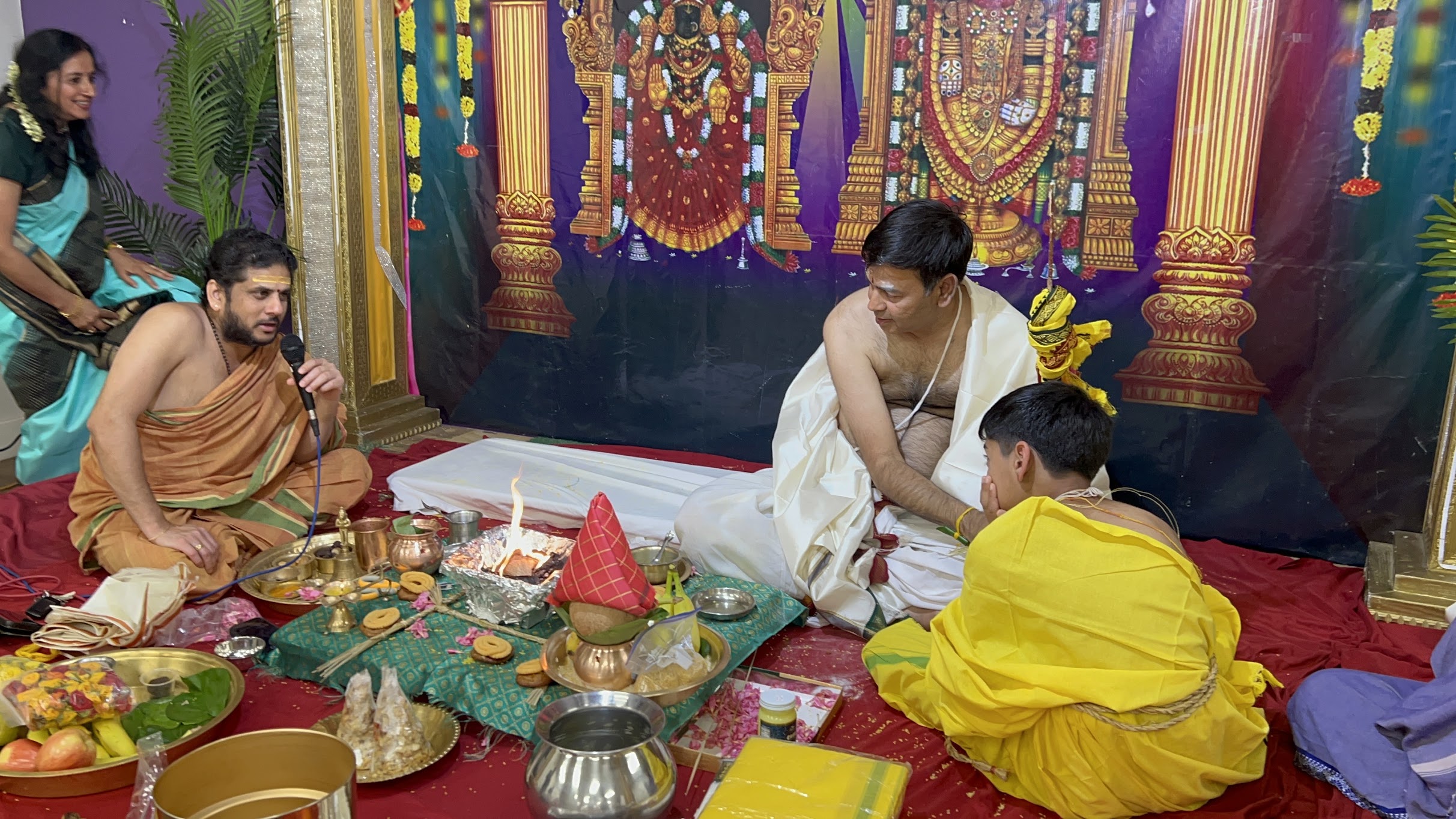
Like all religious functions, this one excluded women, but insisted they were there for all the work. The organizing, the decorating, the gift-giving, the hosting. Just nothing religious. Every time I looked particularly bored on that stage, the priest would give me something to do.

 “Take that drop of water, and drip it on the coconut, amma!”

“Hold this bunch of dried grass against the shoulder, amma!” 

Then, a chuckle. “Not that shoulder amma, this shoulder!”

While all of these tasks weren’t exactly skillful, they ensured it kept me there. Otherwise, the poor priest found me wandering off the stage to talk to people. 

Then, summons were sent. Summoning the lady of the house on stage at a religious function is a curious case study of sonar technology and people movements. Every one calls out for you, and nobody realizes or remembers why I was summoned. Like a wave gathering in intensity before crashing on the shores.

Summoned!

Smiles to go before I sleep!

“How come you are smiling in all the pics, while I…”

“Look like you’re having your tooth extracted?” I finished smugly.

The husband paused to frown and then smiled, “Yes – like that!” 

“Easy! I had absolutely nothing to do but smile at people. Also, I looked for the phones and smiled pointedly. There’s a lot of time for not understanding a thing, and being dressed to the nines up there.” I said. 

“Talk about unfair – look how I looked in all the pics: confused, concentrating on getting the words right, while you…”

“Pranced and fluttered about the room? There are advantages to being a butterfly.”

So, that is how we survived a thread ceremony, without storm warnings.

Reflecting on 30 Years at a High School Reunion

30 years 30 minutes

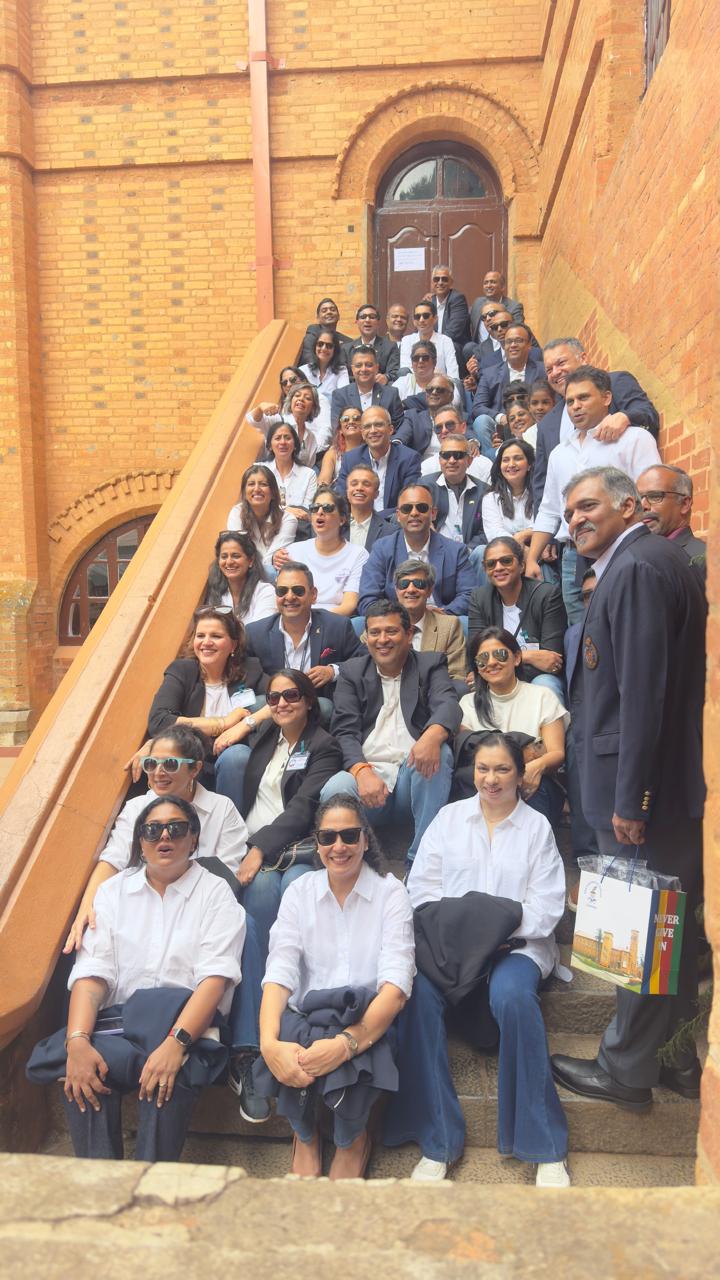
When we look back on life – what do you tell those who knew you when you were but a little girl? Some had grown into more distinguished versions of themselves, few were hardly recognizable (especially those who had embraced facial hair – mustaches, beards, and the like), and a rare few looked far younger than their biological age.

There was a strange moment when I asked a fellow classmate, “I am sorry, I am unable to recognize you – can you remind me who you are?”

“Oh come on Saumya!” He said, and I felt a flush creep up my cheek.

“Not the right response man!” I said laughing, as he reminded me with a helpful anecdote to place him. 

In 30 years, a lifetime has passed, and yet felt like a heartbeat.

Sounds cliched I know. Probably the thing that everyone who has attended a high school reunion feels. 

As I gazed fondly around the room taking in the whirlwind of activity and the people who were at school with me, I felt gratitude first for all the memories. Even the bitter ones seemed to have attained a bitter-sweet tinge to it, which did not quite seem possible at the time. 

When we left school 3 decades ago, everything felt sharp – in a way that teenagers can feel. The angst, the turbulence, the weight of expectations, the sense of trepidation for what lies ahead. And then somehow, life happened in those moments of angst. The years rolled by. Careers were made, lives were built, children were birthed and raised, and through it all, our families and friends bore the thrum of Lawrence School almost like background music. 

It was fantastic to see where life had led us all in the three decades since. Many had embraced growth, some had endured it, and a few had denied it. But we were all swimming across the river and continuing to brave the currents. Some of us were still in the whirlwinds of the swift currents, some were looking forward to the quiet moments of water lapping around the shores on the opposite side. Regardless of where we were in life though, there was an enormous affection.

I remember thinking as a girl why the Old Lawrencians made such a fuss about their reunions decades later – they all seemed to be so happy to be there with their hair greying and limbic nimbility dwindling. I understand now. 

People Currents

It was curious to see the patterns emerging after all these years. How we sought out the people we liked, had a polite curiosity about the people we didn’t, and found out about the ones we respected after all these years. Finding out about those who had exceeded expectations, those who braved life’s storms with equanimity and grace, and those who had simply let themselves go in the intervening years.

As we traded our life stories, it was humbling to see all the different and varied ways in which the world had tested and tried us over the past few decades. Love makes us endure horrendous things just as much as it makes us do inspiring things. It is no wonder there is a Love door in the Department of Mysteries in the Harry Potter Universe!

Life truly is a mystic game. I was reminded several times of the quote by Leo Tolstoy:

All happy families are alike; each unhappy family is unhappy in its own way

Leo Tolstoy, Anna Karenina

As we took several walks down the memory lane, each one had recollections of their life in boarding school that was unique: sometimes traumatic, other times funny, many times reflections on moments of personal growth and realization. I don’t think I’ve laughed this much over inane things since adulthood. 

Just for that, it was all worth it.

The Meaning of a Good Life

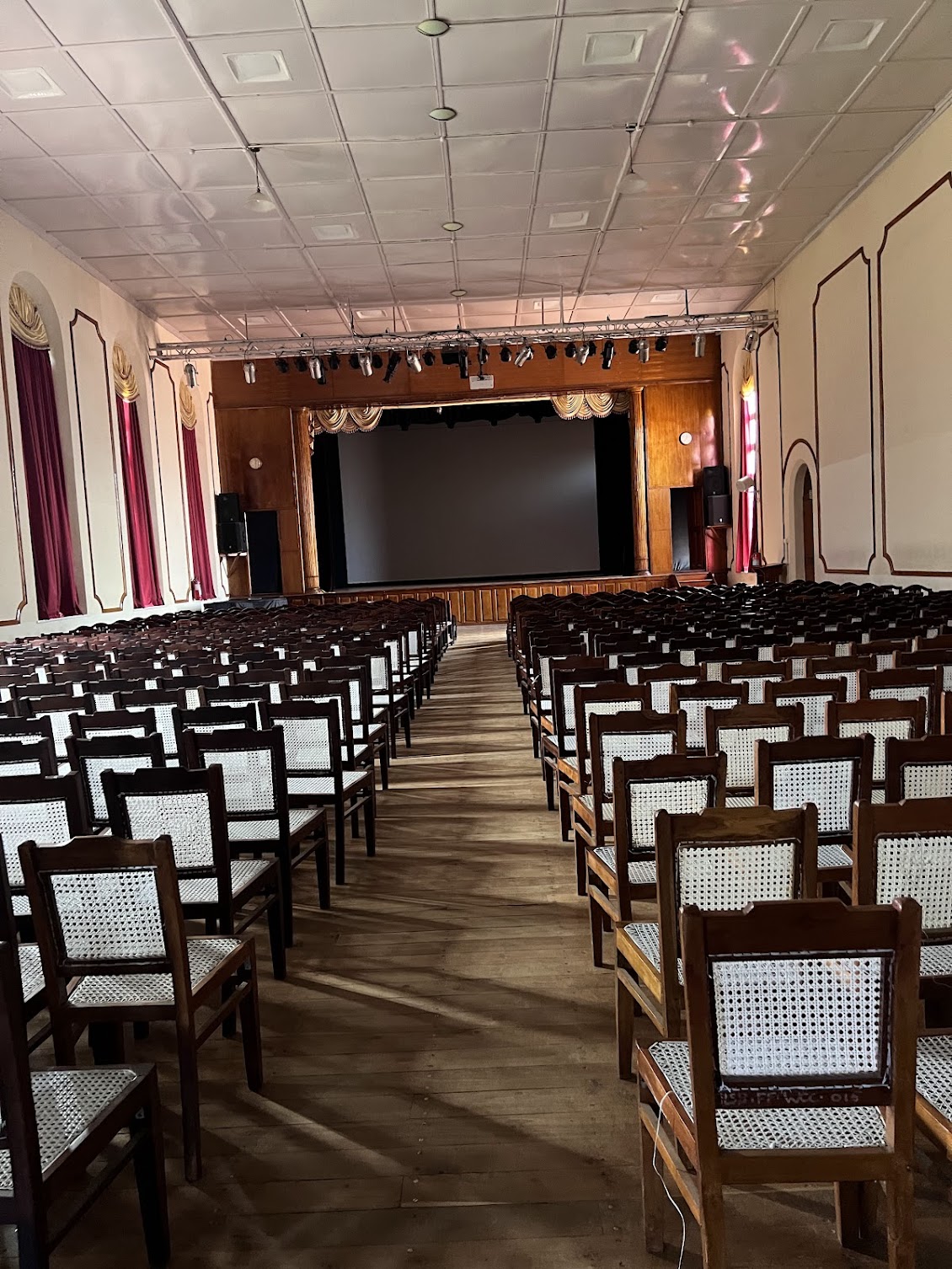
We went to visit our old school haunt – the home of our school days, and some of the best memories. If there is a utopia, I’d like to think it is very much like that place. There was plenty of ‘real’ life there too – It was by no means devoid of pain or jealousies or strife or suffering, but life still felt full of promise. Like the universe was conspiring and preparing us for a fantastic future. Maybe it was the optimism of youth, maybe it was the collective talent of the folks around us, or just the marvelous eucalyptus scented air around us in a beautiful location in the Nilgiri Hills.

Of course, one cannot help feeling like you’ve let down the school quite a bit, but what can you do? Luckily, most of our teachers have retired, but I felt I could feel their encouraging presence at every science lab and every playground. 

A visit there at this stage in life though, revitalized me in ways I did not comprehend till I had the quiet and solitude to mull things over after coming back to the USA. “You can still do a great many small things to make things better for the world around you, couldn’t you?”, a small voice whispered in my ears. Maybe after all these decades of striving, that is what you come to realize. That, as Mother Teresa said, there is greatness in small acts:

“Not all of us can do great things, but we can do small things with great love.”. – Mother Teresa

I asked my father what he thought at the time – he was a teacher there. Did he think any of his students would go on to win the Nobel Prize, or the Booker Prize or become the Finance Minister or make it big in the field of Arts/Drama/Acting?

He said that the markings of greatness were visible in few children at such a young age. Mostly, it was the potential that excited the teachers. You ask the pater a question, and he can turn it into an impromptu speech within seconds. So, I wrapped up and set off on a walk while talking to him. Always the best thing to do. He said,

To rephrase Shakespeare:

Some people are born into greatness, some acquire greatness, and some have greatness thrust upon them.

In good schools with well to do parents (by that I mean parents who not only have the means but also the interest to invest in the success and achievements of their children), many children belong to the first category. Success is expected of them, and the tools are there for the taking. Barring any major life events or health issues, these children can build a life for themselves – that is not to say there isn’t struggle. For those very expectations of greatness can be a burden to overcome.

The second category of talent comes up despite their circumstances – the distance they go in life, the differential between where they started and where they end up is the yardstick for their success. Many children from modest means who go onto achieve success belong to this category.

The last and final category can come from either of the categories above – but these people are tested beyond what normal people endure. Their hurdles are frequent, gargantuan and any progress they make is a success in and of itself. Health issues, career issues or relationship issues (sometimes all three) test them. Many break under the stress and strain of it, but those who are thrust into greatness endure, secure in their understanding that small victories and sustained mindsets often tide them over better.

Many are the stories and epics written about these characters. But more importantly, we all know friends and family in this category. Even if it isn’t obvious, even if we aren’s writing songs about them, they are truly heroes of their stories. Being a stable parent in a tumultuous relationship, navigating health hurdles, being a steady breadwinner through times of economic upheavals, being a steady person when all around you have lost their minds – that is their greatness.

IF – By Rudyard Kipling

If you can keep your head when all about you   

    Are losing theirs and blaming it on you,   

If you can trust yourself when all men doubt you,

    But make allowance for their doubting too; 

Yours is the Earth and everything that’s in it,   

    And—which is more—you’ll be a Man, my son!

Or more along the lines of: You’ll be a Human-being, my child!

The evening was drawing cold, and I knew I had to cut my walk short, even as I mulled on the father’s answer. Making the best of things, and Never Give In were the things they taught apart from Languages, Mathematics, Arts, Sports, Sciences and History. For those it served well, it was heartening that it had, and for those that it hadn’t, well there was still hope that they would learn to do so. That, right there, was the philosophy of a teacher in one grand stroke.

The walk made me reflect on two of my favorite speeches:

On The Importance of Failure and Imagination – By J K Rowling

Harvard’s 80 year old Study on Happiness and Success (Harvard Study Article)

Greatness is something we are told to pursue, without properly knowing what it means, at a young age. For many, the pursuit of a living (and maybe fame or renown) occupies time and energy. But life is far more complicated and richer than that. It means good and close relationships with family and friends, good health, good wealth, good pursuits (intellectual, spiritual and physical), purposeful work, the ability to feel joy, and so much more.

Maybe this is why school reunions and such are planned at a certain stage in life. The environs can stimulate thoughts and spur us on towards growth and meaning.

Journey Through Timezones: 15 Destinations in 15 Days

In what turned out to be the journey of clocks – we managed to visit 15 places in as many days over three distinct timezones. I wondered where we were, how we got up, and how we made it from one place to another at all. But it seems we did, and we made it in one piece back to our home, so all is well.

Sometimes, I’d get up – the biological clock warring with the physical ones, and the expectations of the day starting in whichever language, country you were in. Orienting oneself always seemed to take a few minutes. I loved the sensation of relief as one realized one was supposed to be on vacation – so it must be alright.

Pack Mules

Packing for a European trip along with an Indian one seems good on paper but involves logistics that would have had a royal ensemble perplexed. With baggage restrictions, it turns out that nothing prepares us for two different cultures like this:

  • One requires thermals, caps, gloves, socks, closed-toe shoes, sweaters and jeans
  • The other requires sarees, in-skirts, blouses, salwar kameezes, cotton kurtis, sandals, and jewellery.

Planes, trains and automobiles

For you see? We also seemed to use every mode of transportation available: planes, trains and automobiles. (The boats were given a sad miss on this trip), though there were plenty of lakesides in which to catch our breath.

img_4807

We travelled by trains in India, slept through the night on berths, shot our heads out into the cool morning air as he watched the moon shine through the countrysides. We travelled by trains in Switzerland, where the freshly fallen snow on the countrysides made it all look like we had woken up in a picture postcard.

We travelled by automobiles – in deft contraptions boasting of 4 wheel drives, automatic braking, abs-something, in hilly regions both in India and Switzerland.

We braved the holiday crowds in airports and felt for the airline staff dealing with large swaths of humanity who all seem to have decided to take a holiday just then on an airplane.

Trains

One time, I woke up as a night train in India jolted me awake from a semi-state of sleep. Then I remembered why I was semi-awake. The son had gone to use the restroom minutes prior, and I suddenly felt wide awake. Could the jolt have meant … but mere seconds later, the fellow came back beaming like the waxing moon outside, “Amma! Luckily I had not yet let go when the train jolted – otherwise, my shoes would have definitely been gone!” he said.

I threw my head back laughing, and couldn’t stop for a few minutes. It was his first experience on Indian Railways for on overnight stint, and he was excited to be in the middle berth, and everything from how the iron chains held a person’s weight, to the loos, to the open doorways seemed to fascinate him.

Planes

Another time, we were prodded out of our console screens by our excited co-passenger. She was a professional photographer of sorts (who was also a nurse), and she took a picture of the clouds outside our airplane window to show us what we were seeing. She had identified it correctly – we had a brilliant look at the dancing skies of the night over the Arctic circle, and we caught the aurora borealis in its glory. It was marvelous. 

img_4178

Automobiles

The ability to catch a marvelous sunrise over the Swiss Alps, or to catch a glimpse of an elephant by the roadside was all the magic required for the automobile sections. We managed to eat exotic fruit in Kerala (nongu), and stop for a quick snacks by the roadside in India. It was all a-thrilling, till we found ourselves snoozing on the uber-ride home after all of it. 

img_4575

We travelled by planes from one continent to the next in the peak holiday season, braving crowds, and delays, and cacophonous announcements. How we managed to get from one place to another inspite of all the things conspiring to derail things was beyond us, but we were grateful for it all. Once we landed back home in San Francisco, the very air around us seemed to ease us into being.

img_4869

It also seemed like the problems we had temporarily left behind, were lurking on the corner of our home, and ambushed us as soon as we came in.

Numinous Navarathris

Navarathri

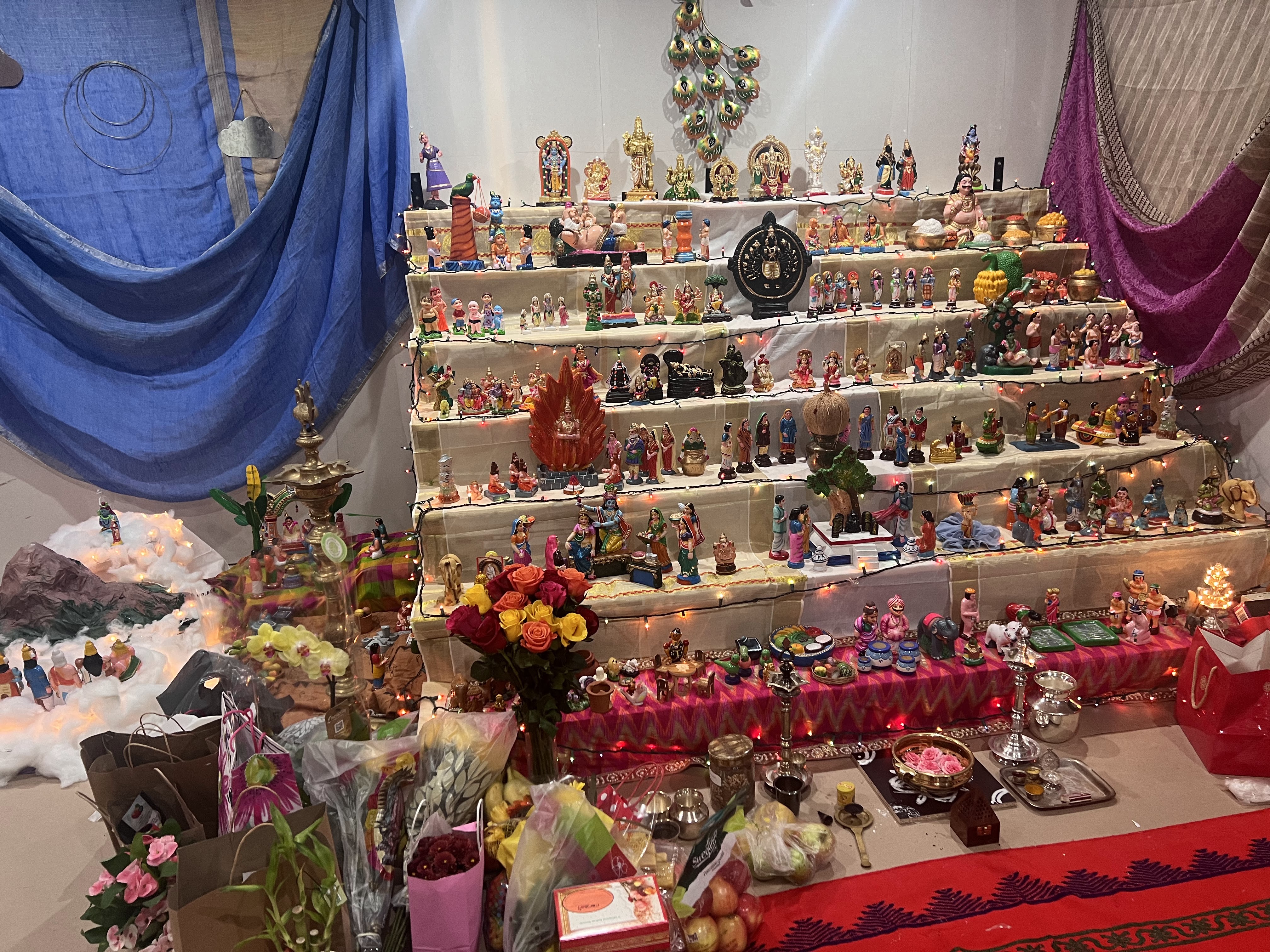
The Navarathri season is behind us. That is to say, the garba dances, the spontaneous bursting into carnatic music, classical dancers getting their Vijayadashami classes, the crowded shamiyana’s with pujo crowds, the golu hoppers, and the first wave of festive wear for the fall season is all behind us. The statues that got to come out and get put on display are all wrapped up, and put away in their cozy confines for another year.

There are many golu aspirants who raise the bar every time. One particular household we enjoy has a side-show gleaming with inventive playfulness. In every golu display there are stories jostling on the orderly steps waiting to be told, but skipped over – possibly waiting for the next year. For there is too much going on for dolls and their stories to be told and listened to. I can imagine and appreciate the whimsical nature of life wanting to be preserved as tradition. Then again, for a country such as India, there is rarely the time for slow pursuits such as mythical story telling sessions over long evenings these days. What was earmarked for that, has morphed into rushed sessions, oodles of food, music and dance bursting at every corner, and like life itself the dolls with the good stories sit quietly – watching, waiting their turn. Ready to amuse, educate and entertain if asked, but purely on stand-by.

img_3393

The Golu Tradition

Golu – as the tradition of the display of dolls is known, is rumored to have started in the 14th Century during the height of the Vijayanagara empire. The royal families of the era particularly around the Thanjavur region were taken in by the opportunity to display their dolls, host gatherings, etc. Slowly, they had musicians and dancers from the local temples over for performances, and it became a time when children were initiated into the Arts. Vijayadashami  became a day of artistic beginnings and blessings. 

In many of the homes we visit, we hear stories of the dolls being passed down from generation to generation. One friend told me that her vegetable set came from her great grandmother – handed down to her grandmother, who brought it to the US in the 60’s, and then passed it to her mother and how she plans to give it to her own daughter one day. I peered at the misshapen vegetables and felt a stirring for why the tradition appeals to so many. There were no perfectly preserved, larger models there. The vegetables had warped surfaces much like the farmers of the time might have produced them, and an artist had rendered them with the best clays and paints available to them. The greens were greener than the vegetables could achieve, and the reds made them look like they were blushing. Very fetching.

img_3493

Why tradition settled on 9 days for Navarathri, I am not sure. But I presume it had something to do with the agricultural cycles of the time. A lull in the work periods between harvest and planting cycles when the plants were at their strongest, and therefore a time for a bit of fun.

What I Wish It Could Be

As a child, I longed to take the golu dolls down from their shelves to play with. But of course, we weren’t allowed to do so. My own grandmother had given them to my mother. It seemed so pointless to have this many dolls all sitting there, waiting to be played with, but out of reach. This many stories waiting to be enacted. We were only ever to touch them the day they were taken out, or the day they were wrapped back in old newspaper and stowed away. A touch of pathos about the way they’d have to nestle back into the wooden crates in the old garden shed about them.

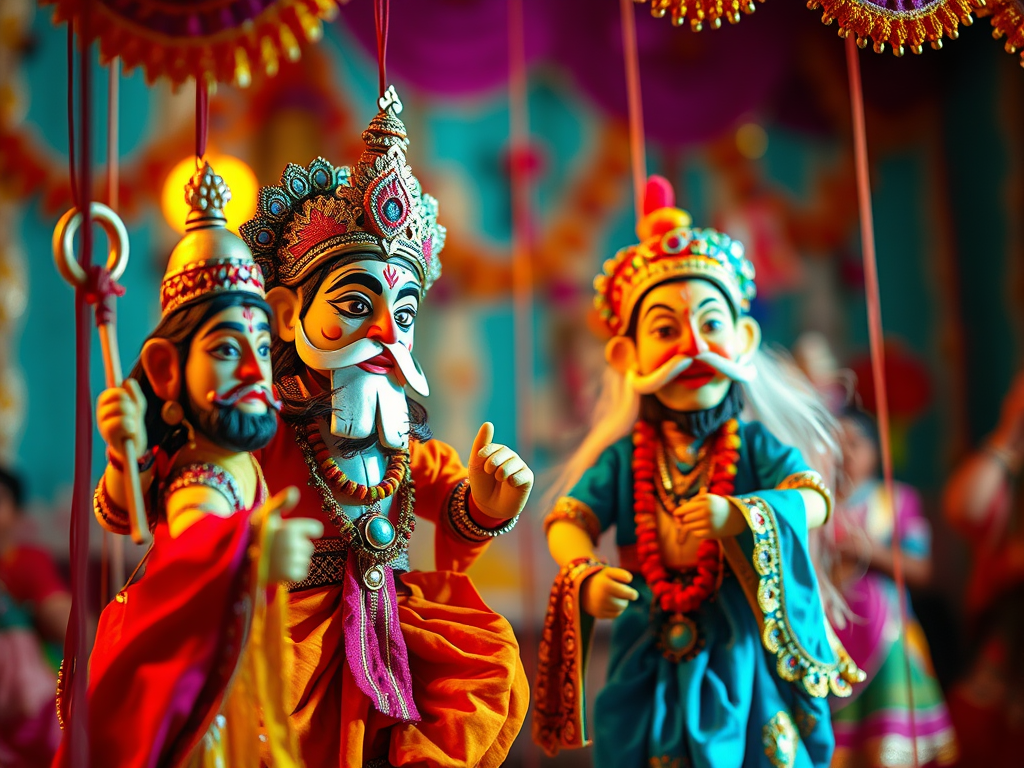
It has been a dear wish of mine to one day make a puppet based theatrical show of this. You know – properly make the dolls come alive, hop off their little shelves, and have them enact their stories. Vishnu’s avatars don’t need another year of standing there – they need to be out there telling you how much one ought to be doing in the face of evil vying and holding power. So what if you have to impersonate half a lion or a fish or turtle for noble purposes? That would be an apt election-time story wouldn’t it?

Make a funny skit or two about how the demon Ghatodgajjan ate his way through the season, or the din to wake Ravana’s brother, Kumbhakarna from his 6-month slumber to fight the war in the Ramayana. Enact the wars with paper mache swords, and bubblegum shaped missiles that could be eaten afterward. That would be cool.

A silly song about the cricket playing Ganesha statues maybe?

Wrap the session with all the Lakshmis being totally brave, daring, intelligent and charming. That would be brilliant.

🐳 Whale Grandma or Toucan Grandma? 🦜

I showed the son a text message capturing a conversation between his cousin and his grandfather, Balu Thaatha. Balu Thaatha has the unique capacity to morph into a 5/10/20/60/80 year old depending on his audience’s mental acuities and potential for mischief making and taking.

“I found your Hero pen – therefore, I am a hero.”

“Thaatha! You are just a zero, not a hero!”

I felt for the old man.

“Serves Thaatha right!” said the son rolling his eyes. 

“Why?! Poor man is not a zero! Though without zero, civilization will be a zero.” I mused and the son laughed.

“True! True! I meant – serves him right to be at the receiving end of this. He thinks he is Dr Seuss amma. He told me the other day that if I eat jhangri, I will not be angry, as when you are hungry you get angry! What even is Jhangri?” said the fellow.

“Diabetes in squiggles!” I said and the pair of us guffawed. 

Later that day, we were going through the book, Grandude – by Paul McCartney. The Beatles star is quite obviously a fun and dedicated grand-father (grandude) and his book outlines the adventures he has with his grandchildren in their quest to find their grandmother, nan-dude.

We fell to discussing the son’s own wonderful grandfathers again: Raju Thaatha & Balu Thaatha. Both loving in their own ways, and exhibiting a pick-and-choose of characteristics between them: sincere, playful, caring, hearty, engaging, mischievous,  witty, booming, quiet, talkative, reserved, humourous, erudite, and so many more.

“You will be a wonderful grandma – like a pirate grandma or a nan-dude!”, the son assured me. 

I glowed – and said, “Really? Would I be a ninja grandma or a butterfly grandma?”

“Yes – and also a toucan grandma, and a whale grandma, and a tree grandma. You will be a fun grandma. Don’t worry – I have confidence in you. “ said the son. He was licking an ice cream with obvious relish, and no doubt the fact that he was allowed ice cream on a cold day by his indulgent mother colored his opinion of me. 

“Marvelous books, isn’t it? Really – I am glad there are books outlining the special grandparents-grandchildren bond. I wonder whether there are good songs, and dances showing that.”

“I am sure there are. Just need to look.” he said stoic as ever. 

We were discussing the books: 

Both books are such joys to thumb through. Light-hearted and joyous, they highlight the beautiful bonds between grandchildren and grandparents.

Appa, My Friend

Appa

Mine was an arranged marriage. The first people I met from the husband’s side of the family were his parents. The one who drew us all in with his quiet charm, shy smiles, simplicity and overall, just by being his authentic self was Appa. He knew how to make an uncomfortable situation comfortable. He must’ve sensed a girl with modern thinking not liking this ‘arranged marriage girl seeing thing’. So, he made it simple by removing the formality from the process: Let’s just chat like we are old friends.

Any new bride going in to a large, loud, slightly overwhelming family knows what it takes to make that first meal or that first cup of tea in an alien kitchen alone. She is intensely aware that all tongues out there are waiting to judge the taste of it, the consistency of it, the heat, and sugar, and the judgements are harsh and swift depending on the existing political climate between the folks in the room.  She also knows that her efficiency, charm, competency all hang on the hinge, even if one is an educated professional girl who should not set store by these things. Appa did the thing he does best. He followed me into the kitchen – quietly removing himself from the larger family, and giving a shy smile. He had come to help.

He gave me the necessary ingredients, a hint or two or how they like the water-milk proportion by making a small joke about it, and then as quietly as he had come, he left.He did not hover giving directions. Then, a few minutes later, as I was flailing around looking for the glasses, he was back again. He took the cups that everyone liked, quietly strained the tea, and left again.  I don’t think anyone noticed the head of the family nip out to the kitchen to help his daughter-in-law.

When the tea was served and everyone smiled happily, he gave me one of his trademark encouraging smiles, and that set the tone for our relationship: Appa was always there for me. He and I were going to be best friends, and I knew it then. He had your back, he was always, firmly in your corner.

Long before corporates came up with terms like inclusivity – Appa showed us how it is done. It is done by making people comfortable.

IMG_3183

Raju Thaatha

When children were born, he was there for them. He was there for us. Any grandchild who has had the privilege of being held by Raju Thaatha has been blessed by the cosmos multiple times over.  He would come to meet me every evening at the railway station with my baby in his hands so I could see her as soon as I came out of the train. Decades later, many fellow commuters have asked me how the baby and her loving grandfather are doing.

Fussing children, overactive children, rambunctious children, shy children, they all felt comfortable in Raju Thaatha’s hands. He could put children to sleep, get them to eat, and he never, ever in all the years I knew him raised his voice with them. They all behaved like perfect lambs because they loved him.

“You need Power only when you want to do something harmful; otherwise
Love is enough to get everything done.”

– Charlie Chaplin

That was Appa – he was not a powerful man, he was a loving man, and that was his greatest power. He loved you, wholly, and simply. We all wanted to do things for him, we all wanted him to be happy because he was such a pure, loving soul.

raju_thaatha

He never took sides in any conflict, but always knew who was aching and soothed everyone just by being him. When anyone was ill, Appa with that keen sense of empathy, knew when a fruit would be welcome, or when a glass of water was required. But he didn’t use words like empathy. He just did things for others – without show, without expectation, and with great competence.

Days after they left, after every visit, I would miss Appa. For he was the one who helped me the most. He was the one who helped me in the kitchen. He was the one who’d cut fruits and lay them on the table because he knew I liked fruit. He was the one who would know when to take a fussy infant from my aching arms. He was the one who went for quiet walks with me.

He was my friend.

When I spoke of my father-in-law like this, many folks were surprised that an Indian man of his generation was like this. But he was – he was supportive of everyone – through and through. He did not tell any of us how to behave, or what to do, he showed us. He would light up when I said “Good Morning Appa!” in the mornings, or when I said a tired ‘Hello Appa’ in the evenings. “Hello Saumya.” “Good morning ma!” , “Yenna ma?” (What is it ma?) – his quiet, friendly voice that surely guided us through life is ringing in my ears as I make the last journey to see his mortal remains.

It hurts me beyond measure to write of him in the past, his sort of love in the lingering type: like the sun, always shining, always nourishing. We are enormously blessed to have had him in our lives.

Thank you Appa – May you always be happy!

The Eyes of Covid

I had to leave for India somewhat urgently. The father had mysteriously picked up a strain of Typhoid and Covid, the mother had Covid after days of caring for the former. As can be imagined, it was not the easiest frame of mind in which travel plans were made. Traveling anywhere in the middle of the pandemic is a nightmare. Traveling from the US to the East is never an easy task. So, traveling from the United States to India during the peak of the Omicron variant of the Covid pandemic is doubly painful. I am grateful I was able to make it though. With flights being the way they are, and travel plans being so erratic, travel is to be avoided if possible. However my travel was unavoidable. 

I took care of things like making a pest of myself with the children since I shall be missing them for sometime, returning the books in the library, packing gloves, masks, and Clorox wipes for the old home etc. The husband’s face, in the meanwhile, took on a serious look, and he plunged into the mode of planning and getting the important things done. 

The husband in planning mode is a force to reckon with. Phone calls flew, chat messages scrambled and unscrambled themselves with the might of the Internet’s speed thrown at them. Friends who had recently made the journey were consulted, advice was given, and mysterious packages containing masks of various sizes and shapes were dropped off at the curb by different cars and occupants. Some of them had recently come back from India, and so, masks for long term wear were dropped off.

One mask made me look like a duck, another like a monkey, and the third like a surgeon. Based on popular user experience, the duck incarnation won the round for the flight. The strap went over the head, and was no problem at all throughout. So, off I went, intensely aware of the long journey between my adult and childhood homes. It might’ve taken 80 days to go around the world before air travel. With air travel, it took approximately 32 hours door-to-door.

Boston Science Museum – Dinosaur with Mask

I have always felt that if there was one place that got the full blast of human emotions, it must be hospital corridors, and airports. I was stopped by the security officer who saw my boarding pass to New Delhi airport and started talking to me in Hindi. 

Sab teek hai?” He asked me, a look of concern in his eyes. (It is astounding how much we notice the eyes post-Covid. I wonder whether babies born in Covid times leaped ahead with this skillset). I was a little confused and taken aback at first- but nodded. Intensely aware that not always will this be the case, and grateful that this time it was.

P.S: The parents are recovering well, and the old father has been itching to start his stock marketing, and has been given the green light to do so.

Dear Lovely Kala Chitthi

I was in a tither, and petered out after the last meeting. 

“Why does it have to be this way? All supposedly smart people with Ivy League fancy degrees and all, and yet half of them don’t know how to utter a statement without ruffling feathers in the room!” I said.

The husband gave me an all-in-day’s-work look and I looked weary.

I could not help thinking of resumes, college degrees, achievements, patents, and all the grand things we give importance to in our society.  And I crumpled and said, “What can’t they be like Kala Chitthi?” (Chitthi means Aunt in Tamil – either mother’s younger sister or father’s younger brother’s wife).

My sister had called that morning with the news that Kala Chitthi had passed away. I said I did not believe her. And I did not. She was not even sixty. Most vacations in our childhood had that glow of warmth and love around it thanks to her.

We live strange lives of dichotomy. I had no time to process the news or make sense of my denial for my morning was filled with meetings. 

Kala Chitthi was the youngest in the large Kalyanam family. Of the brood of 9 children that Visalam Paati and Kalyanam Thaatha bore, Kala Chitthi was the 9th child’s wife. She entered a large family as the youngest member – a daunting task for anyone. Yet, she chose to put her best foot forward and was accepted and loved by 3, and at times 4, generations of people in the large brood. She was ever respectful, yet got her way. She neither ruffled feathers, nor shied away.

I remember one hot summer vacation when I was a teenager. We were visiting our dear uncle, aunt and grandmother in the village. The pater insisted on me wearing a half-saree. When pressed for a reason, he said something about Culture. Like my grandmother used to say with a wink: He left the village in his twenties, and he just remembers how his sisters dressed as children, that is all.

It was true. The father seemed to be stuck in a village scene of the 1940’s.

I know some people really like half-sarees. I suppose they looked nice enough on Tamil movie heroines, who knew how to sway their hips just so, while walking and dancing gracefully like the palm trees swaying in the breeze. Self? I detested them. I was not at all used to them in day-to-day life, and they made me feel like an ice cream in the sun. Would the slippery top slip off, would the long flowy skirt stay?

I liked to walk fast. The half sarees impeded my long manly stride with hands tied behind my back. No gentle sways of h. here. I suppose my gait was best suited to a sergeant major’s uniform, but I was willing to settle in for a salwar kameez with a dupatta. 

So, there I was arguing with the pater. Logically, I asked him, “What part of this dress is less decent than the half-saree? “. Seeing as there was no good answer to this, the pater was starting to huff and play the But-I-know-village-life card. 

Kala Chitthi was watching the unfolding drama as she went about her morning chores. Somehow she connected with everyone in the family – young and old.  She knew how much I hated the half-saree, and also how it was going to be difficult for the pater to slide down the palm tree he was climbing up with every sentence. 

She came along in that swift manner of hers, and hugged me about the midriff and said, “If you wear a half-saree, it will be so much easier to pinch you around here right? You should try it sometime!” And then smiling she said to her much older brother-in-law,  “Anna…you remember a village of long ago. These days, all girls wear a nightie or salwar kameez and stand outside. This looks beautiful!” She whisked us both on our way smiling all the way through. She had a morning full of duties to attend to and this matter was resolved with the attention it deserved. No more no less.

She loved all her nephews and nieces, brothers-in-law and sisters-in-law, parents-in-law. She made them all her sons and daughters, brothers and sisters, parents. She loved and was loved by all who knew her, with a generosity of spirit that was hard to comprehend. How could one soul have so much capacity to love? 

“There is not one big cosmic meaning for all; there is only the meaning we each give to our life, an individual meaning, an individual plot, like an individual novel, a book for each person.” ― Anaïs Nin, The Diary of Anaïs Nin, Vol. 1: 1931-1934

I had my next meeting to get to, but Kala Chitthi reminded me that life is not as prickly as we make it out to be. Human beings just need to be heard and understood is all. We have things to do, and one must be happy going about it.

Chitthi’s LinkedIn profile would not boast of any patents, for they do not give patents for unifying souls, who lavish their love and generosity upon everyone. But they should. It would make the world a better place.

Love, Acceptance & Gumption

Rarely do the skies reflect our inner turmoils so accurately. The past few days have been a strange time in that respect. The wildfires in California have been giving us days of poor air & light quality.

The first day dawned with the daughter waking us up looking excited. “Oh look how beautiful the light is outside. Everything is so pretty!” I peered outside and indeed it was. The world was bathed in a mellow yellow light, radiating a divine light. “It looks like a day when you feel you must count your blessings!” I said and rolled out of bed looking for the colors of the sunrise.

It turned out be a day to be doing exactly that – counting your blessings. A day to be celebrating a truly marvelous life, and thankful for the opportunity of having his presence in our lives. 

When I checked my phone, I saw that our dear Maama (Mother’s brother) – the younger one, had passed away. My mother confirmed that he passed away while on a video call with his daughter in the USA. Till the end, he was not in pain, and in these times of Covid troubles, he passed away peacefully at home. In death he had been blessed. Though if you had asked him, he would have said he had been blessed in birth as well.

For the past few months, he had been re-living his early years with his siblings at times. His conversations flitted to the village of his youth often, and he spoke of his life as a little boy, and he asked after his little siblings. In moments of clarity, he gave his caregivers careful instructions on how to reach the village where his dear siblings were: “Turn right from the road, and go straight for 6 miles, and you will see a small temple on the side of the road. “

His caregivers, like everyone who had the privilege of loving and being loved by him, indulged him. He truly was a man of many gifts – loving pragmatism was just one of them. 

Dear maama’s life was full of verve, energy, fun, love, and was tragic at the same time.

Yet, he never dwelled on the tragic. He was always a man of action. His nimble mind moved quickly with any tragic event to acceptance, and then looked for the actionable. He never considered any other course that a lesser human being might have resorted to. He was going to be helpful however he could, and he would do whatever was in his power to do. That was his responsibility. 

Talking to some of the lives he had touched after the dear man passed away, I found myself crying at times, laughing at some loving and funny thing that was so characteristic of him at others. The skies went from a count-your-blessings light to a gloomy ash-spewing state as the fires continued to spread through acres of land. 

Gloomy skies spewing ash

I have often wondered how the young children moved past self-pity. After all, the universe had played a low trick on them. He must have been a 11 or 12 year old boy when his father died, and his mother went into a decline from which she never recovered. The youngest sibling of his was my mother, all of 2 and a half years old, and he took her under his protective wing from when she could remember. 

Every time I think of the mammoth responsibilities the brothers shouldered, I shuddered. In an unforgiving world, the 7 siblings formed a bond like none others. 

No story about my mother is ever complete without Jayaram Maama and Pattumani Maama. Corporate environments would have made one write the vision statement and the other the mission statement. The younger of the two brothers, Ambi, as he was affectionately known, was the visionary one. He was also the effervescent one. The brothers made it their mission to educate their sisters at a time when most girls were married off at a tender age with an elementary school education – #HeForShe before it became a thing. They were curious combinations of the ritualistic and progressive. (My mother and her sister were the first women graduates from their village and went on to teach High School Maths, Physics and Chemistry)

Always forward looking, always willing to take action for what needs to happen next; his life is a lesson in acceptance, gumption, and constant self improvement. 

Today the skies have cleared up sufficiently for the sun to shine through again. It doesn’t feel apocalyptic anymore. 

Maybe the grand man is ready for the next great adventure. After all, he joined Pattumani on his second death anniversary.

To the well-organized mind, death is but the next great adventure.” Albus Dumbledore in Harry Potter