Scoff at Coffee Or Chess With a Super-Hero?

This winter has been a time of amazing road trips:

Dodo, Dragon, Dinosaur Dis-apparitions
In Boysenberry Jelly & Mistletoe Jam
The Wind, The Snow & The Rain – Part 1
Weaving The Sequins Of Time
The Curious Curvy Trees
The Salons of Bodie

With all the excitement of the trips and the experiences therein, there is also the time in the car. Audio books and songs compete for time with games in the car. Playing games with children is an experience unto itself. Peacekeeping forces are deployed every now and then, council meetings to determine rules and regulations, are required. Who said the family isn’t a mini-government unto itself? In spite of all this, hiccups arise in the most unexpected quarters.

I remember the time we were playing hangman. I was wondering what the words were and how I was getting them all wrong before I realized that for playing hangman properly one needs to know the spelling of the words, and foneticaly speaking, that is a very different game for kindergarteners.

‘Let me give you a hint’, the toddler son said one day as I was waiting for a cup of coffee en-route to somewhere. He was trying his best to mask his frustration, since my A, E, S and I, had all gone to nearly hang the man. He then coughed and sputtered and then beamed up at me expectantly. Could that be C-O-U-G-H?

‘O?’

‘Yes! Very good amma,’ he said and added O at the second place. I was frazzled. He had 4 dashes laid out. What could mean ‘Cough’, but be spelt with 4 letters?

C? I got another very-good, and after that nothing. The G finally got the man’s throat and he gasped and croaked. After another few trying minutes, in which the brain felt fairly rattled, the fellow wrote C-O-F-F.  Cough, see? He beamed rather freely at this, and the doting tween sister of his scoffed and ruffled his hair.

‘Scoff all you want, but cough up the dough for my coffee. ‘, I said to my unappreciative audience as I went to get my fortifying cup of coffee.

‘Would You Rather Coff Or Have Coffee? Get it?’,  said the daughter and I rolled my eyes.

I was reminded yet again of a charming book written by Miss Read. The book, Farewell to Fairacre,  written by Dora Saint,  is based in the imaginary village of Fairacre in the English countryside. The protagonist and narrator, Miss Read, taught at the village school, and said of her children.

‘More worldly children require computers and video games to occupy themselves, but the children of Fairacre are quite happily engaged with paper and pencils’

playing_games

I am glad we are able to derive our pleasures in simple ways still.

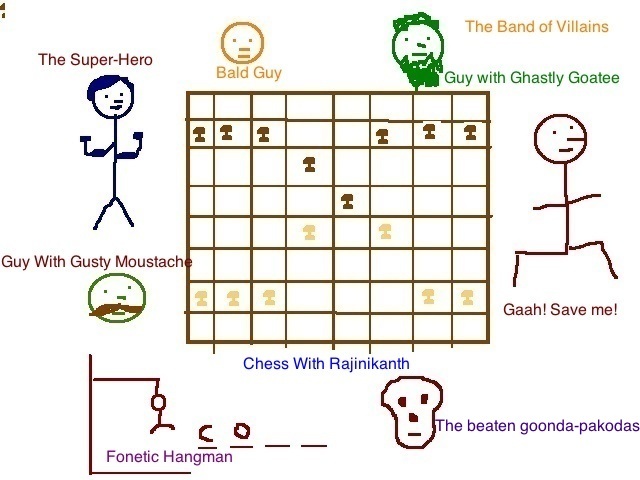
Then of course, if ever anyone wants to see how Rajinikanth plays Chess, you can come by and watch the toddler play chess with his imaginary friend when bored. If one has watched the old Tamil movies, one knows how villains attack Cinema heroes. The villains would stand around the hero. Cornered. See? Then, they’d go on to scowl, growl, grimace and crack their knuckles on the sidelines, touching their bald heads, caressing their unshaven beards and glaring like tigers given melons for lunch.

The hero stands there sizing them up and then one fellow comes and aah! He gets beaten up in a giffy. You’d think that would knock some sense into the remaining goonda pakodas, but it doesn’t. They all roar and then send another huge guy into the rink. Thulped. Another grimace and still no learning here. All fourteen idiots would go one at a time and get beaten up.

All known laws of Physics are also massacred in the process. Thermodynamics, laws of motion are all left begging for reprieve along with the band the villains.

Apply the same principle to the Chess board and you have the game: Every pawn comes one at a time and gets beaten up by the toddler’s side of the chess set. His shining knight battles on destroying his opponent’s pawns and his brave army thinks nothing of thumping Queens and locking bishops in with his own pawns.

Would You Rather be a Villain in a Tamil movie set or a pawn in Rajinikanth’s Chess? Get it?

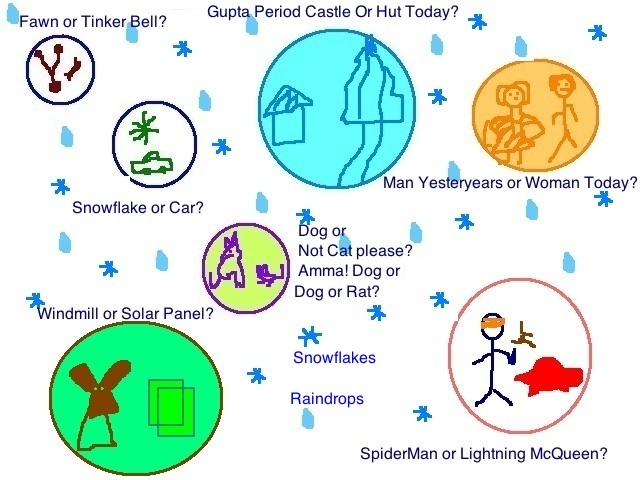
Which brings us to the stimulating Would-You-Rather game (Part 2)

In Boysenberry Jelly & Mistletoe Jam

On the drive back from the Inyo Canyons, in one day, we found ourselves dealing with gusty winds, a snow storm and a rain storm before the day was out. The Wind, The Snow & The Rain – Part 2.

We were now stuck in a snow storm. The highway men had come and swapped the rustic freeway sign to ‘Snow Chains Required’ and left. We had snow chains and I supposed they worked.

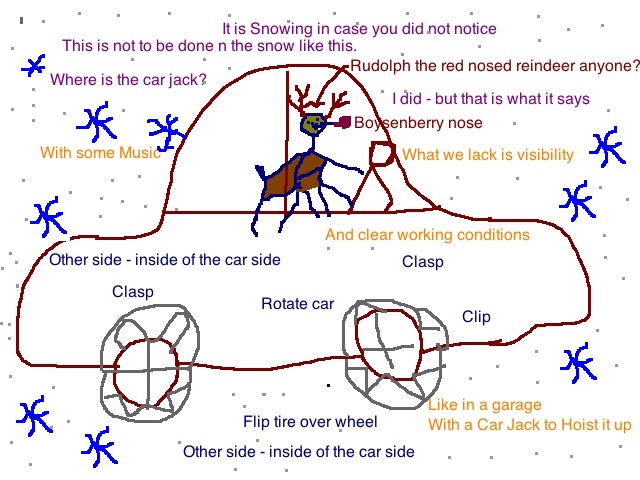
By the time we had pulled out the snow chains, we were covered with snow. Our brains were exhorting the toes to wiggle but there was no inclination from the toes to w. Miss-tle-toe for you. The nose was thirty degrees below freezing point. Rudolph the red nosed reindeer anyone? Ours had turned a lovely boysenberry color and had a reindeer been about would gladly have chomped off our noses. We peered into the snow chain package. The husband beamed like a snowman with a crooked twig for a smile and said he had opened the case prior to leaving in a rare state of prescience. I gave him the my-hero look and fumbled for the instruction manual. There it was: in 8 easy steps, it laid out how to install snow chains.

Take clip, Clasp to the tire,  Move to opposite side of tire,  Do something on the side of the tire facing the inside of the car, Take clip and clasp to the tire,  Rotate the chain under the tire and, Clasp,  Click

It looked easy enough to do on a sunny day with our garage door open, some music in the background and no car on top. But the instructions seemed to have completely missed the car on top of the tires in the pictures. One look at the tires, the snow, our freezing hands, and the car on top of it was enough. There are times when we look competent, and times when we don’t. This was one of those times when we were not. Looking c I mean.

reindeer_snowchains

It is at moments like this that the husband really comes into his own. While I was fumbling with the instructions, he was gone. One second, I was oh-see-this-ing to him and the next moment, I was oh-see-this-ing to a sympathetic looking fir tree. He bolted like a hare into the tavern conveniently located on the opposite side of the road, and came back with an eminently more competent looking chap from the pub. The cherubic fellow rubbed his hands together and said he could help. ‘I have done snow tires before, but you really should try it out once you know. ‘ he said plainly putting a decent face to his thoughts.

In less than ten minutes, the chap had installed the snow chains. I clasped his hands with gratitude looking like a dying duck who had just been given a new lease of life. I quacked on to thank him effusively and went so far as to call him a brother in need. The daughter, keen as always, asked me why I said that since she was not sure her Anand Maama would be any help with installing snow chains even if he had been in the car. A fair point.

There is something grandiose about snow chains. I suppose emperors frequently feel this way once they wear their crowns. They get a swagger, a dangerous over-confidence. The snow chains were the crowns to the tires, and off we went all smiles, confidence and swagger.

Post snow chains, in about 43 seconds, we found the car doing the reindeer-magic-mushroom sequence again with renewed vigor and whim. The car was not just mobile but intent on being perpendicular to the road and spinning a good 180 degrees.

Nature had not even shown her fury, and there we were spinning on highways, making boysenberry jelly with our noses, playing mistletoe with our toes,  and wondering whether we would be able to get out – snow tires or not, before nightfall. In what is a miracle,after about an hour in which a child tumbling could have overtaken us, we emerged into the rain and not an ounce of snow. It was as if they were different worlds.

As we were fumbling on the roadside in the rain to take the snow chains off, a brilliant red fire truck pulled up behind us, and the firemen helped us out smiling and chatting amiably all the while. We did the dying-duck-thank-sequence, and off we went on our way driving in the pouring rain.

In one day, we had whipped past gusty, gale-like winds, glided helplessly in a snow storm and thundered through a heavy rain storm.  The bright blue skies had turned grey and murky to ink blue and thunderous all in the span of a few hours.

We tottered into the house for a hastily made rasam and rice, and sighed like octogenarians with our feet in front of the heater that there was no place like home.

Weaving The Sequins Of Time

This article was published in The India Currents magazine dated 17th Feb 2018: The Magic We Miss Every Night

Taking a drive up the mountains is always a nostalgic experience for me. Regular readers know I grew up in a small village nestled in the mountainside and every time I spot a pine cone or take in a whiff of Eucalyptus scented air, I get a gleamy look in my eyes that prompts the daughter to ask me for a story about my childhood. I comply almost gleefully and she sits back and imagines her mother as a little girl, a person who is vastly more interesting than the adult version. One loopy enough to jump across streams, build mud tree houses and make a wish against a shooting star.

I was thoroughly pleased to do that again during our recent visit to the Inyo Canyons. Not build a mud tree house, but to make a wish against a shooting star. One of the best things about going out to the vast expanses of nature that we urban dwellers completely forget is how the dark the sky is at night (duh!) and how many stars we can see against this backdrop.

We were blessed with remarkably clear skies during our time there, and we headed out bundled up like Eskimoes in Winter to see the night skies. We made our way up a winding mountain road that overlooked a vast plain thereby giving us a wonderful vantage point for seeing the skies. Maybe it was the enormity of what was in front of us, but it subdued our normally stentorian voices temporarily. We stood there in companionable silence for a while just gazing at the outer arms of the Milky Way (at this time of year, apparently, we do not get to see the whole Milky Way).

My, it is so dark – it can be lonely here, we whispered to each other after some time.

The stars tousled our hair gently teasing us : of course it is dark, what did you expect, and look up at us. You are not lonely unless you wish to be. You have a universe unto yourself. ( I have an idea brewing here: it may be laughably inadequate, but that has not stopped me from publishing before)

The sun groaned from the other side : Duh, everyday I give you the gift of night, you know?

For the first time, I saw Ursa Major or Big Dipper drawn large against the night sky, with nothing to impede its view. It is amazing how many different civilizations managed to study the skies in varying yet similar ways.

There is the North Star, that was known as the Dhruva Nakshatram  in the early days when the Indian civilization named it (Story here: https://en.wikipedia.org/wiki/Dhruva).

Can you see Arundathi? Did you know the story about Arundathi being a twin star to Vashishta and rotating around each other? That is why it is a wedding ritual.  Alcor & Mizar known as Vashishta and Arundhati. Really?

So it went.

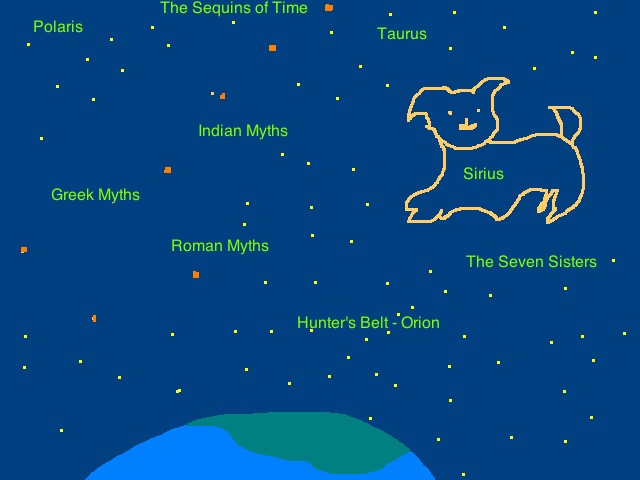
The daughter rattled stories from Greek Mythology that we tried to find Indian equivalents for. The magic of story-telling under the stars came alive for us that night. Sirius barked and Taurus ran. The hunters belt was bright and gleaming, the Plaeidis cluster was there, the Seven sisters were being relentlessly chased by the Big Hunter, while the same Krittikai sisters raised Karthikeya in the plains of Indus Valley millenia ago.

sequins_of_time

Lest you run off thinking that the daughter has sat down with the classics and pondered the deep recesses of ancient cosmology, let me assure you that Rick Riordan and his Percy Jackson books formed the basis for the bulk of her knowledge.

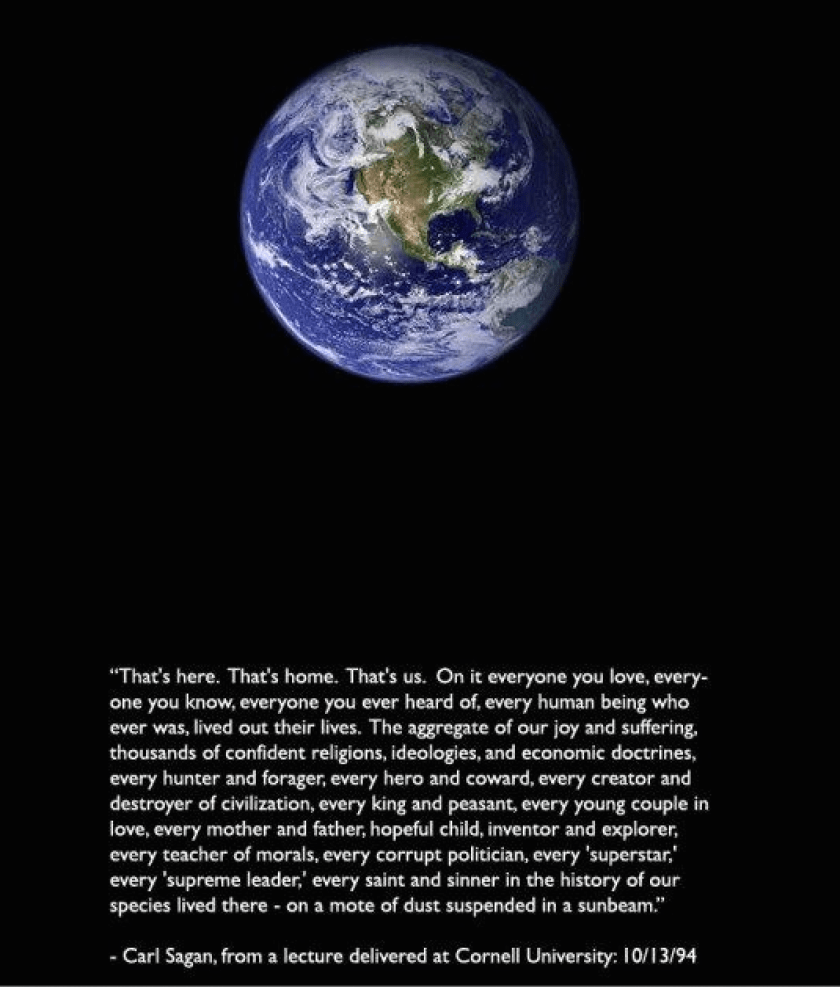
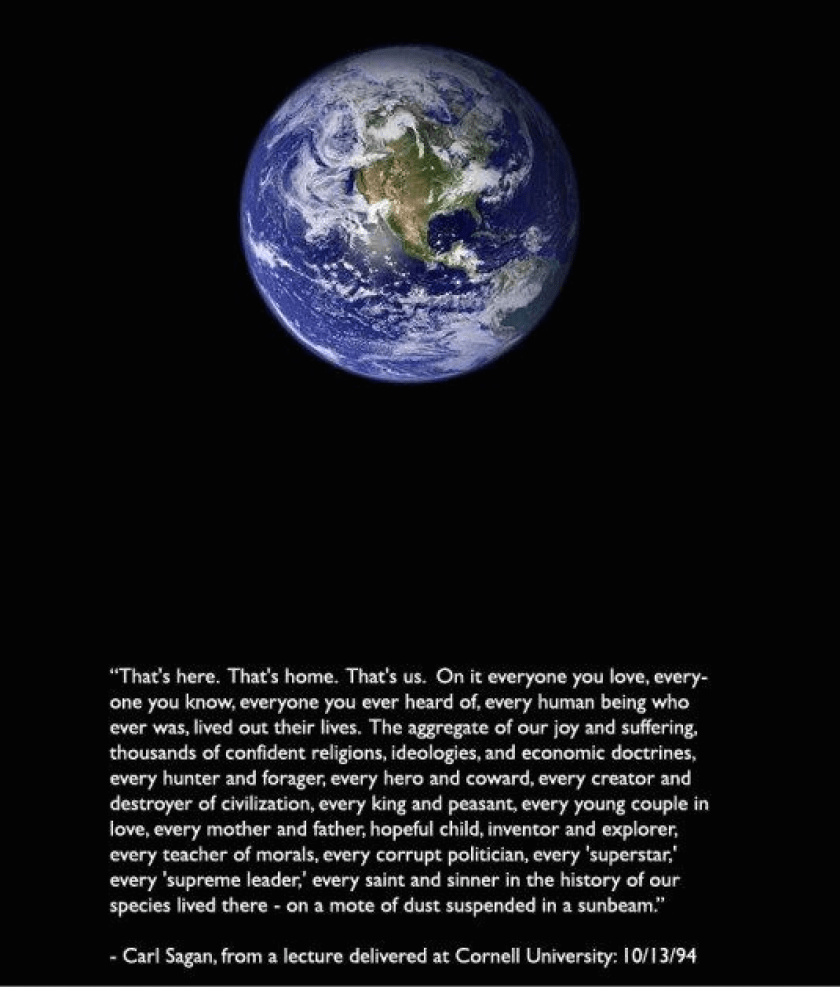
The white cloud that we never really see in urban areas was visible – consisting of millions of stars, the cosmos probably is home to millions of Earths fostering life and intelligent lifeforms. I was reminded yet again of Carl Sagan’s words  about the pale blue dot.

pale_blue_dot.png

It is true, every tyrant, every usurper of power, every chaser of money, every person with cares in this world, should stand beneath the blanket of stars everyday, and look at our souls in a detached manner. See ourselves as specks in a dark world where the only place for us to find light is by looking inwards and capture the feeling of light in our hearts like Earth captures sunlight and warmth in its atmosphere.

As we stood there with the children bundled up in the cold on a mountainside overlooking a vast plain with the stars shining down, we saw in the distant horizon seven or eight shooting stars.

Magical moments come in various ways, sometimes it comes in the form of shooting stars, sometimes it comes in the form of a fluttering leaf falling upon you and other times it comes in the warmth of a lazy winter morning when all the world outside seems bleak, but you feel warm inside. Even these cold winters can be translated to a warm feeling that the Danish have a wonderful word for: Hygge. ( pronounced – Hoo-ghey)

Embracing Hygge – The Danish Secret to staying happy in the winter

It is the feeling of warmth and coziness even when the world outside is harsh and cold.

As Louisa Thomsen Brits, author of The Book of Hygge: The Danish Art of Living Well says, “It leads to a sense of a rich inner life that radiates out through bleak days.”

What better way to weave the little sequins of magical moments into the fabric of life?

The Salons of Bodie

During our trip to the Inyo Canyon area, we got truly lucky.  Not just because of the weather (which I need to write about in a later post), but because we got to see many places that are usually closed this time of the year due to heavy snow conditions. Bodie State Park is one such. I have only visited the Inyo canyons twice so far and both times, they woke the spiritual in me. Maybe it was the sheer magnificence of nature in the area, I don’t know. Spiritual Mysticism or Spiritual Naturalism

Bodie State Park is a ghost town. A bustling, mining town a century ago, there are no more than a few hundred shacks left in a dilapidated condition in the town now. If ever one needs a humbling lesson in the ephemeral nature of our existence, the bristlecone pine forest and Bodie ghost town have it covered between themselves.

As I peered into the dust covered windows of the various buildings, a dozen observations flitted through my mind.

The apothecary seems to have catered to similar problems judging by the bottles still on display there. There was a house with dusty furnishings – a rattled bath-tub, an old kitchen. A picture on the wall said, ‘Nothing endures but change’. The school house with a steeple on its roof looked remarkably like schools do today: with wooden chairs and desks all facing the teacher up in the front. Some things don’t change even in a century, I mused.

As we meandered up and down the ghost town, we stopped to listen to the park ranger. He was giving details of life in the town at the height of its glory, and we stood there enthralled, each of us contorting a story and an image of life in those times in our head.

Bodie was a town of maybe 8,000 or 10,000 people, and they seemed to have had quite a good life. Traveling caravans had theatrical performances here, fresh octopus and seafood supplies arrived regularly from San Francisco on iced wagons. People from nearby hills trudged up to this town for a day out or for market supplies. It certainly sounded like a bustling, happening place and looking at the town in the present age was a disconcerting sensation. Hundred or two hundred years from now, would people be taking a cruise out to where we live, and saying that this used to be a bustling place too? Given the current rate of global warming, it is a very plausible scenario.

http://ocean.nationalgeographic.com/ocean/critical-issues-sea-level-rise/

http://environment.nationalgeographic.com/environment/global-warming/gw-impacts-interactive/

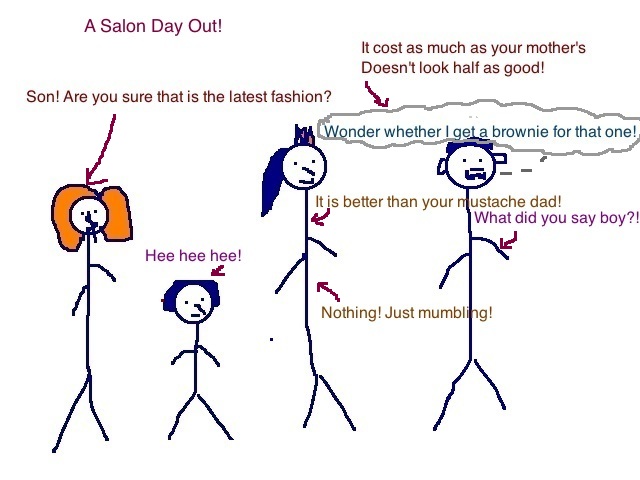
Standing there in the town with the vastness of the Sierra Nevadas engulfing us on all sides, it seemed surreal to imagine that this very place was witness to human drama, tragedy, hope, love affairs and scandals. There was family life, culture, entertainment, education, sickness and health here. One could imagine the barber’s son eloping with the mine owners daughter or some such thing. As if the ranger had read my thoughts he said pointing down the hill to the right – this part of town had 50-60 salons too.

My mind buzzed and I asked him – “Really for a town of 10,000 people, they needed 50-60 salons? They must have been a pretty well groomed lot. And everyone had to trudge down to one part of town too.“

The ranger gave me a quizzical look, and thought of saying something but decided to let it go. “Beyond that, were the jails – you know so that area was not very respectable back in the day.”

My! I thought, not only did people have to cut across town to get a haircut, but also scout near the jails? Assuming 50% of the population were males, that is approximately 1 salon for every 100 males, and considering they probably needed a haircut once a month …. I could imagine the mothers giving out the money to the little fellows with dire warnings as to what happens if they strayed near the jails, and how they were to get a hair cut and head straight back home.

I don’t know whether pedicures and manicures were popular during the day for the women or whether their hair styles were demanding ones or simple ones.

inyo_salon

What about pet grooming salons? Did folks a century ago groom their pets as dearly as they do today?

It struck me how keenly these authors of historical fiction have to think. For instance, were there razors and portable blades 100 years ago, or did people have to go to the salon for everything?

I mentioned these profound revelations to the husband and he gave me a look similar to the one the ranger had given and said with a smile playing at the tip of lips, “You realize that by salon, he did not mean hair cutting salons like today, right?”

“What do you mean? Oh! “ I said my eyes widening and the husband laughed.

“Oh! You are naive!”, he said laughing, “Why else would they be clustered together like that?”

Looking around at the ghost town around me, suddenly made me realize that half the world’s cares, worries and problems were just as man-made a century ago as they are today. Some things at least don’t change.

The Boy Who Harnessed The Wind

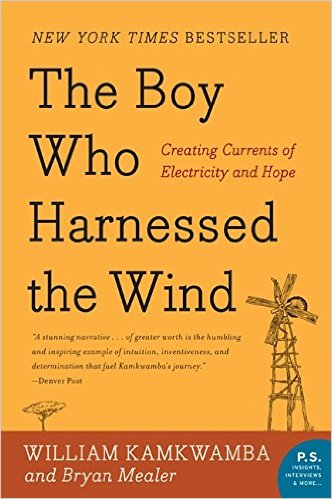
Every now and then, there arrives a book that is designed to knock the sails out of your windpipe. William Kamkwamba’s journey to build a windmill and uplift his community is one such. It is the true story of a poor boy in Malawi.

boy

I bought the book a while ago, and it lay languishing on my tsundoku pile. Maybe, there was a purpose to the book. The book needed to be read at a time when I most wanted to reassure myself on human potential if only we choose to apply it for good.

The only son, among eight children, of a poor Malawian farmer in Wimbe near Kasungu, Malawi, this is a true story of William Kamkwamba.

The book started off slowly talking about tales of magic, witchcraft and sorcery in Africa. As you read about William and his journey, you cannot help getting absorbed into the life around him with good natured understanding. You like his dog, Khambe, and his friends, Geoffrey and Gilbert, who show themselves to be the kind of stalwart friends you wish your children will grow up to be. Kind hearted, supportive, fun and ready to lend a hand, always.

When, famine hits Malawi, William Kamkwamba is forced to drop out of school, it is crushing to read how his father felt and I wish no parent should have to face that in their life.He writes about how his family struggled for months with nothing but a few nsima cakes between them to eat everyday. Everything we tell our children about starving children in Africa is true.

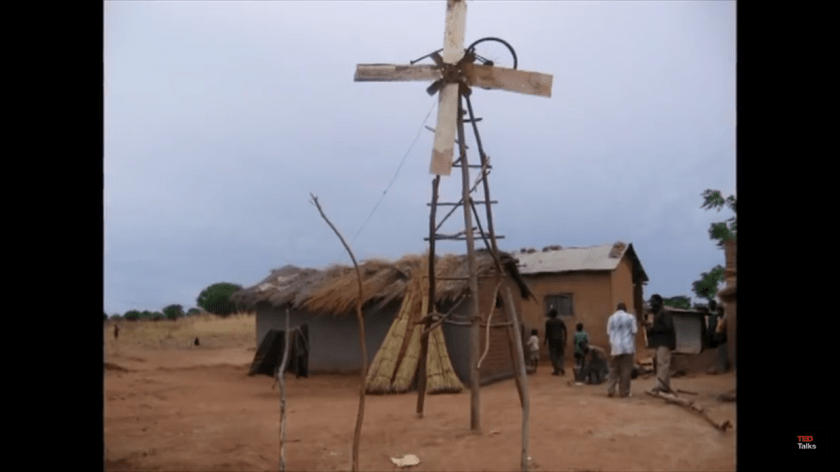
During those long hours of working in the fields to do their best to see if they can fortify themselves against another famine, it is William’s dream to build a windmill that keeps him going. William had seen pictures of a windmill, and given that his little village is always blessed with wind, he wants to build one, so that water and electricity can mitigate another famine. He is called misala (crazy) for haunting the trash piles to find something reusable to build his windmill.

After months, of scouring trash piles and junkyards, using tools that would not pass any safety standards laid out in the West, it is a proud moment indeed when finally he connects his rickety windmill to a tiny light bulb.

img_4243

The windmill is noticed by a school official who notifies a professor and a blogger. From there to TED Fellow in 2007 is a remarkable journey for a boy who had never set foot outside his little village in Wimbe.

When William is finally called upon to talk at the TED conference, he is justifiably nervous. His English is poor among other things, and to make it easier for him, his host on stage, Chris, prefers to ask him a few questions that he can answer instead:

My heart beat fast like a mganga drum as I climbed the steps to face the audience, which totaled 450: inventors, scientists and doctors who’d stood on that stage in the previous days.

Five years ago, you had an idea”, Chris said, “What was that?”
“I want to made a windmill”. Wrong again. Chris smiled.
“So what did you, how did you realize that?”
I took a deep breath and gave it my best. “After I drop out of school, I went to library…and I get information about windmill…”
Keep going, keep going…”And I try and, I made it.”

The problem with reading a book like The Boy Who Harnessed The Wind on public transport is that it is takes phenomenal effort to keep from tearing up. You can manage a silent tear that just needs to come out, and one that you can unobtrusively wipe away as if some dirt got in there. But if the book goes on to make you want to weep not out of despair or sadness, but out of pride, joy and the eternal good-ness of mankind despite everything, that is hard to do.

Some pictures from the book: The image of his prototypes, his big windmill and one of his parents after he was able to harness the energy generated from the windmill to provide clean drinking water and electricity in his village.

Unfortunately, for every William who is outstanding in perseverance, grit and intelligence, there are thousands of williams who flounder in the stormy tempests of life. Every time I am caressed by the wind during this Thanksgiving break, I will know what to give thanks for. Thanks to William Kamkwamba.

I try, and I made it.

Please watch the TED talks, even if you are unable to get to the book:

TED Fellow William Kamkwamba

If

We had been to the East coast to gulp in the beauty of the fall colors before the trees were stripped bare for the Winter. I marveled at the beautiful tapestry that nature had laid out for us. The greens, golds, yellows, rusts, oranges, reds and browns blended together beautifully to please the eye. The same patch of forest looked beautiful in the different lights of day. The color of the skies above, the intensity of the sunlight, the shadows of the scudding clouds above, all painted marvelous pictures and nature soothed in a way that it has always done.

A forest is beautiful to look at. A forest in fall colors is brilliant to look at. The diversity in colors is mind boggling, and it all pieces together beautifully in a marvelous tapestry. It is the differences in color that make it glorious.

An artist’s palette is made more vibrant with different shades.

As much as we all like everyone to be like us, it is the fact that we are different that makes the world a beautiful place. It is the disappointments that should propel us forward.

I am distraught at the person America has chosen as its President elect. I am trying to find solace in the words of Carl Sagan on Earth:

Look again at that dot. That’s here. That’s home. That’s us. On it everyone you love, everyone you know, everyone you ever heard of, every human being who ever was, lived out their lives. The aggregate of our joy and suffering, thousands of confident religions, ideologies, and economic doctrines, every hunter and forager, every hero and coward, every creator and destroyer of civilization, every king and peasant, every young couple in love, every mother and father, hopeful child, inventor and explorer, every teacher of morals, every corrupt politician, every “superstar,” every “supreme leader,” every saint and sinner in the history of our species lived there-on a mote of dust suspended in a sunbeam.

screen-shot-2016-11-14-at-1-56-32-pm

Now, more than ever before, is the time for all of us to come together and become heroes in our own ways. I felt this was the right time to read Rudyard Kipling’s poem ‘If’ to the children.

If you can keep your head when all about you   
    Are losing theirs and blaming it on you,   
If you can trust yourself when all men doubt you,
    But make allowance for their doubting too;   
If you can wait and not be tired by waiting,
    Or being lied about, don’t deal in lies,
Or being hated, don’t give way to hating,
    And yet don’t look too good, nor talk too wise:
If you can dream—and not make dreams your master;   
    If you can think—and not make thoughts your aim;   
If you can meet with Triumph and Disaster
    And treat those two impostors just the same;   
If you can bear to hear the truth you’ve spoken
    Twisted by knaves to make a trap for fools,
Or watch the things you gave your life to, broken,
    And stoop and build ’em up with worn-out tools:
If you can make one heap of all your winnings
    And risk it on one turn of pitch-and-toss,
And lose, and start again at your beginnings
    And never breathe a word about your loss;
If you can force your heart and nerve and sinew
    To serve your turn long after they are gone,   
And so hold on when there is nothing in you
    Except the Will which says to them: ‘Hold on!’
If you can talk with crowds and keep your virtue,   
    Or walk with Kings—nor lose the common touch,
If neither foes nor loving friends can hurt you,
    If all men count with you, but none too much;
If you can fill the unforgiving minute
    With sixty seconds’ worth of distance run,   
Yours is the Earth and everything that’s in it,   
    And—which is more—you’ll be a Man, my son!


When the materialistic society around us automatically glorifies money, we can use the moment to say that money does not equal dignity, money does not beget culture, money may earn you servitude, but not loyalty.

And point to the example in The White House.

The Yin & Yang of Diwali & Halloween

This post was also published in India Currents magazine dated 3rd Nov 2016

Wrinkled brows, scorching cuts and decisive strokes greeted me as I went upstairs a few days before Diwali. We have to get started on our Halloween decorations, said the daughter cutting out a spider. The toddler son was lying on his stomach on the floor, helping his sister by coloring the ghost she had cut out from white paper, white. A cozy, merry scene with the sunlight streaming in from the windows.

When bees create their colonies, I am sure they don’t care about a little mess. Neither did my bee-lings. I navigated the crayons strewn on the floor and walked past the strands of paper littering my path to peek at the objects of art.

A morose sort of skeleton was being drawn and I shuddered at the image. I hated to take a pail of cold water and swamp their enthusiasm with it, but then I did. Sorry guys. That weekend is Diwali and I won’t have skeletons and cobwebs hanging off the front door on Diwali. (This year, Diwali fell on a week-end and Halloween the day after, on a Monday.)

A mutinous roar went up. Amma – Diwali is the opposite of Halloween. It is the festival of lights. You’ll put up those little diyas everywhere and light everything up and then you’ll make everyone dress up beautifully – it is the complete opposite of Halloween.

I disagreed. They may be celebrated differently, but they are both meant to fight evil. Ward off evil – whatever. The concept is to banish your demons. Even the inner demons. So, Diwali and Halloween are like that Yin-Yang thing. Black and white together. Both are there in us and in the world around us.

yin-yang

I felt like a teapot spouting philosophy from my long snout to a couple of trouts in the stream. I sometimes think children must feel we played tag with Confucius and hide-and-seek with Buddha. I tried desperately to gain ground again.

You can always find light in the darkest of places if only you remember to turn on the lights. Remember who said that?

Albus Dumbledore in Harry Potter And The Prisoner of Azkaban

Albus Dumbledore! sighed the daughter. Dementors – yes! Maybe we will do dementors also this time.

Also Voldemort – we can draw Voldemort and hang him outside, piped the toddler son. He has no fear of He-who-must-not-be-named, and his sister beamed with pride at her little Gryffindor brother.

Guys! Guys! I won’t have Voldemort hanging on my front porch on Diwali either. Does Halloween have to be gory? Think of some themes and see if you can come up with decor that does not drip blood. Something positive, a call to action and also save our souls. How about that? I said.

When the daughter said, Fine!, I left them to their own devices and pottered around the house.

I must say that I was mighty impressed with the resulting effort.

keena_halloween_nature

We picked your favorite theme, Nature, amma. So, you can put up some of this stuff for Diwali too. Then after Diwali, the next day, we can quickly put up bats and pumpkins all around and we are set, she said.

I agreed.

img_3701

On the Diwali rangoli, we placed a large pumpkin surrounded by little lamps. The rain helpfully washed away the rangoli that very night leaving a damp, morose spot for the Pumpkin the next day. All very satisfying.

Happy Diwali and Happy Halloween. May we learn to take care of our World, the living beings we share it with, and balance our yin and yang for a beautiful whole.

img_3874

The Cry of Natural Symphonies

Regular readers of this blog know what a pesky cricket I can be when it comes to babbling about nature. If I see one of those news articles about hippos dwindling in number, I grieve.  The day I saw a ninety foot tree logged in our neighborhood, I grieved. I had seen the number of birds that roosted in the tree every evening as dusk fell, and I felt that we lost out on all that natural chitter for no good reason.

I moon about hills and flop around pictures of beautiful Mother Earth and all that in spite of negligible botanical and zoological knowledge. Ducks and Canadian Geese I will bucket as one, hippos and rhinos I draw about the same (one with a horn and one without).

I am also one for natural sounds – I like to listen to the cascading brook or the patter of the rain. I like to be able to say, “Coo! Did you hear that blue kingfisher? Easily distinguishable by that rich guttural sonic burst.” So, one can readily imagine why I picked up a book called ‘The Animal Orchestra’ by Bernie Krause. I must say the book was a revelation of sorts.

screen-shot-2016-10-06-at-8-48-46-am

Most of us have an idea about the damage we are wreaking on Earth. We are aware of over population, we are aware of shocking deforestation and we are aware of global warming. What this book gives us is another perspective to the problems that face Earth.

Bernie Krause is a musician who has since turned to recording the natural sounds around him. He has recorded the forest areas before and after selective logging operations, he has dipped his receivers into a coral reef to hear the natural sounds, he has recorded in the depths of the rain forest, and the great barren deserts and the frozen tundra.

I have written about Biophony before with a link to Bernie Krause’s recording on NPR before: https://nourishncherish.wordpress.com/2015/01/14/cacophony-for-biophony-socialization-for/

Recording:listen-as-a-california-forest-grows-quiet-over-time/

Birds
Birds

What Bernie Krause finds with his recordings is that the human touch affects biophony in unimaginable ways. You can hear some of his recordings at thegreatanimalorchestra.com. Even if unable to read the book, please try to listen to some of the sound tracks on the site. It makes for an enriching experience.

There are a number of passages in the book that I can go back to re-read any number of times. One such passage is the one where he refers to a beaver recording. In a remote lake in Minnesota, some wardens of the preserve, blew up a beaver dam killing most of the beaver young and females. The recording was taken later that evening, and describes the sounds of the grieving beaver male. He says that to date it is the most heart-rending sound he has ever heard made. A poignant sadness to it that the most heart-rending human music cannot even come close to.

Or of the time he describes the sonic variances between the sounds of orcas in captivity and the sounds of the pod from which the orcas were captured in the wild. The ones in the wild were always “filled with energy and vitality”. While the captive vocalizations were “palpably lethargic and slow”.

He talks off a recording he took where a logging company resorted to selective logging i.e. deliberately taking a few trees here and there so as to not disturb the ecosystem much. However, the sounds recorded before the logging operation and after have perceptibly changed. The pictures taken later show a fairly decent rebound of the wilderness, but the biophonic recordings  give us a different perspective – the more disturbing and truthful perspective. Though the area looked wild enough, the great natural symphony never bounced back.

From a BBC program titled ‘A Small Slice of Tranquillity‘: There were certain sounds such as breathing, footsteps, a heartbeat, birdsong, crickets, lapping waves, and flowing streams that people described as tranquil. Researchers demonstrated that such sounds stimulate the limbic system in the brain, resulting in the release of endorphins and a feeling of serenity. The program says that tranquillity is an elemental acoustic foundation upon which we can rest our mental processes.

By definition a tranquil area is one that is this many miles from the nearest road, away from the sonic boom of aircraft etc. In the 1960s UK had more than 40 tranquil areas, now there are less than 5.

Bernie Krause concluded that  the book on a note that I cannot help agreeing with. He says that he is asked almost at the end of every lecture what we can do to help preserve our remaining natural environments. He says: “It’s easy: leave them alone and stop the inveterate consumption of useless products that none of us need.”

For the Love of ( Halloween & the Environment) – Part 1

Usually, when Halloween rolls around, I am left out. What I mean is that I am the butler, the enabler, the inefficient decorator, the bad make-up doer, the scrambler, the chef, the doler of chocolates. But I am rarely one of the featuring stars in the evening’s show. When I say these things, I don’t want you running off with the idea of a pestilential sulker dulling Halloween. Far from it. I may decorate like a wet cracker, but there is one thing I bring to the evening – enthusiasm. One of my friends once said after witnessing a football game played by kindergartners that there was more enthusiasm than skill in the game. Exactly how I like to slot myself in the Halloween throng of emotions.

When I smile after hoisting a ghastly costume on folks, I smile widely, deeply and with affection. It gives the wearer confidence as they head out into the Halloween night. I like Halloween, for it is the one night when it is okay for serious minded adults who think of worldly problems to go out and publicly quack like ducks. It is often an illuminating experience to see that people give more attention to one’s quacks as a duck, than their most reasoned and logical arguments. It is all good – imagine if the Hippoceres lightened up.

What?! Don't listen to me now! I am just Quacking!
What?! Don’t listen to me now! I am just Quacking!

If you like Halloween so much, why is it you don’t make more of an effort to dress up yourself? You ask. My answer drips in selfless service. There is usually a gaggle of folk around me needing attention – the costumes have to be just so and the food needs to be just so-so, the parents or parents-in-law have to be convinced to loosen up for Halloween and there it is. By the time the vampires, fairies  and super-heroes come laden with plastic pumpkins, I have barely had time to lay the dinner on the table and grab a devil-hairband bought years ago, and smile (I have been accused of being the friendliest devil known to mankind, thereby failing spectacularly in even the simplest of costumes.)

This time, Halloween was on a Saturday and I had more time and energy on my hands. I started planning a whole two hours ahead that I wanted to be something too. Not just that. I was the decisive force: I wanted my costume to be Environment Themed. In what I thought was a brilliant teachable moment, I said that if we don’t save the environment, we won’t need Halloween Decorations at all, since the macabre stuff we see as Halloween Decorations, would be the sorry state of Earth.

Look at the sorry state of Earth here:

http://usuncut.com/climate/10-terrifying-before-and-after-photos-will-silence-global-warming-deniers/

The husband gave me a shocked, dismal look. The meaning of that look needs a much stronger pen than my own to record. I realized that far from a Teaching Moment, it could well become a Traumatic Moment, and swiftly swerved the conv. towards suggestions.

That did the trick. Ask us to talk and give suggestions, we trip over one another. There was a lot of shouting and a few good suggestions.

We need Water, Save Water, Less Plastic, More running water: (rivers, brooks), Recycle better, Anti Deforestation, More Trees, Drop of Water, Become a Cloud, No Toys (The toddler son came up with this and said proudly that he did not want to play with his toys anymore, and that I could give them all away, and not buy anymore. The pride on his face I tell you! It would have been a lot more virtuous if he had remembered that at the Lego Store the next day). The daughter said that I should crusade against oil spills since they harm animals, why not a Clean Ocean-Reef? Or Be a Farm.

The Wind in the Reefs
An Ocean Reef – How in the name of Willow’s Marina Reefs can this be made into a Halloween Costume in an hour?

I wonder if you notice a theme here: viz: Dashed hard to pull off. No dropping into a store and plucking a costume from the Shelf here. It would have to be made. I have already written about the complete lack of skills in areas like that.

The daughter said I needed to keep an open mind and try, or I’ll never know. I heeded her advice. How hard could it be?

Coming up Next: Part 2