
Rediscovering the Art of Play: Exploring the Wonders of the Solar System

I vividly remember one Science class in which my teacher explained the solar system, our place in it, and how fast we were traveling through Space. It is an incredible concept, and when explained well, can spark interest and curiosity in a young child. I remember being flushed after that Science class, maybe because I was chosen to be the Earth. I had to rotate and spin around one of my best friends who was the Sun. What greater joy could there be?

man_in_stars

 As interesting as the lesson was, what sealed the memory in my mind is the fact that the chosen sun that day was exuberant, the chosen earth was joyous, and the rest of the class giggly and slightly jealous that they weren’t the ones to be given the chance to get up from their seats. The latter point gave way to some accusations about being picked by the teacher  “How come you both were picked? Sitting right next to each other too?”

I saw their point. Usually, teachers are careful about picking volunteers or nominees from opposite ends of the classroom. These little dramas are part of what makes our time together memorable.

The little upset may have dampened our spirits somewhat, but we were quick to regain lost ground. To children who generally liked the joy of spinning, the morning lesson was a gift indeed. To those of you who have not experienced the heady giddy sensation of going round-and-round  recently, please try it again. It is marvelous. If you can find a giggly companion, young at heart, please do so, and it enhances the experience in no small manner. 

Hypothesis, Conclusions, Fact-Checking & Collaborations

I remember it was during our little spin-ney-spin-ney sessions that one of us had a question as to why we feel giddy when we spin. Science is full of people who came up with their hypotheses and then set out to prove it. Our little band of scientists was no less committed. I came up with a perfectly wrong explanation for the phenomenon and it shows the sturdy nature of my friends that no one laughed at me that day. Instead, they indulged me in an experiment. 

“Maybe the Earth is already spinning and when we spin in the opposite direction, it makes us feel dizzy.”  

There were some thoughtful nods at this – “Then we should be able to spin even faster if we were to go the same direction right? “ said one. There was only one way to check – spin in both directions and find out for ourselves if this was the right theory.

 “Which direction does the Earth spin – do you know?” A collective wave of shoulders shrugged at the same time, but little things like this do not deter the determined. Someone said we will just time each other for 10 spins in each direction, adjust for right-handed, left-handed, ambidextrous, null-i-dexterous (the opposite word for being equally clumsy with both hands is called ambisinister, but I think null-i-dexterous sounds kinder) and we would be set.

That’s what we did. The exercise resulted in loud laughter, and the sound waves brought the earlier complainants to the fold wanting to join in the game too. All recent rancors forgotten, the experiments were done with rigor, encouragement and accuracy.
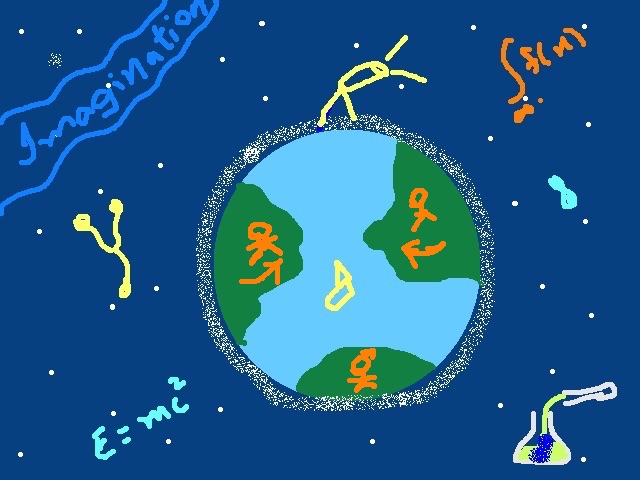
the_world_playground

While we are always in awe of the creative thinkers who take us a leap forward with their works, I have always wondered how each moment came to be: how Thinking Man figured so much out. This is one of the best ways in which I have seen the sentiment expressed.

 Excerpt from The Book That Nobody Read – Chasing the Revolutions of Nicholas Copernicus by Owen Gingrich

“The greatest of scientists have been unifiers, men who found connections that had never before been perceived. Isaac Newton destroyed the dichotomy between celestial and terrestrial motions, forging a common set of laws that applied to the Earth and sky alike. James Clerk Maxwell connected electricity and magnetism, and showed that light was electromagnetic radiation. Charles Darwin envisioned how all-living organisms were related through common descent. Albert Einstein tore asunder the separation between matter and energy, linking them through his famous E=mc^2 equation.”


Scientists do not always know what to expect and can sometimes be surprised at the results. That is what happened to us. The results were inconclusive and resulted in:

* One of us falling to the ground laughing heartily

* Another banging their head against a conveniently placed pole nearby 

* Another giving off an inaccurate imitation of a drunkard, which was impressive given that this was happening prior to the Internet or Cable Television, and the child’s parents were teetotallers

* Two subjects crashing into each other mid-orbital, resulting in tummy aches and headaches together 

 Our motley band of scientists had by this time dissolved into a fit of giggles. Good naturedly, we shrugged off the theory, accepting with grace that it may be an erroneous hypotheses and moved on to the next thing to play together. Consensus, criticism, fact checking, and collaborations had been achieved with the greatest of unity and hilarity. 

The Art of Play

In every problem, creativity and imagination are our solid allies. The simple act of playing together and collaborating to solve problems, keeping each other true is now more valued than ever. Today to see that school recess times have come down; children do not play out on the streets in free play mode anymore, but are rather being ferried up and down to supervised, classes with rigid rules of social conduct usually in the presence of adults; and the playgrounds in our neighborhood have become safe havens for spiders to spin their webs. 

Could we add in structured unstructured time – so we can all benefit from free spirited Play once again?

Those who were never exposed to Play may not miss it, but those who know the beauty of it, will always feel the richer for it. Much like Art, Play is Art, and I pray we do not lose the Art of Play.
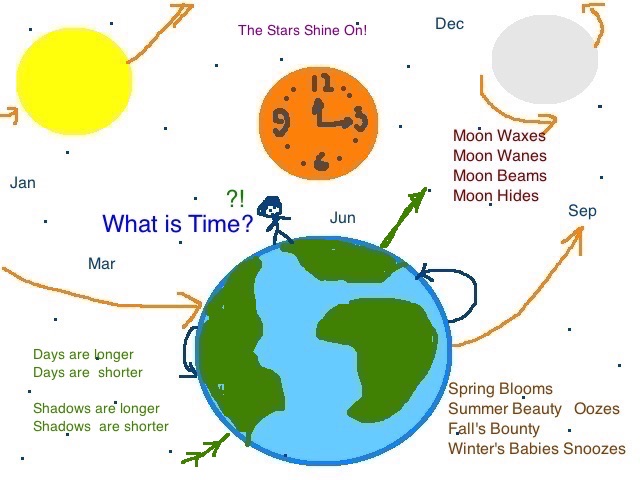
Annus Confusionis

His voice  quivered with excitement as he read the page out to us. 

Never mind that it was early in the morning, and he did not yet know that the  morning tea was working its way slowly through the cells waking them up. The cells were hitting snooze like the body they reside in usually does with the alarm clock. Yes, things  were getting off to a slow start in the old body. The son, in sharp contradistinction, woke up like a light bulb switched on to full power with the opening of the eyelids. He shone brightly, and his vocal chords took on the  timbre of the morning bugle as he trumpeted the queer finding on Time. 

“Can you imagine a year with 445 days?”

“uhhhhnnnhhhuuujn” 

To this legible response, he prattled on reading aloud to us from his Encyclopedia of Queer Facts.

“Yeah! It was in the year 46 B C, King  Julius Ceaser corrected the lunar  calendar.  This year became known as the annus confusionis or the year of confusion, since the year  had 445 days! Imagine how our  school must have felt!” he said looking up from the thrilling page. 

Time has always excited him – what  it is, how do we measure it, why does it always flow forward and never backwards? 

Time

I poked my cells up into waking up – it seemed the decent things to do in the presence of such excitement.  

“Exciting huh?! Would they have increased the number of school holidays  (a 5 month summer vacation) or the number of school days?”

It must have been enthralling.  Only, school as we know it today was not in session then – schooling as we know it today only came into existence about   200 years ago to equip people with the ability to sit in one place and learn to get used to it.

So they probably continued with their statue making and war-ring even though the seasons were completely out of whack with what was happening around them. What did they name the months? It must  have been an exciting time to be on the committee determining such things! I wish I could go back in time and be a fly on the  wall for those meetings, instead of the ones I  usually go to. 

“Isn’t it amazing the  kinds of things human beings  have figured out?” I said, “And, then we used this knowledge to build on it, and build some more. I suppose it will only truly get boring when we  have nothing to keep us curious. Thinker & Tinkers!”

This was probably the conversation that inspired me to read about Nicholas Copernicus.

I have often marveled at how Thinking Mankind figured out our place in the Cosmos, the fact that Earth  is round, rotates on its axis, and so much more. After all, there were no spacecraft beaming pictures back to us then. The irony was not lost on me, that had we not figured out these things, the spacecraft could not have been built at  all. How  would we  know escape velocities and  thermodynamic thrusts and gravitational pulls in the first place?

This year is a leap year, and a reminder that we can figure out when we need years  of confusion, and when we need to just  look upon  the years of confusion benignly  to  stir ourselves towards better things. Like Jane Goodall said:

“Only when our clever brain and our human heart work together in harmony can we achieve our true potential.”  – Jane Goodall

Posts referenced in this post:

Books:

The Man Who Deciphered the Heavens

I wonder often how humanity figured out things like the Earth revolving around the sun while rotating on its tilted axis every 24 hours. Questions such as our place in the Cosmos, and our understanding of it have wracked humanity for centuries. Religions sought to answer some of these questions through myths and erroneous theories. One man though, was instrumental in moving us from a geo-centric to a helio-centric model.

How one man figured out the vastness of the Universe by contemplating the night skies with his naked eye and working diligently to find the accompanying Mathematical proof is a story well worth reminding ourselves of again.

Nicholas Copernicus was born on Feb 19th 1473, and he died in May, 1543. He was born during the times when the pseudoscience of Astrology and the science of Astronomy were regarded as one and the same. Even then, in his letters, he seems to have warned humanity against believing the astrological predictions based on appearance of comets, and planets, since there was no proof linking our own futures and the astrological happenings in the heavens.

Little is known about the man who revolutionized our understanding of the Cosmos. Copernicus was the Healing Physician for the Bishop, and the Canon (an administrator) for the Catholic Church. His private passion, though, was understanding the Cosmos and our place in it. It is poetic to imagine the man standing and observing the night skies for decades almost every night in Torun somewhere in modern day Poland, figuring out what the Ptolemic system got right, understanding Pythagorean Mathematics, scouring books of scientific interest when he had little access to them. Where they were gaps in the current understanding he fearlessly questioned never resting till he came up with a satisfactory explanation and the Mathematics required to support his own hypothesis. Copernicus expanded his initial calculations through rigorous observations all done with the naked eye. (Galileo’s ’spyglass’ as he called his early telescopes would not be available till 1610.)

Copernicus-Boissard
By Theodor de Bry – Uni Mannheim Mateo (Mannheimer Texte Online); Source [1]; Image:[2], Public Domain, https://commons.wikimedia.org/w/index.php?curid=2976063
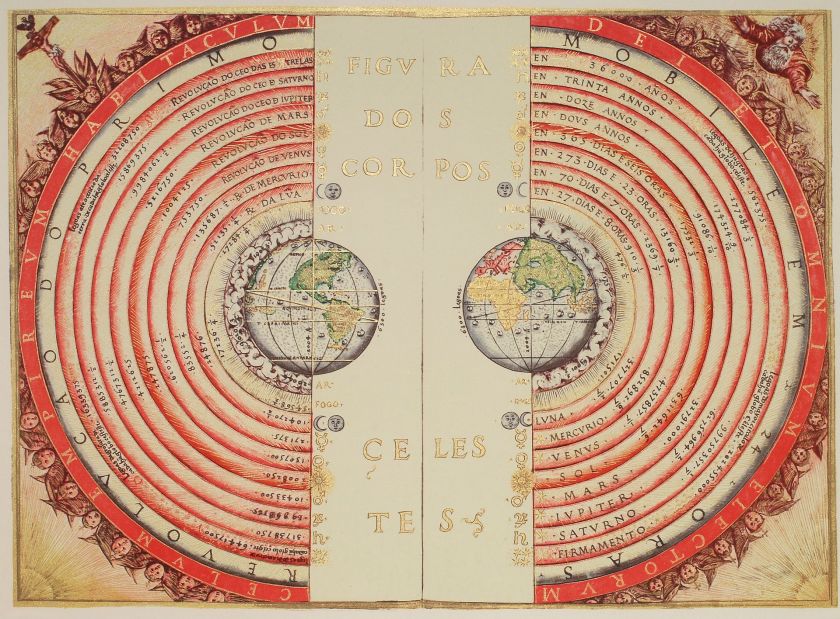
Though he confided his findings to a few close friends, he was worried about the backlash from the Catholic Church. After all, religion put Earth at the center of the universe, and mythology made the sun ride his chariot to give us life everyday. It would have been dangerous to go all out and refute all theories at once. Man’s place in the Universe would suddenly not just become less grandiose, but downright humbling. We are small specks who happened to evolve into intelligent life on a tiny planet revolving around the sun? The very idea was scary.

1920px-Bartolomeu_Velho_1568
Figure of the heavenly bodies — An illustration of the Ptolemaic geocentric system by Portuguese cosmographer and cartographer Bartolomeu Velho, 1568 (Bibliothèque Nationale, Paris)

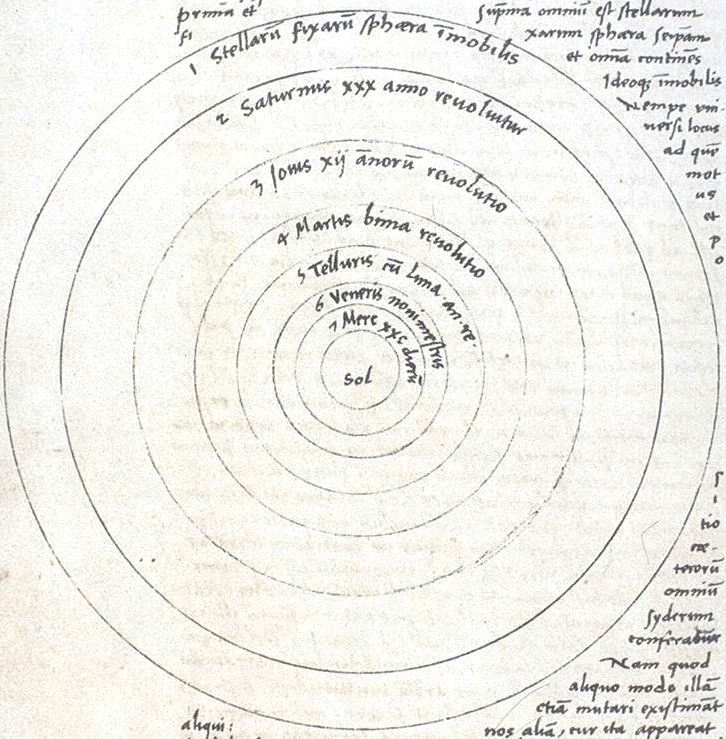
Finally, his friends, most persistent among them, mathematician, Georg Joachim Rheticus, convinced him to publish his volumes after checking and double checking the validity of the Mathematics accompanying his proofs. Slowly leading up to the theory of Earth being one of the planets revolving around the Sun, De revolutionizes orbium coelestium (On the Revolutions of the Heavenly Spheres) was published by a house in Nuremberg in modern day Germany.

De_Revolutionibus_ms_p9v
By Nicolaus Copernicus – Commons file De_Revolutionibus_manuscript_p9b.jpg, Public Domain, https://en.wikipedia.org/w/index.php?curid=58001466

Copernicus died almost as soon as his book was printed, and the book would have languished in the corners never to be read, had Johannes Kepler and Galileo Galilei not taken it up again. In many ways, what Copernicus feared would happen to him happened to Kepler and Galileo. They bore the brunt of the Christian Church for overturning their understanding of the world and our importance in it. But the book paved the way for further scientific research.

From Newton’s Theory of Relativity to our current forays into Space with telescopes sending us newer images of galaxies far far away, to the detection of gravitational waves, we are now in a constant state of wonder and on the cusp to more wondrous advances, all thanks to one man. One man, who believed that he could unearth the truth if he stuck with the problem, one man whose friends kept him honest and took the time to support and understand his work.

Books:

  • A More Perfect Heaven – How Copernicus Revolutionized the Cosmos – By Dava Sobel
  • The Book that Nobody Read – Chasing the Revolutions of Nicholas Copernicus – By Owen Gingrich
  • De revolutionizes orbium coelestium (On the Revolutions of the Heavenly Spheres) _ by Nicholas Copernicus