Imagined Realities

I read some books over and over again. I confess to being an Anglophile too considering the amount of time spent as a child reading about the English countryside. That love for English literature has not diminished. Enid Blyton, Agatha Christie, P G Wodehouse and Jane Austen may be gone, but the likes of Miss Read, J K Rowling, Jeffrey Archer, Stephen Fry, Gerald Durrell, Alexander McCall Smith and Jacqueline Winspear came in. It is why whenever I set foot in the United Kingdom, I suffer from an acute case of star-struckedness. There is a luminosity to my imagined version of the UK, even if the reality has been different in some cases. 

Scones & Jams

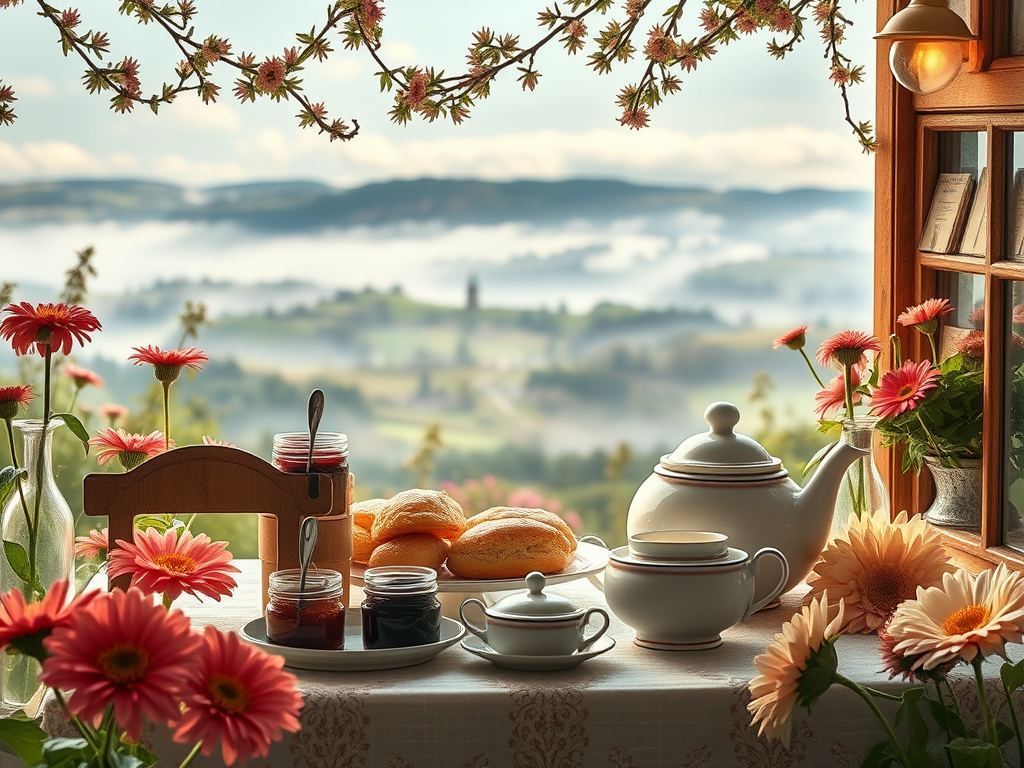
When I first ate a scone, I was a little let down. I’d read about scones and jams for decades, and had envisioned a rather elaborate affair waiting to overwhelm the senses. I remember walking into this little tea place in Oxford, bursting at the seams with excitement, and ordering scones and jams. I already was a little star-struck. I had never in my wildest dreams imagined that I could travel to Oxford, let alone order scones at a local tea-room. 

Imagined Realities

This is why I am always a little nervous when good books are made into movies, or good settings are translated to theme parks. They can be marvelous, or they can fail to live up to one’s imagination. The scones, I am sorry, did not live up my imagination. They were tasty enough – just not what I had imagined. Now, years later, the name ‘scone’ still conjures up misty hillsides and picnic baskets with clotted creams, and cucumber sandwiches, scones and jams, replete with berries and fruit. But I have managed to live with the earthly version being presented to me.

The same thing happened the first time I tasted Butterbeer in Harry Potter World at Universal Studios. I don’t know what I was expecting exactly, but it wasn’t that.

Life can be that way. Teaching you reality in funny ways. Oh well!

I felt the same when I saw the gazania flowers. Don’t get me wrong – I love the vibrant colors and the rather distinct kolam shape gazanias have. But when younger, not having access to the internet etc, the name inspired a rather more mystical and tremendous shape in my mind’s eye. Like the Brahma Kamalam flowers, or the moon-lilies, I dream of under the ocean. If there are such things, I am not sure how much they will love up to my imagined version of them. 

Which brings me to the virtual or artificial intelligence based realities.

AI Realities

Sometimes, as I am writing up a post, I try to imagine the AI generated image my post would produce, and I am, many times, disappointed. Sorry to see that most of the time the AI generated ones are like seeing the real scones after my imagined versions. But they are better than the stick figure atrocities that I was coming up with, so there’s that. 

I wonder how much of life is like that. Imaginations far better than realities. Maybe that is the real reason, humanity seeks to set store by entertainment. We have gone from myths, ballads, novels to movies, soap operas, sports shows, to social media, and short bursts of wisdom. Maybe all of this is really a quest to see how best human imaginations can stretch. Why magic seems to still take a hold of our imaginations. 

PS: I also have to admit that in a post where I am writing about human imagination being far superior and the AI image falling short, this post actually generated an image better than what I was imagining. Really – life can be a teacher with a sense of humor!

What do you think? Where have your imaginations been disappointed by the realities?

“Few people have the imagination for reality”

Johann Wolfgang von Goethe

From Science Fairs to Real-World Solutions

Almost everyday I am amazed at human potential and dismayed by what we choose to do with it. We are problem solvers, but we have enough folks who create them in the first place too. We have the ingenuity of using tools to forge ahead, and shortsighted enough to be thwarted by our own creations. We are a meticulous species, and a callous one. 

As I was musing thus, my thoughts were interrupted. “What if we run out of problems?” one of the children at the Science Fair asked me.

Problem Solvers or Creators?

I assured the worried children that as long as humans are around we will never run into that particular problem. We will always have problems to solve, and we will always ourselves to blame for creating most of them too. “So, you can choose to be problem solvers or creators – I think you kids are good kids who may land up becoming problem solvers” They beamed.

We were standing at the Alameda County Science and Engineering Fair, and the projects on display were truly inspiring and mind-boggling. “We created AI to solve many problems, but I assure you it will create some of its own too!” I said, “Then, we can set about solving them. We’ll be busy!” and they laughed nodding.

The AI Revolution

Over on the High School side, it seemed the children had taken the AI revolution to heart and attempted to solve almost everything with AI. 

Detecting lung cancer early, patterns of dyslexia, Parkinson’s disease, watering crops, even solving mathematical theorems. 

As I meandered slowly through the aisles looking at the display boards I took in as much as I could. The musings came later:

So what does AI predict for us? Especially if we are to use it for so many things? The Internet wave seems like one to play in at the beach compared to this surf wave.

Science Project Areas

It was fascinating to see all the areas in which the children had attempted to solve problems. Sustainability, environmental science, plant growth, reducing microplastics, hydro-farming, disease detection, water purification, working around the problem of microplastics in our soil and water, and so much more. 

One project on elder care had me hurtling back decades. It was a pill dispenser for the elderly. I thought of my grandmother, Visalakshi fondly. One day I caught her popping 15-16 pills at one shot, and was truly fascinated. Did she need that many to keep ticking? I was probably 7 years old at the time, and everyone with grey hair seemed impossibly old. Oh! Youth! She looked at me fondly when I asked her that, and said that she had merely forgotten the morning and afternoon doses. “Paati  – no! You can’t just eat them altogether!” I said, and she laughed like I was overreacting. I can see that particular project being quite useful, as I am sure that particular trait is not something that simply fades. 

I walked around the fair, admiring the vast variety of problems in front of us, and the many, many ones that did not even make it to the Science Fairs. The atmosphere felt promising, hopeful even. How could it not be? This is one of the places where the appeal of problem solving is showcased for all of us. The world doesn’t seem to be as bogged down by negativity and impossibility.

We need to teach our kids that it’s not just the winner of the Super Bowl who deserves to be celebrated, but the winner of the science fair.

Barack Obama

That is why he remains one of our favorite presidents.

Sitare Spotlight Podcast: Gaining Wisdom and Perspective from Diverse Lives

Dear Friends,

I am pleased to announce that we are launching Sitare Spotlight – a Podcast on the India Currents Channel

The Description on the India Currents Channel

Sitare Spotlight is a brand new India Currents podcast, in which host Saumya Balasubramanian interviews prominent individuals from the Indian-American community with diverse interests and professional backgrounds.

For the first episode, Saumya interviewed Krishna Srinivasan, an AI Researcher with google’s DeepMind team. Apart from his professional interest in AI, he also has a deep passion for the Bhagavad Gita and the wisdom it contains. Take a look!

Sitare Spotlight

Sitare means Stars. The theme of this podcast is that we live amidst stars on a daily basis. How would it be if we could gain perspective & learnings from one another? So, we could all shine a little brighter in our own lives?

Why should only books have dedications?

This podcast series, Sitare Spotlight, is dedicated to one the most-oft featured people in the blog ( in fact he is famously known as ‘The Husband’ in our circle of friends), and the children who prod me to try new things and believe I can do it (even as I fumble to open the right song on YouTube for them every time) , with a specific shoutout to the son who learnt video editing and taught me patiently as I tried to piece things together. 

This episode to Lavanyaa Ganesan – Krishna’s better half 🙂 

What Can We Expect From the Series?

The podcast series is aimed to gain perspectives and learnings from the stars in our midst as explained above. I hope to be able to interview people from diverse backgrounds, who inspire us with their lives on a daily basis.

Please share this in your circles and help us all shine a little bit brighter in our own lives.

😇 Even AI Knows 😈

A Guild of Authors

A friend and I were returning from a meeting in which authors from different genres were presenting their works. We fell to discussing the books that appealed to us, and what worked in the format, and what didn’t. I, for one, felt that giving folks a platform to present their books, while noteworthy, could just as well have been done via a YouTube short, but what would have been harder to achieve would have been moderating a discussion about the overlapping topics between the authors. That was something I would have loved to see.

A Company of Authors – Stanford Guild

The sections were grouped together by genre, and topic, so it would have been a good panel to have discussions around. 

Even AI Knows!

As conversations usually go, we meandered, and I said something to the effect of the housework and the truth of an Indian woman having its effect on writerly ambitions etc, to which he mentioned a joke he’d chanced upon, and I guffawed at the truth of it.

“With AI, I thought, it would take over monotonous tasks such as dishwashing and house cleaning, so I could take up Poetry & Art. Instead AI has taken up what little I had of Poetry and Art and left me to do the dishwashing and cleaning!”

Even AI knows to steer clear of household tasks, while humans (women still bear the brunt of the housework) are in charge of these mundane tasks. Who says the universe doesn’t have a sense of humor?

“Really! Of all the things I wanted help with – it was Art that was the least. Give us one tough thing to spend our lives mastering and perfecting!” I said. “Help me with robots – one for the chores, one for help to care for the aged, another with companionship for the lonely etc. Why art, literature and poetry?”

“I do think there are startups for every one of these in the off-ing somewhere.” said he – sanguine as ever and optimistic in the ways of the world’s future.

He was right of course.

Intuition & Instinct?

It did help us loop back to a book that was discussed in which the author spoke about intuition/instinct being a precursor to our conscious thinking, and whether AI would be able to simulate that level of prescience. Which made me wonder, whether that was what made us human, but plenty of us have learnt to ignore these things over time (after all, we don’t need to know when a tiger is lying in the bushes). But would it help us identify dangers in our life?

https://open.substack.com/pub/managingeditor/p/surfin-mia?r=2e6vr0&utm_campaign=post&utm_medium=email

More importantly, if that too can be modeled, what does that leave us with to claim our humanity? Messy emotions and imperfect decisions maybe?

Which brings me to the most important question: What would you like AI to help with, and what would you prefer AI kept is nose out of?

The Past, Present and Future of Jobs

“So, you work at a job that essentially takes away your own job?”, said the son.This is the kind of meta stuff that he finds exciting.

The Thanksgiving week-end was rife with conversations about the corporate drama that in yester years could be equated to the coups of thrones. Would the CEO go? Would the Board of Governors go? Would they both go? Who would be their replacement?

Last year the world popped their popcorns and watched the unfolding drama of an unraveling Twitter with Elon Musk and his hostile takeover of the company, now rechristened X, though the URL still points to twitter.com because the TFE team was probably let go.

This year, it seems much of the dramatic action came from OpenAI CEO, Sam Altman. In modern day Wall Street wars, CEOs, (or C-Staff) and the Boards of companies provide for much of the action. Will the market hold? Will the Sensex drop?

What happens to the interest rates?

One of our friends was explaining to the children about their own roles – technical roles in which they enable AI to be utilized intelligently. One was working on images, another on code frameworks itself. A niece who was majoring in biology told me how they were already being encouraged to use ChatGPT to generate code for them. They only needed to see the results of the datasets fed into the model.

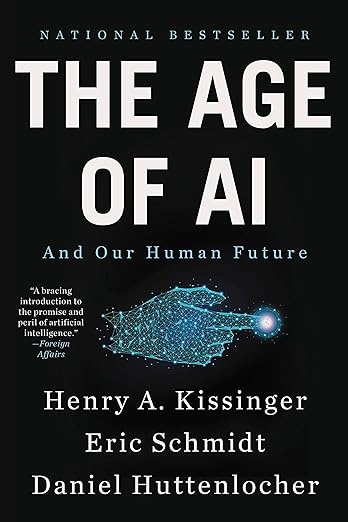
age_of_ai

Fascinating as it all was, I was left musing on the future of work. It seems a rather recurring theme of late. There are image generators to replace artists, code generators for software engineers, of course plenty of writing that can be replaced with intelligent prompting. So, why not the design and maintenance of these systems too?

I picked up the book from my recent library pile:

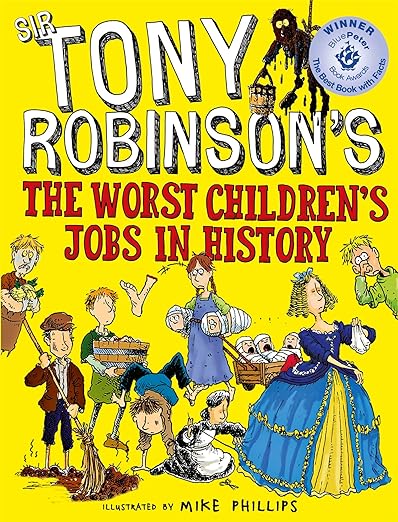
The Worst Children’s Job in History – Sir Tony Robinson

worst_jobs

The book was truly horrific and true. If anyone was wondering about the future of jobs and feeling glum, they could actually be grateful that the past nature of our jobs are well behind us.

Every job not only held misery, but a generous helping of walloping, not enough food, abysmal conditions, no thought for safety etc. Compared to those jobs, the present day conditions of occupying ourselves and our children seems fantastic. I only hope this trend continues for, our current nature of jobs is about to upended again.

It seems with the speed of technological challenges, the cycles with which our jobs are upended seems to be quicker and quicker.

A couple of generations ago, seamstresses, tailors, knitters, bat makers, ball makers, farmers, equipment handlers all saw their jobs upended by mechanization.

Then the next generation saw people’s fortunes needing more specialized skillsets such as coding, scientific knowledge etc.

Recently, call center jobs, desk phones, phones that were in the family room all went away, to be replaced by cell phones. Those of us who remember having to take a friend’s call in the living room with three uncles, five aunts, three cousins of varying age and maturity levels, two grandparents and a maid, will forever envy the children of today who quietly buzz out of vicinity taking their phone calls mysteriously with them. 

The next wave of AI seems to be disrupting industries that I’d hoped would not be. Creative industries that are already hard to make a living in: storytelling, image generation, writing, etc

Will our grandchildren read books about us in this era and feel sorry for us that we had to slave in front of our computers all day long to accomplish certain things, spend days getting tests done in medical labs to determine what was the matter with us?

What would the future of our jobs look like?

More importantly, in this quest for bettering the use of our time, do we hope to become at peace with who we are without being defined by what occupies our time? If so, maybe we should start equipping ourselves towards that, shouldn’t we?

Let me know your thoughts.

Books:

  • The Worst Children’s Jobs in History – Sir Tony Robinson
  • The Age of AI – Henry Kissinger